


Overview
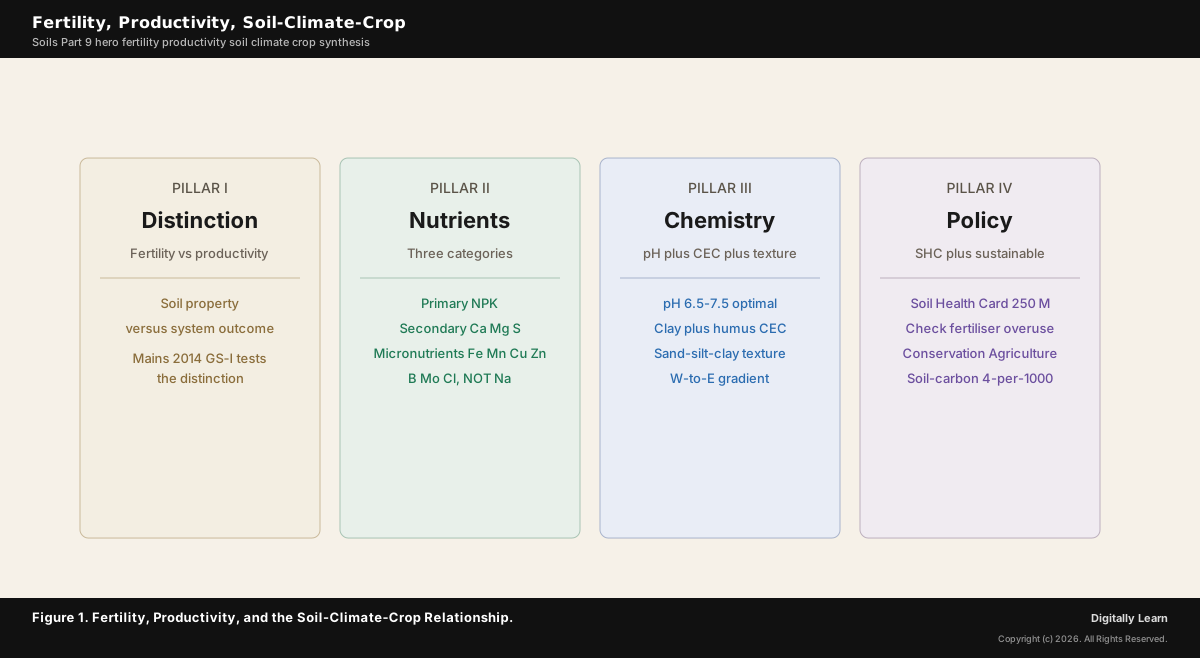
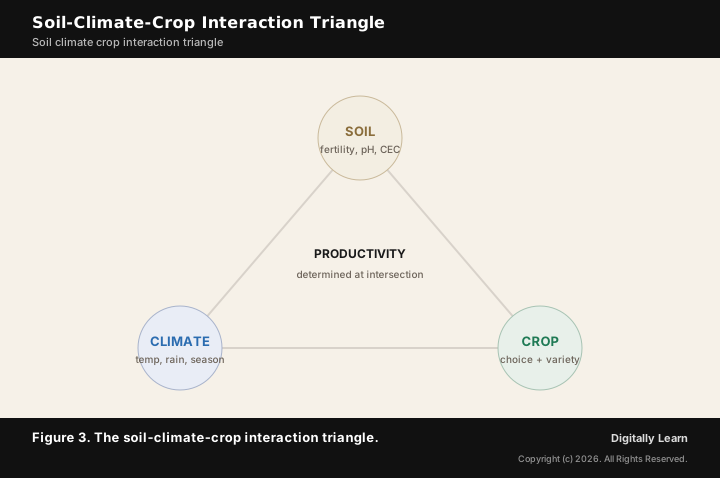
Soil fertility and soil productivity are the two measures that together decide how an Indian soil performs in farming. Fertility is the soil's inherent capacity to supply essential nutrients to plants; it depends on macronutrient and micronutrient content, soil organic matter, pH, and cation exchange capacity. Productivity is the actual yield the soil delivers under a given climate, irrigation, and management; a fertile soil can be unproductive without water, and a less-fertile soil can be productive with the right input mix. The link between the two runs through the soil-climate-crop interaction triangle, the frame that joins this part to the eight soil types covered in Parts 1 through 8.
Background and Historical Context
Why it matters: Indian agriculture supports roughly half the country's workforce on soils that vary from the highly fertile Indo-Gangetic alluvial belt to the nutrient-poor laterite of the Western Ghats and the salt-affected coastal margins. The fertility-to-productivity bridge underpins every policy lever, from minimum support price geography to the Soil Health Card scheme, the National Mission for Sustainable Agriculture, and the wider food-security framework. UPSC Prelims has tested the aims of the Soil Health Card scheme directly.
What is the significance of the soil-climate-crop relationship? Three working dimensions follow. The nutrient chain explains why a soil rich in potash, phosphoric acid, and lime, such as the Indo-Gangetic alluvium of Part 2, still needs heavy nitrogenous fertiliser because nitrogen is the chronic deficit, while a laterite rich in iron and aluminium oxides, as in Part 4, needs lime because acidity locks up nutrient availability. The crop-choice constraint explains why the same alluvial belt carries rice in the high-rainfall east and wheat in the lower-rainfall, canal-irrigated west. The Green Revolution geography explains why the high-yielding-variety package adopted in Punjab, Haryana, and western Uttar Pradesh did not transfer easily to Bihar, West Bengal, and eastern Uttar Pradesh despite comparable alluvial fertility.
Contemporary linkages: The Soil Health Card scheme, launched in February 2015, has generated over 250 million cards carrying farm-level nutrient profiles and fertiliser recommendations; its principal aim is to check the overuse of fertilisers, not to expand irrigation or to assess bank loans. The National Mission for Sustainable Agriculture under the National Action Plan on Climate Change funds soil conservation and integrated nutrient management. The ICAR-Indian Institute of Soil Science at Bhopal leads fundamental soil-science research, the ICAR-Indian Institute of Farming Systems Research at Modipuram leads cropping-system research, and the FAO Voluntary Guidelines for Sustainable Soil Management set the international agenda; soil-carbon storage under the 4-per-1000 Initiative is the emerging climate-policy dimension.
Introduction: Fertility versus Productivity
Two measures of the same soil
Soil fertility and soil productivity are often used interchangeably but mean two different things. Fertility measures the soil's inherent capacity to supply essential plant nutrients. It is a property of the soil itself and depends on macronutrient and micronutrient content, soil organic matter, pH, and cation exchange capacity. Productivity measures the actual yield the soil delivers under a given climate, irrigation, and management. It is a property of the soil together with the farming system around it.
The distinction matters in practice. A fertile soil can be unproductive without water, as in the alluvial tracts of rain-shadow eastern Rajasthan. A less-fertile soil can be productive with the right input mix, as in the lateritic Western Ghats under irrigated tea and coffee plantation. The earlier parts of this series describe the nutrient endowment of each soil type; this part explains how that endowment converts into actual yield.
| Parameter | Soil fertility | Soil productivity |
|---|---|---|
| Definition | Inherent capacity to supply nutrients | Actual yield delivered per unit area |
| Nature | Property of the soil itself | Property of soil plus the farming system |
| Determined by | Nutrients, organic matter, pH, cation exchange capacity | Fertility plus water, climate, inputs, management |
| Can it be high alone? | Yes, even where yield is low | No, it always depends on fertility as one input |
| Policy lever | Soil testing and balanced fertilisation | Irrigation, crop choice, technology, market access |
Nutrient Profile: Macronutrients, Micronutrients, Organic Matter
Three nutrient categories every soil chemistry depends on
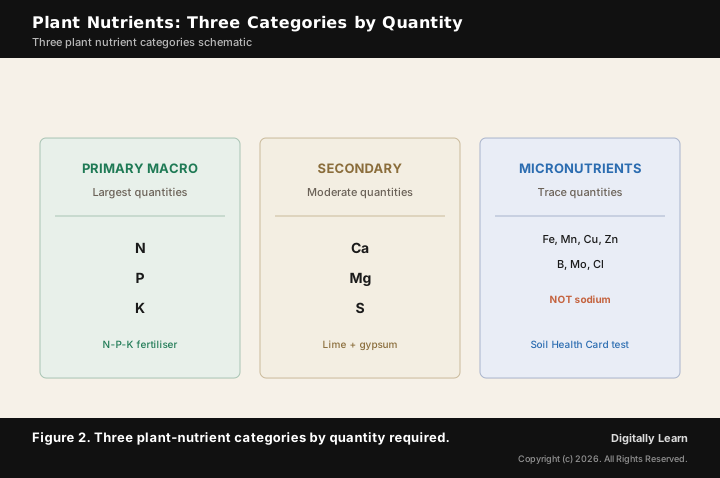
Plant nutrients are classified by quantity required into three categories. The category determines the fertiliser-application strategy and the Soil Health Card prescription framework.
- (i) Primary macronutrients (NPK): Nitrogen, phosphorus, and potassium are required in the largest quantities; the standard N-P-K fertiliser formulation targets these three. Indian alluvial soils are typically deficient in nitrogen; Black Soil is rich in potash but poor in N and P; laterite is deficient across all three.
- (ii) Secondary macronutrients: Calcium, magnesium, and sulphur are required in moderate quantities; lime application supplies Ca; magnesium deficiency is documented on acidic laterite soils; sulphur deficiency is widespread on oilseed-growing alluvial tracts.
- (iii) Micronutrients: Iron, manganese, copper, zinc, boron, molybdenum, and chlorine are required in trace quantities. Sodium is NOT an essential plant micronutrient; zinc deficiency is the most common Indian micronutrient deficit on alluvial soils, documented in Soil Health Card prescriptions.
Soil organic matter, present as humus, is the variable that amplifies every nutrient effect. It binds cations on its exchange complex, releases nitrogen through mineralisation, improves moisture-holding capacity, and supports the microbial community that drives nutrient cycling. The chronic decline of organic matter under intensive rice-wheat cropping in the Indo-Gangetic belt is the documented basis for Conservation Agriculture promotion.
Chemistry: pH, Cation Exchange, Texture-Productivity
How pH, CEC, and texture interact to set productivity
Three soil-chemistry properties together decide how efficiently the soil converts inputs into yield. The Soil Health Card scheme reports all three to the farmer along with the N-P-K profile.
- (i) pH (acidity-alkalinity): Most crops prefer a near-neutral pH around 6.5 to 7.5. Acidic laterite (pH 4.5 to 6.0) locks up phosphorus and increases aluminium toxicity; lime application is the standard remediation. Alkaline arid and sodic soils (pH 8.5 to 10.5) lock up iron and zinc; gypsum application via Solonetz pathway is the standard remediation (Soils Part 7).
- (ii) Cation Exchange Capacity (CEC): The soil’s ability to hold positive nutrient ions on the clay-plus-humus exchange complex. Clay-rich soils (Black Cotton, alluvial fine fractions) carry high CEC and retain nutrients; sandy soils (laterite uplands, arid Aridisols) carry low CEC and leach nutrients rapidly.
- (iii) Texture (sand-silt-clay proportions): Sandy soils drain rapidly and warm quickly; clay soils hold moisture but waterlog easily; loams (balanced sand-silt-clay) give the best general productivity. The west-to-east sand-content gradient across the Indo-Gangetic plain, covered in Soils Part 2, is the clearest Indian example of texture shaping productivity.
Soil-Climate-Crop Interaction Across the Indian Geography
Three observable outcomes of the interaction triangle
Observable outcomes shape the agricultural map. The eight per-soil-type entries of Parts 1 through 8 each implicitly carried a climate-and-crop signature. Reading them together produces the national agricultural geography.
- (a) Alluvial belt rice-wheat rotation: Indo-Gangetic alluvial fertility, rich in potash, phosphoric acid, and lime, combined with monsoon-fed eastern tracts and canal-irrigated western tracts, yields the dominant national grain belt; rice-wheat is the standard rotation, and the west-to-east sand-content gradient sub-divides the belt.
- (b) Black Soil cotton economy: Vertisol moisture-retention plus rain-shadow Deccan climate plus deep-rooted cotton yields the commercial cotton belt across Maharashtra, Madhya Pradesh, Gujarat, Karnataka, and Telangana; the Cotton Corporation of India runs the procurement.
- (c) Laterite plantation economy: Western Ghats laterite acidity plus heavy-rainfall climate plus deep-rooted acid-tolerant plantation crops yields the tea-coffee-rubber-cashew economy regulated by separate commodity boards under the Ministry of Commerce.
The climate of India sets the second axis of the triangle. The monsoon distribution, the temperature regime, and the Koppen and Thornthwaite climate-classification maps all interact with the soil to fix the agricultural outcome. Where climate and soil pull in the same direction, as in the alluvium under reliable monsoon, productivity is high. Where they pull against each other, as in laterite acidity under heavy rainfall, reclamation and plantation-crop choice become the working levers.
Green Revolution Impact and Sustainable Soil Management
HYV adoption geography, eastern bypass, Soil Health Card
The Green Revolution package of high-yielding-variety seeds, irrigation, fertiliser, and mechanisation was adopted intensively on the western Indo-Gangetic alluvium of Punjab, Haryana, and western Uttar Pradesh from the mid-1960s. The package shifted the country from a food-import economy to a self-sufficient grain producer. Eastern alluvial tracts in Bihar, eastern Uttar Pradesh, and West Bengal carried comparable fertility but did not see the same adoption.
- Green Revolution geography: Punjab-Haryana-western-UP alluvium with canal-tubewell irrigation and land-consolidated holdings adopted the HYV package; eastern alluvial tracts with smaller fragmented holdings, weaker irrigation, and historical land-tenure constraints adopted the package much later and more partially.
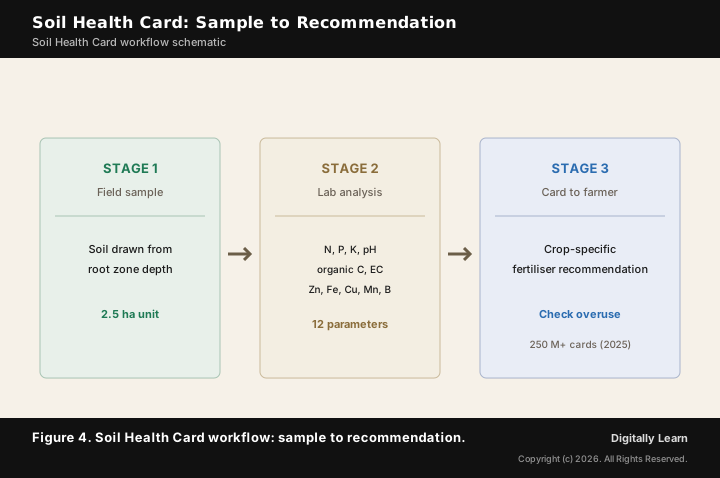
- Soil Health Card scheme: Launched February 2015; over 250 million cards distributed; the principal aim is checking fertiliser overuse, NOT to expand irrigation or to enable bank-loan assessment; the scheme delivers farm-level N-P-K-pH profiles with crop-specific fertiliser recommendations.
- Conservation Agriculture: Promoted on Indo-Gangetic belt to break rice-wheat mono-cropping degradation; zero tillage, crop residue retention, and diversified rotations are the three pillars.
- Cross-link to Green Revolution cluster: The Green Revolution authoring covers the productivity-rise side; this synthesis section covers the soil-degradation feedback (falling water tables, deteriorating soil organic matter, salinity in canal-command tracts).
- Soil as carbon sink: The 4-per-1000 Initiative under UNFCCC targets annual soil-carbon increase of 0.4 per cent in agricultural soils to offset fossil-fuel emissions; Indian agricultural soils are net carbon sources today, with restoration potential as a climate-mitigation lever.
Previous Year UPSC-CSE Questions
Previous Year UPSC-CSE Questions By the end you will be able to draft model answers for the following UPSC questions. Each question carries a collapsible framework showing how to approach it in the exam.
- UPSC Prelims 2017Consider the following statements: The nation-wide 'Soil Health Card Scheme' aims at
- Expanding the cultivable area under irrigation.
- Enabling the banks to assess the quantum of loans to be granted to farmers on the basis of soil quality.
- Checking the overuse of fertilizers in farmlands.
Which of the above statements is/are correct?
How to approach this Prelims question
Approach: Evaluate each statement against the Soil Health Card mandate. The scheme delivers farm-level N-P-K-pH-micronutrient profiles to farmers with crop-specific fertiliser recommendations. The principal policy purpose is to check overuse of fertilisers documented in canal-irrigated tracts of the Indo-Gangetic plain. Irrigation expansion is PMKSY's mandate, not SHC's. Bank-loan assessment is not part of the scheme.
Trap to watch: Statement 1 reads as plausible because both schemes target farm productivity, but irrigation falls under PMKSY. Statement 2 is a fabricated objective that does not appear in the scheme guidelines.
Key facts to recall:
- Soil Health Card scheme launched February 2015 by MoA
- Over 250 million cards distributed by 2025
- Card reports 12 soil parameters including N, P, K, pH, organic carbon, EC, and micronutrients
- Principal aim is checking fertiliser overuse, NOT irrigation expansion or credit scoring
- Sample frequency typically 2.5 hectares per soil-type unit
Answer signal: Correct answer is (b): 3 only.
- UPSC Prelims 1996Which one of the following is NOT an essential micronutrient for plants?
How to approach this Prelims question
Approach: Recall the seven essential plant micronutrients: iron, manganese, copper, zinc, boron, molybdenum, chlorine. Eliminate the three options that ARE on the list (boron, zinc, copper) to identify sodium as the non-essential option. Sodium is in fact toxic at the high concentrations that define Solonetz alkaline-sodic soils.
Trap to watch: Sodium is biologically important in animals (electrolyte balance, nerve function) but plays no documented role in plant micronutrition; the test checks plant-nutrient specificity.
Key facts to recall:
- Seven essential plant micronutrients: Fe, Mn, Cu, Zn, B, Mo, Cl
- Sodium is NOT an essential plant micronutrient
- Sodium becomes toxic in Solonetz sodic soils (Soils Part 7)
- Zinc deficiency is the most common Indian micronutrient deficit
- Boron deficiency is documented on light-textured arid soils
Answer signal: Correct answer is (c): Sodium.
- UPSC Mains 2014 GS-IWhy did the Green Revolution in India virtually by-pass the eastern region despite fertile soil and good availability of water?
How to structure the answer in the exam
Introduction: Concede that eastern alluvial soils were as fertile and water-rich as Punjab and Haryana, then state that the Green Revolution package needed system conditions that the east lacked, so productivity diverged despite similar fertility.
Body (sub-themes to develop):
- Land-tenure history: permanent-settlement zamindari in Bengal and Bihar left fragmented holdings, while ryotwari and mahalwari in the west left larger consolidated units suited to the capital-intensive high-yielding-variety package.
- Irrigation infrastructure: Punjab and Haryana had canal-and-tubewell networks ready at scale, whereas eastern tracts depended on the monsoon and on tanks, so assured water was missing.
- Marketing and institutional support: assured procurement, mandi infrastructure, and cooperative credit were dense in the west and sparse in the east, weakening the incentive to adopt.
- Social and agrarian structure: western peasant communities had greater risk appetite and credit access than the small and marginal farmers who dominated the east.
Conclusion: Close that fertility is a property of the soil while productivity is a property of the soil plus its farming system; the east had the first but not the second, which later targeted programmes have begun to correct.
This question is the clearest exam test of the fertility-versus-productivity distinction that this article develops. The eastern region had the fertility but lacked the system inputs, irrigation, holdings, credit, and markets, that convert fertility into yield.
Sources
- NCERT Class 11 India Physical Environment, Chapter 6 (Soils)
- NCERT Class 12 India People and Economy, Chapter 5 (Land Resources and Agriculture)
- Indian Council of Agricultural Research (ICAR)
- ICAR-Indian Institute of Soil Science (IISS), Bhopal
- National Bureau of Soil Survey and Land Use Planning (NBSS&LUP), Nagpur
- Ministry of Agriculture and Farmers Welfare, Soil Health Card
- United Nations Food and Agriculture Organization: Sustainable Soil Management
- USDA Natural Resources Conservation Service
- Wikipedia: Soil fertility
- Wikipedia: Green Revolution in India
Disclaimer
This article is prepared for UPSC preparation by Digitally Learn's editorial team. It covers soil fertility and productivity, the nutrient and chemistry profile of Indian soils, the soil-climate-crop relationship, and the Soil Health Card policy framework. Key facts and named institutions are cross-verified with NCERT and the authoritative sources listed below.