


Overview
Indian Agriculture, Part 6
India's hill-and-slope plantation economy.
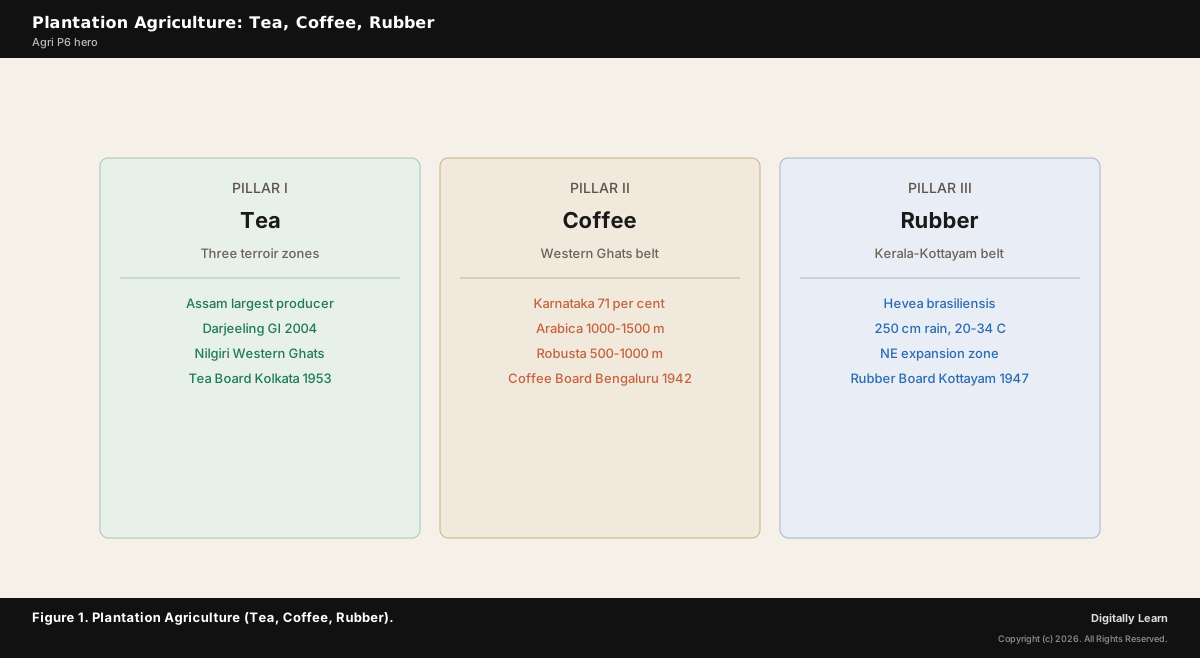
Plantation agriculture refers to large-estate cultivation of perennial commercial crops on contiguous land tracts under organised labour, capital-intensive management, and tight processing integration on or near the estate. India's three pillar plantation crops are tea, coffee, and rubber, each concentrated in distinct agro-climatic zones. Tea dominates Assam (the single largest producing state), the Darjeeling slopes of West Bengal, and the Nilgiri hills of Tamil Nadu under the Tea Board of India established by the Tea Act 1953. Coffee concentrates in the Western Ghats belt of Karnataka (around 71 per cent of national output), Kerala, and Tamil Nadu under the Coffee Board established in 1942. Rubber is largely Kerala-centric under the Rubber Board constituted by the Rubber Act 1947. All three commodity Boards report to the Ministry of Commerce and Industry, and the resident plantation workforce is regulated under the Plantations Labour Act 1951.
Background and Historical Context
Plantation agriculture forms the most export-oriented segment of Indian agriculture, supplying foreign-exchange earnings, sustaining rural employment in Assam, Karnataka, Kerala, and Tamil Nadu, and underwriting the welfare-regulated estate-labour economy that distinguishes plantation cultivation from contract agricultural labour. UPSC Prelims has tested Tea Board institutional architecture and the headquarter locations of the Coffee, Rubber, Tea, and Tobacco Boards directly.
What is the significance of the plantation-agriculture cluster? Three operational dimensions follow. The agro-ecology fit binds each crop to a specific elevation-rainfall-soil combination: tea on acidic well-drained slopes at moderate elevation, coffee on Western-Ghats midlands under two-tier shade, rubber on humid laterite plains below 600 metres. The statutory-board architecture organises each sector under a separate commodity Board (Tea Board, Coffee Board, Rubber Board) reporting to the Ministry of Commerce and Industry, distinguishing plantation governance from the food-crop Ministry of Agriculture and Farmers Welfare. The labour-policy integration under the Plantations Labour Act 1951 mandates housing, medical, educational, and welfare provisions for resident plantation workers, encoding a regulated-estate-labour model distinct from elsewhere in Indian agriculture.
Climate vulnerability is documented across all three crops. The Tea Research Association at Tocklai (Assam) tracks tea-yield decline tied to temperature rise and rainfall variability. The Central Coffee Research Institute at Balehonnur and the Coffee Board headquartered in Bengaluru coordinate Arabica-zone elevation-shift research. The Rubber Research Institute of India at Kottayam coordinates yield research and the non-traditional rubber expansion into the North-East under the Indian Natural Rubber Production Strategy. The Geographical Indication tag protects Darjeeling tea (first Indian GI 2004), Nilgiri tea, Monsooned Malabar coffee, and Coorg Arabica coffee as terroir-linked premium segments.
Introduction: Three Plantation Pillars
What binds tea, coffee, and rubber together
Tea, coffee, and rubber share four operational features that distinguish plantation agriculture from food-crop and cash-crop cultivation. All three are perennial woody species with multi-year gestation before commercial yield. The estates are organised at large contiguous-land scale with a resident workforce. Each commodity reports to a separate statutory commodity Board under the Ministry of Commerce and Industry, not the Ministry of Agriculture.
The three crops occupy three distinct agro-ecological zones. Tea concentrates in Assam (Brahmaputra valley), Darjeeling (Eastern Himalaya foothills), and the Nilgiri-Annamalai hills. Coffee concentrates in the Western Ghats midlands of Karnataka, Kerala, and Tamil Nadu. Rubber concentrates in the Kerala laterite plains and the adjoining Kanyakumari belt of Tamil Nadu, with active expansion into the North-East.
- (i) Perennial woody crops: Tea bush economic life around 50 to 70 years; coffee tree 30 to 50 years; rubber tree around 32 years (7 immature plus 25 productive).
- (ii) Estate organisation: Large contiguous holdings with resident workforce; sharply distinct from smallholder food-crop cultivation.
- (iii) On-estate processing: Tea factories, coffee curing works, rubber sheeting and centrifuge units integrated with cultivation.
- (iv) Statutory commodity Boards: Tea Board (Kolkata), Coffee Board (Bengaluru), Rubber Board (Kottayam), all under the Ministry of Commerce and Industry.
- (v) Plantations Labour Act 1951: Housing, medical, educational, and welfare provisions for resident plantation workforce; under the Ministry of Labour and Employment.
Tea: Assam, Darjeeling, Nilgiri, and the Tea Board
Three tea zones, Tea Board architecture, and climate vulnerability
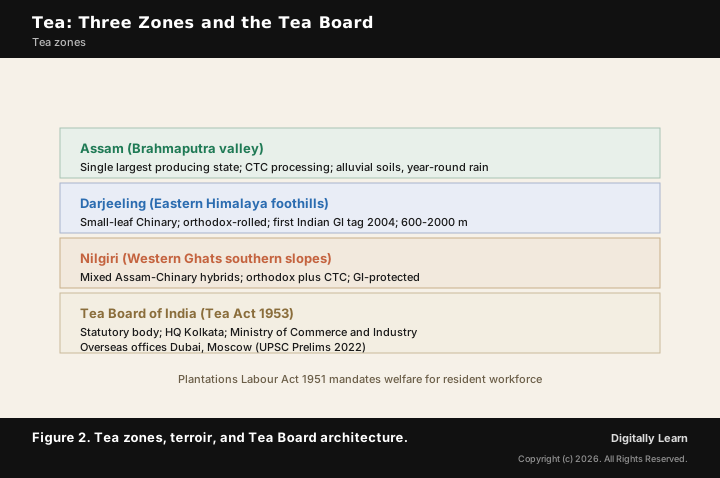
The tea bush (Camellia sinensis) requires deep well-drained acidic soils, year-round rainfall above 150 cm with no dry spell, and temperatures between 13 and 32 degrees Celsius. India produces tea in three principal zones with distinct terroir. Assam is the single largest producing state, supplying roughly half of national output; Darjeeling produces a small-leaf high-elevation muscatel variety; the Nilgiri-Annamalai hills yield a third terroir with year-round harvest.
- (i) Assam zone: Brahmaputra valley alluvial soils; year-round rainfall; CTC (Crush-Tear-Curl) processing dominant; single largest producing state; supplies bulk of mass-market Indian tea.
- (ii) Darjeeling zone: Eastern Himalaya foothills 600 to 2000 metre elevation; small-leaf Chinary variety; orthodox-rolled processing; Darjeeling tea was the first Indian Geographical Indication tag in 2004.
- (iii) Nilgiri zone: Western Ghats southern slopes; mixed Assam and Chinary hybrids; orthodox plus CTC processing; Nilgiri tea also GI-protected.
- (iv) Tea Board of India: Statutory body under the Tea Act 1953; headquartered at Kolkata; under the Ministry of Commerce and Industry; overseas offices include Dubai and Moscow (UPSC Prelims 2022).
- (v) Plantations Labour Act 1951: Mandates housing, medical, educational, and welfare provisions for the resident tea-estate workforce; concentrated implementation in Assam and West Bengal estates.
- (vi) Climate vulnerability: Assam tea-yield decline tracked by Tea Research Association at Tocklai under temperature-and-rainfall variability; Darjeeling faces growing-season pressure from monsoon-onset shifts.
Coffee: Western Ghats Belt, Arabica vs Robusta, Coffee Board
Karnataka dominance, two-variety agro-ecology, shade-grown biodiversity
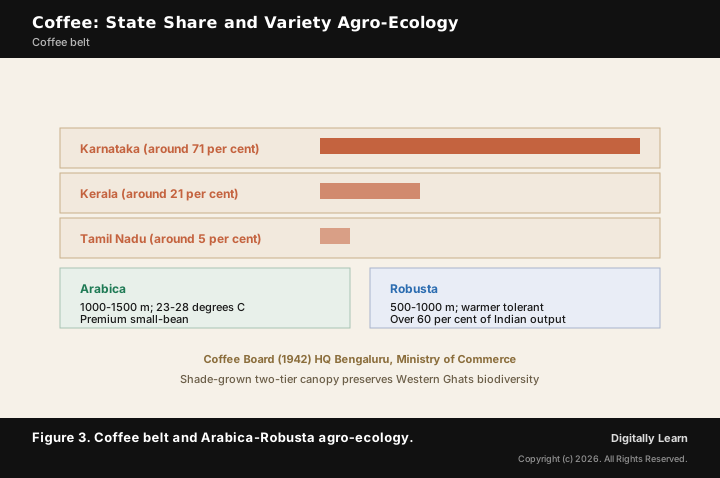
Indian coffee concentrates in the Western Ghats midlands of Karnataka (around 71 per cent of national output, Kodagu district alone around 33 per cent), Kerala (around 20 per cent), and Tamil Nadu (around 5 per cent). The cultivation system is overwhelmingly shade-grown, with two tiers of shade trees and inter-cropping with cardamom and clove, generating an agroforestry ecosystem that preserves canopy biodiversity.
- (i) Arabica: 1000 to 1500 metre elevation; cooler temperature range 23 to 28 degrees Celsius; small-bean premium price; concentrated in higher-elevation Western Ghats.
- (ii) Robusta: 500 to 1000 metre elevation; tolerates warmer conditions; higher yield per hectare; now accounts for over 60 per cent of Indian coffee production, reversing historical Arabica dominance.
- (iii) Karnataka belt: Kodagu (Coorg), Chikmagalur, Hassan districts; Western Ghats hotspot overlap; Coorg Arabica is GI-protected.
- (iv) Kerala and Tamil Nadu belt: Malabar (Kerala), Wayanad, Nilgiri, Yercaud, Kodaikanal; Monsooned Malabar is a distinctive monsoon-cured GI-protected variety.
- (v) Coffee Board of India: Established 1942; headquartered at Bengaluru (UPSC Prelims 2008); under the Ministry of Commerce and Industry; Central Coffee Research Institute at Balehonnur.
- (vi) Shade-grown biodiversity co-benefit: Two-tier canopy with native shade trees preserves the Western-Ghats forest mosaic; coffee estates sustain an agroforestry system consistent with the Gadgil-Kasturirangan Eco-Sensitive Zone framework.
Rubber: Kerala Belt, Hevea Brasiliensis, Rubber Board
Kottayam dominance, climatic requirements, non-traditional expansion
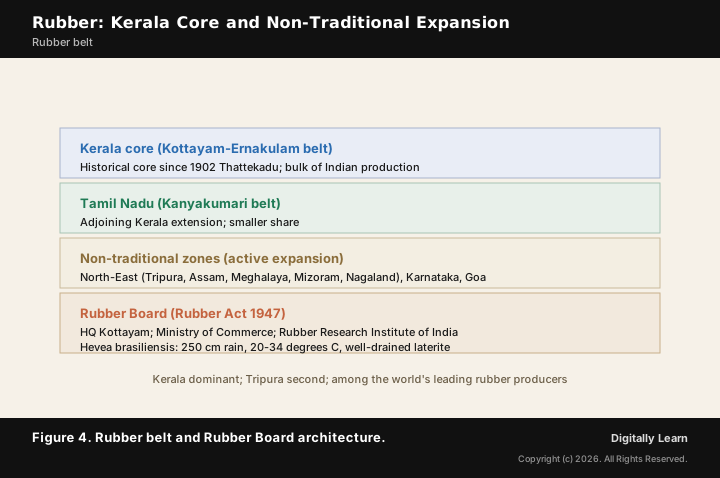
Natural rubber from Hevea brasiliensis concentrates overwhelmingly in Kerala (the bulk of national output), with the Kottayam-Ernakulam belt as the historical core; Tripura is the second-largest producing state. India is among the world's leading natural-rubber producers and one of its largest consumers. Rubber trees have a gestation period of around seven years before commercial latex tapping and a productive economic life of around twenty-five years thereafter.
- (i) Climatic requirements: Rainfall around 250 cm evenly distributed with at least 100 rainy days; temperature 20 to 34 degrees Celsius with monthly mean 25 to 28; humidity around 80 per cent; sunshine around 2000 hours per year.
- (ii) Soil requirements: Well-drained weathered laterite soils, sedimentary types, slightly acidic; below 600 metre elevation; cross-link to the Soils cluster laterite typology.
- (iii) Tree economics: Around 32 years total economic life with 7 immature years before tapping and 25 productive years thereafter; replanting cycles drive demand for nursery stock.
- (iv) Rubber Board: Constituted under the Rubber Act 1947; headquartered at Kottayam, Kerala (UPSC Prelims 2008); under the Ministry of Commerce and Industry; Rubber Research Institute of India at Kottayam.
- (v) Non-traditional zones: Active expansion into the North-East (Tripura, Assam, Meghalaya, Mizoram, Nagaland), Karnataka, Goa, and Konkan coast under the Indian Natural Rubber Production Strategy.
- (vi) Industrial linkage: Tyre industry (largest consumer), automotive components, footwear, latex products; cross-link to Make-in-India manufacturing geography.
Comparative Architecture and Contemporary Policy
How the three plantation Boards compare
The three plantation commodity Boards share a common ministerial home (Ministry of Commerce and Industry) and a common labour regulation (Plantations Labour Act 1951), but differ in establishment year, headquartered city, research institute, and Geographical Indication portfolio. The comparison shows how plantation governance converged on a common architecture while preserving crop-specific research regimes.
- (a) Establishment: Tea Board under Tea Act 1953; Coffee Board established 1942; Rubber Board under Rubber Act 1947. The three statutes pre-date the current Ministry of Commerce and Industry organisation but all three Boards are now under that ministry.
- (b) Headquarters: Tea Board at Kolkata; Coffee Board at Bengaluru; Rubber Board at Kottayam (all three confirmed in the UPSC Prelims 2008).
- (c) Research institutes: Tea Research Association Tocklai (Assam) for tea; Central Coffee Research Institute Balehonnur (Karnataka) for coffee; Rubber Research Institute of India Kottayam for rubber.
- (d) Plantations Labour Act 1951: Mandates housing, medical, educational, and welfare provisions for resident plantation workers across all three crops; falls under the Ministry of Labour and Employment.
- (e) Geographical Indication portfolio: Darjeeling tea (first Indian GI 2004), Nilgiri tea, Coorg Arabica coffee, Monsooned Malabar coffee, Wayanad coffee; the GI tag protects terroir-anchored premium segments across all three crops.
| Feature | Tea | Coffee | Rubber |
|---|---|---|---|
| Climate | Warm humid, 150-300 cm rain, well-drained sloping land | Warm humid hill-slope, two-tier shade | Hot very wet equatorial, around 250 cm rain |
| Leading state | Assam (largest), West Bengal, Tamil Nadu | Karnataka (largest), Kerala, Tamil Nadu | Kerala (dominant), Tripura second |
| Statutory Board (HQ) | Tea Board, Kolkata (Tea Act 1953) | Coffee Board, Bengaluru (1942) | Rubber Board, Kottayam (Rubber Act 1947) |
| Research institute | Tea Research Association, Tocklai | Central Coffee Research Institute, Balehonnur | Rubber Research Institute of India, Kottayam |
| Global standing | India 2nd-largest producer after China | Modest global producer | Among leading producers; large consumer |
Climate vulnerability is the active research front across the three sectors. The Tea Research Association tracks Assam-yield decline tied to temperature and rainfall variability; the Central Coffee Research Institute studies Arabica-zone elevation shift; the Rubber Research Institute studies latex-flow disruption under heat stress. The institutional lesson is that statutory commodity Boards with dedicated research institutes have proven durable for plantation crops.
Sources
- NCERT Class 12 India People and Economy, Chapter 5 (Land Resources and Agriculture), pp 54-57
- Tea Board of India
- Coffee Board of India
- Rubber Board (Ministry of Commerce and Industry)
- Ministry of Commerce and Industry, Government of India
- Ministry of Labour and Employment: Plantations Labour Act 1951
- Department of Agriculture and Farmers Welfare
- Wikipedia: Coffee production in India
- Wikipedia: Rubber Board
Previous Year UPSC-CSE Questions
Previous Year UPSC-CSE Questions By the end you will be able to draft model answers for the following UPSC questions. Each question carries a collapsible framework showing how to approach it in the exam.
- UPSC Prelims 2022With reference to the Tea Board in India, consider the following statements:
- The Tea Board is a statutory body.
- It is a regulatory body attached to the Ministry of Agriculture and Farmers Welfare.
- The Tea Board's Head Office is situated in Bengaluru.
- The Board has overseas offices at Dubai and Moscow.
Which of the statements given above are correct?
How to approach this Prelims question
Approach: Tea Board is statutory under the Tea Act 1953 (statement 1 true). The ministry attachment is Commerce and Industry, not Agriculture (statement 2 false). HQ is Kolkata, not Bengaluru (statement 3 false). The overseas offices are Dubai and Moscow (statement 4 true).
Trap to watch: Statement 2 swaps the ministry; commodity Boards (Tea, Coffee, Rubber) all sit under Commerce and Industry, NOT Agriculture. Statement 3 swaps headquarters; Bengaluru is the Coffee Board's HQ, not Tea Board.
Key facts to recall:
- Tea Board established under Tea Act 1953
- HQ at Kolkata under Ministry of Commerce and Industry
- Overseas offices include Dubai and Moscow
- Coffee Board HQ is at Bengaluru; Rubber Board HQ is at Kottayam
Answer signal: Correct answer is (d): 1 and 4.
- UPSC Prelims 2008Match List-I with List-II and select the correct answer using the code given below the Lists:
- A. Coffee Board
- B. Rubber Board
- C. Tea Board
- D. Tobacco Board
- 1. Bengaluru
- 2. Guntur
- 3. Kottayam
- 4. Kolkata
Select the correct match using the codes given below.
How to approach this Prelims question
Approach: Anchor each plantation Board to its city. Coffee Board sits in Bengaluru, Karnataka (close to the coffee belt). Rubber Board sits in Kottayam, Kerala (in the rubber heartland). Tea Board sits in Kolkata, West Bengal (close to historical Assam and Darjeeling tea trade). Tobacco Board sits in Guntur, Andhra Pradesh (the principal tobacco belt).
Trap to watch: Wrong-pair distractor swaps Coffee and Tea HQs (option 1 puts Coffee at Guntur and Tea at Kottayam). Reading the city list against crop geography rules out the wrong sets.
Key facts to recall:
- Coffee Board HQ: Bengaluru
- Rubber Board HQ: Kottayam
- Tea Board HQ: Kolkata
- Tobacco Board HQ: Guntur
Answer signal: Correct answer is (b): A-1 B-3 C-4 D-2.
- UPSC Prelims 2018With reference to the circumstances in Indian agriculture, the concept of 'Conservation Agriculture' assumes significance. Which of the following fall under Conservation Agriculture?
- Avoiding the monoculture practices
- Adopting minimum tillage
- Avoiding the cultivation of plantation crops
- Using crop residues to cover soil surface
- Adopting spatial and temporal crop sequencing or crop rotations
Select the correct answer using the code given below.
How to approach this Prelims question
Approach: Conservation Agriculture rests on three Food and Agriculture Organization principles: minimum mechanical soil disturbance (minimum tillage), permanent organic soil cover (crop residues), and crop diversification (rotations and sequencing). Plantation crops are not excluded; the framework can be applied to plantation systems via reduced tillage in young-stand replanting and shade-cover residue retention.
Trap to watch: Statement 3 is the canonical distractor that confuses Conservation Agriculture with biodiversity-conservation forestry, which DOES limit plantation monocultures. CA is a soil-and-water conservation framework, not a biodiversity framework.
Key facts to recall:
- CA principle 1: minimum tillage
- CA principle 2: permanent soil cover (residues)
- CA principle 3: crop diversification (rotations)
- Plantation crops can be cultivated under CA
Answer signal: Correct answer is (c): 2, 4 and 5.
Disclaimer
This article covers India's three plantation crops (tea, coffee, rubber), their agro-ecology, the statutory commodity Boards, and the Plantations Labour Act welfare framework. Key institutions and figures are cross-verified with NCERT and the authoritative sources listed below. Production figures and global ranks shift over time and should be checked against the latest Board statistics.