


Overview
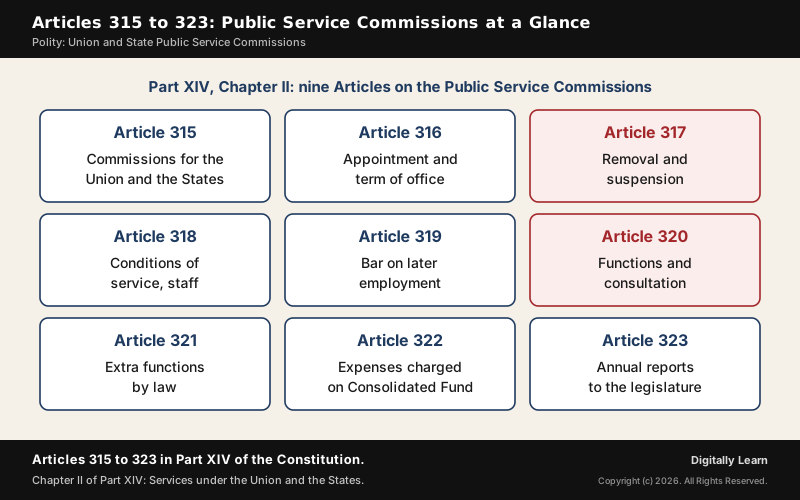
Under Article 315 of the Constitution, the Public Service Commissions are the independent bodies that recruit civil servants on merit: the Union Public Service Commission for the Union and a State Public Service Commission for each State, governed by Articles 315 to 323.
Union Public Service Commission: Article 315 and Its History
What Is Union Public Service Commission: Article 315 and Part XIV
The Union Public Service Commission (UPSC) is the central recruiting agency of India. It is an independent constitutional body: Articles 315 to 323, in Chapter II of Part XIV of the Constitution, provide for its composition, the appointment and removal of its members, its independence, and its powers and functions. It recruits officers for the All India Services and the Group A and Group B Central services.
Article 315 says there shall be a Public Service Commission for the Union and a Public Service Commission for each State. Two arrangements allow sharing. Two or more States may agree to have one Commission; if the legislature of each passes a resolution, Parliament may by law provide a Joint State Public Service Commission. The UPSC may also, at the request of a State's Governor and with the President's approval, agree to serve all or any of that State's needs.
Union Public Service Commission Established: 1926 to 1950
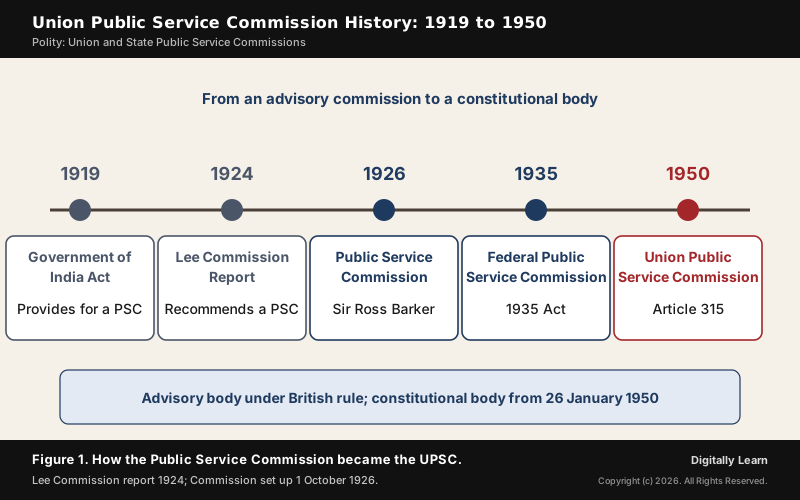
The Commission is older than the Constitution. The Government of India Act, 1919 provided for a Public Service Commission, and the Royal Commission on the Superior Civil Services in India, chaired by Lord Lee of Fareham and set up in 1923 with equal numbers of Indian and British members, recommended setting it up in its 1924 report. The Lee Commission also proposed that 40 per cent of future entrants be British, 40 per cent Indians recruited directly, and 20 per cent Indians promoted from the provincial services. Two years before the report, in 1922, Indian candidates had been allowed to sit the Indian Civil Service examination in Delhi.
The first Public Service Commission was set up on 1 October 1926 under Sir Ross Barker, with a limited advisory role. The Government of India Act, 1935 reconstituted it as the Federal Public Service Commission and also provided for Provincial Commissions and Joint Commissions for two or more provinces. After independence the Federal Commission became the Union Public Service Commission, and it gained constitutional status on 26 January 1950. Its headquarters is Dholpur House in New Delhi.
UPSC Chairman and Members: Appointment, Removal and Independence
UPSC Chairman and Members: Appointment and Term Under Article 316
The President appoints the Chairman and the other members of the UPSC (Article 316). The Constitution does not fix their number; Article 318 lets the President decide the strength and the conditions of service, and the Commission usually has nine to eleven members including the Chairman. The only qualification is that, as nearly as may be, half the members must have held office for at least ten years under the Government of India or a State.
- Term: Six years, or until the age of 65, whichever is earlier; for a State Commission or a Joint Commission the age limit is 62, raised from 60 by the 41st Amendment of 1976.
- Acting Chairman: If the office of Chairman is vacant, or the Chairman cannot act, the President appoints one of the members to perform the duties (Article 316(1A), added by the 15th Amendment of 1963).
- Resignation: A member may resign at any time by writing to the President.
- No second term: A member is not eligible for reappointment to the same office after the term ends (Article 316(3)).
Removal of UPSC Members Under Article 317
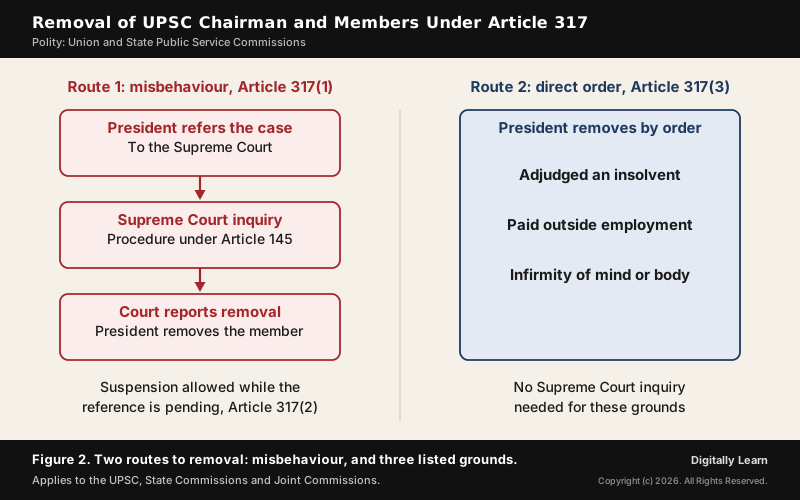
A member of a Public Service Commission can be removed only in the ways Article 317 sets out, and only by the President. For misbehaviour, the President must first refer the case to the Supreme Court, which holds an inquiry under the procedure prescribed under Article 145; the President may remove the member only if the Court reports that the member ought to be removed. While the reference is pending, the President may suspend the member.
Article 317(3) allows removal by a simple order of the President, without a Supreme Court inquiry, on three grounds: the member is adjudged an insolvent, takes paid employment outside the duties of the office, or is in the President's opinion unfit to continue because of infirmity of mind or body. Article 317(4) defines one kind of misbehaviour: being concerned or interested in a contract or agreement made by or for the Union or a State government, or sharing in its profit, otherwise than as an ordinary member of an incorporated company.
Independence of UPSC: Constitutional Safeguards and Article 319
Several provisions keep the Commission free of pressure from the government whose recruitment it oversees. Members have security of tenure, since they can be removed only as Article 317 provides. Their conditions of service, though set by the President, cannot be varied to their disadvantage after appointment (Article 318). All the Commission's expenses, including the salaries, allowances and pensions of members and staff, are charged on the Consolidated Fund of India (Article 322), so they are not put to the vote of Parliament.
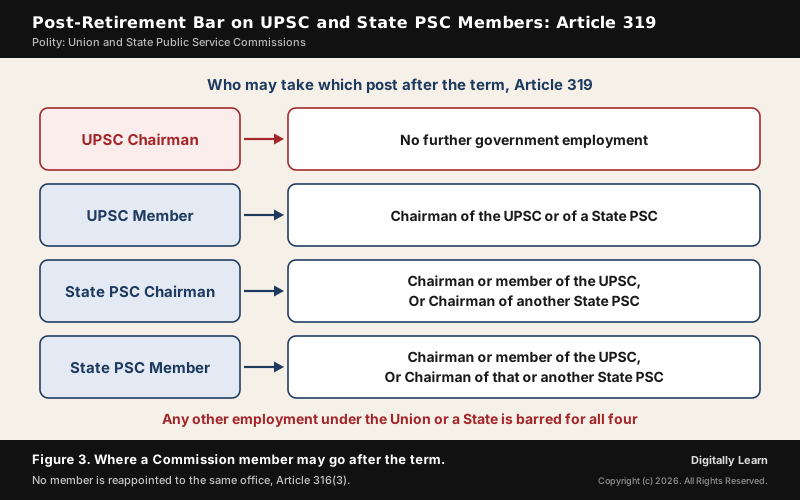
Article 319 closes the door to rewards after office. The Chairman of the UPSC cannot take any further employment under the Union or a State. A UPSC member may become Chairman of the UPSC or of a State Commission, and State Commission chairmen and members may move to the UPSC or to the chair of a State Commission, but none of them may take any other government employment.
How the UPSC Works: Articles 320 to 323
Functions of UPSC Under Article 320
Article 320 makes the Commissions responsible for recruitment and for advice. The UPSC conducts examinations for appointments to the services of the Union, and, if two or more States ask, helps them frame and run schemes of joint recruitment for services that need special qualifications. The government must consult it on the matters listed in Article 320(3).
- Methods of recruitment to civil services and civil posts.
- Principles for appointments, promotions and transfers from one service to another, and the suitability of candidates for them.
- All disciplinary matters affecting a person serving the Union or a State in a civil capacity, including memorials and petitions.
- Claims by a civil servant for the costs of defending legal proceedings over acts done in the course of duty.
- Claims for a pension for injuries suffered while in service, and the amount of the award.
The Commission must also advise on any other matter the President refers to it. Under Article 321, Parliament may give the UPSC additional functions by law, including over the services of a local authority, a statutory corporation or a public institution. Every year the UPSC reports on its work to the President, who lays the report before both Houses of Parliament with a memorandum explaining each case in which its advice was not accepted, and why (Article 323). Cases of non-acceptance must be approved by the Appointments Committee of the Cabinet; a single ministry cannot reject the Commission's advice.
Advisory Role of UPSC and Limits on Consultation
The UPSC advises; it does not decide. Its recommendations are not binding, and the government's only check is that it must answer to Parliament for departing from them. The Supreme Court has held that if the government fails to consult the UPSC, the decision is not invalid and the aggrieved public servant has no remedy in court, so the duty to consult is directory, not mandatory. A selection by the UPSC also gives the candidate no right to the post, although the government must act fairly and without arbitrariness.
- Reservations: Article 320(4) says the Commission need not be consulted on how reservations for backward classes are made under Article 16(4), or on giving effect to the claims of Scheduled Castes and Scheduled Tribes under Article 335.
- Excluded posts: Chairmanship or membership of commissions and tribunals, posts of the highest diplomatic nature, most Group C and Group D posts, and temporary appointments for less than a year are outside its purview.
- Exemption regulations: The President may make regulations listing matters on which consultation is not needed; they are laid before each House for at least fourteen days, and Parliament may amend or repeal them.
The UPSC is a recruiting agency, not the government's personnel agency. Classification of services, pay, cadre management and training are handled by the Department of Personnel and Training.
Disciplinary cases also go to the Central Vigilance Commission (CVC), set up by a Government resolution of 11 February 1964 on the recommendation of the Santhanam Committee; its first Commissioner, Nittoor Srinivasa Rau, took office on 19 February 1964. After the Supreme Court's judgment in Vineet Narain v. Union of India, the CVC was given statutory status by the Central Vigilance Commission Act, 2003. Because the government consults both bodies before acting against a civil servant, their advice can conflict; the UPSC, being a constitutional body, carries more weight.
State Public Service Commission and Joint State PSC
State Public Service Commission: Appointment by Governor, Removal by President
Each State has a State Public Service Commission under the same Articles 315 to 323. Its Chairman and members are appointed by the Governor, who also decides its strength and conditions of service; half the members must have ten years of government service. They hold office for six years or until the age of 62, and may resign by writing to the Governor.
Although the Governor appoints them, only the President can remove them, on the same grounds and in the same manner as UPSC members. The Governor may suspend a member while a reference to the Supreme Court is pending. A State Commission reports every year to the Governor, who lays the report before the State Legislature with a memorandum on advice not accepted. The Governor also consults it, together with the High Court, when framing rules for appointments to the State's judicial service other than district judges.
| Feature | UPSC | State PSC | Joint State PSC |
|---|---|---|---|
| Created by | Constitution (Article 315) | Constitution (Article 315) | Act of Parliament on State resolutions |
| Appointed by | President | Governor | President |
| Age limit | 65 | 62 | 62 |
| Removed by | President | President | President |
| Annual report to | President | Governor | Governor of each State |
Joint State Public Service Commission: A Statutory Body
A Joint State Public Service Commission serves two or more States. While the UPSC and the State Commissions are created by the Constitution, a Joint Commission is created by an Act of Parliament on the request of the State legislatures concerned, so it is a statutory and not a constitutional body. Its Chairman and members are appointed by the President, who decides their number and conditions of service; they hold office for six years or until 62, and may be suspended or removed only by the President.
A Joint Commission reports to the Governor of each State it serves, and each Governor lays the report before the State Legislature. Punjab and Haryana had a Joint Commission for a short period after Haryana was created out of Punjab in 1966. The other way of sharing a Commission is for the UPSC itself to serve a State, at the Governor's request and with the President's approval.
Sources and Further Reading
- Legislative Department, Ministry of Law and Justice: The Constitution of India
- Union Public Service Commission: news on the home page (Chairman's oath, 15 May 2025; 99th Foundation Day and the Centenary Year, 1 October 2025)
- NCERT: Indian Constitution at Work, Class 11, Chapter 4, Executive
- Second Administrative Reforms Commission, Fourth Report: Ethics in Governance (January 2007)
- The Hindu (Delhi): UPSC releases provisional answer key of Prelims exam, 28 May 2026
- Wikipedia: Union Public Service Commission
- Wikipedia: Indian Civil Service
- Wikipedia: Central Vigilance Commission
Editorial Disclaimer
This article explains the Public Service Commissions from the Constitution's text and the other sources listed.


