


Overview
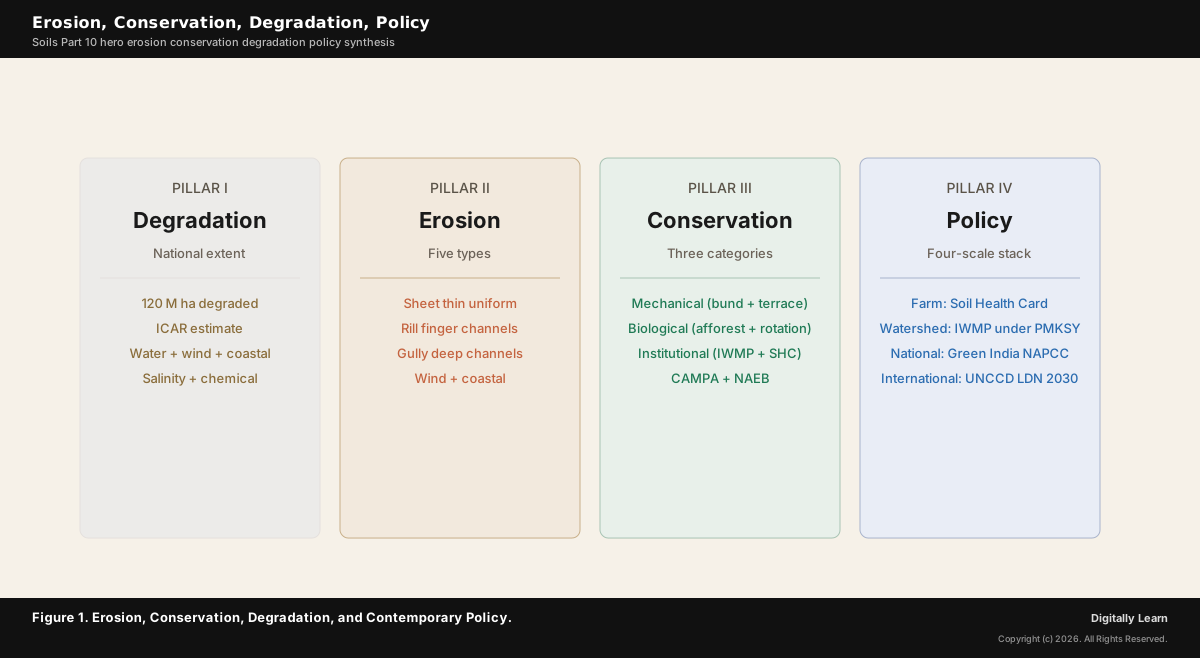
Soil degradation is the decline in soil quality and productive capacity caused by the combined action of natural processes and human activity. Soil erosion is the principal degradation process: the detachment and transport of soil particles by water, wind, or human intervention. The Indian Council of Agricultural Research estimates that around 120 million hectares of Indian land carry some form of degradation, including erosion-affected, salinity-affected, and chemically-degraded tracts. Five erosion types are recognised: sheet, rill, gully, wind, and coastal. The conservation toolkit spans mechanical (contour bunding, terracing, check dams, shelter belts), biological (afforestation, strip cropping, crop rotation, mulching), and institutional (Integrated Watershed Management Programme, Soil Health Card, National Mission for Sustainable Agriculture) methods.
Background and Historical Context
Soil degradation undermines the productive capacity of Indian farmland on which food security rests. The Indian Council of Agricultural Research finds that India loses about 5.3 billion tonnes of soil a year, stripping nutrient-rich topsoil from the Indo-Gangetic belt, the Deccan black-soil belt, and the Western Ghats laterite tracts. UPSC Prelims has tested soil-erosion causes and soil-conservation methods directly, while Mains GS-I and GS-III recur on desertification and land-degradation policy.
What is the significance of the degradation-conservation problem? Three working dimensions follow. The erosion-type match matters because the response differs by type: sheet erosion needs contour cropping, gully erosion needs check dams, wind erosion needs shelter belts, and coastal erosion needs mangrove restoration. The scale-mismatch problem separates farm-level work (crop rotation, mulching) from watershed-level work (check-dam networks, afforestation) and from policy-level work (watershed-programme funding, the Land Degradation Neutrality target). The climate-change pressure raises extreme-rainfall events, dust-storm frequency, and sea-level-rise coastal erosion, all of which strain traditional methods.
The Integrated Watershed Management Programme, now part of the Pradhan Mantri Krishi Sinchayee Yojana (PMKSY) watershed component, is the main operational instrument for soil-and-water conservation across rain-fed and drought-prone tracts. The National Mission for Sustainable Agriculture and the National Mission for a Green India under the National Action Plan on Climate Change carry the climate-linked conservation agenda. The ICAR-Indian Institute of Soil and Water Conservation at Dehradun leads the research. At UNCCD COP-14 (Greater Noida, 2019) India pledged to restore 26 million hectares of degraded land by 2030, in line with the Land Degradation Neutrality target under SDG 15.3.
Introduction: Soil Degradation as a National-Scale Challenge
National extent and the principal degradation processes
Soil degradation is the decline in soil quality and productive capacity caused by natural processes and human activity. The Indian Council of Agricultural Research (ICAR) places around 120 million hectares of Indian land under some form of degradation, with erosion the largest share. The principal processes are water erosion, wind erosion, coastal erosion, salinisation (covered in the saline-alkaline soils article), waterlogging, chemical degradation (acidification, fertiliser-overuse imbalance), and physical degradation (compaction, crusting).
Each process has a distinct geography. Water erosion dominates the steep Himalayan slopes and the laterite Western Ghats. Wind erosion dominates the arid Thar and Aravali tracts of the western dryland. Salinisation concentrates in the Punjab-Haryana canal-command belt and the coastal Sundarbans. The ISRO Space Applications Centre Desertification Atlas finds about 30 per cent of India's land degraded, which fixes the scale of the conservation task.
| Degradation process | Where it dominates | Conservation response |
|---|---|---|
| Water erosion (sheet, rill, gully) | Himalayan slopes, Western Ghats, Chambal ravines | Contour bunding, terracing, check dams, gully plugging |
| Wind erosion | Thar desert and Aravali fringe in the arid west | Shelterbelts, sand fences, dune stabilisation |
| Coastal erosion | Sundarbans and east-coast deltas | Mangrove restoration, Coastal Regulation Zone enforcement |
| Salinisation and waterlogging | Punjab-Haryana canal-command tracts | Drainage, gypsum amendment, balanced irrigation |
| Chemical and physical degradation | Intensively cropped Indo-Gangetic belt | Soil Health Card, balanced fertiliser, organic inputs |
Types of Soil Erosion in India: Sheet, Rill, Gully, Wind and Coastal
How erosion is classified by process and agent
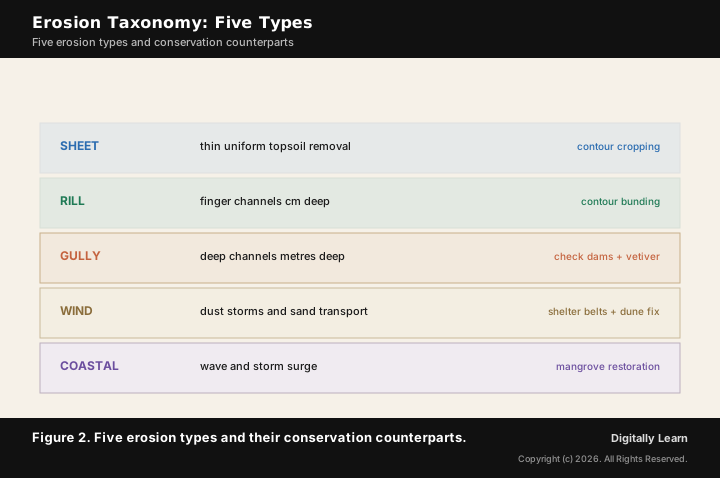
Why classification matters: Each erosion type needs a different conservation response, so naming the type is the first step in choosing the remedy. The five recognised Indian erosion types follow the agent (water, wind or wave) and the landform expression (sheet, channel or dune).
- (i) Sheet erosion: Uniform removal of a thin layer of topsoil from the entire surface; barely visible to the eye in early stages; long-term cumulative impact on fertility; addressed by contour cropping, cover crops, and crop residue retention.
- (ii) Rill erosion: Small finger-like channels (centimetres deep) cut by surface runoff; the intermediate stage between sheet and gully erosion; addressed by contour bunding and surface roughness restoration before rills deepen into gullies.
- (iii) Gully erosion: Deep channels several metres deep cut by concentrated runoff; the most visible and damaging water-erosion form. The Chambal ravines across Madhya Pradesh, Rajasthan and Uttar Pradesh are India’s largest gully badlands; addressed by check-dam networks, gully plugging, and vetiver-grass bio-engineering.
- (iv) Wind erosion: Dust storms and sand transport in the arid and semi-arid west, such as the Rajasthan Thar; addressed by shelter belts, sand fences, and dune-stabilisation planting with hardy species.
- (v) Coastal erosion: Wave action and storm surge on coastal tracts; intensified by sea-level rise and cyclone frequency; addressed by mangrove restoration, groyne construction, and Coastal Regulation Zone enforcement.
Soil Conservation Methods in India: Mechanical, Biological and Institutional
Three categories of conservation intervention
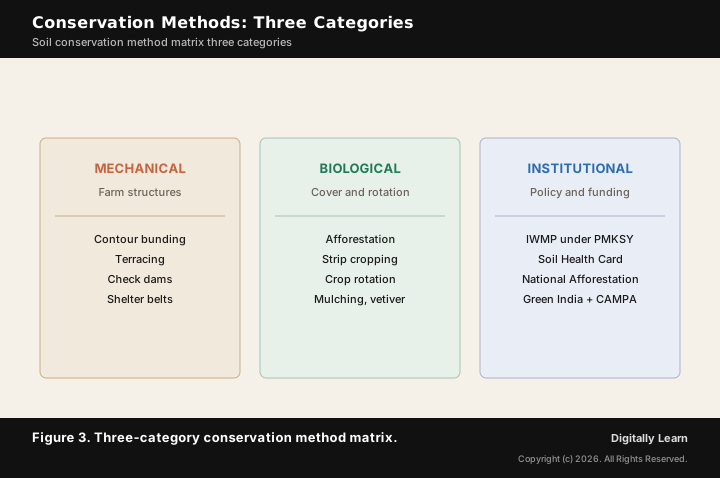
How conservation interventions stack across scales. The conservation toolkit operates at three scales: the farm level (mechanical structures plus biological cover), the watershed level (integrated planning across multiple farms), and the policy level (institutional funding and regulatory framework). Reading the toolkit as a stacked menu rather than a single answer is the analytical key.
- (a) Mechanical methods: Contour bunding (used on sloping land in semi-arid regions, not on deserts or flood plains or scrublands), terracing on steeper Himalayan and Western Ghats slopes, check-dam networks across gully systems, shelter belts of trees and shrubs across wind-erosion tracts.
- (b) Biological methods: Afforestation and reforestation, strip cropping (alternating rows of cover crops and main crops across the slope), crop rotation (pulses-cereal alternation rebuilds organic carbon and breaks pest cycles), mulching with crop residue, vetiver-grass and khus-grass plantation for gully control.
- (c) Institutional methods: Integrated Watershed Management Programme under PMKSY, Soil Health Card scheme (fertiliser-overuse check), National Afforestation Programme via NAEB, National Mission for a Green India under NAPCC, Compensatory Afforestation Fund Management and Planning Authority (CAMPA).
Causes of Soil Degradation in India and Climate-Change Pressure
Five drivers operating at different scales
Observable outcomes of contemporary degradation drivers. Five drivers operate across Indian soils today, each amplified by climate-change-driven extreme weather. Reading them as a stacked set rather than independent forces is essential for policy design.
- (a) Deforestation: Removal of forest cover strips humus and accelerates downslope transport; documented across the Himalayan front ranges, the Western Ghats, and the north-eastern hills; deforestation is the single largest erosion driver in India.
- (b) Overgrazing and shifting cultivation: Overgrazing strips ground cover on common-land tracts; jhum shifting cultivation in the north-eastern hills degrades soil organic carbon faster than recovery cycles permit.
- (c) Faulty agricultural practices: Ploughing down the slope, fertiliser overuse, monocropping (rice-wheat in the Indo-Gangetic belt, cotton in Vidarbha), and excess canal irrigation drive secondary salinisation and groundwater depletion.
- (d) Mining and quarrying: Open-cast mining in Jharkhand, Odisha, Chhattisgarh and Goa strips topsoil over large tracts; laterite quarrying in the Western Ghats removes the cultivable layer.
- (e) Climate-change amplification: Extreme-rainfall events intensify gully and landslide formation; rising dust-storm frequency worsens wind erosion in the arid Thar and Aravali west; sea-level rise amplifies coastal erosion across the Sundarbans and east-coast deltas.
Soil Conservation Policy in India: IWMP, NMSA, Green India Mission and UNCCD
From IWMP at the farm level to UNCCD LDN at the international level
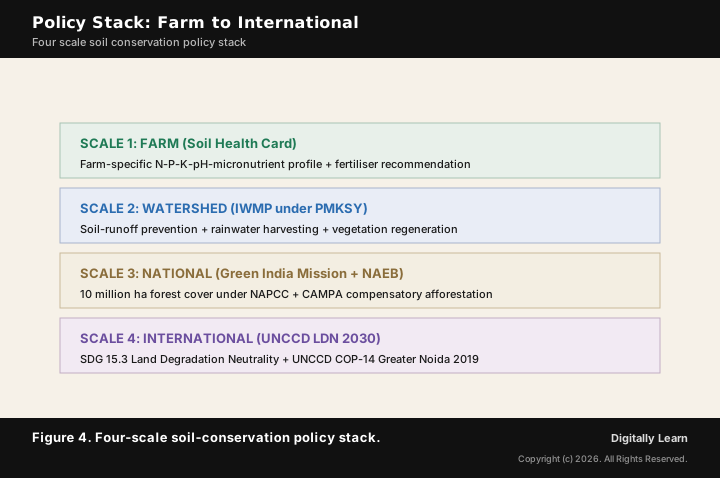
India's soil-conservation policy works across four scales. It runs from the farm-level Soil Health Card and the watershed-level Integrated Watershed Management Programme to the national-level National Mission for Sustainable Agriculture and Green India Mission under the NAPCC, and up to the international Land Degradation Neutrality target under the UNCCD.
- Integrated Watershed Management Programme (IWMP): Implemented from 2009-10 and merged into the Watershed Development Component of PMKSY in 2015-16; benefits include prevention of soil runoff, rainwater harvesting and groundwater recharge, and regeneration of natural vegetation.
- National Mission for Sustainable Agriculture (NMSA): One of the eight missions under the National Action Plan on Climate Change; promotes rainfed area development, soil health management, agroforestry and water-use efficiency.
- National Afforestation Programme (NAP): Managed by the National Afforestation and Eco-development Board; channels funds through Forest Development Agencies and Joint Forest Management committees to degraded forest tracts.
- National Mission for a Green India (GIM): A further NAPCC mission targeting about 10 million hectares of new and improved forest and tree cover, with the Compensatory Afforestation Fund (CAMPA) funding restoration.
- UNCCD Land Degradation Neutrality 2030: International target under SDG 15.3; at UNCCD COP-14 (Greater Noida, 2019) India pledged to restore 26 million hectares of degraded land by 2030, with the ISRO Desertification Atlas mapping the baseline.
Soil-conservation policy connects three areas of the syllabus. It links agricultural geography (the soil-type and crop-pattern topics), climate geography (rainfall intensity and the monsoon regime), and biodiversity policy (the National Action Plan on Climate Change). For UPSC, the strongest answers read these threads together rather than treating erosion as a standalone topic.
Previous Year UPSC-CSE Questions
Previous Year UPSC-CSE Questions By the end you will be able to draft model answers for the following UPSC questions. Each question carries a collapsible framework showing how to approach it in the exam.
- UPSC Prelims 2014In India, the problem of soil erosion is associated with which of the following?
- Terrace cultivation
- Deforestation
- Tropical climate
Select the correct answer using the code given below.
How to approach this Prelims question
Approach: Test each statement against how erosion actually starts. Deforestation strips humus and speeds downslope transport on every Indian slope, so it is the single largest erosion driver. Terrace cultivation is a conservation method that reduces erosion on Himalayan and Western Ghats slopes, so it is a remedy, not a cause. Tropical climate raises rainfall intensity but does not cause erosion on its own without slope and loss of cover.
Trap to watch: Statement 1 is the trap: terracing appears next to erosion in many texts but it is the solution, not the problem. Statement 3 mistakes a climate zone for a cause.
Key facts to recall:
- Deforestation is the largest erosion driver in India
- Terracing is a mechanical conservation method that reduces erosion
- Erosion needs slope, rainfall and loss of cover; climate alone is not enough
- ICAR estimates around 120 million hectares of degraded land in India
- Sheet, rill, gully, wind and coastal are the five erosion types
Answer signal: Correct answer is (b): only deforestation (Statement 2).
- UPSC Prelims 2010With reference to soil conservation, consider the following practices:
- Crop rotation
- Sand fences
- Terracing
- Wind breaks
Which of the above are considered appropriate methods for soil conservation in India?
How to approach this Prelims question
Approach: Each method addresses one of the five erosion types. Crop rotation is a biological method that rebuilds organic carbon and breaks pest cycles. Sand fences and wind breaks are methods for wind-erosion control in the arid Thar and Aravali tracts. Terracing is the standard mechanical method for slope-erosion control on Himalayan and Western Ghats land. All four belong to the Indian conservation toolkit.
Trap to watch: No trap: all four are correct. The distractors offer subsets to tempt students into excluding sand fences (less familiar) or crop rotation (seems agricultural not conservation).
Key facts to recall:
- Mechanical methods: contour bunding, terracing, check dams, shelter belts
- Biological methods: afforestation, strip cropping, crop rotation, mulching
- Sand fences arrest wind transport in Thar
- Wind breaks alias shelter belts protect crops from wind erosion
- Crop rotation breaks pest cycles and rebuilds organic carbon
Answer signal: Correct answer is (d): all four (1, 2, 3, 4).
- UPSC Prelims 2014What are the benefits of implementing the 'Integrated Watershed Development Programme'?
- Prevention of soil runoff
- Linking the country's perennial rivers with seasonal rivers
- Rainwater harvesting and recharge of groundwater table
- Regeneration of natural vegetation
Select the correct answer using the code given below.
How to approach this Prelims question
Approach: Evaluate each statement against IWDP mandate. The Integrated Watershed Development Programme operates at watershed scale to prevent soil runoff, harvest rainwater into groundwater, and regenerate vegetation. River linking is a separate scheme under the National Water Development Agency with different objectives. IWDP is now subsumed within the Pradhan Mantri Krishi Sinchayee Yojana watershed component.
Trap to watch: Statement 2 (river linking) is the trap because both IWDP and river-linking are water-sector schemes; the distinction is that IWDP works WITHIN a watershed while river linking moves water BETWEEN basins.
Key facts to recall:
- IWDP works within watersheds, not between river basins
- Three core IWDP outcomes: soil-runoff prevention, rainwater harvest, vegetation regeneration
- IWDP is now under PMKSY watershed component
- Inter-linking of rivers is a separate scheme under NWDA
- Watershed-scale work delivers farm-level benefits across multiple holdings
Answer signal: Correct answer is (c): 1, 3 and 4 only (NOT river linking).
Sources
- NCERT Class 11 India Physical Environment, Chapter 6 (Soils), pp 76-77
- Indian Council of Agricultural Research (ICAR)
- ICAR-Indian Institute of Soil and Water Conservation (IISWC), Dehradun
- National Bureau of Soil Survey and Land Use Planning (NBSS&LUP), Nagpur
- Ministry of Environment, Forest and Climate Change (MoEFCC)
- United Nations Convention to Combat Desertification (UNCCD)
- Ministry of Agriculture and Farmers Welfare, Soil Health Card
- USDA Natural Resources Conservation Service: Soil Erosion
- Wikipedia: Soil erosion
- Wikipedia: Soil conservation
Disclaimer
This article is prepared for UPSC preparation by Digitally Learn's editorial team. Figures and named institutions are cross-checked with NCERT and the authoritative sources listed below. Readers should consult the primary sources for the latest official data.