


Overview
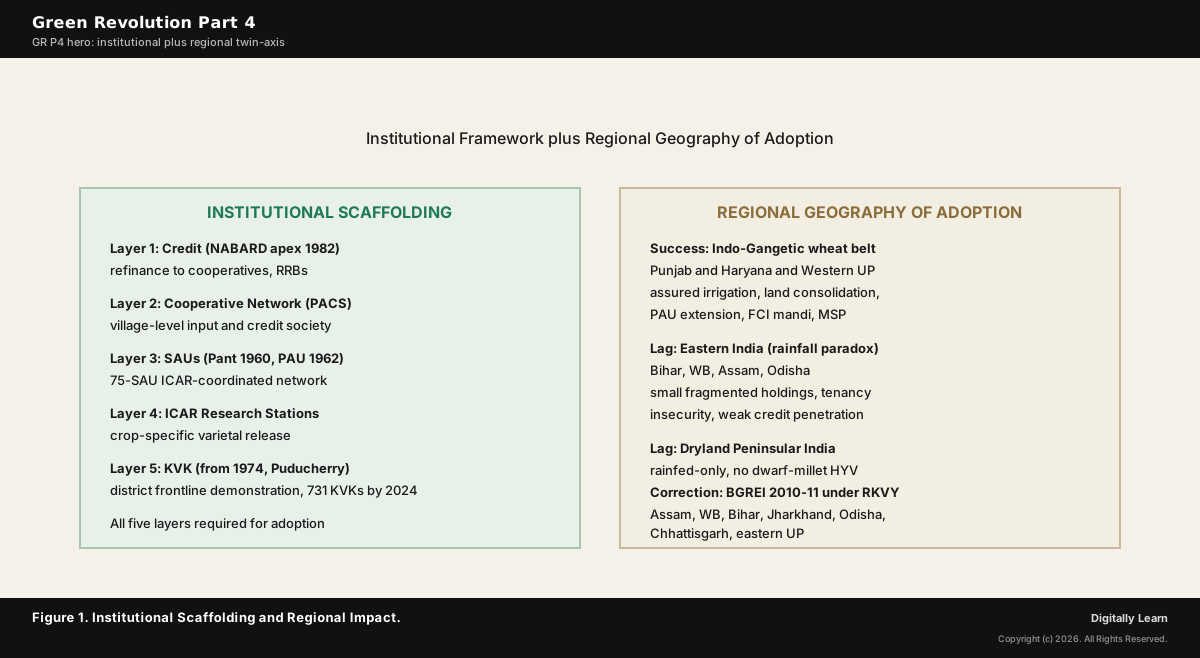
The institutional framework of the Green Revolution is the layered support system that delivered the technological package to millions of farmers. The framework has five interlocking layers. The credit layer is the agricultural-credit architecture, with cooperative banks at the village level, regional rural banks at the district level, commercial banks at the block level, and NABARD as the apex refinance institution (established 1982). The cooperative layer is the village-level service cooperative for input supply and the primary agricultural credit society for production loans. The university layer is the state agricultural university (the Pant University at Pantnagar in 1960 was the first), modelled on the United States land-grant university system. The research layer is the state agricultural research station network coordinated by ICAR (Indian Council of Agricultural Research). The extension layer is the Krishi Vigyan Kendra (KVK), the district-level farm-science centre established from 1974 onwards for frontline demonstration and farmer training. The regional geography of adoption is the spatial pattern that emerged. The Punjab-Haryana-Western Uttar Pradesh wheat belt became the success model. Eastern India and dryland Peninsular India lagged for two decades.
Background and Historical Context
The technological package of GR P3 was necessary but not sufficient. A farmer could not buy HYV seed without credit, could not learn dwarf-rice nursery techniques without extension, could not access dwarf-wheat seed multiplication without state research stations, and could not be confident of price without procurement. The institutional support system made the package operational; the regional geography decided where it took root. UPSC Prelims has tested the institutional-credit architecture repeatedly (UPSC Prelims 2011 on commercial-vs-cooperative share, UPSC Prelims 2013 on RRB and Land Development Bank direct credit versus NABARD apex refinance, UPSC Prelims 2020 on the DCCB-PACS cooperative pyramid). Mains has repeatedly tested the regional-disparities-of-Green-Revolution prompt and the institutional-architecture-of-agricultural-credit prompt.
What is the significance of the institutional plus regional twin-axis? Three operational dimensions follow. The institutional-framework axis means GR succeeded because credit, cooperatives, universities, research stations, and extension worked as a coordinated stack; remove any layer and adoption collapses (the rainfed-Peninsular case proves the point because extension was thin and credit costly). The regional-concentration axis means GR concentrated where assured irrigation existed (Indo-Gangetic Plain), where land-holdings were consolidated enough for tube-well investment (post-1956 land-consolidation in Punjab), where procurement infrastructure functioned (FCI mandis), and where state agricultural extension was dense; absent any precondition, the package did not adopt. The institutional-regional-feedback axis means concentration reinforced concentration, because Punjab Agricultural University at Ludhiana (1962) trained the wheat-belt extension cadre and the Indo-Gangetic credit infrastructure deepened around the wheat-belt borrowers, leaving the eastern and Peninsular regions doubly disadvantaged.
Current threads include the BGREI (Bringing Green Revolution to Eastern India) scheme launched 2010-11 under the Rashtriya Krishi Vikas Yojana umbrella covering Assam, West Bengal, Bihar, Jharkhand, Odisha, Chhattisgarh, and eastern Uttar Pradesh, the KVK network expansion to 731 KVKs by 2024 with one KVK per rural district as the policy target, the NABARD refinance role in the Kisan Credit Card scheme covering crop-loan and term-loan disbursal through cooperative and regional rural banks (covered in Agri P9), and the state agricultural university network expansion to 75 SAUs and deemed-universities under ICAR coordination. The institutional-design lesson is that the original Green Revolution institutional architecture solved the wheat-belt productivity problem; the contemporary framework is solving the eastern-region equity problem and the dryland-region climate-resilience problem that the wheat-belt model could not address.
Institutional Plus Regional Twin-Axis
Why the technological package alone was insufficient
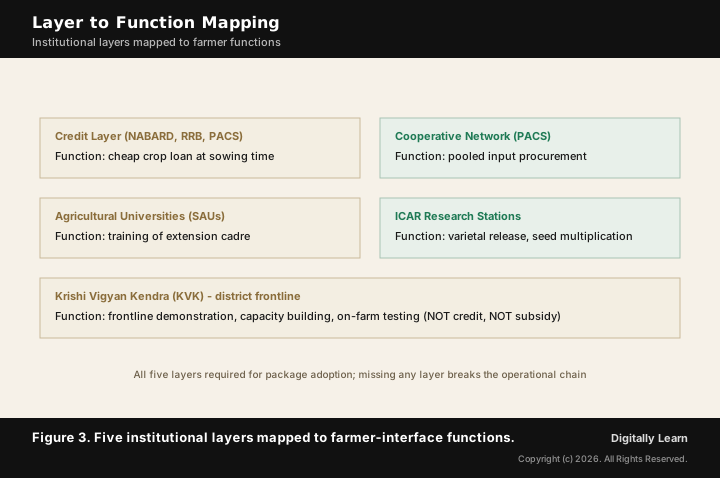
The Green Revolution technological package (HYV seed, fertiliser, water, mechanisation, scientific practice) covered in GR P3 was the supply side of the story. The demand side required an institutional support system to operate. A small farmer needed credit to buy a fertiliser bag and a pump-set, a cooperative society to access subsidised seed at planting time, and an agricultural university to develop the dwarf-rice variety suited to the local cropping calendar.
The farmer also needed a state research station to multiply the seed, a Krishi Vigyan Kendra to demonstrate the spacing-and-fertiliser protocol, and an FCI mandi within bullock-cart distance to sell the surplus at assured minimum support price. Remove any layer and the package collapses at the farmer interface. The Indo-Gangetic Plain wheat belt assembled the full stack; the eastern and dryland Peninsular regions assembled only fragments, and the regional divergence was the result.
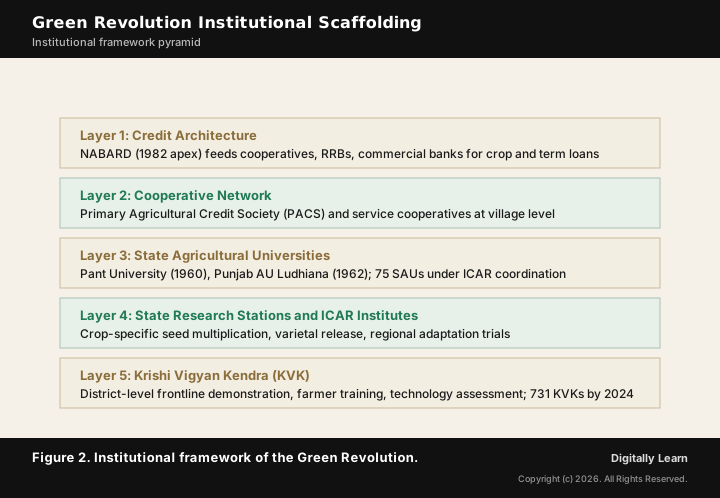
Institutional Framework: Five Layers
Credit architecture and cooperative network
Agricultural credit in pre-GR India was dominated by moneylenders charging usurious interest. The All-India Rural Credit Survey 1954 documented that cooperative credit covered only a small share of rural lending. The Green Revolution required cheap institutional credit at planting time, repayable at harvest. The architecture that emerged has four institutional types coordinated by the apex refinance body.
- Primary Agricultural Credit Society (PACS): Village-level cooperative for crop loans, input supply, and short-term production credit; the frontline borrower-interface.
- District Central Cooperative Bank (DCCB): District-level refinance to PACS; aggregates village-level demand and channels apex refinance.
- State Cooperative Bank (SCB): State-level apex of the cooperative pyramid; receives NABARD refinance.
- Regional Rural Bank (RRB): Established 1975 on the M Narasimham Committee recommendation; jointly owned by Government of India, sponsor commercial bank, and state government; combines cooperative reach with commercial-bank discipline.
- NABARD apex: National Bank for Agriculture and Rural Development established 1982 on the Sivaraman Committee recommendation; refinances cooperative banks and RRBs rather than lending directly to farmers (UPSC Prelims 2013 on the apex-versus-retail distinction).
| Institution | Founding year | Core function |
|---|---|---|
| Food Corporation of India (FCI) | 1965 | Procurement, storage, movement, and distribution of foodgrains under the Food Corporations Act 1964 |
| Agricultural Prices Commission (renamed CACP in 1985) | 1965 | Recommends the Minimum Support Price (MSP) for major crops |
| Regional Rural Bank (RRB) | 1975 | Direct retail rural credit; hybrid of cooperative reach and commercial-bank discipline |
| NABARD | 1982 | Apex refinance institution for cooperative banks and RRBs; does not lend directly to farmers |
| First State Agricultural University (Pantnagar) | 1960 | Research and the training of the agronomy and extension cadre |
Agricultural universities, research stations, Krishi Vigyan Kendra
The American land-grant university model was the inspiration. The first state agricultural university was the Govind Ballabh Pant University of Agriculture and Technology at Pantnagar in Uttarakhand, founded 1960 with United States Agency for International Development collaboration. Punjab Agricultural University at Ludhiana followed in 1962 and trained the wheat-belt extension cadre that drove Punjab adoption. The current network has 75 ICAR-coordinated state agricultural universities and deemed-universities.
The state research station network operates under ICAR (Indian Council of Agricultural Research, headquartered at New Delhi, statutory body 1929 reorganised 1965-66). Crop-specific institutes (Indian Agricultural Research Institute at Pusa New Delhi for cereals, Central Rice Research Institute at Cuttack for rice, Indian Institute of Pulses Research at Kanpur for pulses) coordinate varietal release, regional adaptation trials, and seed multiplication. The All India Coordinated Rice Improvement Project (AICRIP) released Jaya (the first widely-adopted Indian-bred dwarf rice, covered in GR P3).
The Krishi Vigyan Kendra (KVK) system is the frontline extension layer. The first KVK was established 1974 at Puducherry on the Mohan Singh Mehta Committee recommendation. The KVK functions are technology assessment and refinement, frontline demonstration of new technology on farmer fields, capacity building of farmers and extension personnel, and on-farm testing of location-specific technology.
The KVK is not a credit-disbursal institution and not a subsidy-administration office, a misconception worth flagging at the institutional-design level. The network reached 731 KVKs by 2024 with the policy target of one KVK per rural district.
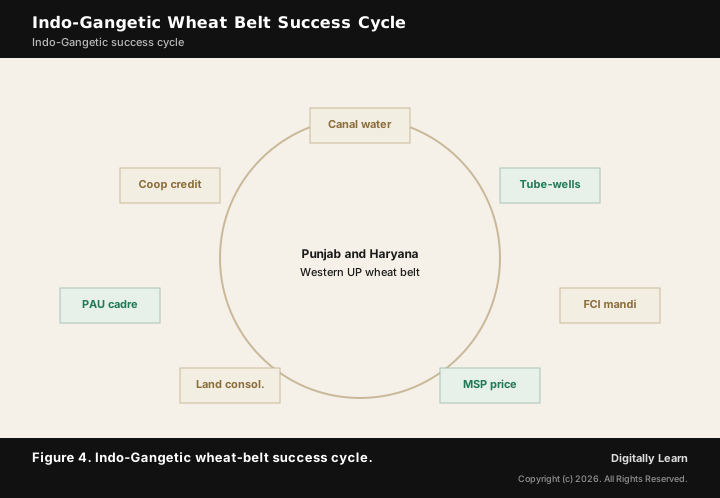
Indo-Gangetic Wheat Belt: The Success Model
Why Punjab, Haryana, Western UP captured the gain
The Indo-Gangetic Plain wheat belt became the unambiguous success of the Green Revolution. The reasons are structural rather than accidental. Six preconditions converged on this belt and did not converge elsewhere.
- Assured canal-and-tube-well irrigation: Bhakra-Nangal canal system (commissioned phase-wise from 1954) and the Western Yamuna Canal provided surface water; alluvial aquifer permitted dense tube-well drilling (covered in Agri P8).
- Post-1956 land consolidation: Punjab and Haryana implemented chakbandi (land consolidation) rigorously, reducing fragmentation that constrained tube-well investment and mechanisation in other states.
- Dense extension cadre: Punjab Agricultural University Ludhiana (1962) produced the wheat-belt agronomy graduates; extension density was higher than the national average.
- FCI procurement at MSP: Food Corporation of India (1965) established procurement mandis throughout the wheat belt, guaranteeing assured price for surplus wheat (covered in Agri P10).
- Credit penetration: Cooperative and commercial-bank branch density in Punjab and Haryana exceeded the national average; crop-loan access at sowing time was reliable.
- Cultural and entrepreneurial orientation: Punjab and Haryana farming community was historically commercially-oriented, with traditions of capital investment in agriculture (well-drilling, livestock improvement, mechanisation) that pre-dated GR.
The result was a wheat-belt productivity gain that pulled India from a net food-grain importer in the mid-1960s to a net surplus producer by the early 1980s. Punjab alone accounted for a disproportionate share of the central FCI procurement pool throughout the GR phase. Wheat-area HYV coverage in the Indo-Gangetic Plain crossed eighty per cent by the mid-1970s, far ahead of the national average.
Regional Divergence: Why East and Dryland Lagged
Eastern India: rainfall paradox
Eastern India (Bihar, West Bengal, Assam, Odisha, eastern Uttar Pradesh) presents the rainfall paradox of the Green Revolution. Rainfall in the eastern belt is substantially higher than in Punjab and Haryana, yet GR adoption lagged for two decades. The constraints were institutional and structural rather than agronomic.
- Small fragmented holdings: Average operational holding in West Bengal and Bihar was substantially below the national average; tube-well investment was uneconomical at sub-hectare scale.
- Tenancy insecurity: Sharecropping and informal tenancy were widespread; tenants without secure rights would not invest in HYV-fertiliser-water package on land they did not own.
- Weak credit penetration: Cooperative network was thinner; moneylender share of rural credit remained higher than in Punjab-Haryana.
- Flood-recession agriculture mismatch: Eastern alluvial tract uses post-flood residual moisture for rabi cropping; dwarf-rice calendar designed for assured-irrigation regime did not fit; tall traditional varieties tolerant of partial submergence remained preferred for kharif rice.
- Thin extension reach: State agricultural universities in eastern India were established later; extension density per thousand farmers remained below the national average through the GR phase.
- Land-reform implementation gap: Bihar and West Bengal had legislated land-ceiling and tenancy-protection laws but implementation lagged; land consolidation was minimal.
Dryland Peninsular India: agronomic mismatch
Dryland Peninsular India (Maharashtra, Karnataka, Andhra Pradesh, Telangana dryland tracts) captured only marginal GR benefit. The constraint here was agronomic rather than institutional. The original Green Revolution package was designed for assured-irrigation wheat and rice; the dryland Peninsular crops are jowar, bajra, ragi, and pulses, for which no dwarf high-yielding variety equivalent to dwarf wheat existed during the original GR phase.
Three further constraints compounded the mismatch. Soil moisture was monsoon-dependent and unreliable. Fertiliser-response was poor on shallow black or red soils under rainfed conditions. And credit-cooperatives could not justify production loans where harvest depended on an uncertain monsoon.
Subsequent decades produced the partial correction. ICAR-CRIDA at Hyderabad (covered in Agri P11) developed dryland-specific package recommendations; ICRISAT at Patancheru released improved millet varieties. The dryland Peninsular adoption remains partial and the productivity gap with the Indo-Gangetic Plain wheat belt remains substantial.
BGREI: the eastern-India policy correction
The Bringing Green Revolution to Eastern India (BGREI) scheme was launched in 2010-11 under the Rashtriya Krishi Vikas Yojana umbrella, with the explicit objective of replicating the wheat-belt success in the historically-lagging eastern states. The covered states are Assam, West Bengal, Bihar, Jharkhand, Odisha, Chhattisgarh, and eastern Uttar Pradesh, per Ministry of Agriculture and Farmers Welfare scheme guidelines.
The intervention components are asset-building (water-harvesting structures, threshing floors, drying yards), frontline demonstration on farmer fields, seed minikits of improved varieties, custom-hiring centres for farm machinery rented at subsidised rates, and capacity-building of farmer field schools. Productivity has improved in West Bengal and Bihar rice belts since BGREI, though the gap with Punjab-Haryana wheat productivity remains substantial.
The deeper lesson of the regional-divergence story is that technology adoption is geographically conditional. The same HYV seed, the same fertiliser, and the same KVK extension protocol yield different outcomes in different regions because the preconditions differ.
The institutional lesson is that the support system has to be tailored to regional structure. Small-holding regions need group-tenancy and farmer-producer-organisation models rather than individual-tube-well models; rainfed regions need risk-pooling crop insurance and drought-tolerant varieties rather than assured-irrigation dwarf wheat. The contemporary policy architecture is finally addressing what the original GR institutional design could not.
Previous Year UPSC-CSE Questions
Previous Year UPSC-CSE Questions By the end you will be able to draft model answers for the following UPSC questions. Each question carries a collapsible framework showing how to approach it in the exam.
- UPSC Prelims 2013Which of the following grants/grant direct credit assistance to rural households?
- Regional Rural Banks
- National Bank for Agriculture and Rural Development
- Land Development Banks
Select the correct answer using the codes given below:
How to approach this Prelims question
Approach: Identify each institution's lending model. Regional Rural Banks lend directly to rural households at the village and block level. Land Development Banks (now mostly merged into State Cooperative Agriculture and Rural Development Banks) provide direct long-term credit for land improvement. NABARD is the apex refinance institution; it refinances cooperative banks and RRBs rather than lending directly to farmers.
Trap to watch: Treating NABARD as a direct retail lender; it is the apex refinance body, not a frontline borrower-interface.
Key facts to recall:
- RRBs established 1975 on M Narasimham Working Group recommendation; direct retail credit to rural households.
- Land Development Banks provide direct long-term credit for land improvement and irrigation investment.
- NABARD established 1982 on Sivaraman Committee recommendation; refinances cooperative banks and RRBs.
- The architectural distinction between apex refinance and frontline retail is the load-bearing concept tested here.
Answer signal: Correct answer is (c) (1 and 3 only); RRBs and Land Development Banks provide direct credit assistance; NABARD does NOT.
- UPSC Prelims 2011In India, which of the following have the highest share in the disbursement of credit to agriculture and allied activities?
How to approach this Prelims question
Approach: Recall the agricultural-credit-share ranking post bank-nationalisation. Commercial banks lead, cooperative banks second, RRBs third, microfinance institutions a small share. The historical inversion (cooperatives were dominant in the early Green Revolution phase) is the trap.
Trap to watch: Recalling the pre-1969 ranking when cooperatives dominated; the post-nationalisation and post-1991 banking-reform period shifted dominance to commercial banks via lead-bank scheme.
Key facts to recall:
- Bank nationalisation 1969 brought 14 major commercial banks under public sector.
- Lead-bank scheme assigned district-level banking responsibility to commercial banks.
- Cooperative banks remain critical at the village PACS interface despite lower aggregate share.
- RRBs combine cooperative reach with commercial-bank discipline (Narasimham Working Group 1975).
Answer signal: Correct answer is (a); Commercial Banks have the highest share in the disbursement of agricultural credit.
- UPSC Prelims 2020Consider the following statements:
- In terms of short-term credit delivery to the agriculture sector, District Central Cooperative Banks (DCCBs) deliver more credit in comparison to Scheduled Commercial Banks and Regional Rural Banks.
- One of the most important functions of DCCBs is to provide funds to the Primary Agricultural Credit Societies.
Which of the statements given above is/are correct?
How to approach this Prelims question
Approach: Statement 1 inverts the credit-share ranking from Prelims 2011 Q83. Statement 2 describes the DCCB's correct role as the district-level apex of the village-cooperative pyramid that refinances PACS.
Trap to watch: Conflating DCCB importance to the cooperative pyramid with overall-credit-share leadership; the DCCB-PACS-SCB pyramid is structurally important but commercial banks dominate aggregate disbursal.
Key facts to recall:
- Cooperative pyramid: PACS (village) -> DCCB (district) -> State Cooperative Bank (state apex).
- Commercial banks lead aggregate agri-credit disbursement (UPSC Prelims 2011 Q83).
- DCCBs refinance PACS using funds from SCB and NABARD.
- NABARD refinances DCCBs and SCBs as the apex of the architecture.
Answer signal: Correct answer is (b) (2 only); DCCBs are NOT the largest short-term agri lender; DCCBs DO fund PACS.
Sources
- Class 12 India People and Economy, Chapter 5 (Land Resources and Agriculture)
- Indian Council of Agricultural Research (ICAR) institutional architecture
- Krishi Vigyan Kendra network and functions
- NABARD: National Bank for Agriculture and Rural Development
- Bringing Green Revolution to Eastern India (BGREI) scheme
- Press Information Bureau release on BGREI scheme launch
- Green Revolution in India: Wikipedia
- Ministry of Statistics and Programme Implementation: Agricultural Statistics at a Glance
Disclaimer
This article presents the institutional and regional dimensions of the Green Revolution for UPSC preparation. Statistical references are illustrative of patterns rather than exact current-year figures. Aspirants should cross-check policy details against official Ministry of Agriculture sources before exam day.