


Overview
The NPCSCB reform of civil-services capacity building
Mission Karmayogi, the National Programme for Civil Services Capacity Building, was approved on 2 September 2020 to shift the civil service from a rules-based to a roles-based, competency-driven and citizen-centric approach.
Mission Karmayogi, formally the National Programme for Civil Services Capacity Building (NPCSCB), is the Government of India's programme to reform how it builds the capacity of its civil servants. Approved by the Union Cabinet on 2 September 2020 under the Ministry of Personnel, Public Grievances and Pensions, its central idea is to move the civil service from a rules-based to a roles-based and competency-driven system. Every position is mapped through the Framework of Roles, Activities and Competencies (FRAC), and training is delivered anytime and anywhere through the iGOT-Karmayogi online platform. The programme is run through a layered institutional architecture: the Prime Minister's Public Human Resources Council, the Capacity Building Commission, the Special Purpose Vehicle Karmayogi Bharat, and a coordination unit under the Cabinet Secretary.
What Mission Karmayogi Is: A National Civil-Services Capacity Building Programme
The NPCSCB and why it was launched
Mission Karmayogi, the National Programme for Civil Services Capacity Building (NPCSCB), was approved by the Union Cabinet on 2 September 2020 under the Ministry of Personnel, Public Grievances and Pensions. It is a comprehensive reform of how the government trains and develops its officials, intended to prepare civil servants for an administration that is more responsive, accountable and aligned with national development goals.
The programme rests on a single guiding idea: a move from a rules-based to a roles-based civil service. In the older approach, an officer's training and posting followed seniority and a fixed set of rules. Mission Karmayogi instead seeks to match each official to the competencies their specific role demands, so that the right person, with the right skills, holds the right post. This is a shift from administering by procedure toward building genuine capability.
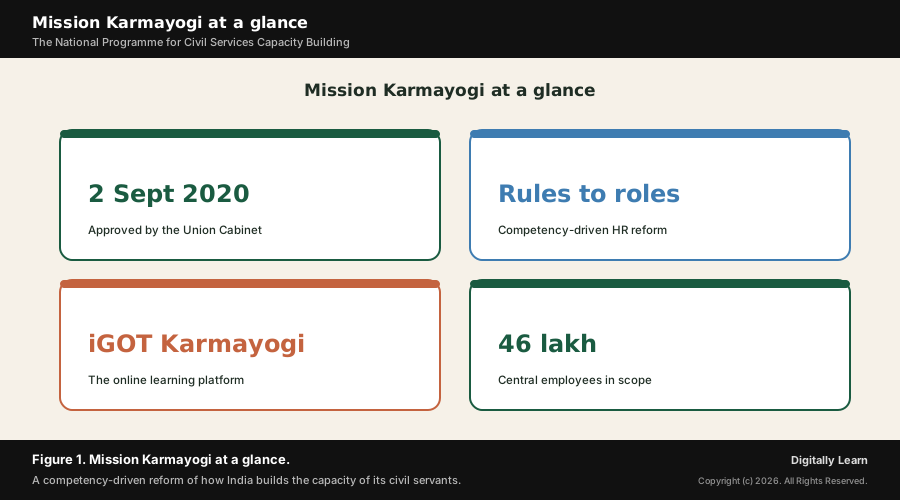
Mission Karmayogi also reframes the purpose of the civil service around the citizen. It treats an agile, citizen-centric administration as the goal, and a well-defined competency framework as the means to reach it. The programme is large in ambition: it is designed to cover around 46 lakh central government employees, with an outlay of about Rs 510.86 crore over the five years from 2020-21 to 2024-25. The figure below sets out the headline facts.
Why Mission Karmayogi Stays in the News: A Live Civil-Services Reform
Annual capacity building plans and a maturing iGOT platform
Why it matters now is that Mission Karmayogi has moved from design into delivery, and each new stage keeps it in public view. The Capacity Building Commission, set up under the programme, has been steering ministries and departments to prepare their Annual Capacity Building Plans, the documents that translate the reform into concrete training for each organisation. The spread of these plans across the government is a recurring marker of progress.
The iGOT-Karmayogi learning platform has likewise matured from a pilot into a working system on which large numbers of officials are registered and complete courses. Its growing scale, the steady addition of course content across behavioural, functional and domain areas, and its extension toward state governments keep the programme a live subject. For the exam, this means Mission Karmayogi is a standing example of governance and administrative reform rather than a one-time announcement.
The Core Idea: From a Rules-Based to a Roles-Based, Competency-Driven Civil Service
What the rules-to-roles shift actually changes
The heart of Mission Karmayogi is the move from a rules-based to a roles-based approach. Under the rules-based model, capacity building was tied largely to rank and a uniform set of procedures, so two officers in very different jobs might receive much the same generic training. The reform asks a different question: what does this role actually require, and does the officer holding it have those competencies?
To answer that, the programme calibrates every government position to a defined set of competencies and then aligns work allocation by matching an official's competencies to the requirements of the post. Training is no longer a one-off event early in a career but a continuous process, with much of it happening on the job. The intended result is an official whose development tracks the real demands of the work rather than a fixed rulebook.
This is best understood as a change in the operating logic of the service rather than a single new scheme. It links recruitment, posting, training and performance around a common idea of capability, and it treats the civil servant as a learner throughout a career. The competency-driven approach is meant to make the administration more effective and more responsive to citizens, which is precisely the long-standing concern that civil-services reform tries to address.
The Framework of Roles, Activities and Competencies (FRAC)
How FRAC maps every role to behavioural, functional and domain competencies
The mechanism that makes the roles-based idea operational is the Framework of Roles, Activities and Competencies (FRAC). For every unique position in government, FRAC defines the roles a post carries, the activities those roles involve, and the competencies an official needs to perform them. In effect it converts a job description into a precise statement of the skills the job requires.
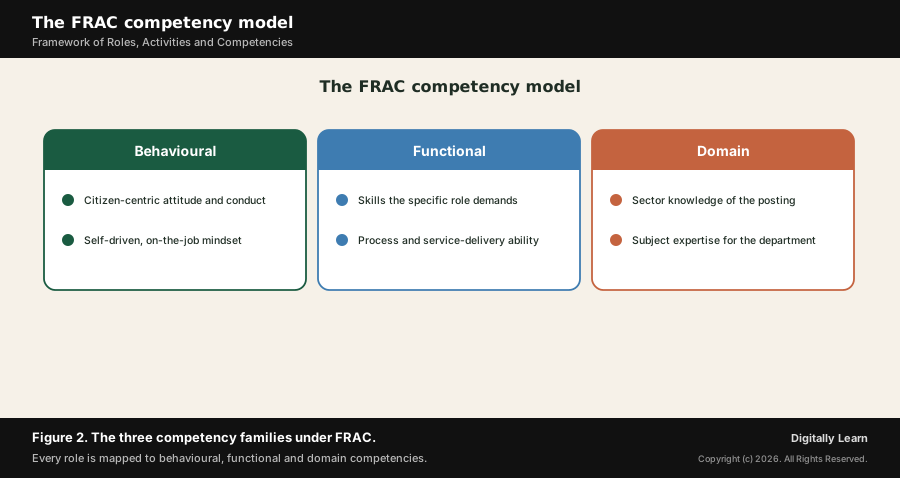
FRAC sorts these competencies into three families. Behavioural competencies cover attitudes and conduct, such as a citizen-centric outlook and the habit of learning on the job. Functional competencies are the practical skills a role demands, from drafting to service delivery. Domain competencies are the sector knowledge a posting needs, such as the subject expertise of a technical department. Together the three give a rounded picture of good performance in a role.
Once a role is mapped through FRAC, content can be matched to it precisely, and an official can follow both self-driven and mandated learning paths to close the gaps. The programme uses an indicative 70:20:10 blend, with the larger share online, a further part on the job and a smaller part in the classroom. FRAC is the link between a post, the competencies it needs and the courses that build them. The three competency families are set out below.
The iGOT-Karmayogi Platform: Anytime, Anywhere Learning
How the digital platform delivers continuous training at scale
The reform is delivered through the iGOT-Karmayogi platform, an integrated online learning system built as part of the Digital India stack. Its purpose is to make training anytime, anywhere and on any device, so that an official need not wait for a place at a training institute. The platform is designed to reach about two crore government employees, a scale traditional methods could never cover.
On the platform, content from government training institutes, research universities and vetted providers is offered as role-specific modules across behavioural, functional and domain areas. An official can follow a learning path tied to the competencies their FRAC role requires, take both mandated and self-chosen courses, and have their progress recorded. The platform thus turns the abstract idea of continuous, competency-driven learning into a concrete daily tool.
Because it is digital and shared, iGOT-Karmayogi also creates a common capacity-building resource for the whole government rather than many isolated training silos. This shared infrastructure lets good content reach scale quickly, supports the extension of the programme toward state governments, and gives the institutions that run Mission Karmayogi the data to see where capability gaps lie. The platform is therefore central to both the reach and the measurement of the reform.
The Institutional Architecture: Who Runs Mission Karmayogi
The PM's HR Council and the Capacity Building Commission
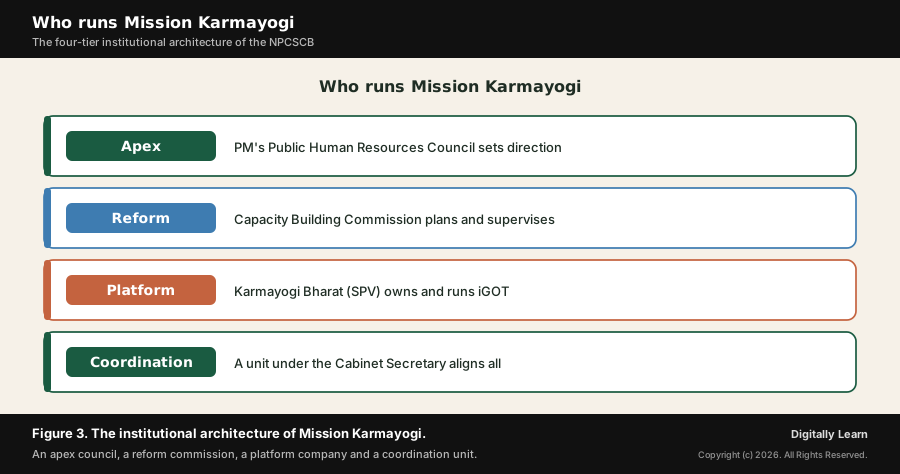
Mission Karmayogi is run through a layered set of institutions, each with a distinct task. At the top sits the Prime Minister's Public Human Resources Council, the apex body chaired by the Prime Minister. It brings together public-HR practitioners, thinkers and members of the political leadership, sets the strategic direction for civil-services reform, identifies areas for policy intervention and approves the National Capacity Building Plan. It is the body that gives the programme its overall mandate.
At the heart of the programme is the Capacity Building Commission, notified in April 2021. The Commission coordinates the preparation of Annual Capacity Building Plans for ministries, departments and organisations, monitors and evaluates how those plans are implemented, and functionally supervises the government's training institutions. In practice the Commission is the engine that turns the policy into yearly, organisation-by-organisation training, and that holds the system to standards.
These two bodies divide the work of direction and delivery. The Council decides where the civil service needs to go and approves the national plan; the Commission works out, ministry by ministry, how to get there and checks whether it is happening. This separation keeps strategic ownership at the highest level while giving the day-to-day reform a dedicated, expert institution. The figure below sets out the full architecture.
Karmayogi Bharat (the SPV) and the Cabinet Secretary's coordination unit
The digital side of the programme is owned and run by a dedicated company, the Special Purpose Vehicle known as Karmayogi Bharat. It is a not-for-profit company set up under Section 8 of the Companies Act, wholly owned by the government and placed under the administrative control of the Department of Personnel and Training. Its job is to own, manage, maintain and keep improving the iGOT-Karmayogi platform and the other digital assets of the programme.
Using a company for the platform is a deliberate design choice. It gives the technology effort the operational flexibility, technical talent and continuity that a digital product needs, while keeping it fully in government hands and not-for-profit in character. Karmayogi Bharat is therefore the institution that makes anytime-anywhere learning a working reality rather than a policy aspiration.
Holding the whole effort together is a Coordination Unit headed by the Cabinet Secretary. This unit oversees the implementation of the programme across the government, aligns the many stakeholders, and provides the mechanism for supervising capacity building plans. With the Council setting direction, the Commission planning and supervising, the SPV running the platform and the Cabinet Secretary's unit coordinating, the architecture gives each function a clear owner.
The Guiding Principles and the Six Pillars of the Programme
Competency-driven, on-the-job and citizen-centric learning across six pillars
Mission Karmayogi is built on a set of guiding principles that follow from the rules-to-roles idea. It supports the shift to roles-based HR management; it aligns work allocation by matching competencies to posts; it emphasises on-the-job learning to complement off-site training, so that an official learns within the work itself and only higher-order learning goes to institutes; and it creates an ecosystem of shared training infrastructure rather than scattered, duplicated efforts.
Two further principles complete the design. The programme calibrates all civil-service positions to the FRAC approach, and it makes available to every civil servant the chance to keep building their behavioural, functional and domain competencies through both self-driven and mandated learning. Running through all of this is the citizen-centric purpose: capability is built so that administration serves the public better, not as an end in itself.
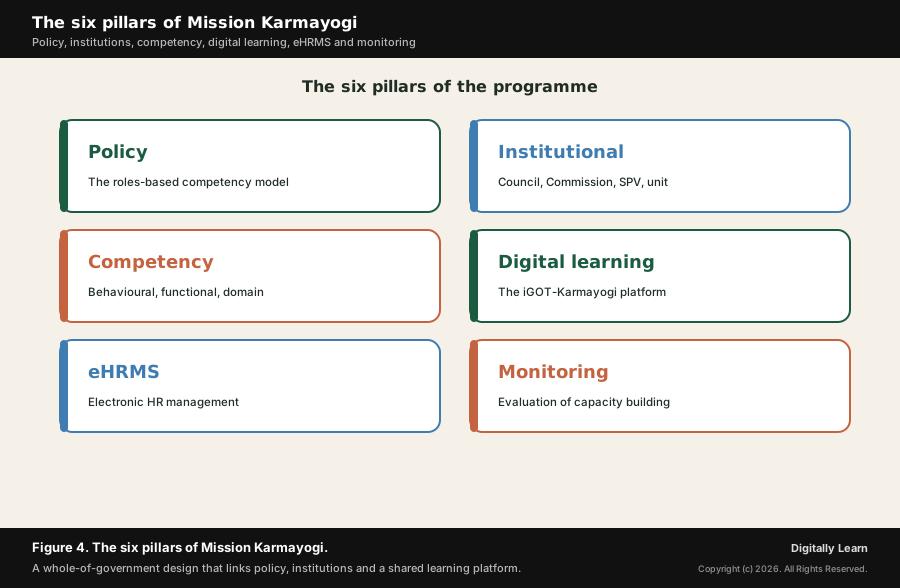
These principles are organised into six pillars. They are the Policy Framework that carries the roles-based model; the Institutional Framework of Council, Commission, SPV and unit; the Competency Framework of FRAC and its three families; the Digital Learning Framework that is iGOT-Karmayogi; the electronic Human Resource Management system; and the Monitoring and Evaluation Framework that measures whether capacity is actually rising. The figure below sets out the six pillars.
| Pillar | What it provides |
|---|---|
| Policy Framework | The roles-based, competency-driven model of capacity building |
| Institutional Framework | The Council, the Commission, the SPV and the coordination unit |
| Competency Framework | FRAC and the behavioural, functional and domain competencies |
| Digital Learning Framework | The iGOT-Karmayogi platform for anytime-anywhere learning |
| Electronic HR Management | The eHRMS that links roles, postings and learning |
| Monitoring and Evaluation | The measurement of whether capacity building is working |
Reading the rows together shows the logic: a policy idea, the institutions to drive it, a way to define and build skills, a platform to deliver them, an HR system to connect them and a means to check the result, all forming one coherent design.
Understanding the Significance of Mission Karmayogi for Governance
Capability, citizen-centric administration and a learning state
What is the significance of Mission Karmayogi lies first in the move from procedure to capability. By defining the competencies each role needs and building them deliberately, the programme tries to close the long-standing gap between what posts demand and what officials are trained for. A more capable bureaucracy is the foundation on which better policy design and implementation rest, which is why administrative capacity is treated as a driver of development.
Its second significance is the reorientation of the service toward the citizen. Mission Karmayogi makes citizen-centric administration an explicit goal and builds the behavioural competencies, such as responsiveness and a service mindset, that support it. For the public this is meant to translate into administration that is more accessible and accountable, the everyday face of governance reform.
Its third significance is the idea of a learning state. Through iGOT and continuous, on-the-job learning, the programme treats capability as something to be renewed across a whole career rather than fixed at recruitment. A government that learns continuously is better placed to handle new and complex challenges, from technology to climate to public health, which is the deeper promise of the reform.
Challenges and Debates: Uptake, Behavioural Change and Federal Reach
Implementation, genuine behavioural change, HR integration and state coverage
A balanced reading must weigh the debates around Mission Karmayogi. The first concerns implementation and uptake. Registering officials on a platform and completing online courses is not the same as deep learning, and observers ask whether course completions translate into real capability on the job, or whether training risks becoming a box-ticking exercise. The quality and relevance of content, and the time officials can actually devote to it, are continuing questions.
A second debate is whether the reform produces genuine behavioural change. Competency frameworks and online modules can build knowledge and some skills, but shifting attitudes, conduct and the culture of an organisation is harder and slower. Critics caution that a citizen-centric mindset cannot be installed by courses alone; it also depends on incentives, leadership and accountability that lie beyond a training platform.
A third concern is integration with the wider HR system. The reform's promise depends on competencies actually shaping postings, performance assessment and career progression, not sitting alongside an unchanged system of seniority-based transfers. Linking FRAC and learning records to real decisions about who is posted where is a demanding institutional task, and the gap between the design and entrenched practice is where much of the risk lies.
A fourth question is federal reach. Most public services that citizens encounter are delivered by state governments, yet the programme began with the central government. Extending Mission Karmayogi and iGOT to the states, while respecting their autonomy, is essential if the reform is to touch the bulk of Indian administration. These debates are best read neutrally: the open questions concern depth, behavioural change, integration and coverage rather than intent.
The Road Ahead for Mission Karmayogi
Embedding competencies in HR, deepening content and widening to the states
The way forward follows directly from the debates. The first task is to embed competencies in real HR decisions, so that FRAC mapping and learning records inform postings, performance appraisal and progression rather than remaining a parallel exercise. Only then does the rules-to-roles idea reshape careers in practice.
A second task is to deepen the learning itself, by improving the quality and relevance of content, blending online modules with mentoring and on-the-job practice, and measuring outcomes rather than completions. A third is to widen the reform to state governments through cooperative means that respect federal principles, so that the capacity of the administration citizens actually meet also rises.
Done well, Mission Karmayogi can mature from a training platform into a durable culture of continuous learning across Indian government. Sustained political backing, credible measurement, and a genuine link between competencies and careers are the conditions on which that outcome depends, and they are the standard against which the reform should be judged.
Mission Karmayogi in Context: Civil-Services Reform and Administrative Capacity
How Mission Karmayogi sits among India's governance and e-governance reforms
Contemporary linkages place Mission Karmayogi within a longer line of civil-services reform in India. Bodies such as the Second Administrative Reforms Commission long argued for a more professional, performance-oriented and citizen-centric bureaucracy, and Mission Karmayogi is the most systematic recent attempt to operationalise that thinking through competencies and continuous learning rather than exhortation alone.
It also connects to the Digital India and e-governance agenda. iGOT-Karmayogi is built as part of the Digital India stack, and the use of a digital platform, shared infrastructure and data to drive training mirrors the wider shift toward technology-enabled administration. Capacity building and e-governance thus reinforce each other, since a more capable official is better able to use digital tools to serve citizens.
Finally, Mission Karmayogi sits at the meeting point of capacity, service delivery and accountability in the governance syllabus. It links the quality of the civil service to the quality of public services and to citizen-centric administration. The following reforms and ideas are worth holding together in working memory:
- Second ARC recommendations: The case for a professional, performance-driven and citizen-centric civil service that Mission Karmayogi tries to operationalise.
- Digital India and e-governance: The technology stack of which iGOT-Karmayogi is a part, linking capability to digital service delivery.
- Citizen-centric governance: Service-delivery and grievance-redress reforms that a more capable, responsive bureaucracy is meant to strengthen.
- Cooperative federalism: The principle that must guide the extension of the programme to state governments and their services.
Taken together, these linkages show that Mission Karmayogi is not a stand-alone training scheme but a node in India's wider effort to build a more capable, digital and citizen-centric state.
UPSC Relevance and Exam Focus
Where Mission Karmayogi fits in the UPSC-CSE syllabus
This topic maps most directly to General Studies Paper II: governance, government policies and interventions, and issues relating to the development and management of the civil services in a democracy. It also touches e-governance and the role of civil services, themes that recur across the governance part of the syllabus and in essay and ethics papers alike.
For Prelims, hold the high-yield facts: Mission Karmayogi is the NPCSCB, approved on 2 September 2020; its core idea is the shift from a rules-based to a roles-based system; FRAC is the Framework of Roles, Activities and Competencies; the three competency families are behavioural, functional and domain; the platform is iGOT-Karmayogi; and the institutions are the PM's Public HR Council, the Capacity Building Commission, the SPV Karmayogi Bharat and a Cabinet Secretary unit.
For Mains, the recurring framing is to assess civil-services reform and capacity building: what Mission Karmayogi changes, why a roles-based and citizen-centric service matters, and how far the reform can deliver genuine behavioural and institutional change. A strong answer treats the programme as a serious attempt at competency-driven administration while weighing the real challenges of uptake, behavioural change, HR integration and federal reach in measured terms.
Recurring linked concepts an aspirant should keep in working memory:
- Rules-based versus roles-based HR: The shift from procedure and seniority to competencies matched to each role.
- FRAC and competencies: The mapping of every post to behavioural, functional and domain competencies.
- Capacity building and e-governance: The iGOT-Karmayogi platform sits in the Digital India stack and links capability to digital service delivery.
- Citizen-centric administration: The public-service purpose that the reform is meant to serve.
A common Prelims trap is to confuse the institutions or to misread FRAC; hold that the apex body is the PM's Public HR Council, the reform body is the Capacity Building Commission, the platform company is the SPV Karmayogi Bharat, and FRAC is the Framework of Roles, Activities and Competencies, not a training course.
A common Mains trap is to describe Mission Karmayogi as merely a new training portal. Its exam value lies in a balanced judgment: the genuine shift to a roles-based, competency-driven and citizen-centric service, the institutional architecture that drives it, and the honest weighing of whether it can achieve deep behavioural change, HR integration and reach across a federal system.
Previous Year UPSC-CSE Questions By the end you will be able to draft model answers for the following UPSC questions. Each question carries a collapsible framework showing how to approach it in the exam.
- UPSC Mains 2017 GS-IIComment on whether the civil services, designed for neutrality and effectiveness now seen as lacking, require drastic reforms.
How to structure the answer in the exam
Body (sub-themes to develop):
- The diagnosis: a procedure-bound, seniority-driven service criticised as insufficiently effective and citizen-centric, the very gap that reform must address.
- The reform under way: Mission Karmayogi's shift from a rules-based to a roles-based, competency-driven service, FRAC mapping of every role, behavioural, functional and domain competencies, and continuous on-the-job learning through iGOT-Karmayogi.
- The institutional seriousness: the PM's Public HR Council, the Capacity Building Commission, the Karmayogi Bharat SPV and the Cabinet Secretary's coordination unit, which show this is a structural reform, not a token one.
- Why caution is warranted: the limits of uptake and online learning, the difficulty of genuine behavioural and cultural change, the need to integrate competencies into postings and appraisal, and the challenge of extending reform across a federal system.
- A measured judgment: deep, sustained reform is indeed required, and Mission Karmayogi is a substantial step, but its success depends on embedding competencies in real HR decisions and reaching the states, not on the platform alone.
Sources and Further Reading
- Press Information Bureau: Cabinet approves Mission Karmayogi (NPCSCB)
- Department of Personnel and Training: NPCSCB, Mission Karmayogi scheme page
- Department of Personnel and Training: Mission Karmayogi Booklet
- Press Information Bureau: Mission Karmayogi institutional framework
- Capacity Building Commission: About the Commission and Annual Capacity Building Plans
- iGOT Karmayogi: FRAC Dictionary of competencies
- NITI Aayog: Governance and Reforms Division, civil-services capacity building
- Wikipedia: Mission Karmayogi
Editorial Disclaimer
This briefing is for UPSC preparation. Verify the facts and provisions against the official DoPT, PIB and Capacity Building Commission sources before relying on them.


