


Overview

Laterite soil forms where high temperature and heavy rain leach the soil so intensely that lime and silica are washed away, leaving iron oxide and aluminium behind. Red soil forms on old crystalline rocks under low rainfall and takes its colour from iron diffused through the rock. Both are red, both are poor in nitrogen and humus, and both belong to the Peninsula, but they form under opposite rainfall.
Laterite Soil and Red Soil: Meaning and Key Difference
What Is Laterite Soil and What Is Red Soil?
The two soils are separate classes in the NCERT scheme, which divides India's soils by genesis, colour, composition and location into eight groups: alluvial, black, red and yellow, laterite, arid, saline, peaty and forest soils. Both are red, both lie mainly on the Peninsula, and both are short of nitrogen and humus, which is why they are so often confused.
The word laterite was coined in 1807 by Francis Buchanan-Hamilton, from rock he saw near Angadipuram in Kerala that could be cut into blocks for building. That double identity, soil for farming and rock for building, runs through everything about laterite.
Red Soil vs Laterite Soil: Rainfall, Leaching and Fertility
The single deciding factor is rainfall. Red soil forms where rain is low; laterite forms where high temperature and heavy rain leach the soil intensely. The table sets out the difference between red soil and laterite soil point by point.
| Point | Red soil | Laterite soil |
|---|---|---|
| Rainfall | Low | High, with wet and dry seasons |
| Formed by | Weathering of crystalline rock | Intense leaching (laterization) |
| Red colour from | Iron diffused in the rock | Excess iron oxide left behind |
| Rich in | Iron | Iron oxide, aluminium, potash |
| Poor in | Nitrogen, phosphorus, humus | Organic matter, nitrogen, phosphate, calcium |
| Fertility | Fine-grained fertile; coarse upland poor | Not suitable without manure |
| Typical crops | Bajra in uplands; cotton, pulses, wheat in valleys | Cashew, tea, coffee |
| Other use | Farming only | Cut as bricks; linked to bauxite |
Red and Laterite Soils in the ICAR and FAO Classifications
The eight NCERT classes are a genetic, descriptive scheme. For international comparison the Indian Council of Agricultural Research (ICAR) also classifies Indian soils by the United States Department of Agriculture's Soil Taxonomy, using data from the National Bureau of Soil Survey and Land Use Planning. Red soils do not map onto a single order: worldwide, soils called red include ultisols, alfisols and oxisols that share a reddish colour from iron.
| Soil order (ICAR, USDA) | Share of India's area |
|---|---|
| Inceptisols | 39.74 per cent |
| Entisols | 28.08 per cent |
| Alfisols | 13.55 per cent |
| Vertisols | 8.52 per cent |
| Aridisols | 4.28 per cent |
| Ultisols | 2.51 per cent |
| Mollisols | 0.40 per cent |
| Others | 2.92 per cent |
The FAO world scheme handles laterite differently. It calls the iron-rich, hardening layer plinthite and groups the soils that carry it as Plinthosols, keeping the word laterite out of the classification because it had been used in too many senses.
Laterite Soil vs Black Soil and Red Soil vs Black Soil
Black soil, the other great soil of the Peninsula, is the natural contrast to both. It covers most of the Deccan Plateau, including parts of Maharashtra, Madhya Pradesh, Gujarat, Andhra Pradesh and Tamil Nadu, and is also called regur or black cotton soil.
| Point | Black soil | Red and laterite soils |
|---|---|---|
| Texture | Clayey, deep, impermeable | Red: loamy to gravelly; laterite: deep, porous |
| Water | Holds moisture for a long time | Low water-holding capacity |
| Rich in | Lime, iron, magnesia, alumina, potash | Iron; laterite also aluminium and potash |
| Poor in | Phosphorus, nitrogen, organic matter | Nitrogen and humus; laterite also calcium |
| Colour from | Deep black to grey | Red, from iron |
The sharpest difference is water. Black soil swells and turns sticky when wet and cracks when dry, a kind of self-ploughing, and it keeps moisture long enough to carry rain-fed crops through the dry season. Red soils hold little water, and both red and laterite soils lose nutrients to leaching, so they need manure, fertiliser or tolerant crops.
Red Soil and Laterite Soil in India Map: States Where They Are Found
Red Soil and Laterite Soil Found in Which States?
Red soil covers the eastern and southern Deccan Plateau: large tracts of Tamil Nadu, Karnataka, southern Maharashtra, Telangana, Andhra Pradesh, Chhattisgarh, Odisha and the Chota Nagpur plateau of Jharkhand. Red loamy soil runs in a long strip along the piedmont of the Western Ghats, and red and yellow soils also occur in the southern parts of the middle Ganga plain.

Laterite has mainly developed in the higher areas of the Peninsular plateau. NCERT names Karnataka, Kerala, Tamil Nadu, Madhya Pradesh and the hilly areas of Odisha and Assam, and adds the Western Ghats of Maharashtra, parts of West Bengal and the North-east. In Madhya Pradesh the laterite capping the plateau is 30 m thick.
| Soil | States and regions |
|---|---|
| Red soil | Tamil Nadu, Karnataka, southern Maharashtra, Telangana, Andhra Pradesh, Chhattisgarh, Odisha, Jharkhand (Chota Nagpur), Western Ghats piedmont |
| Laterite soil | Karnataka, Kerala, Tamil Nadu, Madhya Pradesh, hilly Odisha and Assam, Western Ghats of Maharashtra, parts of West Bengal |
| Red laterite | Tamil Nadu, Andhra Pradesh, Kerala |
Red Soil in India: Formation, Colour and Characteristics
How Is Red Soil Formed? Crystalline Rock and Low Rainfall
Red soil develops on crystalline igneous rocks in areas of low rainfall. In India these are the ancient crystalline and metamorphic rocks of the Pre-Cambrian shield, chiefly granites, gneisses and quartzites, weathering under low to moderate rain. Red soils contain large amounts of clay.
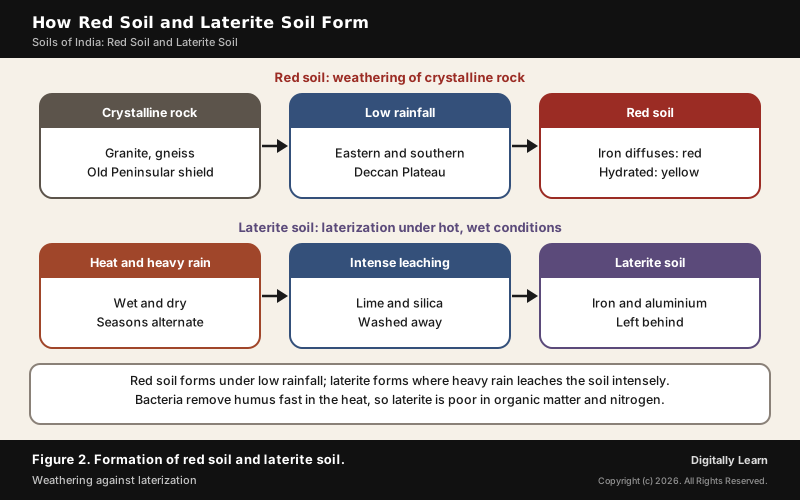
The colour comes from a wide diffusion of iron through the crystalline and metamorphic rocks. Where the iron occurs in a hydrated form, the same soil looks yellow, which is why NCERT treats red and yellow soils as one class. Worldwide, red soils come in shades from reddish brown to reddish yellow because of their high iron content.
Characteristics of Red Soil and Red Soil Crops
Red soil is not uniformly poor; its value depends on its texture and where it lies. The main characteristics:
- Texture decides fertility: Fine-grained red and yellow soils are normally fertile; coarse-grained soils of dry uplands are poor.
- Nutrients: Generally poor in nitrogen, phosphorus and humus.
- Acidity: Red soils are generally acidic, which often leaves them short of nutrients.
- Water-holding capacity: Heavy leaching gives many red soils a low water-holding capacity, and in drier regions they are prone to drought.
- Depth: In the uplands they are thin, gravelly, sandy or stony; on lower plains and valleys they are deep, dark and fertile loams.
These weaknesses can be corrected. Liming raises the pH of acidic red soils so that crops intolerant of acidity can grow, and fertiliser makes up for the nitrogen lost to leaching and erosion. Phosphorus and potassium can also run short after repeated harvests, so they too have to be replaced.
What grows on red soil follows its depth. On the thin, porous soils of the uplands only highly tolerant food crops such as bajra can be grown. On the deep loams of the lower plains and valleys, with irrigation, red soil produces excellent crops:
- Fibre and cash crops: Cotton and tobacco.
- Cereals and millets: Wheat, jowar and millet.
- Pulses and oilseeds: Pulses and linseed.
- Others: Potatoes and fruits.
Laterite Soil in India: Laterization, Characteristics and Uses
Laterite Soil Formation: Laterization, Sesquioxides and Plinthite
Laterite soil develops in areas of high temperature and high rainfall, under a tropical or subtropical climate with alternating wet and dry seasons. The repetition of wet and dry seasons is essential: percolating rain leaches the rock in the wet season, and the dry season follows. The process is called laterization.
- Leaching: Heavy tropical rain washes lime and silica out of the soil.
- Enrichment: Iron oxide and aluminium compounds, which do not wash away easily, are left behind.
- Loss of humus: Bacteria that thrive in the heat remove humus quickly.
- Hardening: Laterite is soft while wet; exposed to air it gradually hardens, as moisture evaporates and iron salts lock into a rigid structure.
Laterite is described as rich in sesquioxides: oxides with three atoms of oxygen to two of a metal, the oxides of iron and aluminium. They accumulate because the silica and bases around them are removed by deep chemical weathering, while they themselves resist it.
Iron behaves in a particular way. While the soil is saturated, much of the iron is in the ferrous form and mobile. When conditions turn drier it precipitates as ferric oxide, and it will not, or only partly, dissolve again when the soil is wet once more. That is why the iron-rich layer shows red mottles, and why nearly all laterites are rusty red from their high iron oxide content.
Soil scientists call this iron-rich layer plinthite. It hardens to ironstone on repeated drying and wetting, and many tropical plateaus are protected by an ironstone cap. Most laterite is old: a period of active laterization ran from about the mid-Tertiary to the mid-Quaternary, between 35 and 1.5 million years ago. Laterite covers are thick on old, stable land surfaces, where they can form an ironstone crust.
Characteristics of Laterite Soil
The leaching that forms laterite also decides its character:
- Rich in: Iron oxide and potash, which are in excess, and aluminium compounds.
- Poor in: Organic matter, nitrogen, phosphate and calcium.
- Acidity and depth: Mostly deep to very deep and acidic, with a pH below 6.0.
- Humus varies with cover: Rich in humus under deciduous and evergreen forest, poor under sparse vegetation in semi-arid areas.
- Erosion: Prone to erosion and degradation because of its position on the landscape.
For these reasons laterite is not suitable for cultivation as it is. Manures and fertilisers have to be applied to make it fertile, and in the hills soil conservation is needed first.
Laterite Soil Uses: Cashew, Tea, Coffee, Bricks and Bauxite
With care, laterite supports valuable tree and plantation crops. After soil conservation, the laterite of the hilly areas of Karnataka, Kerala and Tamil Nadu is very useful for tea and coffee, and red laterite in Tamil Nadu, Andhra Pradesh and Kerala suits tree crops such as cashew nut.
- Cashew: A hardy crop introduced by the Portuguese about five centuries ago, first in Goa; well-drained red, sandy and laterite soils are ideal for it.
- Tea and coffee: Grown on conserved laterite of the southern hills.
- Tapioca: Cassava, called tapioca in Indian English and kappa in Malayalam, grows productively on poor soil and is a staple of Kerala.
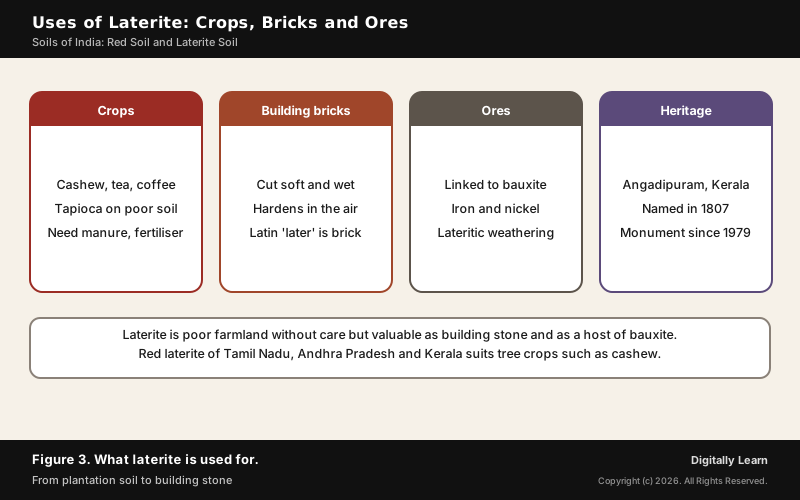
Laterite soils are widely cut as bricks for house construction. It is quarried while below the water table, when it is wet and soft enough to cut with a spade; it then hardens in the air and resists the weather. The laterite around Angadipuram is widely quarried for building, and that quarrying now threatens the deposit.
Laterite also matters for mining. Laterites are associated with deposits of bauxite, iron and nickel, and lateritic bauxites form by lateritization of silicate rocks such as granite, gneiss and basalt. India's bauxite reserves are among the ten largest in the world, and most lie on tribal land.
Managing Red and Laterite Soils for Farming
Improving Red and Laterite Soils: Liming, Manure and Conservation
Both soils lose nutrients to leaching, so management starts by putting them back. The main methods:
- Liming: Raises the pH of acidic red soils; used too heavily, it can speed microbial breakdown of organic matter and harm soil structure.
- Manures and fertilisers: Needed on laterite before it can be cultivated, and on red soils to replace nitrogen, phosphorus and potassium.
- Soil conservation: On hill slopes of Karnataka, Kerala and Tamil Nadu, conservation comes first; only then does laterite carry tea and coffee.
- Choosing tolerant crops: Bajra on thin red upland soil, cashew and tapioca on poor laterite.
Knowing which soil lies where also protects against a common exam trap. The Prelims 2006 question paired a statement about Andhra Pradesh's net sown area with the reason that most of the state's soil is laterite. The reason is false: Andhra Pradesh is listed among the red soil states, and laterite occurs there only as red laterite in parts.
Previous Year UPSC-CSE Questions
Previous Year UPSC-CSE Questions By the end you will be able to draft model answers for the following UPSC questions. Each question carries a collapsible framework showing how to approach it in the exam.
- UPSC Prelims 2013 Prelims-GSWhich of the following statements regarding laterite soils of India are correct?
- They are generally red in colour.
- They are rich in nitrogen and potash.
- They are well-developed in Rajasthan and UP.
- Tapioca and cashew nuts grow well on these soils.
Select the correct answer using the codes given below.
How to approach this Prelims question
Approach: Test each statement against the laterite profile. Statement 1: laterite is generally red, from excess iron oxide: true. Statement 2: it is rich in iron oxide and potash but poor in organic matter, nitrogen, phosphate and calcium, so 'rich in nitrogen' makes it false. Statement 3: laterite belongs to the Peninsula and the hilly north-east, not Rajasthan and Uttar Pradesh: false. Statement 4: cashew and tapioca grow well on it: true.
Trap to watch: Laterite is rich in iron oxide and potash but poor in nitrogen; Rajasthan and Uttar Pradesh are not laterite states.
Key facts to recall:
- (a) 1, 2 and 3: wrong. Statements 2 and 3 are false: laterite is poor in nitrogen, and it is not a soil of Rajasthan or Uttar Pradesh.
- (b) 2, 3 and 4: wrong. It includes both false statements and leaves out the true statement 1.
- (c) 1 and 4: right. Laterite is generally red, and cashew and tapioca grow well on it.
- (d) 2 and 3 only: wrong. Both of these are the false statements.
Answer signal: Statements 1 and 4 are correct, so option (c) is the answer.
- UPSC Prelims 2010 Prelims-GSWhen you travel in certain parts of India, you will notice red soil. What is the main reason for this colour?
How to approach this Prelims question
Approach: Red soil forms on old crystalline rocks under low rainfall and takes its colour from iron diffused through the rock. Pick the option that names iron, and reject the ones that name other constituents.
Trap to watch: Humus darkens a soil; it does not redden it.
Key facts to recall:
- (a) Abundance of magnesium: wrong. Magnesium does not colour the soil red; iron does.
- (b) Accumulated humus: wrong. Red soil is poor in humus, and humus darkens a soil rather than reddening it.
- (c) Presence of ferric oxides: right. Iron diffused in crystalline and metamorphic rocks gives the red colour; the soil looks yellow when hydrated.
- (d) Abundance of phosphates: wrong. Red soil is poor in phosphorus, and phosphate does not give it colour.
Answer signal: Iron, as ferric oxide, makes the soil red, so option (c) is the answer.
- UPSC Prelims 2006 Prelims-GSConsider the following Assertion and Reason:
- Assertion (A): The percentage of net sown area in the total area of Andhra Pradesh is less as compared to that of West Bengal.
- Reason (R): The soil of most of Andhra Pradesh is laterite.
Select the correct answer using the codes given below:
How to approach this Prelims question
Approach: UPSC's key takes the Assertion about net sown area as true. Test the Reason against the soil map: most of Andhra Pradesh has red soil; laterite belongs to Karnataka, Kerala, Tamil Nadu, Madhya Pradesh and the hilly parts of Odisha and Assam. So R is false.
Trap to watch: Andhra Pradesh has red laterite in parts, but its soils are mostly red.
Key facts to recall:
- (a) Both true, R explains A: wrong. R is false: most of Andhra Pradesh has red soil, not laterite.
- (b) Both true, R does not explain A: wrong. R is still false.
- (c) A true, R false: right. The key accepts A, and the soil of most of Andhra Pradesh is red.
- (d) A false, R true: wrong. R is the false half.
Answer signal: A is true and R is false, so option (c) is the answer.
Sources and Further Reading
- NCERT: India Physical Environment (Class XI), Soils
- NCERT: Contemporary India II (Class X), Resources and Development
- FAO: Lecture Notes on the Major Soils of the World, Plinthosols and Ferralsols
- PIB: Geo-Heritage Sites (Geological Survey of India national geological monuments)
- Directorate of Cashewnut and Cocoa Development: Crop history and production technology of cashew
- Wikipedia: Laterite
- Wikipedia: Red soil
- Wikipedia: Angadipuram Laterite
- Wikipedia: Bauxite
- Wikipedia: Cassava
- UPSC: Previous year question papers
Editorial Disclaimer
This article is compiled from the reference materials listed in the Sources section. It is an explainer for UPSC preparation and is not a substitute for primary documents (NCERTs, GoI ministry releases, IMD bulletins, RBI / CEA / MoEFCC publications, and Standing-Committee reports).