


Overview
India's central-sector cash transfer of Rs 6,000 a year to farmers
PM-KISAN, the Pradhan Mantri Kisan Samman Nidhi, is a central-sector scheme that pays every eligible landholding farmer family Rs 6,000 a year in three installments, sent by Direct Benefit Transfer into Aadhaar-seeded bank accounts and run by the Ministry of Agriculture and Farmers Welfare.
PM-KISAN, the Pradhan Mantri Kisan Samman Nidhi, is a central-sector scheme that gives every eligible landholding farmer family a fixed Rs 6,000 a year as direct income support, paid in three equal installments of Rs 2,000. It is run by the Ministry of Agriculture and Farmers Welfare and funded wholly by the Union, while the States and Union Territories identify and verify the beneficiaries from their land records. The money is sent by Direct Benefit Transfer into the farmer's Aadhaar-seeded bank account, with eKYC required to keep the rolls clean. Announced in 2019 and first paid for holdings up to two hectares, it now covers all landholding farmers subject to exclusion criteria, and it is linked to the PM Kisan Maandhan pension and the Kisan Credit Card.
What PM-KISAN Is: A Central-Sector Direct Income-Support Scheme for Farmers
The scheme, its launch and the shift from price support to direct income support
PM-KISAN, the Pradhan Mantri Kisan Samman Nidhi, is a Government of India scheme that pays every eligible landholding farmer family a fixed sum of Rs 6,000 a year as direct income support, sent straight into their bank accounts. It was announced in the interim Budget of 1 February 2019 and operationalised with benefits effective from December 2018, and the first installment was released on 24 February 2019. The scheme is run by the Ministry of Agriculture and Farmers Welfare.
The design marks a deliberate change in how the state helps farmers. Most older support reached the farmer indirectly, through a subsidy on an input such as fertiliser or through a support price for the crop, so its value depended on how much a farmer bought or sold and often leaked along the way. PM-KISAN instead gives an unconditional cash transfer of a known amount to the family itself, money the household can use for seeds, for a pump repair, for a child's school fee or for daily needs in a lean month, restoring some choice to the farmer.
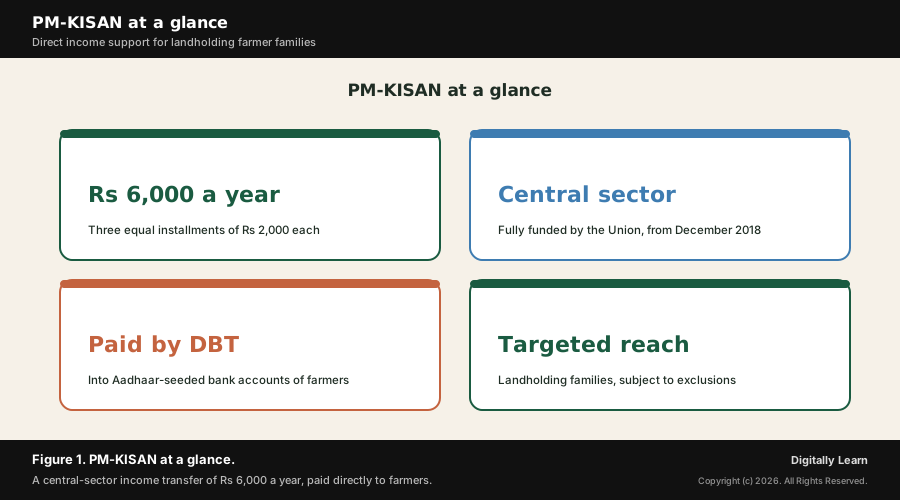
Why it matters is that this makes PM-KISAN one of the world's largest programmes of direct income support to farmers and a working test of cash transfers as a tool of farm policy. Because the amount is fixed and the payment is automatic, the scheme is simple to understand and hard to divert, though, as later sections show, that same simplicity raises questions about whether a flat sum is enough and whether it reaches the neediest. The figure below sets out its headline features.
The Scheme Design: Rs 6,000 in Three Installments, Central Funding and Eligibility
The three installments of Rs 2,000, the central-sector funding and the definition of a family
The benefit is built around a single, easily remembered figure. Each eligible family receives Rs 6,000 in a year, paid in three equal installments of Rs 2,000, released across the four-monthly cycles of the year. The unit of the benefit is the family, which the scheme defines narrowly as the husband, the wife and their minor children, so that a single landholding household draws one set of installments rather than several.
The funding model is what makes PM-KISAN unusual among welfare programmes. It is a central-sector scheme, which means the entire cost is borne by the Union Government rather than shared with the States, with benefits effective from December 2018. The States and Union Territories do the work of identifying and verifying beneficiaries, but they do not pay a matching share, so the scheme runs on a uniform national rule and a single funding line, which keeps the entitlement the same for a farmer in any State.
Eligibility turns on one simple test, softened by exclusions. At launch in early 2019 the scheme covered only small and marginal farmers with cultivable land up to two hectares, but within months, with effect from 1 June 2019, it was widened to cover all landholding farmer families whatever the size of their holding, subject to the exclusion criteria. The qualifying condition is therefore cultivable landholding recorded in the land records, not a poverty line, which makes the scheme broad while the exclusions below trim it at the top.
The Exclusion Criteria: Why Many Landholders Are Kept Out
Institutional landholders, income-tax payers, professionals, constitutional post holders and pensioners
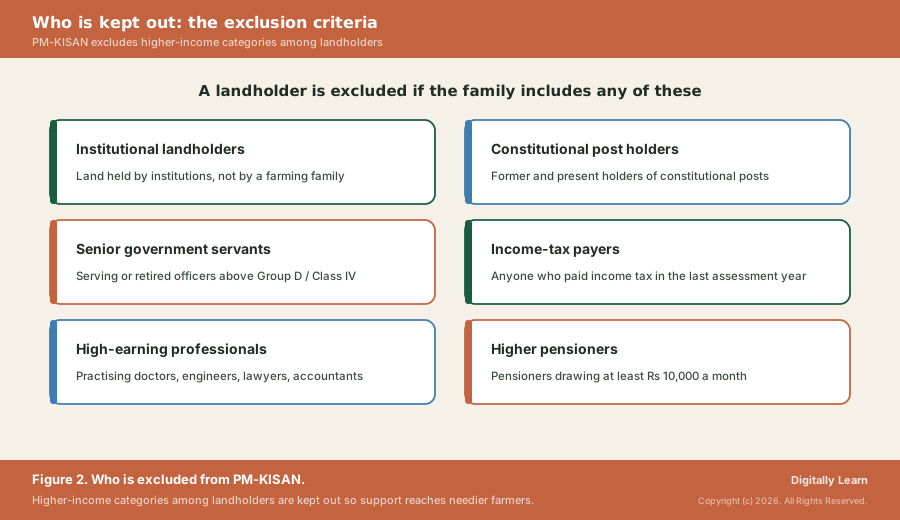
Although the scheme reaches every landholding family in principle, a list of exclusion criteria keeps out those judged well enough off not to need the support. The first cut removes institutional landholders, that is, land held by an institution rather than by a farming family, since the support is meant for households, not bodies. The aim throughout is to direct the limited funds towards the smaller and needier cultivator rather than the prosperous landowner.
The remaining exclusions target families with a member in a higher-income category. A family is left out if any member is or was a holder of a constitutional post, or a serving or retired officer or employee of the government or a public-sector body above the lowest grades, the Group D and Class IV staff being spared the bar. The same applies to any family with a member who paid income tax in the last assessment year, a simple and verifiable marker of comfortable means.
Two further categories complete the list. Families that include a practising professional, such as a doctor, an engineer, a lawyer or a chartered accountant registered with a professional body and carrying on that practice, are excluded, as are pensioners drawing a monthly pension of at least Rs 10,000, again leaving out the lowest-grade retirees. Taken together these rules mean the scheme is wide at the base and pruned at the top, so that the cash flows towards the ordinary cultivator. The figure below sets out the excluded categories.
The Delivery Architecture: From the Ministry to the Aadhaar-Seeded Bank Account
The Ministry, the State and Union Territory nodal officers, land records and the verification chain
PM-KISAN is delivered through a chain that runs from the Union ministry down to a single bank account in a village. At the top, the Ministry of Agriculture and Farmers Welfare frames the rules, runs the national portal and releases the funds, since the whole cost is central. The Ministry sets the eligibility conditions and the exclusion list, but it does not itself decide who in a village is a farmer, which is left to the State.
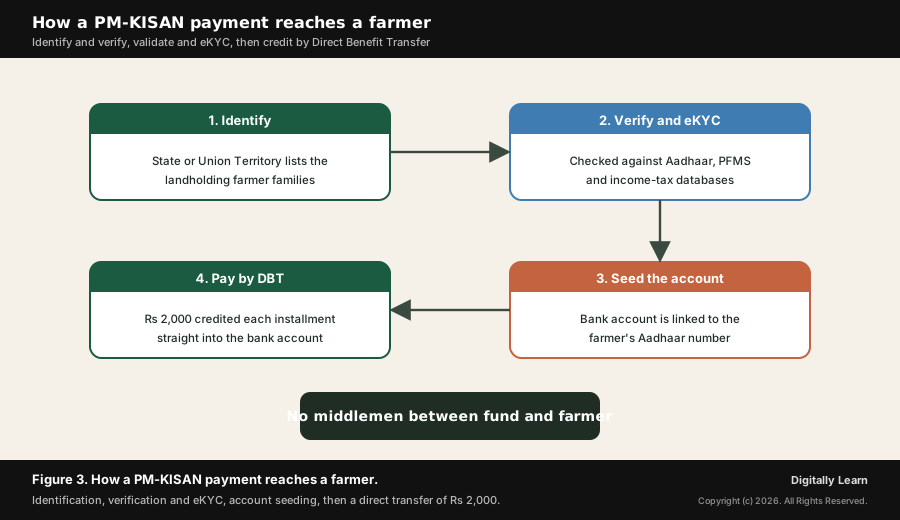
Identification is the work of the States and Union Territories. Each State or Union Territory appoints nodal officers for the scheme and uses its land records to draw up the list of landholding families, then uploads the verified data to the PM-KISAN portal. Because the right turns on recorded landholding, the quality of a State's land records directly shapes who gets the money, which is one reason the scheme works more smoothly where records are clean and digitised than where they are old or disputed.
The uploaded data then passes through a national filter before any money moves. Each record is validated against the Aadhaar database, the Public Financial Management System and the income-tax database, so that the exclusion rules are applied and duplicate or ineligible names are caught. Only after this verification does the benefit move, which is why a wrong or unmatched record can hold up a genuine farmer's payment until it is corrected, a friction the scheme has had to manage.
Aadhaar-seeded accounts, Direct Benefit Transfer, the eKYC requirement and the mobile app
The payment itself is made through Direct Benefit Transfer. The installment is credited straight into the farmer's Aadhaar-seeded bank account, meaning an account that has been linked to the holder's Aadhaar number, so the money goes from the Union treasury to the household without passing through any intermediary who might delay or skim it. This is the same plumbing that makes PM-KISAN, by its own description, one of the largest direct-transfer programmes in the world.
To keep the list clean, the scheme requires eKYC, an electronic verification of the farmer's identity against Aadhaar. Over successive installments the government progressively made eKYC, the seeding of land details and Aadhaar-based payment effectively mandatory, so that a farmer who has not completed these steps can find an installment held back until the verification is done. The stated purpose is to ensure that each payment reaches a real, eligible person and that the rolls are not padded with ghost or ineligible names.
These checks are made easier through a dedicated PM-KISAN mobile app and portal. The app, with a self-registration facility and a way to track one's payment status, was opened to farmers, and from 2023 it added a face-authentication feature so that a farmer can complete eKYC simply by scanning their face on a phone, without a fingerprint device or a visit to a centre. By putting registration, status-checking and identity verification on a phone, the scheme tries to lower the cost of staying on the rolls, though access still depends on a working phone, a signal and a correctly matched record.
Integration With the Pension and Credit Schemes: Kisan Maandhan and the Kisan Credit Card
The PM Kisan Maandhan pension and the Kisan Credit Card saturation drive
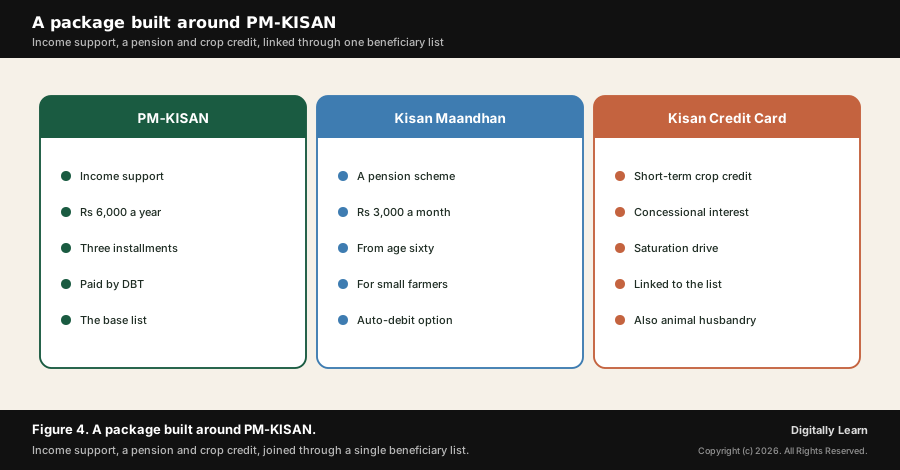
PM-KISAN does not stand alone; its beneficiary list has become the base for a wider package of farmer support. The first link is the Pradhan Mantri Kisan Maandhan Yojana, a voluntary pension scheme launched in September 2019 for small and marginal farmers, which pays an enrolled farmer a monthly pension of Rs 3,000 after the age of sixty. A farmer may even choose to pay the small monthly contribution to this pension out of the PM-KISAN benefit, so that the income support seeds the retirement saving.
The second link is to institutional credit through the Kisan Credit Card. The government ran a saturation drive, beginning in February 2020, to issue a Kisan Credit Card to every PM-KISAN beneficiary who did not already hold one, using the existing list and a simplified one-page form to cut the paperwork. The card gives the farmer access to short-term crop credit at a concessional rate of interest, with the benefit later extended to animal husbandry and fisheries, so that the same family that receives the cash support can also borrow cheaply for the season.
Read together, the three schemes form a deliberate support package around a single list. PM-KISAN supplies the regular income support, the Maandhan scheme adds an old-age pension, and the Kisan Credit Card opens a line of cheap crop credit, with eligible farmers also nudged towards the government's accident and life-insurance covers. The advantage of building on one verified list is that a farmer already in PM-KISAN can be enrolled in the others with little extra effort, turning a cash transfer into a gateway to a broader safety net. The figure below maps this package.
What PM-KISAN Achieves: Liquidity, Reach and the Limits of a Flat Transfer
Easing the cash crunch, the scale of reach and the assessed effects on farm households
The clearest contribution of PM-KISAN is to ease the cash crunch that grips many farm households at the start of a season. A small, assured transfer arriving before sowing lets a family buy seed, fertiliser or diesel without turning to a moneylender at a punishing rate, and government and independent assessments credit the scheme with relieving exactly this liquidity constraint on the purchase of farm inputs. For a marginal cultivator with little saving, a predictable Rs 2,000 at the right moment can be the difference between timely sowing and a delayed, costlier season.
The scheme's second achievement is its sheer reach. Because the qualifying test is landholding rather than a poverty assessment, PM-KISAN extends to a very large number of farmer families across every State, making it one of the broadest direct-transfer programmes anywhere. This breadth is itself a kind of safety net, since the support is automatic and does not require the farmer to apply afresh each season once enrolled, and it reaches groups, such as women landholders, who are often missed by input subsidies tied to large purchases.
On the wider effects the honest reading is cautious. Studies suggest the transfer modestly raises spending on inputs and on the household's own needs and can reduce reliance on informal debt, yet a flat national sum of Rs 6,000 is small against the real cost of cultivation, so the income effect is a cushion rather than a transformation. The figures for total families covered and total money disbursed are large and move with each installment, so this article keeps them qualitative; the safe conclusion is that PM-KISAN provides meaningful liquidity at low leakage while leaving the deeper problem of farm incomes to other policies.
The Critiques and Debates: Tenant Exclusion, Land Records, Targeting and Adequacy
The exclusion of the landless and tenants, land-record dependence, inclusion and exclusion errors, and the cash-versus-investment debate
A balanced view sets the achievements against serious critiques, presented here as they are argued by independent researchers and farm economists. The most fundamental is that, by tying the benefit to recorded landholding, the scheme leaves out the landless agricultural labourers and most tenant farmers and sharecroppers, who do the farming but whose names are not on the land record, even though these are often the poorest in the countryside, so the design can miss those who need help most.
A closely related concern is the scheme's heavy dependence on the quality of land records. Where records are outdated, disputed or not digitised, a genuine owner can be wrongly left out while errors elsewhere let an ineligible name slip in, producing both exclusion errors and inclusion errors. Critics note that the same reliance on Aadhaar seeding, eKYC and database matching that curbs fraud can also hold up payments to real farmers when a record fails to match, so the verification that protects the scheme can also exclude the very people it is meant to serve.
The deepest debate is about adequacy and design. Some economists argue that a flat Rs 6,000, undifferentiated by farm size or need and not indexed to rising costs, is too small to lift farm incomes and that the money might do more if spent on irrigation, research or markets, the classic cash-versus-investment question. Others reply that a clean, leak-resistant cash transfer respects the farmer's own judgement and reaches them directly, unlike a leaky subsidy. On whether direct income support should be widened, raised and better targeted, or balanced against public investment in agriculture, a careful answer treats the question as open and weighs both sides.
Comparison With State Income-Support Schemes: Rythu Bharosa, KALIA and Others
How PM-KISAN compares with the State-level farmer income-transfer schemes
PM-KISAN sits within a wider family of direct income-support schemes for farmers, several of them run by State governments, and comparing them sharpens what the central scheme does and does not do. A number of States introduced their own farmer cash transfers around the same period, broadly of two kinds: a per-acre transfer keyed to the size of the holding, and a flat transfer per family of the PM-KISAN type.
The contrast lies in targeting and coverage. A per-acre State transfer rewards the size of the holding, so a larger farmer receives more, whereas some State schemes deliberately widened the net to include landless and tenant cultivators and farm labourers whom a landholding test would exclude, addressing the very gap for which PM-KISAN is criticised. PM-KISAN, by contrast, pays the same flat sum to every eligible family regardless of holding size and is confined to landholders, which makes it simpler and uniform across the country but blunter as a tool for reaching the poorest.
Set side by side, the schemes illuminate the central policy choices in farm income support. Whether to pay a flat sum or to scale it by landholding, whether to confine support to recorded owners or to extend it to those who actually till the land, and whether such schemes are best run uniformly by the Union or tailored by each State, are the live design questions, and PM-KISAN represents one consistent set of answers, prized for its scale and simplicity and faulted for its exclusions. State schemes are referred to here in general terms, since their rules and amounts vary and change over time.
| Design choice | PM-KISAN | Some State income-support schemes |
|---|---|---|
| How the amount is set | A flat sum per family, the same for all | Often a per-acre amount, larger for bigger holdings |
| Who is covered | Landholding farmer families only, with exclusions | Some extend cover to tenant and landless cultivators |
| Who runs and funds it | The Union, as a central-sector scheme | The State government, tailored to local conditions |
| Main strength | Scale, uniformity and low leakage | Sharper targeting of those who actually farm the land |
Understanding the Significance: Farm Welfare, Cash-Transfer Policy and the JAM Architecture
A rights-style income floor, a model for cash transfers and a use of the digital payment rails
What is the significance of PM-KISAN lies first in its place in farm welfare. By giving every eligible landholding family a regular, assured cash transfer, the scheme puts a small income floor under farm households that arrives independently of the harvest or the market price, cushioning them against the swings of weather and prices that dominate a cultivator's life. This makes income support a standing feature of agricultural policy rather than a one-off relief, which is why it is studied as a landmark in how India supports its farmers.
Its second significance is for cash-transfer policy more broadly. PM-KISAN is a large, real-world test of whether an unconditional cash transfer can deliver support more cleanly than a price subsidy or an input subsidy, and its low leakage and direct reach are cited by those who argue for replacing leaky subsidies with money paid straight to people. The debate it has sparked, about adequacy, targeting and the exclusion of tenants, is exactly the debate any serious move towards cash transfers must settle, so the scheme has become a reference point in that wider argument.
Its third significance is technological and institutional. PM-KISAN runs on the JAM rails, the combination of bank accounts under the financial-inclusion drive, Aadhaar identity and mobile phones, and it shows what that infrastructure can do at scale, moving money to a vast number of accounts with little intermediary loss. At the same time it exposes the system's weak points, the dependence on clean land records, correct seeding and reliable eKYC, so the scheme is read as a study in the promise and the limits of digital welfare delivery in India.
The Way Forward: Reaching Tenants, Cleaning Land Records and Calibrating the Amount
Extending to the landless, fixing records and verification, and revisiting the size of the transfer
The way forward follows directly from the critiques. The first priority is to widen the reach of the support beyond recorded owners, so that tenant farmers, sharecroppers and landless agricultural labourers, who till the land but hold no title, are not left out; State experiments that include such cultivators show that the gap can be closed, though doing so demands reliable ways to identify those who actually farm a plot.
The second priority is to fix the plumbing on which the scheme depends. Cleaning and digitising land records, and making eKYC, account seeding and database matching robust and easy, would cut both the exclusion of genuine farmers whose records fail to match and the inclusion of ineligible names, while ensuring that the verification meant to protect the scheme does not itself become a barrier that holds up an honest farmer's payment.
The third priority is to revisit the amount and design of the transfer. Reviewing whether a flat Rs 6,000 should be raised, indexed to rising costs or better targeted towards the smallest cultivators, and weighing direct income support against public investment in irrigation, research and markets, would let policy strike a balance between putting cash in farmers' hands and building the assets that raise farm incomes over the long run. Pursued together, these steps would make PM-KISAN a fairer and more effective instrument of farm welfare.
UPSC Relevance and Exam Focus
Where PM-KISAN fits in the UPSC-CSE syllabus
This topic maps most directly to General Studies Paper II: government policies and interventions for development in various sectors, and issues arising out of their design and implementation; and welfare schemes for vulnerable sections, since PM-KISAN is a flagship welfare scheme whose design choices and delivery problems are textbook material. It also links to General Studies Paper III, agriculture and the economy, where the scheme appears in the discussion of farm distress, minimum support prices, subsidies and the case for direct income support.
For Prelims, hold the high-yield facts: PM-KISAN is a central-sector scheme with full Union funding, run by the Ministry of Agriculture and Farmers Welfare; it pays Rs 6,000 a year in three equal installments of Rs 2,000 to eligible landholding farmer families; it began for holdings up to two hectares and was widened in 2019 to all landholding farmers subject to exclusions; the money is paid by Direct Benefit Transfer into Aadhaar-seeded accounts with eKYC; and it is linked to the PM Kisan Maandhan pension and the Kisan Credit Card.
For Mains, the recurring framing is to weigh direct income support against the alternatives and to test the scheme's design against its delivery. A strong answer treats PM-KISAN as a case study in cash transfers versus subsidies, in the use of the JAM architecture for welfare, and in the trade-off between broad, simple coverage and accurate targeting, weighing its genuine gains in liquidity and reach against the exclusion of tenants, the dependence on land records and the question of whether a flat sum is adequate.
Recurring linked concepts an aspirant should keep in working memory:
- Direct Benefit Transfer: The routing of welfare money straight into a beneficiary’s bank account, of which PM-KISAN is a leading example, used to cut leakage and middlemen.
- Central-sector versus centrally sponsored schemes: PM-KISAN is fully Union-funded, unlike a centrally sponsored scheme such as the rural employment guarantee, where the cost is shared with the States, as it was under MGNREGA and remains under the VB-G RAM G Act of 2025 on a 60:40 basis.
- JAM trinity: The combination of bank accounts, Aadhaar and mobile phones that makes large-scale direct transfers possible and on which PM-KISAN runs.
- Cash transfer versus price or input subsidy: The policy debate over whether to pay farmers directly or to subsidise an input or a crop price, which PM-KISAN tests at scale.
A common Prelims trap is to confuse the funding type and the amount; hold that PM-KISAN is a central-sector scheme fully funded by the Union, that the benefit is Rs 6,000 a year in three installments per family, and that it now covers all landholding farmers subject to exclusions, not only those below a poverty line.
A common Mains trap is to praise the transfer and stop there. The exam value lies in a balanced judgment: the real gains in liquidity, reach and low leakage, set honestly against the exclusion of the landless and tenants, the dependence on land records, the inclusion and exclusion errors, and the open question of whether a flat amount is adequate.
Previous Year UPSC-CSE Questions By the end you will be able to draft model answers for the following UPSC questions. Each question carries a collapsible framework showing how to approach it in the exam.
- UPSC Mains 2022 GS-IIArgue why reforming the government's delivery system through Direct Benefit Transfer is a progressive step, then weigh its limitations, illustrating both sides with a working example.
How to structure the answer in the exam
Body (sub-themes to develop):
- Why it is progressive: DBT removes intermediaries, cuts leakage and delay, lets a fixed sum reach the household directly and respects the beneficiary's own judgement, as PM-KISAN's Aadhaar-seeded transfers and broad reach show.
- The enabling conditions: DBT works only on the JAM rails, that is, bank accounts, Aadhaar and mobile phones, and on clean records, so the reform is only as good as the data and the accounts beneath it.
- The limitations of exclusion: tying a benefit to recorded landholding or to a clean database leaves out the landless, tenants and those whose records fail to match, so DBT can miss the neediest.
- The limitations of friction: mandatory eKYC, account seeding and database matching can hold up genuine payments, and inclusion and exclusion errors persist, so the verification that protects the scheme can also harm beneficiaries.
- A balanced verdict: DBT is a progressive reform of delivery whose limitations are real but manageable through better records, easier verification and wider coverage, a point that extends from PM-KISAN to the whole government delivery system.
Sources and Further Reading
- Ministry of Agriculture and Farmers Welfare: PM-KISAN Samman Nidhi portal
- PM-KISAN: Revised Operational Guidelines
- Press Information Bureau: Features of the PM-KISAN scheme
- Press Information Bureau: PM-KISAN extended to all eligible farmer families irrespective of size of landholding
- Press Information Bureau: Kisan Credit Card saturation drive for PM-KISAN beneficiaries
- Press Information Bureau: Five successful years of the Pradhan Mantri Kisan Maandhan Yojana
- Department of Agriculture and Farmers Welfare: Farmers Welfare Division
- Economic Survey, Ministry of Finance: agriculture and farm income support
- NITI Aayog: strengthening the Indian agriculture ecosystem
- Wikipedia: Pradhan Mantri Kisan Samman Nidhi
Editorial Disclaimer
This briefing is for UPSC preparation. Verify the facts and provisions against the official PM-KISAN portal and the Ministry of Agriculture and Farmers Welfare before relying on them.


