


Overview
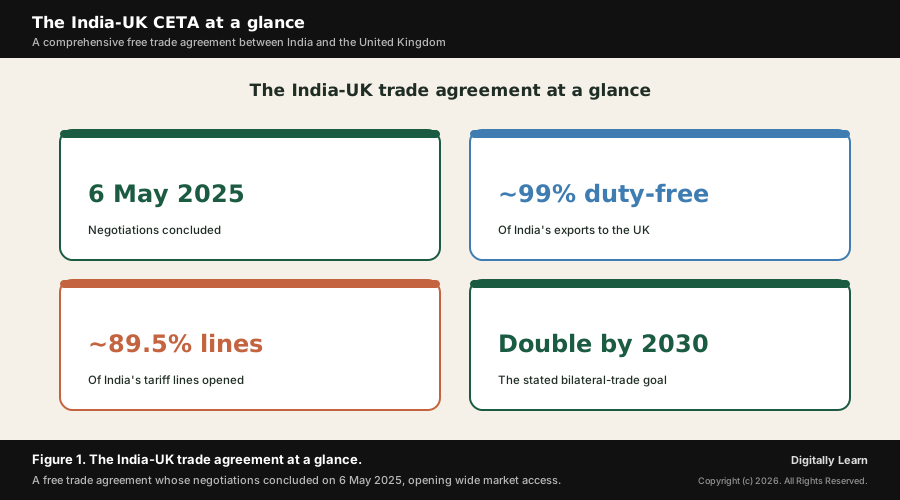
The India-UK Comprehensive Economic and Trade Agreement (CETA) is a free trade agreement between India and the United Kingdom. Negotiations were concluded on 6 May 2025 and the Agreement was signed in 2025 before the two Prime Ministers. Spanning thirty chapters, it goes beyond tariffs: the UK gives duty-free access to about 99 per cent of India's exports, India opens about 89.5 per cent of its tariff lines while safeguarding sensitive sectors, and the deal covers services, mobility, government procurement and intellectual property. A separate Double Contribution Convention exempts Indian workers on temporary assignment in the UK, and their employers, from UK social-security contributions for three years. Bilateral trade of around USD 56 billion is to be doubled by 2030. CETA is India's first deep agreement with a major developed Western economy.
What the India-UK CETA Is: A Comprehensive Free Trade Agreement
A thirty-chapter free trade agreement between India and the United Kingdom
The India-UK Comprehensive Economic and Trade Agreement (CETA) is a free trade agreement between India and the United Kingdom. A free trade agreement is a treaty in which partners lower or remove tariffs and other barriers on trade between them, so that each side's goods, and often its services, enter the other's market on preferential terms. CETA applies this idea across thirty chapters, covering not just goods but services, the movement of professionals, government procurement and intellectual property.
Negotiations on the agreement were concluded on 6 May 2025, and CETA was signed later in 2025 by India's Commerce and Industry Minister and the UK Secretary of State for Business and Trade, in the presence of the two Prime Ministers. The signing marked the end of a long negotiation and the start of the work of bringing the agreement into force, a sequence in which a deal is first negotiated, then signed, and only later enters into operation.
What sets CETA apart is its scope. It is one of India's most comprehensive trade agreements and its first deep agreement with a major developed Western economy. Rather than a narrow tariff deal, it bundles goods, services, mobility and a set of modern chapters into a single treaty, which is why it is read as a template for India's next generation of trade pacts. The figure below sets out its headline terms.
Why the India-UK CETA Is in the News
A concluded deal with a developed economy and a doubling-of-trade goal
Why it matters now is that India has concluded a comprehensive free trade agreement with a major developed economy, a milestone for a country that for years negotiated such deals slowly and cautiously. The conclusion of CETA on 6 May 2025, followed by its signing, signalled that India is willing to enter deep trade commitments with advanced markets, not only with developing partners, and to do so across goods, services and mobility at once.
The agreement also draws attention for its stated economic goal. Bilateral trade between India and the United Kingdom stands at around USD 56 billion, a figure stated as approximate and as of the signing, and the two governments have set out to double it by 2030. A deal that promises duty-free access for India's labour-intensive exports, mobility for its professionals and a doubling of trade is, by its nature, a live subject for analysts and for the exam.
Understanding the Significance of the India-UK CETA
Market access for jobs-rich exports, services and a strategic FTA
What is the significance of the India-UK CETA lies first in the market access it gives India's exports. By opening about 99 per cent of India's exports to the United Kingdom duty-free, the agreement removes tariffs on the labour-intensive goods, textiles, leather, marine products, gems and jewellery and toys, where India competes hard on price and which employ large numbers of workers. For these sectors, the removal of UK tariffs is a direct boost to exports and jobs.
Its second significance is in services and mobility. India has secured commitments across all major service sectors and easier movement for its professionals and business visitors to the UK, opening a developed-country market for India's services strength. For a country whose comparative advantage runs deep in services and skilled labour, that access is a substantial gain alongside the goods chapter.
Its third significance is strategic. CETA is India's first deep free trade agreement with a major developed Western economy and a template for the deals that follow. It advances India's wider FTA strategy and its trade diplomacy, and it does so while testing the balance between opening up to imports and protecting sensitive sectors, a balance that defines India's approach to every such agreement.
What the India-UK CETA Covers: Goods, the DCC, Services and More
Goods market access: about 99 per cent for India, about 89.5 per cent of India's tariff lines
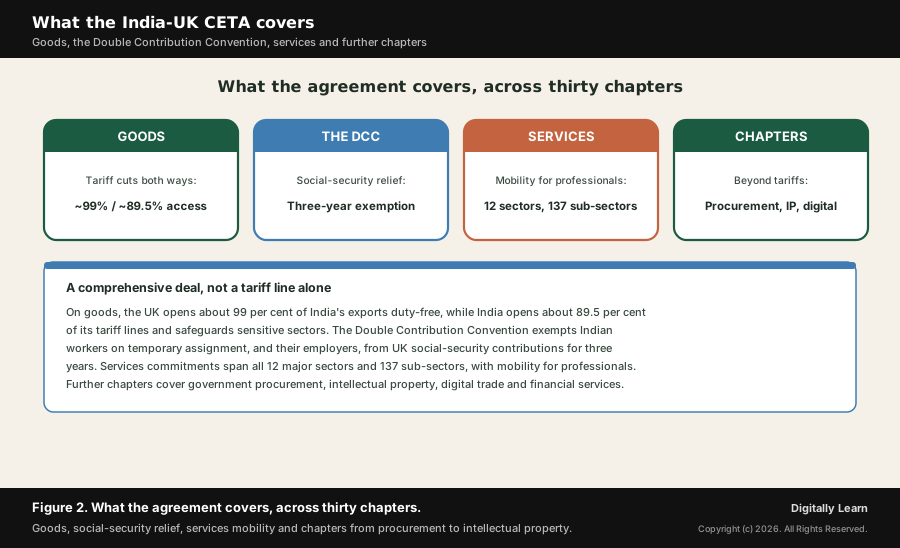
On goods, the agreement is asymmetric in India's favour at the headline level. The United Kingdom gives duty-free access to about 99 per cent of India's exports, covering nearly the whole value of what India sells to the UK, so that almost all Indian goods enter the British market without tariffs. This is the central market-access gain and the reason the deal is read as export-friendly for India.
In return, India opens about 89.5 per cent of its tariff lines, covering roughly 91 per cent of UK exports to India. Crucially, India has not opened everything: it has safeguarded sensitive sectors and strategically important products where domestic capability is still being built, keeping the most exposed areas of agriculture and dairy and key industrial lines either out of the deal or on protected terms. This selective opening is how India reconciles liberalisation with protection.
| Element | What it provides | Who it helps |
|---|---|---|
| UK market access | About 99 per cent of India's exports duty-free | India's exporters across most sectors |
| India's tariff lines | About 89.5 per cent opened, sensitive lines safeguarded | UK exporters, with Indian sectors protected |
| Sensitive sectors | Agriculture, dairy and key lines kept out or shielded | Indian farmers and vulnerable industries |
| Coverage of value | Nearly the whole value of India's UK trade | The bulk of India's export basket |
Reading the rows together shows the logic of the bargain: near-total duty-free entry for Indian goods into the UK, a large but selective opening of India's market in return, and an explicit carve-out for the sectors India judges too sensitive to expose.
The Double Contribution Convention: social-security relief for Indian workers
Alongside CETA sits a separate and much-discussed instrument, the Double Contribution Convention (DCC). Under it, Indian workers who are sent to the United Kingdom on a temporary assignment, and their employers, are exempted from UK social-security contributions for three years, the period agreed at the signing. Without such a convention, a worker posted abroad for a few years would pay into the host country's social-security system without ever drawing a benefit from it.
The DCC removes that double burden. By sparing the worker and the employer from paying UK National Insurance for the duration of the posting, it lowers the cost of sending Indian talent to Britain and raises the worker's take-home earnings. The Government has presented it as a measure that improves the competitiveness of Indian services firms and benefits tens of thousands of workers and the companies that employ them.
For India, the DCC matters because so much of its economic engagement with developed countries runs through its skilled professionals. A convention that makes it cheaper for Indian firms to deploy staff to the UK directly supports the services and mobility side of the relationship, which is why it is treated as a headline win of the wider trade package rather than a technical footnote.
Services and mobility: access for professionals and business visitors
Beyond goods, CETA opens services and mobility. India has secured commitments from the United Kingdom across all twelve major service sectors and a large number of sub-sectors, covering the great bulk of India's services export interests. For an economy whose strength lies in information technology, professional and business services, this access to a developed-country market is a significant complement to the goods chapter.
The agreement also eases the movement of professionals. The United Kingdom has made mobility commitments for categories such as contractual service suppliers, which include occupations from independent professionals to roles such as yoga instructors, classical musicians and chefs, and for independent professionals, allowing defined numbers of skilled Indians to work in the UK on a temporary basis. This mobility, paired with the Double Contribution Convention, is how the deal turns India's human capital into a tradable advantage.
Taken together, the services and mobility provisions mean CETA is not only about selling more goods to Britain. It is also about selling more services and moving more people, which is where India's long-term comparative advantage increasingly lies, making this side of the agreement as important as the tariff cuts on goods.
Government procurement, intellectual property and other modern chapters
CETA also carries a set of modern chapters that mark it out as a next-generation agreement. For the first time in a bilateral deal, India has included a government procurement chapter, giving UK suppliers defined access to Indian central-government tenders; importantly, this access is limited to central-government departments, with states and sensitive ministries such as defence kept outside, preserving policy space where it matters most.
The agreement contains India's most comprehensive intellectual property chapter to date, spanning a large number of provisions on patents, trademarks, copyright, geographical indications and trade secrets. The Government has stressed that this chapter is balanced: it protects rights-holders while safeguarding India's long-standing priorities on access to medicines, public health and the preservation of traditional knowledge, so that stronger IP commitments do not crowd out affordable healthcare.
Further chapters extend to digital trade, telecommunications and financial services, modernising the rules that govern commerce between the two economies. The breadth of these chapters is what justifies the label comprehensive: CETA writes rules not only for today's trade in goods but for the services, data and procurement that increasingly define a modern economy.
Sector Impact: Labour-Intensive Exports, Manufacturing and Services
Why labour-intensive exports underperformed, and how CETA addresses it
To see why the goods chapter matters, it helps to recall why India's labour-intensive exports have long underperformed. India's manufacturing has struggled to convert abundant labour into large export volumes in textiles, leather and footwear, where competitors operate at greater scale, enjoy lower logistics and power costs, and face lower destination-market tariffs. High tariffs abroad, in particular, blunted the price advantage that India's lower labour costs should have given these goods.
Several structural reasons account for this shortfall. Fragmented, small-scale production limited economies of scale; complex rules and slow logistics raised costs; and a long tilt of incentives toward capital-intensive industry meant that the most jobs-rich, labour-intensive lines never grew their export share as East Asian economies did. Where rivals enjoyed duty-free entry to big markets through trade agreements, Indian exporters often faced tariffs that priced them out, so the goal of labour-intensive export growth went substantially unmet.
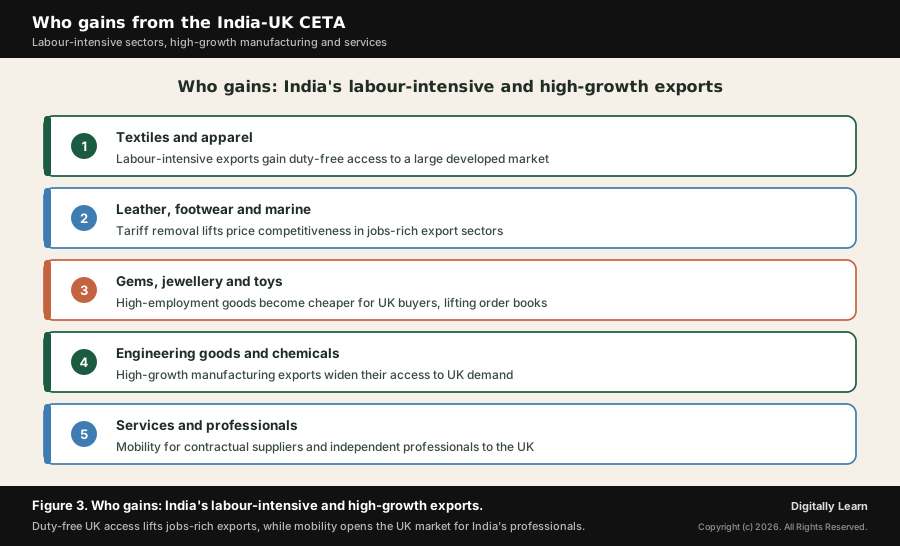
CETA addresses one of these constraints directly. By removing UK tariffs on about 99 per cent of India's exports, it hands the labour-intensive sectors, textiles, leather, marine products, gems and jewellery and toys, duty-free access to a large developed market, restoring the price competitiveness that foreign tariffs had eroded. A trade agreement that opens a major market is, in this sense, a concrete measure to make India's exports more labour-intensive, by making its most employment-heavy goods cheaper abroad.
High-growth manufacturing and the services and mobility gains
The gains are not confined to traditional labour-intensive lines. High-growth manufacturing sectors such as engineering goods and chemicals also win wider access to UK demand, helping India move up the value chain even as it expands its jobs-rich exports. The agreement therefore supports both ends of the manufacturing spectrum: the employment-heavy goods that absorb large workforces and the higher-value goods that raise productivity. The figure below maps the principal winners.
On the services side, the impact runs through professionals and firms. Easier mobility for contractual service suppliers and independent professionals, reinforced by the Double Contribution Convention, lets Indian services exporters deploy talent to the UK at lower cost, while the broad services commitments open a developed market to India's information-technology and professional-services strength. For a country whose comparative advantage increasingly lies in services and skilled labour, this is a structural gain.
Set against these gains, the deal also exposes some Indian producers to UK competition in the tariff lines India has opened, and the benefits will materialise only if exporters can meet quality standards and rules-of-origin requirements. The honest reading is that CETA improves the conditions for India's labour-intensive and high-growth exports without guaranteeing the outcome, which still depends on domestic competitiveness.
India's FTA Strategy and the Debates Around the CETA
CETA within India's wider FTA push: the UAE, Australia and EFTA
CETA does not stand alone but sits within a wider FTA strategy India has pursued with new energy lately. After a long period of caution, it signed a comprehensive economic partnership with the United Arab Emirates in 2022, an economic cooperation and trade agreement with Australia the same year, its first deal with a developed economy in over a decade, and a partnership with the EFTA bloc in 2024. CETA is the most ambitious of this run.
This sequence shows a deliberate shift in India's trade posture. Having long stayed out of mega-regional blocs and negotiated slowly, India is now signing deep bilateral agreements, increasingly with developed economies, to lock in market access for its exporters and to integrate into global supply chains. CETA, as the first deep deal with a major developed Western partner, is the clearest expression of this new, more confident trade diplomacy.
The strategy is also a form of diversification. By spreading agreements across the Gulf, the Pacific, Europe and now the United Kingdom, India widens the markets open to its goods and services and reduces its dependence on any single partner. Each new FTA, CETA included, is a building block in a network meant to give Indian exporters preferential access across the world's major markets.
The debates: sensitive sectors, implementation and trade deficits
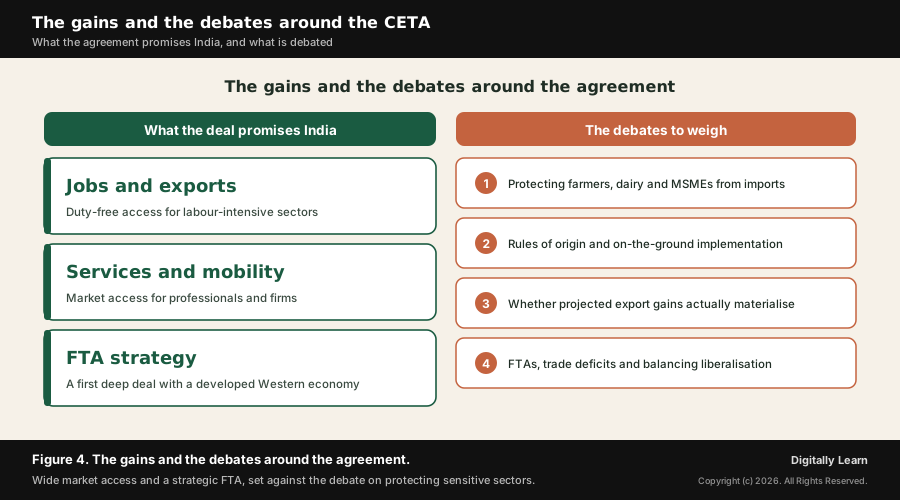
A balanced reading must weigh the debates around the agreement, because deep FTAs carry real costs as well as gains. The most pointed concern is the protection of sensitive sectors: farmers, the dairy industry and small and medium enterprises fear that opening India's market, even partially, exposes them to cheaper imports. India's response, keeping agriculture, dairy and key lines out or on protected terms, is meant to answer this, but the balance between liberalisation and protection remains contested.
A second debate concerns implementation and rules of origin. The headline market access counts for little unless exporters can actually use it, which requires meeting product standards, certification and rules-of-origin requirements that prove a good genuinely originates in India. Weak implementation, or rules that are hard to satisfy, can leave much of the promised benefit on paper, so the value of CETA depends on the unglamorous work of putting it into practice.
A third, broader debate is whether such agreements deliver. Critics point to FTAs that widened India's trade deficits rather than boosting exports, and ask whether projected gains will materialise this time. The realistic assessment is that CETA is a significant and promising agreement whose worth will be judged on whether India's exporters seize the access it opens, whether sensitive sectors stay protected, and whether trade grows in a balanced way. The figure below sets the gains against these debates.
The CETA in Context: Trade Diplomacy, Atmanirbhar Bharat and India-UK Ties
How the agreement sits among India's trade, self-reliance and foreign-policy goals
Contemporary linkages place CETA within India's wider trade diplomacy. It belongs beside India's other recent agreements with the UAE, Australia and EFTA, and beside its negotiations with the European Union, as part of a concerted push to secure preferential access to the world's major markets. The agreement is the United Kingdom-facing piece of a larger effort to weave India into the global trading system on terms that favour its exporters.
CETA also connects to the debate between Atmanirbhar Bharat and liberalisation. India's self-reliance drive seeks to build domestic capability and reduce import dependence, while a trade agreement, by design, opens the economy to imports and competition. The way CETA squares the two, near-total access for Indian exports abroad, a selective and safeguarded opening of India's own market, shows how India tries to pursue self-reliance and trade integration together rather than treating them as opposites.
Finally, the agreement deepens the broader India-UK relationship. Trade sits alongside a large Indian diaspora in Britain, investment flows in both directions, and cooperation in technology, education and security, so a comprehensive economic agreement strengthens one pillar of a wider partnership. CETA is therefore read not only as an economic deal but as a marker of closer strategic ties between the two countries.
- India’s FTA network: The agreements with the UAE, Australia and EFTA within which CETA sits as the deepest deal with a developed Western economy.
- Atmanirbhar Bharat and liberalisation: The balance between building domestic capability and opening the economy that CETA’s selective tariff cuts embody.
- Services and mobility: India’s comparative advantage in skilled labour, which the services chapter and the Double Contribution Convention seek to monetise.
- India-UK ties: The diaspora, investment and strategic cooperation that the trade agreement reinforces.
Taken together, these linkages show that CETA is not an isolated trade deal but a node in India's evolving economic foreign policy, joining its FTA strategy, its self-reliance debate and its partnership with the United Kingdom.
UPSC Relevance and Exam Focus
Where the India-UK CETA fits in the UPSC-CSE syllabus
This topic maps directly to General Studies Paper II: bilateral, regional and global groupings and agreements involving India, and the effect of policies of developed countries on India's interests. It also sits firmly in General Studies Paper III, where India's economy, foreign trade and export competitiveness are tested, since CETA is at once a foreign-policy and an economic agreement.
For Prelims, hold the high-yield facts: CETA is the India-UK free trade agreement whose negotiations concluded on 6 May 2025; the UK gives duty-free access to about 99 per cent of India's exports; India opens about 89.5 per cent of its tariff lines and safeguards sensitive sectors; a separate Double Contribution Convention exempts Indian workers in the UK from social-security contributions for three years; and the goal is to double bilateral trade, around USD 56 billion, by 2030.
For Mains, the recurring framing is to assess the agreement's significance for India's exports and jobs, its services and mobility gains, its place in India's FTA strategy, and the debate over protecting sensitive sectors. A strong answer treats CETA as trade diplomacy that must be judged on implementation and on whether India's labour-intensive exporters actually seize the access it opens.
Recurring linked concepts an aspirant should keep in working memory:
- Free trade agreements and the WTO: How preferential agreements lower barriers between members, and how they relate to the multilateral trading system.
- Labour-intensive exports: Why India’s jobs-rich sectors underperformed and how market access measures such as CETA address it.
- India’s FTA strategy: The UAE, Australia and EFTA agreements and the shift toward deep deals with developed economies.
- Liberalisation versus protection: The balance between opening the economy and shielding agriculture, dairy and MSMEs.
A common Prelims trap is to confuse CETA's market-access figures, attributing the 99 per cent to India's own tariff lines rather than to the UK's opening, or to forget that India safeguarded sensitive sectors. Hold the asymmetry precisely: about 99 per cent for India's exports into the UK, about 89.5 per cent of India's tariff lines opened.
A common Mains trap is to praise the deal without testing it. Its exam value lies in a balanced judgment: the genuine gains in market access, services and FTA strategy, set honestly against the need to protect sensitive sectors, to implement rules of origin, and to ensure the projected export gains actually materialise.
Previous Year UPSC-CSE Questions By the end you will be able to draft model answers for the following UPSC questions. Each question carries a collapsible framework showing how to approach it in the exam.
- UPSC Mains 2017 GS-IIIExplain why India's manufacturing failed to achieve labour-intensive exports, and suggest measures for more labour-intensive exports.
How to structure the answer in the exam
Body (sub-themes to develop):
- Accounting for the failure: fragmented small-scale production and weak economies of scale; high logistics, power and compliance costs; an incentive tilt toward capital-intensive industry; and high tariffs in destination markets that eroded India's labour-cost advantage.
- Sectors affected: textiles and apparel, leather and footwear, marine products, gems and jewellery and toys, the jobs-rich lines whose export share lagged behind East Asian competitors.
- Measures, market access: trade agreements such as the India-UK CETA that remove foreign tariffs (about 99 per cent of India's exports duty-free into the UK) and restore price competitiveness for labour-intensive goods.
- Measures, competitiveness and scale: improving logistics and ease of doing business, supporting scale and clusters, and meeting standards and rules of origin so that the access an FTA opens is actually used.
- Balanced close: market access is necessary but not sufficient; labour-intensive export growth needs both the demand-side access of FTAs and supply-side competitiveness at home.
Sources and Further Reading
- Ministry of Commerce and Industry: India – United Kingdom Comprehensive Economic and Trade Agreement (CETA)
- Ministry of Commerce and Industry: India-UK CETA Synopsis of Key Chapters
- Press Information Bureau: India and UK Sign Comprehensive Economic and Trade Agreement (CETA)
- Press Information Bureau: Demystifying the IPR Chapter in the India-UK CETA
- Press Information Bureau: India's achievements in Free Trade Agreements
- Ministry of Commerce and Industry: India-EFTA Trade and Economic Partnership Agreement (TEPA)
- World Bank: Trade (lowering tariff and non-tariff barriers through trade agreements)
- OECD: Preferential Trade Agreements (how trade agreements lower barriers and deepen integration)
- NITI Aayog
- Wikipedia: India-United Kingdom Comprehensive Economic and Trade Agreement
Editorial Disclaimer
This explainer is prepared for UPSC preparation and general awareness. Trade figures and the agreement's provisions are summarised from official sources and may be revised as the agreement enters into force. Readers should consult the official Commerce Ministry and PIB releases for the authoritative text.


