


Overview
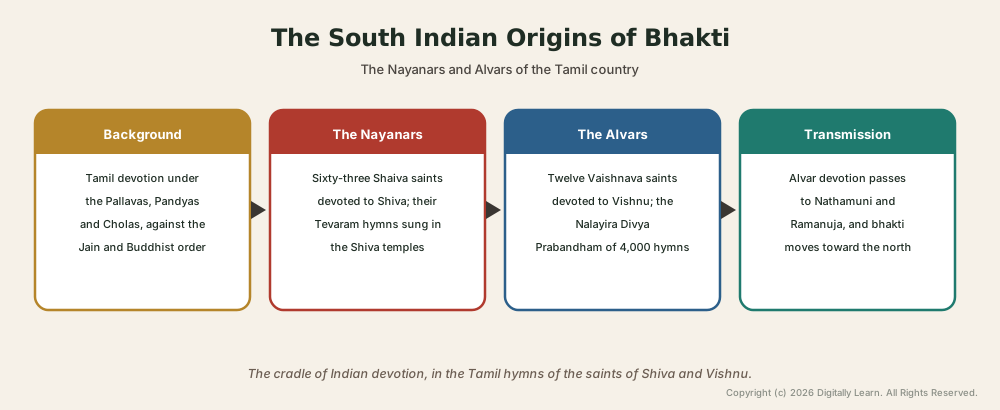
The Nayanars and the Alvars were the Tamil poet-saints who began the Bhakti movement in the far south of India, between roughly the sixth and the ninth centuries. The Nayanars were the sixty-three saints who sang their love of Shiva, and the Alvars were the twelve saints who sang their love of Vishnu. They wandered from shrine to shrine across the Tamil land, pouring out their devotion in hymns of great beauty, which were later gathered into revered collections: the Tevaram of the Shaiva saints and the Nalayira Divya Prabandham of the Vaishnava saints. Under the patronage of the Pallava, Pandya and Chola kings, their devotion swept aside the older Jain and Buddhist order and made the worship of Shiva and Vishnu the living faith of the south.
Historical Background: Tamil Bhakti under the Pallavas, Pandyas and Cholas
The Tamil Bhakti Milieu and Royal Patronage
The Bhakti movement was born in the Tamil country, and to understand it one must first picture the land and the kings who gave it room to grow.
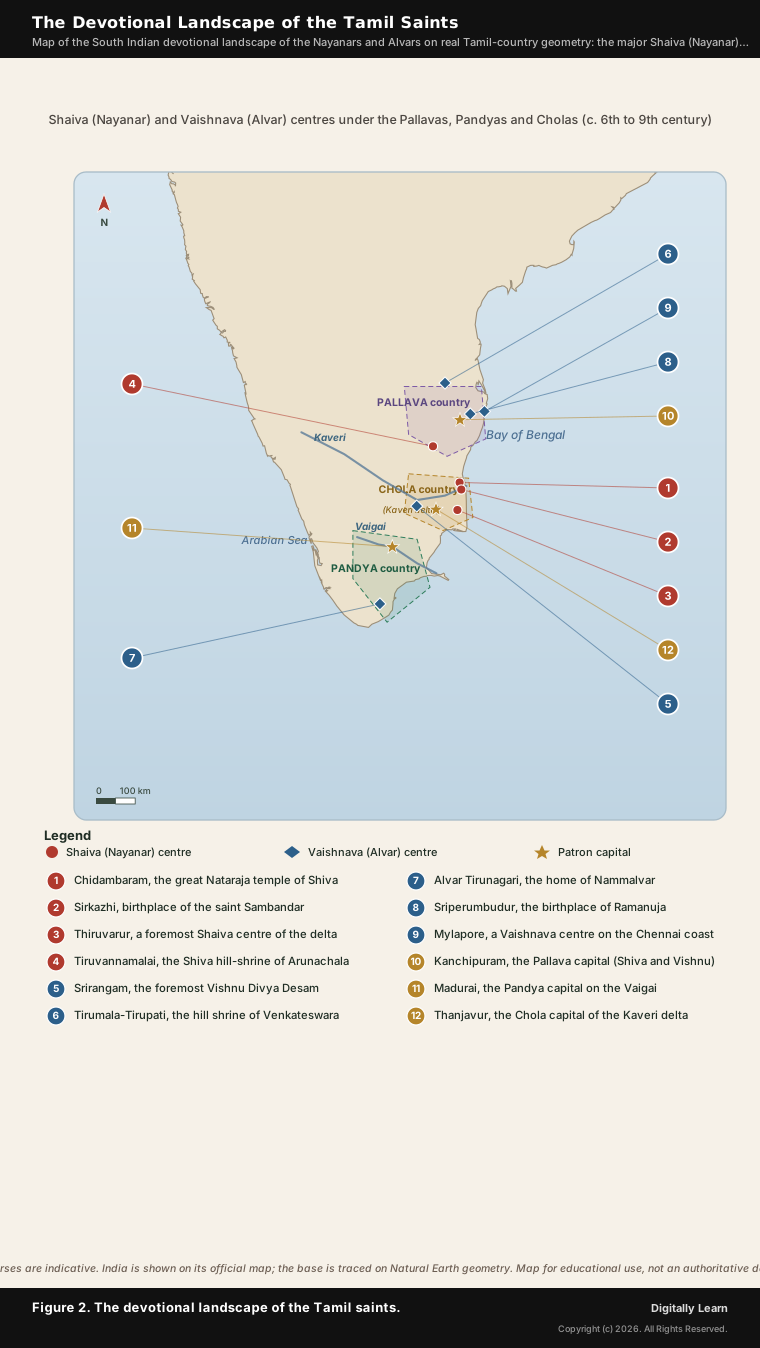
Between the sixth and the ninth centuries the Tamil south was held by three great ruling houses: the Pallavas, with their capital at Kanchipuram; the Pandyas, who ruled from Madurai on the river Vaigai; and the rising Cholas of the Kaveri delta, around Thanjavur. These kings were great builders of temples and generous patrons of the poet-saints, and their courts and shrines became the setting of the new devotion.
It was in this world that the Nayanars, the saints of Shiva, and the Alvars, the saints of Vishnu, arose. They were not court poets but wandering devotees, who moved from one holy town to another and sang at each shrine in the people's own Tamil. The map below sets out the chief Shaiva and Vaishnava centres of this devotional land and the three patron capitals.
The Shaiva-Vaishnava Revival against Jainism and Buddhism
The bhakti of the Tamil saints was a revival, a turning of the people back to the worship of Shiva and Vishnu, in a land where other faiths had long been strong.
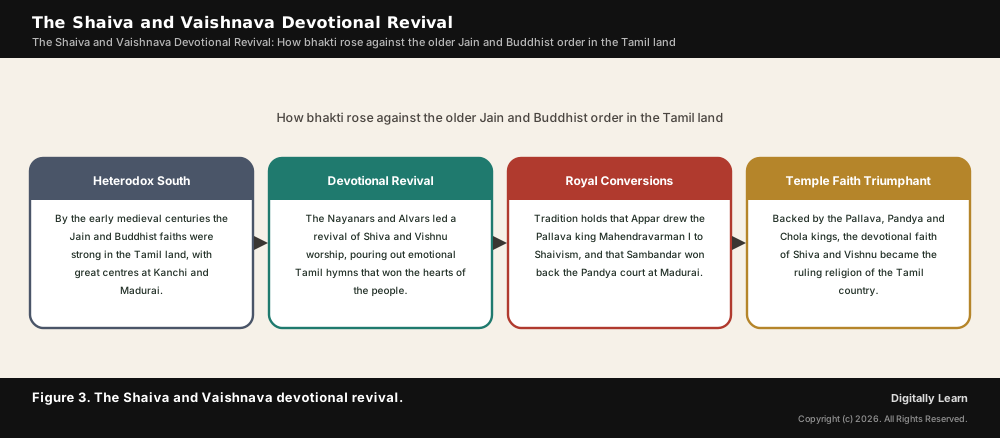
By the early medieval centuries, Jainism and Buddhism had deep roots in the Tamil country, with great monasteries and learned teachers at Kanchipuram, Madurai and beyond. The philosophy of these faiths, of the kind the earlier Buddhist thinker Nagarjuna had built, lay outside the warm, personal path of loving devotion that the saints now preached.
Against this older order the Nayanars and Alvars set their emotional hymns, and won the people back to the temple gods. Tradition holds that Appar, once a Jain monk named Dharmasena, drew the Pallava king Mahendravarman I to Shiva, and that the child-saint Sambandar later won the Pandya court at Madurai to the same faith. These traditional accounts show how closely the devotional revival was bound to the patronage of kings. The figure below traces this revival.
The Nayanars: Sixty-Three Shaiva Saints and the Tevaram Hymns
Devotion to Shiva and the Tamil Shaiva Tradition
The Nayanars were the saints of Shiva, the sixty-three devotees whose love of the great god gave the Tamil Shaiva tradition its living heart.
The word Nayanar means a leader or a hound of Shiva, and the standard list counts sixty-three of them. They came from every walk of life: there were Brahmins and kings among them, but also potters, hunters, washermen and fisherfolk, for the saints held that the love of Shiva, and not birth, was the one thing needful. Their devotion was intense and personal, given to Shiva as a master, a father and a friend.
Their hymns were later gathered into the great Shaiva scripture, the Tirumurai, a collection in twelve books that holds the whole body of the Tamil Shaiva song. The first seven books form the Tevaram, the most famous of all, and the saints' lives are told in the twelfth. Together these books made the Nayanars a part of the daily worship of every Shiva temple in the Tamil land.
Appar, Sambandar, Sundarar and Manikkavasagar
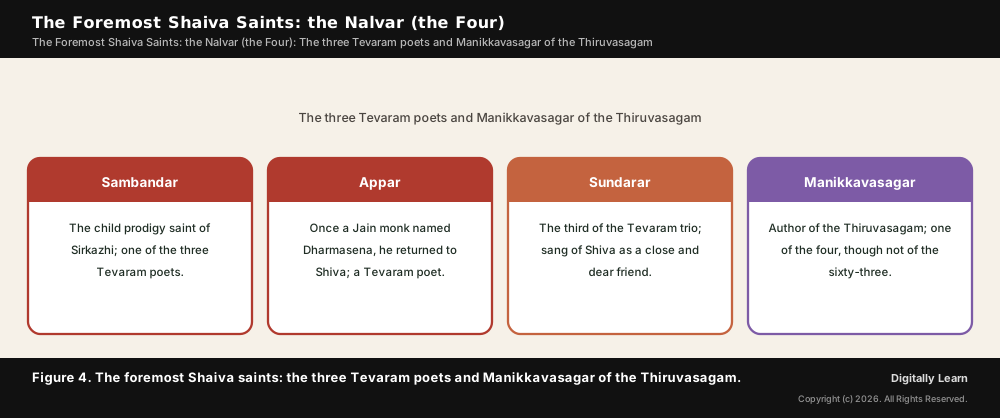
Four saints stand above the rest, the Nalvar or the Four, whose hymns are the very core of the Tamil Shaiva song.
Three of them, the muvar or the Three, are the poets of the Tevaram. Sambandar was the child prodigy of Sirkazhi, who is said to have sung of Shiva as an infant. Appar, also called Tirunavukkarasar, was an older man who had turned to Jainism before returning to Shiva, and who served humbly at the temples. Sundarar, the third, sang of Shiva in the easy tone of a friend who could even quarrel with his god.
To these three the tradition joins a fourth, Manikkavasagar, the author of the Thiruvasagam, so that together they form the Nalvar. His date is debated, but he is most often placed in the ninth century, and he is remembered above all for the depth of feeling in his verse. The figure below presents these four foremost Shaiva saints.
Tevaram and Thiruvasagam Distinguished
The Tevaram and the Thiruvasagam are two different works, and the examiner often tests whether a student can keep them apart.
The Tevaram is the collection of the Shaiva hymns of the three saints, Sambandar, Appar and Sundarar, and it makes up the first seven books of the Tirumurai. These hymns were scattered and almost lost until, in the tenth century, a temple priest named Nambiyandar Nambi gathered them together and arranged them for temple use, in the reign of the Chola king Rajaraja I.
The Thiruvasagam, by contrast, is the single great work of Manikkavasagar alone, and it forms the eighth book of the Tirumurai, separate from the Tevaram. A common error is to fold Manikkavasagar in among the three Tevaram poets, or even among the sixty-three Nayanars, but he belongs to neither group, though he is honoured as one of the Four. The table below sets the three great collections side by side.
| Collection | Author or authors | Place in the canon and faith |
|---|---|---|
| Tevaram | Sambandar, Appar and Sundarar (the muvar). | Books one to seven of the Shaiva Tirumurai; compiled by Nambiyandar Nambi. |
| Thiruvasagam | Manikkavasagar alone. | The eighth book of the Shaiva Tirumurai; distinct from the Tevaram. |
| Nalayira Divya Prabandham | The twelve Alvars together. | The Vaishnava collection of 4,000 hymns; compiled by Nathamuni. |
Karaikkal Ammaiyar and Nandanar, Women and Low-Caste Saints
The Nayanars opened the path to women and to the low-born, and the standard list of the sixty-three is itself proof of this openness.
Among them was Karaikkal Ammaiyar, a woman saint of the sixth century and one of the three women counted among the Nayanars. She gave up an ordinary life to wander as a devotee of Shiva, and her fierce, ecstatic poems are among the earliest in the whole Shaiva song. That a woman was honoured as a saint in her own right was itself a quiet revolution in the religion of the age.
The list also held the low-born. Nandanar was a saint of an untouchable community, a labourer who longed to worship at the great temple of Chidambaram, and whom the tradition raised to sainthood for the purity of his love. Through such figures the Nayanars taught, in act as well as word, that devotion to Shiva knew no bar of caste or sex, a teaching that the whole later Bhakti movement would carry forward.
Periya Puranam, the Hagiography of the Sixty-Three
The lives of the sixty-three Nayanars are told in the Periya Puranam, the great book of saints that completes the Tamil Shaiva scripture.
The Periya Puranam was composed in the twelfth century by Sekkizhar, a minister at the Chola court, and it was added to the Tirumurai as its twelfth and last book. In it Sekkizhar gathered the stories of all the sixty-three saints, telling of their birth, their trials and the wonders of their devotion, so that the deeds of the Nayanars should never be forgotten.
More than a book of legends, the Periya Puranam is a window onto the society of the Tamil land, for its saints come from every caste and calling, and their stories show the life of the temple, the village and the court. It fixed the standard list of the sixty-three and shaped the Shaiva faith for all the centuries that followed, and it remains a chief source for the history of the movement.
The Alvars: Twelve Vaishnava Saints and the Divya Prabandham
Emotional Devotion to Vishnu
The Alvars were the saints of Vishnu, the twelve devotees whose deep and emotional love of the preserver god is the Vaishnava counterpart of the Nayanars.
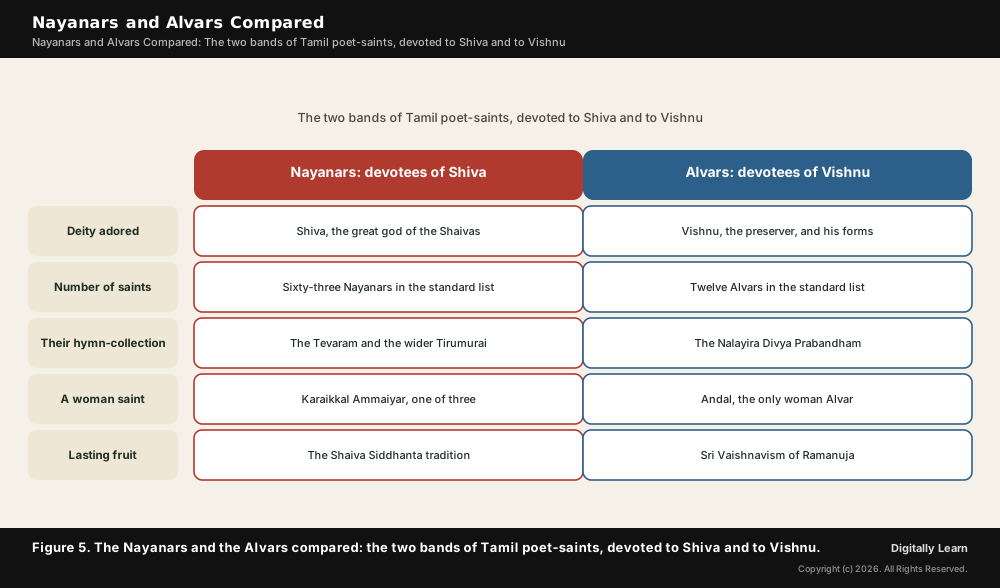
The word Alvar means one who is immersed, drowned in the love of God, and the name tells of the depth of their feeling. There were twelve of them in the standard list, and they sang their love of Vishnu and of his forms, above all of Krishna and Rama, in Tamil hymns of great tenderness. Their devotion was often cast as the love of a soul for its lord, longing for union with him.
Like the Nayanars, the Alvars came from every rank, from Brahmins to a chieftain and a saint of humble birth, and they too taught that devotion alone, and not caste, opens the way to God. They were the close contemporaries of the Nayanars, and the two bands together made the Tamil country the cradle of Indian devotion. The figure below sets the two side by side.
Nammalvar, Periyalvar and Tirumangai Alvar
Among the twelve Alvars, a few stand out, and their names and works are the ones an aspirant must hold in mind.
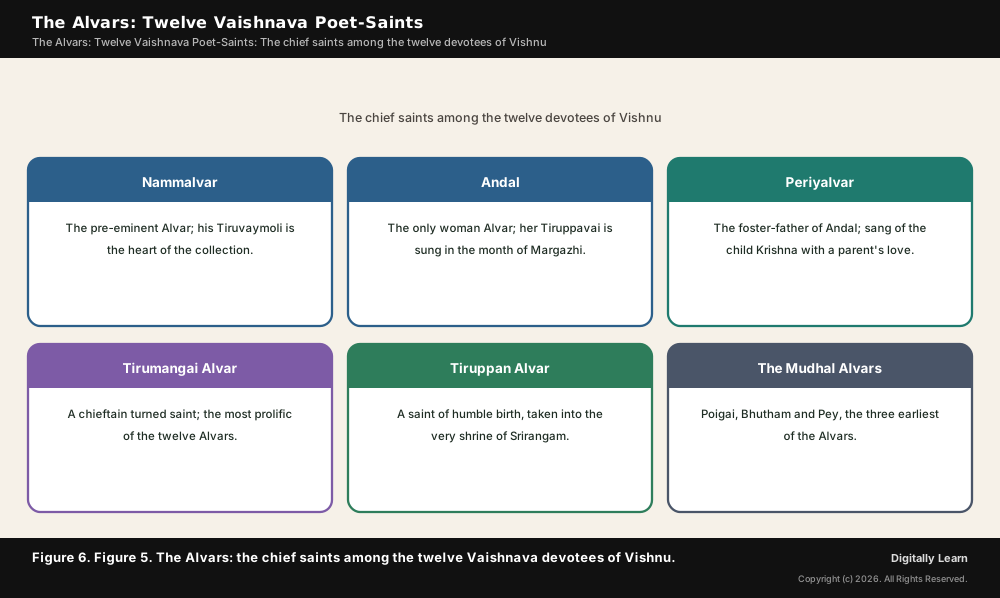
The greatest was Nammalvar, held the foremost of all the Alvars, whose long hymn the Tiruvaymoli, of over a thousand verses, is honoured as the heart of the Vaishnava song, even called a Tamil Veda. Periyalvar sang of the child Krishna with a parent's tenderness, and was the foster-father of the woman saint Andal. Tirumangai Alvar, once a chieftain, became the most prolific of the twelve and a great builder at Srirangam.
The earliest of the line were the three Mudhal Alvars, Poigai, Bhutham and Pey, who are held to be the first of the saints. There was also Kulasekhara, a king who turned devotee, and the philosophy of the whole group reached its summit in the work of the saint of Alvar Tirunagari. The figure below presents the chief saints among the twelve Alvars.
Andal, the Only Woman Alvar, and the Tiruppavai
Andal was the one woman among the twelve Alvars, and she is the most beloved of all the Vaishnava saints of the Tamil land.
By tradition Andal was found as a child and raised by the saint Periyalvar at Srivilliputhur, and she gave herself wholly to the love of Vishnu, whom she longed to wed. Her great work, the Tiruppavai, a hymn of thirty verses, is sung with deep love every year in the Tamil month of Margazhi, and tells of young girls who keep a holy vow to win the grace of Krishna.
In Andal the devotion of the Alvars reaches its tenderest pitch, the love of the soul for God cast as a bride's love for her lord. That a woman should be counted among the saints, her hymns sung in the temples beside those of the men, shows how Tamil bhakti gave women a place of honour the older religion had denied them, a theme the later women saints of the north would take up.
Nalayira Divya Prabandham and the Hundred-and-Eight Divya Desams
The hymns of the Alvars form the Nalayira Divya Prabandham, the four thousand verses that are the scripture of Tamil Vaishnavism.
Like the Shaiva hymns, the songs of the Alvars were once scattered and in danger of being lost, until the teacher Nathamuni gathered them, in the ninth or tenth century, into the Nalayira Divya Prabandham, the collection of four thousand verses. He set them to music and brought them into the temple service, so that the Alvar hymns became, like the Tevaram, a part of the daily worship of the Vishnu temples.
The shrines that the Alvars praised in their hymns are honoured as the Divya Desams, the hundred and eight holy abodes of Vishnu, of which the temple of Srirangam on the Kaveri is the foremost. To this day the Divya Prabandham is recited in these temples, and a class of temple singers carries the hymns down the generations, a living link with the Alvars of the Tamil dawn.
Transmission and Impact: From Alvar Hymns to the Sri Vaishnava Acharyas
Nathamuni, Yamunacharya and the Bridge to Ramanuja
The devotion of the Alvars passed into a great philosophy, carried forward by a line of teachers that runs from Nathamuni to Ramanuja.
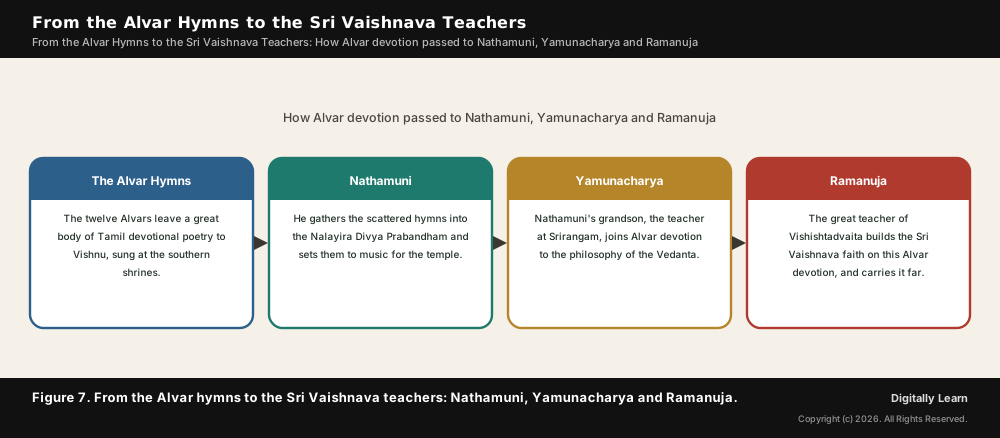
The first of these teachers was Nathamuni, who not only gathered the Alvar hymns but began to join their warm devotion to the reasoned thought of the Vedanta. His grandson Yamunacharya, also called Alavandar, the teacher at the temple of Srirangam, carried this work further, and laid the ground for the master who was to come, though the two never met.
That master was Ramanuja, who lived in the eleventh and twelfth centuries and became the chief voice of Vishishtadvaita, the qualified non-dualism that gave loving devotion a firm philosophical base. Ramanuja built his Sri Vaishnava faith squarely on the devotion of the Alvars, drawing especially on Nammalvar's Tiruvaymoli, so that the Tamil hymns became the root of a system of thought spread far beyond the south. The figure below traces this passage from hymn to philosophy.
The Spread of Temple Culture and Tamil Devotional Literature
The bhakti of the saints reshaped the temple and the Tamil tongue, leaving a double gift of great architecture and great literature.
The devotion of the Nayanars and Alvars grew up around the temple, and it spurred the kings to build on a grand scale. The Pallavas of Kanchi led the way: their king Mahendravarman I began to cut shrines out of the living rock, and a famous record at Mandagapattu boasts of a temple made without brick, timber, metal or mortar.
Under Narasimhavarman I, the rock was carved into the monolithic Pancha Rathas and the great open relief of Arjuna's Penance at Mamallapuram, the Pallava port. The structural Shore Temple and the Kailasanatha temple at Kanchi then rose in built stone under Rajasimha. The figure below traces this Pallava temple architecture that framed the saints' devotion.
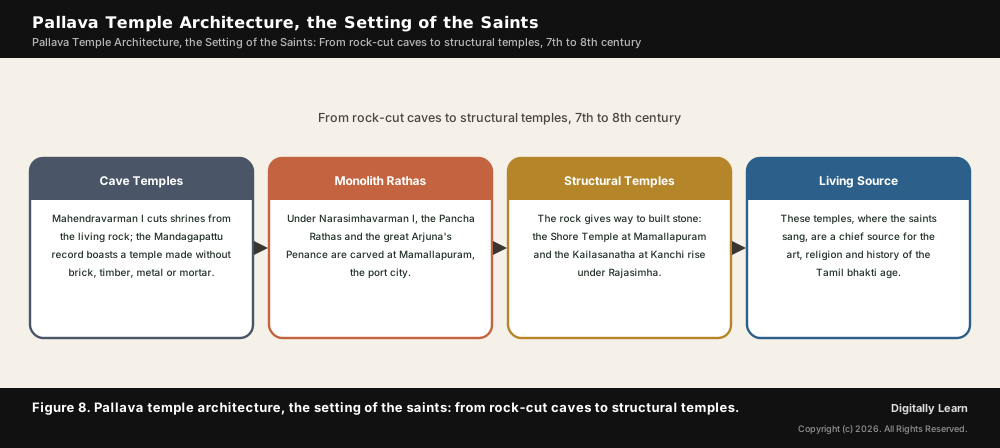
These temples, where the saints sang, are a chief source for the art, religion and history of the age, since the shrines, with their sculpture and inscriptions, tell us how people worshipped and lived.
Alongside this architecture grew a great body of Tamil devotional literature, the Tevaram, the Thiruvasagam and the Divya Prabandham, which enriched the Tamil language and raised it to a vehicle of the highest religious feeling.
The Hand-Off to North Indian Bhakti
The devotion that began in the Tamil south did not stay there, but moved slowly northward to become the great Bhakti movement of medieval India.
The bridge was built first by the Vaishnava teachers. Ramanuja and the acharyas who followed him carried the devotion of the Alvars across the Deccan and into the north, so that loving devotion to a personal God, first sung by the Tamil saints, became the common faith of the later Bhakti saints.
The earlier parts of this series set out the philosophy of that movement; here the point is that its living source lay in the hymns of the Nayanars and Alvars.
The same devotional impulse runs forward through a long line of later proponents of bhakti, from Vallabhacharya's worship of Krishna and Tukaram of Maharashtra to the saint-composer Tyagaraja of the Tamil country, all of them heirs to the path the southern saints had opened. The next parts of this series follow that path: the Vedanta teachers and the Lingayat reform, the nirguna saints Kabir and Nanak, and the saguna devotion to Ram and Krishna in the north.
UPSC Relevance and Previous-Year Questions
Where the Nayanars and Alvars Fit in the UPSC-CSE Syllabus
This topic belongs to General Studies Paper I: medieval Indian history and culture, and the Nayanars and Alvars, as the founders of the Bhakti movement, are a recurring and high-yield theme in both Prelims and Mains.
The questions most often test the sect and number of the two bands, the names of their works, the distinction between their hymn-collections, and the place of the Tamil saints in the wider growth of devotion and of South Indian art.
Several linked points recur and are worth holding in working memory:
- Sect and number: Nayanars are sixty-three Shaiva saints (Shiva); Alvars are twelve Vaishnava saints (Vishnu).
- The three collections: Tevaram (Shaiva, the three saints), Thiruvasagam (Manikkavasagar), Nalayira Divya Prabandham (Alvars).
- Women and the low-born: Karaikkal Ammaiyar and Andal; the untouchable saint Nandanar; the humble Tiruppan Alvar.
- The transmission: Alvar devotion passes through Nathamuni and Yamunacharya to Ramanuja and Sri Vaishnavism.
- The setting: the patronage of the Pallavas, Pandyas and Cholas, and the rise of South Indian temple architecture.
A 2010 Prelims question asked which of four figures was not a proponent of the bhakti cult; the answer is Nagarjuna, the Buddhist philosopher, who stood wholly outside the devotional path, while Tukaram, Tyagaraja and Vallabhacharya were all saints of bhakti. This part teaches that contrast directly, setting the devotional revival of the Tamil saints against the older Jain and Buddhist faiths, and naming the later bhakti proponents who carried the movement on.
A Mains question of 2020 asked candidates to discuss rock-cut architecture as one of the most important sources of our knowledge of early Indian art and history. The temple culture of the Tamil saints supplies the South Indian strand of that answer: the Pallava cave temples and monolithic rathas at Mamallapuram, and the structural temples of Kanchi, are a rich source for the art, religion and society of the bhakti age, as this part explains.
Previous Year UPSC-CSE Questions
Previous Year UPSC-CSE Questions By the end you will be able to draft model answers for the following UPSC questions. Each question carries a collapsible framework showing how to approach it in the exam.
- UPSC Prelims 2010 GS-IAmong the following, who was not a proponent of bhakti cult?
How to approach this Prelims question
Approach: Identify which of the four belongs to a different tradition; Nagarjuna is a Buddhist Madhyamaka philosopher, while the other three are saints or teachers of bhakti.
Trap to watch: Do not be misled by Tyagaraja (a later South Indian saint-composer) or Vallabhacharya (a Vaishnava acharya); both are within the bhakti fold. Nagarjuna alone is the Buddhist thinker outside it.
Key facts to recall:
- Nagarjuna was the great Buddhist philosopher of the Madhyamaka school, not a bhakti saint.
- Tukaram (Maharashtra), Tyagaraja (Tamil country) and Vallabhacharya (Krishna devotion) were all proponents of bhakti.
- The Tamil bhakti of the Nayanars and Alvars rose against the Jain and Buddhist order.
Answer signal: Nagarjuna was not a proponent of the bhakti cult.
- UPSC Mains 2020 GS-IThe rock-cut architecture represents one of the most important sources of our knowledge of early Indian art and history. Discuss.
How to structure the answer in the exam
Introduction: Rock-cut architecture, the shrines and halls hewn from the living rock, is among the richest sources for the art and history of early India, the more so as so many other structures of the time have perished.
Body (sub-themes to develop):
- As a source of religious history: Buddhist chaityas and viharas, Jain caves, and Hindu cave temples mark the faiths and their patronage.
- As a source of art: the sculpture and relief (for example the Pallava Arjuna's Penance and the Pancha Rathas at Mamallapuram) reveal the styles and skill of the age.
- As a source of inscriptions and dating: records like the Mandagapattu inscription of Mahendravarman I fix the patron, the date and the purpose.
- As a source of social and economic life: donative records name guilds, kings and devotees, lighting up the society around the shrine.
- South Indian strand: the Pallava progression from cave temple to monolith to structural temple frames the devotional life of the Tamil bhakti saints.
Conclusion: Thus rock-cut architecture, surviving where built structures have not, is one of the most important and direct sources for the religion, art, dating and society of early India.
Sources and Further Reading
- NCERT, Themes in Indian History and Medieval India (NCERT-inspired grounding)
- Wikipedia: Nayanars
- Wikipedia: Alvars
- Wikipedia: Tevaram
- Wikipedia: Manikkavacakar (the Thiruvasagam)
- Wikipedia: Sri Vaishnavism (Nathamuni, Yamunacharya, Ramanuja)
- Wikipedia: Pallava art and architecture
- Wikipedia: Appar
- Wikipedia: Divya Desam
- Ministry of Culture, Indian Culture portal: the saints of the Bhakti tradition
- Press Information Bureau (Government of India): the Bhakti saints of the south
- Indira Gandhi National Centre for the Arts (IGNCA): Tamil devotional traditions
- Archaeological Survey of India (the temples of the Pallavas and the Tamil saints)
- Sahitya Akademi (the devotional literature of the Tamil saints)
Editorial Disclaimer
This article is for UPSC preparation. The account of the Nayanars and Alvars follows the standard scholarship on Tamil devotional religion, drawn from the hymns of the saints, their traditional lives and the established histories. Some dates of the saints, and several conversion stories, are traditional and contested, and are given as such.