


Overview
The regional bhakti movement carried devotion to a personal god into the languages of the people between the thirteenth and seventeenth centuries: the Varkari saints of Maharashtra from Dnyaneshwar to Tukaram, Chaitanya's Gaudiya Vaishnavism in Bengal, Sankardev's Ekasarana Dharma in Assam, and Narsinh Mehta, Mirabai and Lal Ded in Gujarat, Rajasthan and Kashmir, with women saint-poets in every tradition.
Regional Bhakti Movement: Devotion in the People's Languages
From Sanskrit to Marathi, Bengali and Assamese: Bhakti in the Vernacular
The regional bhakti movement was devotion to a personal god sung in the local language. In Maharashtra, for example, it was widely believed that Sanskrit was needed to reach God. The Varkari saints Dnyaneshwar and Namdev showed instead that devotion alone was enough, and that it did not depend on caste or creed. From the thirteenth to the seventeenth centuries Maharashtra saw a great number of saint-poets whose songs in simple Marathi still inspire people.
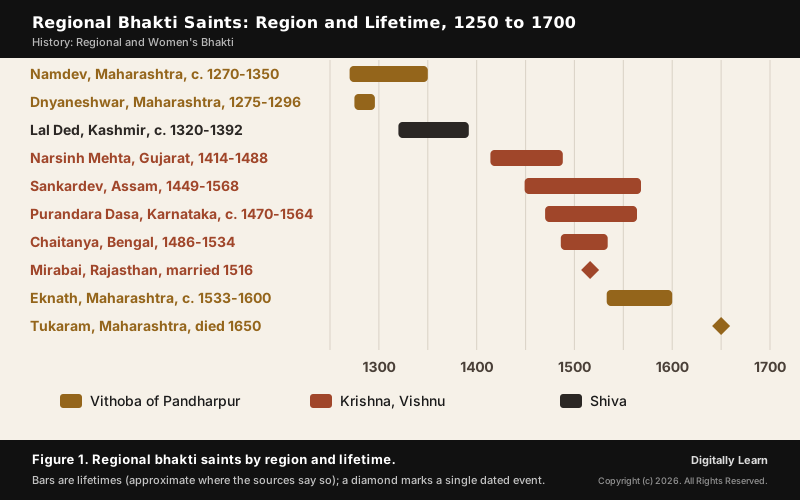
The same thing happened region after region, each with its own saints, its own form of God and its own language. Figure 1 places the main saints of this page on one time line, region by region.
The earlier stages of the story are told on other pages: the Tamil Nayanars and Alvars, whose movements emerged between the seventh and ninth centuries, and the north Indian sants such as Kabir, a weaver, and Ravidas, of a leather-working family, on the nirguna bhakti page.
Common Features of the Regional Bhakti Movements
The regional movements had much in common, even though their saints rarely met. Their shared marks were:
- Language: Songs and commentaries in the regional tongue, not Sanskrit.
- A personal god: Vitthala at Pandharpur, Krishna with Radha in Bengal, Krishna as the one refuge in Assam, and the notion of a god who lives in the heart of every person.
- Against ritual and birth: The saints rejected ritualism, outward show of piety and social differences based on birth.
- Life in the world: Many rejected renunciation, lived with their families and earned a living like anyone else.
- Song and congregation: The abhang, the kirtan, the borgeet and the bhajan, sung together.
A new humanist idea grew out of this: that bhakti lay in sharing the pain of others. The Gujarati saint Narsi Mehta put it in one line, "They are Vaishnavas who understand the pain of others". Further south the same devotion was carried by the Haridasa singers of Karnataka, such as Purandara Dasa (about 1470 to 1564), called the grandsire of Carnatic music, and much later by Tyagaraja (1767 to 1847), whose devotional kritis, mostly in Telugu, praise Rama.
Varkari Movement of Maharashtra: Dnyaneshwar to Tukaram
What Is the Varkari Movement: Vithoba of Pandharpur and the Wari
The Varkari movement is a sampradaya of Maharashtra whose name means one who performs the vari, the pilgrimage. Varkaris worship Krishna as Vitthala, also called Vithoba or Panduranga, a form of Vishnu, with his consort Rukmini as Rakhumai. The tradition took shape in the thirteenth century and recognises around fifty poet-saints whose works span 500 years.
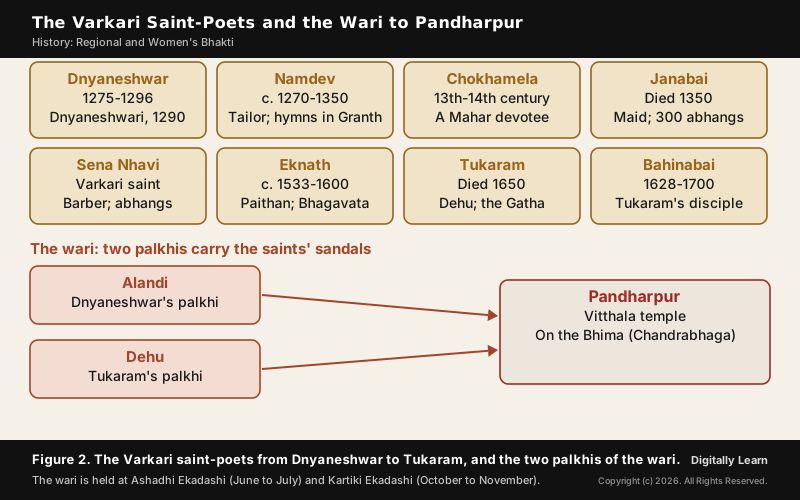
Its centre is the Vitthal-Rukmini temple of Pandharpur, on the Bhima river, which is locally called the Chandrabhaga because it curves like a crescent moon near the town. Vithoba stands on a brick with his arms akimbo. Twice a year, at Ashadhi Ekadashi (June to July) and Kartiki Ekadashi (October to November), Varkaris walk for days to Pandharpur in the wari, singing abhangs. The palkhis of Dnyaneshwar from Alandi and of Tukaram from Dehu carry the saints' sandals, a custom started by Tukaram's youngest son, Narayan, in 1685.
Varkari practice asks for moral conduct, a sattvic diet without alcohol or tobacco, fasting on ekadashi, and equality for all, rejecting discrimination by caste, gender or wealth. Women walk the wari with the same zeal as men. The government is building dedicated palkhi routes, the Sant Dnyaneshwar Maharaj Palkhi Marg (NH-965) and the Sant Tukaram Maharaj Palkhi Marg (NH-965G), with walkways for the pilgrims.
Dnyaneshwar, Namdev and the Early Varkari Saints from Every Caste
Dnyaneshwar (1275 to 1296), also called Jnaneshwar, was one of the founders of the Varkari tradition. In a life of only twenty-one years he wrote the Dnyaneshwari, a commentary on the Bhagavad Gita completed in 1290, and the Amrutanubhav. These are the oldest surviving literary works in Marathi. The Dnyaneshwari reads the Gita in the Advaita tradition, in the form of a song-sermon, and its date is the one fixed point in his life.
He was one of four children: Nivruttinath, his elder brother and his guru, Sopan and their sister Muktabai, who wrote abhangs of her own. Dnyaneshwar took samadhi at Alandi in 1296, and his legacy inspired Eknath and Tukaram.
Namdev (traditionally about 1270 to 1350) is recorded as a shimpi, of the tailor community, and was a devotee of Vithoba of Pandharpur, known across India for his bhajan-kirtans. He is honoured beyond Maharashtra too: some of his hymns are in the Guru Granth Sahib, and the Dadu Panthis and Kabir Panthis remember him.
Around Namdev gathered saints from the lowest ranks of society:
- Chokhamela: A Mahar, then counted among the low castes, initiated into bhakti by Namdev. He was refused entry to the Pandharpur temple, yet his tomb stands in front of it today.
- Sena Nhavi: A barber in a king’s service who gave up his trade and composed abhangs to Vithoba.
- Janabai: A maid in Namdev’s household, of the Matang caste by birth, to whom about 300 abhangs are attributed.
Eknath and Tukaram: Abhangas and the Critique of Caste
Eknath (about 1533 to 1600) of Paithan is seen as the spiritual successor of Dnyaneshwar and Namdev. He wrote the Eknathi Bhagavata and the Bhavarth Ramayan, and restored the text of the Dnyaneshwari, asking that nothing be changed or added.
Tukaram of Dehu, who died in 1650, is, with Dnyaneshwar, one of the greatest saints of the Varkari movement. His abhangs, collected in the Tukaram Gatha and composed between about 1632 and 1650, attack social injustice, caste hierarchy and the misconduct of religious leaders, and he faced opposition for it. One of his abhangs says that a saint is the one who identifies with the battered and the beaten, for God is with him.
His birth year is uncertain, one account giving 1577, but he lived in the reign of Jahangir (1605 to 1627) and into that of Shah Jahan, who ruled from 1628 to 1658. Aurangzeb came to the throne only in 1658, after Tukaram's death. His disciple Bahinabai (1628 to 1700) is one of the women saints met later on this page.
Chaitanya Mahaprabhu and Gaudiya Vaishnavism in Bengal
Who Was Chaitanya Mahaprabhu: Life, Sankirtan and Teaching
Born Vishvambhara Mishra at Nabadwip in Bengal, Chaitanya Mahaprabhu (1486 to 1534) founded Gaudiya Vaishnavism. He came long after the great Vedanta teachers, Shankara of the eighth century and Ramanuja (about 1077 to 1157), whose ideas are on the Vedanta acharyas page.
- 1508 to 1509: At Gaya he was initiated by the ascetic Ishvara Puri and returned to Nabadwip changed, giving up scholarly pride for devotion to Krishna.
- Sankirtan: He closed his school and, with Nityananda and Advaita Acharya, led congregational chanting in public. When the local ruler, the Chand Kazi, banned it, tradition says Chaitanya led a peaceful procession of thousands to his house.
- 1510: He became a sannyasi at Katwa and made Jagannatha Puri in Odisha his base, travelling through south India.
- Around 1515: At Vrindavan he instructed Rupa and Sanatana, former ministers of Sultan Husain Shah of Bengal.
His teaching centred on devotion to Radha and Krishna, sung and danced in company. He popularised the Hare Krishna maha-mantra, composed eight prayers, the Shikshashtakam, and is seen as the chief proponent of achintya-bhedabheda, inconceivable difference in non-difference between God and the soul. People born Muslim, such as Haridasa Thakur, took part in his movement from the very beginning.
The Six Goswamis of Vrindavan and the Legacy of Gaudiya Vaishnavism
Chaitanya left the theology to his disciples. The Six Goswamis of Vrindavan, among them Rupa, Sanatana and their nephew Jiva, systematised Gaudiya Vaishnavism and identified the sacred sites of Vrindavan linked with Radha and Krishna, where large temples rose. Rupa Goswami gave the practice its theoretical foundation, and Jiva Goswami later explained achintya-bhedabheda in his writings.
The tradition, rooted in the Bhagavad Gita and the Bhagavata Purana, revived in Bengal in the nineteenth century, and from its Gaudiya Math came the International Society for Krishna Consciousness, the Hare Krishna movement.
Sankardev and the Ekasarana Dharma of Assam
Sankardev's Ekasarana Dharma, the Sattra and the Namghar
A saint, poet, playwright, musician and reformer of Assam, Sankardev (Shankaradeva; 1449 or 1483 to 1568, his birth year disputed) founded its greatest devotional movement. He emphasised devotion to Vishnu and composed poems and plays in Assamese. The faith he spread, Ekasarana Dharma, means shelter in one: devotion to Krishna alone, through listening (shravan) to and singing (kirtan) his name and deeds, with less weight on Vedic ritual.
The sect was simple and open, and drew Hindus and non-Hindus alike into its egalitarian fold. New followers are initiated in a ceremony called xoron-lowa, taking shelter. Its central text is Sankardev's Bhagavat, an Assamese rendering of the Sanskrit Bhagavata Purana. His chief disciple Madhavdev, once a Shakta, succeeded him in 1568 and wrote the Naam Ghosa.
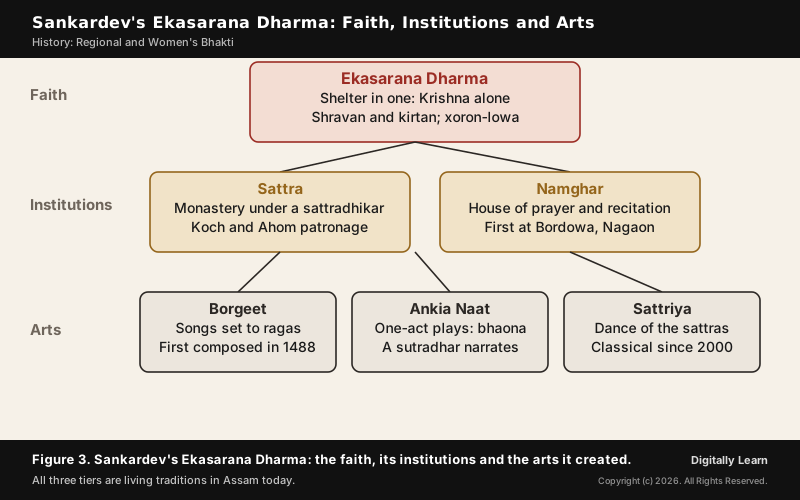
Sankardev's movement lived through two institutions. The sattra is a monastery headed by a sattradhikar. Sattras began in the sixteenth century, grew rapidly in the seventeenth with the patronage of the Koch and then the Ahom kings, and now number in the hundreds; many hold vast lands, house resident monks (bhakats) and keep religious relics. The river island of Majuli is a hub of this neo-Vaishnavite culture.
The namghar, a house of recitation and prayer, is the second. Sankardev began the practice, which continues to this day; the first namghar was set up at Bordowa in Nagaon district. A namghar is also the central hall of every sattra, and in the villages it serves as a meeting house and a theatre for bhaona, with often more than one in a single village.
Borgeet, Ankia Naat and Sattriya: Sankardev's Arts
Sankardev built new art forms around devotion, all still alive in Assam:
- Borgeet: Songs set to ragas, by Sankardev and Madhavdev, written in Brajavali; the first was composed at Badrikashram in 1488. Borgeets open the prayer services in the sattra and the namghar.
- Ankia Naat: One-act plays centred on Krishna, also in Brajavali; a performance is called a bhaona, and a narrator, the sutradhar, explains each stage to an audience that was mostly unlettered.
- Sattriya: The dance first created as part of the bhaona and kept alive in the sattras, danced to borgeets set to classical ragas, with the khol drum; on 15 November 2000 the Sangeet Natak Akademi recognised it as one of the classical dances of India.
The Sangeet Natak Akademi runs a Sattriya Kendra in Guwahati, and the dance is now performed on stages well beyond the sattras.
Bhakti in Gujarat, Rajasthan and Kashmir: Narsinh Mehta, Mirabai, Lal Ded
Narsinh Mehta of Gujarat and Vaishnava Jana To
Narsinh Mehta (1414 to 1488), born at Talaja, is honoured as the Adi Kavi, the first poet, of Gujarati. He lived in poverty at Junagadh in the reign of Ra Mandalika, devoted to Krishna, and wrote bhajans that have been sung in Gujarat and Rajasthan for over five centuries. His best-known poem, Vaishnava Jana To, defines a true devotee by conduct alone: empathy for the suffering of others, honesty, humility and freedom from greed, with nothing about caste, community or gender.
Mahatma Gandhi made the poem part of his daily prayer. It was sung in his ashrams, its opening stanza stands on the title page of the Ashram Bhajanavali, and Gandhi said the poem alone would sustain him even if he forgot the Bhagavad Gita. He used it in public to argue against untouchability, and it became popular with freedom fighters across India.
Mirabai of Rajasthan and Lal Ded of Kashmir: Women Who Defied Their Age
Mirabai is perhaps the best-known woman poet of the bhakti tradition. Her life has been reconstructed mainly from the bhajans attributed to her, passed on orally for centuries. A Rajput princess of Merta in Marwar, she was married against her wishes to a prince of the Sisodia clan of Mewar, Bhoj Raj, in 1516. She refused the role of wife and mother and took Krishna as her lover.
Her in-laws, tradition says, tried to poison her, and she left the palace to live as a wandering singer. She became a disciple of Ravidas (Raidas), a saint from a caste considered untouchable, and her songs openly challenged the norms of the upper castes; NCERT records the discipleship, while other accounts find no corroborating evidence for it. Mirabai founded no sect, yet her songs are still sung, especially by the poor and those counted low caste in Gujarat and Rajasthan.
Lalleshwari, or Lal Ded (about 1320 to 1392), was a mystic of the Kashmir Shaivism school. Married at twelve, she is said to have left an unhappy marriage to follow a Shaiva teacher, travelled alone on foot living on alms, and became a teacher herself.
She created the vakh, a form of mystic verse; the 285 vakhs attributed to her are among the earliest compositions in Kashmiri. They draw on Sanskritic, Islamic and Sufi influences, and she is closely linked in memory with Nund Rishi, founder of the Rishi order of Kashmiri Sufism.
Women Saints of Bhakti Movement: Voices From Every Region
List of Female Bhakti Saints: From Karaikal Ammaiyar to Bahinabai
One of the most striking features of bhakti was the presence of women. They came from every region and from very different lives: a merchant's wife at Karaikal, a girl found in a temple garden at Srivilliputhur, a princess of Merta, a maid in Namdev's house. They worshipped Shiva, Vishnu, Krishna and Vithoba, and wrote in Tamil, Kannada, Marathi and Kashmiri. Figure 4 sets the main women saint-poets in order of time, and the table adds what each one wrote:
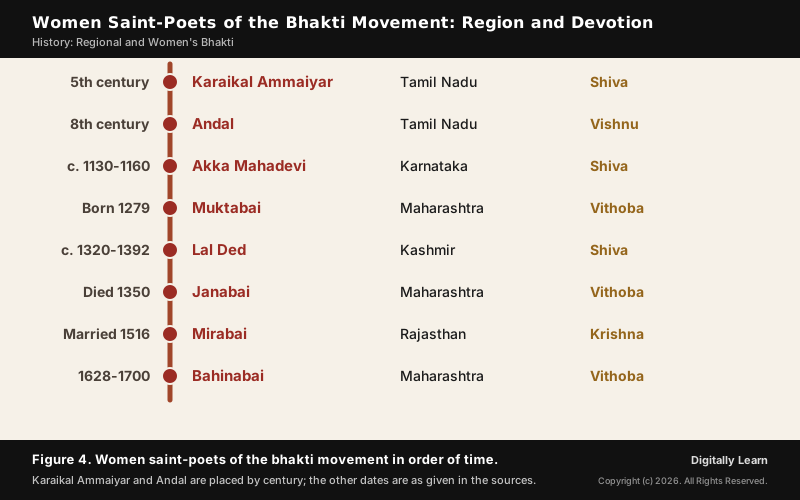
| Saint | Region and language | Devotion and work |
|---|---|---|
| Karaikal Ammaiyar | Tamil Nadu, Tamil | Shiva; extreme asceticism; one of three women among the 63 Nayanars |
| Andal | Tamil Nadu, Tamil | Vishnu; the only woman Alvar; Tiruppavai |
| Akka Mahadevi | Karnataka, Kannada | Shiva as Chenna Mallikarjuna; 430 vachanas |
| Janabai, Muktabai | Maharashtra, Marathi | Vithoba; abhangs |
| Lal Ded | Kashmir, Kashmiri | Shiva; 285 vakhs |
| Mirabai | Rajasthan | Krishna; bhajans |
| Bahinabai | Maharashtra, Marathi | Vithoba; autobiography Atmamanivedana |
What Women's Bhakti Changed: Voice, Defiance and Limits
These women renounced their social obligations but did not join an alternative order or become nuns. Their very existence and their compositions challenged patriarchal norms. Andal saw herself as the beloved of Vishnu; Karaikal Ammaiyar described herself as a fearsome demoness, against every ideal of feminine beauty; Akka Mahadevi took Shiva as her husband and is said to have refused a king who sought to marry her; Mirabai defied the Rana of Mewar.
Not every woman saint broke away. Bahinabai, a disciple of Tukaram born in a Brahmin family and married as a child, stayed married all her life, and her abhangs speak of the pull between her husband and her god. Janabai, a maid, and Chokhamela's family show that devotion also gave a voice to those low in both caste and gender.
Significance of the Regional and Vernacular Bhakti Movement
Regional Languages, Identity and Social Reform: Gains and Limits
Regional bhakti gave several Indian languages their first great literature. The Dnyaneshwari is the oldest surviving literary work in Marathi; Narsinh Mehta is the first poet of Gujarati; Lal Ded's vakhs are among the earliest compositions in Kashmiri; Sankardev wrote in Assamese and devised Brajavali, the literary language of his songs and plays.
These works also shaped regional identity. The wari still draws Varkaris from across Maharashtra each year, and the namghars still serve Assam's villages as halls of prayer, meeting and theatre.
The movement questioned the social order: the Varkari saints rejected differences based on birth, the Ekasarana Dharma took in followers of every background, and saints from the tailor, barber, Mahar and Matang castes were honoured alongside Brahmins. In the words of the Varkari tradition, no one was to be discriminated against by caste, gender or wealth.
The limits were as plain. Chokhamela was kept out of the temple he sang to; Tukaram was opposed for attacking caste; and the women saints spoke as individuals, renouncing their social roles without founding orders of their own.
Previous Year UPSC-CSE Questions
Previous Year UPSC-CSE Questions By the end you will be able to draft model answers for the following UPSC questions. Each question carries a collapsible framework showing how to approach it in the exam.
- UPSC Mains 2018 GS-IThe Bhakti movement received a remarkable re-orientation with the advent of Sri Chaitanya Mahaprabhu. Discuss.
Answer outline: how to structure the answer
What the question asks, the main arguments, relevant examples and the direction of the conclusion. This is not a full model answer.
Introduction: Open with Chaitanya Mahaprabhu (1486 to 1534) of Nabadwip, founder of Gaudiya Vaishnavism, who turned bhakti in Bengal into a mass movement of song and dance.
Body (sub-themes to develop):
- Practice: sankirtan, congregational chanting and dancing in public, in place of solitary worship or learned debate; the Hare Krishna maha-mantra.
- Theology: Radha and Krishna at the centre; achintya-bhedabheda, later explained by Jiva Goswami; the Shikshashtakam.
- Social reach: disciples of every caste and Muslims by birth such as Haridasa Thakur; Rupa and Sanatana, former ministers of Husain Shah; peaceful protest against the Chand Kazi's ban.
- Institutions and spread: the Six Goswamis at Vrindavan, temples, Puri and south India; the nineteenth-century revival, the Gaudiya Math and ISKCON.
Conclusion: Conclude that Chaitanya made bhakti collective, emotional and open, and that through the Goswamis it gained a lasting theology and an international life.
- UPSC Prelims 2006 Prelims-GSBhakta Tukaram was a contemporary of which Mughal Emperor?
How to approach this Prelims question
Approach: Step 1: Tukaram composed his abhangs between about 1632 and 1650 and died in 1650. Step 2: place the emperors: Babur died in 1530, Akbar in 1605, Jahangir ruled 1605 to 1627, Aurangzeb from 1658. Step 3: of the four, only Jahangir's reign falls within Tukaram's lifetime.
Trap to watch: Shah Jahan, the emperor of Tukaram's last years, is not among the options; Aurangzeb came to the throne only after Tukaram's death.
Key facts to recall:
- (a) Babar: wrong. Babur died in 1530, long before Tukaram.
- (b) Akbar: wrong. Akbar died in 1605; only the earliest account of Tukaram's birth, 1577, would overlap.
- (c) Jahangir: right. His reign, 1605 to 1627, falls in Tukaram's lifetime.
- (d) Aurangzeb: wrong. He became emperor in 1658, after Tukaram died in 1650.
Answer signal: Jahangir: option (c), the official answer.
- UPSC Prelims 2014 Prelims-GSWith reference to Sattriya, consider the following statements:
- It is a combination of music, dance and drama.
- It is a centuries-old living tradition of the Vaishnavites of Assam.
- It is based on classical Ragas and Talas of devotional songs composed by Tulsidas, Kabir and Mirabai.
Which of the statements given above is/are correct?
How to approach this Prelims question
Approach: Step 1: statement 1: Sattriya grew out of the Ankia Naat performances, which combine music, dance and drama; right. Step 2: statement 2: it is a living tradition of the Vaishnava sattras of Assam; right. Step 3: statement 3: its music is the borgeets of Sankardev and Madhavdev, not songs of Tulsidas, Kabir and Mirabai; wrong.
Trap to watch: Statement 3 borrows the best-known north Indian bhakti poets; Sattriya's songs are Assam's own.
Key facts to recall:
- (a) 1 only: wrong. Statement 2 is also right.
- (b) 1 and 2 only: right. Music, dance and drama; a living tradition of the Vaishnavas of Assam.
- (c) 2 and 3 only: wrong. Statement 3 is wrong.
- (d) 1, 2 and 3: wrong. The songs are borgeets, not Tulsidas, Kabir or Mirabai.
Answer signal: 1 and 2 only: option (b), the official answer.
- UPSC Prelims 2019 Prelims-GSConsider the following pairs: Famous place – River
- Pandharpur : Chandrabhaga
- Tiruchirappalli : Cauvery
- Hampi : Malaprabha
Which of the pairs given above are correctly matched?
How to approach this Prelims question
Approach: Step 1: Pandharpur stands on the Bhima, called the Chandrabhaga there; right. Step 2: Tiruchirappalli is on the Kaveri (Cauvery); right. Step 3: Hampi lies on the Tungabhadra, not the Malaprabha; wrong.
Trap to watch: The Malaprabha is another Karnataka river; Hampi's river is the Tungabhadra.
Key facts to recall:
- (a) 1 and 2 only: right. Pandharpur on the Chandrabhaga and Tiruchirappalli on the Cauvery.
- (b) 2 and 3 only: wrong. Pair 3 is wrong and pair 1 is right.
- (c) 1 and 3 only: wrong. Hampi is on the Tungabhadra.
- (d) 1, 2 and 3: wrong. Pair 3 is wrong.
Answer signal: 1 and 2 only: option (a), the official answer.
- UPSC Prelims 2001 Prelims-GSMatch List I with List II and select the correct answer using the codes given below the Lists:
- List I (Bhakti Saint) I. Namdev II. Kabir III. Ravidas IV. Sena
- List II (Profession) A) Barber B) Weaver C) Tailor D) Cobbler
How to approach this Prelims question
Approach: Step 1: Namdev was a shimpi, a tailor (C). Step 2: Kabir was raised by a Muslim weaver (B). Step 3: Ravidas came from a leather-working family, a cobbler (D). Step 4: Sena Nhavi was a barber (A). I-C, II-B, III-D, IV-A.
Trap to watch: Options (a) and (c) swap Ravidas and Sena; the name Nhavi itself means barber.
Key facts to recall:
- (a) I-B, II-C, III-A, IV-D: wrong. It makes Namdev the weaver and Kabir the tailor.
- (b) I-C, II-B, III-D, IV-A: right. Namdev tailor, Kabir weaver, Ravidas cobbler, Sena barber.
- (c) I-C, II-B, III-A, IV-D: wrong. It makes Ravidas the barber and Sena the cobbler.
- (d) I-B, II-C, III-D, IV-A: wrong. It swaps Namdev and Kabir.
Answer signal: I-C, II-B, III-D, IV-A: option (b), the official answer.
- UPSC Prelims 2004 Prelims-GSWhich one of the following sequences indicates the correct chronological order?
How to approach this Prelims question
Approach: Step 1: Shankara: eighth century. Step 2: Ramanuja: about 1077 to 1157. Step 3: Chaitanya: 1486 to 1534. The order is Shankaracharya, Ramanuja, Chaitanya.
Trap to watch: Options (b) and (c) put Ramanuja first; Shankara, of the eighth century, came about three centuries before him.
Key facts to recall:
- (a) Shankaracharya – Ramanuja – Chaitanya: right. Eighth century, eleventh to twelfth, fifteenth to sixteenth.
- (b) Ramanuja – Shankaracharya – Chaitanya: wrong. Shankara came before Ramanuja.
- (c) Ramanuja – Chaitanya – Shankaracharya: wrong. Shankara was the earliest, not the latest.
- (d) Shankaracharya – Chaitanya – Ramanuja: wrong. Ramanuja came before Chaitanya.
Answer signal: Shankaracharya – Ramanuja – Chaitanya: option (a), the official answer.
- UPSC Prelims 2010 Prelims-GSAmong the following, who was not a proponent of bhakti cult ?
How to approach this Prelims question
Approach: Step 1: Tukaram, the Varkari saint, and Tyagaraja, whose kritis praise Rama, were bhakti devotees. Step 2: Vallabhacharya founded the Krishna-centred Pushtimarga. Step 3: Nagarjuna (about 150 to 250 CE) founded the Madhyamaka school of Mahayana Buddhism.
Trap to watch: Tyagaraja is remembered as a composer, but his kritis are devotional songs to Rama.
Key facts to recall:
- (a) Nagarjuna: right, he was not. He was a Mahayana Buddhist philosopher, founder of Madhyamaka.
- (b) Tukaram: wrong. He was a Varkari bhakti saint of Vithoba.
- (c) Tyagaraja: wrong. His devotional kritis, mostly in Telugu, praise Rama.
- (d) Vallabhacharya: wrong. He founded the Pushtimarga sect of Krishna bhakti.
Answer signal: Nagarjuna: option (a), the official answer.
Sources
- NCERT: Themes in Indian History II (Class XII), Bhakti-Sufi Traditions
- NCERT: Our Pasts II (Class VII), Devotional Paths to the Divine
- Department of Tourism, Government of Maharashtra: Pandharpur
- Department of Tourism, Government of Maharashtra: Dehu and Alandi
- PIB: PM lays foundation stone of Sant Dnyaneshwar and Sant Tukaram Palkhi Marg (8 November 2021)
- Sangeet Natak Akademi: Sattriya Kendra
- Wikipedia: Bhakti movement
- Wikipedia: Varkari
- Wikipedia: Vithoba
- Wikipedia: Pandharpur
- Wikipedia: Dnyaneshwar
- Wikipedia: Dnyaneshwari
- Wikipedia: Muktabai
- Wikipedia: Namdev
- Wikipedia: Chokhamela
- Wikipedia: Sena Nhavi
- Wikipedia: Janabai
- Wikipedia: Eknath
- Wikipedia: Tukaram
- Wikipedia: Bahinabai
- Wikipedia: Abhanga
- Wikipedia: Chaitanya Mahaprabhu
- Wikipedia: Gaudiya Vaishnavism
- Wikipedia: Six Goswamis of Vrindavan
- Wikipedia: Kirtan
- Wikipedia: Sankardev
- Wikipedia: Ekasarana Dharma
- Wikipedia: Madhavdev
- Wikipedia: Sattra
- Wikipedia: Namghar
- Wikipedia: Borgeet
- Wikipedia: Ankia Naat
- Wikipedia: Sattriya
- Wikipedia: Majuli
- Wikipedia: Narsinh Mehta
- Wikipedia: Vaishnav Jan To
- Wikipedia: Mirabai
- Wikipedia: Lal Ded
- Wikipedia: Karaikal Ammaiyar
- Wikipedia: Andal
- Wikipedia: Akka Mahadevi
- Wikipedia: Purandara Dasa
- Wikipedia: Tyagaraja
- Wikipedia: Kabir
- Wikipedia: Ravidas
- Wikipedia: Adi Shankara
- Wikipedia: Ramanuja
- Wikipedia: Vallabha
- Wikipedia: Nagarjuna
- Wikipedia: Jahangir
- Wikipedia: Shah Jahan
- Wikipedia: Babur
- Wikipedia: Aurangzeb
- Wikipedia: Hampi
- Wikipedia: Tiruchirappalli
- UPSC: Civil Services Examination question papers
Editorial Disclaimer
Dates of several saints are approximate or disputed in the sources; the page gives the commonly accepted years and says where they differ. This article draws on the sources listed on this page.


