


Overview
The Sufi silsilas were the orders of Muslim mystics: chains of masters and disciples that linked each living teacher, through an unbroken line, to the Prophet. Four great silsilas shaped medieval India: the Chishti of Moinuddin Chishti and Nizamuddin Auliya, the Suhrawardi of Bahauddin Zakariya, the Qadiri and the Naqshbandi of Ahmad Sirhindi, with smaller orders such as the Firdausi, the Rishi of Kashmir and the Shattari beside them.
What a Sufi Silsila Is: Khanqah, Pir, Murid and the Chain of Masters
Silsila in Sufism: Khanqah, Pir, Murid and How a Sufi Order Worked
Sufis were Muslim mystics who sought God through love and devotion rather than through the rules and arguments of the theologians. By the eleventh century Sufism had become a well-developed movement, and around the twelfth century its followers began to group themselves into orders. The word silsila literally means a chain: a continuous link between master and disciple, stretching as an unbroken spiritual genealogy to the Prophet Muhammad. Spiritual power and blessings were believed to pass down this chain to the devotees.
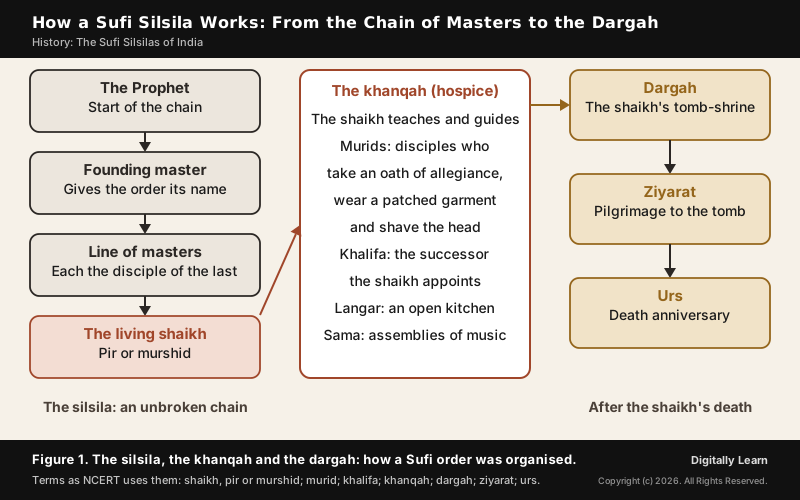
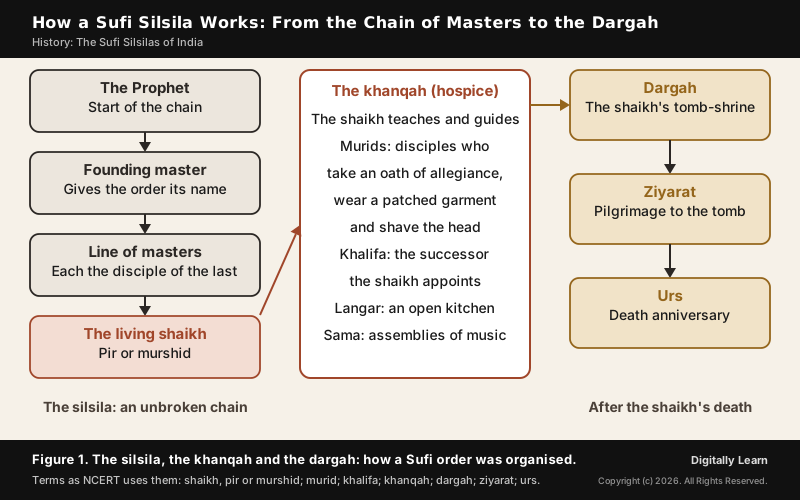
Each order was organised around a khanqah, a hospice run by a teaching master called a shaikh in Arabic and a pir or murshid in Persian. Figure 1 shows how the parts fitted together:
- Murid: A disciple. On joining he took an oath of allegiance, wore a patched garment and shaved his hair.
- Khalifa: The successor the shaikh appointed to carry on his teaching.
- Dargah: The shaikh’s tomb-shrine after his death; the word is Persian for court.
- Ziyarat and urs: Pilgrimage to the tomb, above all on the saint’s death anniversary, the urs, which was understood as the union of his soul with God.
Each order followed its own tariqa, a slightly different method of instruction and ritual. The common tools were zikr (chanting a name of God or a sacred formula), contemplation, sama (music), breath control and the discussion of parables, all under the guidance of the pir. Most orders took their name from a founding figure, as the Qadiri order did from Shaikh Abdul Qadir Jilani; the Chishti order is the exception, named after its place of origin, the town of Chisht in Afghanistan. The beliefs behind all this are explained in the Sufi movement: origins, doctrines and institutions.
Sufi Orders in India: When They Arrived and How They Compare
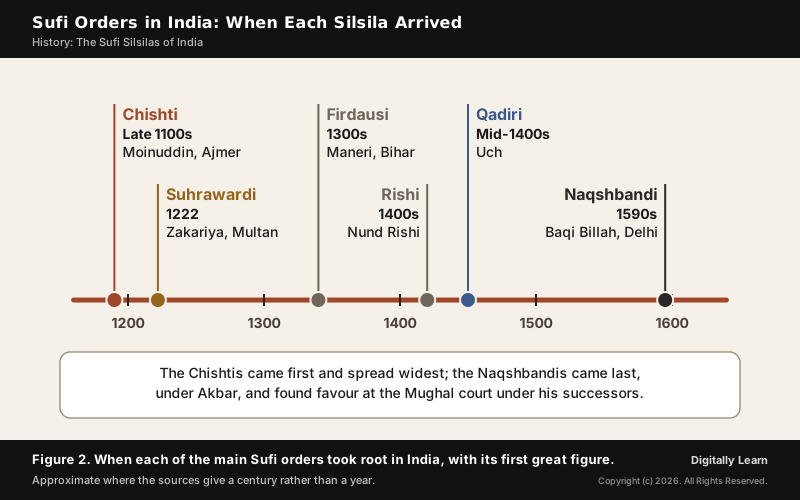
Sufis from Central Asia began settling in India from the eleventh century. One of the first was Abul Hasan al-Hujwiri, who settled in Lahore, wrote the Kashf-ul-Mahjub in Persian to explain Sufism and died in 1073; he is still revered as Data Ganj Bakhsh. The flow grew stronger after the Delhi Sultanate was founded, when major Sufi centres developed across the subcontinent. Figure 2 shows when each order took root.
| Order | Founder | Brought to India by | Main centres | Stand towards the state |
|---|---|---|---|---|
| Chishti | Abu Ishaq Shami, at Chisht | Moinuddin Chishti | Ajmer, Delhi, Pakpattan, Gulbarga | Kept its distance |
| Suhrawardi | Abu Najib Suhrawardi | Bahauddin Zakariya | Multan, Uch, Bengal | Worked with rulers |
| Qadiri | Abdul Qadir Jilani, Baghdad | Muhammad Ghaus Gilani | Uch, Lahore | Close to Mughal princes |
| Naqshbandi | Bahauddin Naqshband, Bukhara | Khwaja Baqi Billah | Delhi, Sirhind | Sought to guide the court |
Chishti Silsila: Founder, Great Saints and Practices
Chishti Silsila Founder in India: Moinuddin Chishti of Ajmer
The Chishti order began at Chisht, a town about 95 miles east of Herat in present-day western Afghanistan, where Abu Ishaq Shami taught Sufism. Of the groups of Sufis who migrated to India in the late twelfth century, the Chishtis became the most influential, because they adapted to the local environment and adopted several features of Indian devotional traditions.
Khwaja Moinuddin Chishti brought the order to India and made Ajmer its first centre. He had studied under the Chishti shaikh Usman Harooni, moved to Lahore and then to Ajmer, where he died. NCERT gives the year of his death as 1235; other accounts give 1236. Popularly he is known as Gharib Nawaz, the comforter of the poor, and his dargah at Ajmer is the most revered of all the Chishti shrines.
- Royal visitors: Muhammad bin Tughlaq was the first Sultan to visit the shrine; the first building over the tomb was paid for in the late fifteenth century by Sultan Ghiyasuddin Khalji of Malwa.
- Akbar: He visited the tomb fourteen times, until 1580, to seek blessings for conquests, vows and the birth of sons; in 1568 he gave a huge cauldron (degh) for cooking for pilgrims and built a mosque in the compound.
- Jahanara: Shah Jahan’s daughter made a pilgrimage there in 1643 and wrote a biography of the saint, Munis al Arwah.
Chishti Saints of Delhi and the Punjab: Kaki, Baba Farid, Nizamuddin Auliya
From Ajmer the order moved to Delhi and the Punjab, carried by a line of masters each the disciple of the one before. Five great Chishti saints stand out, and people of every creed and class have visited their dargahs for more than seven centuries:
| Sufi teacher | Year of death | Dargah |
|---|---|---|
| Shaikh Muinuddin Sijzi (Moinuddin Chishti) | 1235 | Ajmer |
| Khwaja Qutbuddin Bakhtiyar Kaki | 1235 | Delhi (Mehrauli) |
| Shaikh Fariduddin Ganj-i Shakar (Baba Farid) | 1265 | Ajodhan, now Pakpattan |
| Shaikh Nizamuddin Auliya | 1325 | Delhi |
| Shaikh Nasiruddin Chiragh-i Dehli | 1356 | Delhi |
- Qutbuddin Bakhtiyar Kaki: Moinuddin’s successor. Before him the order was confined to Ajmer and Nagaur; he established it securely in Delhi, where Iltutmish held his urs in high regard and built the Gandhak ki Baoli for him.
- Baba Farid: Kaki’s successor, who settled at Ajodhan in the Punjab. He was the first major Punjabi poet, and verses in the local language attributed to him were taken into the Guru Granth Sahib. After him the order divided into two branches, the Nizami of Nizamuddin Auliya and the Sabiri of Alauddin Sabir Kaliyari.
- Nizamuddin Auliya (1238 to 1325): The most famous Chishti of Delhi, called Mahbub-e-Ilahi, the beloved of God, and sultan-ul-mashaikh by his disciples. His khanqah stood at Ghiyaspur on the Yamuna, then on the outskirts of Delhi.
- Nasiruddin Chiragh-i Dehli: Nizamuddin’s disciple and successor, the lamp of Delhi, remembered as the last important Chishti of the city.
Nizamuddin's khanqah shows what Chishti life looked like. It had several small rooms and a big hall, the jama'at khana, where inmates and visitors lived and prayed, and an open kitchen, the langar, run on unasked-for charity (futuh). Soldiers, slaves, singers, merchants, poets, rich and poor, Hindu jogis and qalandars came there. The poet Amir Hasan Sijzi recorded the Shaikh's conversations as the Fawaid ul Fuad, a book of the kind called malfuzat, the sayings of a master. Nizamuddin also sent his successors to set up hospices in other parts of the subcontinent, which is how the order spread so fast.
Chishti Practices: Sama, Qawwali, Hindavi and Distance from the Court
Music sat at the heart of Chishti devotion. Sufis remembered God either through zikr, the recitation of the divine names, or through sama, literally audition, the performance of mystical music to evoke His presence. Sama was integral to the Chishtis and shows how they drew on India's own devotional traditions. Besides music, the Chishtis kept five basic devotional practices:
- Dhikr-i jali: Reciting the names of God aloud, in a set posture at set times.
- Dhikr-i khafi: Reciting them silently.
- Pas-i anfas: Regulating the breath.
- Muraqaba: Absorption in meditation on the Divine.
- Chilla: Forty or more days of confinement in a lonely cell for prayer and contemplation.
Amir Khusrau (1253 to 1325), poet, musician and disciple of Nizamuddin Auliya, gave the Chishti sama a form of its own. He introduced the qaul, a hymn sung at the opening or close of a qawwali, followed by Sufi poetry in Persian, Hindavi or Urdu, and the qawwals at Nizamuddin's shrine still begin their recital with the qaul. He is credited with refining the style of presentation that became the foundation of the qawwali tradition. Language followed the same path: Chishtis in Delhi conversed in Hindavi, the language of the people, and poems on divine love such as Malik Muhammad Jayasi's Padmavat were recited in the hospices.
The Chishtis also kept away from worldly power. Moinuddin is remembered for telling his followers never to go to the courts of kings, and a ruler could be a disciple but was treated as just another devotee. The distance was never absolute: Chishtis accepted unasked-for gifts in cash and kind, but spent them at once on food, clothes, shelter and sama rather than storing them. When Sultan Ghiyasuddin, then still known as Ulugh Khan, offered Baba Farid money and the deeds to four villages, the Shaikh took the money for the dervishes and returned the land deeds.
Chishti Order in the Deccan, Bengal and the Mughal Court
After Nizamuddin the Chishti way spread across the subcontinent. Two lines of transmission came from him. One ran through Nasiruddin Chiragh-i Dehli; the other through Akhi Siraj, whom Nizamuddin sent to Bengal, and his disciple Alaul Haq Pandavi of Pandua. Fourteen successive Bengal Sultans took Shaikh Ala al-Haq as their spiritual master.
The Deccan received the order through Gesudaraz, also called Bande Nawaz (1321 to 1422), the disciple and successor of Nasiruddin. He fled Delhi in December 1398 as Timur's army approached and, at the invitation of the Bahmani Sultan Taj ud-Din Firuz Shah, settled at the Bahmani capital Gulbarga in 1399/1400. His shrine there made Gulbarga a Chishti centre. In the seventeenth and eighteenth centuries Chishti Sufis around Bijapur composed short poems in Dakhani that women sang while grinding grain and spinning, which helped Islam find a place in the villages of the Deccan.
At Bijapur the Sultan Ibrahim Adil Shah II (ruled 1580 to 1627) was a devotee of Bande Nawaz. His Kitab-i Nauras, the Book of Nine Rasas, is a collection of 59 songs and 17 couplets in Dakhani. A large share of the songs praise Saraswati, Ganesha and other Hindu deities, while others praise the Prophet and the Sufi saint Bande Nawaz.
Several Mughal emperors were Chishti devotees, and Akbar the most fervent. He sought the blessing of Shaikh Salim Chishti (1478 to 1572), a descendant of Baba Farid, at Sikri, and named the son born after it Salim, the future Jahangir. Akbar built Fatehpur Sikri at the same site and moved his court there from 1572 to 1585 to honour the Shaikh. His tomb stands in the quadrangle of its Jama Masjid, a symbol of the bond between the Chishtis and the Mughal state.
Suhrawardi Silsila: Bahauddin Zakariya, Multan and the State
Suhrawardi Silsila Founder and Bahauddin Zakariya of Multan
The Suhrawardi order was founded by Abu Najib Suhrawardi, who died in 1168. In India it was established by three disciples of Shihabuddin Abu Hafs Umar Suhrawardi of Baghdad, who set up branches in Delhi, Bengal and Multan. Its most successful teacher was Bahauddin Zakariya, who settled at Multan in 1222. Under him Multan came to be called the Baghdad of the East.
Zakariya's order took a different path from the Chishtis. When Iltutmish overthrew Nasiruddin Qabacha, the ruler of Multan, in 1228, Zakariya's support helped him, and the Sultan gave him the title Shaikh-ul-Islam to oversee the state's spiritual matters. The contrast with the Chishtis shows in four points:
| Point | Chishti | Suhrawardi |
|---|---|---|
| Wealth | Poverty as the ground of spirituality | Ordinary food and clothing; poverty not required |
| The state | Kept away from the court | Accepted state office and patronage |
| Sama | Central to worship | Joined only on occasion |
| Bowing to the shaikh | Practised by disciples | Rejected |
Zakariya stressed fasting, alms-giving and scholarship, and rejected the Chishti custom of bowing before the shaikh. He died at Multan, where his mausoleum still draws pilgrims at the time of his urs. His teaching spread through southern Punjab and Sindh, and his order later moved east into Gujarat and Bengal. In Uch, Jalaluddin Bukhari, called Makhdum-i Jahaniyan, became the best-known figure of the Multan branch.
Suhrawardi Order in Bengal, Kashmir and Bihar
- Bengal: Jalaluddin Tabrizi, a disciple of Shihabuddin Suhrawardi, reached Delhi under Iltutmish around 1210 and then went on to Bengal, recently conquered by Bakhtiyar Khalji. He was buried in his khanqah at Pandua, whose endowed land earned it the name Baish Hazari Dargah.
- Kashmir: The order had its greatest presence in India here. Sayyid Sharafuddin, known as Bulbul Shah, is credited with converting the Kashmiri king Rinchana to Islam.
- Bihar, the Firdausi branch: The Firdausi silsila grew out of the Suhrawardi. Its greatest figure, Sharafuddin Yahya Maneri (1263 to 1381), became a disciple of Shaikh Najibuddin Firdausi at Delhi, spent thirty years in the forests and hills of Bihar and settled at Bihar Sharif, where Muhammad bin Tughlaq built him a khanqah. His letters (Maktubat) are read as a guide to the Sufi path.
Qadiri and Naqshbandi Silsilas in Mughal India
Qadiri Order: Abdul Qadir Jilani, Uch, Mian Mir and Dara Shikoh
The Qadiri order is named after Abdul Qadir Jilani (1077 to 1166), a scholar and preacher of Baghdad, and it became one of the most widespread orders of the Islamic world. It took root in India in the fifteenth century. In the mid-1400s Muhammad Ghaus Gilani, a descendant of Abdul Qadir, set up a khanqah at Uch, which made Uch the order's centre; the Qadiri later became the dominant order of the Punjab.
Its golden age in India came under the Mughals. Mian Mir (about 1550 to 1635), a Qadiri saint of Lahore, kept worldly men at bay and once made the Emperor Jahangir wait at his gate. He is best known as the spiritual instructor of Dara Shikoh, Shah Jahan's eldest son. After Mian Mir's death, his successor Mullah Shah Badakhshi became the spiritual guide of both Dara Shikoh and his sister Jahanara. Dara wrote about these saints in his Sakinat ul-Auliya.
Naqshbandi Order: Baqi Billah, Ahmad Sirhindi and Orthodox Reform
The Naqshbandi order is named after Bahauddin Naqshband, a fourteenth-century master born near Bukhara. It traces its chain to the Prophet through the first caliph, Abu Bakr, and stands out for strict adherence to the shari'a and for silent zikr. Khwaja Baqi Billah (1564 to 1603), born in Kabul and trained in Kabul and Samarkand, brought the order to India at the end of the sixteenth century. He died at Delhi three years later and is buried there.
His disciple Shaikh Ahmad Sirhindi (1564 to 1624) made the order popular. Born at Sirhind in the Punjab, he joined the Naqshbandis at the age of thirty-six and became their leading master. He opposed heterodox trends at the Mughal court, such as Akbar's Din-i Ilahi, and argued for stricter observance of Islamic law, which earned him the title Mujaddid Alf-i Sani, the renewer of the second millennium. Jahangir had him imprisoned, including a year in the Gwalior prison, before restoring him to favour, after which Sirhindi travelled with the emperor's entourage to the Deccan.
His deputies carried the order across the empire, and for two centuries it was the most common Sufi order in the subcontinent; Shah Waliullah of Delhi belonged to it in the eighteenth century.
Other Sufi Orders: Rishi, Shattari, Madari and Qalandari
Rishi Order of Kashmir and the Shattari, Madari and Qalandari Orders
The Rishi order is an indigenous Sufi tradition that grew up in the Kashmir Valley in the fifteenth century. Its central figure, Nund Rishi or Shaikh Nuruddin (about 1377 to 1438), preached and wrote in Kashmiri rather than Persian or Arabic, and his mystical poems, the shruks, are among the important works of medieval Kashmiri literature. Muslims honour him as Alamdar-e-Kashmir, the flag-bearer of Kashmir, and Hindus as Nund Lal and Sahajananda. Sultan Zain-ul-Abidin had a tomb built for him at Chrar-i-Sharif.
The Rishis lived simply, in seclusion and meditation. Jahangir wrote that they ate no flesh, took no wives and planted fruit trees for others to enjoy, desiring no gain for themselves. The order made an important contribution to Kashmiriyat, the shared cultural consciousness of the Kashmiri people.
Three more orders completed the picture in north India:
- Shattari: Founded by Abdullah Shattar, who brought it to India in the fifteenth century; shattar means swift. Its great master, Shah Muhammad Ghawth of Gwalior (1500 to 1562), taught the Emperor Humayun, wrote the Jawahir-i Khams and translated the Sanskrit Amrtakunda into Persian, bringing yoga practices into Sufism. He also taught the musician Tansen, who is buried in Ghawth’s tomb complex.
- Madari: Begun by Shah Madar Badi al-Din and centred on his dargah at Makanpur in Kanpur district. Popular in Uttar Pradesh, Bihar, Bengal and Gujarat, it is known for its syncretic beliefs and inner zikr.
- Qalandari: Wandering dervishes who shaved their beards and eyebrows, lived on charity and ignored formal religious observance; Lal Shahbaz Qalandar of Sehwan in Sindh is its best-known Indian saint. With the Madaris and Malangs they formed the be-shari’a stream of Indian Sufism.
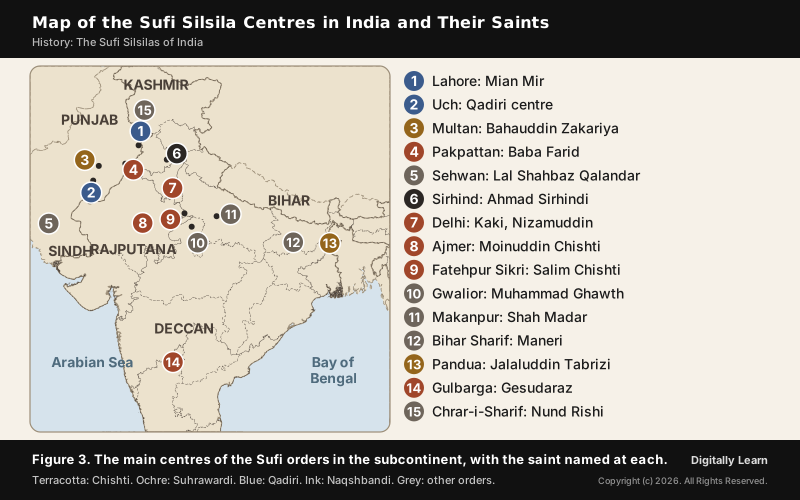
Figure 3 places these smaller orders beside the four great ones, and the map shows a pattern. Several of the oldest centres lie in the Punjab and Sindh, on the routes from Central Asia: Lahore, where Hujwiri settled, and Multan and Uch. From Ajmer and Delhi the Chishtis later spread to the Deccan and Bengal, while smaller orders took root in Bihar and Kashmir.
Sufi Orders, the State and Indian Society
Sufis and the State: Patronage, Legitimacy and Conflict
Rulers and Sufis needed each other. The Sultans set up charitable trusts (auqaf) for hospices and granted tax-free land (inam). They also sought legitimacy from the Sufis: when the Turks founded the Delhi Sultanate they resisted the ulama's demand to impose the shari'a as state law, because most of their subjects were not Muslims, and turned instead to the Sufis, whose authority was believed to come directly from God. Kings often wanted their own tombs near Sufi shrines, since the saints were believed to intercede with God.
The relationship had its tensions. Both sides expected rituals such as prostration and the kissing of feet, and Nizamuddin's disciples called him sultan-ul-mashaikh, the sultan among shaikhs. In 1313 Nizamuddin refused a local ruler's gift of two gardens and much land. The orders differed in how close they came: the Suhrawardis under the Delhi Sultans and the Naqshbandis under the Mughals worked with the state, and some of their members accepted court offices, while the Chishtis took gifts but kept their distance.
Significance of the Sufi Silsilas for Indian Society and Culture
The silsilas left a lasting mark on India's shared culture. Their dargahs drew people of every faith: an eighteenth-century visitor found the whole population of Delhi camping at the shrine of Nasiruddin Chiragh in the month of Diwali, with Hindus and Muslims visiting in the same spirit. They carried devotion into the people's languages, from Hindavi in Delhi and Punjabi in Baba Farid's verse to Dakhani in the Deccan and Kashmiri in Nund Rishi's shruks, and through sama they gave India the qawwali.
Their reach had limits too. The Sufis were generally unconcerned with converting people and welcomed Hindus and Muslims alike to their discourses, and there is no evidence that large numbers of lower-caste people embraced Islam because of their influence. The orthodox reaction of Ahmad Sirhindi shows that the shari'a-minded current remained strong within Islam itself. The orders softened the lines between communities more than they changed the structure of either society.
Previous Year UPSC-CSE Questions
Previous Year UPSC-CSE Questions By the end you will be able to draft model answers for the following UPSC questions. Each question carries a collapsible framework showing how to approach it in the exam.
- UPSC Mains 2014 GS-ISufis and medieval mystic saints failed to modify either the religious ideas and practices or the outward structure of Hindu/Muslim societies to any appreciable extent. Comment.
Answer outline: how to structure the answer
What the question asks, the main arguments, relevant examples and the direction of the conclusion. This is not a full model answer.
Introduction: Open with the Sufi orders as the main organised form of Islamic mysticism in medieval India, spreading from the late twelfth century through the khanqah and the dargah.
Body (sub-themes to develop):
- Religious ideas changed: love of God over formal ritual; sama and qawwali; the Chishti adoption of local devotional ways; Kitab-i Nauras praising Saraswati and Bande Nawaz.
- Practices changed: shrines visited by Hindus and Muslims alike (Nasiruddin's dargah at Diwali); Hindavi, Punjabi, Dakhani and Kashmiri in place of Persian.
- Limits within Islam: the ulama and the Naqshbandi reaction of Ahmad Sirhindi kept the shari'a current strong.
- Limits in society: Sufis were generally unconcerned with conversion; no evidence of mass lower-caste conversion through them; caste and community structures stood.
Conclusion: Conclude that the statement holds for social structure but not for religious practice: the orders softened the lines between communities more than they reshaped either society.
- UPSC Mains 2017 GS-IThe spirit of tolerance and love is not only an interesting feature of Indian society from very early times, but it is also playing an important part at the present. Elaborate.
Answer outline: how to structure the answer
What the question asks, the main arguments, relevant examples and the direction of the conclusion. This is not a full model answer.
Introduction: Open with the idea that Indian society has long made room for many faiths, and that its devotional movements, Sufi and bhakti, turned that room into shared practice.
Body (sub-themes to develop):
- Early roots: plural traditions of thought and worship coexisting.
- The Sufi orders: the khanqah and langar open to all; dargahs such as Ajmer visited by every creed and class; sama and qawwali.
- Regional examples: Nund Rishi honoured as Alamdar-e-Kashmir and as Nund Lal; Kashmiriyat; the Kitab-i Nauras at Bijapur.
- The present: urs at Ajmer and Nizamuddin, qawwali in public culture, constitutional secularism and fraternity as the modern form of the same spirit.
Conclusion: Conclude that tolerance and love are not only a memory of the past but a living practice, renewed whenever people of different faiths meet at the same shrine.
- UPSC Prelims 1996 Prelims-GSThe sufi saint who maintained that devotional music was one way of coming close to God was
How to approach this Prelims question
Approach: Step 1: the idea that music brings the soul close to God is sama. Step 2: sama was integral to the Chishti order. Step 3: of the four names, the founder of the Chishti order in India is Muin-ud-din Chishti.
Trap to watch: Baba Farid and Gesudaraz were Chishtis too, but the question looks for the order's founding figure in India.
Key facts to recall:
- (a) Muin-ud-din Chishti: right. He founded the Chishti order in India, which made sama central to worship.
- (b) Baba Farid: wrong. He was a later Chishti master, remembered above all for his Punjabi verse.
- (c) Saiyid Muhammad Gesudaraz: wrong. He took the order to the Deccan two centuries later.
- (d) Shah Alam Bukhari: wrong. He is not the saint associated with this teaching.
Answer signal: Muin-ud-din Chishti: option (a), the official answer.
- UPSC Prelims 1997 Prelims-GSConsider the following Assertion (A) and Reason (R):
- Assertion (A): The sponsor and the most prominent figure of the Chisti order of Sufis in India is Khwaja Moinuddin Chisti.
- Reason (R): The Chisti order takes its name from a village Chisti in Ajmer.
In the context of the above two statements, which one of the following is correct?
How to approach this Prelims question
Approach: Step 1: the assertion: Moinuddin Chishti is the sponsor and most prominent figure of the order in India; true. Step 2: the reason: the order is named after a village Chisti in Ajmer; false, it is named after Chisht in Afghanistan. Step 3: A true, R false.
Trap to watch: Ajmer is the order's first Indian centre, which makes the false reason sound right.
Key facts to recall:
- (a) Both true, R explains A: wrong. R is false.
- (b) Both true, R does not explain A: wrong. R is false.
- (c) A true, R false: right. Moinuddin led the order in India; its name comes from Chisht in Afghanistan.
- (d) A false, R true: wrong. A is true and R is false.
Answer signal: Option (c), the official answer: A is true and R is false.
- UPSC Prelims 2002 Prelims-GSWith reference to Sufism in Indian history, consider the following statements:
- Shaikh Ahmad Sarhandi was a contemporary of Ibrahim Lodi
- Shaikh Nasiruddin Chirag-i-Dehlavi was a disciple of Shaikh Nizamuddin Auliya
- Aurangzeb was contemporary of Shaikh Salim Chisti
- The Qadiri order of Sufis was first introduced in India by Shaikh Niamtullah and Makhdum Muhammad Jilani
Which of these statements are correct?
How to approach this Prelims question
Approach: Step 1: statement 1: Sirhindi was born in 1564, long after Ibrahim Lodi fell at Panipat in 1526; wrong. Step 2: statement 2: Nasiruddin Chiragh was Nizamuddin's disciple and successor; right. Step 3: statement 3: Salim Chishti died in 1572 under Akbar, while Aurangzeb ruled from 1658; wrong. Step 4: statement 4: the official key accepts that the Qadiri order was first introduced by Shaikh Niamatullah and Makhdum Muhammad Jilani; right. Answer: 2 and 4.
Trap to watch: Statements 1 and 3 each pair a real Sufi with a ruler from the wrong century.
Key facts to recall:
- (a) 1 and 2: wrong. Sirhindi lived under Akbar and Jahangir, not Ibrahim Lodi.
- (b) 1 and 3: wrong. Both statements misdate their Sufi.
- (c) 2 and 3: wrong. Salim Chishti was Akbar's contemporary, not Aurangzeb's.
- (d) 2 and 4: right. Nasiruddin was Nizamuddin's disciple, and the Qadiri statement is accepted.
Answer signal: 2 and 4: option (d), the official answer.
- UPSC Prelims 2003 Prelims-GSConsider the following statement:
- Kitab-I-Nauras, a collection of songs in praise of Hindu deities and Muslim saints, was written by Ibrahim Adil Shah II
- Amir Khusrau was the originator in India of the early form of the musical style known as Qawwali.
Which of these statements is/are correct?
How to approach this Prelims question
Approach: Step 1: statement 1: the Kitab-i Nauras is Ibrahim Adil Shah II's book of songs, praising Hindu deities and Muslim saints; right. Step 2: statement 2: Amir Khusrau is credited with the early form of qawwali; right. Step 3: both.
Trap to watch: A Muslim sultan praising Saraswati can look unlikely, which tempts a wrong 'Only 2'.
Key facts to recall:
- (a) Only 1: wrong. Statement 2 is also right.
- (b) Only 2: wrong. The Kitab-i Nauras does praise Hindu deities and Muslim saints.
- (c) Both 1 and 2: right. Both statements are correct.
- (d) Neither 1 nor 2: wrong. Both are correct.
Answer signal: Both 1 and 2: option (c), the official answer.
- UPSC Prelims 2012 Prelims-GSWith reference to the religious history of medieval India, the Sufi mystics were known to pursue which of the following practices?
- Meditation and control of breath
- Severe ascetic exercises in a lonely place
- Recitation of holy songs to arouse a state of ecstasy in their audience
Select the correct answer using the codes given below:
How to approach this Prelims question
Approach: Step 1: statement 1: meditation and breath control are muraqaba and pas-i anfas; right. Step 2: statement 2: severe ascetic exercises in a lonely place are the chilla; right. Step 3: statement 3: holy songs arousing ecstasy are sama; right. All three.
Trap to watch: Statement 3 looks un-Islamic to some, but sama was integral to the Chishtis.
Key facts to recall:
- (a) 1 and 2 only: wrong. Sama, statement 3, was also a Sufi practice.
- (b) 2 and 3 only: wrong. Breath control and meditation were practised too.
- (c) 3 only: wrong. Statements 1 and 2 are also right.
- (d) 1, 2 and 3: right. Muraqaba and pas-i anfas, the chilla, and sama.
Answer signal: 1, 2 and 3: option (d), the official answer.
Sources
- NCERT: Themes in Indian History II (Class XII), Bhakti-Sufi Traditions
- NCERT: Our Pasts II (Class VII), Devotional Paths to the Divine
- NCERT: Medieval India (Satish Chandra), Economic and Social Life under the Delhi Sultanat
- Wikipedia: Chishti Order
- Wikipedia: Mu'in al-Din Chishti
- Wikipedia: Qutbuddin Bakhtiar Kaki
- Wikipedia: Baba Farid
- Wikipedia: Nizamuddin Auliya
- Wikipedia: Nasiruddin Chiragh Dehlavi
- Wikipedia: Qawwali
- Wikipedia: Bande Nawaz
- Wikipedia: Ibrahim Adil Shah II
- Wikipedia: Kitab-i Nauras
- Wikipedia: Salim Chishti
- Wikipedia: Suhrawardiyya
- Wikipedia: Bahauddin Zakariya
- Wikipedia: Jalaluddin Tabrizi
- Wikipedia: Sharfuddin Yahya Maneri
- Wikipedia: Sufism in India
- Wikipedia: Qadiriyya
- Wikipedia: Uch
- Wikipedia: Mian Mir
- Wikipedia: Shah Badakhshi
- Wikipedia: Naqshbandi
- Wikipedia: Khwaja Baqi Billah
- Wikipedia: Ahmad Sirhindi
- Wikipedia: Nund Rishi
- Wikipedia: Rishi order
- Wikipedia: Shattariyya
- Wikipedia: Muhammad Ghawth
- Wikipedia: Madariyya
- Wikipedia: Qalandariyya
- Wikipedia: Lal Shahbaz Qalandar
- Wikipedia: Mughal Empire
- Incredible India (Ministry of Tourism): Ajmer Sharif Dargah
- Akashvani News: Annual Urs of Sufi saint Khwaja Moinuddin Hasan Chishti begins in Ajmer (2 January 2025)
- Archaeological Survey of India: Fatehpur Sikri
- UPSC: Civil Services Examination question papers
Editorial Disclaimer
Years of death of the Chishti saints follow the NCERT textbooks; other accounts may differ by a year. This article draws on the sources listed on this page.


