


Overview
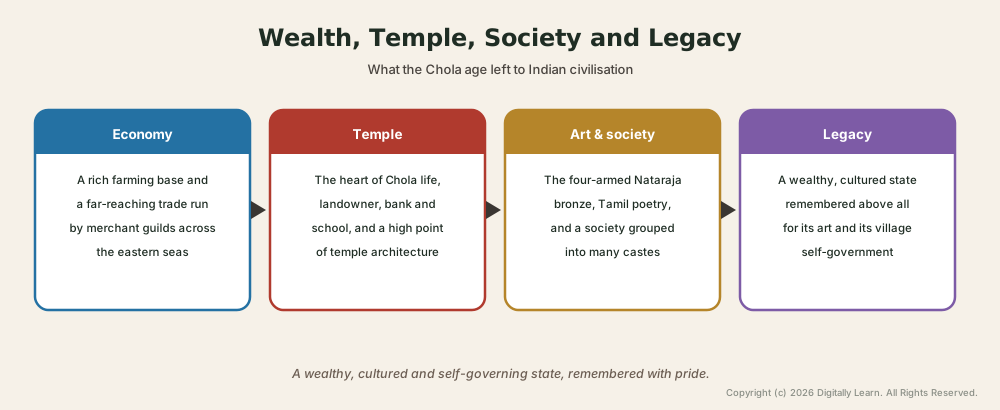
The wealth that paid for the Chola state and its armies came from a rich economy and found its highest expression in the temple. Agriculture on the watered lands of the Kaveri was the base, and a far-reaching trade, run by powerful merchant guilds, carried Chola goods across the seas to Sri Lanka, Southeast Asia and China. The temple was the heart of this world, at once a great landowner, employer, bank and school, and the setting for the finest art of the age, the bronze images of which the dancing Nataraja is the most famous. The lasting legacy of the Cholas lies in this art and, above all, in their model of village self-government.
The Agrarian and Commercial Economy
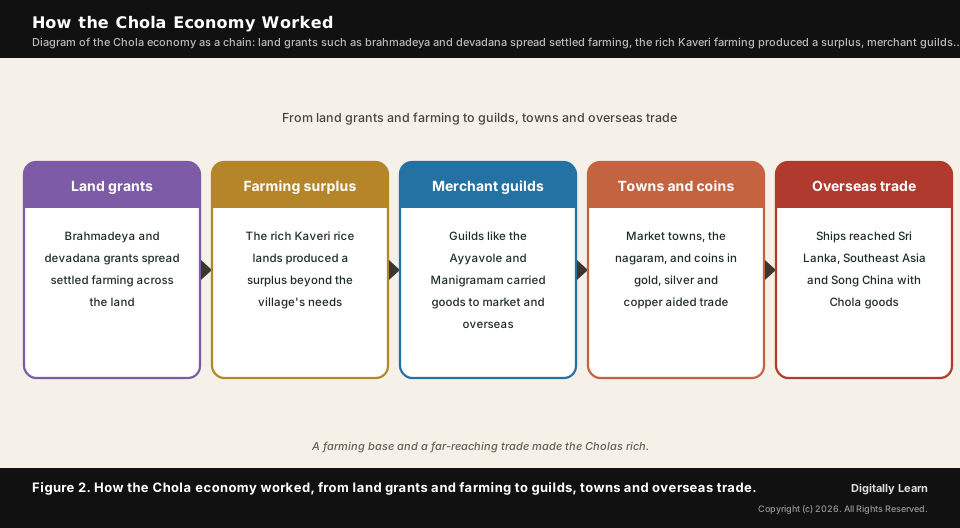
The Agrarian Base and the Spread of Land Grants
What is the significance of the Chola economy: the strength of the Chola state, its armies and its temples all rested on a wealthy economy, and the base of that economy was farming. The watered rice lands of the Kaveri were among the richest in India, and their surplus paid for everything else.
Distinguishing the land grants: the Cholas extended farming by making generous grants of land. A brahmadeya was a village given to Brahmins, and a devadana was land given to a temple; both brought new land under the plough, spread settled cultivation into forest and waste, and tied the countryside to the centres of learning and worship.
Distinguishing the result: this steady spread of cultivation made the Chola country prosperous. A growing farm surplus could feed towns, support craftsmen and merchants, and be carried to distant markets, turning a farming society into a trading one.
Merchant Guilds, Overseas Trade and Coinage
What is the significance of Chola trade: the Cholas were not only a great farming power but one of the great trading powers of the medieval world. Their command of the Bay of Bengal, won by the navy of the previous part of this series, made the sea a Chola highway for commerce.
Distinguishing the guilds: much of this trade was carried not by individuals but by powerful, self-governing merchant guilds. The greatest were the Ayyavole, also called the Ainnurruvar or the Five Hundred, and the Manigramam; bodies like the Nanadesi, the merchants of many countries, traded far beyond the empire's borders.
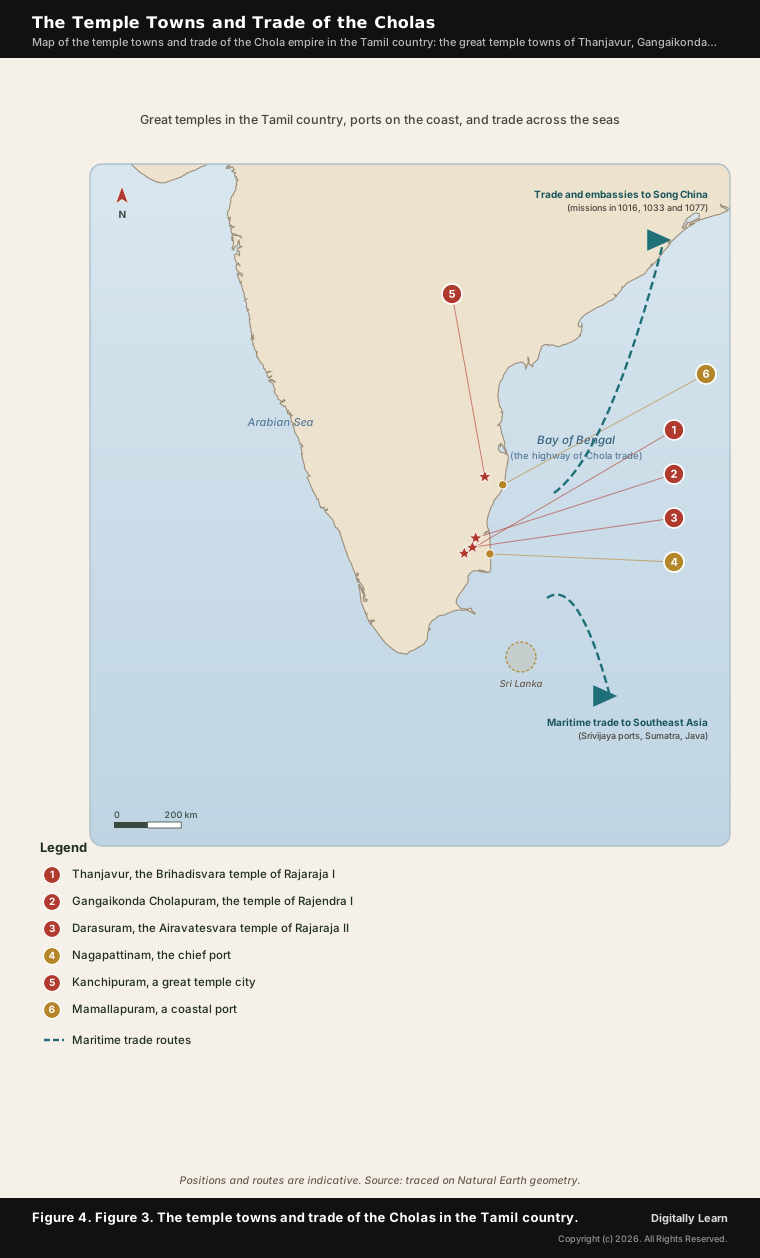
Distinguishing the overseas reach: Chola and guild ships traded with Sri Lanka, with the ports of Southeast Asia, and with Song China, to whose court the Cholas sent diplomatic and trading missions in 1016, 1033 and 1077. Spices, gems, sandalwood, pearls and fine cloth went out across the seas in exchange for the goods of distant lands.
Distinguishing the towns and money: trade gathered in market towns, the nagaram, each with its own assembly of merchants, and was eased by a coinage the Cholas issued in gold, silver and copper. Town, guild and coin together made the Chola economy one of the most developed of its day.
The Temple as an Institution
The Temple as Landowner, Employer, Bank and School
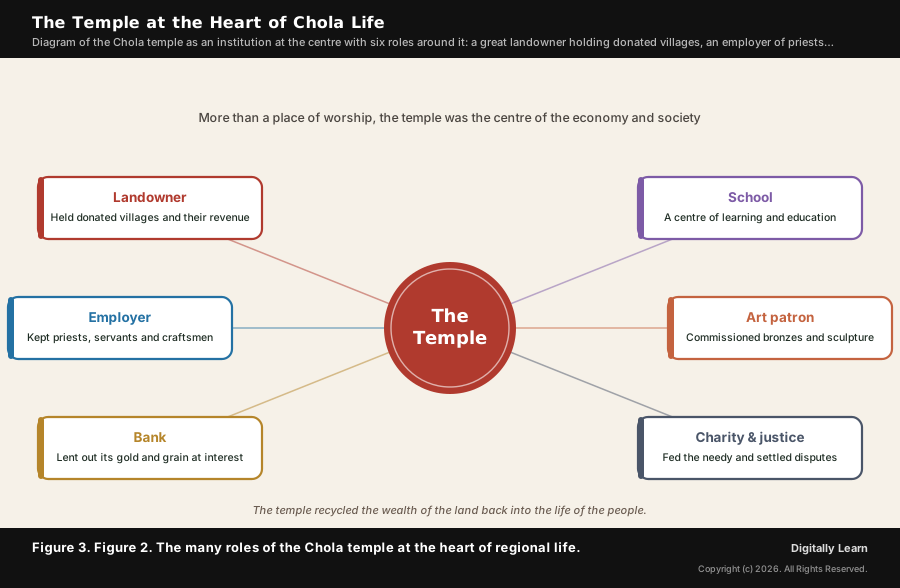
What is the significance of the temple: in the Chola world the temple was far more than a place of worship. It was the single greatest institution of the land, the centre around which the economic, social and cultural life of a whole region turned.
Distinguishing its economic roles: the temple was a great landowner, holding the villages granted to it as devadana; it was a large employer of priests, servants, musicians and craftsmen; and, holding great wealth in gold and grain, it acted as a kind of bank that lent at interest to villages and individuals.
Distinguishing its social roles: the temple was also a school and a centre of learning, a patron of art that commissioned bronzes and sculpture, and a centre of charity and justice that fed the needy in famine and settled local disputes. It thus gathered the surplus of the land and returned it to the life of the people.
The Great Living Chola Temples and Dravidian Architecture
What is the significance of Chola architecture: the wealth and devotion of the age produced the finest temples of southern India, the high point of the Dravidian style, marked by the towering pyramidal tower over the sanctum, the vimana, and richly carved halls and gateways.
Distinguishing the great temples: the supreme example is the Brihadisvara temple at Thanjavur, built by Rajaraja I and completed about 1010, whose vimana rises more than sixty metres. His son Rajendra I raised a second great temple at his capital Gangaikonda Cholapuram, and a later king, Rajaraja II, built the jewel-like Airavatesvara temple at Darasuram. Together these three are honoured today as the Great Living Chola Temples, a UNESCO World Heritage Site.
| Temple | Place | Built by | About |
|---|---|---|---|
| Brihadisvara temple | Thanjavur | Rajaraja I (c. 1010) | The grandest Chola temple; inscribed by UNESCO in 1987 |
| Brihadisvara temple | Gangaikonda Cholapuram | Rajendra I (c. 1035) | Built at Rajendra's new capital; a UNESCO extension |
| Airavatesvara temple | Darasuram | Rajaraja II (c. 1166) | A smaller, finely carved later temple; a UNESCO extension |
Art, Literature and Society
Chola Bronzes and the Tamil Literary Flowering
What is the significance of Chola art: alongside their temples the Cholas left the finest bronzes in Indian art. Cast by the lost-wax method, in which a wax model is covered in clay and then melted out to leave a mould for the metal, these images of gods and saints are prized the world over for their grace and life.
Distinguishing the Nataraja: the most famous Chola bronze is the Nataraja, Shiva as the lord of the cosmic dance, shown with four arms within a ring of fire, one foot raised and the other crushing the demon of ignorance. The four-armed dancing figure has become a symbol of Indian art itself.
Distinguishing the literature: the age was also rich in Tamil literature. Its supreme work is the Ramavataram of Kamban, a retelling of the Ramayana that is a classic of the Tamil language, while devotional poetry to Shiva and Vishnu continued the great bhakti tradition of the south.
The Structure of Chola Society
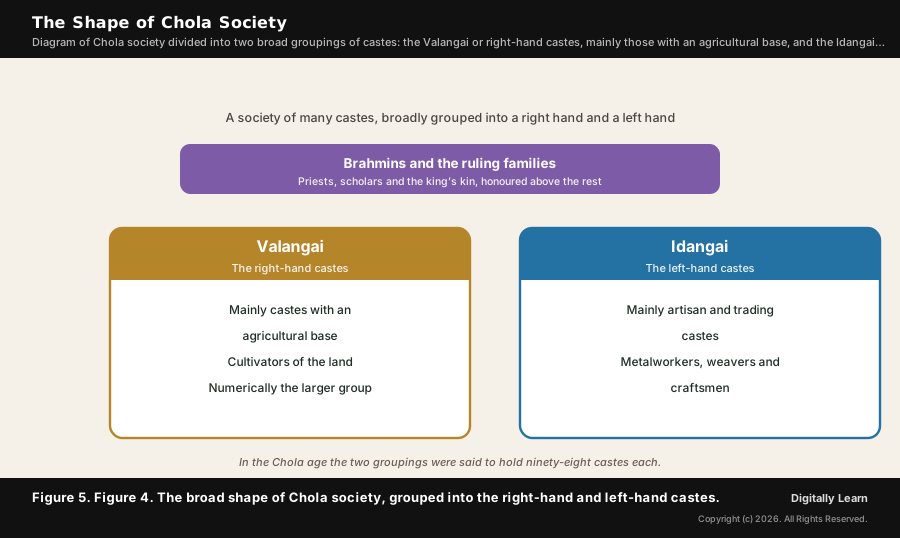
What is the significance of Chola society: Chola society was ordered, like the rest of India, by varna and by the many jatis or castes, with Brahmins and the ruling families honoured at the top and a great mass of cultivators, craftsmen and labourers below.
Distinguishing the right and left hand: a feature peculiar to the south was the grouping of castes into two broad divisions, the valangai or right-hand castes, mostly those with an agricultural base, and the idangai or left-hand castes, mostly artisan and trading groups such as metalworkers and weavers. In the Chola age each grouping was said to hold ninety-eight castes, and the two sometimes came into rivalry.
Distinguishing the place of women: women of property could own and gift land, as many temple inscriptions record, and queens were honoured patrons of temples; but the period also saw the temple service of dancing girls, the devadasis, dedicated to the deity. Society was thus layered and unequal, yet bound together by the temple and the village.
The Administrative Legacy of the Cholas
Why Chola Administration Mattered in Indian History
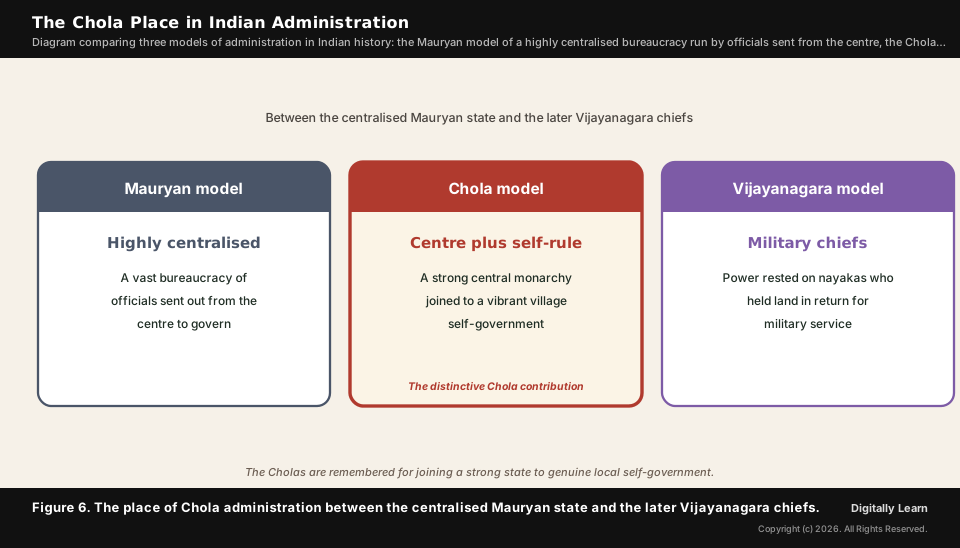
What is the significance of the Chola legacy: the Chola administration is remembered as one of the most developed systems of government in the medieval world, and its distinctive achievement was to join a strong central monarchy to a genuine and vigorous tradition of local self-government.
Distinguishing the comparison: set against the highly centralised Mauryan state, run by officials sent out from the capital, and the later Vijayanagara state, which rested on military chiefs holding land for service, the Chola model stands out for the life it gave to the village assembly. The Uttaramerur inscriptions of the local self-government, studied earlier in this series, are its lasting monument.
The Decline of the Cholas and Their Enduring Legacy
Distinguishing the decline: after the great kings of the eleventh century the empire slowly weakened, pressed by the revived Pandyas in the south and the Hoysalas in the west, until the line came to an end in the later thirteenth century. The empire passed, but its works did not.
What is the significance for today: the legacy of the Cholas endures in the living temples and the bronzes that still draw the world to Tamil Nadu, in the Tamil poetry of the age, and above all in the memory of their village self-government, which later generations have held up as an early Indian example of democracy at the local level.
UPSC Relevance and Exam Focus
Where This Fits in the UPSC-CSE Syllabus
This topic belongs to General Studies Paper I, both to medieval Indian history and to Indian art and culture, where Chola temple architecture and the Chola bronzes are among the most frequently examined themes.
For Prelims, hold the key facts: the chief merchant guild was the Ayyavole, or the Five Hundred, and Manigramam was another; the Great Living Chola Temples are the Brihadisvara at Thanjavur, the temple at Gangaikonda Cholapuram and the Airavatesvara at Darasuram; and the Chola Nataraja bronze shows Shiva with four arms.
For Mains, the Cholas are a ready example for questions on the high points of Indian temple architecture, on the contributions of an age to Indian heritage and culture, and on India's tradition of local self-government.
Recurring linked concepts an aspirant should keep in working memory:
- Ayyavole and Manigramam: the great Chola merchant guilds that traded overseas.
- Great Living Chola Temples: Thanjavur, Gangaikonda Cholapuram and Darasuram, a UNESCO site.
- Chola Nataraja: the four-armed dancing Shiva, the masterpiece of Chola bronze.
- Valangai and idangai: the right-hand and left-hand groupings of castes in the south.
A common Prelims trap is on the Nataraja bronze: the Chola dancing Shiva is shown with four arms, not two or eight, a fact tested directly in the past.
A common Mains trap is to praise Chola art and forget the administration. Their twin legacy is the art of the temple and the model of village self-government, and the strongest answers hold both together.
Previous Year UPSC-CSE Questions
Previous Year UPSC-CSE Questions By the end you will be able to draft model answers for the following UPSC questions. Each question carries a collapsible framework showing how to approach it in the exam.
- UPSC Prelims 1995 GS-IBronze icons of Nataraja cast during the Chola period invariably show the deity with
How to approach this Prelims question
Approach: Recall the standard form of the Chola Nataraja bronze.
Trap to watch: The Chola Nataraja is shown with four hands, not two, six or eight.
Key facts to recall:
- The Chola Nataraja, Shiva as lord of the dance, is shown with four arms.
- Chola bronzes were cast by the lost-wax method.
Answer signal: Four hands.
- UPSC Prelims 1997 GS-IWhich one of the following was a corporation of merchants in ancient India?
How to approach this Prelims question
Approach: Identify which of the names was a guild of merchants.
Trap to watch: Manigramam (Manigrama) was a merchant guild; the other terms refer to a Brahmin village, a council and the elephants of the directions.
Key facts to recall:
- Manigramam was a major South Indian merchant guild.
- The Ayyavole, or the Five Hundred, was the greatest Chola-era merchant guild.
Answer signal: Manigrama (a merchant guild).
- UPSC Mains 2013 GS-IChola architecture represents a high watermark in the evolution of temple architecture. Discuss.
How to structure the answer in the exam
Introduction: Open with the Dravidian style and the Cholas as its high watermark, wealthy patrons of temple building.
Body (sub-themes to develop):
- The towering vimana over the sanctum, supremely at the Brihadisvara temple, Thanjavur (Rajaraja I).
- Scale, planning and engineering: large complexes with halls, gateways and enclosures.
- The Great Living Chola Temples (Thanjavur, Gangaikonda Cholapuram, Darasuram) as a UNESCO site.
- Sculpture and the Chola bronzes that adorned and accompanied the temples.
Conclusion: Conclude that in scale, planning and art the Chola temple marks the summit of the Dravidian tradition.
- UPSC Mains 2024 GS-I“Though the great Cholas are no more yet their name is still remembered with great pride because of their highest achievements in the domain of art and architecture.” Comment.
How to structure the answer in the exam
Introduction: Open by agreeing that the Cholas are remembered above all for their art and architecture.
Body (sub-themes to develop):
- Architecture: the Brihadisvara temple and the Great Living Chola Temples, the high point of the Dravidian style.
- Sculpture: the Chola bronzes, led by the four-armed Nataraja, prized the world over.
- Wider culture: Tamil literature such as Kamban's Ramavataram and a flourishing temple life.
- Beyond art: the model of village self-government as part of the same proud legacy.
Conclusion: Conclude that the Chola name endures chiefly through its temples and bronzes, a legacy of art that time has not dimmed.
Sources and Further Reading
Editorial Disclaimer
This article is for UPSC preparation. Details of the Chola economy, temples and society are reconstructed from inscriptions and standard histories; verify specific dates and figures before relying on them.