


Overview
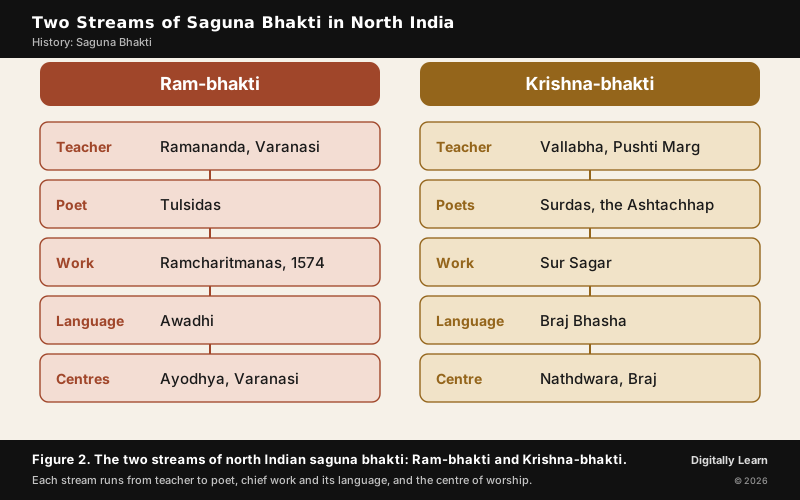
Saguna bhakti is devotion to God with form and qualities, above all Rama and Krishna as avatars of Vishnu. In north India it found its voice in Tulsidas, whose Ramcharitmanas retold the Ramayana in Awadhi, and in Surdas and the Ashtachhap poets of Vallabha's Pushti Marg (also written Pushtimarg), who sang of Krishna in Braj Bhasha. Its counterpart, nirguna bhakti, worshipped a formless God.
What Is Saguna Bhakti: Meaning, Features and the God With Form
Difference Between Saguna and Nirguna Bhakti
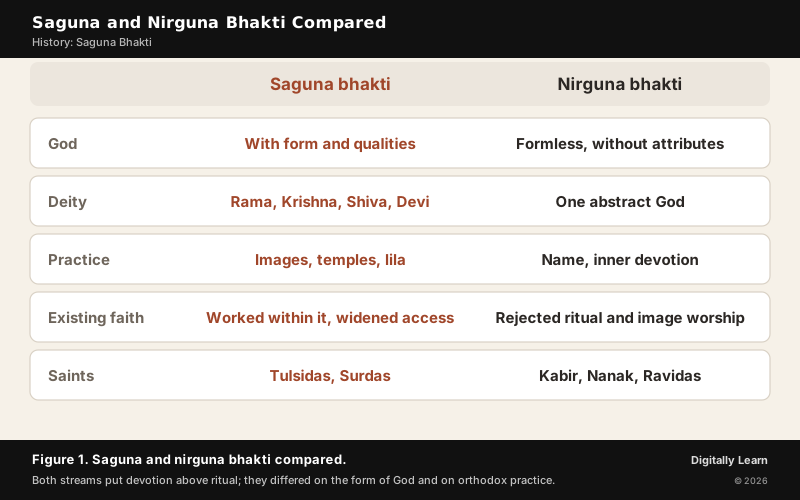
Historians of religion divide the bhakti traditions into two broad streams. Saguna bhakti, devotion to God with attributes, focused on specific deities such as Shiva, Vishnu and his avatars, and forms of the goddess, often pictured in human form. Nirguna bhakti was the worship of an abstract, formless God. The word saguna itself means with qualities; Saguna Brahman is the Absolute with qualities.
The two streams also differed in their attitude to the faith around them. Guru Nanak, a nirguna saint, rejected sacrifices, ritual baths, image worship and the scriptures of both Hindus and Muslims. Kabir, whose verses are compiled in the Bijak, belonged to the same nirguna stream. Tulsidas worked within existing faith instead, retelling the Ramayana in Awadhi so that its teachings reached wider sections of society.
Lila, Murti and the Avatar: How Saguna Devotees Saw God
Three ideas made a God with form something a devotee could love and serve. The first is the avatar: Rama and Krishna are forms of Vishnu who came into the world, so their stories are God's own deeds. The second is lila, divine play. Creation is not a task God needed to finish but the outcome of a playful, free nature, and in Vaishnava devotion lila means the deeds of God and his devotees, Krishna's childhood among the cowherds of Vrindavan above all.
The third is the murti, the devotional image of a deity used in worship. Some traditions see it as a symbol of the divine; others hold that after consecration, prana pratishtha, God is truly present in it and receives worship through it. This is why saguna bhakti built temples, served images with food and music, and enacted the lilas as drama and dance, from the Ramlila of Rama to the rasa lila, in which Krishna dances with Radha and the gopis of Braj.
Philosophical Roots of Saguna Bhakti: Ramananda, Vallabha and Nimbarka
North Indian saguna devotion drew on the Vedanta teachers of the south, Ramanuja and Madhva among them, and on teachers who settled in the Ganga valley. The main figures behind the two streams of devotion were:
- Ramananda (fourteenth century): A Brahmin who lived for most of his life in Varanasi (Banaras) and is recognised as the founder of the Ramanandi Sampradaya. Tradition links his ideas to Ramanuja; he accepted disciples without discrimination of gender, class or caste.
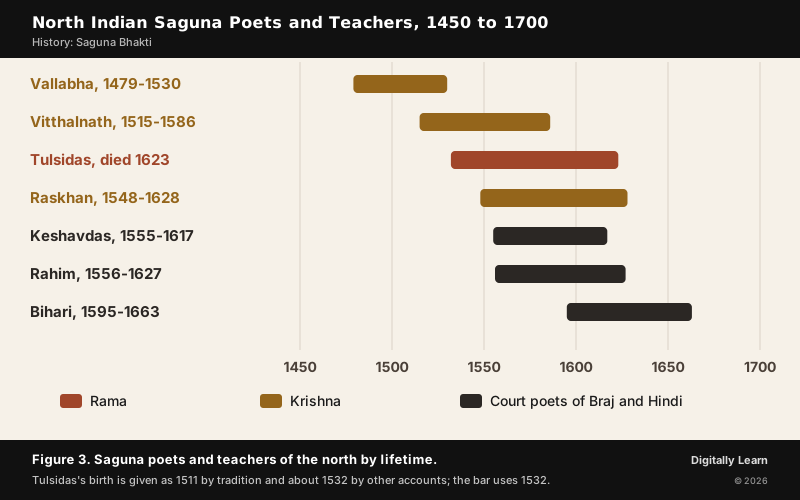
- Vallabha (about 1479 to 1530): Founder of the Pushti Marg, which worships the youthful Krishna under his philosophy of Shuddhadvaita.
- Nimbarka: Chief proponent of Dvaitadvaita, dualistic non-dualism, and founder of the Nimbarka Sampradaya; born in the south, he spent most of his life in Mathura. His date is disputed, from the twelfth or thirteenth century to as early as the sixth or seventh.
Ram-Bhakti: Tulsidas and the Ramcharitmanas
Tulsidas: Life, Works and Varanasi
Born Rambola Dubey, Tulsidas was a Vaishnava saint of the Ramanandi tradition and poet devoted to Rama. He died in 1623; his birth is placed in 1511 by one tradition and around 1532 by other accounts. He spent most of his life in Varanasi and Ayodhya. The Tulsi Ghat on the Ganga at Varanasi is named after him, and he founded the Sankat Mochan Hanuman temple there.
He wrote in Sanskrit, Awadhi and Braj Bhasha; his best-known works are in Awadhi and Braj Bhasha:
| Language | Works |
|---|---|
| Awadhi | Ramcharitmanas; Hanuman Chalisa; Ramlala Nahachhu; Barvai Ramayan; Parvati Mangal; Janaki Mangal; Ramagya Prashna |
| Braj Bhasha | Vinaya Patrika; Gitavali; Krishna Gitavali; Dohavali; Vairagya Sandipani |
The Hanuman Chalisa is 40 chaupais in praise of Hanuman; the Vinaya Patrika, a letter of petition, is a set of hymns to Rama and other deities. In the Kavitavali and the Vinaya Patrika Tulsidas writes that his family abandoned him after his birth.
Tulsidas is also credited with starting the Ramlila, the folk-theatre form of the Ramayana. His influence reaches today into the language, the Ramlila stage, Hindustani classical music and popular culture.
The Ramcharitmanas: The Ramayana Retold in Awadhi
Tulsidas began the Ramcharitmanas at Ayodhya in 1574. Its name means the lake of the deeds of Rama, and its chief inspiration is the Sanskrit Ramayana of Valmiki. Tulsidas knew Sanskrit well, but he chose Awadhi, a widely spoken variety of Hindi in the Awadh region of present-day Uttar Pradesh, so that ordinary people could read it, and tradition says the Sanskrit scholars of Varanasi criticised him for writing in the vernacular.
The work matters both as an expression of devotion and as literature. It has been called the greatest book of all devotional literature and the most trustworthy guide to the popular living faith of the Indian people, and it is known in common speech simply as the Tulsi Ramayana or the Manas.
Its standing is international too. In 2024 the Ramcharitmanas, with the Panchatantra and the Sahrdayaloka-Locana, entered UNESCO's Memory of the World Asia-Pacific Regional Register at the tenth meeting of its committee in Ulaanbaatar, on nominations made by the Indira Gandhi National Centre for the Arts.
Krishna-Bhakti: Vallabha, Surdas and the Ashtachhap Poets
Vallabhacharya's Pushti Marg and the Worship of Shrinathji
The Pushti Marg, the path of nourishing, was founded by Vallabha in the early sixteenth century and developed by his son Vitthalnath (1515 to 1586). Its followers worship the youthful Krishna of the Bhagavata Purana and of Govardhan Hill. In Vallabha's teaching the human soul is inseparable from God yet depends on his grace, and liberation comes from Krishna's grace.
Braj, the country around Mathura and Vrindavan on the Yamuna, is where the Bhagavata Purana places Krishna's childhood among the cowherds. Govardhan Hill, about 21 kilometres from Vrindavan, is its sacred centre and is itself revered as a natural form of Krishna.
Worship takes the form of seva, service of Krishna's image with food, music and art that recreate his day as a youth in Braj. The central image is Shrinathji, Krishna as a seven-year-old child, whose worship Vitthalnath institutionalised. The image was later carried from Govardhan near Vrindavan to Rajasthan, to protect it from the Mughal emperor Aurangzeb's attacks on the temples around Vrindavan, and it now stands in the temple of Nathdwara, near Udaipur. The sect is strongest in Rajasthan and Gujarat.
Surdas, the Ashtachhap and Raskhan: Krishna Poets of Braj
Surdas was a sixteenth-century blind devotional poet and singer of Krishna, whose life is traditionally dated 1483 to 1563, and who wrote most of his songs in Braj Bhasha. His best-known collection, the Sur Sagar, the ocean of Sur, describes Krishna as the lovely child of Gokul and Braj, often through the eyes of the gopis; many of its poems were added later by others writing in his name.
The Pushti Marg counts Surdas as an initiated disciple of Vallabha and the foremost of its eight poets, though modern scholars consider that link unhistorical. His poems remain at the centre of the sect's sung worship.
The Ashtachhap, the eight seals, is the group of eight poets whose Braj Bhasha kirtans are sung in Pushti Marg worship, named after the chhap, the poet's signature at the end of each poem: Kumbhandas, Surdas, Nanddas, Paramanandadas, Krishnadas, Chaturbhujdas, Govindswami and Chhitswami. Around them grew a wider devotional and courtly literature in Hindi:
- Raskhan: Syed Ibrahim Khan, a Muslim poet who learned the bhakti path from Vitthalnath, lived at Vrindavan and accepted Krishna as the supreme god; his best-known work is the Prem Vatika (also written Premavatika), the forest of love.
- Rahim (1556 to 1627): Abdul Rahim Khan-i-Khanan, one of the Navaratnas, the nine jewels of Akbar's court, known for his Hindustani couplets (dohe).
- Keshavdas (1555 to 1617): Poet of the Orchha court, whose Rasikpriya opened the Riti period of Hindi poetry.
- Bihari (1595 to 1663): Author of the Satsai, about 700 Braj couplets on Radha and Krishna, the best-known book of the Riti period.
Saguna Bhakti Across India: Rama, Krishna and Vithoba
Saguna Devotion Beyond Awadh and Braj
Saguna bhakti was not confined to the Hindi heartland. Vallabha in Braj, Sankardev in Assam and Chaitanya in Bengal were the leading Krishna teachers of the fifteenth and sixteenth centuries, and the same devotion to a God with form took regional shapes in Rajasthan, Bengal and Maharashtra:
- Mirabai of Rajasthan sang of Krishna as her beloved.
- Chaitanya in Bengal led public sankirtan to Radha and Krishna.
- The Varkari saints of Maharashtra worshipped Vithoba, a form of Krishna, at Pandharpur.
Significance of Saguna Bhakti: Literature, Ramlila and Temple Culture
Hindi Literature, the Ramlila and the Limits of Saguna Bhakti
Saguna bhakti wrote its classics in two forms of Hindi. Awadhi carried the Ramcharitmanas and the Hanuman Chalisa; Braj Bhasha, the speech of the country around Mathura, carried the Sur Sagar, the Ashtachhap kirtans, the Vinaya Patrika, Keshavdas's Rasikpriya and Bihari's Satsai. Poets of the court and of the temple wrote in the same language, and Muslim poets wrote in Hindi too: Raskhan sang of Krishna, and Rahim wrote Hindustani couplets (dohe).
The legacy of saguna bhakti is still lived every day. The Ramlila re-enacts the Ramayana in towns across north India; in 2008 UNESCO declared it part of the Intangible Cultural Heritage of Humanity, naming Ayodhya, Ramnagar and Varanasi, Vrindavan, Almora, Satna and Madhubani among its notable traditions, and describing it as bringing people together without distinction of caste, religion or age.
Beyond the Ramlila, the Hanuman Chalisa is recited regularly by Hindus, and the Pushti Marg's seva continues at Nathdwara, with nearly 10,000 padas by 30 to 40 poets in its musical liturgy.
Saguna bhakti had limits too. Working within existing faith rather than against it, it widened who could worship more than it changed the social order; the sharper challenge to caste and ritual came from the nirguna sants.
Previous Year UPSC‑CSE Questions
Each Prelims question is explained option by option, and each Mains question comes with an answer outline.
- UPSC Prelims 2014Consider the following statements:
- 'Bijak' is a composition of the teachings of Saint Dadu Dayal.
- The Philosophy of Pushti Marg was propounded by Madhvacharya.
Which of the statements given above is/are correct?
How to approach this Prelims question
Approach: Test each statement's pairing of a text or school with its saint.
- Step 1: The Bijak is a collection of verses attributed to Kabir, not Dadu Dayal, so statement 1 is wrong.
- Step 2: The Pushti Marg was founded by Vallabha, while Madhvacharya taught Dvaita, so statement 2 is wrong too.
Trap to watch: Both statements pair a real text or school with the wrong saint.
Why each option is right or wrong:
- (a) 1 only: Wrong. The Bijak is Kabir's, not Dadu's.
- (b) 2 only: Wrong. The Pushti Marg is Vallabha's, not Madhva's.
- (c) Both 1 and 2: Wrong. Both pairings are false.
- (d) Neither 1 nor 2: Correct. The Bijak belongs to Kabir and the Pushti Marg to Vallabha.
Answer: (d) Neither 1 nor 2. The Bijak is Kabir's and the Pushti Marg is Vallabha's.
- UPSC Prelims 2010Among the following, who was not a proponent of bhakti cult ?
How to approach this Prelims question
Approach: Ask which of the four was not a devotee of a personal god.
- Step 1: Vallabhacharya founded the Krishna-centred Pushti Marg.
- Step 2: Tukaram, the Varkari saint, and Tyagaraja, whose kritis praise Rama, were bhakti devotees.
- Step 3: Nagarjuna (about 150 to 250 CE) founded the Madhyamaka school of Mahayana Buddhism, so he was not a proponent of the bhakti cult.
Trap to watch: Tyagaraja is remembered as a composer, but his kritis are devotional songs to Rama.
Why each option is right or wrong:
- (a) Nagarjuna: Correct. He was a Mahayana Buddhist philosopher, founder of Madhyamaka, not a proponent of bhakti.
- (b) Tukaram: Wrong. He was a Varkari bhakti saint of Vithoba.
- (c) Tyagaraja: Wrong. His devotional kritis, mostly in Telugu, praise Rama.
- (d) Vallabhacharya: Wrong. He founded the Pushti Marg sect of Krishna bhakti.
Answer: (a) Nagarjuna. Nagarjuna was a Buddhist philosopher, not a bhakti saint.
- UPSC Prelims 1996Prem Vatika, poems on the life of Krishna, was composed by
How to approach this Prelims question
Approach: Match the work to its poet, then rule out the other three by their own works.
- Step 1: The Prem Vatika, the forest of love, is the best-known work of Raskhan, the Muslim poet who took Krishna as the supreme god.
- Step 2: Bihari wrote the Satsai, Surdas the Sur Sagar and Kabir the Bijak, so none of them fits.
Trap to watch: Surdas is the best-known Krishna poet, but the Prem Vatika is not his.
Why each option is right or wrong:
- (a) Bihari: Wrong. His work is the Satsai, about 700 Braj couplets.
- (b) Surdas: Wrong. His songs are collected in the Sur Sagar.
- (c) Raskhan: Correct. The Prem Vatika is his best-known work.
- (d) Kabir: Wrong. His verses are collected in the Bijak, and he worshipped a formless God.
Answer: (c) Raskhan. The Prem Vatika is the best-known work of Raskhan.
- UPSC Mains 2021 GS‑IEvaluate the nature of the Bhakti literature and its contribution to Indian culture.
Answer outline
The outline sets out what the question asks, the main arguments, relevant examples and the direction of the conclusion; it is not a full model answer.
Introduction: Bhakti literature is devotional writing in the regional languages, in two streams, saguna for a God with form and nirguna for a formless God.
Body (sub-themes to develop):
- Nature: Vernacular (Awadhi, Braj Bhasha, Marathi); devotional song (pad, doha, kirtan); retelling of the Ramayana and the Bhagavata; personal love of God over ritual.
- Language: The Ramcharitmanas and the Hanuman Chalisa in Awadhi; the Sur Sagar, Ashtachhap and Bihari's Satsai in Braj Bhasha.
- Culture: Ramlila, temple seva at Nathdwara, bhajan and kirtan; Muslim poets such as Raskhan and Rahim writing in Hindi.
- Society: Nirguna sants such as Guru Nanak rejected ritual and image worship; saguna poets such as Tulsidas carried existing faith to wider sections of society.
Conclusion: Bhakti literature gave Indian languages their classics and gave popular religion a shared, sung form that is still alive.
Sources
- NCERT: Themes in Indian History II (Class XII), Bhakti-Sufi Traditions
- NCERT: Exploring Society: India and Beyond (Class VII), Resistance and Resilience (1000 to 1700 CE)
- PIB: Ramcharitmanas, Panchatantra and Sahrdayaloka-Locana enter UNESCO's Memory of the World Asia-Pacific Regional Register
- Akashvani News: India's literary heritage enters UNESCO's Memory of World Asia-Pacific Register (14 May 2024)
- Department of Tourism, Government of Rajasthan: Rajsamand (Nathdwara)
- Wikipedia: Bhakti movement
- Wikipedia: Saguna brahman
- Wikipedia: Lila (Hinduism)
- Wikipedia: Murti
- Wikipedia: Rasa lila
- Wikipedia: Krishnaism
- Wikipedia: Govardhan Hill
- Wikipedia: Ramlila
- Wikipedia: Ramananda
- Wikipedia: Nimbarka
- Wikipedia: Madhvacharya
- Wikipedia: Vallabha
- Wikipedia: Pushtimarg
- Wikipedia: Vitthalanatha
- Wikipedia: Shrinathji
- Wikipedia: Tulsidas
- Wikipedia: Ramcharitmanas
- Wikipedia: Hanuman Chalisa
- Wikipedia: Vinaya Patrika
- Wikipedia: Surdas
- Wikipedia: Raskhan
- Wikipedia: Abdul Rahim Khan-i-Khanan
- Wikipedia: Keshavdas
- Wikipedia: Bihari (poet)
- Wikipedia: Braj Bhasha
- Wikipedia: Kabir
- Wikipedia: Tyagaraja
- Wikipedia: Nagarjuna
- Wikipedia: Tukaram
- Wikipedia: Varkari
- Wikipedia: Chaitanya Mahaprabhu
- UPSC: Civil Services Examination previous question papers
Editorial Disclaimer
This article draws on the NCERT textbooks Themes in Indian History Part II and Exploring Society: India and Beyond (Class VII) and the other sources in its Sources list.
See more of our UPSC articles in Google Search
Add to Preferred Sources

