


Overview
Nirguna bhakti is devotion to a formless God without attributes. Its north Indian sants, Kabir, Guru Nanak, Ravidas and Dadu Dayal, rejected the outward practices of both Hindus and Muslims, taught the remembrance of the divine name in the people's languages and spoke against caste; Guru Nanak's community grew into Sikhism, whose scripture also holds the verses of Kabir and Ravidas.
What Is Nirguna Bhakti: The Formless God and the Sant Tradition
Saguna and Nirguna Streams and the Sant Mat Movement
Historians set nirguna bhakti beside saguna bhakti, the worship of a deity with attributes. The nirguna saints are called sants, and their movement, Sant Mat ("the teachings of the sants"), ran from the thirteenth to the seventeenth century. It taught inward, loving devotion to God and rejected caste, which set it apart from orthodox Hindu and Muslim practice.
The sants fell into two groups. The northern group, from the Punjab, Rajasthan and Uttar Pradesh, wrote mainly in vernacular Hindi; the southern group, the Varkari saints such as Namdev, wrote in Marathi. Whereas saguna poets such as Tulsidas accepted existing beliefs and made them accessible, Kabir and Guru Nanak rejected all orthodox religions.
Ramananda: The Northern Root of the Sants and Bhakti in Hindi
Ramananda, a fourteenth-century Vaishnava saint of Varanasi, is remembered as a pioneer of the bhakti movement in north India and the founder of the Ramanandi Sampradaya. He composed and taught in vernacular Hindi, saying it made knowledge accessible to the masses, and two Hindi treatises, the Gyan-lila and the Yog-cintamani, are attributed to him. He accepted disciples without regard to gender, class or caste.
Tradition counts Kabir, Ravidas and Bhagat Pipa among his disciples. Historians are cautious: Kabir's verses speak of a guru and a satguru but name none, and it is very difficult to make Ramananda and Kabir contemporaries without giving one or both an improbably long life. The traditions linking them show how much later generations valued Kabir's legacy.
Kabir: Life, Bijak and Teachings of the Weaver-Saint of Banaras
Kabir's Life: The Julaha Weavers, Banaras and the Debate Over His Birth
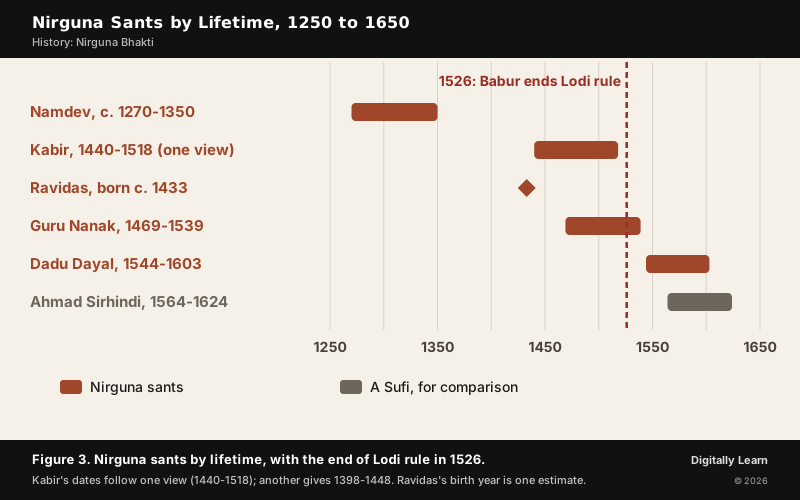
Kabir is one of the most outstanding poet-saints of the age, and one of the least certain in his dates. NCERT places him in the fourteenth to fifteenth century in one textbook and the fifteenth to sixteenth in another; historians favour either 1398 to 1448 or 1440 to 1518. His life has been reconstructed from the verses attributed to him and from hagiographies written about 200 years after his lifetime.
Kabir's legacy was claimed by several groups, which is why his birth was debated. Vaishnava hagiographies suggest he was born a Hindu, Kabirdas, but raised by a poor Muslim family of julahas, weavers who were relatively recent converts to Islam; in one account the infant was found at Lahartara Lake by a weaver named Niru and his wife Nima. The name Kabir is an Arabic word meaning great. His ideas probably took shape through dialogue with the Sufis and yogis of Awadh.
The family that raised him lived in or near Banaras, and the tradition remembers him as a weaver at his loom.
Kabir Bijak, Granthavali, Sant Bhasha and Ulatbansi: Kabir's Verse
Kabir's verses survive in three overlapping traditions, all compiled long after his death:
- Kabir Bijak: It is preserved by the Kabirpanth in Varanasi and elsewhere in Uttar Pradesh.
- Kabir Granthavali: It is associated with the Dadupanth in Rajasthan.
- Adi Granth: Many of his compositions are in the Sikh scripture.
His poems are in several languages and dialects. Some are in sant bhasha, the special language of the nirguna poets; others are ulatbansi, upside-down sayings that invert everyday meanings, such as the lotus that blooms without a flower or the fire raging in the ocean, to hint at how hard it is to put the Ultimate Reality into words.
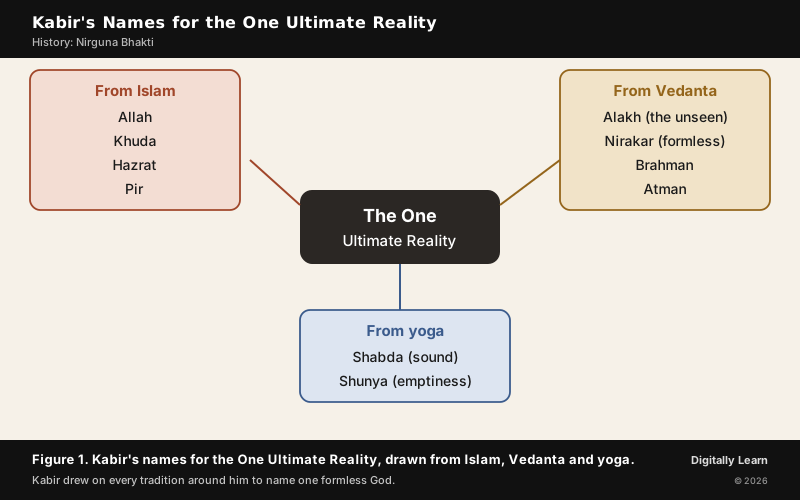
To name that reality Kabir drew on every tradition around him. In one well-known composition he asks how there can be two lords of the world, since God is called by many names, Allah, Ram, Karim, Keshav, Hari and Hazrat, just as gold shaped into rings and bangles is gold all the same.
Kabir's Teachings: Critique of Ritual and Caste, and the Kabirpanth
Kabir believed in a formless Supreme God and preached that the only path to salvation was bhakti. He rejected the outward religiosity of both communities. Some of his poems use Islamic monotheism and iconoclasm to attack Hindu polytheism and idol worship, while others use the Sufi ideas of zikr and ishq to express nam-simaran, the remembrance of God's name. In the composition on the one Lord he says Hindus and Muslims are both mistaken, one killing the goat and the other cows, and waste their lives in dispute. The influences on his thought came from the Sufis, yogis and bhaktas of his own time; Ahmad Sirhindi (1564‑1624), the Naqshbandi reformer of the Mughal age, was born after Kabir's death on either dating.
Kabir drew followers from among both Hindus and Muslims, and the Kabirpanth, the path of Kabir, still preserves his Bijak. Whether or not every verse is his, the corpus has made him a source of inspiration to this day for those who question entrenched religious and social institutions.
Kabir's samadhi stands at Maghar, in Sant Kabir Nagar district of Uttar Pradesh, a place where legend says Kabir, Guru Nanak and Baba Gorakhnath once met in spiritual discussion. On his 500th death anniversary the foundation of a Sant Kabir Academy was laid there, and the Academy and Research Centre was inaugurated on 5 June 2022.
Guru Nanak: Life, Teachings and the Foundations of Sikhism
Guru Nanak's Life: Talwandi, Travels and Kartarpur
Born into a Hindu merchant family at Talwandi, now Nankana Sahib in Pakistan, Guru Nanak (1469‑1539) grew up near the river Ravi in the largely Muslim Punjab. He trained as an accountant, studied Persian and married young, but spent most of his time among Sufis and bhaktas, and travelled widely.
He then set up a centre at Kartarpur on the Ravi. There a regular worship of singing his own hymns was established, and his followers, whatever their former creed, caste or gender, ate together in the common kitchen, the langar.
Kartarpur now lies in Pakistan. Under an agreement signed on 24 October 2019, the Kartarpur Sahib Corridor, from Dera Baba Nanak to the international border, opened to let Indian pilgrims visit, without a visa, Gurdwara Darbar Sahib Kartarpur on the banks of the Ravi, where Guru Nanak spent the last 18 years of his life. India suspended the corridor on 7 May 2025, after the Pahalgam attack.
Teachings of Guru Nanak: Nam, Shabad, Sangat and Langar
Guru Nanak taught a form of nirguna bhakti. He firmly rejected the external practices of the religions around him, such as sacrifices, ritual baths, image worship, austerities and the scriptures of both Hindus and Muslims. For him the Absolute (Rab) had no gender or form. His teaching rested on a few practices:
- Nam: Remembering and repeating the divine name as the simple way to connect with God.
- Shabad: Hymns in Punjabi, the language of the region, which he sang in various ragas while his companion Mardana played the rabab.
- Sangat: Congregational worship with collective recitation.
- Langar: The common kitchen, where all ate together.
He organised his followers into a community and, before his death in 1539, appointed his disciple Lehna as his successor, Guru Angad, a practice followed for nearly 200 years. He does not appear to have wished to found a new religion, but after his death his followers consolidated their own practices and set themselves apart from both Hindus and Muslims.
From Guru Nanak to the Guru Granth Sahib and the Khalsa
The fifth Guru, Guru Arjan, compiled Guru Nanak's hymns with those of his four successors and of other religious poets, Baba Farid, Ravidas and Kabir among them, in the Adi Granth, completed in 1604. These hymns, the gurbani, are in various languages.
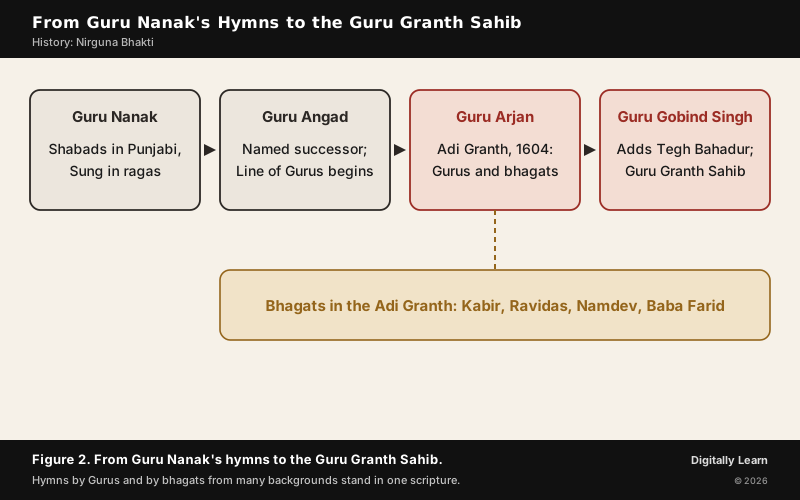
In the late seventeenth century the tenth Guru, Guru Gobind Singh, added the compositions of the ninth, Guru Tegh Bahadur, and the scripture became the Guru Granth Sahib. He also founded the Khalsa Panth, the army of the pure, with its five symbols of uncut hair, a dagger, a pair of shorts, a comb and a steel bangle. Other Gurus shaped the community between them: Guru Amar Das, the third, divided the congregations into 22 manji zones, and Guru Hargobind wore two swords that represented miri and piri.
| Guru | Contribution |
|---|---|
| Guru Nanak (first) | Nam, shabad, sangat, langar; the community at Kartarpur |
| Guru Angad (second) | Named successor; the line of Gurus begins |
| Guru Amar Das (third) | 22 manji zones for the congregations |
| Guru Arjan (fifth) | Compiled the Adi Granth, completed in 1604 |
| Guru Hargobind (sixth) | Two swords representing miri and piri |
| Guru Gobind Singh (tenth) | Added Guru Tegh Bahadur's hymns; Guru Granth Sahib; the Khalsa |
Ravidas, Dadu Dayal and the Wider Body of Nirguna Sants
Ravidas and Begampura, Dadu Dayal and the Bhagat Bani
Ravidas, also called Raidas, was a mystic poet-saint of the fifteenth and sixteenth centuries, born, some scholars believe, in 1433, to parents of a leather-working Chamar community counted untouchable. He taught the removal of social divisions of caste and gender, and his devotional verses are in the Guru Granth Sahib. He is venerated as a guru across Uttar Pradesh, the Punjab, Rajasthan, Maharashtra and beyond.
His vision is summed up in Begampura, "the city without sorrow", a society he imagined without taxes, property or caste, where people once divided by caste could become true friends. Ravidas could not build it in the real world, while Guru Nanak began his own form of it at Kartarpur.
Dadu Dayal (1544‑1603) was a poet-saint and reformer of Rajasthan who spoke against formalism and priestcraft. He settled at Naraina near Jaipur, where his followers formed the Dadupanth, the sect that preserves the Kabir Granthavali. Born after the Lodi dynasty had fallen, he belongs to the age of Akbar.
The voices of the sants were gathered in the Sikh scripture. Besides the Gurus, it includes the Bhagat Bani, the hymns of 15 bhagats, among them Kabir, Ravidas, Namdev and Baba Farid, so that sants of very different origins are read and sung together.
Significance of the Nirguna Sants: Caste, Language and Sikhism
Social Radicalism and Legacy of the Sants: Caste, Ritual and the Sikh Panth
Their critique of caste and ritual, heard in Kabir's verses, Nanak's langar and Ravidas's Begampura, reached the working castes from which many of them came. Kabir was raised among weavers, Ravidas was born into a leather-working family, Namdev was a tailor (shimpi) and Sena Nhavi a barber, and craftspersons, peasants, traders and labourers thronged to hear them.
The limits are also clear. The sants changed how devotion was imagined more than the institutions of caste, and the very groups that claimed Kabir later argued over whether he was Hindu or Muslim, so the old boundaries returned around his memory.
The sants left three lasting legacies. Their language, sant bhasha and the vernacular Hindi and Punjabi of their hymns, made devotion accessible to ordinary people. Their borrowing from Islam, Vedanta, yoga and Sufism made their poetry a meeting place of traditions. And from Guru Nanak's community came Sikhism, with its scripture that holds the voices of Kabir, Ravidas, Namdev and Farid beside those of the Gurus.
Previous Year UPSC‑CSE Questions
Each Prelims question is explained option by option, and each Mains question comes with an answer outline.
- UPSC Prelims 2019Consider the following statements:
- Saint Nimbarka was a contemporary of Akbar.
- Saint Kabir was greatly influenced by Shaikh Ahmad Sirhindi.
Which of the statements given above is/are correct?
How to approach this Prelims question
Approach: The question turns on dating each saint against the figure named with him.
- Statement 1: Nimbarka is placed in the twelfth or thirteenth century, or even the sixth or seventh, never in Akbar's time, so it is wrong.
- Statement 2: Kabir died before Sirhindi was born in 1564, on either dating of his life, so it is wrong.
Trap to watch: Both statements join a real saint to a figure of another age.
Why each option is right or wrong:
- (a) 1 only: Wrong. Nimbarka was not Akbar's contemporary.
- (b) 2 only: Wrong. Kabir lived before Sirhindi.
- (c) Both 1 and 2: Wrong. Both are false.
- (d) Neither 1 nor 2: Correct. Nimbarka lived centuries before Akbar, and Kabir before Sirhindi.
Answer: (d) Neither 1 nor 2. Nimbarka lived centuries before Akbar, and Kabir died before Sirhindi was born.
- UPSC Prelims 2014Consider the following statements:
- 'Bijak' is a composition of the teachings of Saint Dadu Dayal.
- The Philosophy of Pushti Marg was propounded by Madhvacharya.
Which of the statements given above is/are correct?
How to approach this Prelims question
Approach: The question turns on pairing each text or school with its founder.
- Statement 1: The Bijak is a compilation of Kabir's verses, kept by the Kabirpanth, not Dadu Dayal's, so it is wrong.
- Statement 2: The Pushti Marg was founded by Vallabha, while Madhvacharya taught Dvaita, so it is wrong.
Trap to watch: Dadu's Dadupanth keeps the Kabir Granthavali, which makes the Dadu-Kabir mix-up tempting.
Why each option is right or wrong:
- (a) 1 only: Wrong. The Bijak is Kabir's.
- (b) 2 only: Wrong. The Pushti Marg is Vallabha's.
- (c) Both 1 and 2: Wrong. Both pairings are false.
- (d) Neither 1 nor 2: Correct. Bijak belongs to Kabir and the Pushti Marg to Vallabha.
Answer: (d) Neither 1 nor 2. The Bijak holds Kabir's teachings, and the Pushti Marg was Vallabha's.
- UPSC Prelims 2013Consider the following Bhakti Saints :
- Dadu Dayal
- Guru Nanak
- Tyagaraja
Who among the above was/were preaching when the Lodi dynasty fell and Babur took over?
How to approach this Prelims question
Approach: The question turns on which saints were alive and preaching in 1526, when the Lodi dynasty fell. Guru Nanak (1469‑1539) was preaching then. Dadu Dayal was born in 1544 and Tyagaraja in 1767, both after the event, so only Guru Nanak fits.
Trap to watch: Dadu Dayal sounds like an early sant, but he was born 18 years after 1526.
Why each option is right or wrong:
- (a) 1 and 3: Wrong. Neither Dadu nor Tyagaraja was alive in 1526.
- (b) 2 only: Correct. Guru Nanak lived from 1469 to 1539.
- (c) 2 and 3: Wrong. Tyagaraja lived from 1767 to 1847.
- (d) 1 and 2: Wrong. Dadu Dayal was born in 1544.
Answer: (b) 2 only. Only Guru Nanak (1469‑1539) was preaching when Babur ended Lodi rule in 1526.
- UPSC Prelims 2002Who among the following was the first Bhakti saint to use Hindi for the propagation of his message?
How to approach this Prelims question
Approach: The question turns on which of the four saints taught in Hindi first. Ramananda, a fourteenth-century saint, taught in vernacular Hindi and is a pioneer of north Indian bhakti. Kabir is remembered as his disciple, and Dadu and Tulsidas lived in the sixteenth century.
Trap to watch: Kabir is the best-known Hindi sant, but Ramananda came before him.
Why each option is right or wrong:
- (a) Dadu: Wrong. Dadu Dayal lived from 1544 to 1603, long after Ramananda.
- (b) Kabir: Wrong. He used Hindi and sant bhasha, but came after Ramananda.
- (c) Ramananda: Correct. He taught in vernacular Hindi to make knowledge accessible to the masses.
- (d) Tulsidas: Wrong. He wrote in Awadhi in the sixteenth century.
Answer: (c) Ramananda. He taught in vernacular Hindi before Kabir, Dadu and Tulsidas.
- UPSC Prelims 2001Match List I with List II and select the correct answer using the codes given below the Lists:List I (Bhakti Saint)
- I. Namdev
- II. Kabir
- III. Ravidas
- IV. Sena
List II (Profession)
- A) Barber
- B) Weaver
- C) Tailor
- D) Cobbler
Codes:
How to approach this Prelims question
Approach: The question turns on the trade of each sant's family. Namdev was a shimpi, a tailor (C). Kabir was raised in a family of julahas, weavers (B). Ravidas came from a leather-working family, a cobbler (D). Sena Nhavi was a barber (A). The match is I‑C, II‑B, III‑D, IV‑A.
Trap to watch: Options (a) and (c) swap Ravidas and Sena; the name Nhavi itself means barber.
Why each option is right or wrong:
- (a) I‑B, II‑C, III‑A, IV‑D: Wrong. It makes Namdev the weaver and Kabir the tailor.
- (b) I‑C, II‑B, III‑D, IV‑A: Correct. Namdev tailor, Kabir weaver, Ravidas cobbler, Sena barber.
- (c) I‑C, II‑B, III‑A, IV‑D: Wrong. It makes Ravidas the barber and Sena the cobbler.
- (d) I‑B, II‑C, III‑D, IV‑A: Wrong. It swaps Namdev and Kabir.
Answer: (b) I‑C, II‑B, III‑D, IV‑A. Namdev was a tailor, Kabir a weaver, Ravidas a cobbler and Sena a barber.
- UPSC Prelims 1996Which one of the following pairs is correctly matched?
How to approach this Prelims question
Approach: The question turns on matching each Guru with the institution he founded. The Adi Granth was compiled by Guru Arjan and completed in 1604, so pair (b) is correct. Miri and piri belong to Guru Hargobind, the manji system to Guru Amar Das, and the Dal Khalsa to the eighteenth century, long after Guru Ram Das.
Trap to watch: The wrong pairs each use a real Sikh institution with the wrong Guru.
Why each option is right or wrong:
- (a) Guru Amar Das … Miri and Piri: Wrong. Miri and piri were Guru Hargobind's; Amar Das set up the manjis.
- (b) Guru Arjan Dev … Adi Granth: Correct. He compiled the Adi Granth, completed in 1604.
- (c) Guru Ram Das … Dal Khalsa: Wrong. The Dal Khalsa was the eighteenth-century force of the Sikh misls.
- (d) Guru Gobind Singh … Manji: Wrong. The manji system was Guru Amar Das's; Gobind Singh founded the Khalsa.
Answer: (b) Guru Arjan Dev … Adi Granth. Guru Arjan Dev compiled the Adi Granth, completed in 1604.
- UPSC Mains 2023 GS‑IVWhat were the major teachings of Guru Nanak? Explain their relevance in the contemporary world.
Answer outline
The outline sets out what the question asks, the main arguments, relevant examples and the direction of the conclusion; it is not a full model answer.
Introduction: Guru Nanak (1469‑1539), the nirguna saint whose community grew into Sikhism, taught devotion to one God without form or gender.
Body (sub-themes to develop):
- Equality: Langar and sangat across caste, creed and gender; relevance to discrimination and social exclusion today.
- Devotion over ritual: Nam over sacrifices, ritual baths and image worship; relevance to superstition and to inner integrity.
- Language of the people: Hymns in Punjabi sung in ragas, a community of worshippers; relevance to making ethics and faith accessible to all.
- Dialogue: Time among Sufis and bhaktas, hymns that later sat beside Kabir's and Farid's; relevance to interfaith harmony.
Conclusion: Equality, service and devotion without ritual remain a working ethic for public life, not only a religious teaching.
Sources
- NCERT: Themes in Indian History II (Class XII), Bhakti-Sufi Traditions
- PIB: PM pays homage to the great saint and poet Kabir at Sant Kabir Nagar (Maghar)
- PIB: President inaugurates Sant Kabir Academy and Research Centre, Maghar (5 June 2022)
- PIB: PM inaugurates Integrated Check Post at Kartarpur Sahib Corridor
- PIB: Cabinet approves commemoration of the 550th birth anniversary of Guru Nanak Devji
- Ministry of Home Affairs: Pilgrimage to Sri Kartarpur Sahib, the corridor portal
- Akashvani News: Kartarpur Sahib Corridor provides free facility to pilgrims
- Wikipedia: Sant Mat
- Wikipedia: Ramananda
- Wikipedia: Kabir
- Wikipedia: Kabir panth
- Wikipedia: Bijak
- Wikipedia: Guru Nanak
- Wikipedia: Kartarpur Corridor
- Wikipedia: Guru Granth Sahib
- Wikipedia: Bhagat Bani
- Wikipedia: Manji (Sikhism)
- Wikipedia: Guru Hargobind
- Wikipedia: Dal Khalsa (Sikh Army)
- Wikipedia: Ravidas
- Wikipedia: Begampura
- Wikipedia: Dadu Dayal
- Wikipedia: Lodi dynasty
- Wikipedia: Akbar
- Wikipedia: Namdev
- Wikipedia: Sena Nhavi
- Wikipedia: Ahmad Sirhindi
- Wikipedia: Nimbarka
- Wikipedia: Pushtimarg
- Wikipedia: Madhvacharya
- Wikipedia: Tyagaraja
- Wikipedia: Tulsidas
- UPSC: Civil Services Examination question papers
Editorial Disclaimer
Dates for Kabir differ between NCERT textbooks and historians, and both views are given.
See more of our UPSC articles in Google Search
Add to Preferred Sources

