


Overview
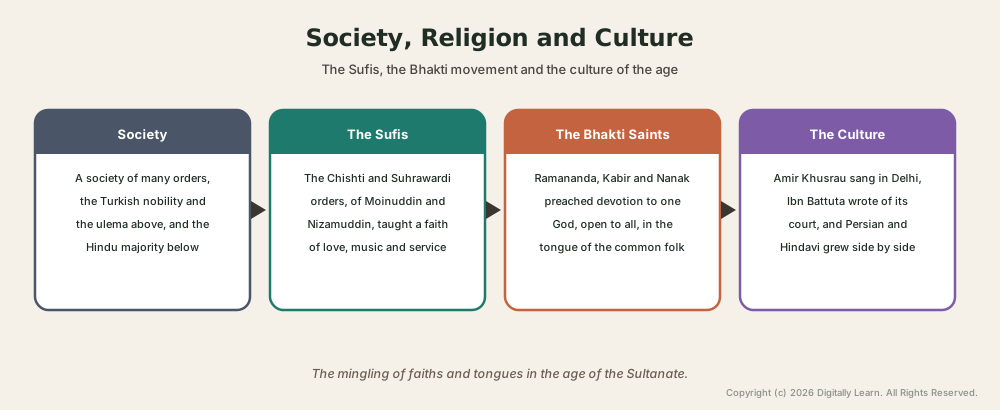
Beneath the wars and the dynasties, the age of the Delhi Sultanate was one of deep change in the religion and culture of India. Its society held many orders, the Turkish and Afghan nobility and the ulema above, the great Hindu majority below. Its religion was stirred by two mighty movements of devotion: the Sufis, the Muslim mystics of the Chishti and Suhrawardi orders, who taught a faith of love and service; and the Bhakti saints, like Kabir and Guru Nanak, who preached devotion to one God, open to all. And its culture found a great voice in the poet Amir Khusrau. This part covers society, the Sufi movement, the Bhakti movement and the culture of the age, and the exam focus.
The Society of the Sultanate
The Social Order of the Sultanate
What is the significance of the social order: the Sultanate set a Muslim ruling class over a great Hindu majority, and the meeting of the two shaped the whole life of the age.
At the top stood the ruling class, the Turkish and later Afghan nobility and, beside them, the ulema, the learned men of the Muslim law who guarded the faith. Below them lay the great mass of the people, the Hindu majority, who were treated as zimmis, the protected non-Muslims, and paid the jizya, the tax laid on them for that protection.
Most of the people were peasants, who tilled the land; with them were the artisans of the towns, the merchants, and a great many slaves. The position of women was on the whole a confined one, in both communities. The table below sets out the chief orders of the society of the Sultanate.
| Order | Place in Society |
|---|---|
| The nobility | The Turkish and Afghan ruling class, holders of the iqtas. |
| The ulema | The learned men of the Muslim law, guardians of the faith. |
| The Hindu majority | Treated as zimmis, the protected, who paid the jizya. |
| Peasants and artisans | The mass of the people, who tilled the land and plied the crafts. |
The Sufi Movement
The Sufi Orders: the Chishti and the Suhrawardi
What is the significance of the Sufis: they were the mystics of Islam, who sought God by love rather than law, and their gentle faith won many hearts and softened the bounds between the religions.
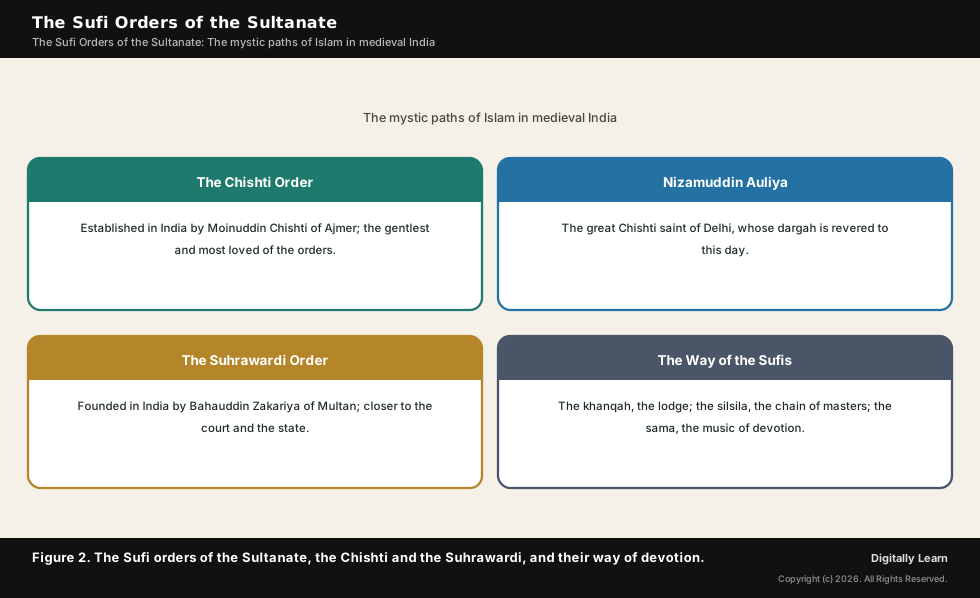
The Sufis were grouped into orders, or silsilas, each a chain of masters and disciples. The greatest in India was the Chishti order, which was established here by Moinuddin Chishti, who settled at Ajmer; its most famous saint was Nizamuddin Auliya of Delhi. Beside it stood the Suhrawardi order, founded in India by Bahauddin Zakariya of Multan.
The two orders differed in temper. The Chishti saints lived in poverty, kept apart from the court, served the poor, and welcomed music, the sama, as a way to God; the Suhrawardi saints, by contrast, accepted the wealth and the favour of the state. The figure below sets out the Sufi orders and their way.
The Khanqah, the Sama and the Way of the Sufis
Distinguishing the way of the Sufis: their life was lived in the khanqah and the company of the master, and their worship was a worship of the heart.
The Sufi lived in the khanqah, the lodge where the master, the pir, gathered his disciples, the murids, about him. There he taught the path to God, by prayer and by the remembrance of His name, the zikr; and among the Chishtis, by the sama, the listening to devotional song that could carry the soul into ecstasy.
The Sufis won a wide love. They preached a religion of the heart, of love and of service to all, that crossed the line between Muslim and Hindu and drew many of both faiths to their doors. Their dargahs, the tombs of the great saints, became places of pilgrimage for all, as the dargah of Nizamuddin in Delhi is to this day.
The Bhakti Movement and the Culture of the Age
The Bhakti Saints of the North
What is the significance of the Bhakti saints: they carried into the north a faith of loving devotion to one God, open to all castes, that ran beside the Sufi movement and often met it.
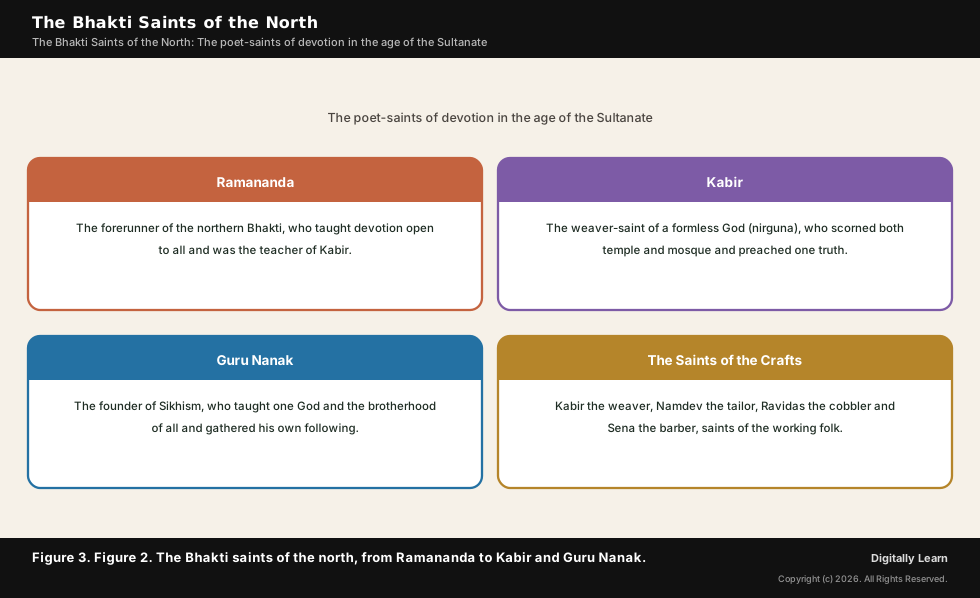
The Bhakti movement of the north grew strong in the later centuries of the Sultanate. Its forerunner was Ramananda, who taught a devotion open to all; from his school came its greatest voice, Kabir, the weaver of Banaras, who worshipped a formless God, the nirguna, and scorned alike the temple and the mosque, the Brahmin and the mullah, preaching one truth above them both.
Beside Kabir rose Guru Nanak, who taught one God and the brotherhood of all and founded the faith of the Sikhs. Many of the Bhakti saints came from the working folk: Kabir the weaver, Namdev the tailor, Ravidas the cobbler, Sena the barber. The figure below sets out the Bhakti saints of the north.
Amir Khusrau and the Writers of the Age
Distinguishing the culture of the age: the Sultanate was a great age of letters and of the mingling of tongues, and it has left us its story in the words of its poets, its travellers and its historians.
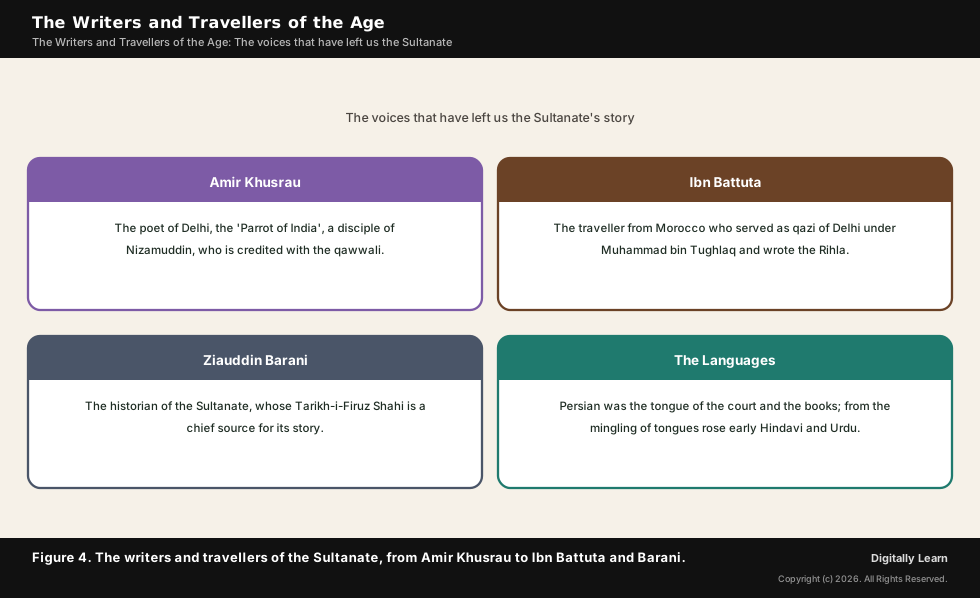
Its greatest poet was Amir Khusrau, the 'Parrot of India', a disciple of the saint Nizamuddin Auliya, who wrote in Persian and is credited by tradition with the qawwali, the Sufi devotional song. The Moroccan traveller Ibn Battuta, who served as the qazi of Delhi under Muhammad bin Tughlaq, has left a vivid account of the age in his book, the Rihla.
The historians too were busy. Ziauddin Barani wrote the Tarikh-i-Firuz Shahi, a chief source for the story of the Sultanate. The tongue of the court and the books was Persian; but from the daily mingling of Persian with the speech of the people grew the early forms of Hindavi and Urdu. The figure below sets out the writers and travellers of the age.
UPSC Relevance and Exam Focus
Where the Sufis and the Bhakti Saints Fit in the UPSC-CSE Syllabus
This topic belongs to General Studies Paper I: medieval Indian history and culture, and the Sufi and Bhakti movements are among the most heavily tested of all its themes, in both Prelims and Mains.
The questions most often test the Sufi orders, above all the Chishti and its saints, the Bhakti saints and their teachings, and the great poet Amir Khusrau.
Several linked points recur and are worth holding in working memory:
- The Chishti order: Established in India by Moinuddin Chishti, who settled at Ajmer.
- Nizamuddin Auliya: The great Chishti saint of Delhi, master of Amir Khusrau.
- Kabir: The weaver-saint of a formless God (nirguna), who scorned temple and mosque.
- Guru Nanak: The Bhakti saint who founded the faith of the Sikhs.
- Amir Khusrau: The poet of Delhi, credited by tradition with the qawwali.
A 1997 question held that Moinuddin Chishti was indeed the most prominent figure of the Chishti order in India, so the assertion was true; but the reason, that the order took its name from a village Chishti in Ajmer, was false, for the order is named after Chisht, a town near Herat. So the assertion was true and the reason false.
A 2001 question matched Bhakti saints to their callings: Kabir the weaver, Namdev the tailor, Ravidas the cobbler and Sena the barber, a reminder that the Bhakti saints often came from the working folk. And a Mains question of 2014 asked whether the Sufis and the saints failed to change Hindu and Muslim society; the answer is that, though they did not overturn its outward forms, they deeply softened its spirit.
Previous Year UPSC-CSE Questions
Previous Year UPSC-CSE Questions By the end you will be able to draft model answers for the following UPSC questions. Each question carries a collapsible framework showing how to approach it in the exam.
- UPSC Prelims 1997 GS-IConsider the following assertion and reason about the Chishti order of the Sufis:
- Assertion (A): The sponsor and the most prominent figure of the Chisti order of Sufis in India is Khwaja Moinuddin Chisti.
- Reason (R): The Chisti order takes its name from a village Chisti in Ajmer.
In the context of the above two statements, which one of the following is correct?
How to approach this Prelims question
Approach: Test the assertion and the reason separately: Moinuddin Chishti as the most prominent figure in India (true); the order named after a village in Ajmer (false, it is named after Chisht near Herat).
Trap to watch: Do not think the Chishti order is named after Ajmer; Ajmer is where Moinuddin settled, but the order is named after Chisht, a town near Herat.
Key facts to recall:
- Moinuddin Chishti established the Chishti order in India and settled at Ajmer.
- The order is named after Chisht, a town near Herat, not Ajmer.
- The assertion is true but the reason is false.
Answer signal: A is true, but R is false.
- UPSC Prelims 2001 GS-IMatch List I (the Bhakti saint) with List II (his profession): I. Namdev, II. Kabir, III. Ravidas, IV. Sena; with A) Barber, B) Weaver, C) Tailor, D) Cobbler.
- Namdev
- Kabir
- Ravidas
- Sena
Select the correct answer using the codes given below the lists.
How to approach this Prelims question
Approach: Anchor on the well-known pair, Kabir the weaver (II-B); then fit Namdev the tailor (I-C), Ravidas the cobbler (III-D) and Sena the barber (IV-A).
Trap to watch: Do not pair Kabir with the cobbler (that is Ravidas) or Namdev with the barber (that is Sena); Kabir was a weaver, Namdev a tailor.
Key facts to recall:
- Kabir was a weaver; Namdev a tailor.
- Ravidas was a cobbler; Sena a barber.
- The Bhakti saints often came from the artisan castes.
Answer signal: I-C, II-B, III-D, IV-A.
- UPSC Mains 2014 GS-ISufis and medieval mystic saints failed to modify either the religious ideas and practices or the outward structure of Hindu / Muslim societies to any appreciable extent. Comment.
How to structure the answer in the exam
Introduction: The Sufi and Bhakti saints of the medieval age worked a change that was deeper in spirit than in outward form, so the statement is true only in part.
Body (sub-themes to develop):
- In support: the outward structures held – caste among the Hindus, the orthodox ulema among the Muslims, the formal creeds and rites continued.
- Against: the saints preached a religion of the heart, of love and devotion, open to all castes and both faiths.
- Against: they drew Hindu and Muslim to common shrines and a shared devotional life, softening the bounds between the communities.
- Against: they fostered the vernacular tongues (the saints sang in the people's speech) and a lasting syncretic culture.
- Against: figures like Kabir and Guru Nanak founded new and enduring traditions of their own.
Conclusion: The saints did not break the outward structure of either society, but they so softened its spirit and enriched its culture that the statement, taken whole, cannot stand.
Sources and Further Reading
Editorial Disclaimer
This article is for UPSC preparation. The religious and cultural history of the Sultanate rests on the Sufi records, the Bhakti poetry and the Persian chronicles, and follows the standard scholarship on the period.