


Overview
The Sufi movement was the growth of tasawwuf, the mystical path within Islam, which sought God through love, remembrance and the training of the heart. It began among the ascetics of eighth-century Iraq, took shape in the teaching of Rabia, Junayd and al-Ghazali, and from the eleventh century spread into India, where it met the Bhakti saints and shaped a shared devotional culture.
What Is Sufism: Meaning, Origin and the History of Sufism
Sufism Meaning: Tasawwuf, and the Words Suf, Safa and Suffa
Sufism is an English word, coined in the nineteenth century. The Islamic texts call it tasawwuf, an inner discipline concerned with spiritual excellence (ihsan), the purification of the heart and remembrance of God, with an ardent love of God at its centre. Historians have explained the word in three ways:
- Suf: Wool, after the coarse woollen clothes the early Sufis wore.
- Safa: Purity, after the purity of heart they sought.
- Suffa: The platform outside the Prophet’s mosque, where a group of his close followers gathered to learn about the faith.
Whichever root is right, the idea behind the word is the same. The Sufis sought salvation through intense devotion and love for God, followed the example of the Prophet as a perfect human being, and read the Qur'an in the light of their own experience.
Origin of Sufism in Islam: Asceticism Against the Worldliness of the Caliphate
Sufism originated in Iraq, among the ascetics of Basra, as a protest. In the early centuries of Islam a group of religious-minded people turned to asceticism and mysticism against the growing materialism of the Caliphate. They were critical of the dogmatic definitions and scholastic methods the theologians used to interpret the Qur'an and the sunna.
The founding figure of this mood was Hasan al-Basri (642 to 728), a preacher of Basra who spoke against worldliness and materialism in the early days of the Umayyad Caliphate and urged renunciation (zuhd). Later Sufi chains of teachers traced themselves back through him. By the eleventh century Sufism had grown into a well-developed movement with its own literature, and around the twelfth century it settled into orders, the silsilas, each built around a master and his disciples.
Where did Sufism come from? Orientalist scholars once traced it to sources outside Islam: Buddhism, Neo-Platonism, Christian asceticism or Gnosticism. Modern scholars have rejected these theories of a non-Islamic origin. The Sufis themselves held the Prophet Muhammad as the model of the path, and the poet Saadi warned that anyone who chose a way contrary to the Prophet's would never reach the destination.
Early Sufi Masters: Rabia, Bayazid, Junayd, Hallaj and al-Ghazali
Rabia, Bayazid, al-Hallaj and the Persian Poets of Divine Love
Rabia of Basra (about 716 to 801), a woman ascetic and one of the earliest Sufis, is said in Sufi accounts to have been the first to set forth the doctrine of divine love, ishq. Her best-known sayings ask that God be worshipped out of love alone, not out of fear of punishment or desire for reward. Very little is known of her life for certain. Figure 1 sets the early masters side by side in time.
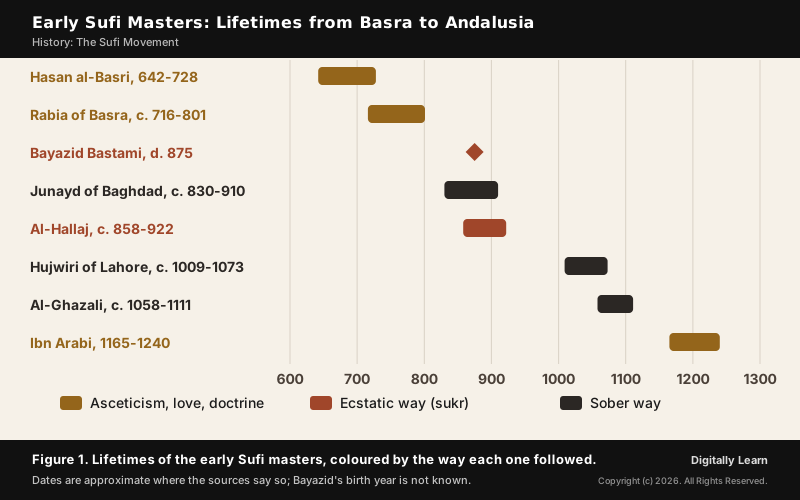
Two Persians took love to its boldest point. Bayazid Bastami (died 875) became famous for his ecstatic sayings about the passing away of the self, and is remembered with the drunken, or ecstatic, school. The teacher who taught him the idea of fana, Abu Ali al-Sindhi, was a Hindu convert from Sindh. Mansur al-Hallaj (about 858 to 922) went further. His cry ana al-Haqq, I am the Truth, was read by the jurists as a claim to divinity, and he was executed at Baghdad in 922; his followers understood it as the voice of God speaking through a self that had passed away.
Persians played a huge role in shaping Sufism. Junayd himself was a Persian of Baghdad, and the great poets of the tradition wrote in Persian: Rudaki, Sanai, Attar of Nishapur, Nizami Ganjavi, Rumi, Saadi, Hafez and Jami. Their poems still resonate across the Muslim world:
- Rumi: The Masnavi.
- Attar of Nishapur: The Conference of the Birds.
- Saadi: The Bustan.
- Hafez: The Divan.
This Persian literature is why Sufism came to India through Persian. The first Sufi treatise written in India, al-Hujwiri's Kashf al-Mahjub, was in Persian, while the Chishti saints of Delhi later spoke to the people in Hindavi.
Junayd's Sober Sufism and al-Ghazali's Reconciliation with Orthodoxy
Against the ecstatics stood Junayd of Baghdad (about 830 to 910), whose teaching laid the foundations of later Sufi doctrine. He insisted that Sufi experience must stay governed by religious law and orthodox conduct, and became the voice of sober Sufism. He taught that all things come from God and return to live in Him, and that the Sufi anticipates this return in fana. The two temperaments ran through the whole later history of the movement:
| Point | Sober way | Intoxicated way (sukr) |
|---|---|---|
| Leading figure | Junayd of Baghdad | Bayazid Bastami, al-Hallaj |
| Experience | Kept within the shari'a | Ecstatic, spoken openly |
| What became of them | Hujwiri revered as Data Ganj Bakhsh | Al-Hallaj executed at Baghdad, 922 |
Al-Ghazali (about 1058 to 1111) made the peace between Sufism and the theologians. After a spiritual crisis he left his chair at the Nizamiyya of Baghdad, the most prestigious teaching post of the Muslim world, and withdrew for over ten years, writing his major works. The greatest of them, the Ihya ulum al-din, The Revival of the Religious Sciences, brought orthodox Sunni theology and Sufi mysticism together into one guide to Muslim life; his Tahafut al-Falasifa, the Incoherence of the Philosophers, is a landmark in the history of philosophy. Sunnis honour him as Hujjat al-Islam, the Proof of Islam.
Sufi Doctrines: Fana and Baqa, Maqamat and Ahwal, Wahdat al-Wujud
The Sufi Path: Sharia, Tariqa, Haqiqa, Marifa and the Seven Maqamat
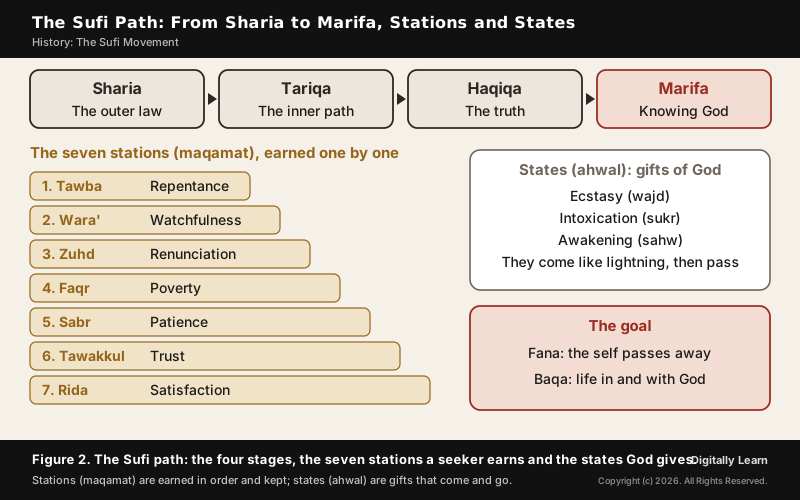
Sufis pictured the search for God as a journey along a path, the tariqa. It begins with the sharia, the outer law every Muslim keeps, passes through the inner path, and leads to haqiqa, the truth, and finally to marifa, knowing God directly. Figure 2 shows the stages and what the seeker meets on the way.
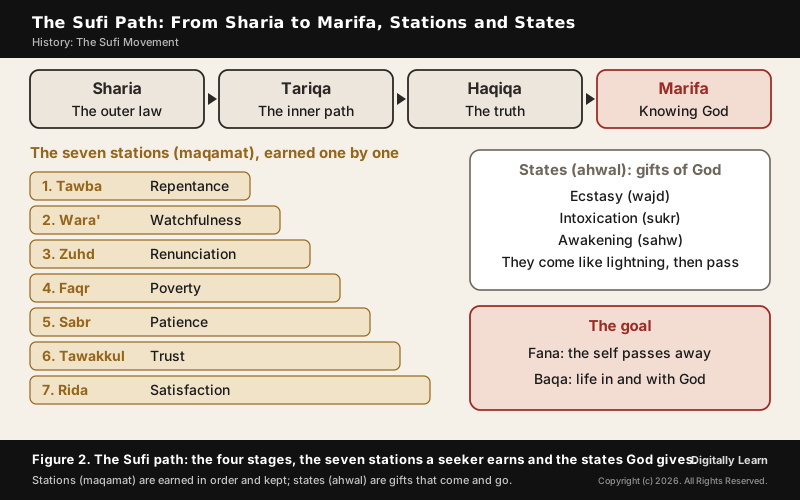
Along the path the seeker earns a series of maqamat, stations. Each is reached by effort, only after the one before, and is kept once gained. Most Sufis count seven:
- Tawba (repentance): Turning back to God from sin, with the promise not to repeat it.
- Wara’ (watchfulness): Avoiding the grey area between the forbidden and the permitted.
- Zuhd (renunciation): Giving up the desire for what is forbidden or uncertain.
- Faqr (poverty): No desire for worldly wealth; the Prophet is reported to have said that poverty was his pride.
- Sabr (patience): In Junayd’s words, bearing the burden for God’s sake until the hardship passes.
- Tawakkul (trust): Trusting that whatever is denied is in agreement with destiny.
- Rida (satisfaction): Acceptance, called the greatest gate to God.
The ahwal, states, are different. Ecstasy, intoxication and awakening come as gifts of God, like flashes of lightning, and pass; no effort can force them or hold them.
Fana and Baqa: Passing Away of the Self and Life in God
The goal of the path is fana, the passing away of the self, sometimes described as dying before one dies. Sufis disagreed on what it meant. For some it was the full annihilation of the ego before God; for the sober masters, Junayd and al-Ghazali among them, it was a vision of God in which the lower self loses its hold. Al-Hujwiri put it simply: fana is the passing away of all remembrance of anything other than God.
Fana is followed by baqa, subsistence or lasting life in God. The self is not reduced to nothing; it is purified and lives on through God, in God and for God. In al-Hujwiri's words, baqa is the subsistence of the remembrance of God. Scholars trace the pair through a line of early masters, from Dhu'l-Nun of Egypt to Junayd, who spread it among the Sufis, and al-Hallaj, who proclaimed it in public.
Wahdat al-Wujud and Wahdat al-Shuhud: The Great Sufi Debate
The biggest argument in Sufi thought was about how the world relates to God. Ibn Arabi (1165 to 1240), a mystic from al-Andalus called Shaykh al-Akbar, the greatest master, was the first to set out wahdat al-wujud, the unity of being: everything in the universe is a manifestation of one single reality. Some 850 works are attributed to him, of which about 400 survive, among them the Futuhat al-Makkiyah and the Fusus al-hikam, where he developed the idea of the perfect human being, al-insan al-kamil. His cosmology became the dominant intellectual framework in many regions of the Muslim world.
In Mughal India the Naqshbandi master Ahmad Sirhindi (1564 to 1624) answered it with wahdat al-shuhud, the unity of appearance. For him the sense of oneness with God is only an experience in the mind of the Sufi who has lost himself in God; creation never actually unites with its Creator. The debate is followed in detail on the Sufi silsilas page.
Sufi Practices: Zikr, Sama, the Pir and the Khanqah
Zikr and Sama: Remembrance of God and Spiritual Music
Zikr, remembrance, is the repeated recitation of the names of God or of a sacred formula. Each Sufi order adopted its own zikr, with a set posture, breathing and movement, done alone or in a group. Sama, literally listening, is the second great practice: music, song and sometimes dance used to evoke the presence of God. Abu Sa'id, a Persian Sufi born in 967, is remembered for bringing music, poetry and dance into the gatherings of the khanqah.
Together with breath control, contemplation, dancing (raqs) and the discussion of parables, these made up the training a Sufi received under his master. The hardest discipline was the chilla, forty or more days spent alone in a cell in prayer and contemplation. Sama was always disputed. The Chishtis made it central, and in India it gave rise to the qawwali, while the Suhrawardi master Bahauddin Zakariya joined in it only on occasion.
Pir, Murid and Khanqah: How Sufis Organised Themselves
Sufism was taught person to person. A master, the shaikh, pir or murshid, guided his disciples, the murids, who joined him by an oath of allegiance. He lived in a hospice, the khanqah, and named a successor, the khalifa, so that an unbroken chain, the silsila, ran from master to disciple back to the Prophet. After his death his tomb, the dargah, became a place of pilgrimage, above all on his death anniversary, the urs, a word meaning marriage, for the union of the saint's soul with God. The urs of Moinuddin Chishti at Ajmer, whose shrine is open to people of all faiths, still draws pilgrims from across the country and abroad; January 2025 saw the 813th.
Behind the shrine lay the idea of the wali (plural auliya), the friend of God: a Sufi believed to be close to God, to receive His grace (barakat) and to work miracles (karamat). Because the saints were thought to be nearer to God after death, people came to their graves for blessings, material and spiritual alike.
Most orders were named after a founder, but some, like the Chishti, after their place of origin. How the Chishti, Suhrawardi, Qadiri and Naqshbandi orders worked in India, and who their saints were, is set out on the Sufi silsilas page.
Sufism in India and the Bhakti Movement
Coming of Sufism to India: al-Hujwiri and the Kashf al-Mahjub
Sufis from Central Asia settled in India from the eleventh century. The first great name is Abul Hasan al-Hujwiri, from near Ghazni, who crossed the Indus in 1039 as a captive of the invading Turkish army and settled in Lahore. There he wrote the Kashf al-Mahjub, the Unveiling of the Veiled, the first formal treatise on Sufism in Persian.
He had travelled for at least forty years, through Syria, Iraq, Persia, Khurasan and Transoxiana, and wrote the book in Lahore without the library he had left behind at Ghazni. A follower of Junayd's sober way, he argued that Sufism was fully consistent with Islam. He died in 1073 and is still revered as Data Ganj Bakhsh, the giver who bestows treasures.
The flow grew stronger once the Delhi Sultanate was founded, when Sufi centres developed across the subcontinent. Of the groups that came in the late twelfth century, the Chishtis became the most influential, because they adapted to the local setting and took up several features of Indian devotional traditions.
Sufism and Bhakti Movement: Shared Ideas, Language and Philosophy
The Sufis and the Bhakti saints had so much in common that they are believed to have taken many ideas from each other. Both centred religion on love of and devotion to God rather than outward ritual, and both spoke of compassion for all people. Figure 3 sets out what they shared and what remained each tradition's own.
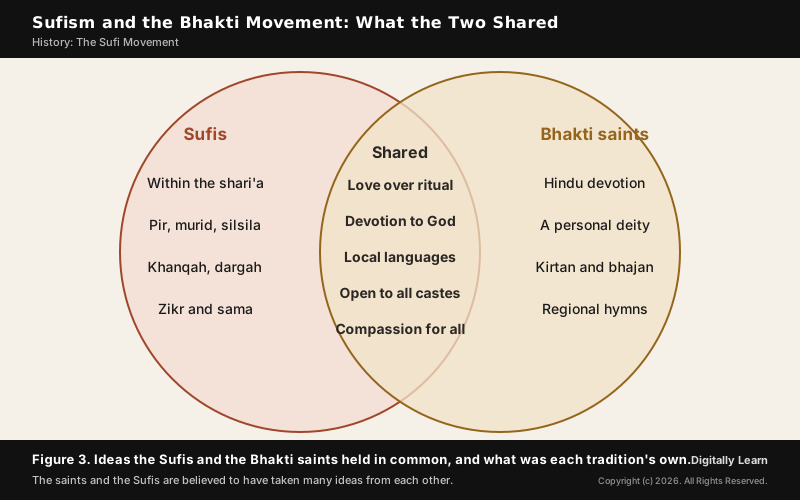
- Language: Chishtis in Delhi spoke Hindavi, and Baba Farid’s verses in the local language entered the Guru Granth Sahib.
- Yoga: The Shattari master Muhammad Ghawth of Gwalior translated the Sanskrit Amrtakunda into Persian, bringing yoga practices into Sufism.
- Philosophy: Dara Shikoh, a Qadiri disciple, argued in Majma-ul-Bahrain (1654-55) that Sufism and Vedanta shared one mystical truth, and in 1657 completed a Persian translation of fifty Upanishads, the Sirr-i-Akbar.
Significance and Limits of the Sufi Movement in Medieval India
The Sufi movement changed the religious life of India more than its social order. Its dargahs drew people of every faith, and in Delhi Hindus and Muslims visited the same shrines in the same spirit. Its saints spoke and wrote in the people's languages, and its music became the qawwali. Rulers sought the Sufis' blessing and legitimacy, endowed their hospices and wished to be buried near them. Akbar, who believed Shaikh Salim Chishti had blessed him with a son in 1569, moved his court to Sikri from 1572 to 1585 to honour the saint.
The limits were real too. The Sufis were generally unconcerned with converting people and welcomed Hindus and Muslims alike to their discourses, and there is no evidence that large numbers of lower-caste people embraced Islam because of their influence. Caste and community structures stood, and within Islam the orthodox current, voiced by Sirhindi, remained strong.
Previous Year UPSC-CSE Questions
Previous Year UPSC-CSE Questions By the end you will be able to draft model answers for the following UPSC questions. Each question carries a collapsible framework showing how to approach it in the exam.
- UPSC Mains 2014 GS-ISufis and medieval mystic saints failed to modify either the religious ideas and practices or the outward structure of Hindu/Muslim societies to any appreciable extent. Comment.
Answer outline: how to structure the answer
What the question asks, the main arguments, relevant examples and the direction of the conclusion. This is not a full model answer.
Introduction: Open with Sufism as the mystical path within Islam, which reached India from the eleventh century and met the Bhakti saints on the common ground of love for God.
Body (sub-themes to develop):
- Ideas changed: love of God over ritual; fana and baqa; wahdat al-wujud close to Vedanta; Dara Shikoh's Majma-ul-Bahrain and the Persian Upanishads.
- Practice changed: shrines shared by Hindus and Muslims; Hindavi and local tongues; sama and qawwali; yoga drawn into Sufism through the Amrtakunda.
- Limits within Islam: the jurists and the Naqshbandi reply of Sirhindi's wahdat al-shuhud.
- Limits in society: the Sufis were generally unconcerned with conversion; no evidence of mass lower-caste conversion through them; caste and community structures stood.
Conclusion: Conclude that the statement holds for social structure but not for religious practice: the mystics softened the lines between communities more than they reshaped either society.
- UPSC Mains 2017 GS-IThe spirit of tolerance and love is not only an interesting feature of Indian society from very early times, but it is also playing an important part at the present. Elaborate.
Answer outline: how to structure the answer
What the question asks, the main arguments, relevant examples and the direction of the conclusion. This is not a full model answer.
Introduction: Open with India's long habit of making room for many faiths, and the devotional movements, Sufi and Bhakti, that turned that room into shared practice.
Body (sub-themes to develop):
- Ideas: Rabia's love of God for its own sake; compassion for all people in Sufi and Bhakti alike.
- Exchange: Hindavi verse, Baba Farid in the Guru Granth Sahib, yoga in the Amrtakunda, Dara Shikoh's Majma-ul-Bahrain and Sirr-i-Akbar.
- Places: dargahs visited by every faith; the urs and the qawwali.
- The present: the same shrines and music today; constitutional secularism and fraternity as the modern form of the same spirit.
Conclusion: Conclude that tolerance and love are not only a memory but a living practice, renewed whenever people of different faiths meet at the same shrine.
- UPSC Prelims 1996 Prelims-GSThe sufi saint who maintained that devotional music was one way of coming close to God was
How to approach this Prelims question
Approach: Step 1: the idea that music brings the soul close to God is sama. Step 2: sama was central to the Chishti order. Step 3: of the four names, the founder of the Chishti order in India is Muin-ud-din Chishti.
Trap to watch: Baba Farid and Gesudaraz were Chishtis too, but the question looks for the order's founding figure in India.
Key facts to recall:
- (a) Muin-ud-din Chishti: right. He founded the Chishti order in India, which made sama central to worship.
- (b) Baba Farid: wrong. He was a later Chishti master, remembered above all for his Punjabi verse.
- (c) Saiyid Muhammad Gesudaraz: wrong. He took the order to the Deccan two centuries later.
- (d) Shah Alam Bukhari: wrong. He is not the saint associated with this teaching.
Answer signal: Muin-ud-din Chishti: option (a), the official answer.
- UPSC Prelims 2012 Prelims-GSWith reference to the religious history of medieval India, the Sufi mystics were known to pursue which of the following practices?
- Meditation and control of breath
- Severe ascetic exercises in a lonely place
- Recitation of holy songs to arouse a state of ecstasy in their audience
Select the correct answer using the codes given below:
How to approach this Prelims question
Approach: Step 1: statement 1: meditation and breath control were part of Sufi training under a master; right. Step 2: statement 2: severe ascetic exercises in a lonely place belong to the Sufi discipline of renunciation, as in the forty-day retreat; right. Step 3: statement 3: holy songs that rouse ecstasy are sama; right. All three.
Trap to watch: Statement 3 looks un-Islamic to some, but sama was central to the Chishtis.
Key facts to recall:
- (a) 1 and 2 only: wrong. Sama, statement 3, was also a Sufi practice.
- (b) 2 and 3 only: wrong. Breath control and meditation were practised too.
- (c) 3 only: wrong. Statements 1 and 2 are also right.
- (d) 1, 2 and 3: right. Meditation with breath control, ascetic retreat, and sama.
Answer signal: 1, 2 and 3: option (d), the official answer.
Sources
- NCERT: Themes in Indian History II (Class XII), Bhakti-Sufi Traditions
- NCERT: Our Pasts II (Class VII), Devotional Paths to the Divine
- NCERT: Medieval India (Satish Chandra), Economic and Social Life under the Delhi Sultanat
- Incredible India (Ministry of Tourism): Ajmer Sharif Dargah
- Archaeological Survey of India: Fatehpur Sikri
- Akashvani News: Annual Urs of Khwaja Moinuddin Chishti begins in Ajmer (2 January 2025)
- Wikipedia: Sufism
- Wikipedia: Hasan al-Basri
- Wikipedia: Rabia Basri
- Wikipedia: Bayazid Bastami
- Wikipedia: Al-Hallaj
- Wikipedia: Junayd of Baghdad
- Wikipedia: Al-Ghazali
- Wikipedia: Tariqa
- Wikipedia: Maqam (Sufism)
- Wikipedia: Hal (Sufism)
- Wikipedia: Fana (Sufism)
- Wikipedia: Baqaa
- Wikipedia: Ibn Arabi
- Wikipedia: Ahmad Sirhindi
- Wikipedia: Dhikr
- Wikipedia: Sama (Sufism)
- Wikipedia: Chishti Order
- Wikipedia: Bahauddin Zakariya
- Wikipedia: Kashf al-Mahjub
- Wikipedia: Ali Hujwiri
- Wikipedia: Muhammad Ghawth
- Wikipedia: Dara Shikoh
- Wikipedia: Mian Mir
- UPSC: Civil Services Examination question papers
Editorial Disclaimer
Dates of the early Sufis are approximate where the sources differ. This article draws on the sources listed on this page.


