


Overview

The Bhakti movement was the spread of loving devotion to a personal God across medieval India, led by poet-saints who sang in the people's own languages. It began with the Alvars and Nayanars of the Tamil country in about the sixth century, reached Karnataka and Maharashtra in the twelfth and thirteenth centuries and north India from the fourteenth, and taught that God can be reached by anyone through devotion, without elaborate ritual.
What Is the Bhakti Movement: Meaning, Origin and Time Period
Bhakti Movement Meaning: Loving Devotion to a Personal God
The word bhakti comes from the Sanskrit root bhaj, which means to divide, share, partake or belong to; from it come the senses of attachment, devotion, faith, love and worship. One who practises bhakti is a bhakta. The Bhakti movement is the name historians give to the many devotional traditions that grew around this idea in medieval India: the conviction that God can be reached through love and devotion, by anyone, without the help of elaborate ritual.
The movement was never one organisation with one founder. It grew region by region around different gods and goddesses, Vishnu and his avatars, Shiva and the Goddess, and around saints who sang in the language of the people they lived among. What tied these traditions together was a shared emphasis: a personal relationship between the devotee and God, open to women and to those whom the Brahmanical order kept out of Vedic learning.
Who Started the Bhakti Movement: Alvars and Nayanars of the Tamil Country
The earliest bhakti movements were led by the Alvars and the Nayanars of the Tamil region. The Alvars, literally those immersed in devotion to Vishnu, and the Nayanars, leaders who were devotees of Shiva, travelled from place to place singing hymns in Tamil in praise of their gods. NCERT's Class XII book dates these first movements to about the sixth century; its Class VII book places the Alvars and Nayanars in the seventh to ninth centuries.
- Who they were: Tradition counts 63 Nayanars and 12 Alvars, from backgrounds ranging from Brahmanas to artisans, cultivators, hunters and castes considered untouchable.
- Best known: Appar, Sambandar, Sundarar and Manikkavasagar among the Nayanars; Periyalvar, his daughter Andal, Tondaradippodi and Nammalvar among the Alvars.
- Their hymns: By the tenth century the compositions of the 12 Alvars were compiled as the Nalayira Divyaprabandham, the Four Thousand Sacred Compositions, often called the Tamil Veda; the poems of Appar, Sambandar and Sundarar form the Tevaram.
- Women saints: Andal saw herself as the beloved of Vishnu, and Karaikkal Ammaiyar, a devotee of Shiva, took the path of extreme asceticism; their very compositions challenged patriarchal norms.
The saints identified certain shrines as the homes of their gods, and large temples were later built at many of these places, which grew into centres of pilgrimage. Singing their hymns became part of temple ritual, and the saints' own images came to be worshipped. A fuller account of each saint is in the Nayanars and Alvars of south India.
Textual Roots of Bhakti: Upanishads, Bhagavad Gita and Bhagavata Purana
Bhakti has roots in older texts. The Shvetashvatara Upanishad uses the word bhakti in its closing verse (6.23), widely cited as one of the earliest mentions of the love of God, though scholars debate whether the verse was added later. The Bhagavad Gita, composed between the fifth and second centuries BCE, presents bhakti as one of three paths to spiritual freedom, beside the path of works (karma) and the path of knowledge (jnana).
The idea of a Supreme God who could free human beings from the cycle of rebirth, if approached with devotion, grew in popularity in the early centuries of the Common Era. The Puranas, composed in simple Sanskrit verse and meant to reach women and Shudras, who were generally kept from Vedic learning, laid down that a devotee could receive the grace of God whatever his caste. The idea became so popular that Buddhists and Jainas also took it up.
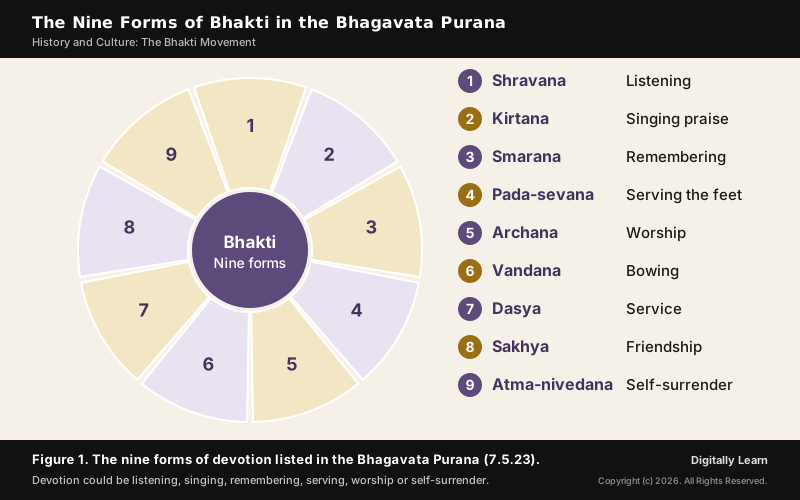
Many ideas of the Tamil bhaktas, especially the Vaishnavas, then entered the Sanskrit tradition through the Bhagavata Purana, one of the best-known Puranas. It lists nine forms of devotion (7.5.23), shown in Figure 1, and its stories of Prahlada and of the gopis' love for Krishna became models of bhakti.
Philosophy of the Bhakti Movement: Saguna, Nirguna and Vedanta
Saguna and Nirguna Bhakti: God With and Without Attributes
Historians of religion divide bhakti traditions into two broad kinds. Saguna bhakti, devotion to God with attributes, focused on particular deities, Shiva, Vishnu and his avatars Rama and Krishna, and forms of the Goddess, usually imagined in human form. Nirguna bhakti, devotion to God without attributes, was the worship of an abstract, formless God.
| Feature | Saguna bhakti | Nirguna bhakti |
|---|---|---|
| Idea of God | God with form and attributes | Formless God without attributes |
| Objects of devotion | Vishnu, Rama, Krishna, Shiva, the Goddess | One God beyond names: Ram, Allah, Hari |
| Leading saints | Alvars, Tulsidas, Surdas, Mirabai, Chaitanya | Kabir, Guru Nanak, Ravidas, Dadu |
| Attitude to existing religion | Accepted beliefs and made them accessible | Rejected external worship and ritual |
| Key texts | Ramcharitmanas, Sursagar | Kabir's sakhis and pads, the Adi Granth |
The difference is one of emphasis, not of two hostile camps. Tulsidas and Surdas accepted existing beliefs and practices but wanted to make them accessible to all, while Kabir and Guru Nanak rejected the orthodox religions around them and taught devotion to a formless God through remembering his name. Both kinds reach the same conclusion: love of God, not ritual, is the way to salvation.
Shankara, Ramanuja and the Vedanta Schools Behind Bhakti
The bhakti saints sang; the philosophers explained. Three schools of Vedanta gave devotion its intellectual foundation, and Figure 2 places them on one line from the oneness of God and the soul to their distinction.
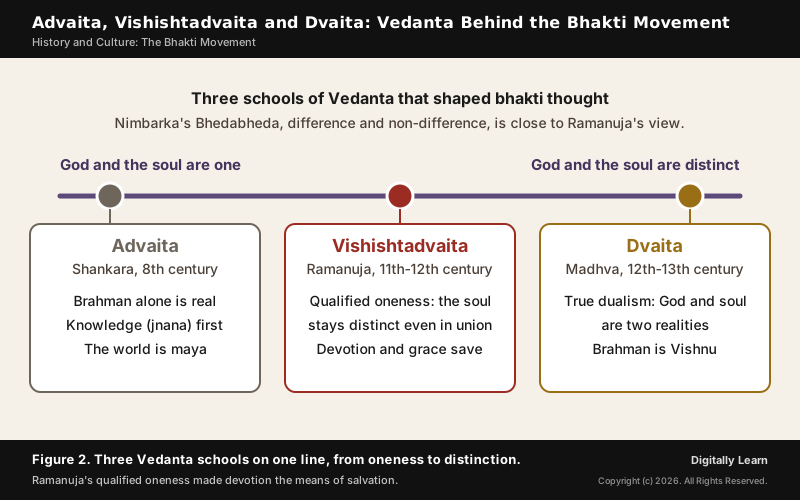
- Shankara and Advaita: Born in Kerala in the eighth century, Shankara taught that Brahman, the only reality, is formless and without attributes, that the world is maya or illusion, and that salvation comes through knowledge. He did not reject bhakti, but a devotee had first to clean his heart through jnana, and this path could be followed by only a few.
- Ramanuja and Vishishtadvaita: Born in Tamil Nadu in the eleventh century and deeply influenced by the Alvars, Ramanuja held that the best means of salvation is intense devotion to Vishnu, who by his grace helps the devotee reach union with him. His doctrine of qualified oneness holds that the soul, even when united with God, remains distinct.
- Madhva and Dvaita: In the twelfth to thirteenth century Madhvacharya of Karnataka taught a true dualism, in which God and the soul are two different realities and the soul depends on God.
Ramanuja's teaching mattered most for the movement. He argued that the grace of God was more important than knowledge about him and that the path of bhakti was open to all, whatever their caste. In this way he built a bridge between the popular devotion of the saints and the Vedic learning of the Brahmanas. Thinkers such as Nimbarka, whose Bhedabheda theology is close to Ramanuja's, and in north India Ramananda and Vallabhacharya, followed in this tradition, and by the early sixteenth century bhakti was acceptable to all sections of Hindu society.
Grace, Surrender and the Guru in Bhakti
Bhakti placed God's grace and the devotee's surrender at the centre of religious life. In Ramanuja's school, total surrender at the feet of the Lord, called sharanagati, is accepted as the sole means of release from the cycle of birth and death. In the fourteenth century that school divided over how much effort the devotee must make: one view compared the devotee to a baby monkey that clings to its mother, the other to a kitten that the mother cat simply carries.
The guru was the devotee's guide on this path. Kabir's verses speak of the guru and the satguru, the true guru, without naming any particular teacher, and Guru Nanak appointed his disciple Angad to succeed him as guru, a practice his followers kept for nearly 200 years. Congregations of devotees gave the same idea a social form: Nanak's sangat with its collective recitation, and Shankaradeva's sat sanga with its recitation of the Lord's names.
Causes of the Bhakti Movement: Why Devotion Spread in Medieval India
Social Causes: Ritual, Caste and the Search for Equality
Social inequality was the deepest cause. Over the centuries before the movement, the idea had gained ground that human beings are unequal even at birth and that social privilege comes from birth in a high caste, and many people were uneasy with these ideas. Women and the lower castes were considered ineligible for liberation within the orthodox Brahmanical framework and were excluded from Vedic learning.
The revival of Hindu worship around Shiva and Vishnu in the early medieval period also increased the power and the arrogance of the Brahmanas. That produced popular movements that stressed human equality and freedom. Bhakti offered exactly that: a path to God open to all, which needed neither a priest nor a costly sacrifice.
- Ritualism: The Vedic gods Agni, Indra and Soma had faded, yet contact with the divine was still tightly regulated through sacrifices and precisely chanted mantras.
- Exclusion: Vedic scholarship and Vedic worship were closed to the lower castes; the bhakti path was open to all, whatever their caste.
- A wish for direct contact: The saints treated religion as a living bond of love between God and the worshipper, not as a cold, formal act.
Religious Causes: Buddhism, Jainism, Tantra, Naths and Sufis
Bhakti also grew out of rivalry and exchange between religious traditions. In the Tamil country the saints were sharply critical of Buddhism and Jainism, which had long drawn support from merchants and artisans; historians explain this hostility as competition for royal patronage. Bhakti won many followers of Buddhism and Jainism to Hinduism, and won over many tribal communities as well.
- Tantra: Tantric practices were open to women and men and ignored caste and class within ritual; in north India the popular counterpart of southern bhakti was tantra.
- Naths, Jogis and Siddhas: They questioned the authority of the Vedas, spoke the languages of ordinary people, taught meditation on a formless Ultimate Reality and were popular among the lower castes; their criticism of conventional religion prepared the ground for devotional religion in north India.
- Tamil Siddhars: Wandering adepts of the Tamil tradition who typically believed in one god and wrote their teachings as Tamil poems.
- Sufis: Muslim mystics who rejected outward religiosity and taught love and devotion to God and compassion for all people; the sants had so much in common with them that each is believed to have adopted ideas of the other.
Whether Islam caused the northern wave is debated. Some scholars see the rapid spread of bhakti in the second millennium partly as a response to Islamic rule; others point out that ecstatic devotional singing in local languages had already flourished in south India centuries before. The safer view is that Islam and Sufism shaped the form of northern bhakti rather than creating it.
Political and Economic Causes: The Delhi Sultanate, Towns and Crafts
Politics explains why north India's bhakti came late. Nothing like the compositions of the Alvars and Nayanars has been found in the north until the fourteenth century. Historians point out that the Rajput states that emerged there gave Brahmanas positions of importance, and little attempt was made to challenge them directly.
The coming of the Turks and the Delhi Sultanate in the thirteenth century undermined many Rajput states and the Brahmanas tied to them. At the same time new towns, organised craft production and long-distance trade with Central and West Asia raised the importance of artisans, among them weavers. Craftspersons, peasants, traders and labourers flocked to hear the new saints, and many of the saints, like Kabir the weaver and Ravidas the leather worker, came from these very groups.
Features of the Bhakti Movement: Teachings of the Bhakti Saints
Devotion Over Ritual: The Core Teachings of the Bhakti Saints
The bhakti saints taught a few clear ideas, repeated across regions and centuries. They put love of God above ritual, sacrifice and austerity, and they spoke to God directly, as a lover, a servant, a friend or a child.
- One personal God: Devotion to a single chosen deity, or to one formless God, rather than to many gods.
- Devotion over ritual: Sacrifices, ritual baths, fasts and pilgrimages were secondary or rejected; Guru Nanak rejected sacrifices, ritual baths, image worship and austerities outright.
- No priestly middleman: The devotee could reach God through love, prayer and the repeated name of God (nam-simaran).
- Life in the world: The saints of Maharashtra rejected renunciation, lived with their families and earned their living, and Guru Nanak asked his followers to be householders in productive work.
- Compassion: Bhakti lay in sharing the pain of others; the Gujarati saint Narsi Mehta said that they are Vaishnavas who understand the pain of others.
Basavanna's sayings show the method. When people see a serpent carved in stone, he observed, they pour milk on it, but when a real serpent comes they cry kill; they offer food to an image of God that cannot eat, but turn away the hungry servant of God at the door. Ritual without compassion, the saints argued, is empty.
Caste and Gender Equality in the Bhakti Movement
Equality before God was the movement's most radical claim. Bhaktas came from every caste, from Brahmanas to castes considered untouchable, and some traditions challenged the caste order itself.
- Virashaivas of Karnataka: The movement of Basavanna (1106-1168), a Brahmana who had been a Jaina and a minister in a Chalukya court; his followers, the Virashaivas or Lingayats, challenged caste and the idea of pollution, questioned the theory of rebirth, accepted post-puberty marriage and the remarriage of widows, and buried their dead instead of cremating them.
- Maharashtra: Chokhamela and his family belonged to the Mahar caste, considered untouchable; his son asked God in an abhang why he had been made low caste.
- North India: Ravidas was a leather worker, and some traditions make him the preceptor of Mirabai; Guru Nanak’s followers ate together in the langar whatever their creed, caste or gender.
- Women: Andal, Karaikkal Ammaiyar, Akkamahadevi, Muktabai, Sakkubai and Mirabai; Mirabai, a Rajput princess of Merta, defied her husband and is the best-known woman poet of the tradition.
Bhakti Literature in Regional Languages: Hymns, Vachanas, Abhangs and Sakhis
The saints composed in the languages people spoke, and their works could be sung. This is the single feature that most changed Indian culture: the movement turned regional languages into languages of religion and literature.
| Region and language | Saints | Form or text |
|---|---|---|
| Tamil Nadu: Tamil | Alvars, Nayanars | Hymns; Divyaprabandham, Tevaram, Tiruvacakam |
| Karnataka: Kannada | Basavanna, Akkamahadevi | Vachanas (sayings) |
| Maharashtra: Marathi | Jnaneshwar, Namdev, Tukaram | Abhangs (devotional hymns) |
| North India: Hindi, Awadhi, Braj | Kabir, Tulsidas, Surdas | Sakhis and pads; Ramcharitmanas; Sursagar |
| Punjab: Punjabi | Guru Nanak | Shabad hymns, sung in ragas |
| Assam: Assamese | Shankaradeva | Poems, plays; Kirtana-ghosha |
Most of this literature lived in song before it was written. The compositions were handed down orally, usually by the poorest communities and by women, who often added their own experiences, so the songs we have today are as much the creation of generations of singers as of the saints. Later scribes and communities collected them: Guru Arjan compiled the Adi Granth in 1604 with the hymns of the Sikh Gurus and of Baba Farid, Ravidas and Kabir.
Bhakti poets also found new ways to say the unsayable. Kabir's ulatbansi, upside-down sayings such as the lotus that blooms without a flower, invert everyday meanings to hint at an Ultimate Reality beyond words, and his poems draw on the words of many traditions at once: Allah, Khuda and Pir, and also alakh, nirakar, Brahman and Atman.
Bhakti Movement Saints of South and North India
Bhakti Movement in South India: Temples, Hymns and Royal Patronage
In the south, bhakti grew together with the temple and the state. The Chola kings of the ninth to thirteenth centuries supported Brahmanical and bhakti traditions with land grants and temples for Vishnu and Shiva, among them the great Shiva temples of Chidambaram, Thanjavur and Gangaikondacholapuram, and between the tenth and twelfth centuries the Chola and Pandya kings built elaborate temples around many shrines the saints had visited.
- Royal singing: The Chola kings introduced the singing of Tamil Shaiva hymns in temples and had them collected into the Tevaram.
- Saints in procession: An inscription of about 945 records that Parantaka I consecrated metal images of Appar, Sambandar and Sundarar in a Shiva temple, carried in procession at their festivals.
- Why kings cared: The Vellala peasants revered the saints, and kings claimed divine support by building temples that brought the saints’ visions to life in stone and bronze.
The south then carried the movement forward. Ramanuja's Vishishtadvaita in the eleventh century, the Virashaiva movement of Karnataka in the twelfth, and the Vitthala devotion of Pandharpur in Maharashtra from the thirteenth century to the seventeenth, with Jnaneshwar, Namdev, Eknath and Tukaram, each gave bhakti a new regional voice. Figure 3 places these saints in their regions.

Bhakti Movement in North India: Ramananda, Kabir, Nanak, Tulsidas and Chaitanya
The period after the thirteenth century saw a new wave of bhakti in north India, an age in which Islam, Brahmanical Hinduism, Sufism, various strands of bhakti and the Naths, Siddhas and Yogis all influenced one another. Ramananda, a Vaishnava teacher who lived for most of his life in Varanasi, stands near its beginning; later tradition made him the guru of Kabir and Ravidas, though historians doubt that he and Kabir were contemporaries.
- Kabir (probably fifteenth to sixteenth century): Brought up in a family of Muslim weavers near Varanasi, he rejected the external worship of both Hinduism and Islam and taught devotion to a formless God; his verses survive in the Bijak, the Kabir Granthavali and the Adi Granth.
- Guru Nanak (1469-1539): Born at Talwandi, now Nankana Sahib, he taught nirguna devotion through the repeated Divine Name, set up a centre at Kartarpur with a common kitchen, and is remembered for nam-japna, kirt-karna and vand-chhakna: right worship, honest living and helping others.
- Tulsidas and Surdas: Saguna poets who accepted existing beliefs; Tulsidas wrote the Ramcharitmanas in Awadhi, and Surdas sang of Krishna in the Sursagar.
- Mirabai (c. fifteenth to sixteenth century): A devotee of Krishna whose bhajans challenged the norms of the upper castes and are still sung in Rajasthan and Gujarat.
- Odisha: A bhakti tradition centred on Jagannatha of Puri, a local deity identified as a form of Vishnu by the twelfth century, began there in that century, with Jayadeva, author of the Gita Govinda, among its poets.
- Chaitanya and Shankaradeva: Chaitanya in sixteenth-century Bengal preached devotion to Krishna and Radha through ecstatic singing and dancing; Shankaradeva in fifteenth-century Assam taught surrender to Vishnu, naam kirtan, and founded satras and namghars.
Their lives and teachings are covered in more depth in Kabir, Nanak and the sant tradition, saguna bhakti of Rama and Krishna and the regional and women's bhakti traditions.
Significance and Limitations of the Bhakti Movement
Significance of the Bhakti Movement for Indian Society and Culture
The movement changed how ordinary Indians practised religion. Salvation, once thought open only to men of the three upper castes, became available to everyone, and the Vedic sacrifice or the monk's withdrawal gave way to a loving relationship with a personally chosen God.
- Languages and literature: Tamil hymns, Kannada vachanas, Marathi abhangs, Kabir’s Hindi sakhis and the Awadhi Ramcharitmanas grew into classics of their languages.
- Music and congregation: Community singing, the chanting together of God’s names, kirtan and naam ghar became lasting forms of worship.
- Social service: Seva, charity and community kitchens; Guru Nanak’s langar became a permanent institution.
- A shared culture: Kabir drew followers from both Hindus and Muslims, and Sufi poets of the Deccan wrote in forms inspired by the vachanas and abhangs.
- Recognition today: In May 2024 Tulsidas’s Ramcharitmanas, written in Awadhi in the sixteenth century, was inscribed with two other Indian works in UNESCO’s Memory of the World Asia-Pacific Regional Register.
- New communities: Guru Nanak’s followers became the Sikh community, the Kabirpanth preserved Kabir’s verses, and the Lingayats remain an important community in Karnataka today.
Limitations of the Bhakti Movement: Did It Reform Caste?
The movement's limits are as important as its achievements. The early Tamil saints disregarded the inequalities of caste, but they did not try to oppose the caste system as such. Brahmanas remained important intermediaries in several forms of bhakti, and the caste order survived the movement in every region.
- Absorbed by power: Kings used the saints to win popular support and legitimacy, as the Cholas did with the Tamil saints, so bhakti was often harnessed by the state it might have questioned.
- No single organisation: The movement was a family of regional traditions, which made its ideas spread widely but kept it from acting as one reform movement.
- Reform or revival: Many scholars now describe bhakti as a revival and reworking of older Vedic themes rather than a rebellion against Brahmanas, pointing out that several of its earliest champions were Brahmanas.
Previous Year UPSC-CSE Questions
Previous Year UPSC-CSE Questions By the end you will be able to draft model answers for the following UPSC questions. Each question carries a collapsible framework showing how to approach it in the exam.
- UPSC Prelims 2022 Prelims-GSThe world's second tallest statue in sitting pose of Ramanuja was inaugurated by the Prime Minister of India at Hyderabad recently. Which one of the following statements correctly represents the teachings of Ramanuja?
How to approach this Prelims question
Approach: Step 1: Ramanuja's Vishishtadvaita makes devotion to a personal God, Vishnu, the way to salvation. Step 2: grace matters more than knowledge, so logic and meditation are not his central means. Step 3: Ramanuja linked bhakti to the Vedic tradition, but the authority of the Vedas is not what his teaching asserts; devotion is.
Trap to watch: Ramanuja respected the Vedas, but the question asks for the statement that represents his teaching; that is devotion, not the authority of the Vedas.
Key facts to recall:
- (a) The best means of salvation was devotion: right. Ramanuja held intense devotion to Vishnu to be the best means of salvation.
- (b) Vedas are eternal, self-existent and wholly authoritative: wrong. Ramanuja tried to bring bhakti into the Vedic tradition, but his teaching is about the means of salvation, devotion and grace, not this claim.
- (c) Logical arguments were essential means for the highest bliss: wrong. Ramanuja argued that God's grace counted for more than knowledge about him.
- (d) Salvation was to be obtained through meditation: wrong. Meditation on a formless reality was the path of the Naths and Yogis; Ramanuja's path was devotion and surrender.
Answer signal: Option (a), the official answer: for Ramanuja, devotion was the best means of salvation.
- UPSC Prelims 2016 Prelims-GSWith reference to the cultural history of medieval India, consider the following statements:
- Siddhas (Sittars) of Tamil region were monotheistic and condemned idolatry.
- Lingayats of Kannada region questioned the theory of rebirth and rejected the caste hierarchy.
Which of the statements given above is/are correct?
How to approach this Prelims question
Approach: Step 1: statement 1, the Tamil Siddhars, typically believed in one god and criticised ritual worship; UPSC's answer accepts the statement as correct. Step 2: statement 2, the Lingayats of Karnataka, challenged caste and questioned the theory of rebirth; correct. Step 3: both are correct.
Trap to watch: Many students know the Lingayats well and doubt the less familiar Siddhas; the official answer accepts both statements.
Key facts to recall:
- (a) 1 only: wrong. Statement 2 is also correct: the Lingayats questioned rebirth and rejected caste.
- (b) 2 only: wrong. Statement 1 is also correct: the Tamil Siddhars typically believed in one god and rejected ritual worship, as UPSC's answer accepts.
- (c) Both 1 and 2: right. Both groups stood outside ritual orthodoxy, the Siddhas in Tamil country and the Lingayats in Karnataka.
- (d) Neither 1 nor 2: wrong. Both statements are correct.
Answer signal: Option (c), the official answer: both statements are correct.
- UPSC Mains 2021 GS-IEvaluate the nature of the Bhakti literature and its contribution to Indian culture.
Answer outline: how to structure the answer
What the question asks, the main arguments, relevant examples and the direction of the conclusion. This is not a full model answer.
Introduction: Introduce bhakti literature as the devotional poetry of the poet-saints from the Tamil Alvars and Nayanars of about the sixth century to the saints of the north up to the seventeenth.
Body (sub-themes to develop):
- Nature, in the language of the people: Tamil hymns, Kannada vachanas, Marathi abhangs, Kabir's Hindi sakhis and pads, the Awadhi Ramcharitmanas, Punjabi shabads, Assamese poems and plays.
- Nature, sung and oral: compositions set to music, handed down by the poor and by women; collected later in the Divyaprabandham, the Tevaram and the Adi Granth (1604).
- Nature, of feeling and dissent: love for a personal God, criticism of ritual and caste (Basavanna's vachanas, the abhangs of Chokhamela's family), Kabir's upside-down sayings.
- Contribution: regional languages became languages of literature; congregational singing, kirtan and naam ghar; seva and the langar; a shared culture (Kabir's Hindu and Muslim followers; Deccan Sufi poems modelled on vachanas and abhangs).
- Evaluation: much of it reworked older Vedic and Puranic themes, and it did not end caste.
Conclusion: Conclude that bhakti literature democratised religion and built India's regional literatures, a contribution that outlasted the limits of its social reform.
- UPSC Mains 2014 GS-ISufis and medieval mystic saints failed to modify either the religious ideas and practices or the outward structure of Hindu/Muslim societies to any appreciable extent. Comment.
Answer outline: how to structure the answer
What the question asks, the main arguments, relevant examples and the direction of the conclusion. This is not a full model answer.
Introduction: Introduce the medieval saints of the bhakti movement and the Sufis as two mystical traditions that preached love of God over ritual from the twelfth to the seventeenth centuries.
Body (sub-themes to develop):
- Where the statement holds: caste survived in every region; the Tamil saints disregarded caste inequalities without opposing the caste system; Brahmanas remained intermediaries; kings and Sultans drew saints and Sufis into their own legitimacy.
- Where it does not hold, ideas: salvation opened to all; women and low castes as saints (Chokhamela, Ravidas, Mirabai); worship without priests; Sufi sama and Hindavi verse.
- Where it does not hold, structures: the Lingayats' break with caste rules on marriage and burial; Guru Nanak's sangat and langar, the root of the Sikh community; namghars and satras.
- A historian's caution: many scholars see bhakti as a revival of older themes, not a revolt.
Conclusion: Conclude that the statement is too strong: the saints and Sufis did not dismantle caste or orthodoxy, but they changed how ordinary people worshipped and created lasting new communities.
Sources
- NCERT: Themes in Indian History, Part II (Class XII), Bhakti-Sufi Traditions
- NCERT: Our Pasts II (Class VII), Devotional Paths to the Divine
- NCERT: Medieval India (Satish Chandra), Economic and Social Life, Education and Religious Beliefs
- Wikipedia: Bhakti movement
- Wikipedia: Bhakti
- Wikipedia: Bhakti yoga
- Wikipedia: Bhagavata Purana
- Wikipedia: Shvetashvatara Upanishad
- Wikipedia: Alvars
- Wikipedia: Nayanars
- Wikipedia: Ramanuja
- Wikipedia: Vishishtadvaita
- Wikipedia: Madhvacharya
- Wikipedia: Nimbarka
- Wikipedia: Ramananda
- Wikipedia: Kabir
- Wikipedia: Guru Nanak
- Wikipedia: Lingayats
- Wikipedia: Basava
- Wikipedia: Siddhar
- Wikipedia: Sant Mat
- Wikipedia: Abhang
- Wikipedia: Dnyaneshwar
- Wikipedia: Namdev
- Wikipedia: Ravidas
- Wikipedia: Surdas
- Wikipedia: Tulsidas
- Wikipedia: Chaitanya Mahaprabhu
- Wikipedia: Sankardev
- Wikipedia: Guru Granth Sahib
- PIB (Ministry of Culture): Ramcharitmanas, Panchatantra and Sahrdayaloka-Locana enter UNESCO's Memory of the World Asia-Pacific Regional Register (13 May 2024)
- United Nations in India: From Epics to Fables, Three Indian Literary Works Enter UNESCO Registry (23 May 2024)
- Prime Minister's Office: PM dedicates to the nation the Statue of Equality commemorating Sri Ramanujacharya (5 February 2022)
- UPSC: Civil Services Examination question papers
Editorial Disclaimer
Dates of the saints follow the NCERT textbooks; other accounts may differ. This article draws on the sources listed on this page.