

Overview
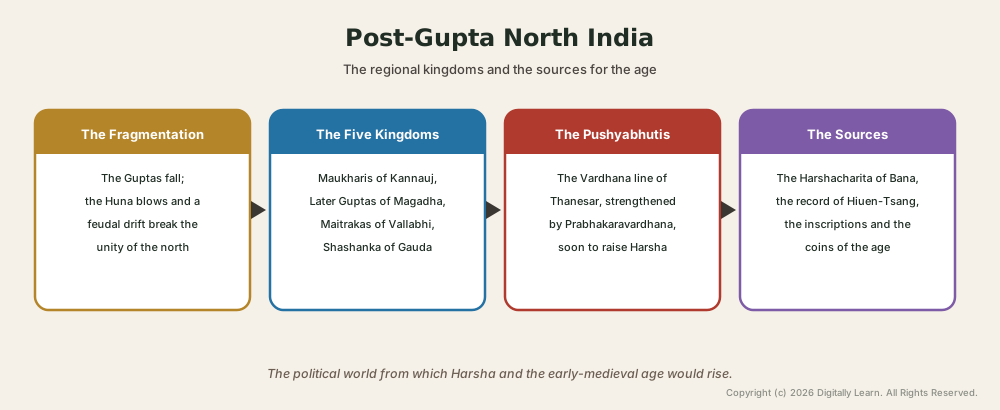
The Post-Gupta North India of the sixth and early seventh centuries was a land of many kingdoms. As the power of the Guptas faded, the north broke into competing regional states: the Maukharis of Kannauj, the Later Guptas of Magadha, the Maitrakas of Vallabhi in the west, and Shashanka of Gauda in Bengal. In the north stood the Pushyabhuti or Vardhana dynasty of Thanesar, the line that would soon raise Harsha. This part covers the fragmentation, the regional kingdoms, the rise of the Pushyabhutis, the sources for the age and the exam focus.
North India after the Guptas
The Fall of the Guptas and the Fragmentation of the North
What is the significance of post-Gupta North India: it is the broken political world, divided among regional kingdoms, out of which Harsha and the early-medieval age would grow.
As the Gupta power faded through the sixth century, weakened by the Huna invasions and the slow rise of land-holding feudatories, the unity of the north dissolved. The old governors and vassals turned into independent kings, and in place of one empire there stood a cluster of regional states, each pressing against its neighbours for land and overlordship.
This was not mere chaos but a new political order, the early-medieval pattern of many kingdoms held in shifting balance. The struggle among them, above all for the rich middle Ganga and the city of Kannauj, would shape the next four centuries of Indian history.
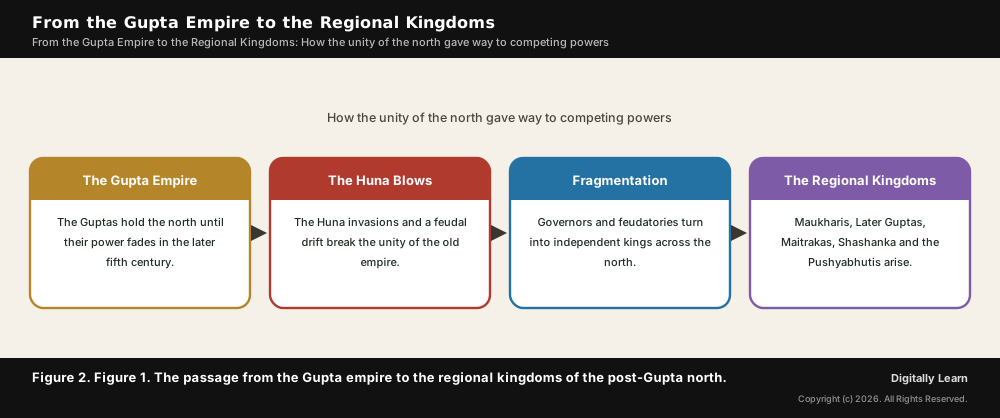
Kannauj, the New Pivot of the North
Distinguishing the new centre: the seat of power in the north shifted west, from Gupta Pataliputra on the lower Ganga to Kannauj on the middle Ganga.
Kannauj, well placed on the fertile middle Ganga, rose to become the great prize of north Indian politics. Whoever held Kannauj claimed the overlordship of the north, and in the centuries after Harsha three great powers would fight for it. Its rise in this age marks the opening of the contest that the later parts of the wider story will follow.
The Regional Kingdoms of the North
The Five Powers of Post-Gupta North India
What is the significance of the regional kingdoms: five powers above all divided the north between the fall of the Guptas and the rise of Harsha, and an aspirant should be able to place each with its capital.
The Maukharis ruled the Ganga-Yamuna doab from Kannauj; the Later Guptas held Magadha from Pataliputra; the Maitrakas governed Saurashtra from Vallabhi; Shashanka ruled Gauda, or Bengal, from Karnasuvarna; and the Pushyabhutis held the north from Thanesar. The map sets each in its place.
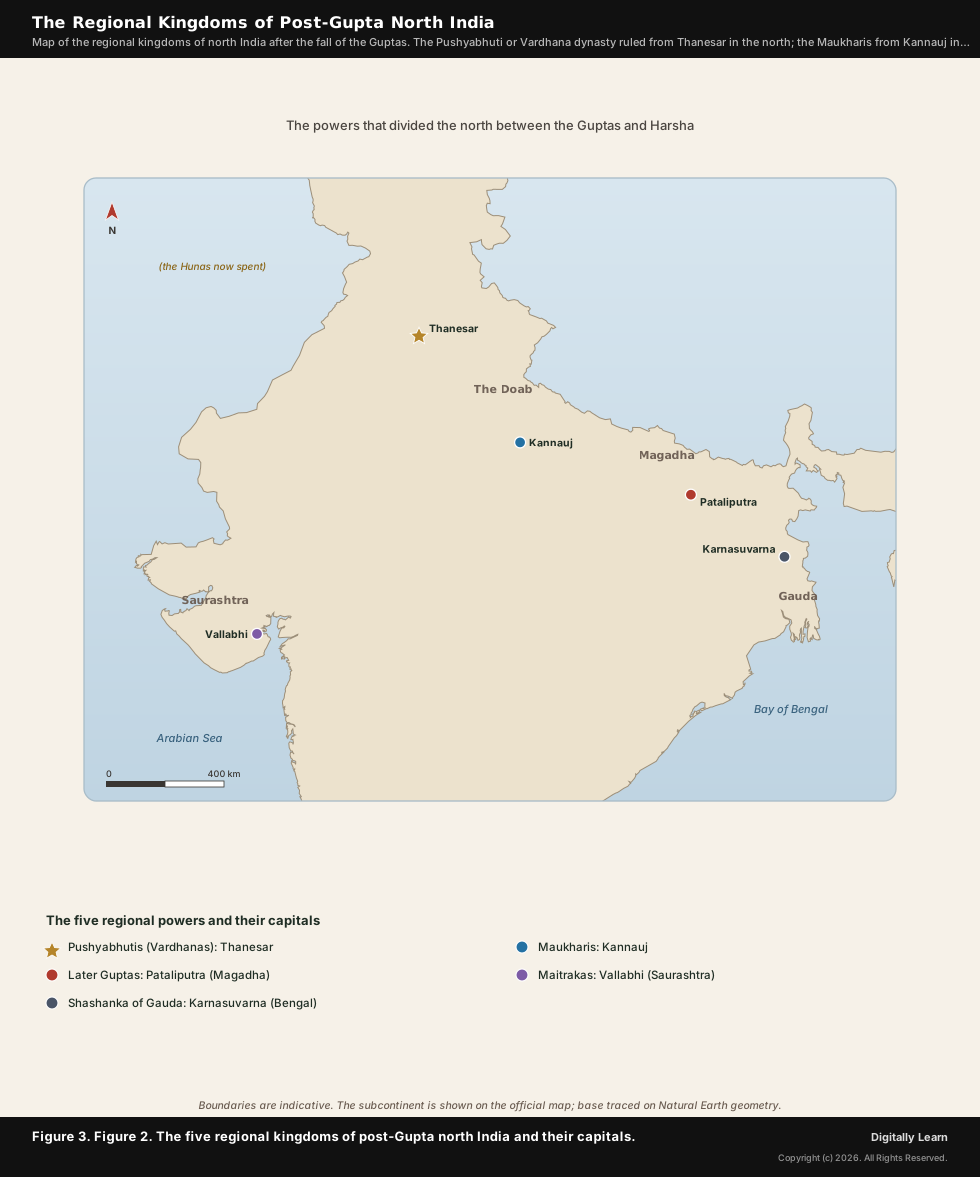
Maukharis, Later Guptas, Maitrakas and Shashanka
Distinguishing the four neighbours: each of the powers around Thanesar had its own seat, its own character and its own place in the story of Harsha.
The Maukharis of Kannauj were the strongest of the doab; their king Ishanavarman was the first to take the high title of Maharajadhiraja, and their last ruler, Grahavarman, married Harsha's sister Rajyashri. The Later Guptas of Magadha were a separate line, not a survival of the imperial Guptas, who had merely taken the same name; their king Devagupta would strike the first blow against Harsha's house.
The Maitrakas of Vallabhi, founded by a former Gupta general, ruled Saurashtra and made Vallabhi a famous seat of learning. Shashanka, the Shaivite king of Gauda in Bengal, ruling from Karnasuvarna, was the great rival of the Pushyabhutis in the east, and the man who would kill Harsha's brother.
| Kingdom | Capital | Region |
|---|---|---|
| The Pushyabhutis (Vardhanas) | Thanesar (Sthanvishvara) | The north, around Kurukshetra. |
| The Maukharis | Kannauj (Kanyakubja) | The Ganga-Yamuna doab. |
| The Later Guptas | Pataliputra | Magadha (a separate dynasty). |
| The Maitrakas | Vallabhi | Saurashtra, in the west. |
| Shashanka of Gauda | Karnasuvarna | Gauda, or Bengal, in the east. |
The Pushyabhuti Dynasty of Thanesar
The Rise of the Pushyabhutis under Prabhakaravardhana
What is the significance of the Pushyabhutis: this is the house of Thanesar that would produce Harsha and gather the north under a single overlord.
The dynasty is often called the Vardhana line, from the ending of its kings' names, but its own name, as Bana gives it, was the Pushyabhuti. Its founder, Pushyabhuti, is a half-legendary figure known only through the later court poet; the house became a real power only with the fourth king after him.
That king was Prabhakaravardhana, who ruled at the close of the sixth century. He took the imperial title of Parama-bhattaraka Maharajadhiraja, held back the Hunas of the north-west, and married his daughter Rajyashri to the Maukhari king of Kannauj, binding Thanesar to its powerful neighbour.
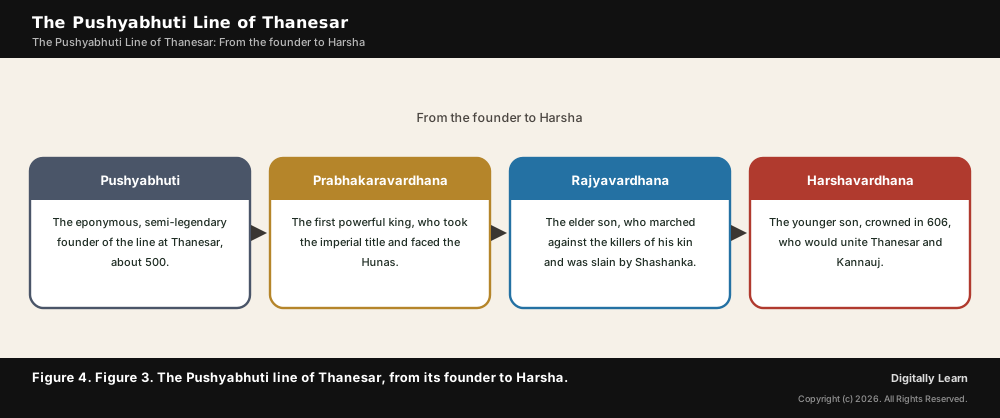
From Pushyabhuti to Harsha
Distinguishing the succession: Prabhakaravardhana left two sons, and the crown would pass through tragedy to the younger of them.
The elder son, Rajyavardhana, came first to the throne on his father's death; the younger was Harshavardhana. Within months a double blow fell on the house, the killing of the Maukhari king and then of Rajyavardhana himself, and the burden of the kingdom passed to the young Harsha in 606. The full story of that blow, and of Harsha's rise, is the subject of the next part.
| Ruler | Note |
|---|---|
| Pushyabhuti | The semi-legendary founder of the line at Thanesar, about 500. |
| Prabhakaravardhana | The first powerful king; took the imperial title; checked the Hunas. |
| Rajyavardhana | The elder son; killed by Shashanka of Gauda. |
| Harshavardhana | The younger son; crowned in 606; the great king of the line. |
The Sources for the Age
The Harshacharita, Hiuen-Tsang and the Inscriptions
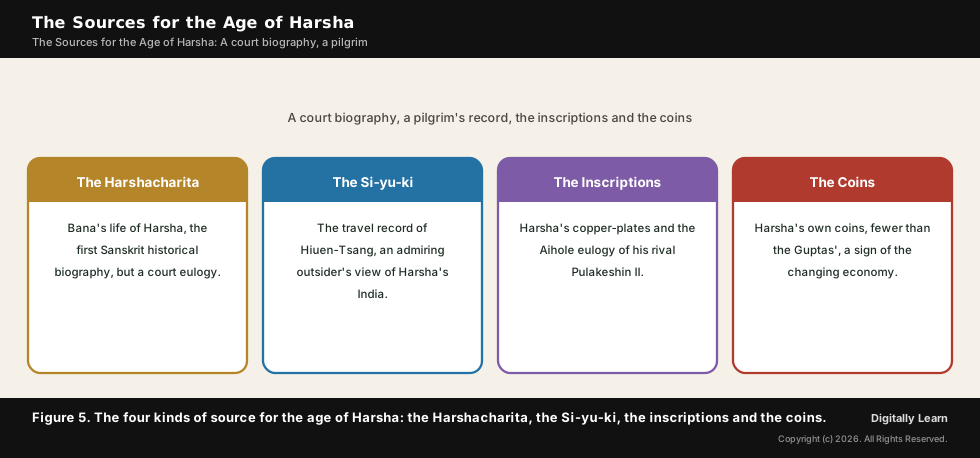
What is the significance of the sources: the age of Harsha is unusually well lit, by a court biography, a pilgrim's travel record, the inscriptions and the coins, each to be read with care.
The Harshacharita, the deeds of Harsha, was written by his court poet Banabhatta; it is counted the first true historical biography in Sanskrit, but it is a court eulogy and must be read as praise, not plain record. The Si-yu-ki, the travel record of the Chinese pilgrim Hiuen-Tsang, gives the admiring view of an outsider who saw Harsha's India with his own eyes.
The inscriptions add the hard frame of fact: Harsha's own Madhuban and Banskhera copper-plates, and, from his rival's side, the Aihole eulogy that records the defeat of Harsha by Pulakeshin II. The coins of Harsha, fewer and poorer than the Guptas', are themselves a sign of the changing, less monied economy of the age.
UPSC Relevance and Exam Focus
Where Post-Gupta North India Fits in the UPSC-CSE Syllabus
This topic belongs to General Studies Paper I: ancient Indian history, and the post-Gupta regional kingdoms and the sources for the age are a regular ground for Prelims matching and chronology questions.
For Prelims, hold the firm pairings: the Maukharis with Kannauj, the Maitrakas with Vallabhi, the Later Guptas with Magadha, Shashanka with Gauda, and the Pushyabhutis with Thanesar. Remember too that the Later Guptas of Magadha are a separate dynasty, not the imperial Guptas.
A favourite question sets the foreign travellers in order. The four who came over the long ages were Megasthenes in the Mauryan age, Fa-Hien in the Gupta age of Chandragupta II, Hiuen-Tsang in the reign of Harsha, and I-Tsing later still; their correct sequence is Megasthenes, Fa-Hien, Hiuen-Tsang, I-Tsing.
Recurring linked concepts an aspirant should keep in working memory:
- The Maukharis: The kings of Kannauj before Harsha.
- The Pushyabhutis: The Vardhana line of Thanesar.
- The Maitrakas: The kings of Vallabhi, a seat of learning.
- Shashanka: The Shaivite king of Gauda, in Bengal.
- The Harshacharita: Banabhatta’s biography of Harsha.
A common Prelims trap treats the Later Guptas of Magadha as the surviving imperial Gupta line; they are a different dynasty that merely took the same name. Another places Hiuen-Tsang in the Gupta age; the Gupta-age pilgrim was Fa-Hien, while Hiuen-Tsang belongs to the reign of Harsha.
Previous Year UPSC-CSE Questions By the end you will be able to draft model answers for the following UPSC questions. Each question carries a collapsible framework showing how to approach it in the exam.
- UPSC Prelims 1999 GS-IThe following persons came to India at one time or another: I. Fa-Hien, II. I-Tsing, III. Megasthenes, IV. Hieun-Tsang.
- Fa-Hien
- I-Tsing
- Megasthenes
- Hieun-Tsang
The correct chronological sequence of their visits is:
How to approach this Prelims question
Approach: Date each visitor by the age he saw: Megasthenes (Maurya), Fa-Hien (Gupta), Hiuen-Tsang (Harsha), I-Tsing (later); then order them III, I, IV, II.
Trap to watch: Do not swap Fa-Hien and Hiuen-Tsang; Fa-Hien is the Gupta-age pilgrim, Hiuen-Tsang the Harsha-age one; Megasthenes is much earlier and I-Tsing much later.
Key facts to recall:
- Megasthenes came in the Mauryan age (Chandragupta Maurya).
- Fa-Hien came in the Gupta age (Chandragupta II); Hiuen-Tsang in Harsha's reign.
- I-Tsing came later than all three.
Answer signal: III, I, IV, II.
Prelims MCQ practice
Each question below tests one specific concept on the topic. Click to reveal the answer and a full option-wise explanation.
Q1. With reference to post-Gupta north India, consider the following pairs of a dynasty and its capital:
- The Maukharis: Kannauj.
- The Maitrakas: Vallabhi.
Which of the pairs given above is/are correctly matched?
- 1 only
- 2 only
- Both 1 and 2
- Neither 1 nor 2
Show answer and explanation
Answer: Both 1 and 2
Explanation.
Both pairs are correct. The Maukharis ruled from Kannauj in the Ganga-Yamuna doab, and the Maitrakas from Vallabhi in Saurashtra. Hence option (c).
Q2. The dynasty that ruled from Thanesar (Sthanvishvara) and to which Harshavardhana belonged was which of the following?
- The Maukhari dynasty
- The Pushyabhuti (Vardhana) dynasty
- The Maitraka dynasty
- The Later Gupta dynasty
Show answer and explanation
Answer: The Pushyabhuti (Vardhana) dynasty
Explanation.
Option (b) is correct. Harsha belonged to the Pushyabhuti or Vardhana dynasty of Thanesar; the Maukharis ruled Kannauj and the Maitrakas Vallabhi. Hence option (b).
Q3. With reference to the Later Guptas of Magadha, which one of the following is correct?
- They were the direct continuation of the Imperial Gupta dynasty
- They were a separate dynasty that adopted the Gupta name
- They ruled from Vallabhi in Saurashtra
- They were a branch of the Maukharis
Show answer and explanation
Answer: They were a separate dynasty that adopted the Gupta name
Explanation.
Option (b) is correct. The Later Guptas of Magadha were a separate dynasty with no evidenced link to the Imperial Guptas; they merely took the -gupta name. Hence option (b).
Q4. The Shaivite king of Gauda (Bengal), who ruled from Karnasuvarna and was a rival of the Pushyabhutis, was which of the following?
- Devagupta
- Grahavarman
- Shashanka
- Bhaskaravarman
Show answer and explanation
Answer: Shashanka
Explanation.
Option (c) is correct. Shashanka, the Shaivite king of Gauda, ruled from Karnasuvarna and was the great eastern rival of the Pushyabhutis. Hence option (c).
Q5. The Harshacharita, often called the first historical biography in Sanskrit, was composed by which of the following?
- Kalidasa
- Banabhatta
- Vishakhadatta
- Hiuen-Tsang
Show answer and explanation
Answer: Banabhatta
Explanation.
Option (b) is correct. The Harshacharita, a biography of Harsha, was written by his court poet Banabhatta; it is read as a eulogy as well as a source. Hence option (b).
Q6. With reference to the foreign travellers to ancient India, consider the following statements:
- Fa-Hien visited India in the Gupta age, in the reign of Chandragupta II.
- Hiuen-Tsang visited India in the reign of Harshavardhana.
Which of the statements given above is/are correct?
- 1 only
- 2 only
- Both 1 and 2
- Neither 1 nor 2
Show answer and explanation
Answer: Both 1 and 2
Explanation.
Both statements are correct. Fa-Hien came in the Gupta age under Chandragupta II, and Hiuen-Tsang came in the reign of Harsha; the two pilgrims must not be confused. Hence option (c).
Sources and Further Reading
Editorial Disclaimer
This article is for UPSC preparation. The dates of the post-Gupta kings are approximate, and the account of the regional kingdoms follows the standard scholarship on early-medieval India.


