


Overview
The Harshacharita ("The Deeds of Harsha") is the life of the Kannauj emperor Harsha, composed in Sanskrit by Banabhatta, who was the court poet of Harsha and wrote in the first half of the seventh century CE. It is the best-known work of an age in which letters, learning and royal patronage flourished together, between Harsha's accession at Kannauj in 606 CE and his death in 647 CE.
Harsha's Court and the Literature of the Age
Harshacharita: The First Historical Biography in Sanskrit
Banabhatta, also called Bana, was a Sanskrit prose writer and poet of the seventh century. He was born into a Kanyakubja Brahmin family in the village of Pritikuta, to Chitrabhanu and Rajadevi. His mother died early, and after his father's death when he was 14 he led a wandering life with his half-brothers before returning to his village. There he received a letter from Krishna, a cousin of Harsha, and met the emperor at his camp near the town of Manitara. Harsha received him with mock signs of anger and then showed him much favour.
The Harshacharita was Bana's first composition, written in ornate poetic prose and divided into eight chapters called ucchvasas. The first two give Bana's own ancestry and early life, and the third explains how the book came to be written. The rest narrate the career of the emperor. It is ranked as the first historical biography in Sanskrit, although it is written in a florid and fanciful style, and it is a prime source for the family of Thanesar, including the legendary founder Pushyabhuti.
It also gives a vivid picture of life in the Indian countryside. A famous passage describes a settlement on the edge of the Vindhya forest, where small farmers apportioned rice-land, threshing ground and arable land and the fields were worked mainly by spade because ploughing was so difficult in the sparse, grass-covered soil. Passages of this kind are rare in ancient literature, which is why historians prize them.
The book has a limit that every student should state in an answer. Bana received the emperor's patronage, so his picture of Harsha is not an unbiased appraisal and presents the emperor's actions in an overly favourable light. The military historian Kaushik Roy calls it historical fiction with a factually correct foundation. A reader therefore checks Bana against the account of Xuanzang and against inscriptions, a method taken up in the section on inscriptions below. The only surviving commentary is the Sanketa by Shankara, a scholar from Kashmir, and the Harshacharita was translated into English by E. B. Cowell and F. W. Thomas in 1897.
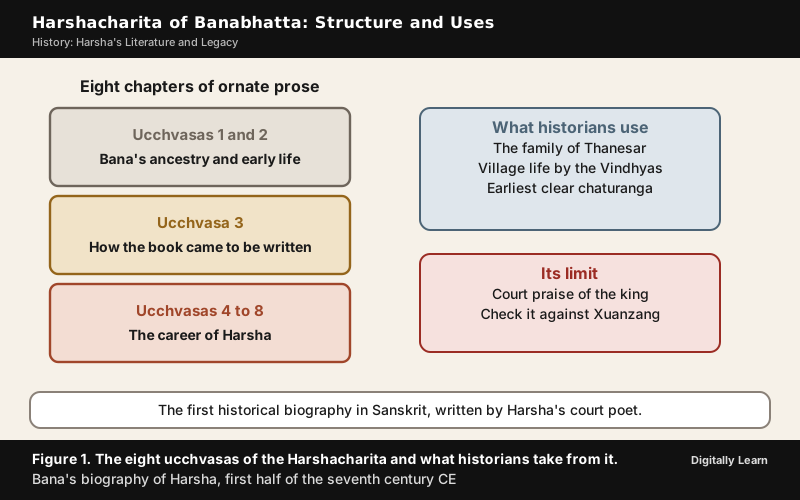
One small detail repays remembering. The earliest clear reference to chaturanga, the common ancestor of chess, comes from the Harshacharita, in a passage that praises the king's reign by saying that only from the Ashtapada board could one learn how to draw up a chaturanga.
Kadambari: Banabhatta's Prose Romance
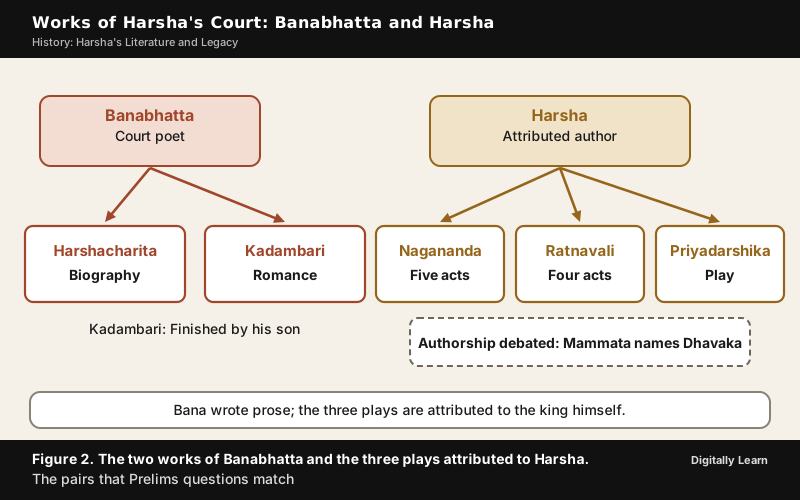
The Kadambari is a romantic novel in Sanskrit, composed mainly by Banabhatta in the first half of the seventh century CE. The Purvabhaga, the first portion, is Bana's; the Uttarabhaga, the second portion, was written by his son Bhushanabhatta to the plan laid down by his father, because Bana died before finishing the book. An alternate tradition gives the son's name as Pulindabhatta. The work is among the great masterpieces of classical Sanskrit and is described as one of the world's first novels.
Its plot is intricate. The central thread is the love of the hero Chandrapeeda for the heroine Kadambari, who does not appear until past the midpoint of the book. Many characters appear in several incarnations, as humans, demigods or animals, and the narration runs in nested frames, so that a large part is a parrot's retelling of a story it heard from a sage, and the sage's story itself contains other stories. The plot is thought to be adapted from the story of King Sumanas in Gunadhya's Brihatkatha. Along the way the book offers glimpses of courtly life, philosophy, nature and aesthetics, which is why historians use such literature to draw out details of culture and society.
The two works of Bana are different in kind, and the difference is the easiest way to avoid mixing them up in an examination. The Harshacharita is a biography of a real king in eight chapters; the Kadambari is a romance of love across births with a parrot narrator and an unfinished first author. Two further works are attributed to Bana, the Chandikashataka and a drama called the Parvatiparinaya. Bana's praise in tradition is summed up in the saying Banochhistam Jagatsarvam, "Bana has described everything in this world and nothing is left."
Nagananda, Ratnavali and Priyadarshika: Plays Attributed to Harsha
Three Sanskrit plays are attributed to Harsha himself. Their themes weave love stories with courtly life, or sacrifice and other high ethical values, and historians use them to draw out details of the society of the time.
- Nagananda: "Joy of the Serpents", a play in five acts. It tells the story of the prince of the vidyadharas, Jimutavahana, who gives up his own body to stop the daily sacrifice of a Naga to the divine eagle Garuda. The invocation to the Buddha in the opening Nandi verse is celebrated as one of the best examples of dramatic invocation, yet the goddess Gauri, the consort of Shiva, plays an important part in the plot by reviving the hero.
- Ratnavali: "The Jewel Necklace", a Natika in four acts. The king Udayana of Kaushambi is served by a loyal and devious minister, Yaugandharayana, who wishes the king to marry Ratnavali, princess of Simhala (presumably Sri Lanka), because a sage had prophesied that the husband of Ratnavali would become an emperor. Ratnavali, shipwrecked and passing under the name Sagarika, becomes the maid of the queen Vasavadatta, and the plot turns on a drawn portrait, three mistaken meetings and a staged fire. The play is one of the first textual references to the celebration of Holi.
- Priyadarshika: The third play attributed to Harsha, translated into English by G. K. Nariman, A. V. Williams Jackson and Charles Ogden in 1923.
The authorship is a debated point, and an answer should say so. Harsha is widely believed to be the author. Some, such as Mammata in the Kavyaprakasha, hold that Dhavaka, one of Harsha's court poets, wrote the plays as a paid commission, while the scholar Wendy Doniger is persuaded that the king wrote them himself.
The sources of the plots also show the king drawing on earlier literature. The Udayana story behind the Ratnavali was dramatised before him by Bhasa, and the story of Jimutavahana in the Nagananda follows shorter versions of the same tale, but Harsha treats it in an original way. The Nagananda has stayed alive on the stage, and it figures in the repertoire of Kutiyattam, the traditional Sanskrit theatre of Kerala.
Sanskrit Works and Authors: Harsha's Age and Earlier Ages
Works of Harsha's court are easily confused with the great Sanskrit works of earlier ages, so the table sets them side by side, each with its author and its age.
| Work | Author | Form | Period and theme |
|---|---|---|---|
| Harshacharita | Banabhatta | Prose biography in eight ucchvasas | Seventh century CE; deeds of Harsha |
| Kadambari | Banabhatta, completed by his son | Prose romance, nested stories | Seventh century CE; love across births |
| Nagananda | Attributed to Harsha | Play in five acts | Seventh century CE; self-sacrifice of Jimutavahana |
| Ratnavali | Attributed to Harsha | Natika in four acts | Seventh century CE; Udayana and Ratnavali |
| Mrichchhakatika | Shudraka | Play in ten acts | Possibly fifth century CE; the Little Clay Cart |
| Buddhacharita | Ashvaghosha | Epic poem in 28 cantos | Early second century CE; life of the Buddha |
| Mudrarakshasa | Vishakhadatta | Play | Dated variously, late fourth to eighth century CE; rise of Chandragupta Maurya |
| Amarakosha | Amarasimha | Lexicon in three books | About 375 CE; one of the nine gems of Vikramaditya |
| Plays and poems of Kalidasa | Kalidasa | Plays and poems | Fourth to fifth century CE; most often placed in the reign of Chandragupta II, 380 to 415 CE |
| Ashtadhyayi | Panini | Grammar of Sanskrit | Between the sixth-fifth and fourth centuries BCE |
The table settles the common mismatches. The Buddhacharita belongs to Ashvaghosha, centuries before Harsha, not to Vasubandhu; Amarasimha and Kalidasa belong to the Gupta age, not to Harsha's court; and Panini, the grammarian, is dated centuries before Pushyamitra Shunga, who reigned from about 185 to 149 BCE.
Education and the Patronage of Nalanda
Royal Patronage of Nalanda Under Harsha
The monastic university of Nalanda is a mahavihara, which means a complex of several monasteries of various sizes. Its foundation was laid by Kumaragupta I in the fifth century CE, and later monarchs carried it forward. The Gupta emperors were its first patrons, and after the Gupta decline the most notable patron was Harsha. According to the Chinese pilgrim Xuanzang, Harsha built majestic Buddhist viharas, and Harsha himself is recorded as granting 100 villages, directing 200 households from each village to supply the monks with daily needs such as rice, butter and milk. The Pala rulers of the eighth to twelfth centuries were the next great patrons.
The curriculum went well beyond Buddhist teaching. All students studied Mahayana and the texts of the eighteen Hinayana sects, together with the Vedas, logic, Sanskrit grammar, medicine and Samkhya. Students were admitted after rigorous evaluation only, and debate was developed into a critical tool of higher learning. Monks came from China, Tibet and Central Asia in the north and from Sri Lanka and Southeast Asia in the south, and took back small sculptures and illustrated manuscripts. Tibetan sources describe a great library named Dharmaganja; the number of its volumes is not known. The site was inscribed as a World Heritage Site by UNESCO on 15 July 2016, and the excavated area is about 23 hectares.
Nalanda's daily life, its later history and its comparison with Taxila, together with Xuanzang's account of the Kannauj and Prayaga assemblies, are set out in Hiuen Tsang and Harsha: Religion, the Kannauj and Prayag Assemblies.
Art, Architecture and Inscriptions of Harsha's Age
Palaces, Stupas and Monasteries in Harsha's Reign
The architecture of Harsha's time is known more from description than from standing monuments. Bana describes the Thanesar of Harsha's family with a defensive wall, a moat and a palace with a two-storied Dhavalagriha, the "white mansion". Xuanzang credits Harsha with building several thousand stupas, each about a hundred feet high, on the banks of the Ganga, and with building hospices for travellers and the poor on highways across India. He also records that Harsha built Buddhist viharas and three temples of the Buddha, Surya and Shiva, all of the same size.
Xuanzang adds that Thanesar itself, which was dominated by Shaivism, had three Buddhist monasteries beside more than a hundred Hindu temples, and that at Kannauj there were a hundred Buddhist monasteries.
The one place where the art of the age can be studied directly is Nalanda. The excavated layout shows a change from groupings around the stupa and chaitya to a formal linear alignment along an axis from south to north.
The sculptural art of Nalanda, in stucco, stone and bronze, grew out of a heavy dependence on the Buddhist Gupta art of Sarnath. By the ninth century a synthesis of the Sarnath Gupta idiom, the local Bihar tradition and that of central India led to the formation of the Nalanda school of sculpture, with consistently high quality of workmanship, an ordered appearance with little crowding, and sculptures worked in three dimensions rather than flat relief.
The Nalanda bronzes, dating from the seventh and eighth centuries to about the twelfth century, outnumber the metal images from all other sites of eastern India. Nalanda stucco influenced practice in Thailand, and its metal art influenced the art of the Malay archipelago, Nepal, Myanmar and Tibet.
Inscriptions, Seals and Coins as Evidence
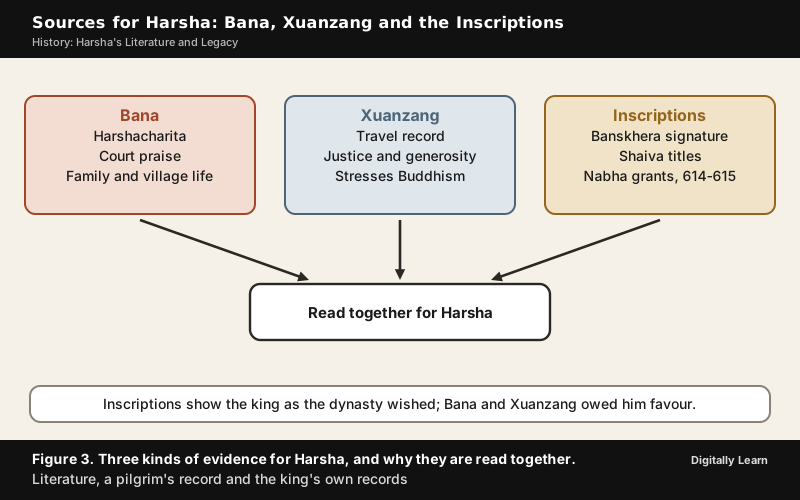
Literature is only one kind of source for Harsha. The royal records give a second check on Bana.
- Banskhera copper plate: A copper plate inscription found at Banskhera in Uttar Pradesh, in Nagari script, a precursor to Devanagari. It carries the king's signature in the words "svahasto mama maharajadhiraja shri harshasya", that is, "By my own hand, the great king of kings, Shri Harsha."
- Seals and land grants: Harsha's seals describe his ancestors as worshippers of the sun god Surya, his elder brother as a Buddhist, and himself as a Shaivite. His land-grant inscriptions describe him as Parama-maheshvara, the supreme devotee of Shiva. Recent copper-plate finds at Nabha record land grants by Harsha to a Brahmin dated 614‑615 CE.
- Coin: A coin depicting King Harsha has a peacock fanning its tail on the reverse.
- The Madhuban plate and the Sonepat and Nalanda seals: In the genealogical portion of the Madhuban and Banskhera plates the name of Harsha's mother Yasomati is not mentioned, while the Sonepat and Nalanda seals mention her as the mother of both Rajyavardhana and Harsha. Different records therefore carry different parts of the royal family's story, and historians read them together.
The value of the royal inscriptions is that they show Harsha as the dynasty wished to show him and not as a court poet decorated him. The inscriptions depict Harsha as a devotee of Shiva, while the account of Xuanzang stresses his attachment to Buddhism; the evidence supports the view that he was eclectic in his religious practice. Harsha's religious policy is treated in full in Hiuen Tsang and Harsha.
Harsha's Death and the End of the Empire
Death in 647 and the End of the Pushyabhuti Line
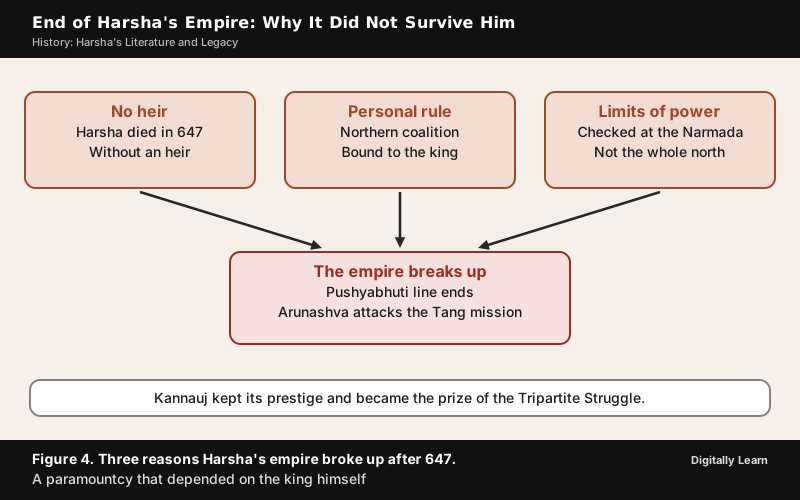
Harsha ruled from April 606 until his death in 647 CE, a reign of about forty years, and he died without an heir. That ended the Pushyabhuti dynasty, also called the Vardhana dynasty, which had begun as a small ruling house of Thanesar and which Harsha had raised to the throne of Kannauj. His domain was by origin a coalition of the north bound to him personally, and with the king gone, there was no heir, no settled machinery of government to carry it on. That machinery is set out in The Administration and Economy of Harsha's Age, and the extent of his overlordship in Harsha's Empire and the Check at the Narmada.
A caution on dates. The year of Harsha's death is 647 in the Class 12 NCERT timeline of 606 to 647 CE and in the Pushyabhuti and Wang Xuance accounts. Some other accounts of his plays give his reign as 606 to 648, so an answer should use 647.
Wang Xuance and Arunashva
The aftermath is known from Chinese records. In 648 the Tang emperor Taizong sent Wang Xuance to Kannauj in reply to an embassy that Harsha had sent to China, and Xuance headed the third Tang mission. On arrival he found that Harsha had died. The new ruler, whom the Chinese name Aluonashun and who is supposed to be Arunashva, attacked Wang and his thirty mounted attendants. Wang escaped to Tibet, assembled a force of 7,000 Nepalese horsemen and 1,200 Tibetan soldiers, and returned to attack Arunashva, capturing him together with about 2,000 prisoners, and also took a reported Buddhist relic to China. He wrote a travel book, the Zhong Tianzhu Guo Xingji ("Travel Notes of Central India").
The episode is a good illustration of the political vacuum. A new ruler had taken the throne soon after the old emperor's death, and he attacked a diplomatic mission from China.
Why a Personal Paramountcy Did Not Survive
The reasons are visible in how Harsha's power was built. Harsha was the most powerful emperor of northern India, but he did not rule the whole of northern India. His attempt to extend his empire southward beyond the Narmada was held in check by Pulakeshin II of the Chalukyas, and his effort to unite the north achieved only mixed success; conflicts with neighbouring kingdoms continued even after an alliance with the Varman dynasty of Kamarupa. A state of this kind, whose cohesion depended on the king's own campaigns and presence, was likely to dissolve when he died.
Assessing Harsha: Legacy and the Last Great Hindu Emperor Debate
Harsha as Ruler, Poet and Patron
Harsha's record has four strands, and a fair assessment holds them together. As a ruler, Harsha united much of northern India and was held in check at the Narmada. As a patron, he supported poets and scholars, among them Bana, and the monks of Nalanda. As a person, the sources show a king who was himself a fine poet and dramatist, and who showed respect for all schools of thought and belief. As an administrator, he left a loose, decentralised government. His court became a centre of cosmopolitanism, attracting scholars, artists and religious visitors from far and wide.
Xuanzang praised his justice and generosity and described him as an energetic ruler who kept a vast army and was often engaged in military campaigns. Bana presents him in an overly favourable light. Between the two, the sensible verdict is that he was an energetic, capable and generous king who built a wide overlordship around himself, and that the praise in both accounts comes from men who owed him hospitality or patronage.
Testing the Label "Last Great Hindu Emperor"
Calling Harsha "the last great Hindu emperor" of northern India makes three claims at once, and an answer should test each against the evidence instead of repeating the label.
| Part of the label | What the evidence shows |
|---|---|
| "Hindu" | Harsha was eclectic in his religious views. Seals call him a Shaivite and his grants call him a supreme devotee of Shiva; Xuanzang calls him a devout Buddhist who banned animal slaughter for food and built stupas and monasteries |
| "Emperor" of the north | He was the most powerful emperor of northern India, but he did not rule the entire north, and Pulakeshin II stopped his advance beyond the Narmada |
| "Last" | His death ended one dynasty and the empire fragmented, but the north was not left without great powers, since the Gurjara-Pratiharas, Palas and Rashtrakutas contested Kannauj in the eighth and ninth centuries |
The varna of the dynasty is itself disputed in the sources. Xuanzang describes Harsha as a Hindu of Bais Kshatriya lineage, while a seventh-to-eighth-century Buddhist text, the Manjushrimulakalpa, and some modern writers say he was of Vaishya origin.
So the label compresses a debate into a slogan. Used carefully, it records that his was the last paramountcy based at Kannauj before the contest among the Pratiharas, Palas and Rashtrakutas; used carelessly, it hides his religious breadth and the limits of his rule.
From Kannauj to the Tripartite Struggle
Harsha had made Kanyakubja, modern Kannauj, his imperial capital, and the city kept its prestige after him. In the eighth and ninth centuries Kannauj became the centre of a long contest among the Gurjara-Pratiharas, the Palas and the Rashtrakutas. That contest is told in full in The Tripartite Struggle for Kannauj. The legacy is plain: Harsha left the north a capital that every later power wished to hold.
Previous Year UPSC‑CSE Questions
Each question comes with an explanation of how to approach it.
- UPSC Prelims 1998Which of the following pairs are correctly matched?
- I. Mrichchhakatikam - Shudraka
- II. Buddhacharita - Vasuvandhu
- III. Mudrarakshasha - Vishakhadatta
- IV. Harshacharita - Banabhatta
How to approach this Prelims question
Approach: Test each pair against the author of the work. The Mrichchhakatika is attributed to Shudraka, the Mudrarakshasa is a play by Vishakhadatta on the rise of Chandragupta Maurya, and the Harshacharita is Banabhatta's, so pairs I, III and IV hold. The Buddhacharita is an epic poem in 28 cantos on the life of the Buddha by Ashvaghosha, from the early second century CE, so pair II is the wrong one.
Trap to watch: Vasubandhu is a Buddhist name, which makes the false pair with the Buddhacharita look right.
Why each option is right or wrong:
- (a) I, II, III and IV: Wrong. Pair II is false, since the Buddhacharita is Ashvaghosha's, not Vasubandhu's.
- (b) I, III and IV: Right. Shudraka, Vishakhadatta and Banabhatta are matched to their own works.
- (c) I and IV: Wrong. It leaves out pair III, which is correct.
- (d) II and III: Wrong. It includes the false pair II and leaves out the correct pairs I and IV.
Answer: (b) I, III and IV. The Buddhacharita is Ashvaghosha's, so only pair II fails.
- UPSC Prelims 2020With reference to the scholars/litterateurs of ancient India, consider the following statements:
- Panini is associated with Pushyamitra Shunga.
- Amarasimha is associated with Harshavardhana.
- Kalidasa is associated with Chandra Gupta – II.
Which of the statements given above is/are correct?
How to approach this Prelims question
Approach: Place each writer in his age. Panini, the grammarian, is dated between the sixth-fifth and fourth centuries BCE, centuries before Pushyamitra Shunga, who reigned from about 185 to 149 BCE. Amarasimha, author of the Amarakosha, is placed about 375 CE, as one of the nine gems of Vikramaditya, not at Harsha's court. Kalidasa is most often placed in the reign of Chandragupta II, 380 to 415 CE. Only statement 3 holds.
Trap to watch: Harsha's court was famous for its writers, which makes a Harsha link sound right for Amarasimha.
Why each option is right or wrong:
- (a) 1 and 2 only: Wrong. Panini is dated centuries before Pushyamitra Shunga, and Amarasimha before Harsha.
- (b) 2 and 3 only: Wrong. Statement 2 is false, since Amarasimha is placed about 375 CE.
- (c) 3 only: Right. Kalidasa is most often placed in the reign of Chandragupta II.
- (d) 1, 2 and 3: Wrong. Statements 1 and 2 are false.
Answer: (c) 3 only. Only the link of Kalidasa with Chandragupta II holds.
Sources
- NCERT Class VII, Our Pasts II: New Kings and Kingdoms (Harsha, Banabhatta)
- NCERT Class XII, Themes in Indian History I: Kings, Farmers and Towns
- NCERT Class XI, An Introduction to Indian Art: Nalanda
- UNESCO World Heritage Centre: Archaeological Site of Nalanda Mahavihara
- Press Information Bureau: Nalanda inscribed on the World Heritage List
- District Nalanda, Government of Bihar: History
- District Kannauj, Government of Uttar Pradesh: History
- Wikipedia: Harsha
- Wikipedia: Harshacharita
- Wikipedia: Banabhatta
- Wikipedia: Kadambari
- Wikipedia: Nagananda
- Wikipedia: Ratnavali
- Wikipedia: Pushyabhuti dynasty
- Wikipedia: Wang Xuance
- Wikipedia: Xuanzang
- Wikipedia: Nalanda
- Wikipedia: Mricchakatika
- Wikipedia: Buddhacharita
- Wikipedia: Mudrarakshasa
- Wikipedia: Amarasimha
- Wikipedia: Kalidasa
- Wikipedia: Pushyamitra Shunga
- Wikipedia: Panini
- Wikipedia: Priyadarshika
- UPSC: Civil Services Examination question papers
Editorial Disclaimer
This article draws on the current NCERT textbooks, the UNESCO World Heritage listing of Nalanda, the district administrations of Nalanda and Kannauj and the other sources listed in the Sources section.