


Overview
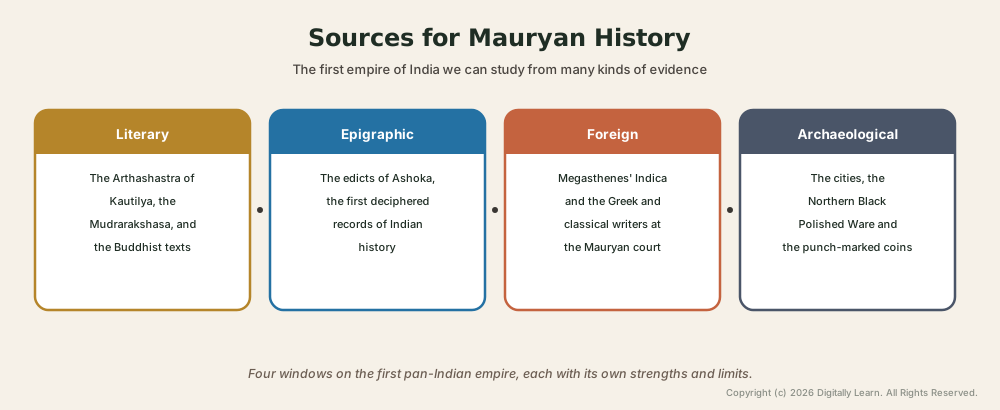
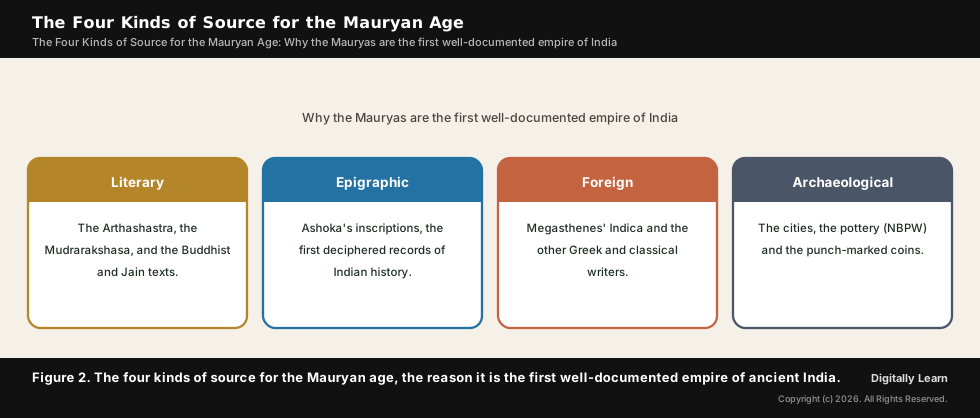
The sources of Mauryan history are unusually rich, and that is why the Mauryan Empire (c. 322 to 185 BCE) is counted the first well-documented empire of ancient India. The evidence falls into four kinds. There are literary texts, above all Kautilya's Arthashastra and the Greek Indica of Megasthenes. There are epigraphic records, the inscriptions of Ashoka, which are the first writings of Indian history that scholars have been able to read. There are foreign accounts left by the Greek and later writers, and there is the archaeology of the cities, the pottery and the coins. This opening part of the cluster surveys these sources and what each can, and cannot, tell us.
Why the Mauryan Period Is the First Well-Documented Empire in Ancient India
The Four Kinds of Mauryan Source
What is the significance of the sources: the wealth of evidence for the Mauryas is itself the first thing to know, for no earlier age of Indian history can be studied from so many kinds of record at once.
Four kinds of source come together for the Mauryan age. The literary texts, written in Sanskrit, Pali and Greek, describe its statecraft and society. The epigraphic records, the inscriptions of Ashoka, speak to us in the king's own words. The foreign accounts of the Greek writers give an outsider's view, and the archaeology of the cities, the coins and the pottery supplies the material proof. Each kind has its own strengths and its own limits.
Literary Sources: Secular, Religious and Dynastic Texts
Kautilya's Arthashastra: The Treatise on Statecraft and Its Disputed Date
What is the significance of the Arthashastra: it is the single most important literary source for the Mauryan state, a manual of government that no other ancient Indian text can match.
The Arthashastra, ascribed to Kautilya (also called Chanakya or Vishnugupta, the minister of Chandragupta), is a treatise on statecraft in fifteen books, covering the king, the bureaucracy, law, taxation, war and diplomacy. Lost for centuries, it was recovered and published by R. Shamasastry in the early twentieth century.
It must, however, be used with care. Many scholars hold that the text reached its final form over a long period, with layers added after the Mauryan age, so it describes an ideal of government rather than a plain record of Chandragupta's rule. It is a treatise on how a state should work, not an eyewitness report of how the Mauryan state did work.
The Mudrarakshasa, the Brahmanical Texts and the Puranas
Distinguishing the other literary texts: alongside the Arthashastra stand a play, the Brahmanical works and the Puranas, each adding its own thread to the story.
The Mudrarakshasa, a Sanskrit play by Vishakhadatta, tells how Chanakya outwitted the minister Rakshasa to win the throne for Chandragupta; its subject is the court intrigue at the time of Chandragupta Maurya, though the play was written long afterwards. The Puranas preserve the dynastic king-lists and regnal years, and Brahmanical works such as Patanjali's Mahabhashya and Kalidasa's Malavikagnimitra throw light on the end of the dynasty.
| Text | Author / tradition | What it tells us |
|---|---|---|
| Arthashastra | Kautilya (Chanakya) | Statecraft, administration, economy and war |
| Mudrarakshasa | Vishakhadatta | Chanakya's intrigue and Chandragupta's rise |
| Puranas | Brahmanical | The Mauryan king-list and regnal years |
| Indica | Megasthenes (Greek) | Pataliputra, administration and society |
| Dipavamsa, Mahavamsa | Sri Lankan Buddhist | Ashoka, the Third Council and the missions |
| Parishishtaparvan | Hemachandra (Jain) | Chandragupta's renunciation and journey south |
The Buddhist Chronicles and the Jain Traditions
Distinguishing the religious sources: the Buddhist and Jain traditions preserve much of what we know of Ashoka and of Chandragupta, though each views the dynasty through the lens of its own faith.
The Sri Lankan chronicles, the Dipavamsa and the Mahavamsa, record Ashoka's turn to Buddhism, the Third Buddhist Council and the mission of Mahinda and Sanghamitra to the island. The Sanskrit Ashokavadana and Divyavadana preserve the legends of Ashoka, while the Jain Parishishtaparvan of Hemachandra tells of Chandragupta's renunciation and his death by the rite of sallekhana at Shravanabelagola in the south.
Epigraphic Sources: The Inscriptions of the Mauryan Age
The Edicts of Ashoka as Contemporary Records
What is the significance of the inscriptions: the edicts of Ashoka are the most valuable source of all, because they are contemporary, official, and the first writings of Indian history that can be read.
Scattered on rocks and pillars across the subcontinent, from Afghanistan to Karnataka, the edicts set out Ashoka's policy of Dhamma, his administrative orders and his own reflections. Because they are the king's own contemporary words, cut in stone, they are free of the later embroidery that colours the literary legends, and they are treated in full in a later part of this cluster.
Non-Ashokan Inscriptions: Sohgaura, Mahasthan and the Junagadh Record
Distinguishing the other inscriptions: a few non-Ashokan records add to the picture, among them two famine-relief orders and one later inscription that looks back to the Mauryan age.
The Sohgaura copper-plate in Uttar Pradesh and the Mahasthan inscription in Bengal record orders about grain-stores and famine relief, evidence of the state's reach into the countryside. The later Junagadh rock inscription of Rudradaman, of about the second century CE, looks back and tells us that the Sudarshana Lake was built under Chandragupta by his governor Pushyagupta, so that even a later record becomes a source for Mauryan administration.
The Languages and Scripts of the Inscriptions
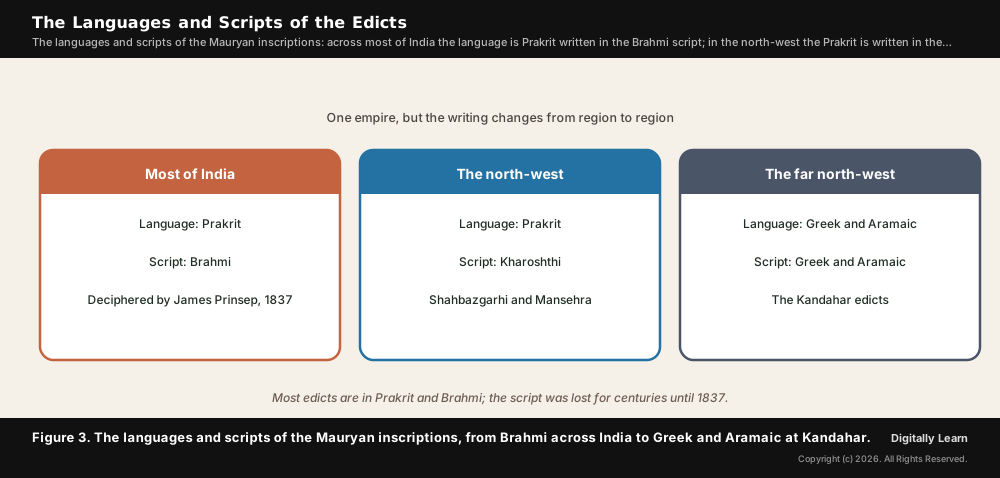
Distinguishing the writing: the Mauryan inscriptions were not all in one language or one script, and knowing the pattern is a favourite examination point.
Across most of the subcontinent the language is Prakrit, written in the Brahmi script. In the north-west the Prakrit is written in the Kharoshthi script, and in the far north-west, at Kandahar, the edicts are in Greek and Aramaic. The Brahmi script had been forgotten for many centuries, and could not be read at all until it was deciphered in the nineteenth century.
Foreign Accounts: Megasthenes and the Classical Writers
Megasthenes' Indica and Its Survival in Fragments
What is the significance of the foreign accounts: the Greek writers give us an outsider's view of the Mauryan world, and the chief of them is Megasthenes, who actually lived at the Mauryan court.
The Greek ambassador Megasthenes was sent by the king Seleucus Nicator to the court of Chandragupta at Pataliputra. His book, the Indica, described the capital, the administration and the society, including a famous account of the city's government and of the classes of Indian society. The original Indica is lost; it survives only in fragments quoted by later writers such as Strabo, Arrian, Diodorus and Pliny.
The Reliability of the Greek Accounts and the Later Chinese Pilgrims
Distinguishing the value and the limits: the Greek accounts are precious but must be read with caution, and they must not be confused with the much later Chinese pilgrims.
Because the Indica survives only in others' quotations, and because Megasthenes saw India through Greek eyes and sometimes repeated wonders, his account is used with care; even so, the Greek form of Chandragupta's name, Sandrokottos, lets historians fix the date of his reign.
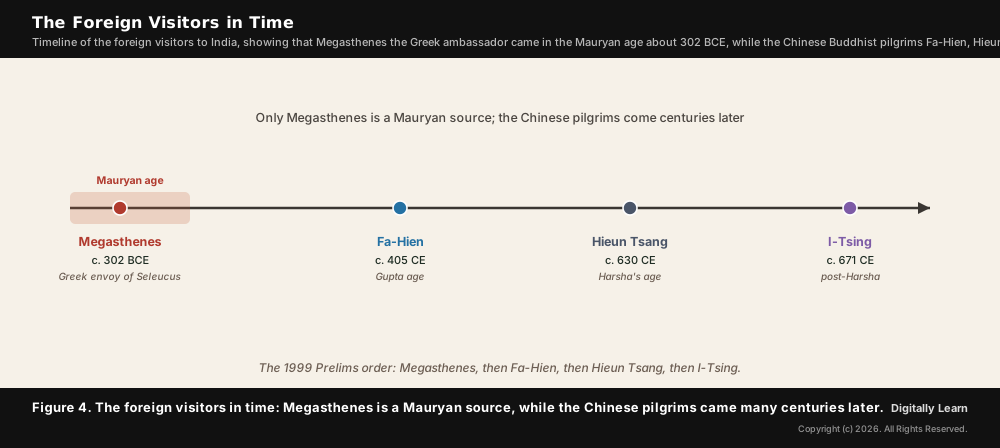
The Chinese pilgrims Fa-Hien, Hieun Tsang and I-Tsing, by contrast, came in the Gupta and post-Gupta centuries, six to nine hundred years after the Mauryas, so they are not Mauryan sources at all, only later travellers who sometimes noted Ashoka's old stupas.
Archaeological Sources: Cities, Pottery and Coins
Mauryan Cities, Pottery and the Punch-Marked Coins
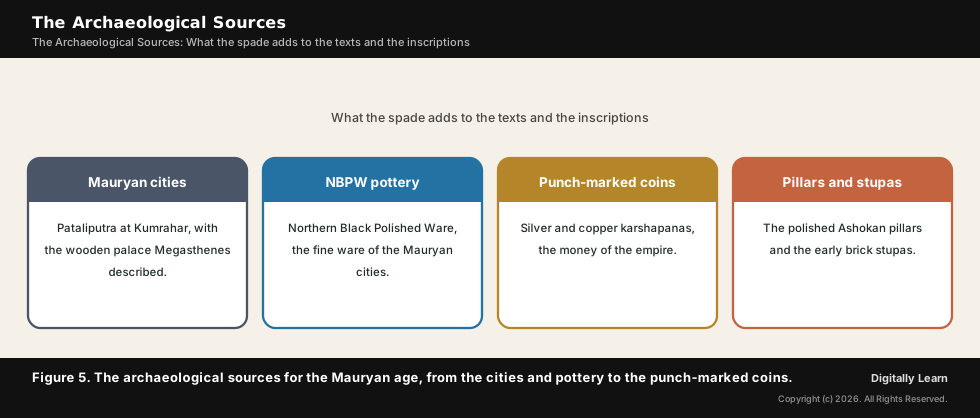
What is the significance of the archaeology: the spade supplies the material proof that the texts and inscriptions describe, and it is the fourth great source for the age.
Excavation at Pataliputra, at Kumrahar and Bulandi Bagh, has uncovered the remains of a great pillared hall and of the wooden palace that Megasthenes described. The fine Northern Black Polished Ware is the typical pottery of the Mauryan cities, and the silver and copper punch-marked coins are the money of the empire. The polished Ashokan pillars and the early stupas, treated in a later part, complete the material record.
UPSC Relevance and Exam Focus
Where the Mauryan Sources Fit in the UPSC-CSE Syllabus
This topic belongs to General Studies Paper I: ancient Indian history and culture, and the sources of Mauryan history are among the most reliably examined areas of ancient India in the Prelims.
For Prelims, hold the firm facts: the Arthashastra is Kautilya's treatise on statecraft; the Mudrarakshasa is Vishakhadatta's play on Chandragupta's rise; Megasthenes was Seleucus's envoy to Chandragupta and wrote the Indica; the Brahmi script was deciphered by James Prinsep in 1837; and the Chinese pilgrims belong to a much later age.
For Mains, the four kinds of source, and the limits of each, make a complete answer on how the history of the first Indian empire is reconstructed and why it is better known than any earlier period.
Recurring linked concepts an aspirant should keep in working memory:
- The Arthashastra: Kautilya’s treatise on statecraft; a manual, used with care.
- The Indica: Megasthenes (Seleucus’s envoy to Chandragupta); lost, survives in fragments.
- The Mudrarakshasa: Vishakhadatta’s play on Chanakya and Chandragupta’s rise.
- The edicts: Ashoka’s contemporary records; Brahmi deciphered by Prinsep in 1837.
- Archaeology: Northern Black Polished Ware and the punch-marked coins.
A common Prelims trap is to count the Chinese pilgrims as Mauryan sources. Fa-Hien, Hieun Tsang and I-Tsing came in the Gupta and later centuries; only Megasthenes, among the foreign writers, is a Mauryan-age source.
Another trap is to treat the Arthashastra as a plain record of Chandragupta's government. It is a treatise on statecraft of uncertain date, used as evidence only with caution.
Previous Year UPSC-CSE Questions
Previous Year UPSC-CSE Questions By the end you will be able to draft model answers for the following UPSC questions. Each question carries a collapsible framework showing how to approach it in the exam.
- UPSC Prelims 2016 GS-IWho of the following had first deciphered the edicts of Emperor Ashoka?
How to approach this Prelims question
Approach: Recall who first read the Brahmi script of the edicts.
Trap to watch: William Jones founded the Asiatic Society and gave the Sandrokottos identification, but it was James Prinsep who deciphered Brahmi; Bühler and Müller are later scholars.
Key facts to recall:
- James Prinsep deciphered the Brahmi script of Ashoka's edicts in 1837.
- Most edicts are in Prakrit written in Brahmi.
Answer signal: James Prinsep.
- UPSC Prelims 2002 GS-IThe ancient Indian play Mudrarakshasa of Visakhadutt has its subject on
How to approach this Prelims question
Approach: Recall what Vishakhadatta's play is about.
Trap to watch: The title's 'Rakshasa' is the Nanda minister's name, not a demon; the play is political, about the court of Chandragupta Maurya, not mythological.
Key facts to recall:
- The Mudrarakshasa is Vishakhadatta's Sanskrit play.
- Its subject is Chanakya's intrigue to secure Chandragupta's throne.
Answer signal: The court intrigues at the time of Chandragupta Maurya.
- UPSC Prelims 1999 GS-IThe following persons came to India at one time or another:
- Fa-Hien
- I-Tsing
- Megasthenes
- Hieun-Tsang
The correct chronological sequence of their visits is:
How to approach this Prelims question
Approach: Place Megasthenes in the Mauryan age and the three Chinese pilgrims in the Gupta and post-Gupta centuries.
Trap to watch: Megasthenes (c. 302 BCE) is by far the earliest; Fa-Hien (c. 405 CE) precedes Hieun Tsang (c. 630 CE), who precedes I-Tsing (c. 671 CE).
Key facts to recall:
- Megasthenes is Mauryan; the pilgrims are Gupta and later.
- Order: Megasthenes, Fa-Hien, Hieun Tsang, I-Tsing.
Answer signal: III, I, IV, II (Megasthenes, Fa-Hien, Hieun-Tsang, I-Tsing).
Sources and Further Reading
Editorial Disclaimer
This article is for UPSC preparation. The dating of the Arthashastra and of some literary sources is given in the conventional ranges used by historians, and a few attributions remain debated.