


Overview
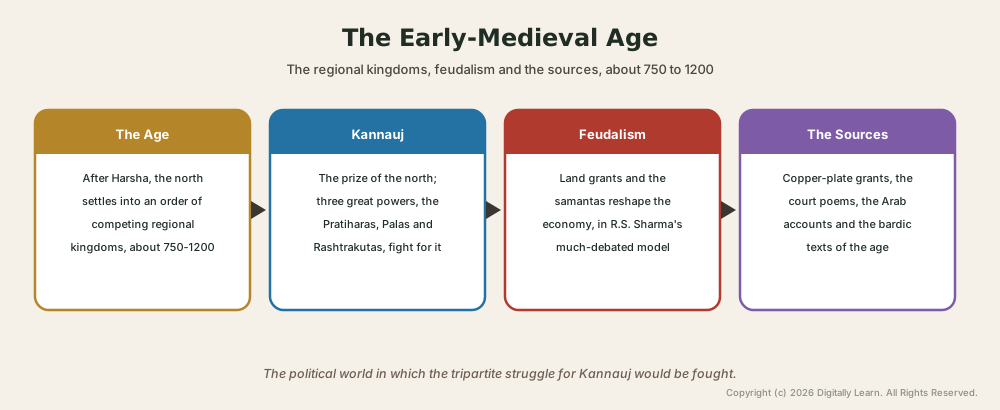
The early-medieval age of Indian history, from about 750 to 1200, was an order of many kingdoms. After the unity of Harsha passed, north India settled into a balance of competing regional powers, and three of them, the Gurjara-Pratiharas of the west, the Palas of the east and the Rashtrakutas of the Deccan, fought for the great prize of Kannauj. The age also saw the spread of land grants and a much-debated Indian feudalism, and it is known to us through a rich body of inscriptions, court poems and foreign accounts. This part sets out the age, the prize of Kannauj, the coming of feudalism, the sources and the exam focus.
The Early-Medieval Age after Harsha
What the Early-Medieval Age Was
What is the significance of the early-medieval age: it is the long period, from about 750 to 1200, in which India was ruled not by one empire but by many regional kingdoms.
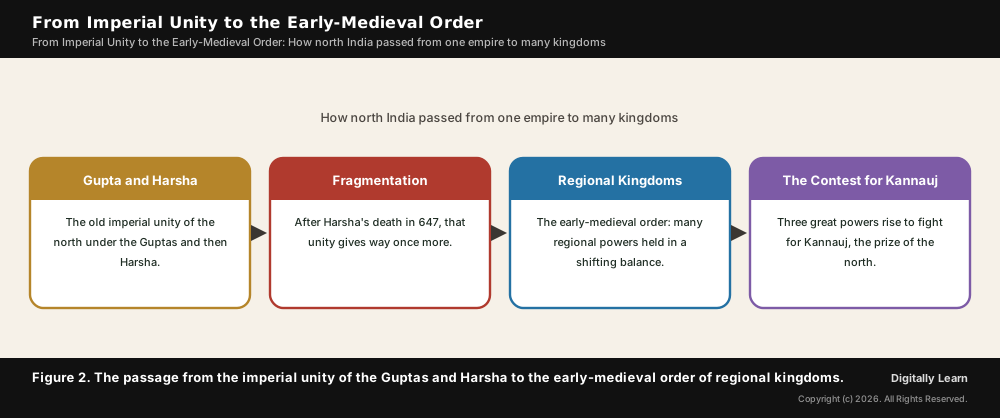
After the death of Harsha in 647, the brief unity of the north dissolved once more, and India entered its early-medieval centuries. In place of a single paramount power there stood a shifting balance of regional states, each with its own dynasty, its own capital and its own ambition over its neighbours.
This was a new political order rather than mere decline: a layered world of kings and their feudatories, of regional cultures and temple cities. The northern half of this world turned on one question above all, the mastery of the rich Ganga plain and its key city, Kannauj.
A boundary worth marking: while the north fought over Kannauj, the deep south had its own great story in the Cholas, treated in their own place. This cluster follows the powers of the north and the Deccan that contested the imperial city.
Kannauj and the Three Great Powers
Distinguishing the prize: of all the cities of the north, Kannauj alone carried the weight of imperial title, and to hold it was to claim the overlordship of northern India.
Kannauj, well placed on the middle Ganga, had been the seat of Harsha; in the words of the sources its throne was 'equivalent to imperial status over all of northern India'. To master it was to master the fertile Doab and the prestige of the old empire, and so it became the prize that three great powers would fight for.
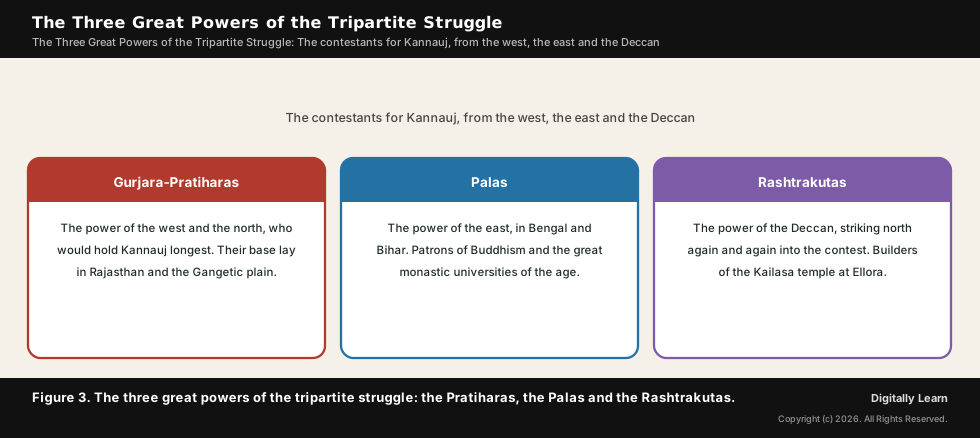
Those three powers were the Gurjara-Pratiharas of the west and the north, the Palas of the east in Bengal and Bihar, and the Rashtrakutas of the Deccan. Their three-cornered contest, the tripartite struggle, runs through the next several parts of this cluster.
The Coming of Indian Feudalism
Land Grants, the Samantas and the Agrarian Order
What is the significance of feudalism: the early-medieval economy is often described through a model of Indian feudalism, in which the granting of land reshaped both the countryside and the state.
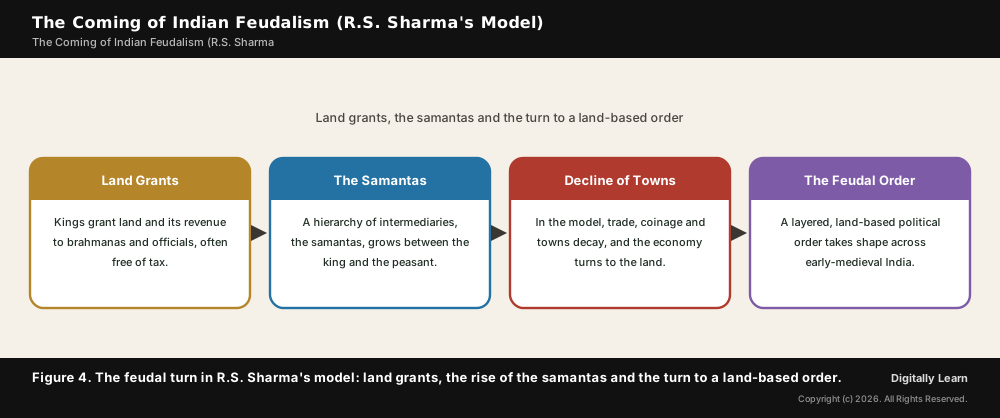
From Gupta times onward, kings increasingly granted villages and their revenue to brahmanas, temples and officials, often free of tax and with rights over the peasants. Over the centuries, the historian R.S. Sharma argued, this produced a layered order of intermediaries, the samantas, standing between the king and the cultivator.
In Sharma's model, set out in his Indian Feudalism, the spread of grants went together with a decline of trade, of coinage and of towns, a process he called urban decay. Power and wealth turned away from the market and toward the land, and the state itself grew more decentralised and 'feudal' from above.
The Feudalism Debate
Distinguishing a model from a fact: Indian feudalism is a scholarly model, not a settled certainty, and an aspirant should know that it has been strongly contested.
Sharma's thesis drew sharp criticism. Harbans Mukhia asked whether there was feudalism in Indian history at all, holding that the land grants were not the same as European manorialism. Burton Stein offered instead a 'segmentary state', while Hermann Kulke and B.D. Chattopadhyaya spoke of an 'integrative' state that was growing, not decaying.
The economic evidence is itself disputed. The currency of credit instruments such as the Hundi, a merchant's bill of exchange, suggests that trade and a money economy did not wholly vanish, and the critics use such evidence against the picture of a total urban and commercial collapse.
| The Indian-feudalism thesis (Sharma) | The critics |
|---|---|
| Land grants created a chain of samanta intermediaries. | Grants were revocable concessions, not European-style fiefs (Mukhia). |
| Trade, coinage and towns decayed; the economy turned to land. | Credit and trade survived, as the Hundi and Arab accounts show. |
| The state grew decentralised and feudal 'from above'. | The state was 'segmentary' (Stein) or 'integrative' and growing (Kulke). |
The Sources for the Early-Medieval Age
Inscriptions, Court Poems and Foreign Accounts
What is the significance of the sources: the early-medieval age is reconstructed from inscriptions, court poems and foreign accounts, each of which must be read with care for its bias.
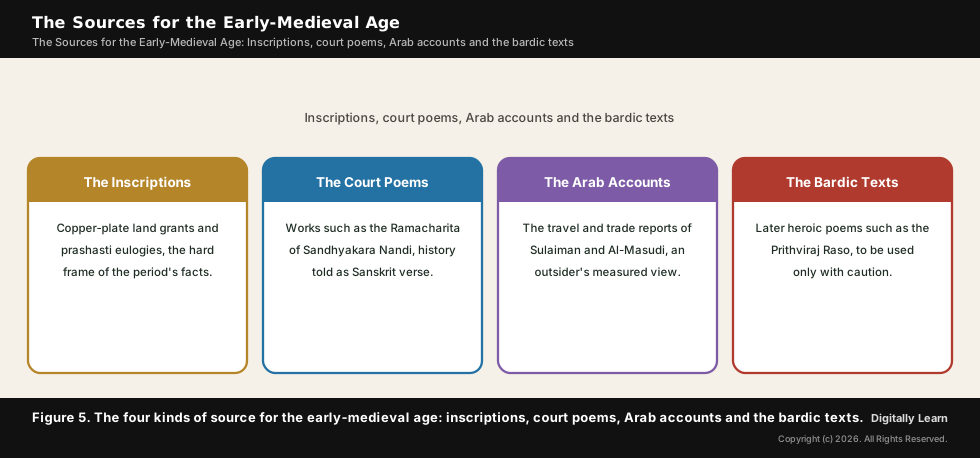
The inscriptions are the firmest ground. Above all the copper-plate land grants, such as the Khalimpur plate of the Palas and the Sanjan plate of the Rashtrakutas, record gifts of land and, in their long prashasti eulogies, the deeds and descent of the kings who made them.
The court poems add the dynasties' own voice. The Ramacharita of Sandhyakara Nandi is the finest example: written in a double-meaning verse, it narrates the story of the Ramayana and the reign of the Pala king Ramapala at one and the same time, a feat of Sanskrit art and a key historical source.
The foreign accounts give the outsider's view. The Arab travellers and writers, above all Sulaiman and Al-Masudi, described the Indian kingdoms and their trade, while later bardic poems such as the Prithviraj Raso must be used only with great caution.
The Chief Records of the Age
Distinguishing the records: an aspirant should be able to name the principal sources of the period and say briefly what each tells us.
The table below gathers the chief records, from the copper-plate grants and the prashasti eulogies to the Ramacharita and the Arab and bardic accounts, with a note on the value and the limits of each.
| Record | Type | What it tells us |
|---|---|---|
| Copper-plate grants (Khalimpur, Sanjan) | Inscription | Records of land gifts, dynasties and deeds, in prashasti form. |
| The Ramacharita | Court poem | Sandhyakara Nandi's double-meaning life of the Pala king Ramapala. |
| Accounts of Sulaiman and Al-Masudi | Arab writing | An outsider's view of the kingdoms, trade and the 'Balhara'. |
| The Prithviraj Raso | Bardic poem | A later heroic tale of Prithviraj, to be used only with caution. |
UPSC Relevance and Exam Focus
Where the Early-Medieval Age Fits in the UPSC-CSE Syllabus
This topic belongs to General Studies Paper I: ancient and early-medieval Indian history, and the framework of the age, feudalism and the sources underlies every later part of this cluster.
The objective paper rewards a firm frame: the early-medieval order of regional kingdoms, the city of Kannauj as the imperial prize, the three powers of the tripartite struggle, and the model of Indian feudalism with its samantas and land grants.
Several linked concepts recur and are worth holding in working memory:
- Kannauj: The imperial prize of the north and the focus of the tripartite struggle.
- The samanta: The landed intermediary at the heart of the feudalism model.
- Indian feudalism: R.S. Sharma’s much-debated model of the early-medieval economy.
- The Ramacharita: Sandhyakara Nandi’s double-meaning poem on Ramapala.
- The Hundi: A bill of exchange, evidence that credit and trade survived.
A 2020 question asked for the meaning of the Hundi of the post-Harsha period; it is a bill of exchange, a merchant's credit note, and its survival is one of the arguments against the idea that trade had wholly collapsed.
The larger analytical theme is the feudalism debate itself: whether the early-medieval centuries are best seen as an age of feudal decay, in R.S. Sharma's sense, or as a period of regional state-formation and growth, as his critics argue.
A common trap treats Indian feudalism as a plain historical fact; it is a model that historians such as Mukhia and Kulke have strongly questioned. Another reads the Hundi as a royal or feudal order; it is in truth a commercial instrument, a bill of exchange.
Previous Year UPSC-CSE Questions
Previous Year UPSC-CSE Questions By the end you will be able to draft model answers for the following UPSC questions. Each question carries a collapsible framework showing how to approach it in the exam.
- UPSC Prelims 2020 GS-IWhich of the following phrases defines the nature of the 'Hundi' generally referred to in the sources of the post-Harsha period?
How to approach this Prelims question
Approach: Recall that the Hundi is a merchant's credit document, a bill of exchange used to transfer money over distance, not a royal or feudal order.
Trap to watch: Options (a) and (d) dress the Hundi as a royal or feudal order; it is a commercial instrument, not an administrative one.
Key facts to recall:
- A Hundi is a bill of exchange, a negotiable credit note used by traders.
- Its use in the post-Harsha period shows that commerce and credit survived.
- It is cited against the 'decline of trade' claim of the Indian feudalism thesis.
Answer signal: A bill of exchange.
Sources and Further Reading
Editorial Disclaimer
This article is for UPSC preparation. The dates of the early-medieval period are approximate, and the account of Indian feudalism follows a model that remains debated among historians.