


Overview
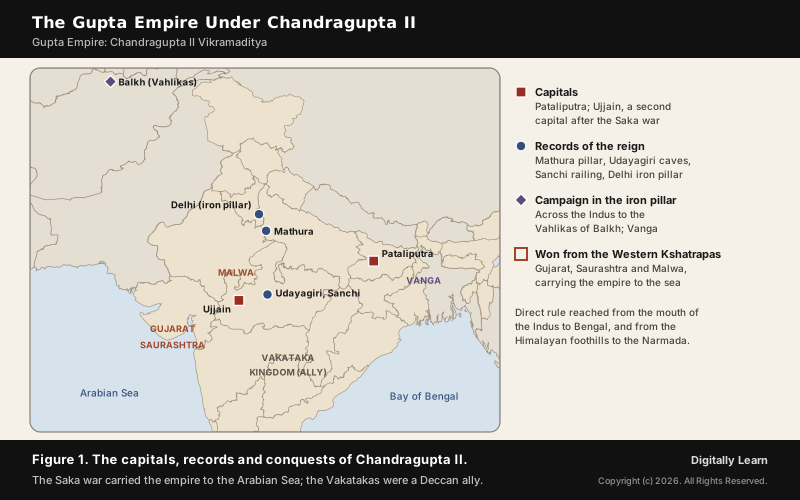
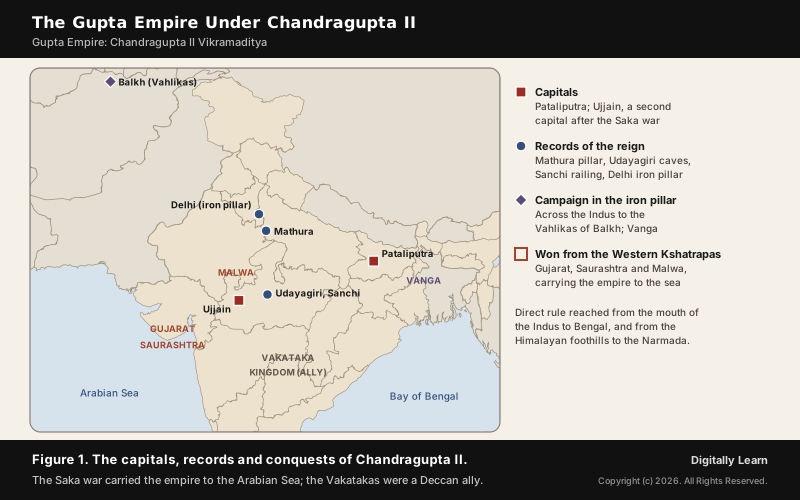
Chandragupta II (reigned c. 375 to 415 CE), also known as Vikramaditya, was the son of Samudragupta and the Gupta emperor under whom the empire reached its greatest extent. He conquered the Saka Western Kshatrapas, carrying Gupta rule to the Arabian Sea, and bound the Deccan to his house through the marriage of his daughter Prabhavati Gupta to the Vakataka king. The Chinese pilgrim Faxian (Fa-Hien) visited India in his reign, and most scholars identify him with King Chandra of the Delhi iron pillar.
Chandragupta II at a Glance
Who Was Chandragupta II: Reign, Family and Achievements
Chandragupta II was the grandson of Chandragupta I, the first Gupta to take the title maharaj-adhiraja, and the son of Samudragupta, whose conquests made the Gupta dynasty an empire. He continued his father's policy of expansion through war and marriage, and his forty-year reign is the high point of Gupta power. The main facts are:
| Question | Answer |
|---|---|
| Reign | c. 375 to 415 CE |
| Parents | Samudragupta and queen Dattadevi |
| Titles and names | Vikramaditya, Chandra, Deva-raja, Deva-gupta, Maharajadhiraja, Apratiratha |
| Wives | Dhruvadevi (mother of Kumaragupta I) and Kuberanaga, a Naga princess |
| Greatest conquest | The Saka Western Kshatrapas of Gujarat, Saurashtra and Malwa |
| Alliances | The Nagas and the Vakatakas by marriage; ties with the Kadambas |
| Capitals | Pataliputra; Ujjain probably a second capital |
| Foreign visitor | The Chinese pilgrim Faxian (Fa-Hien) |
| Successor | Kumaragupta I, from about 415 CE |
Why Chandragupta II Is Known as Vikramaditya
The title Vikramaditya means "brave as the sun", a title Chandragupta II took himself: his silver coins carry the legend "Chandragupta Vikramaditya, King of Kings, and a devotee of Vishnu", and the Supiya pillar inscription of his descendant Skandagupta also calls him Vikramaditya. His coins call him simply "Chandra".
The title matters because Indian tradition remembers a legendary King Vikramaditya of Ujjain, the ideal ruler, generous and brave, who drove out the Sakas and was called Shakari, "enemy of the Sakas". Many historians believe these legends are based at least partly on Chandragupta II, who really did defeat the Sakas and whose rule reached Ujjain. The legend is not history: the Vikram Samvat era of 57 BCE, linked to the legendary king, took that name only from the ninth century.
Accession of Chandragupta II and the Ramagupta Question
Dates of the Reign and the Devichandraguptam Story
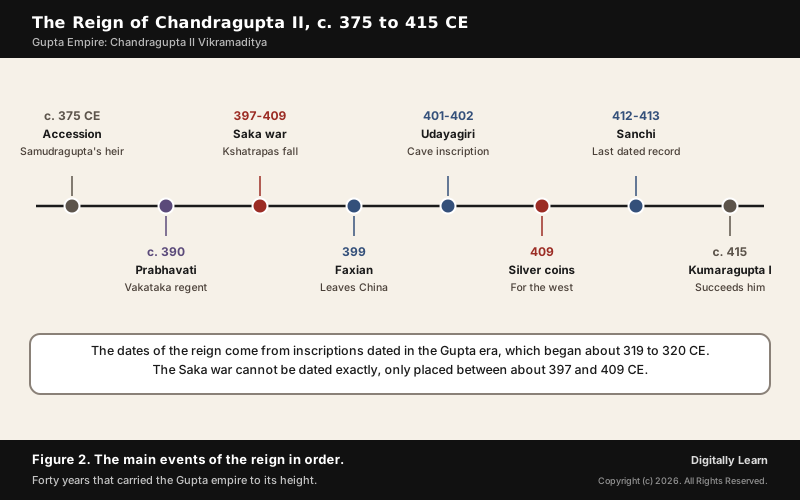
According to the official Gupta genealogy, Samudragupta chose Chandragupta, his son by queen Dattadevi, as his successor. The dates of the reign come from inscriptions dated in the Gupta era, which began about 319 to 320 CE. A Mathura pillar inscription of year 61 of that era places the start of the reign around 376 to 381 CE.
The last dated record of the reign is the Sanchi inscription of 412 to 413 CE (Gupta year 93), and his son Kumaragupta I was on the throne by 415 to 416 CE, so Chandragupta II died sometime between 412 and 415 CE. The customary dates for his reign are therefore c. 375 to 415 CE.
A Sanskrit play, the Devichandraguptam, attributed to Vishakhadeva (generally identified with Vishakhadatta), tells a different story of the succession. Only fragments of it survive, quoted in later works, and they were first found in 1923. In the play, an elder brother named Ramagupta is king; besieged by a Saka enemy, he agrees to surrender his queen Dhruvadevi. Chandragupta goes to the enemy camp disguised as the queen and kills the Saka chief, and later he dethrones Ramagupta and marries Dhruvadevi.
Historians still debate whether this happened. The official Gupta genealogy never names Ramagupta, though three undated inscriptions from central India mention a king of that name, and some coins found there have been attributed to him, an attribution not all historians accept. What is certain is that Dhruvadevi was Chandragupta II's queen and the mother of Kumaragupta I.
Conquests of Chandragupta II: The Western Kshatrapas and Beyond
Conquest of the Saka Western Kshatrapas
The Western Kshatrapas, also called the Sakas, ruled west-central India: Gujarat, Saurashtra and Malwa. Chandragupta II overcame the last of them, and this is the achievement for which he is best known. The evidence comes from several directions:
- Inscriptions in central India: His foreign minister Virasena’s Udayagiri inscription says he came there with the king who sought to “conquer the whole world”; a feudatory’s record at Udayagiri dates to 401 to 402 CE, and his officer Amrakardava’s Sanchi inscription of 412 to 413 CE praises victories in many battles.
- The coins: Kshatrapa coins stop abruptly in the last decade of the fourth century. The last, of Rudrasimha III, dates to 388 or 397 CE.
- The new coins: Chandragupta’s silver coins, dated to 409 CE, copy the Kshatrapa design but replace the Kshatrapa dynastic symbol with the Gupta Garuda.
- Literature: The Devichandraguptam’s story of the Saka chief and the Vikramaditya legends of the king who drove out the Sakas point the same way.
The victory cannot be dated exactly; it falls between about 397 and 409 CE. With it Chandragupta II extended the empire to the Arabian Sea coast of present-day Gujarat, and Rudrasimha III was the last ruler of the Western Kshatrapas, so the conquest ended Saka rule in the subcontinent.
Campaigns in the Iron Pillar Inscription: Vanga, the Indus and Balkh
The Sanskrit inscription on the Delhi iron pillar praises a king named Chandra who won sole sovereignty "by his own arm". If Chandra is Chandragupta II, as most scholars accept, the inscription adds two campaigns: he defeated an alliance of enemies in Vanga (Bengal), and he crossed the "seven faces" of the Indus and defeated the Vahlikas, the people of Balkh in present-day Afghanistan.
These northern victories were not lasting conquests. There is no evidence that Punjab was annexed, and after his reign it was ruled by petty chiefs. Short inscriptions naming Chandra, one with the epithet Vikramaditya, on the Sacred Rock of Hunza may record the same campaign. At its height his empire stretched from the mouth of the Indus and northern Pakistan in the west to Bengal in the east, and from the Himalayan foothills to the Narmada.
Matrimonial Alliances of Chandragupta II: Nagas, Vakatakas and Kadambas
Wives of Chandragupta II and the Vakataka Regency of Prabhavati Gupta
Chandragupta II had at least two queens. Dhruvadevi, named in the Gupta records, was the mother of his successor Kumaragupta I; a clay seal from Basarh calls a queen Dhruvasvamini, probably the same woman. Kuberanaga (Kuvera-naga) was a princess of the Naga dynasty, which had held power in central India before Samudragupta subdued it.
Both marriages served policy. The Naga marriage may have helped him consolidate the empire and may have brought Naga support in the war against the Western Kshatrapas. The Kadambas, who ruled in present-day Karnataka, also married their daughters into the Gupta family, and later chiefs of that region claimed descent from Chandragupta, which suggests that Gupta influence reached the far Deccan through marriage, not war.
The most important alliance was with the Vakatakas, the leading power of the Deccan, just south of the Gupta empire. Prabhavati Gupta, Chandragupta's daughter by Kuberanaga, married the Vakataka king Rudrasena II. He died after a reign of about five years, around 390 CE, and Prabhavati ruled as regent for her young sons, from about 390 to 410 CE.
Her copper-plate grants show how close the two kingdoms became. They list her Gupta ancestors with their imperial titles before the Vakataka king with the lesser title Maharaja, and she gives her father's gotra, not her husband's. Historians describe the Vakataka kingdom during her twenty-year regency as practically a part of the Gupta empire, and it secured the southern flank while Chandragupta fought the Sakas.
Administration, Religion and Coinage Under Chandragupta II
Feudatories, Ministers and Religious Tolerance
Chandragupta II ruled through feudatories and officers, several of whom are known from their own records. Their inscriptions also show that the king, a devoted Vaishnava who called himself parama-bhagavata, "supreme devotee of Vishnu", tolerated other faiths:
| Person | Role | What the record shows |
|---|---|---|
| Virasena | Foreign minister | A Shiva temple at Udayagiri |
| Sanakanika | Feudatory Maharaja | A Vaishnava cave temple at Udayagiri, 401 to 402 CE |
| Amrakardava | Military officer | Gifts to the Buddhist monastery at Sanchi, 412 to 413 CE |
| Shikhara-svami | Minister | Named in the records of the reign |
The Udayagiri caves near Vidisha in Madhya Pradesh were made under his patronage and consecrated in 401 CE; they are the only site that can be firmly tied to a Gupta king by its inscriptions. Their best-known sculpture is the great relief of Vishnu as Varaha, the boar, lifting the earth goddess Bhudevi on his tusk.
Gold and Silver Coins of Chandragupta II
Gupta gold coins are famous for their artistry, and Chandragupta II added to the range. He kept most of his father's gold coin types, such as the Archer and the Tiger-slayer, and introduced new ones that show him at war and at leisure:
- Lion-slayer: The king kills a lion, with the legend simha-vikrama; the lion replaced his father’s tiger, perhaps after the conquest of Gujarat, the home of the Asiatic lion.
- Horseman: The king rides a fully caparisoned horse; his son Kumaragupta I used the type too.
- Couch type: The king sits on a couch holding a flower, with the legend rupa-kriti.
- Chakra-vikrama: A gold coin found at Bayana shows him receiving a discus from Vishnu.
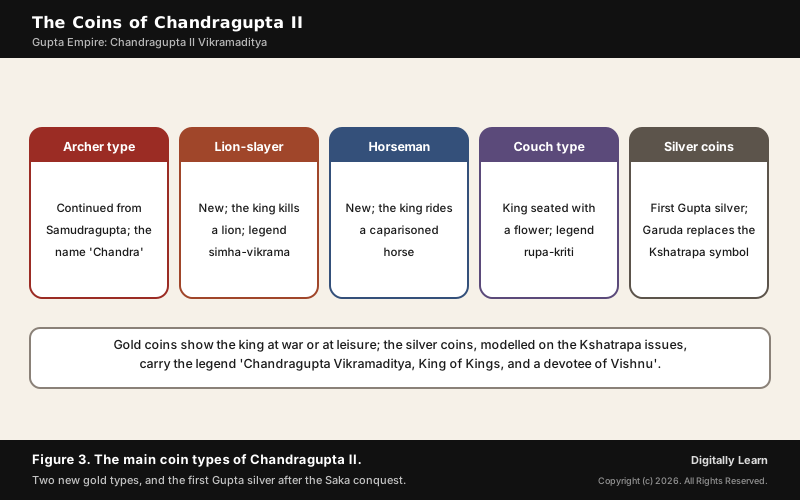
Chandragupta II was also the first Gupta king to issue silver coins. They were meant to replace the silver coinage of the Western Kshatrapas in the conquered west, and copied it closely: a bust of the king with a corrupted Greek legend on one side, and on the other the Gupta Garuda in place of the Kshatrapa symbol, with his title in Brahmi.
Faxian (Fa-Hien) and India Under Chandragupta II
Faxian's Journey to India, 399 to 412 CE
Faxian, formerly written Fa-Hien, was a Chinese Buddhist monk who set out from Chang'an in 399 CE, at about sixty, to find Buddhist scriptures. He walked along the overland Silk Road, entered India from the north-west and reached Pataliputra, visiting the places linked with the Buddha's life: Kapilavastu, Bodh Gaya, Varanasi, Shravasti and Kushinagar. He learned Sanskrit and collected texts.
He went home by sea. After two years in Sri Lanka, a storm drove his ship to an island, probably Java; he threw away his own belongings but clung to his books and statues of the Buddha. He reached China in 412 CE, and his record, the Foguoji (Record of the Buddhist Kingdoms), is an independent account of India in Chandragupta II's time; he spent about six years in the Gupta kingdom.
| Visitor | When | Court or period |
|---|---|---|
| Megasthenes | Mauryan period | Greek envoy of Seleucus to Chandragupta Maurya |
| Faxian (Fa-Hien) | About 1,600 years ago | Reign of Chandragupta II |
| Xuan Zang (Hiuen-Tsang) | About 1,400 years ago | The time of Harsha |
| I-Qing (I-Tsing) | About 50 years after Xuan Zang | Buddhist pilgrim from China |
What Faxian Saw: Madhyadesha, Pataliputra and the Chandalas
Faxian was interested in Buddhism, not politics, and he never records the name of the reigning king. His picture of the Madhyadesha, the Middle Kingdom south-east of Mathura, is idealised, but its main point, a peaceful and prosperous land, is probably true: unlike the later pilgrim Xuan Zang, he met no robbers. He noted:
- Light government: People did not register their households or attend on magistrates.
- Mild punishment: Criminals were fined; only repeated rebels lost a right hand.
- Paid service: The king’s bodyguards and attendants received salaries.
- Food and trade: Except the Chandalas, people avoided meat, liquor, onions and garlic; cowries were used in the markets.
- Charity: In Pataliputra, the most prosperous region, Vaishya chiefs ran centres that gave food and medicine to the poor and the sick.
His account also records the harsh treatment of the Chandalas, who were treated as untouchable. They lived apart and, when they entered a town or market, struck a piece of wood so that others could avoid touching them. The historian R. C. Majumdar cautions that his remarks on diet may reflect the Buddhist community he lived among rather than the whole population.
The Delhi Iron Pillar, Kalidasa and the Navaratnas
The Mehrauli Iron Pillar of King Chandra
The iron pillar in the courtyard of the Qutb complex at Mehrauli in Delhi bears a Sanskrit inscription in Brahmi script. According to the Archaeological Survey of India, it records that the pillar was set up as a Vishnudhvaja, a standard of Vishnu, on a hill called Vishnupada, in memory of a mighty king named Chandra. The inscription says the king had already died when it was engraved.
Scholars generally identify this King Chandra with Chandragupta II: his coins call him Chandra, he was a devotee of Vishnu, and the script matches his dated records. The pillar is 7.21 metres high and weighs more than six tonnes, and it is famous for resisting rust. The explanation is chemical, not mysterious: a thin, even layer of iron phosphate forms on its high-phosphorus iron and protects it. It was probably erected elsewhere, possibly at Udayagiri, and moved to Delhi much later.
Kalidasa and the Navaratnas of the Vikramaditya Legend
The Navaratnas, the "nine gems", are nine scholars said to have attended the court of the legendary Vikramaditya: Kalidasa, Amarasimha, Dhanvantari, Ghatakarapara, Kshapanaka, Shanku, Varahamihira, Vararuchi and Vetala Bhatta. The list comes from the Jyotirvidabharana, a work attributed to Kalidasa that several scholars regard as a later forgery; no earlier text mentions the nine.
There is no evidence that these nine lived at the same time or served the same king, and the historian D. C. Sircar called the tradition worthless for history. One of them may truly belong to the reign: several scholars believe Kalidasa was Chandragupta II's court poet. Even the idea that his court also held the astronomer Aryabhata rests only on later belief, not on any record of the reign.
Chandragupta II in UPSC Previous Year Questions
What UPSC Has Asked About Chandragupta II and Faxian
UPSC's objective questions on this reign test three things: the king in whose reign Faxian came, the order of the foreign visitors, and which scholars belong to which king. The Mains question on Gupta coins asks why their artistry was not matched later; the coins of this reign are the best evidence for an answer.
| Year | What the question asked | The point being tested |
|---|---|---|
| 2025 | The reign in which Faxian travelled to India | Chandragupta II, not Samudragupta |
| 2020 | Scholars and the kings they are linked with | Kalidasa with Chandragupta II |
| 1999 | The order of Megasthenes, Faxian, Xuan Zang and I-Tsing | Megasthenes, Faxian, Xuan Zang, I-Tsing |
| 2017 Mains | Why the excellence of Gupta coins was not matched later | New gold types, first silver, later imitations |
Previous Year UPSC-CSE Questions
Previous Year UPSC-CSE Questions By the end you will be able to draft model answers for the following UPSC questions. Each question carries a collapsible framework showing how to approach it in the exam.
- UPSC Mains 2017 GS-IHow do you justify the view that the level of excellence of the Gupta numismatic art is not at all noticeable in later times?
Answer outline: how to structure the answer
What the question asks, the main arguments, relevant examples and the direction of the conclusion. This is not a full model answer.
Introduction: Open with Gupta gold coins as the finest struck in ancient India, a record of kings and their ideals.
Body (sub-themes to develop):
- Artistry: the king as archer, lion-slayer, horseman, or seated with a flower; legends such as simha-vikrama.
- Message: the king as devotee of Vishnu (Garuda, the discus from Vishnu) and as a patron of the arts.
- Adaptation: the first Gupta silver coins, modelled on the Kshatrapa issues after the conquest of the west.
- Later times: petty chiefs of Punjab copied Kidarite coins; a later ruler, Harigupta, struck copper imitations of Chandragupta II's gold.
Conclusion: Conclude that later coinage borrowed the Gupta designs but not their skill, variety or metal.
- UPSC Prelims 2025 Prelims-GSFa-hien (Faxian), the Chinese pilgrim, travelled to India during the reign of
How to approach this Prelims question
Approach: Place Faxian's stay in the Gupta kingdom in the early fifth century.
Trap to watch: Samudragupta is the famous conqueror, but Faxian came in the reign of his son.
Key facts to recall:
- (a) Samudragupta: wrong. Faxian left China in 399 CE, after Samudragupta's reign had passed to his son.
- (b) Chandragupta II: right. Chandragupta II reigned about 375 to 415 CE, and Faxian travelled from 399 to 412 CE.
- (c) Kumaragupta I: wrong. Kumaragupta I succeeded Chandragupta II about 415 CE, after Faxian had gone home.
- (d) Skandagupta: wrong. Skandagupta, a later descendant, ruled long after Faxian's visit.
Answer signal: Faxian visited in the reign of Chandragupta II, so the answer is option (b).
- UPSC Prelims 2020 Prelims-GSWith reference to the scholars/litterateurs of ancient India, consider the following statements:
- Panini is associated with Pushyamitra Shunga.
- Amarasimha is associated with Harshavardhana.
- Kalidasa is associated with Chandra Gupta – II.
Which of the statements given above is/are correct?
How to approach this Prelims question
Approach: Match each scholar to his period, not to the most famous king.
Trap to watch: Amarasimha is one of the legendary navaratnas, not a scholar of Harsha's court.
Key facts to recall:
- (a) 1 and 2 only: wrong. Neither pairing is right: Panini is not linked to Pushyamitra Shunga, and Amarasimha is linked to the Vikramaditya legend, not Harshavardhana.
- (b) 2 and 3 only: wrong. Statement 2 is wrong.
- (c) 3 only: right. Kalidasa is widely held to have been the court poet of Chandragupta II.
- (d) 1, 2 and 3: wrong. Statements 1 and 2 are wrong.
Answer signal: Only the Kalidasa pairing is correct, so the answer is option (c).
- UPSC Prelims 1999 Prelims-GSThe following persons came to India at one time or another:
- I. Fa-Hien
- II. I-Tsing
- III. Megasthenes
- IV. Hieun-Tsang
The correct chronological sequence of their visits is:
How to approach this Prelims question
Approach: Anchor each visitor to a king: Chandragupta Maurya, Chandragupta II, Harsha.
Trap to watch: I-Tsing came after Xuan Zang, not before him.
Key facts to recall:
- (a) III, I, II, IV: wrong. Xuan Zang (Hieun-Tsang) came before I-Tsing, not after.
- (b) III, I, IV, II: right. Megasthenes in the Mauryan period, Faxian in Chandragupta II's reign, Xuan Zang in Harsha's time, and I-Tsing about fifty years after Xuan Zang.
- (c) I, III, II, IV: wrong. Megasthenes came centuries before Faxian.
- (d) I, III, IV, II: wrong. Megasthenes, not Faxian, came first.
Answer signal: The order is Megasthenes, Faxian, Xuan Zang and I-Tsing, so the answer is option (b).
Sources
- NCERT: Our Pasts I (Class VI), Traders, Kings and Pilgrims; New Empires and Kingdoms
- NCERT: Themes in Indian History Part I (Class XII), Kings, Farmers and Towns
- Archaeological Survey of India: Qutb Minar and its Monuments, Delhi
- Delhi Tourism (Government of NCT of Delhi): Qutab Minar
- Incredible India (Ministry of Tourism): Udayagiri Caves
- Wikipedia: Chandragupta II
- Wikipedia: Western Satraps
- Wikipedia: Rudrasimha III
- Wikipedia: Iron pillar of Delhi
- Wikipedia: Faxian
- Wikipedia: Prabhavatigupta
- Wikipedia: Ramagupta
- Wikipedia: Devichandraguptam
- Wikipedia: Vikramaditya
- Wikipedia: Navaratnas
- Wikipedia: Udayagiri Caves
- Wikipedia: Gupta Empire
- UPSC: Civil Services Examination question papers
Editorial Disclaimer
This article is for UPSC preparation. The Ramagupta episode, the identity of the king Chandra of the Mehrauli pillar, and the navaratnas tradition are debated among historians, and the conventional accounts are given here.