


Overview
Indian Agriculture, Part 5
India's principal cash crops and where they grow.
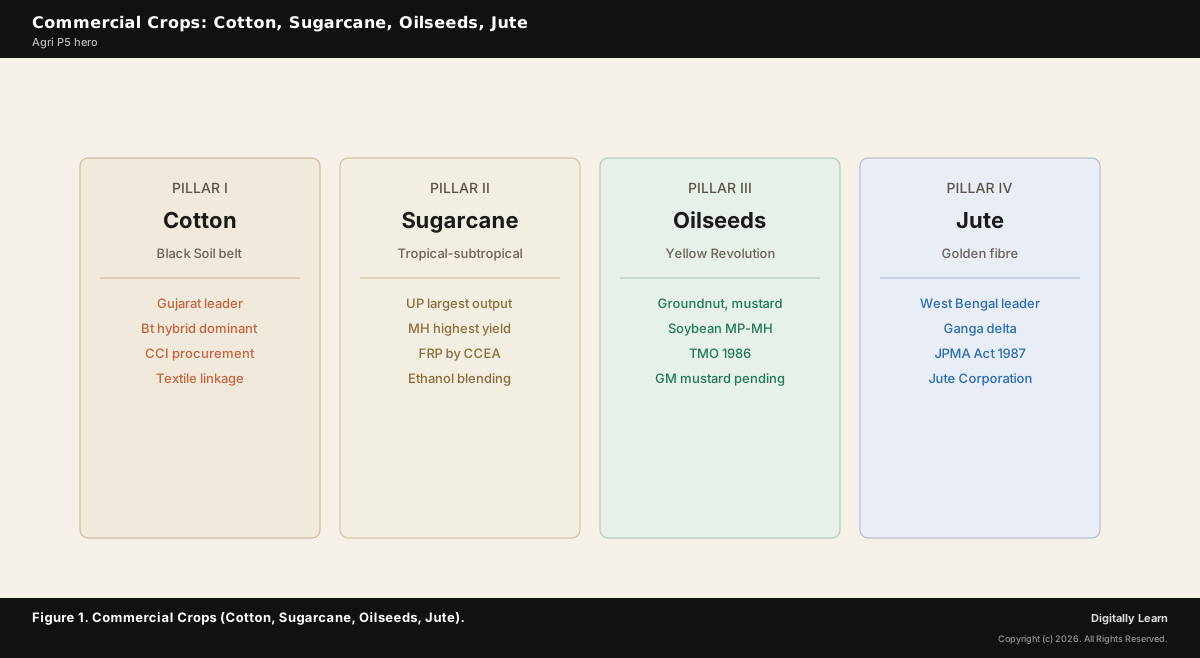
Cotton, sugarcane, oilseeds, and jute are the four pillar commercial cash crops of Indian agriculture. Cotton is a fibre crop of the Black Soil belt covered in Soils Part 3; India is one of the world's largest cotton producers with most acreage under Bt cotton hybrids. Sugarcane is a long-duration tropical and subtropical crop of the irrigated Indo-Gangetic belt and the peninsular wet zones; Uttar Pradesh and Maharashtra dominate output. Oilseeds cover around 14 per cent of cropped area with groundnut, rapeseed-mustard, soybean, and sunflower as the principal crops; the Yellow Revolution transformed Indian oilseed output through TMO 1986. Jute is the principal fibre crop of the Ganga-Brahmaputra delta; the golden fibre supports West Bengal's traditional jute industry.
Background and Historical Context
Commercial crops feed industrial value chains beyond direct food consumption. Cotton supplies the textile sector (India's largest manufacturing employer after agriculture); sugarcane supplies sugar mills, ethanol distilleries, and bagasse cogeneration; oilseeds supply edible-oil processors and the Pradhan Mantri Krishi Sinchayee Yojana micro-irrigation push; jute supplies the eco-friendly packaging industry. UPSC Prelims has tested FRP institutional architecture, GM mustard, and the Sustainable Sugarcane Initiative directly.
What is the significance of the four-crop cash bundle? Three operational dimensions follow. The soil-crop fit defines geographic distribution: cotton on Black Soil, sugarcane on alluvial-coastal, oilseeds on dryland-alluvial, jute on humid delta. The price-support architecture differs across crops: cotton uses MSP via Cotton Corporation, sugarcane uses Fair and Remunerative Price approved by the Cabinet Committee on Economic Affairs (per UPSC Prelims 2015), oilseeds and jute use MSP under CACP. The industrial-geography link means cotton-textile, sugar-ethanol, oil-processing, and jute-packaging value chains are geographically tied to producer regions.
The ICAR-Central Institute for Cotton Research at Nagpur coordinates cotton research; the Cotton Corporation of India handles MSP procurement and stabilises the cotton market. The Indian Sugar Mills Association and the Vasantdada Sugar Institute Pune cover the sugar sector. The Technology Mission on Oilseeds (TMO) launched 1986 drove the Yellow Revolution; the Solvent Extractors Association of India tracks oilseed processing. The Jute Corporation of India supports the West Bengal jute sector; the Jute and Jute Textiles Industry comes under the Ministry of Textiles. Climate-change vulnerability is documented across all four: cotton bollworm risk under temperature rise; sugarcane water demand under groundwater depletion; oilseed monsoon dependency; jute saline-intrusion risk in the Sundarbans delta.
Introduction: Four Commercial Cash Crops
Why cotton, sugarcane, oilseeds, jute form a cluster
The four commercial cash crops covered here share a market-first orientation and a substantial linkage to downstream industrial value chains. Cotton feeds the textile sector; sugarcane feeds sugar mills and ethanol distilleries; oilseeds feed edible-oil processors; jute feeds the packaging-and-twine industry. Together they occupy a substantial share of Indian cropped area and underwrite significant rural employment beyond direct cultivation.
Each of the four crops links to a specific soil base. Cotton sits on Black Soil for its moisture-retention property. Sugarcane sits on alluvial Indo-Gangetic and coastal soils for its heavy water-and-nitrogen demand. Oilseeds spread across alluvial, Black, Red, and laterite soils depending on the crop. Jute concentrates on the Ganga-Brahmaputra delta alluvium.
| Crop | Season | Soil and climate | Leading states |
|---|---|---|---|
| Cotton | Kharif | Black (regur) soil; 21 to 30 degrees Celsius; 50 to 100 cm rainfall or irrigation; 210 frost-free days and bright sunshine | Gujarat, Maharashtra, Telangana |
| Sugarcane | Long-duration (10 to 18 months) | Hot humid tropical-subtropical; 21 to 27 degrees Celsius; 75 to 150 cm rainfall with irrigation | Uttar Pradesh (largest), Maharashtra, Karnataka |
| Oilseeds | Kharif and rabi | Dryland to alluvial; varies by crop (groundnut rainfed, mustard rabi alluvial, soybean kharif) | Gujarat, Rajasthan, Madhya Pradesh, Maharashtra |
| Jute | Kharif | Fertile alluvial delta; high temperature; heavy rainfall over 150 cm; humid climate | West Bengal (largest), Bihar, Assam |
Cotton: Black Soil Belt and Bt Cotton
Geographic conditions, Bt cotton, Cotton Corporation
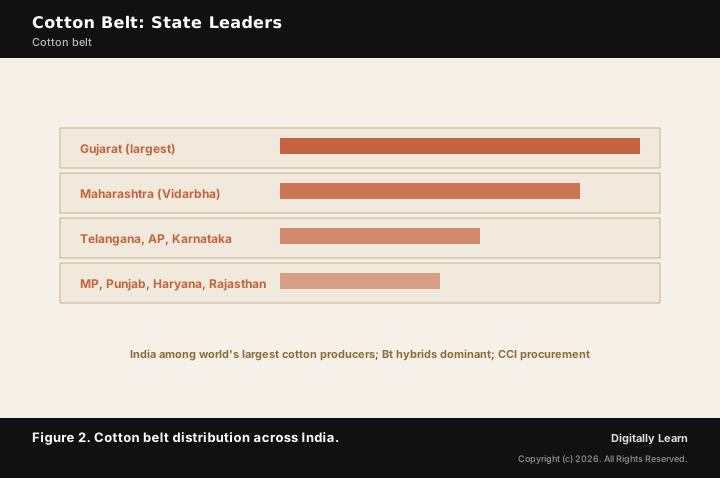
Cotton is a kharif crop of tropical and sub-tropical regions, requiring high temperature (21 to 30 degrees Celsius), 50 to 100 cm of rainfall or assured irrigation, and around 210 frost-free days with bright sunny harvest weather. The Black Cotton Soil (regur) of the Deccan Plateau is the canonical growing medium because of its strong moisture-retention property.
- (i) Distribution: Gujarat is the largest producer; Maharashtra (Vidarbha cotton belt) and Telangana follow; Andhra Pradesh, Karnataka, Madhya Pradesh, and canal-irrigated Punjab are also major; the top three states alone contribute the majority of national output.
- (ii) Bt cotton: Genetically modified cotton with Bacillus thuringiensis gene for pest resistance; covers the bulk of Indian cotton acreage since regulatory clearance in 2002; pink-bollworm resistance breakdown is the current operational concern.
- (iii) Cotton Corporation of India: Public-sector body handling MSP procurement; stabilises cotton market in years of price collapse.
- (iv) Climate vulnerability: Bollworm cycle altered by temperature rise; rainfall variability shifts kharif window; long-staple cotton concentrated in Tamil Nadu and Telangana faces growing-season pressure.
- (v) Industrial linkage: Textile sector is India’s largest manufacturing employer after agriculture; cotton textile clusters concentrated in Coimbatore, Tirupur, Mumbai, Ahmedabad.
Sugarcane: FRP, Sugar Industry, Ethanol
Tropical-subtropical cultivation and the sugar-ethanol value chain
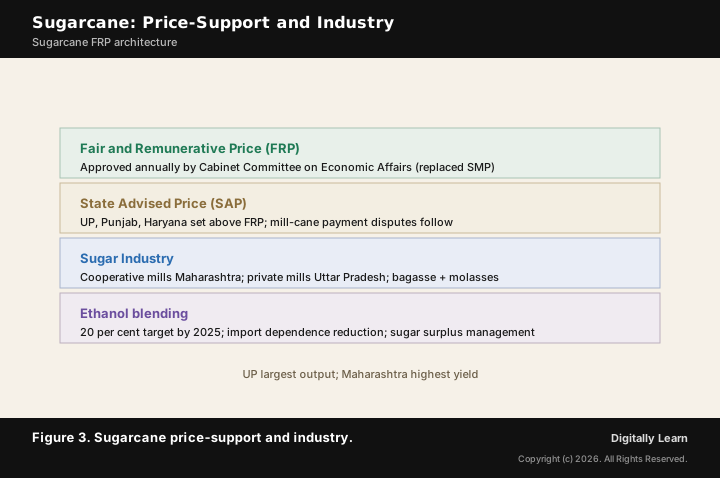
Sugarcane is a long-duration (10 to 18 month) tropical and subtropical crop requiring high temperature (21 to 27 degrees Celsius), 75 to 150 cm rainfall, and heavy soil moisture. India is the world's second-largest sugarcane producer after Brazil. Uttar Pradesh leads national output, followed by Maharashtra (highest yield), Karnataka, Tamil Nadu, Bihar, and Gujarat. The tropical southern belt yields more per hectare; the subtropical northern belt covers more area.
- (i) Fair and Remunerative Price (FRP): Approved annually by Cabinet Committee on Economic Affairs (per UPSC Prelims 2015); replaces the older Statutory Minimum Price.
- (ii) State Advised Price (SAP): Some states (UP, Punjab, Haryana) set SAP above FRP; mill-cane payment disputes follow.
- (iii) Sugar Industry: Cooperative-mill model dominates Maharashtra; private mills dominate UP; bagasse cogeneration and molasses ethanol diversify income.
- (iv) Ethanol blending programme: 20 per cent blending target by 2025 raises sugarcane-ethanol demand; reduces import dependence; cross-link to energy security.
- (v) Sustainable Sugarcane Initiative (SSI): Low seed cost, drip irrigation effective, intercropping with pulses possible; well-documented advantages on shade, drought, intercropping, productivity.
Oilseeds and Jute: Yellow Revolution and Golden Fibre
Five oilseeds plus the Ganga-delta golden fibre
How oilseeds and jute complete the cash-crop bundle. Oilseeds occupy around 14 per cent of cropped area; jute is the largest fibre crop after cotton. Both groups share a kharif-dominant calendar and a strong industrial-value-chain linkage. The Yellow Revolution under the Technology Mission on Oilseeds (1986) transformed oilseed output; the jute economy has structurally declined but still supports West Bengal's traditional industry.
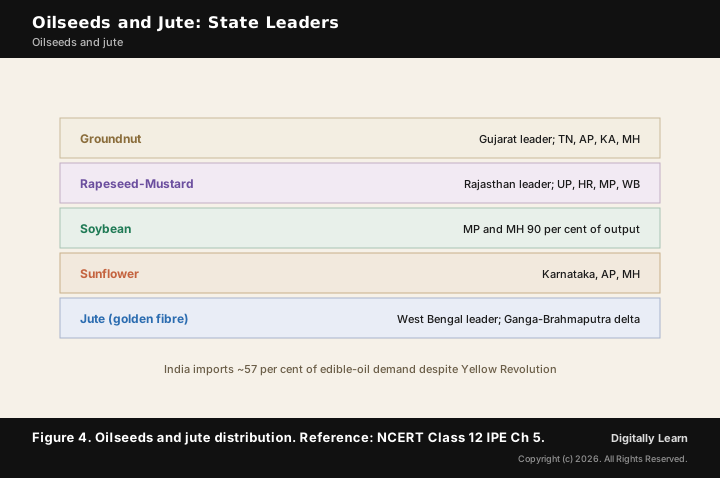
- (a) Groundnut: Largest Indian oilseed; rainfed kharif on dryland Saurashtra and Deccan; Gujarat, Tamil Nadu, Andhra Pradesh, Karnataka, Maharashtra; rabi cycle in southern India.
- (b) Rapeseed-Mustard: Rabi crop on Indo-Gangetic alluvial belt; Rajasthan leader, UP, Haryana, MP, West Bengal. GM mustard (DMH-11) carries genes for hybrid-seed production, regulatory clearance contested.
- (c) Soybean: Kharif crop concentrated in Madhya Pradesh and Maharashtra; 90 per cent of national soybean output; transformed dryland Vidarbha cropping.
- (d) Sunflower: Karnataka, Andhra Pradesh, adjoining Maharashtra; smaller crop with high oil content.
- (e) Jute: Kharif crop of the Ganga-Brahmaputra delta; West Bengal leader, followed by Bihar, Assam, Andhra Pradesh, Odisha. Golden fibre supports West Bengal traditional industry; Jute Packaging Materials Act 1987 mandates jute bags for sugar and grain.
Contemporary Policy and Industry Linkages
Five policy supports across the four crops
The four commercial crops are backed by distinct price-support and industry-promotion architectures. The cross-crop comparison reveals how Indian commercial-cropping policy differentiates across soil, scale, and industrial linkage, from MSP procurement to packaging mandates.
- Cotton Corporation of India: Public-sector procurement at MSP; stabilises market in price-collapse years; supports Maharashtra cotton-suicide-vulnerable Vidarbha belt.
- Sugarcane FRP architecture: CCEA-approved FRP plus state-level SAP; mill-payment disputes; ethanol-blending policy redirects surplus.
- Yellow Revolution and TMO 1986: Technology Mission on Oilseeds expanded groundnut, mustard, soybean output; India still imports ~57 per cent of edible-oil demand.
- Jute Packaging Materials Act 1987: Mandates jute bags for sugar and food-grain procurement; supports West Bengal traditional jute industry.
- Industrial-linkage geography: Cotton-textile (Coimbatore, Tirupur, Mumbai, Ahmedabad); sugar-ethanol (UP, Maharashtra mill clusters); edible-oil processing (Mumbai, Kandla, Mangalore); jute mills (Hooghly belt).
Previous Year UPSC-CSE Questions
Previous Year UPSC-CSE Questions By the end you will be able to draft model answers for the following UPSC questions. Each question carries a collapsible framework showing how to approach it in the exam.
- UPSC Prelims 2015The Fair and Remunerative Price (FRP) of sugarcane is approved by the
How to approach this Prelims question
Approach: Distinguish recommending body (CACP) from approving authority (CCEA). The CACP recommends FRP; the Cabinet Committee on Economic Affairs grants final approval; APMC operates at mandi level.
Key facts to recall:
- FRP replaced the Statutory Minimum Price for sugarcane
- CACP recommends; CCEA approves
- State Advised Price (SAP) is set by some states above FRP
- Sugarcane Control Order 1966 underpins the architecture
Answer signal: Correct answer is (a): Cabinet Committee on Economic Affairs.
- UPSC Prelims 2018With reference to the Genetically Modified mustard (GM mustard) developed in India, consider the following statements:
- GM mustard has the genes of a soil bacterium that give the plant the property of pest-resistance to a wide variety of pests.
- GM mustard has the genes that allow the plant cross-pollination and hybridization.
- GM mustard has been developed jointly by the IARI and Punjab Agricultural University.
Which of the statements given above is/are correct?
How to approach this Prelims question
Approach: DMH-11 was developed at Delhi University's Centre for Genetic Manipulation; the barnase-barstar gene system suppresses self-pollination to enable hybrid seed production, NOT pest resistance.
Trap to watch: Statement 1 confuses GM mustard with Bt cotton (which DOES have soil-bacterium pest-resistance genes). Statement 3 fabricates the developing institution.
Key facts to recall:
- DMH-11 developed at Delhi University CGMCP
- Barnase-barstar gene system enables hybrid seed production
- GEAC under MoEFCC regulates GM-crop clearance
- Bt cotton has pest-resistance; GM mustard has hybrid-seed enablement
Answer signal: Correct answer is (b): only statement 2.
- UPSC Prelims 2014What are the significances of a practical approach to sugarcane production known as 'Sustainable Sugarcane Initiative'?
- Seed cost is very low in this compared to the conventional method of cultivation.
- Drip irrigation can be practiced very effectively in this.
- There is no application of chemical/inorganic fertilizers at all in this.
- The scope for intercropping is more in this compared to the conventional method of cultivation. Select the correct answer using the code given below:
How to approach this Prelims question
Approach: SSI principles include single-bud setts (low seed cost), drip irrigation, intercropping with pulses; chemical fertilisers are reduced but not eliminated, so claim of 'no chemical fertiliser' is false.
Trap to watch: Statement 3 reads attractive but SSI is sustainable, not organic; chemical fertilisers are used at lower rates.
Key facts to recall:
- SSI uses single-bud setts at lower seed cost
- SSI permits drip irrigation effectively
- SSI permits intercropping with pulses
- SSI reduces but does not eliminate chemical fertilisers
Answer signal: Correct answer is (b): 1, 2 and 4 only.
Sources
- NCERT Class 12 India People and Economy, Chapter 5 (Land Resources and Agriculture), pp 50-54
- Indian Council of Agricultural Research (ICAR)
- ICAR-Central Institute for Cotton Research (CICR), Nagpur
- Cotton Corporation of India (CCI)
- Department of Agriculture and Farmers Welfare
- Department of Food and Public Distribution: Sugar Directorate
- Jute Corporation of India
- Agricultural and Processed Food Products Export Development Authority (APEDA)
- United Nations Food and Agriculture Organization (FAO)
- Wikipedia: Cotton production in India
- Wikipedia: Sugarcane in India
Disclaimer
This article supports UPSC – CSE preparation and covers the four commercial cash crops of Indian agriculture: cotton, sugarcane, oilseeds, and jute. It explains their soil-and-climate fit, the MSP and FRP price-support framework, and the industrial value chains each crop feeds. Key concepts and named institutions are cross-verified with NCERT and the authoritative sources listed below.