


Overview
India's umbrella mission for irrigation and water use
An umbrella scheme launched in 2015 and run across the Ministries of Jal Shakti, Agriculture and Rural Development, PMKSY expands assured irrigation through Har Khet Ko Pani and raises water-use efficiency through Per Drop More Crop micro-irrigation, making it India's central response to water stress, groundwater depletion and the low efficiency of conventional irrigation.
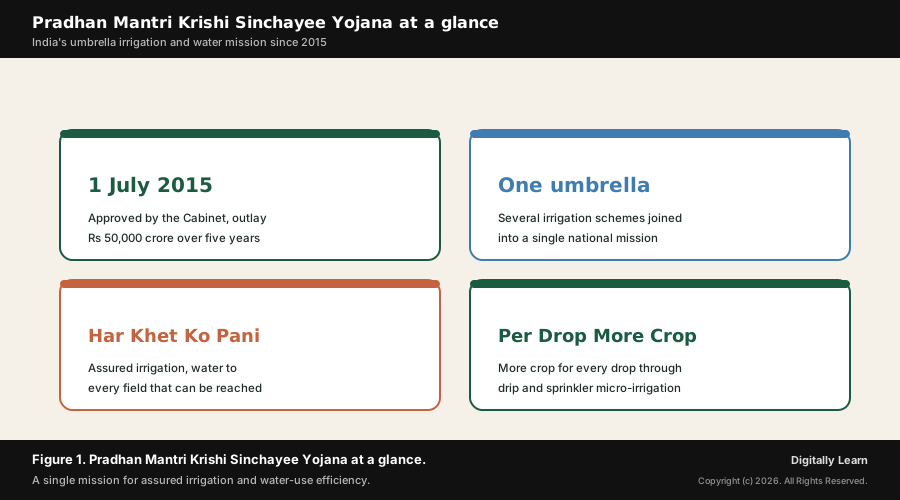
Pradhan Mantri Krishi Sinchayee Yojana, or PMKSY, is an umbrella scheme launched in 2015 to bring India's scattered irrigation and water-management efforts under a single mission. Approved by the Cabinet on 1 July 2015 with an outlay of Rs 50,000 crore, it joined together the Accelerated Irrigation Benefit Programme, watershed development and on-farm water management. Its twin goals are Har Khet Ko Pani, water to every field, and Per Drop More Crop, more output from every drop through micro-irrigation. Renewed as PMKSY 2.0 for 2021 to 2026, it is India's main answer to a deepening water crisis.
What PMKSY Is: The 2015 Umbrella Mission for Irrigation and Water Management
The 1 July 2015 launch, the umbrella design and the twin goals of Har Khet Ko Pani and Per Drop More Crop
Pradhan Mantri Krishi Sinchayee Yojana, almost always shortened to PMKSY, is India's flagship effort to put irrigation water within reach of every farm. The Cabinet approved the scheme on 1 July 2015 with an outlay of Rs 50,000 crore for the five years to 2019-20. Its purpose is to provide an end-to-end answer to the farmer's water problem, from creating a water source, to carrying the water through a distribution network, to applying it efficiently in the field, so that farming no longer depends on the uncertain arrival of the monsoon.
Why it matters is that, before PMKSY, the country's irrigation effort was split across several schemes run by different ministries, which led to overlap in some places and gaps in others. PMKSY was designed as an umbrella scheme that gathered these separate efforts into one mission with a shared goal and a single name. It brought together the Accelerated Irrigation Benefit Programme for large projects, the watershed work for rainfed land, and on-farm water management, so that the same farm could be served by a joined-up plan rather than by competing schemes.
Two simple slogans capture the whole design. The first is Har Khet Ko Pani, water to every field, which stands for expanding the area under assured irrigation so that crops are not left to chance. The second is Per Drop More Crop, which stands for getting more output from each unit of water through micro-irrigation and better practice. Together they hold the two halves of the water question, bringing more water to the field and then using that water far more carefully. The figure below sets out PMKSY at a glance.
Why PMKSY Was Created: India's Water Stress, Groundwater Depletion and Low Irrigation Efficiency
The mismatch of people and water, the over-reliance on groundwater and the low efficiency of conventional irrigation
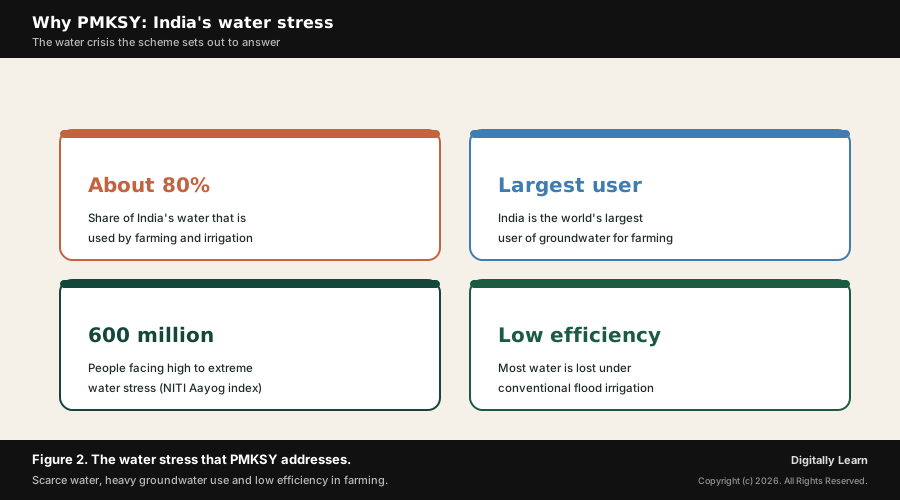
To see why a dedicated water mission was needed, it helps to start from a hard fact about India's water balance. The country holds a very large share of the world's people but only a small share of its fresh water, and farming takes the lion's share of what there is. About 80 per cent of India's usable water goes to agriculture, which means that any answer to the nation's water crisis must begin on the farm. With demand from cities and industry also rising, the water left for irrigation is under growing pressure, and the margin for waste has all but disappeared.
The deeper problem is a heavy and worsening reliance on groundwater. India is the world's largest user of groundwater for irrigation, and in many regions tube wells now draw water faster than the rains can refill the aquifer, so water tables are falling year after year. The NITI Aayog Composite Water Management Index has warned that close to 600 million people face high to extreme water stress, and that several major cities risk running short of groundwater. A scheme that did not tackle this depletion would leave the central danger untouched.
A third weakness lies in how the water is actually used. Most Indian farms still flood their fields, a method under which only about 30 to 50 per cent of the water reaches the crop while the rest is lost to evaporation and seepage. Large areas remain rainfed, dependent on a monsoon that arrives unevenly and is becoming less predictable with climate change. PMKSY was built to attack all three weaknesses at once, scarce supply, falling groundwater and wasteful use. The figure below sets out this water stress that the scheme must answer.
The Components of PMKSY: AIBP, Har Khet Ko Pani, Per Drop More Crop and Watershed Development
The Accelerated Irrigation Benefit Programme, Har Khet Ko Pani, Per Drop More Crop micro-irrigation and the watershed development component
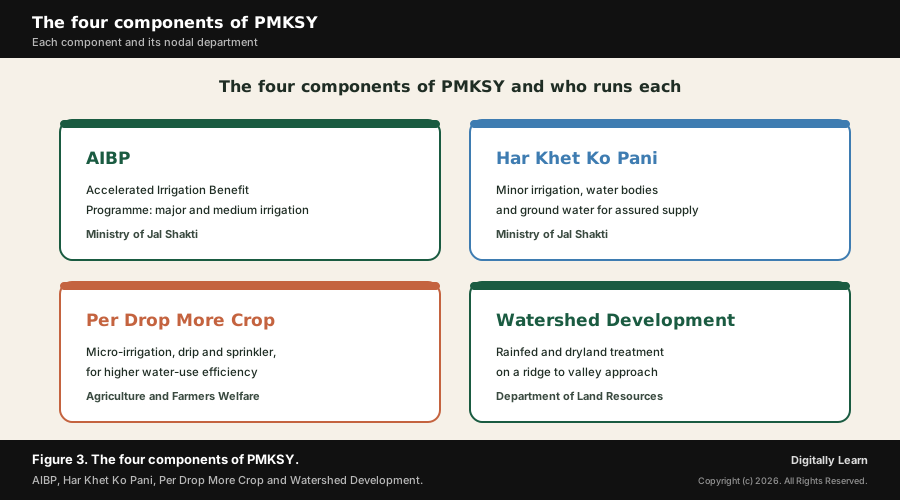
The first component is the Accelerated Irrigation Benefit Programme, or AIBP, which carries the heavy end of the work. AIBP funds major and medium irrigation projects, the large dams, reservoirs and canal systems that store and carry water across a region. Its central task is to complete long-pending projects so that the irrigation potential they promise is finally created on the ground. Run by the Ministry of Jal Shakti, AIBP is how PMKSY adds new assured irrigation at scale, the supply side of the Har Khet Ko Pani goal.
The second component is Har Khet Ko Pani, or HKKP, which fills the gaps that large projects leave behind. It supports minor irrigation, the repair, renovation and restoration of village water bodies such as tanks and ponds, ground water development, and command area work that links a source to the field. Also run by the Ministry of Jal Shakti, HKKP works at the local scale, reviving traditional water harvesting and small structures so that assured irrigation reaches farms that a big canal can never serve.
The remaining two components shift the focus to efficiency and the dry lands. Per Drop More Crop, run by the Department of Agriculture and Farmers Welfare, promotes micro-irrigation by drip and sprinkler to raise water-use efficiency on the farm. The Watershed Development Component, run by the Department of Land Resources under the Ministry of Rural Development, treats rainfed and degraded land on a ridge to valley plan, conserving soil and rainwater where there is no canal at all. The figure below sets out the four components and who runs each.
Per Drop More Crop and Micro-Irrigation: Drip, Sprinkler and Water-Use Efficiency
What micro-irrigation is, how it raises water-use efficiency, the Micro Irrigation Fund under NABARD and the limits of the technology
Micro-irrigation is the heart of the Per Drop More Crop idea. Instead of flooding a field, it delivers water in small, measured amounts close to the plant. In drip irrigation water seeps through pipes and emitters directly to the root zone, drop by drop; in sprinkler irrigation it is sprayed over the crop like light rain. Because the water is placed where the plant can use it, far less is lost to evaporation and seepage, which is why the Department of Agriculture and Farmers Welfare promotes these systems as the core of efficient farming.
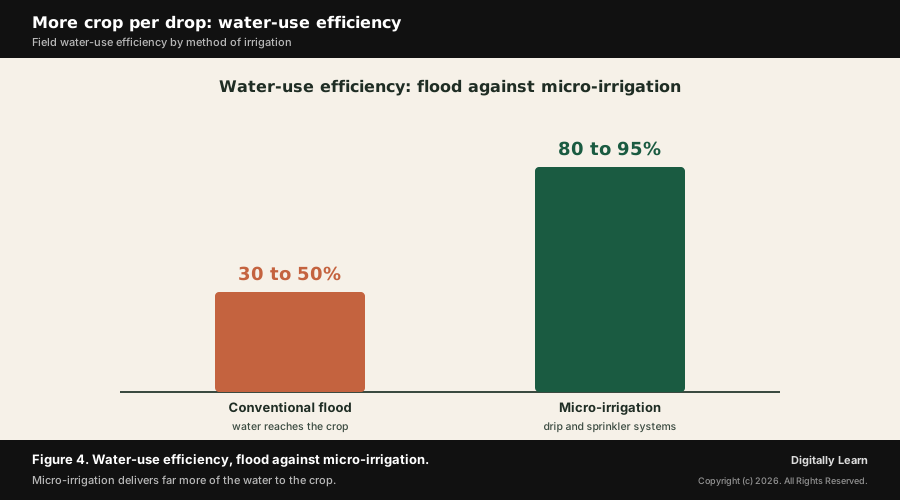
The gain in efficiency is large. Under conventional flood irrigation only about 30 to 50 per cent of the water reaches the crop, while micro-irrigation raises water-use efficiency to roughly 80 to 95 per cent, as official assessments report. The same systems also cut the use of fertiliser, energy and labour, and they often raise yields, because the crop receives a steady supply rather than alternating flood and drought. This is how micro-irrigation directly helps the water crisis, the same harvest is grown with far less water, freeing supply and easing the pressure on the aquifer.
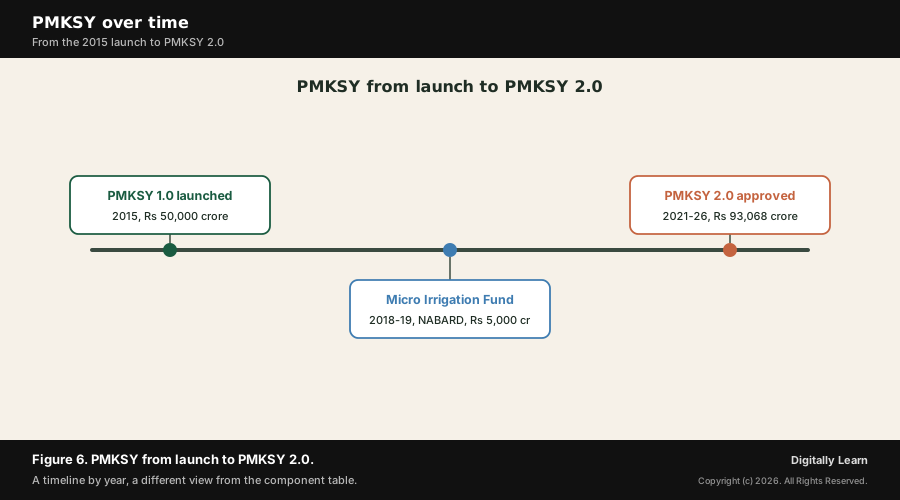
To spread the technology, the government created a dedicated Micro Irrigation Fund under NABARD, with an initial corpus of Rs 5,000 crore, to help states offer farmers extra support on top of the regular subsidy. Yet the benefit has limits, which is why micro-irrigation can only go so far in solving the water crisis. The upfront cost deters small and marginal farmers, uptake has been uneven and concentrated in a few states, and a system that saves water per hectare can tempt a farmer to expand the irrigated area and so use more water overall. The figure below compares the two methods.
The Institutional Architecture: Multi-Ministry Coordination, the National Steering Committee and District Irrigation Plans
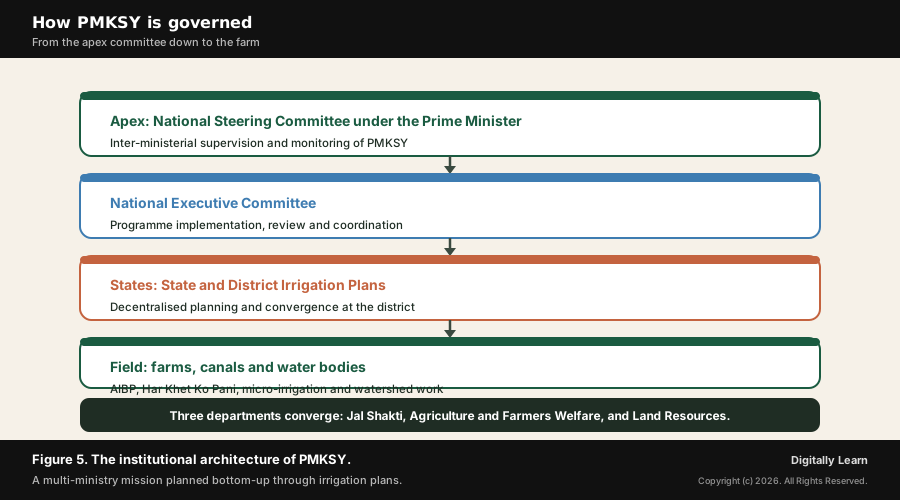
The three departments, the National Steering Committee under the Prime Minister, the National Executive Committee and decentralised irrigation plans
PMKSY is unusual in that it is run by three departments at once, which makes coordination the core of its design. The Ministry of Jal Shakti handles AIBP and Har Khet Ko Pani, the Department of Agriculture and Farmers Welfare handles Per Drop More Crop, and the Department of Land Resources under Rural Development handles watershed development. The whole point of the umbrella is convergence, so that the source created by one department, the field application improved by another and the watershed treated by a third all add up on the same piece of land.
To hold these strands together, PMKSY is supervised by an inter-ministerial National Steering Committee chaired by the Prime Minister, which gives the mission direction and keeps the ministries aligned. A National Executive Committee oversees day-to-day implementation, review and coordination across the departments. This apex structure matters because, without a single body above the ministries, a multi-department mission can easily drift back into the separate, overlapping schemes that PMKSY was created to replace, defeating the purpose of the umbrella.
Planning, by contrast, is deliberately built from the bottom up. Each state prepares a State Irrigation Plan, and within it every district prepares a District Irrigation Plan that maps local water sources, the distribution network and field application, then sets priorities to suit the district's own conditions. This decentralised method lets a desert district and a flood-prone one each shape the mission to its needs, while the Micro Irrigation Fund under NABARD adds resources at the state level. The table sets out the components and their departments, and the figure shows the governance flow.
| Component | Nodal department or ministry | Focus |
|---|---|---|
| Accelerated Irrigation Benefit Programme (AIBP) | Ministry of Jal Shakti | Major and medium irrigation projects |
| Har Khet Ko Pani (HKKP) | Ministry of Jal Shakti | Minor irrigation, water bodies and ground water |
| Per Drop More Crop (PDMC) | Department of Agriculture and Farmers Welfare | Micro-irrigation and water-use efficiency |
| Watershed Development Component (WDC) | Department of Land Resources, Ministry of Rural Development | Rainfed and dryland area treatment |
PMKSY 2.0: The 2021 Cabinet Approval, the 2021 to 2026 Period and Command Area Development
The 2021 renewal, the outlay and period, command area development, the watershed target and the move of Per Drop More Crop
When the first phase ran its course, the government chose to renew rather than retire the mission. In December 2021 the Cabinet approved PMKSY 2.0 for the period 2021-22 to 2025-26, with an overall outlay of about Rs 93,068 crore, made up of central assistance, debt servicing to NABARD for loans raised, and the states' own share. The renewal carried forward the two main components, AIBP and Har Khet Ko Pani, under the Ministry of Jal Shakti, keeping the umbrella in place while sharpening its targets.
A central aim of the second phase is to close the gap between potential created and potential used. Many AIBP projects had built dams and main canals but the water never reached the fields, because the smaller channels were missing. PMKSY 2.0 therefore puts weight on command area development, the field channels, land levelling and water management that carry stored water the last stretch to the farm. Completing a set of ongoing major and medium projects, together with their command area work, is meant to turn promised irrigation into real irrigation on the ground.
The Watershed Development Component was also continued as a renewed phase for 2021 to 2026, with a target of treating about 49.5 lakh hectares of rainfed and degraded land and bringing additional area under protective irrigation. Per Drop More Crop, which had been part of PMKSY since 2015, is now carried forward separately by the Department of Agriculture and Farmers Welfare, while micro-irrigation support through the Micro Irrigation Fund continues. The figure below traces PMKSY from its launch to PMKSY 2.0.
Challenges: AIBP Project Delays, Uneven Micro-Irrigation Adoption, Groundwater Overuse and Maintenance
Completion delays, the slow and uneven spread of micro-irrigation, the overuse of groundwater and the upkeep of assets
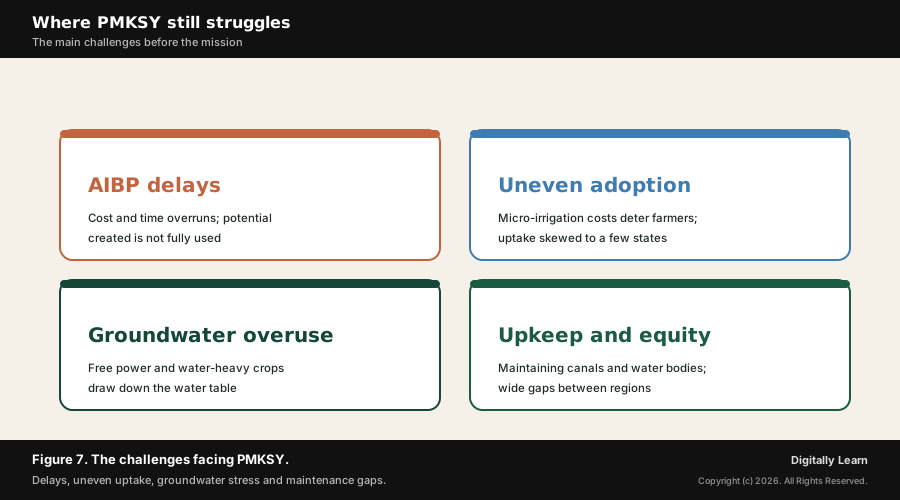
The first challenge is the slow completion of projects. Many AIBP works are large, span several years and run into cost and time overruns, held up by land acquisition, funding gaps between the Centre and the states, and resettlement. The result is a persistent gap between the irrigation potential created on paper and the area actually watered, because the command area work that should carry water to the field lags behind the dam. Until projects are finished end to end, the promised benefit stays out of the farmer's reach.
The second challenge is the uneven spread of micro-irrigation. Although drip and sprinkler systems save water, their upfront cost, the need for upkeep and gaps in awareness keep many small and marginal farmers from adopting them, and uptake has been concentrated in a handful of states. There is also a subtler risk: by making each hectare cheaper to water, efficient systems can encourage farmers to extend the irrigated area or shift to thirstier crops, so that water saved on one field is spent on another and the aquifer gains little.
The third challenge is the overuse of groundwater and the upkeep of what is built. Free or heavily subsidised electricity for pumps, together with support prices that favour water-heavy crops such as paddy and sugarcane, pushes farmers to pump more than the aquifer can sustain, a pull that no construction scheme alone can offset. Once assets are built, maintenance of canals, field channels and restored water bodies is often neglected, and wide gaps remain between water-rich and water-scarce regions. The figure below summarises these challenges.
The Way Forward: Demand-Side Water Management, Completing Projects and Sustaining Efficiency
Balancing supply with demand management, finishing command area work, scaling micro-irrigation and reforming power and crop incentives
The lesson of PMKSY so far is that building supply is necessary but not enough; the harder task is to manage demand. On the supply side, the priority is to finish the ongoing AIBP projects together with their command area work, so that water already stored actually reaches the field. On the demand side, the country must use less water for the same harvest by scaling up micro-irrigation, shifting away from the most water-hungry crops, and pricing both power and water so that the incentive to overpump is reduced rather than reinforced.
Lasting gains also depend on institutions and upkeep, not on construction alone. Farmers organised into water user associations can run and maintain local systems far better than a distant agency, while firm groundwater regulation is needed in over-exploited blocks to slow the fall in water tables. Above all, the mission should be judged by outcomes, the area actually irrigated and the water genuinely saved, rather than by money spent or structures built. The measures below set out a balanced path that pairs more water with far wiser use.
- Complete the ongoing AIBP projects together with their command area development, so that stored water reaches the field.
- Scale up Per Drop More Crop micro-irrigation, with stronger support for small and marginal farmers through the Micro Irrigation Fund.
- Encourage a shift away from the most water-intensive crops through better prices, advice and procurement.
- Reform power and water pricing so that the incentive to overpump groundwater is reduced rather than reinforced.
- Strengthen water user associations and local upkeep of canals, field channels and restored water bodies.
- Regulate groundwater in over-exploited blocks and judge the mission by the area irrigated and the water saved.
UPSC Relevance: Prelims Pointers, Mains Framing and Linked Water Schemes
The GS-III fit, the facts to remember, the micro-irrigation and water-crisis framing and the related schemes to distinguish
For the examination, PMKSY sits squarely in GS-III, under agriculture, water resources and infrastructure, and it also carries a governance angle as a major centrally sponsored scheme. The facts worth fixing for Prelims are the 2015 launch, the umbrella design, the four components and their nodal departments, the slogans Har Khet Ko Pani and Per Drop More Crop, the Micro Irrigation Fund under NABARD, and the renewal as PMKSY 2.0. A common trap is to assign every component to a single ministry, when in fact the mission is shared across three departments.
For Mains, the strongest use of PMKSY is in answers on the water crisis and on raising water-use efficiency. The scheme lets a student show both how micro-irrigation helps, by lifting efficiency and easing groundwater stress, and to what extent it falls short, because adoption is uneven and demand-side reform is missing. It is the worked example for the argument that India's water problem is solved less by building more storage than by using existing water far more carefully, pairing supply with serious demand management.
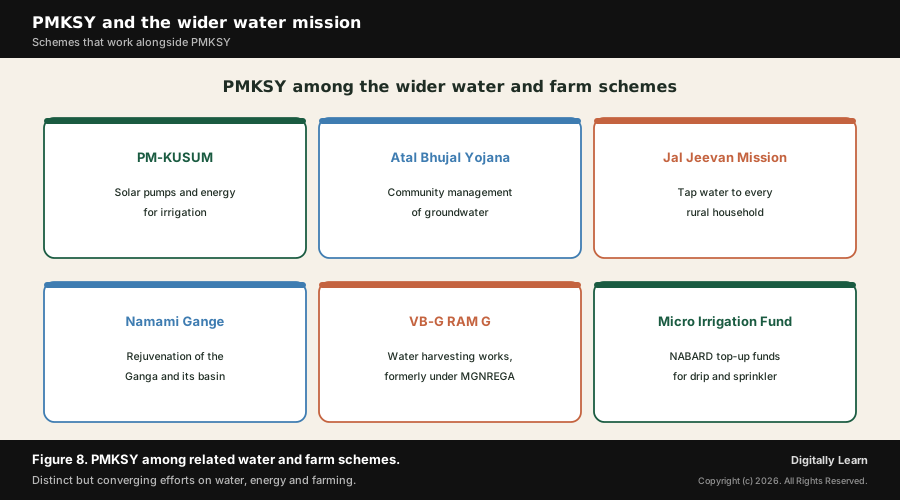
PMKSY should be distinguished from the schemes that work alongside it. PM-KUSUM supports solar pumps and farm energy, Atal Bhujal Yojana targets community management of groundwater, Jal Jeevan Mission delivers drinking water to rural homes, and Namami Gange rejuvenates the Ganga, while many small water-harvesting works are built under the rural employment guarantee law, MGNREGA until its repeal on 1 July 2026 and the VB-G RAM G Act, 2025 since, which keeps water security as one of its four permissible domains of work. PMKSY is the umbrella for irrigation and water-use efficiency in farming, and it is at its best when read as one part of this wider water effort. The figure below places it among the related schemes.
Previous Year UPSC-CSE Questions By the end you will be able to draft model answers for the following UPSC questions. Each question carries a collapsible framework showing how to approach it in the exam.
- UPSC Mains 2021 GS-IIIHow and to what extent would micro-irrigation help in solving India’s water crisis?
How to structure the answer in the exam
Body (sub-themes to develop):
- Set out the water crisis the question assumes: a small share of the world's water, agriculture consuming about 80 per cent of it, India as the world's largest groundwater user with falling water tables, and low efficiency under conventional flood irrigation.
- Explain how micro-irrigation helps: drip and sprinkler deliver water to the root zone, raising water-use efficiency from about 30 to 50 per cent under flooding to about 80 to 95 per cent, so the same harvest is grown with far less water and groundwater draft is eased.
- Add the wider gains: micro-irrigation also cuts fertiliser, energy and labour use and often raises yields, and it is delivered at scale through PMKSY-PDMC and the Micro Irrigation Fund under NABARD.
- Weigh the extent and the limits: high upfront cost and weak awareness keep adoption uneven and concentrated in a few states, small and marginal farmers are left behind, and efficiency can paradoxically raise total use if farmers expand the irrigated area or switch to thirstier crops.
- Conclude on scope: micro-irrigation is necessary but not sufficient, and it solves the crisis only when paired with crop diversification, power and water pricing reform, groundwater regulation and the completion of irrigation projects.
Relevance to this topic. The article teaches the water crisis, shows how micro-irrigation raises water-use efficiency from about 30 to 50 per cent to 80 to 95 per cent and eases groundwater stress, and weighs its limits of uneven adoption and cost, so a student can argue both how it helps and to what extent.
Sources and Further Reading
- Department of Water Resources (Ministry of Jal Shakti): PMKSY and the National Steering Committee
- Press Information Bureau: Components of PMKSY and nodal ministries
- Press Information Bureau: Micro Irrigation Fund under NABARD
- Press Information Bureau: micro-irrigation and water-use efficiency
- Department of Agriculture and Farmers Welfare: Per Drop More Crop and micro-irrigation
- Department of Land Resources: Watershed Development Component of PMKSY (WDC-PMKSY)
- NITI Aayog: Composite Water Management Index
- Wikipedia: Pradhan Mantri Krishi Sinchai Yojana
Editorial Disclaimer
This briefing is for UPSC preparation. Verify the figures against the official PMKSY, Ministry of Jal Shakti and Department of Agriculture and Farmers Welfare sources before relying on them.


