


Overview
Regur soil: formation, characteristics, crops and the Deccan Trap

Black soil is the dark, clayey soil that covers most of the Deccan Plateau. It is also called regur soil and, because it is ideal for cotton, black cotton soil. It forms from the weathering of the basalt of the Deccan Trap in a hot climate with wet and dry seasons; it swells when wet, cracks when dry, holds moisture for a long time, and is rich in lime and iron but poor in nitrogen and phosphorus.
Black Soil: Meaning, Names and Extent
What Is Black Soil: Regur Soil and Black Cotton Soil
The dark, clayey soil that covers most of the Deccan Plateau is black soil. It is also known as regur soil, and because it is ideal for growing cotton it is called black cotton soil. Its colour ranges from deep black to grey.
India classifies its soils by genesis, colour, composition and location into groups such as alluvial, black, red and yellow, and laterite soils. In the US soil taxonomy black soils belong to the Vertisols, which cover 27,960 thousand hectares, or 8.52 per cent of India.
The other soil groups are explained in their own articles: soil formation and classification, alluvial soil, and red and laterite soil.
Black Soil in India: Which States It Is Found In
Black soil is typical of the Deccan Trap region of the north-west Deccan plateau, which is made up of lava flows. It covers the plateaus of Maharashtra, Saurashtra, Malwa, Madhya Pradesh and Chhattisgarh, and extends south-east along the Godavari and Krishna valleys.

- States with black soil: Parts of Maharashtra, Madhya Pradesh, Gujarat and Andhra Pradesh, and some parts of Tamil Nadu.
- Deepest soil: In the upper reaches of the Godavari and the Krishna, and in the north-western Deccan, the black soil is very deep.
- Deccan Trap lobes: The trap itself falls into four subprovinces: the main Deccan, the Malwa Plateau, the Mandla Lobe and the Saurashtran Plateau.
Formation of Black Soil and the Deccan Trap
How Black Soil Is Formed: Deccan Trap Basalt and Climate
Black soil formation depends on two things: the parent rock and the climate. The parent rock is the basalt of the Deccan Trap. As it weathers in a climate that is seasonally wet and dry, it breaks down into fine clay rich in expansive clay minerals, which gives black soil its character.
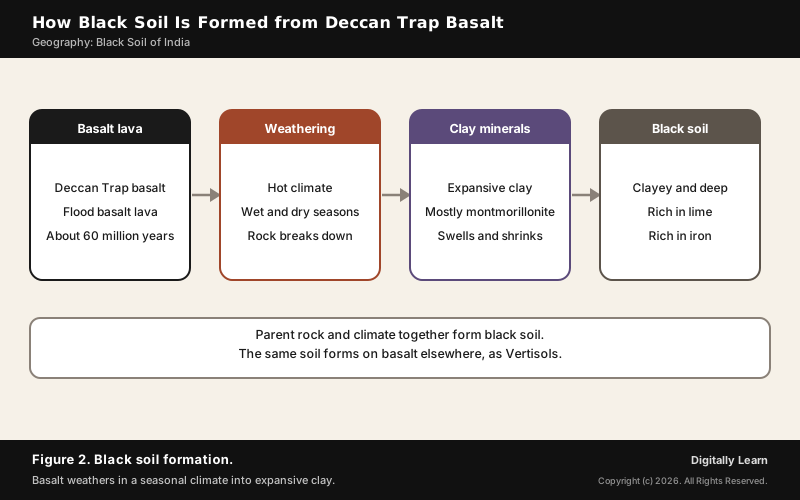
- Basic rock: Vertisols typically form from highly basic rocks, such as basalt, in climates that are seasonally humid or subject to erratic droughts and floods.
- Clay minerals: Their expansive clay, much of it montmorillonite, forms deep cracks in the drier seasons.
- Around the world: Similar soils cover eastern Australia, parts of Sudan and Ethiopia and southern Texas; they are called black earths in Australia and black cotton soils in East Africa.
Deccan Trap: How the Lava Plateau Formed
The Deccan Trap is a flood basalt province. Highly fluid lava poured out and flowed for long distances, and individual flows extend for hundreds of km. Dykes in western Maharashtra are considered the feeders of these eruptions. The trap now covers most of the Maharashtra plateau, and it once covered a much larger area.
- Age: NCERT dates the start of the outpouring to about 60 million years before the present, when the Indian plate was moving towards Asia and was still close to the equator; other accounts give about 66 million years, at the end of the Cretaceous.
- Size: Its layers of basalt are more than 2 km thick and cover about 500,000 square km; originally they may have covered 1.5 million square km.
- Basalt: At least 95 per cent of the lavas are tholeiitic basalts.
- Source: The eruptions are thought to have come largely from the Reunion hotspot, which also built the Mascarene Islands.
- Name: Trap comes from the Swedish word for stairs, after the step-like hills of the region.
- Extinction debate: The eruptions were once blamed for the mass extinction at the end of the Cretaceous; the Chicxulub impact is now thought to be the primary cause, and the eruptions played a minor role at most.
Characteristics of Black Soil: Texture, Moisture and Chemistry
Black Soil Characteristics: Clay, Moisture and Chemical Composition
Black soils are generally clayey, deep and impermeable. They swell and become sticky when wet and shrink when dried, so in the dry season they develop wide cracks. This is a kind of self-ploughing.
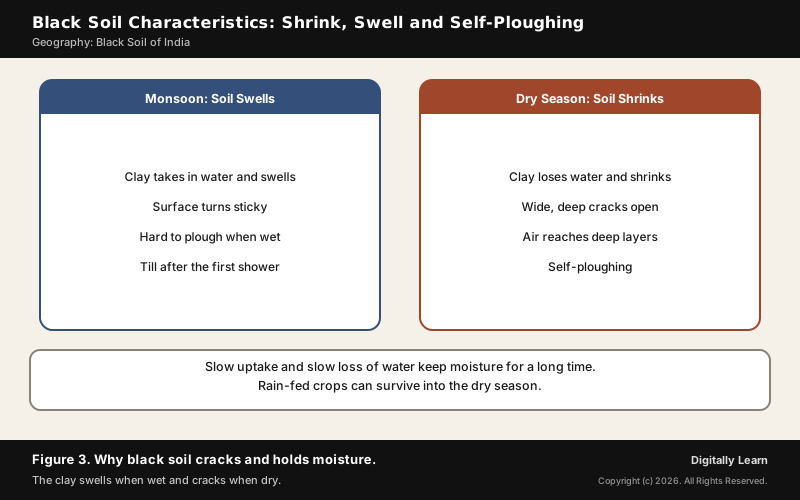
- Moisture: Because water is absorbed and lost slowly, black soil retains moisture for a very long time; this helps crops, especially rain-fed ones, to survive into the dry season.
- Aeration: The deep cracks of hot weather let air into the soil.
- Tillage: The soil is sticky and difficult to work when wet, so it must be tilled immediately after the first shower or during the pre-monsoon period.
- Self-mixing: Alternate shrinking and swelling keeps mixing the soil; heaving can raise a hummocky surface known as gilgai.
- Engineering: The same shrinking and swelling can damage buildings and roads.
- Vegetation: The natural vegetation of such soils is grassland, savanna or grassy woodland; the heavy, unstable soil makes it hard for many trees to grow.
The chemistry of black soil comes from its basaltic parent rock. Black soil is rich in lime, iron, magnesia and alumina and also contains potash, but it lacks phosphorus, nitrogen and organic matter.
| Rich in | Poor in |
|---|---|
| Lime and calcium carbonate | Phosphorus |
| Iron and magnesia | Nitrogen |
| Alumina and potash | Organic matter |
Crops Grown in Black Soil and Comparison with Other Soils
Crops Grown in Black Soil: Cotton, Soybean, Sorghum and Pulses
Black soil is ideal for growing cotton, which gives it its popular name. On the Deccan Plateau of Maharashtra, Madhya Pradesh, Gujarat and Karnataka it also carries soybean, sorghum, pulses and sugarcane, which with cotton are the main black soil crops.
- With irrigation: Cotton, wheat, sorghum and rice can be grown; the soil suits rice because it is almost impermeable when saturated.
- Rain-fed farming: Working the soil is difficult because it is very hard when dry and very sticky when wet, so it can be ploughed only within a narrow range of moisture.
- Holding water: Its long moisture retention lets rain-fed crops carry on into the dry season.
Salinity and its reclamation in irrigated tracts are explained in the article on saline and alkaline soil.
Difference Between Black Soil, Red Soil, Laterite Soil and Alluvial Soil
Each of India's main soils takes its character from its parent material and its climate. Setting black soil beside the others shows what makes it distinct: a basalt parent, a clay texture and a store of lime and potash.
| Soil | How it differs |
|---|---|
| Black soil | Forms on Deccan Trap basalt; clayey and moisture-retentive; rich in lime and potash, poor in phosphorus; ideal for cotton |
| Red soil | Develops on crystalline igneous rocks in areas of low rainfall; reddish from iron diffused through the rock |
| Laterite soil | Forms under high temperature and heavy rainfall by intense leaching; low in humus; grows tea and coffee on the hills and cashew nut in red laterite |
| Alluvial soil | Laid down by rivers; adequate potash, phosphoric acid and lime; ideal for sugarcane, paddy and wheat |
Deccan Trap: Natural Resource Potential
Natural Resources of the Deccan Trap: Soil, Water, Stone and Heritage
The Deccan Trap gives west-central India more than its soil. Its layered basalt shapes the region's groundwater, its rivers and power, its building materials, its forests and even its monuments.
- Soil and farming: Fertile black soil supports the cotton, soybean, sorghum and pulse farming of the plateau.
- Groundwater: The basalt holds water in its weathered and fractured zones and in vesicular layers 15 to 25 m thick. Water lies under phreatic conditions down to 15 to 20 m and is semi-confined to confined below. In Latur district, for example, dug wells yield 25 to 250 cubic metres a day, but bore wells only 0.5 to 52.
- Water power: The Western Ghats here are built of Deccan Trap basalt. The Koyna, rising at Mahabaleshwar, feeds the Koyna project of 1,960 MW, the second largest completed hydroelectric plant in India.
- Laterite and stone: Laterite forms by the leaching of rocks including basalt; in Madhya Pradesh the laterite capping the plateau is 30 m thick, and laterite can be cut into brick-shaped blocks for building.
- Forests: Sal is completely absent on the Deccan Trap, where teak takes its place.
- Heritage: The Ajanta caves are carved out of a cliff of the Deccan Traps above the Waghora river, and the 34 monasteries and temples of Ellora were dug into a high basalt cliff near Aurangabad.
Previous Year UPSC-CSE Questions
Previous Year UPSC-CSE Questions By the end you will be able to draft model answers for the following UPSC questions. Each question carries a collapsible framework showing how to approach it in the exam.
- UPSC Prelims 2021 Prelims-GSThe black cotton soil of India has been formed due to the weathering of
How to approach this Prelims question
Approach: Recall the parent rock of black soil.
Trap to watch: Granite and schist give red soil, not black soil.
Key facts to recall:
- (a) Brown forest soil: wrong. Black soil formed from rock, not from an older soil.
- (b) Fissure volcanic rock: right. The Deccan Trap basalt came out through fissures as flood lava, and its weathering made the black soil.
- (c) Granite and schist: wrong. These crystalline rocks of the east and south give red soil, not black soil.
- (d) Shale and limestone: wrong. Black soil's parent rock is basalt, not these sedimentary rocks.
Answer signal: Fissure volcanic rock, option (b).
- UPSC Mains 2022 GS-IDiscuss the natural resource potentials of ‘Deccan Trap’.
Answer outline: how to structure the answer
What the question asks, the main arguments, relevant examples and the direction of the conclusion. This is not a full model answer.
Introduction: Open with the Deccan Trap as a flood basalt province, more than 2 km thick, covering about 500,000 square km of west-central India.
Body (sub-themes to develop):
- Soil: black cotton soil, moisture-retentive, rich in lime and iron; cotton, soybean, pulses.
- Water: groundwater in weathered, fractured and vesicular basalt; dug wells far outyield bore wells.
- Power: the Koyna project on basalt Western Ghats.
- Stone, forests and heritage: laterite blocks, teak forests, Ajanta and Ellora cut in basalt.
Conclusion: Conclude that the trap's resources are rich but need careful use: low-yield aquifers and a hard-to-work soil call for watershed management and suitable crops.
Sources
- NCERT: Contemporary India II (Class X), Resources and Development
- NCERT: India Physical Environment (Class XI), Soils
- NCERT: Fundamentals of Physical Geography (Class XI), Interior of the Earth and Plate Tectonics
- Central Ground Water Board: Ground water brochure, Latur district (Deccan Trap basalt)
- ICAR: India and the BRICS Agricultural Research Platform, soils and crops
- UNESCO World Heritage: Ajanta Caves
- UNESCO World Heritage: Ellora Caves
- Wikipedia: Vertisol
- Wikipedia: Deccan Traps
- Wikipedia: Koyna Dam
- Wikipedia: Laterite
- Wikipedia: Ajanta Caves
- Wikipedia: Ellora Caves
- UPSC: Civil Services Examination question papers
Disclaimer
This article draws on the NCERT geography textbooks, the Central Ground Water Board, the Indian Council of Agricultural Research and the other sources listed on this page. Soil areas and the age of the Deccan Trap differ slightly between sources.