


Overview
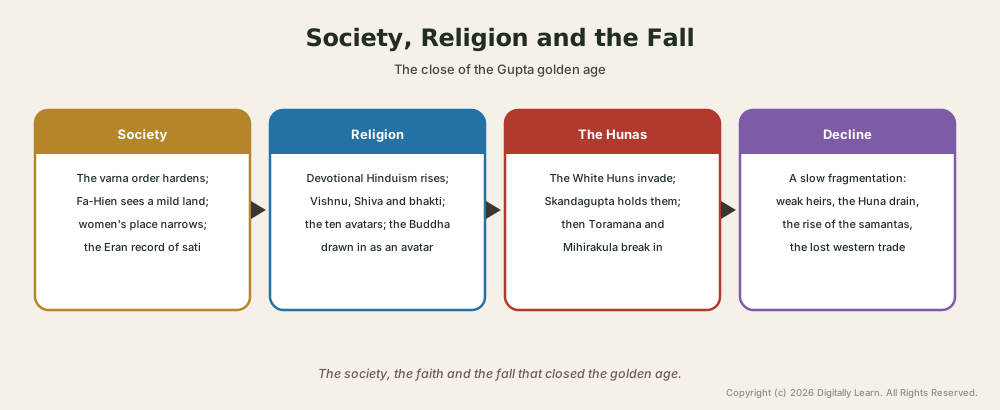
The Gupta society and decline of the empire's last age show a world both at its height and on the turn. Society grew more rigid under the varna order, the pilgrim Fa-Hien describing a mild and prosperous land in which the Chandalas yet lived apart; in faith, a devotional Hinduism of Vishnu and Shiva rose, drawing even the Buddha in as an avatar. Then came the Huna invasions: Skandagupta held them, but his successors could not, and the empire broke slowly into pieces. This part covers society, religion, the Hunas, the decline and the exam focus.
Gupta Society
The Varna Order and the Account of Fa-Hien
What is the significance of Gupta society: behind the golden age lay a social order that was growing more rigid, its ranks more fixed by birth and its rules more closely drawn.
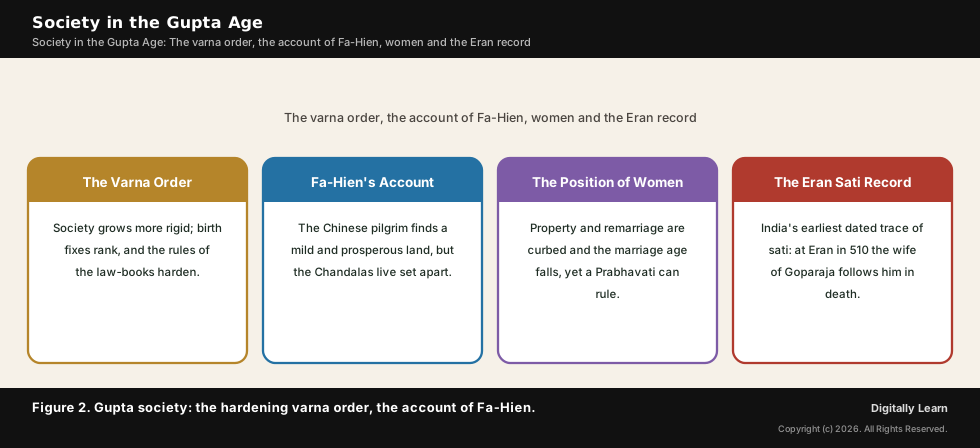
The varna order hardened in this age, the law-books fixing the duties and the rank of each group ever more firmly, and the Chandalas and other untouched groups pressed further to the margins. The number of mixed and craft castes, the jatis, also grew, so that the society was at once settled and increasingly closed.
Fa-Hien, the Chinese pilgrim who travelled India in the reign of Chandragupta II, has left the clearest picture: a mild and prosperous land, lightly taxed and gently ruled, where the better people did not eat meat. Yet he also records that the untouchables had to live apart and strike a piece of wood to warn of their coming, the shadow of the bright age.
The Position of Women and the Eran Record of Sati
Distinguishing the place of women: the age that raised so much beauty also narrowed the freedom of its women, even as a few of high birth still wielded real power.
The position of women declined: their rights over property were curbed, the remarriage of widows was discouraged, and the age of marriage fell. Against this stands the figure of Prabhavati Gupta, the daughter of Chandragupta II, who ruled the Vakataka Deccan as regent, a reminder that women of the highest rank could still hold authority.
The custom of sati, the burning of a widow on her husband's pyre, leaves its earliest firmly dated trace in India in this age. The Eran inscription of 510, in the reign of Bhanugupta, records that the wife of the chief Goparaja followed him into the fire; the word sati is not yet used, but the act is plainly there.
Religion in the Gupta Age
The Rise of Puranic Hinduism and Bhakti
What is the significance of Gupta religion: it is the age in which devotional, temple-centred Hinduism rose to the place it has held ever since.
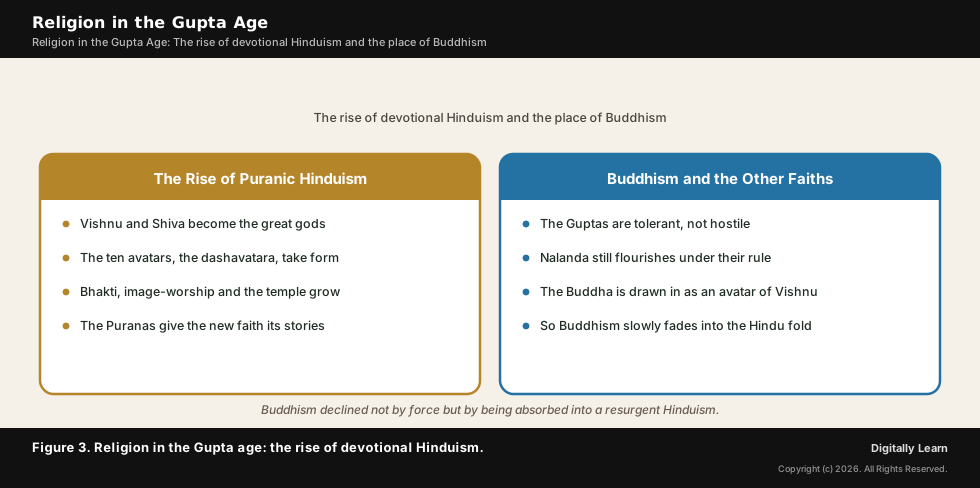
Vishnu and Shiva became the great gods of a new, devotional faith. The worship of images in temples, the rise of bhakti or loving devotion, and the gathering of the old stories into the Puranas gave Hinduism the shape an ordinary worshipper could follow. The ten incarnations of Vishnu, the dashavatara, took their settled form in this age.
The religious life held many kinds of seeker. A parivrajaka was a wandering renunciant who had left the world; a shramana was a wandering ascetic, a seeker rather than a priest of high rank; and an upasaka was a lay follower, most often of the Buddhist faith, who kept the householder's life while honouring the teaching.
The Buddha as an Avatara of Vishnu
Distinguishing the fate of Buddhism: it began its long, slow decline in India not by persecution but by being quietly absorbed into the rising Hindu faith.
The Gupta kings were Vaishnavas, devoted to Vishnu, but they were tolerant and not hostile to other faiths; the great Buddhist university of Nalanda was founded and flourished under their rule. It is therefore wrong to say that the Guptas opposed Buddhism, or that invaders persecuted it into decline.
The deeper cause lay elsewhere. As devotional Hinduism grew, it drew the Buddha himself into its fold, counting him as one of the avatars of Vishnu, so that a Buddhist deity became a Hindu one. Robbed in this way of its distinct place, and later of its royal patrons, Buddhism slowly faded in the land of its birth.
The Huna Invasions and the Fall of the Empire
Skandagupta and the First Huna Invasion
What is the significance of the Huna invasions: they were the hammer-blows from the north-west that, more than any other single force, broke the strength of the Gupta state.
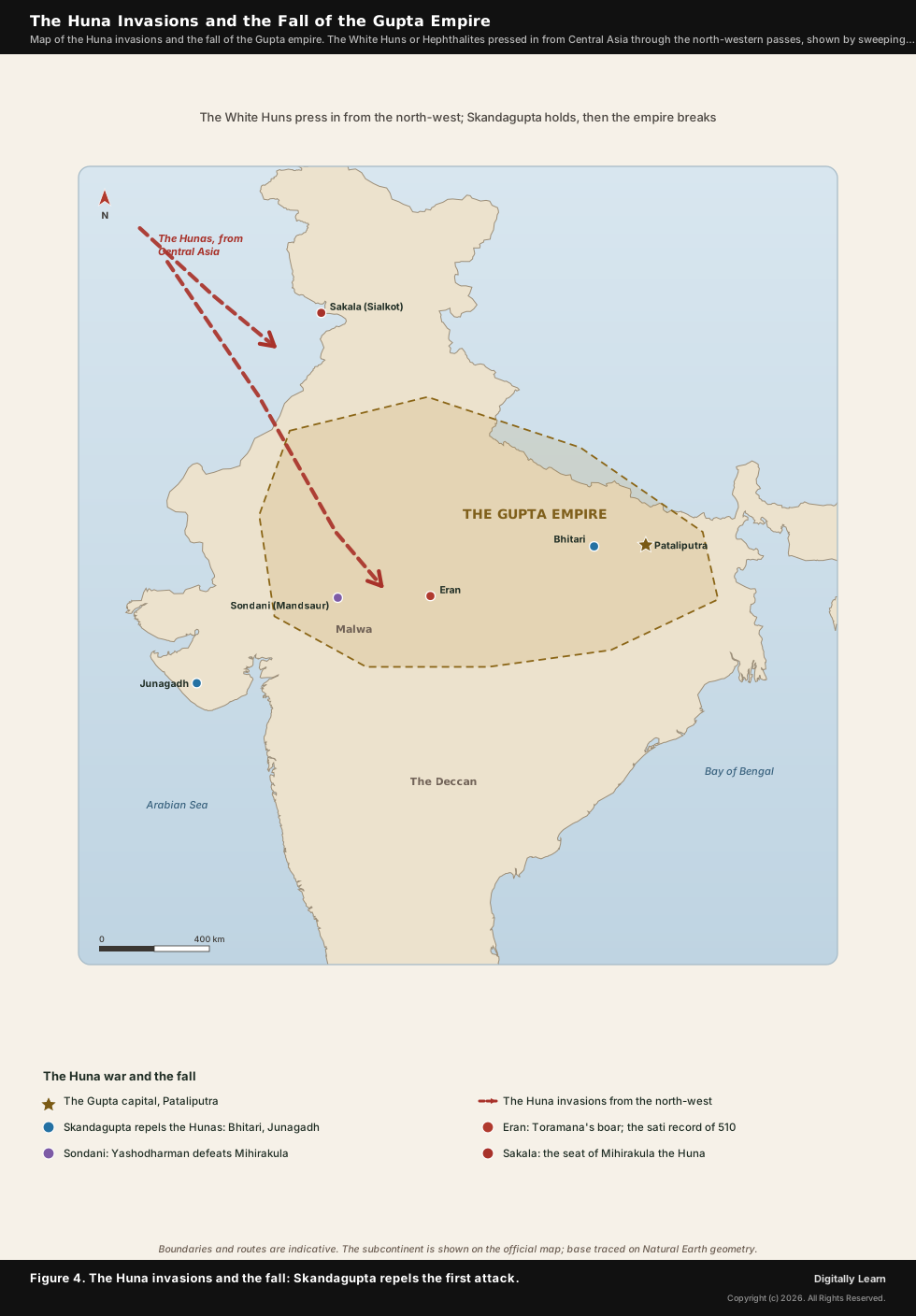
The Hunas, a branch of the White Huns or Hephthalites of Central Asia, pressed down through the north-western passes in the later fifth century. The emperor Skandagupta, who ruled about 455 to 467, met and threw back their first great invasion; his pillars at Bhitari and Junagadh record the hard-won victory that held the frontier in his lifetime.
After his death, however, no ruler of his strength followed. The defence of the north-west weakened, the treasury was drained by the long wars, and the way lay open for the next and heavier wave of the Huna assault upon the heart of the empire.
Toramana, Mihirakula and the Defeat at Sondani
Distinguishing the later Hunas: two kings, a father and a son, carried the second wave deep into India and ruled a swathe of the north-west before they were thrown back.
Toramana, the Huna king, overran Malwa about the start of the sixth century, leaving his name on the great boar image in the temple at Eran. His son Mihirakula, who ruled from Sakala and is remembered as a cruel persecutor of the Buddhists, carried the Huna power to its height in India.
The turning came at Sondani, near Mandsaur, where about 528 to 530 the local king Yashodharman of Malwa shattered the army of Mihirakula and raised a victory pillar. It was Yashodharman, not the Guptas, who broke the Huna power; but the empire that the Hunas had shaken never recovered its old strength.
| King | When | What he did |
|---|---|---|
| Skandagupta | c. 455 to 467 | Repelled the first Huna invasion; held the frontier in his lifetime. |
| Toramana | c. 493 to 515 | Overran Malwa; left his boar inscription at Eran. |
| Mihirakula | c. 515 to 540 | Ruled from Sakala; a persecutor of the Buddhists. |
| Yashodharman | c. 528 to 530 | Defeated Mihirakula at Sondani; not a Gupta, but the breaker of the Hunas. |
Why the Gupta Empire Declined
The Many Causes of the Decline
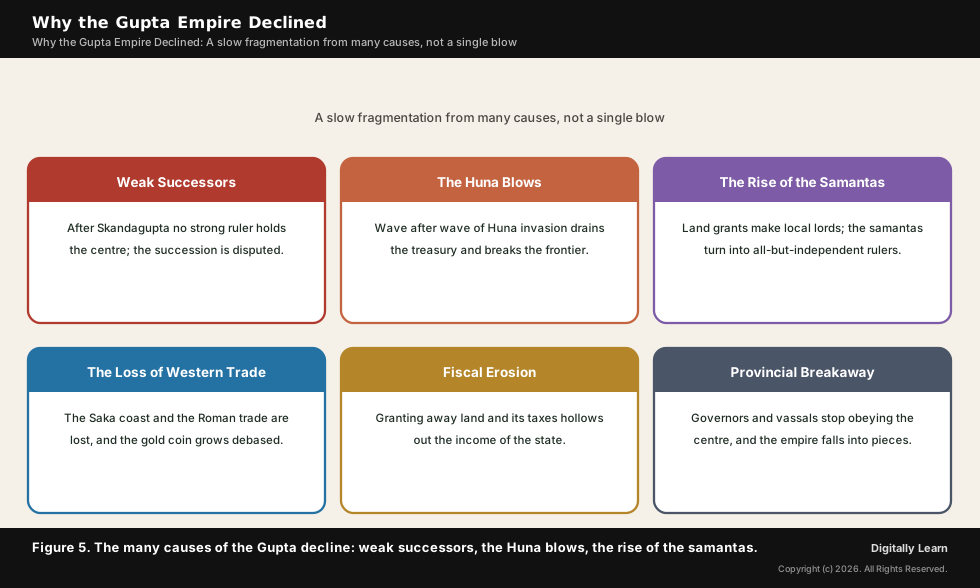
What is the significance of the decline: the Gupta empire did not fall at a stroke but wasted slowly away, undone by a gathering of causes rather than a single blow.
The Huna wars drained the treasury and broke the north-western frontier, while a line of weak successors after Skandagupta could not hold the centre. Beneath these blows worked a deeper rot: the practice of granting away land and its taxes, treated in the part on the economy, hollowed out the income of the state.
Those land grants raised up local lords, the samantas, who in time behaved as all-but-independent rulers and ceased to obey the centre. The loss of the western coast and the Roman trade thinned the flow of gold, the coinage grew debased, and province after province broke away, until the great empire had crumbled into many small kingdoms.
The Verdict on the Gupta Golden Age
Distinguishing the legacy: though the empire fell, the age left a harvest of achievement so rich that it shaped Indian civilisation for a thousand years.
The Gupta contribution to the heritage and culture of India is hard to overstate: the decimal system and the science of Aryabhata, the poetry of Kalidasa, the classical Buddha and the first stone temples, a settled administration and a fine gold coinage. In the same centuries the Chola age of the south would raise its own high watermark in temple architecture and bronze, so that the two together hold much of the classical achievement of India.
| What the golden age gave | How the empire ended |
|---|---|
| The decimal system, zero and the astronomy of Aryabhata. | A line of weak successors after Skandagupta. |
| The Sanskrit poetry of Kalidasa and the classical drama. | The hammer-blows of the Huna invasions. |
| The classical Buddha image and the first Nagara temples. | The rise of the samantas and the feudal break-up. |
| A settled administration and a fine gold coinage. | The lost western trade and the debased coin. |
UPSC Relevance and Exam Focus
Where the Close of the Gupta Age Fits in the UPSC-CSE Syllabus
This topic belongs to General Studies Paper I: ancient Indian history, society and culture, and the society, religion and decline of the Gupta age are a steady ground for both Prelims and Mains questions.
For Prelims, hold the firm points: the Eran inscription of 510 as the earliest dated record of sati in India; the Buddha drawn in as an avatar of Vishnu as a cause of Buddhism's decline; the Guptas as tolerant Vaishnavas who did not oppose Buddhism; and the Huna sequence of Skandagupta, Toramana, Mihirakula and Yashodharman.
For Mains, the close of the Gupta age supplies the answer on the contributions of the period to Indian heritage and culture, and on the causes of the decline of empires in early India.
Recurring linked concepts an aspirant should keep in working memory:
- The Eran inscription: India’s earliest dated record of sati, 510 CE.
- The Buddha as avatar: Drawn into Vaishnavism; a cause of Buddhism’s decline.
- Skandagupta: Repelled the first Huna invasion.
- Mihirakula: The Huna king defeated by Yashodharman at Sondani.
- The samantas: The local lords whose rise fragmented the empire.
A common Prelims trap claims that the Gupta kings opposed Buddhism or that invaders persecuted it into decline; in truth the Guptas were tolerant and patronised Nalanda, and Buddhism declined mainly because it was absorbed into Hinduism with the Buddha as an avatar of Vishnu. Another credits the defeat of Mihirakula to the Guptas; it was Yashodharman of Malwa, not a Gupta emperor.
Previous Year UPSC-CSE Questions
Previous Year UPSC-CSE Questions By the end you will be able to draft model answers for the following UPSC questions. Each question carries a collapsible framework showing how to approach it in the exam.
- UPSC Prelims 2010 GS-IWhy did Buddhism start declining in India in the early medieval times? Consider the following statements:
- Buddha was by that time considered as one of the incarnations of Vishnu and thus became a part of Vaishnavism.
- The invading tribes from Central Asia till the time of the last Gupta king adopted Hinduism and persecuted Buddhists.
- The kings of the Gupta dynasty were strongly opposed to Buddhism.
Which of the statements given above is/are correct?
How to approach this Prelims question
Approach: Judge each cause: the Buddha absorbed as a Vishnu avatar is the real reason (true); Gupta kings opposing Buddhism is false (they were tolerant, patrons of Nalanda); invader persecution as the cause is false. Only statement one is correct.
Trap to watch: Do not accept that the Guptas opposed Buddhism or that invaders persecuted it into decline; the absorption into Hinduism is the accepted cause.
Key facts to recall:
- The Buddha was counted as an avatar of Vishnu.
- The Gupta kings were tolerant Vaishnavas who supported Nalanda.
- Buddhism declined by absorption, not by Gupta or invader persecution.
Answer signal: 1 only.
- UPSC Prelims 2020 GS-IWith reference to the cultural history of India, consider the following pairs of a term and its meaning:
- Parivrajak: a renunciant and wanderer.
- Shramana: a priest with a high status.
- Upasaka: a lay follower of Buddhism.
Which of the pairs given above are correctly matched?
How to approach this Prelims question
Approach: Test each pair: parivrajaka = wandering renunciant (correct); shramana = a wandering ascetic, NOT a high-status priest (wrong); upasaka = lay follower of Buddhism (correct). So pairs one and three only.
Trap to watch: Shramana means an ascetic or seeker, the opposite of a priest of high status; that pairing is wrong.
Key facts to recall:
- A parivrajaka is a wandering renunciant.
- A shramana is an ascetic, not a high-status priest.
- An upasaka is a lay follower, usually of Buddhism.
Answer signal: 1 and 3 only.
- UPSC Mains 2022 GS-IDiscuss the main contributions of Gupta period and Chola period to Indian heritage and culture.
How to structure the answer in the exam
Introduction: Open by noting that the Gupta age in the north and the Chola age in the south are each remembered as a classical high point of Indian civilisation.
Body (sub-themes to develop):
- Gupta contributions: the decimal system, zero and the astronomy of Aryabhata; the Sanskrit poetry of Kalidasa and the classical drama.
- Gupta contributions: the classical Sarnath and Mathura Buddha, the first free-standing Nagara temples, the murals of Ajanta, and a fine gold coinage.
- Chola contributions: the high watermark of Dravida temple architecture (the Brihadisvara temple), the bronze Nataraja, and a strong local self-government.
- The shared classical character: devotional religion, a refined art and a settled, prosperous state, north and south.
Conclusion: Conclude that the Gupta and Chola ages together carry much of the classical heritage of India, in science and letters in the north and in temple and bronze in the south.
Sources and Further Reading
Editorial Disclaimer
This article is for UPSC preparation. The dates of the late Gupta kings and the Huna invasions are approximate, and the account of the decline follows the standard scholarship on early Indian history.