


Overview
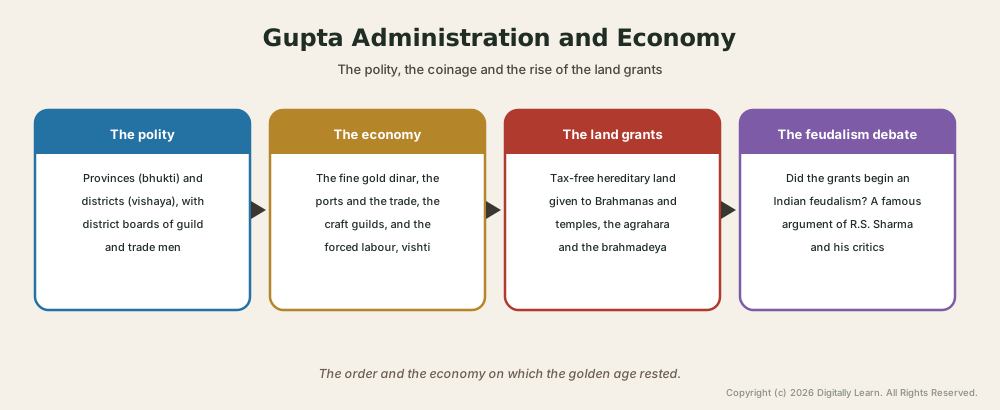
Gupta administration governed the classical empire through a tidy hierarchy of provinces and districts, and its economy rested on the finest gold coinage of ancient India. The empire was divided into provinces, the bhukti, and these into districts, the vishaya, where boards of guild and trade men shared in local government. The economy turned on the gold dinar, on trade through busy ports, and on the craft guilds. Above all, this age saw the rise of the land grant, the gift of tax-free land to Brahmanas and temples, which began the long process that historians have called Indian feudalism. This part covers the administration, the economy and coinage, the land grants, and the feudalism debate.
The Administration of the Gupta Empire
Provinces, Districts and Villages: Bhukti, Vishaya and Grama
What is the significance of the Gupta administration: the empire was governed through a clear ladder of provinces, districts and villages, less centralised than the Mauryan.
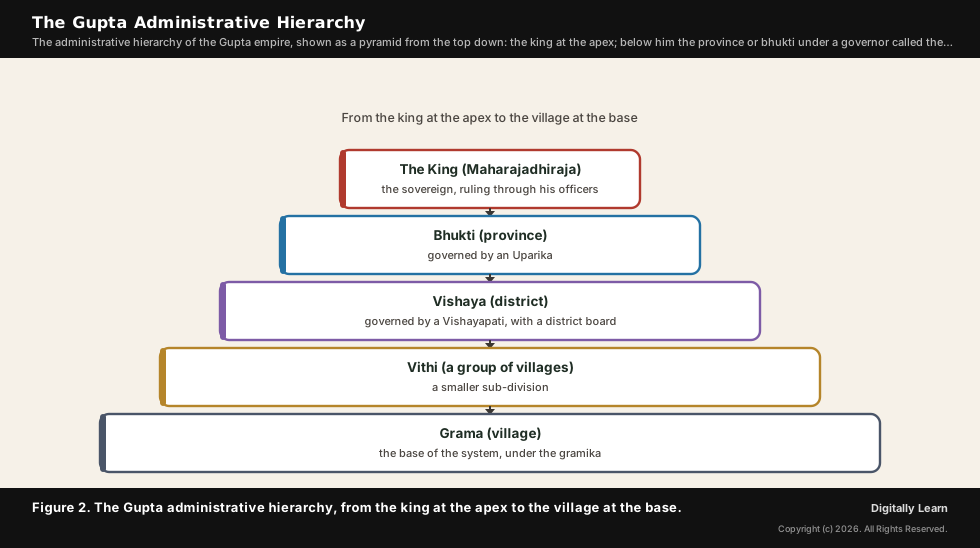
The empire was divided into provinces called bhuktis, each under a governor, the uparika, often a prince of the royal house. The bhuktis were divided into districts, the vishayas, each under a vishayapati; below these lay the vithi, a group of villages, and at the base the grama, or village, under its headman. The Gupta state ruled with a lighter hand than the Mauryan, leaving much to local bodies.
The District Board and Local Self-Government
Distinguishing the local government: a striking feature of Gupta rule was the share that townsmen, merchants and guilds had in running the districts.
In the districts, the vishayapati was advised by a board, the adhikarana, on which sat the chief banker, the chief merchant, the chief artisan and the chief scribe of the town. That the leaders of trade and craft sat in local government shows the high place of the guilds and the merchant class in the Gupta order, and a real measure of local self-rule.
| Member of the district board | Whom he represented |
|---|---|
| Nagarashreshthi | The chief banker or guild-president of the town. |
| Sarthavaha | The chief merchant, leader of the caravans. |
| Prathama-Kulika | The chief artisan or craftsman. |
| Prathama-Kayastha | The chief scribe or record-keeper. |
The Economy: Coins, Trade and Forced Labour
The Gold Dinar and the Money Economy
What is the significance of the coinage: the Gupta age struck the finest gold coins of ancient India, the sign of a rich and settled economy.
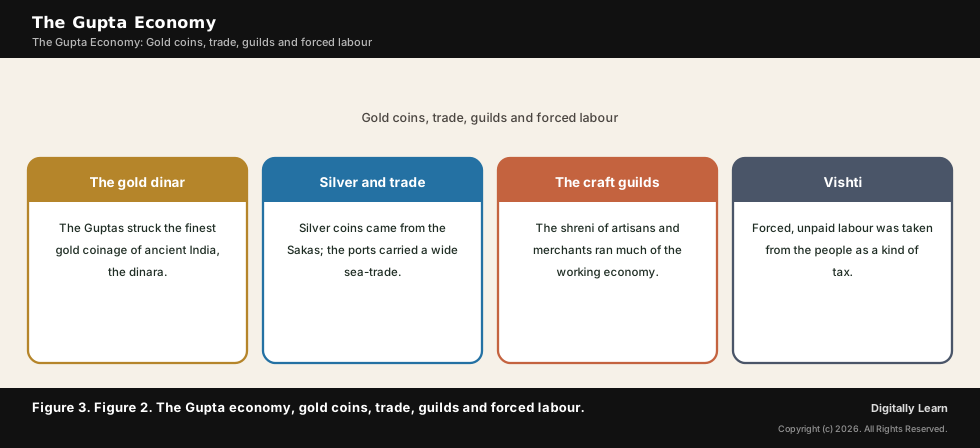
The Guptas issued a splendid gold coinage, the coins called dinaras, with their fine portraits and scenes, and after the conquest of the Sakas they struck silver coins too for the western provinces. In their later years the gold of the coins grew less pure, a sign that the great age of trade was beginning to pass. The abundant coinage of the height of the empire is the surest mark of its prosperity.
Trade, the Ports and the Guilds
Distinguishing the trade: the Gupta economy was knit together by a busy inland and sea trade, carried on through great ports and run by the guilds.
The empire traded by sea through its ports: Tamralipta in Bengal in the east, Bharuch in the west, and Ghantasala and other towns on the southern coast. The craft and merchant guilds, the shreni, organised production and acted as bankers, as they had in earlier ages. From about the close of the Gupta period, however, the long-distance trade with the west declined, and with it the prosperity of the towns.
| Port | Region | Role |
|---|---|---|
| Tamralipta | Bengal (the east) | The great eastern port to South-East Asia. |
| Bharuch (Barygaza) | Gujarat (the west) | The western port for the Arabian-Sea trade. |
| Ghantasala, Kadura, Chaul | The Andhra and Konkan coast | Ports handling the southern foreign trade. |
Vishti: The Forced Labour of the Age
Distinguishing vishti: beside the taxes in coin and kind, the Gupta state took labour itself from its people.
Vishti was forced, unpaid labour, a corvée that the state could demand of the common people for its works. It was treated as a source of income for the State, a kind of tax paid not in money but in toil, and it fell most heavily on the peasantry. The growth of such demands, beside the rise of the land grants, is part of the changing burden on the village in the later Gupta age.
The Rise of Land Grants and the Feudalism Debate
Agrahara and Brahmadeya: The Grant of Tax-Free Land
What is the significance of the land grants: the most far-reaching change of the age was the king's gift of tax-free land, which slowly reshaped the countryside.
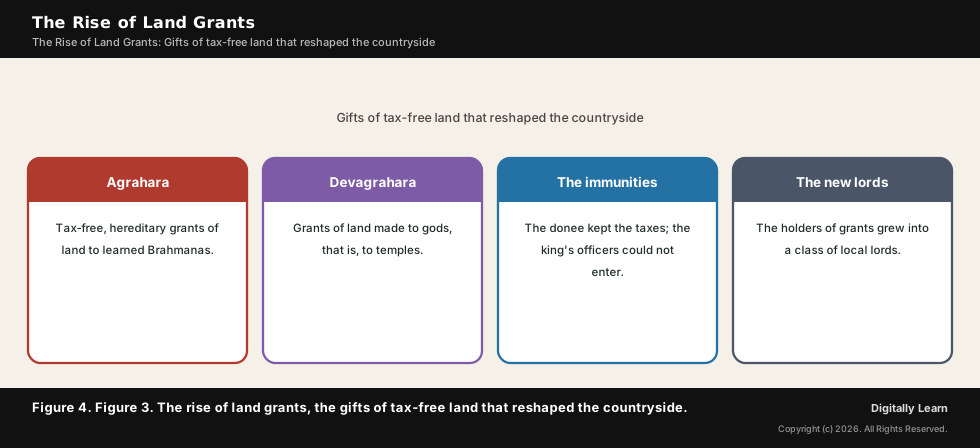
Gupta kings, and still more their successors, granted villages of land to learned Brahmanas, the agrahara, and to temples, the devagrahara, as pious gifts recorded on copper plates. The grant was tax-free and hereditary, and it often carried with it the right to collect the revenue and even to govern, while the king's own officers were barred from entering. The holders of such grants grew, in time, into a class of local lords standing between the king and the peasant.
The Beginnings of Indian Feudalism
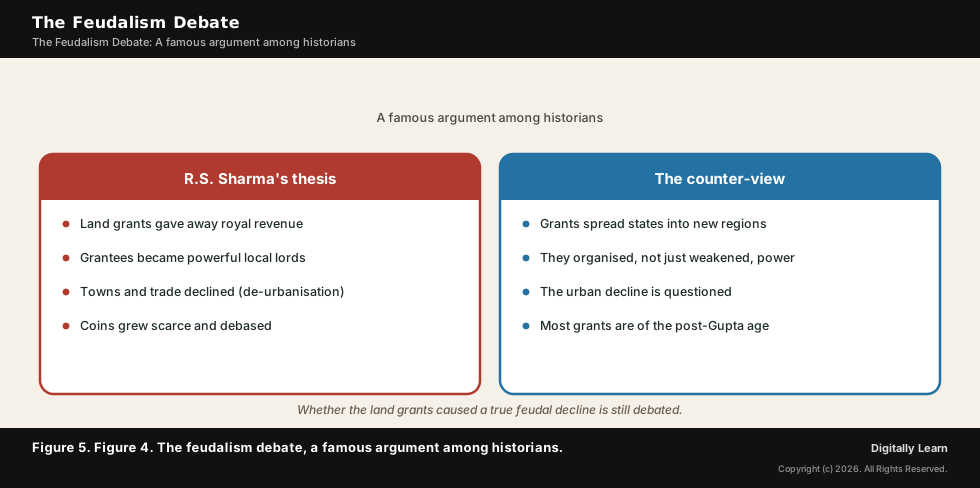
Distinguishing the feudalism debate: from these land grants historians have drawn a famous and much-argued theory of Indian feudalism.
The historian R.S. Sharma argued that the spread of land grants gave away the king's revenue and authority, raised a class of feudal lords, the samantas, and led to a decline of trade, coinage and towns, an Indian feudalism. Other historians, such as B.D. Chattopadhyaya, have questioned this, seeing in the grants the spread of states into new lands rather than simple decay. It is worth remembering that the grants became truly widespread only in the centuries after the Guptas.
UPSC Relevance and Exam Focus
Where Gupta Administration and Economy Fit in the UPSC-CSE Syllabus
This topic belongs to General Studies Paper I: ancient Indian history and culture, and Gupta administration, economy and the land grants are a steady source of Prelims questions.
For Prelims, hold the firm facts: the empire was divided into provinces, the bhukti under an uparika, and districts, the vishaya under a vishayapati; the district board included the banker, merchant, artisan and scribe; the gold coins were the dinaras; ports such as Ghantasala, Kadura and Chaul handled the foreign trade; vishti was forced labour taken as a kind of tax; and the tax-free land grant to Brahmanas was the agrahara.
For Mains, the land grants and the feudalism debate are a rich theme on state and society in early India.
Recurring linked concepts an aspirant should keep in working memory:
- Bhukti and Vishaya: The province (uparika) and the district (vishayapati).
- The district board: Banker, merchant, artisan and scribe.
- The dinar: The Gupta gold coin.
- Vishti: Forced labour, taken as a kind of tax.
- Agrahara: Tax-free hereditary land granted to Brahmanas.
A common Prelims trap is to swap the bhukti and the vishaya; the bhukti is the larger province and the vishaya the smaller district within it. Another treats the feudalism thesis as settled fact; it is the argument of R.S. Sharma, and other historians dispute it.
Previous Year UPSC-CSE Questions
Previous Year UPSC-CSE Questions By the end you will be able to draft model answers for the following UPSC questions. Each question carries a collapsible framework showing how to approach it in the exam.
- UPSC Prelims 2020 GS-IWith reference to the period of Gupta dynasty in ancient India, the towns Ghantasala, Kadura and Chaul were well known as
How to approach this Prelims question
Approach: Recall that these were coastal towns; in the Gupta age they were ports handling the foreign sea-trade.
Trap to watch: They were not capitals, art centres or pilgrimage sites, but ports of the foreign trade.
Key facts to recall:
- Ghantasala, Kadura and Chaul were Gupta-age ports of the foreign trade.
- The Gupta economy traded by sea through such coastal ports.
Answer signal: Ports handling foreign trade.
- UPSC Prelims 2019 GS-IWith reference to forced labour (Vishti) in India during the Gupta period, which one of the following statements is correct?
How to approach this Prelims question
Approach: Recall that vishti was unpaid forced labour treated as a State income, a tax paid in labour.
Trap to watch: Vishti was unpaid (no weekly wages), not region-absent, and not a son-for-son levy; it was a source of State income, a kind of tax.
Key facts to recall:
- Vishti was forced, unpaid labour in the Gupta period.
- It was treated as a source of income for the State, a kind of tax.
Answer signal: A source of income for the State, a sort of tax.
Sources and Further Reading
Editorial Disclaimer
This article is for UPSC preparation. The theory of Indian feudalism is a debated interpretation among historians, and both the thesis and its criticisms are noted here.