


Overview
Samudragupta was the second emperor of the Gupta dynasty and the ruler who turned his father's small imperial beginning into an empire across northern India. His reign is known above all from the Allahabad Pillar inscription, also called the Prayaga Prashasti, which is a long Sanskrit eulogy composed by his court poet Harishena and cut on an Ashokan pillar at Prayaga, modern Prayagraj. The prashasti lists his victories king by king and, more usefully for a student, tells what he did with each group he met. Northern kings were uprooted and their kingdoms taken, southern kings were captured and then released, forest chiefs were made servants, and frontier states and distant powers paid tribute or sought his favour. Coins, a second inscription at Eran and later records add to the picture.
Gupta Background: From Gupta to Chandragupta I
Gupta and Ghatotkacha: The Maharaja Kings
The Allahabad prashasti is also the earliest source for the dynasty's first two kings. It names Samudragupta's great-grandfather Gupta and his grandfather Ghatotkacha, and gives each the title Maharaja ("great king"). Neither is known from an inscription or coin of his own. The next king, Chandragupta I, is called Maharajadhiraja ("king of great kings"), so he is taken to be the first imperial ruler of the line.
Gupta most probably ruled in the second half of the third century CE, and Ghatotkacha followed him; the exact years are uncertain, and estimates differ by several decades. The title Maharaja was used by feudatories in later times, which has led some historians to call the first two kings vassals, possibly of the Kushanas. Others point out that paramount rulers also used the title and that the Kushana empire had already declined, so the question stays open. What is certain is that both held a lower rank than Chandragupta I.
Chandragupta I and the Lichchhavi Marriage
Chandragupta I married the Lichchhavi princess Kumaradevi. The Lichchhavis were an ancient clan whose base in the Buddha's time was Vaishali in present-day Bihar. Gold coins attributed to Chandragupta I show the king and queen together and carry the legend Lichchhavayah ("the Lichchhavis"); the reverse shows a seated goddess identified as Lakshmi. The Gupta inscriptions name the maternal family only for Kumaradevi, and they call Samudragupta Lichchhavi-dauhitra, "the daughter's son of the Lichchhavi". The Guptas clearly treated the marriage as a mark of honour.
Most historians think the alliance added to Gupta power and allowed Chandragupta I to take the higher title Maharajadhiraja. Which Lichchhavi kingdom Kumaradevi came from is not certain. It is unlikely to have been Nepal, because the prashasti lists Nepala separately as a tribute-paying frontier state.
Samudragupta's Accession and the Problem of Dates
The prashasti says that Chandragupta I embraced his son, told him "so protect thou the whole earth", and chose him while others of equal birth looked on with sad faces. The Eran inscription also says the father chose him for his devotion, righteous conduct and valour. One reading takes the "others of equal birth" to be neighbouring kings, so that the accession was uncontested. Another takes them to be Gupta princes with a rival claim. Samudragupta's Lichchhavi mother may have worked in his favour.
NCERT dates Samudragupta to c. 335‑375 CE and the beginning of Gupta rule to c. 320 CE. Other accounts place the start of his reign anywhere from about 319 to 350 CE, because the founder of the Gupta era and the length of Chandragupta I's reign are both uncertain. His death falls before about 380 CE, when his granddaughter Prabhavatigupta is known to have been married in the reign of Chandragupta II. His successor was Chandragupta II, his son by Dattadevi.
Coins of a Gupta ruler named Kacha, who is called "the exterminator of all kings", closely resemble Samudragupta's. One theory makes Kacha an earlier name of Samudragupta; another makes him a separate claimant to the throne. The question is unsettled.
Allahabad Pillar Inscription: The Pillar and Its Records
An Ashokan Pillar with Three Sets of Records
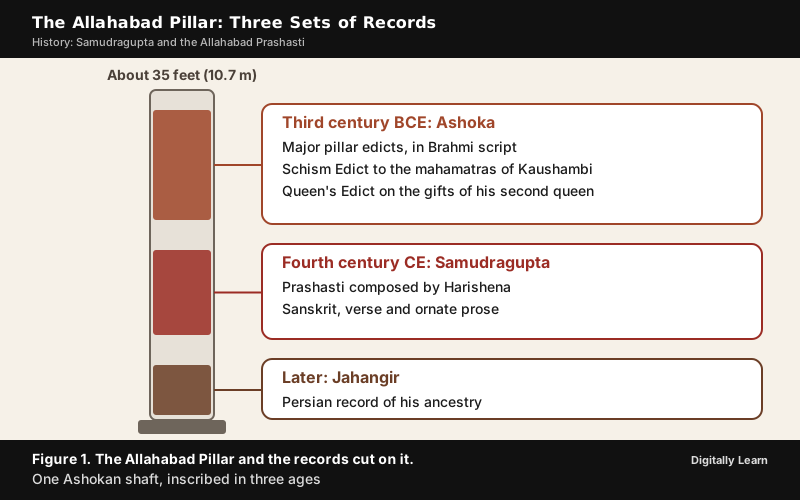
The Allahabad Pillar is a single shaft of polished sandstone about 35 feet (10.7 m) high. It was first inscribed in the third century BCE with the major pillar edicts of Ashoka, in Brahmi script, together with the Schism Edict addressed to the mahamatras of Kaushambi and the Queen's Edict that records the gifts of Ashoka's second queen. Below the edicts the Gupta text of Samudragupta was cut in the fourth century CE. Much later, a Persian inscription of the Mughal emperor Jahangir, tracing his ancestry, was added, and it damaged part of the Ashokan text.
Scholars disagree on where the pillar first stood. One theory holds that it came from Kaushambi, about 50 km to the west; another, argued from the dates of the inscriptions and the importance of the Ganga-Yamuna confluence, holds that it always stood at Prayaga. The Brahmi script of Ashoka's edicts, such as those on this pillar, was deciphered by James Prinsep in 1838.
Harishena and the Form of the Prashasti
The text was composed in Sanskrit by Harishena and written in the Gupta script, a later form of Brahmi. Harishena describes himself as a servant of Samudragupta and as Sandhivigrahika (minister for peace and war), Kumaramatya and Mahadandanayaka, the son of the Mahadandanayaka Dhruvabhuti, from Khadyatapaka. He calls his own work a kavya, a poem, and it mixes verse and ornate prose. Its closing lines say that it was executed by the Mahadandanayaka Tilabhattaka.
A prashasti is a genre of inscription composed by poets in praise of rulers. Typically it gives a genealogy, the ruler's qualities, his victories and his piety, and it often ends with gifts made. The earliest prashasti in classical Sanskrit, the Junagadh inscription of Rudradaman (c. 150 CE), became the model for later Gupta-age prashastis, and the Allahabad prashasti is its best-known successor.
What the Prashasti Records
The inscription runs from praise of the king's learning and poetry, through his selection by his father, to a catalogue of kings, and ends with the genealogy and the poet's own name. In outline, it records:
- Early victories: Achyuta, Nagasena and a third king (restored as Ganapati-naga) uprooted, and the scion of the Kota family captured while the king amused himself at Pushpa, the city of Pataliputra.
- Dakshinapatha: Twelve kings captured and then released.
- Aryavarta: The forcible uprooting of eight kings, and the forest kings made servants.
- Frontier states and tribes: Tribute, obedience and attendance at court.
- Foreign powers: Attendance, gifts of daughters and requests for the Garuda seal.
- Character: Compassion to the poor, strict rule, learning, poetry and music, with divine comparisons.
- Genealogy: Gupta, Ghatotkacha, Chandragupta I and the Lichchhavi mother.
Campaigns and the Policy Toward Each Group
Aryavarta and the Forest Kingdoms: Uprooting
The key to the prashasti is that Samudragupta did not treat all rulers alike. It sorts them into groups and states what was done to each, as the table below sets out.
| Group | Treatment stated in the prashasti | Examples named |
|---|---|---|
| Kings of Aryavarta (north) | Forcibly uprooted; kingdoms annexed | Rudradeva, Matila, Nagadatta, Chandravarman, Ganapatinaga, Nagasena, Achyuta-Nandin, Balavarman |
| Kings of Dakshinapatha (south) | Captured first, then released and favoured | Mahendra of Kosala, Vyaghraraja of Mahakantara, Vishnugopa of Kanchi, Hastivarman of Vengi, and eight others |
| Forest kings | Made servants | Not named |
| Frontier kingdoms and tribes | Tribute, orders obeyed, attendance for homage | Samatata, Davaka, Kamarupa, Nepala, Kartripura; Malavas, Yaudheyas, Madrakas and others |
| Distant and foreign powers | Attendance, daughters offered, Garuda seal sought | Daivaputra-Shahi-Shahanushahi, Shaka lords, Simhala and other islands |
The Aryavarta kings were "forcibly exterminated", in the inscription's strong wording, and the absence of any mention of their territories suggests that their kingdoms were annexed to the empire. Several of the names belong to Naga rulers: Ganapatinaga is known from coins found at Mathura, Nagasena appears to have ruled from Padmavati in present Madhya Pradesh, and Achyuta ruled at Ahichchhatra in present Uttar Pradesh. The inscription says Achyuta, Nagasena and Ganapati were already uprooted in an earlier verse, and some historians think they rebelled again and were defeated twice; others think the poet merely repeated their names.
The same verse states that all the kings of the forest regions (atavika) were reduced to servitude. These lay probably in central India, where later inscriptions speak of "eighteen forest kingdoms". Annexing the Gangetic plain and controlling the forest belt secured the heart of the empire and the road to the south.
Dakshinapatha: Captured, Then Released
Twelve southern kings were first captured and then, in the prashasti's phrase, favoured with release. They ruled the eastern coast, and Samudragupta most probably passed through the forests of central India, reached the coast in present-day Odisha and marched south along the Bay of Bengal. The list includes Mahendra of Kosala, Vyaghraraja of Mahakantara, Mahendragiri of Pishtapura, Svamidatta of Kottura, Vishnugopa of Kanchi, Nilaraja of Avamukta, Hastivarman of Vengi, Ugrasena of Palakka, Kubera of Devarashtra and Dhananjaya of Kusthalapura. Kanchi, the Pallava capital, is the farthest point reached.
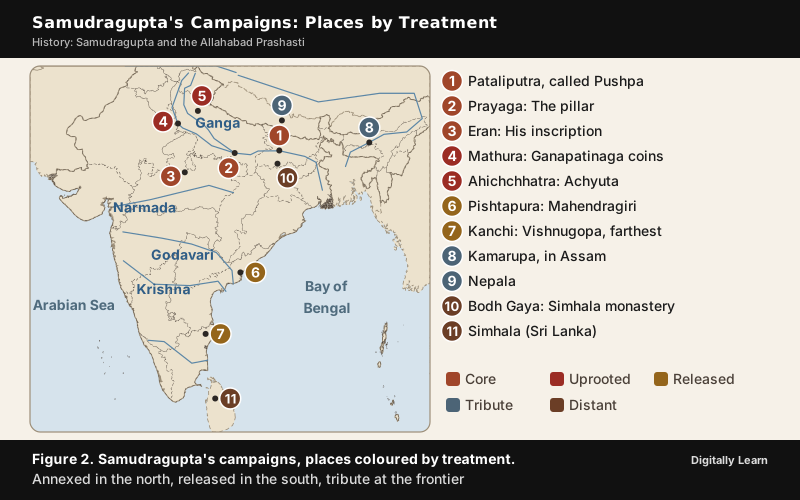
Samudragupta defeated a Pallava ruler but did not take over the region, and let local kings keep their thrones as long as they accepted his rule and paid tribute. Most historians therefore treat the southern kings as tributaries. The policy fits the ideal of the dharmavijayi, the "righteous conqueror" of the Arthashastra, who restores a defeated king in return for acknowledgement of his overlordship; the covetous conqueror takes the possessions of the defeated king, and the demonic conqueror annexes the land and kills him. A few historians doubt that a campaign so far south ended in clear victory, but no evidence of a southern confederacy has been found.
Frontier Kingdoms and Tribal Republics
Five frontier kingdoms are named: Samatata (in Bengal), Davaka and Kamarupa (in Assam), Nepala (Nepal) and Kartripura (probably in present Uttarakhand). With them are nine named tribal polities: Malavas, Arjunayanas, Yaudheyas, Madrakas, Abhiras, Prarjunas, Sanakanikas, Kakas, Kharaparikas and others. The Malavas are placed around Nagar in Rajasthan, the Yaudheyas between the Sutlej and the Yamuna, the Madrakas between the Ravi and the Chenab, and the Arjunayanas near Mathura.
They paid all tributes, obeyed his orders and came to bow before him, but they stayed in place under their own rulers. In the northeast, Samudragupta defeated the ruler of Kamarupa without taking direct control. It is likely that his conquests in Aryavarta and Dakshinapatha had made the frontier rulers submit without fighting. The relationship shows some features of feudatory rule.
Foreign Powers: The Kushana, Shaka and Simhala Rulers
The last group is the most distant. It includes the Daivaputra-Shahi-Shahanushahi (usually read as Kushana princes of the northwest, with Shahanushahi sometimes taken for the Sasanian king), the Shaka lords, and the rulers of Simhala (Sri Lanka) and other islands. The prashasti says they offered personal attendance, gave their daughters in marriage and asked for the Garuda seal, the badge of Gupta authority, to run their own territories.
This is where the prashasti's praise needs most care. Chinese sources report that Meghavarna, king of Simhala, sent gifts and asked leave to build a monastery at Bodh Gaya for pilgrims from his island, and Samudragupta allowed it. The poet turned an act of diplomacy into submission. Xuanzang, who visited the monastery much later, also described the gifts as tribute. For the other islands, no evidence shows that their rulers were subordinate to the Guptas; they probably exchanged embassies and trade.
Ashvamedha, Coins and Patronage
The Ashvamedha and Its Gold Coin
The Ashvamedha is the horse sacrifice by which a king proclaimed himself a paramount sovereign. A consecrated horse was let loose to roam, and its safe return affirmed the king's claim over the lands it crossed. Samudragupta performed it and struck a gold coin to mark the event. The obverse shows the decorated horse standing before a sacrificial post (yupa) and the legend "the overlord of kings, who has performed the horse-sacrifice, having protected the earth, conquers the heaven"; the reverse shows a standing queen holding a towel and the legend Ashvamedhaparakramah. A specimen in the Allahabad Museum weighs 7.3 g and was found at Bharatpur in Rajasthan.
His son Chandragupta II's Mathura inscription calls him "the restorer of the Ashvamedha sacrifice that had been long in abeyance". Yet kings of the Bharashiva, Vakataka and other dynasties had performed it before him, and scholars explain the claim in different ways, for example by saying that his was a full-scale sacrifice with real imperial claims. The surviving verses of the prashasti do not mention the Ashvamedha, and one theory is that the pillar was erected to mark the beginning of the ceremony.
Samudragupta's Gold Coins: Types and Meaning
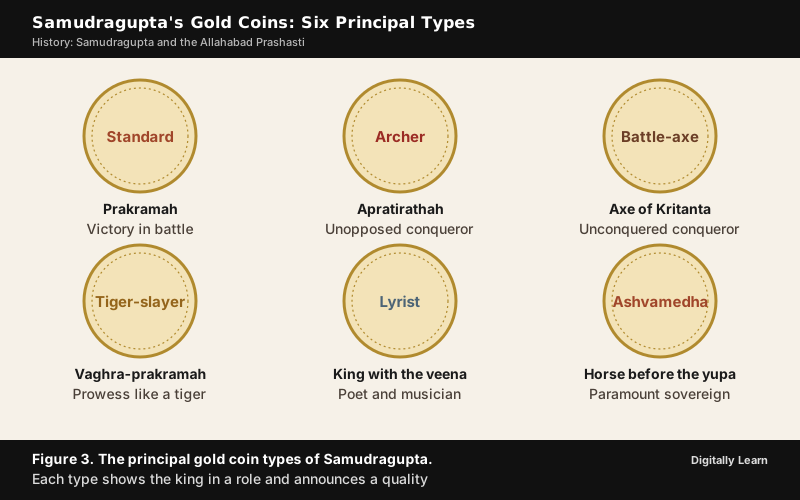
Samudragupta's coinage was of gold only. The Gupta dinara of about 8 g was modelled on the Roman denarius, and the early Gupta coinage took its weight standard and designs from the Kushana coinage after the conquests of the northwest. The coins are inscribed in Sanskrit.
| Type | What it shows | What it announces |
|---|---|---|
| Standard | King at an altar, halo, Garuda standard; legend "Prakramah" | Victory in hundreds of battles |
| Archer | King standing with bow and arrow; legend "Apratirathah" | Unopposed conqueror of the earth |
| Battle-axe | King with the axe of Kritanta, god of death | Unconquered conqueror of unconquered kings |
| Tiger-slayer | King trampling a tiger; legend "Vaghra-prakramah" | Prowess like a tiger |
| Lyrist | King seated, playing the veena on his knees | The poet and musician-king |
| Ashvamedha | Horse before the yupa | Paramount sovereign who performed the horse sacrifice |
The archer type became the most common and characteristic Gupta type, struck by at least eight later kings. Coins showing Chandragupta I with Kumaradevi may have been issued by Samudragupta to commemorate his parents, though some attribute them to Chandragupta I himself. A seated Samudragupta playing the veena has the goddess Lakshmi on the reverse.
A Poet-King and Patron of Learning
The prashasti calls him "King of Poets" for his many compositions, none of which survive, and says that he put Tumburu and Narada to shame by his music. The lyrist coin supports the claim. Harishena also writes of the king's support to art, learning and trade. The king was a devotee of Vishnu (parama-bhagavata in two disputed records), and the Eran inscription records the installation of a Vishnu image; he also permitted a Buddhist monastery at Bodh Gaya, so his rule was tolerant. The prashasti describes him as the giver of many hundred-thousands of cows and as a ruler who restored fallen royal families.
Later Buddhist tradition links the philosopher Vasubandhu with a Gupta king, but the accounts name different kings (Chandragupta II or Skandagupta, in a debate at Ayodhya), so no secure link to Samudragupta can be drawn.
Samudragupta's Empire: Extent and the Verdict of History
Core Territory, Tributaries and Limits
The empire had a core under direct rule and a ring of dependent states. By one estimate, the core ran from the Ravi in the west to the Brahmaputra in the east, and from the Himalayan foothills to the Vindhya hills in the south, with a south-western line from near Karnal to Bhilsa. Eran in Madhya Pradesh certainly lay within it, because his inscription stands there. Beyond the core came the tribal states and frontier kingdoms, then the southern kings who paid tribute, and then the distant powers.
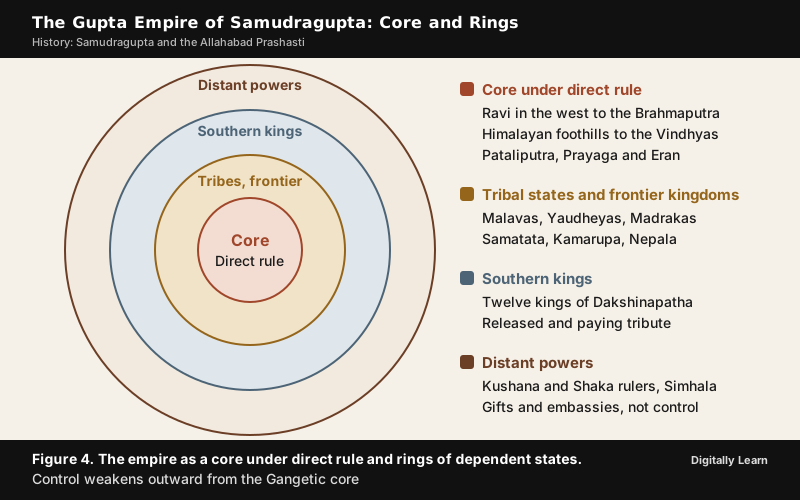
At its height the Gupta Empire as a whole covered most of present-day north and west India, along with parts of central and east India. The claims for the south and for foreign powers rest on a royal eulogy, so they are best read as influence rather than control; the southern kings were not under his direct rule and only paid tribute. An older view that Samudragupta conquered part of Maharashtra rests on a mistaken identification of Devarashtra and Erandapalla and is no longer accepted.
The Eran Inscription of Samudragupta
At Eran in present-day Madhya Pradesh, a damaged red sandstone inscription of Samudragupta is now kept in the Indian Museum, Kolkata. It compares him with Kubera and Yama in pleasure and anger, says the whole tribe of kings on earth was overthrown, and states that he surpassed Prithu and Raghava in giving gold. It names no defeated king, probably because its main purpose was to record the installation of a Vishnu image in a temple. It also shows Gupta rule reaching Eran, whose earlier Shaka ruler Sridharavarman he may have ousted.
Chandragupta II's Mathura inscription likewise calls Samudragupta an exterminator of all kings and a ruler without an equally powerful enemy, and says that his fame was tasted by the waters of the four oceans. That record is later and briefer than the prashasti, yet it agrees with its picture of a conqueror and helps to check it.
The "Napoleon of India" Label
The historian V. A. Smith called Samudragupta the "Indian Napoleon", pointing to the sweep of his northern conquests, his long expeditions in the Deccan and an empire with a strong core ringed by friendly or dependent states. It is a modern comparison made by a historian, not an ancient title, and nothing in the prashasti or the coins uses it. The comparison also has limits. Samudragupta is described as undefeated in battle, whereas Napoleon's ambitions were ended at Waterloo, and his tributary system relied on restoring defeated rulers rather than replacing them.
Reading a Prashasti as Historical Evidence
What a Prashasti Can and Cannot Tell Us
Historians often try to draw factual information from compositions like this, while those who composed and read them treasured them as works of poetry rather than as accounts that were literally true. The Allahabad prashasti is the standing example.
What it does well is give a list of kingdoms and tribes with their rough location; it shows a theory of kingship in which the king is compared with Kubera, Varuna, Indra and Yama; and it separates kinds of political submission. What needs checking is the poet's wording of "tribute" for gifts and diplomacy; the "uprooting" of kings for whom no other record exists; the claim of rule over islands; and silence on defeats or on matters the king did not wish praised. The check is to set each statement against other evidence, namely coins (such as the Gadahara coin that bears the legend Samudra), the Eran inscription, the Chinese account of Meghavarna, and finds from the territories named.
Previous Year UPSC‑CSE Questions
Each question comes with an explanation of how to approach it.
- UPSC Prelims 2006The Allahabad Pillar inscription is associated with which one of the following?
How to approach this Prelims question
Approach: Separate the pillar from the inscription the question names. The pillar itself carries Ashoka's edicts, but the Allahabad Pillar inscription of the question is the Prayaga Prashasti, composed by Harishena for Samudragupta.
Trap to watch: Ashoka raised the pillar, which tempts (c); the inscription the question names is Samudragupta's.
Why each option is right or wrong:
- (a) Mahapadma Nanda: Wrong. The pillar bears records of Ashoka, Samudragupta and Jahangir; none belongs to the Nandas.
- (b) Chandragupta Maurya: Wrong. The edicts on the pillar are Ashoka's, who ruled after Chandragupta Maurya, and no record of Chandragupta stands on it.
- (c) Ashoka: Wrong. He raised the pillar and his edicts are on it, but the inscription known by the pillar's name in Gupta history is Samudragupta's prashasti.
- (d) Samudragupta: Correct. His court poet Harishena composed the eulogy that was cut on the pillar.
Answer: Option (d) Samudragupta: The prashasti by Harishena sits on an Ashokan pillar at Prayaga.
- UPSC Prelims 2025Fa-hien (Faxian), the Chinese pilgrim, travelled to India during the reign of
How to approach this Prelims question
Approach: Place the pilgrim's dates against the Gupta reigns. Faxian began his journey from China in 399 CE, reached India in 405 CE and stayed until 411 CE, so his stay falls within the years of Chandragupta II (c. 375‑415 CE).
Trap to watch: Samudragupta is the best-known name in the list, but his reign had ended before Faxian set out.
Why each option is right or wrong:
- (a) Samudragupta: Wrong. His reign (c. 335‑375 CE) ended well before Faxian set out in 399 CE.
- (b) Chandragupta II: Correct. His reign, c. 375‑415 CE, covers Faxian's years in India, 405 to 411 CE.
- (c) Kumaragupta I: Wrong. His reign began in about 415 CE, after Faxian had left.
- (d) Skandagupta: Wrong. He ruled after Kumaragupta I, so his reign too falls after Faxian had left.
Answer: Option (b) Chandragupta II: The pilgrim's years in India, 405 to 411 CE, fall within c. 375‑415 CE.
- UPSC Prelims 1997The silver coins issued by the Guptas were called
How to approach this Prelims question
Approach: Match each coin name with its metal and age. The Guptas' standard gold coin was the dinara; their silver coin was the rupaka, worth one-sixteenth of a dinara.
Trap to watch: The dinara is the best-known Gupta coin, but it was gold, not silver.
Why each option is right or wrong:
- (a) rupaka: Correct. It was the silver coin of the Guptas, worth 1/16 of a dinara and weighing about 2.27 g; silver coinage came with Chandragupta II, after Samudragupta's all-gold issues.
- (b) karshapana: Wrong. This is the punch-marked coin of the age of the mahajanapadas, long before the Guptas.
- (c) dinara: Wrong. It was the Gupta gold coin of about 8 g.
- (d) pana: Wrong. It is another name for the early punch-marked karshapana.
Answer: Option (a) rupaka: The dinara is gold, and the karshapana and pana are punch-marked coins.
- UPSC Mains 2017 GS‑IHow do you justify the view that the level of excellence of the Gupta numismatic art is not at all noticeable in later times?
Answer outline
The outline sets out what the question asks, the main arguments, relevant examples and the direction of the conclusion; it is not a full model answer.
Introduction: Gupta coinage began under Chandragupta I and Samudragupta, built on the Kushana standard of weight and design.
Body (sub-themes to develop):
- Excellence: Many types with royal portraits in varied roles (archer, battle-axe, tiger-slayer, lyrist, Ashvamedha), with Sanskrit legends.
- Metal and weight: Mainly gold dinaras of about 8 g, of high purity under the early kings.
- Decline: Gold purity fell from about 90 per cent under Chandragupta I to 75‑80 per cent under Skandagupta; design and execution deteriorated; silver money disappeared with the loss of territory.
Conclusion: Later coinages did not match the variety and finish of the early Gupta gold.
Sources
- NCERT: Themes in Indian History Part I (Class XII), Theme 2, Kings, Farmers and Towns
- NCERT: Exploring Society, India and Beyond (Grade 7), the Gupta age
- Dakshin Dinajpur district administration: History
- Museums of India: Gold coin of Samudragupta, Ashvamedha type, Allahabad Museum
- NCERT: An Introduction to Indian Art (Class XI), Chapter 4
- Prayagraj district administration: History
- Wikipedia: Samudragupta
- Wikipedia: Allahabad Pillar
- Wikipedia: Harisena
- Wikipedia: Prashasti
- Wikipedia: Gupta (king)
- Wikipedia: Ghatotkacha (king)
- Wikipedia: Chandragupta I
- Wikipedia: Ashvamedha
- Wikipedia: Coinage of India
- Wikipedia: Vasubandhu
- Wikipedia: Gupta Empire
- UPSC: Civil Services Examination question papers
Editorial Disclaimer
This article draws on the current NCERT textbooks, the inscriptions as published and the other sources listed in the Sources section. Reign dates of the early Guptas differ between sources; NCERT's are used here.