


Overview
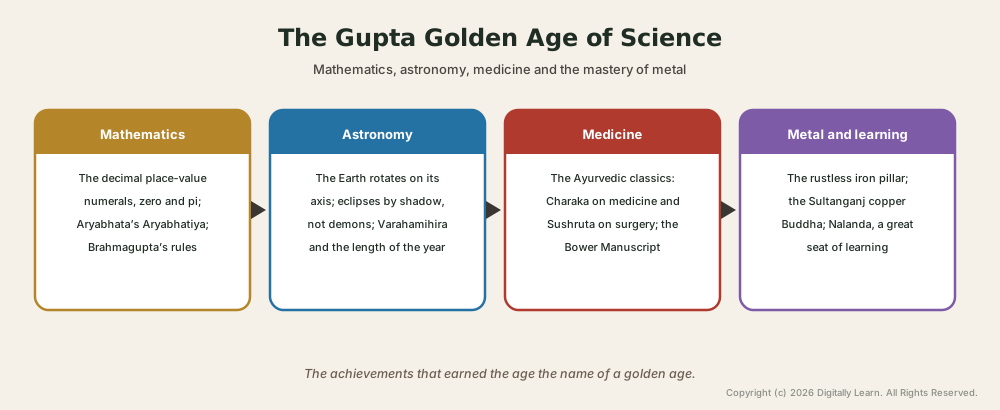
The Gupta science and mathematics of classical India reached a height so striking that the age is remembered as a golden age of learning. In this period Aryabhata set out the decimal place-value system, gave a fine value for pi, and held that the Earth rotates on its axis; a little later Brahmagupta made the zero a number in its own right and described gravity as an attractive force. Varahamihira gathered the astronomy of the age, while the Ayurvedic classics and the rustless iron pillar show its medicine and its mastery of metal. This part covers the mathematics, the astronomy, the sciences of life and metal, and the exam focus.
The Gupta Golden Age of Science
Why the Gupta Age Became a Golden Age of Learning
What is the significance of the Gupta golden age of science: a long peace, a rich economy and the patronage of kings and monasteries let learning flower as never before in early India.
Political peace under the great Guptas, a settled and prosperous economy, and the support of royal and monastic patrons gave scholars the leisure to think. Sanskrit became the common language of science, so that a discovery made in one place could be read across the land. Ujjain grew into the chief seat of astronomy, and the monastery of Nalanda, founded by Kumaragupta I about 427 CE, became one of the greatest centres of learning in the ancient world.
The Myth of the Navaratnas and the True Dates of the Scholars
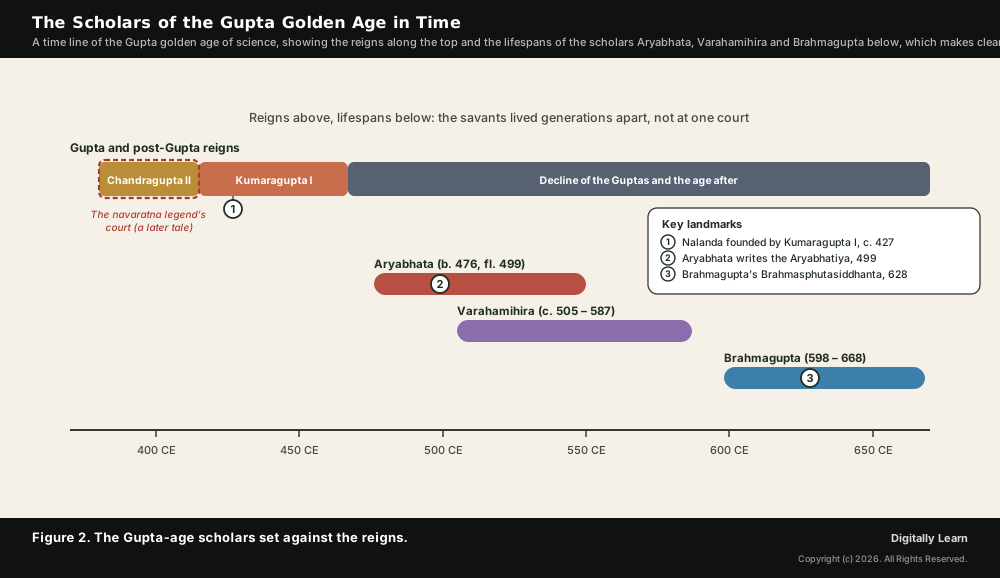
Distinguishing legend from history: a famous later tale gathers nine gems, the navaratnas, at one royal court, but the great scientists in fact lived generations apart.
Varahamihira lived about 505 to 587 CE, and Brahmagupta from about 598 to 668 CE, while the navaratna legend places them at the court of Chandragupta II, who reigned more than a century earlier. Historians treat the list of nine gems as a much later literary tradition, not a record of any real gathering. The true measure of the age is not a court of nine, but a line of original thinkers stretching across two hundred years.
Aryabhata and the Mathematics of Zero, Pi and Trigonometry
Aryabhata and the Aryabhatiya of 499 CE
What is the significance of Aryabhata's work: a single short book, written by a young man, set the course of Indian mathematics and astronomy for a thousand years.
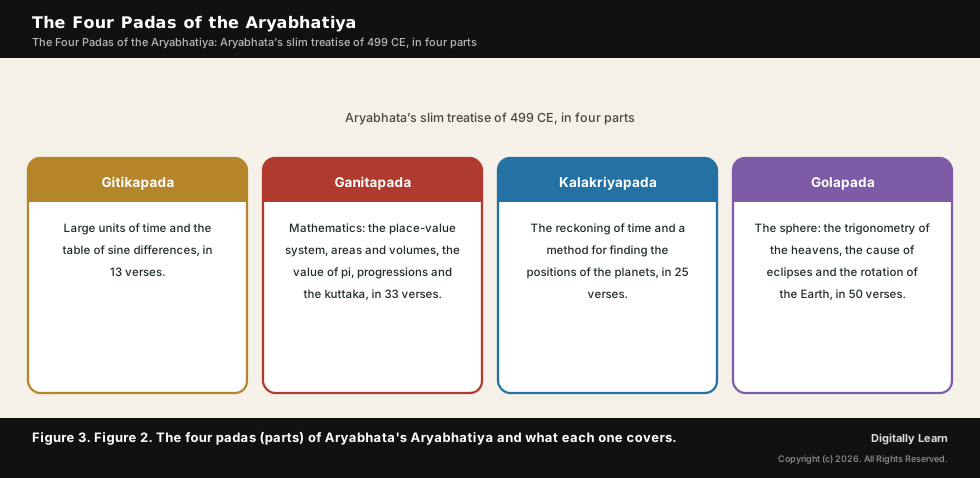
Born in 476 CE, Aryabhata composed his great work, the Aryabhatiya, in 499 CE, when he was just twenty-three. It is a slim treatise of about a hundred and twenty verses in four parts, the padas, covering the reckoning of time, mathematics, the motions of the heavens and the geometry of the sphere. So compressed is the work that later scholars wrote long commentaries simply to unfold its meaning.
Zero, the Decimal Place-Value System, Pi and Kuttaka
Distinguishing the mathematics: Aryabhata's lasting gift was a way of writing and working with numbers that the whole world would in time adopt.
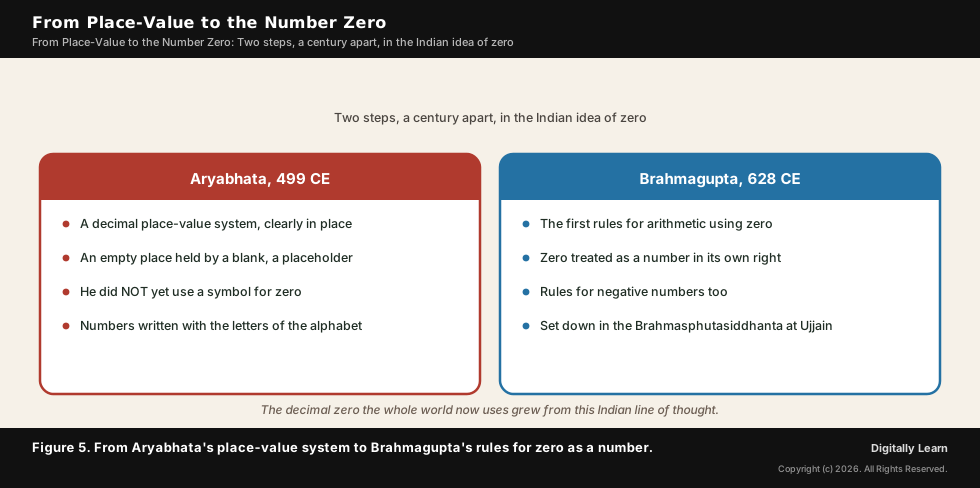
Aryabhata's numerals rested on a decimal place-value system, in which the worth of a figure depends on its position. He did not yet use a written symbol for zero, but the idea of an empty place was already at work in his method.
For the circle, he gave the ratio that yields pi as about 3.1416, and hinted that its true value can never be written exactly. He drew up the first tables of the sine, and his kuttaka, the pulveriser, solved equations that had long troubled mathematicians.
| Aryabhata's result | What it was | How it stands today |
|---|---|---|
| The place-value system | Numbers written by position, in tens. | The basis of all modern arithmetic. |
| The value of pi | Pi given as about 3.1416, and hinted to be inexact. | Correct to four decimal places. |
| The sine table | The first tables of the sine and versine. | The foundation of trigonometry. |
| The rotating Earth | The daily turning of the Earth on its axis. | A true insight, rare for its age. |
| The length of the year | The year reckoned at about 365.2586 days. | Very close to the modern figure. |
Astronomy, Varahamihira, Brahmagupta and the Sciences of Life and Metal
The Rotating Earth and the True Cause of Eclipses
What is the significance of Aryabhata's astronomy: he sought natural, geometric causes for what he saw in the sky, in place of the demons of the older sky-lore.
Apparent motion of the stars across the night sky, Aryabhata taught, is not the stars turning about us but the Earth turning on its own axis, a daring thought for his time. He kept, all the same, an earth-centred model of the heavens, with the Sun and Moon carried on circles.
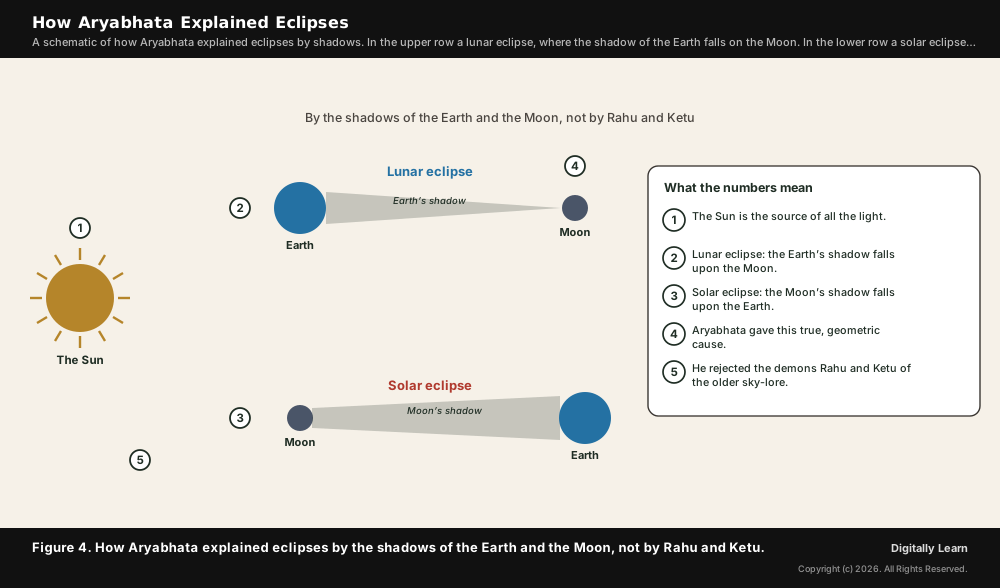
A lunar eclipse occurs, he held, when the Moon enters the shadow of the Earth, and a solar eclipse when the shadow of the Moon falls upon us. In this he gave the true, geometric cause, and rejected the old belief that the demons Rahu and Ketu swallowed the lights of the sky.
Varahamihira, Brahmagupta and the Idea of Gravity
Distinguishing the later masters: two great scholars carried the science of the age to its height and a little beyond, in astronomy and in the working of numbers.
A century after Aryabhata, Varahamihira of Ujjain gathered the astronomy of his day in the Pancha-Siddhantika, which set side by side five systems of reckoning, both Indian and Greek; his Brihat Samhita ranged over the whole of natural knowledge.
At the close of the age, Brahmagupta set down in his Brahmasphutasiddhanta of 628 CE the first rules for calculating with the zero and with negative numbers. He also held that gravity is an attractive force, that it is the nature of the Earth to draw things to itself, a thought that anticipated Newton by a thousand years.
Ayurveda and Metallurgy: Medicine and the Mastery of Metal
What is the significance of the other sciences: beyond number and the heavens, the age cultivated medicine and a mastery of metal that still astonishes.
The Charaka Samhita, on internal medicine, and the Sushruta Samhita, on surgery, are the great classics of Ayurveda; they took shape before the Guptas but were studied and copied in this age, and the Bower Manuscript, in Gupta script, holds the oldest dated fragments of an Indian medical text.
In metal, the age produced the famous rust-resistant iron pillar of Delhi and the Sultanganj Buddha, the largest surviving metal sculpture of the Gupta world, more than two metres tall and cast in pure copper by the lost-wax method.
| Scholar or work | Field | What it gave |
|---|---|---|
| Aryabhata | Mathematics and astronomy | The Aryabhatiya: place-value, pi, the sine, the rotating Earth. |
| Varahamihira | Astronomy | The Pancha-Siddhantika and the Brihat Samhita. |
| Brahmagupta | Mathematics | Rules for zero and negatives; gravity as an attractive force. |
| Charaka Samhita | Medicine | The great classic of internal medicine (Ayurveda). |
| Sushruta Samhita | Surgery | The great classic of surgery, with its many operations. |
| The Bower Manuscript | Medicine | The oldest dated fragments of an Indian medical text. |
UPSC Relevance and Exam Focus
Where Gupta-Age Science Fits in the UPSC-CSE Syllabus
This topic belongs to General Studies Paper I: ancient Indian history and culture, and the science, mathematics and astronomy of the Gupta age are a favourite ground for Prelims matching questions.
For Prelims, hold the firm pairings: Aryabhata with the place-value system, the value of pi and the rotation of the Earth; Brahmagupta with the rules for zero and the idea that things gravitate to the Earth; Varahamihira with astronomy; and Charaka with medicine. Note that the famous matching question pairs the digit zero with Aryabhata and gravity with Brahmagupta, not the other way round.
For Mains, Gupta-age science is strong material for an answer on why the period is called a golden age, and on the achievements of ancient Indian science.
Recurring linked concepts an aspirant should keep in working memory:
- Aryabhata: Place-value, pi as 3.1416, the rotating Earth, eclipses by shadow.
- The Aryabhatiya: His work of 499 CE, in four padas.
- Brahmagupta: The first rules for zero; gravity as an attractive force.
- Varahamihira: The Pancha-Siddhantika and the Brihat Samhita.
- Ayurveda: Charaka on medicine and Sushruta on surgery.
A common Prelims trap is to credit Aryabhata with heliocentric astronomy or with the formal symbol for zero; he taught the Earth's rotation within an earth-centred model, and the rules for zero as a number came with Brahmagupta in 628 CE. Another swaps Brahmagupta and Aryabhata on the idea of gravity; it was Brahmagupta who said that things gravitate to the Earth.
Previous Year UPSC-CSE Questions
Previous Year UPSC-CSE Questions By the end you will be able to draft model answers for the following UPSC questions. Each question carries a collapsible framework showing how to approach it in the exam.
- UPSC Prelims 2006 GS-IMatch the finding, invention or calculation in List-I with the ancient Indian scholar in List-II, where List-II is 1. Aryabhatta, 2. Bhaskaracharya, 3. Budhayana, 4. Gyandev. List-I is:
- A. Time taken by the Earth to orbit the Sun
- B. Calculation of the value of 'pi'
- C. Invention of the digit zero
- D. The game of snakes and ladders
Select the correct code:
How to approach this Prelims question
Approach: Anchor the one sure Gupta-age pairing first: the digit zero goes with Aryabhata (option C with 1); that alone fixes the answer as the option reading A 2 B 3 C 1 D 4.
Trap to watch: The digit zero is matched with Aryabhata, not the value of pi; in the official key pi goes to Baudhayana and the orbital period to Bhaskaracharya.
Key facts to recall:
- The official key pairs the digit zero with Aryabhata.
- Bhaskaracharya (Bhaskara II) is matched with the time the Earth takes to orbit the Sun.
- Snakes and ladders is matched with Gyandev (Dnyaneshwar).
Answer signal: A 2 B 3 C 1 D 4.
- UPSC Prelims 1996 GS-IMatch the classical figure in List-I with the field in List-II, where List-II is A. Medicine, B. Drama, C. Astronomy, D. Mathematics. List-I is:
- I. Visakhadatta
- II. Varahamihira
- III. Charaka
- IV. Brahmagupta
Select the correct code:
How to approach this Prelims question
Approach: Fix the science pairings taught here: Varahamihira to astronomy, Charaka to medicine and Brahmagupta to mathematics; Visakhadatta, the only non-scientist, must then go to drama.
Trap to watch: Do not give Brahmagupta to astronomy; his fame in this list is for mathematics, while Varahamihira holds astronomy.
Key facts to recall:
- Varahamihira is the astronomer (Pancha-Siddhantika).
- Charaka is the physician (Charaka Samhita).
- Brahmagupta is the mathematician; Visakhadatta is the dramatist.
Answer signal: I – B, II – C, III – A, IV – D.
- UPSC Prelims 1995 GS-I110. Who among the following anticipated Newton by declaring that all things gravitate to the earth?
How to approach this Prelims question
Approach: Recall that the idea that the Earth attracts bodies to itself belongs to Brahmagupta, who called it the Earth's nature to draw things down.
Trap to watch: The tempting wrong answer is Aryabhata; the gravity statement is Brahmagupta's, not Aryabhata's.
Key facts to recall:
- Brahmagupta described gravity as an attractive force.
- He said it is the nature of the Earth to attract and keep things.
- This idea is in his Brahmasphutasiddhanta of 628 CE.
Answer signal: Brahmagupta.
Sources and Further Reading
Editorial Disclaimer
This article is for UPSC preparation. The dates of some ancient scholars are approximate, and the contributions follow the standard accounts of the history of Indian science.