


Overview

Gupta art and architecture is the sculpture, painting, temple building, metalwork and coinage of the Gupta age, whose peak ran from about 300 to 480 CE. The art and architecture of the Gupta period is regarded as the classical peak of north Indian art: the calm Buddha images of Mathura and Sarnath, the murals of Ajanta and Bagh, the first free-standing temples at Deogarh and Bhitargaon, the rust-resistant iron pillar and the finest gold coins in a purely Indian style.
Gupta Art and Architecture: Meaning, Period and Classical Features
What Is Gupta Art: Period, Patrons and Surviving Forms
Gupta art is the art of the Gupta Empire, which ruled most of northern India, with its peak between about 300 and 480 CE, and survived in a much reduced form until about 550. The period is regarded as the classical peak of north Indian art for all the major religions. Under Gupta patronage, Indian art attained classic perfection in human, animal and floral forms and set the standard of artistic creation for the centuries that followed.
The term is used broadly. It covers work from north and central India outside direct Gupta rule, above all the Deccan of the Vakataka dynasty (about 250 to 500), where the Ajanta caves were mostly made in this period. Most surviving works are religious sculpture, mostly in stone with some in metal or terracotta, and architecture, mostly in stone with some in brick. Painting was evidently widespread, but Ajanta is virtually the only large survival, and the fine gold coinage is the main survival in metalwork.
- Sculpture: Images of the Buddha, Vishnu, Shiva and the Jain tirthankaras from Mathura, Sarnath, Udayagiri, Eran and Deogarh.
- Painting: The murals of Ajanta and the Bagh caves.
- Structural temples: The first structural shrines, at Sanchi, Udayagiri, Tigawa, Nachna, Bhitargaon and Deogarh.
- Metal and terracotta: The Sultanganj Buddha, the iron pillar, and the terracottas of Bhitargaon and Ahichchhatra.
- Coins: The gold dinaras, the one art form that pictures the kings themselves.

Features of Gupta Art: The Classical Style
The Gupta style is known for its classical decorum. Deities of every religion are shown in a calm and majestic meditative style, and Hindu, Buddhist and Jain images share one style, a growing likeness of form that continued after the period. The main features of Gupta sculpture, clearest in the Buddha images, are these.
- Halo: Ornate halos with floral and gem motifs behind the head.
- Drapery: Thin, diaphanous robes that cling to the body.
- Face: Specific hair curls, meditative eyes, elongated earlobes, relatively thick lower lips and often three lines across the neck.
- Scale: Large, often near life-size figures of the major deities, Vishnu, Shiva and the Buddha; the main figure in a scene is many times larger than the others.
- Pose: Subtly tilted standing figures instead of the columnar rigidity of earlier images.
- New figures: The river goddesses Ganga and Yamuna on either side of doorways, and the main bodhisattvas, prominent in sculpture for the first time.
Religious patronage shifted as well. The dynasty favoured Vishnu, who now appears more often, where the Kushan rulers had generally preferred Shiva; yet the lingam remained the central image in most temples. Minor figures such as yakshis, prominent in earlier art, became smaller and rarer, and the crowded scenes of the Buddha's previous lives, the Jataka tales, became rare.
Gupta Sculptures: Mathura, Sarnath and the Hindu Image
Mathura and Sarnath Schools of Gupta Sculpture
Three schools of Gupta sculpture are usually recognised, at Mathura, at Varanasi and nearby Sarnath, and to a lesser extent at Nalanda. Each used a distinctive stone, which helps to identify the sculptures they exported to other parts of northern India. Kosambi also emerged as a centre.
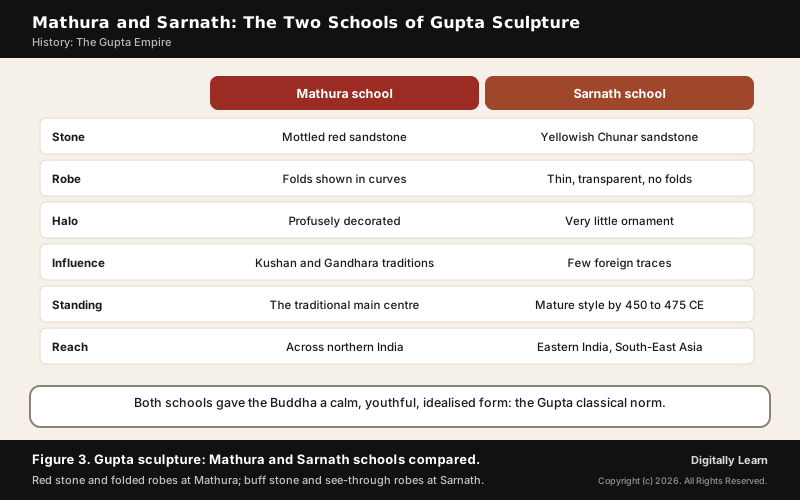
Mathura remained the traditional main centre. Its sculptors used mottled red stone from Karri in the district and continued the traditions of Gandhara and Kushan art. Under the Guptas its pink sandstone images reached great fineness and delicacy, with an air of calm and serenity. The robe still shows its folds, and the halo is profusely decorated. The Mankuwar Buddha near Allahabad, dated 448 in the reign of Kumaragupta I, shows how far east the Mathura style reached.
Sarnath, near Varanasi, produced mainly Buddhist images in yellowish sandstone from the quarries of Chunar, without the foreign influences seen at Mathura. Folds disappear, and the robe covering both shoulders is so thin that it looks transparent; the halo carries very little ornament. Dated examples show that the mature style developed only by 450 to 475. The Sarnath Buddha set the image followed in eastern India and South-East Asia for many centuries, and was the origin of Buddha images in Siam, Cambodia and Java.
Hindu Sculpture: Udayagiri Varaha, Eran and the New Deities
The first dated sculptures in a fully developed early Gupta style come from the rock-cut Udayagiri Caves near Vidisha in Madhya Pradesh. Udayagiri is the only site that can be verifiably tied to a Gupta king through its inscriptions: one records the gift of a minister of Chandragupta II, and the caves were consecrated in 401 CE. More on the king is in Chandragupta II Vikramaditya.
The most famous work at Udayagiri is the relief in Cave 5, about 7 by 4 metres, of Vishnu as the boar Varaha. He rescues the earth, shown as the goddess Bhudevi clinging to his tusk, from the primordial waters, watched by rows of much smaller gods, sages and celestial beings. It is the iconographic centre-piece of the site.
- Eran: A large single column dated 484/5 by an inscription of Buddhagupta, with two Garuda figures at the top; also a huge boar on four legs, its body covered with rows of small figures of sages.
- Nachna: A Nataraja that appears to be the earliest image of the dancing Shiva.
- Khoh: An ekamukha Shivalinga, a linga with one face, now a masterpiece of the National Museum.
- Deogarh: Large reliefs of Vishnu reclining on the serpent, of Nara-Narayana and of Gajendramoksha on the temple walls.
Metal and Terracotta: Sultanganj Buddha, Iron Pillar, Ahichchhatra
Metal statues were probably about as numerous as stone ones, but almost none survive. The copper Sultanganj Buddha from Bihar, over life-size at 2.3 metres, is the only remaining metal statue of any size from Gupta art. Cast by the lost-wax process and dated between 500 and 700 CE, it follows the Sarnath style, with a very thin, clinging robe. It was found in 1861 during the building of the East Indian Railway.
The iron pillar now in the Qutb complex at Mehrauli, Delhi, is a feat of metallurgy. It is 7.21 metres high and carries an inscription of a king named Chandra, generally identified as Chandragupta II. It resists corrosion because an even protective layer forms on its high-phosphorus iron, a testimony to the skill of ancient Indian ironsmiths. It was probably first set up elsewhere, possibly outside the Udayagiri caves, and moved to Delhi in the 11th century.
Gupta terracotta is of very fine quality and even more uniform in style across the empire than the stone sculpture. Relief panels survive on the brick temple at Bhitargaon, and a pair of river goddesses from a temple at Ahichchhatra is 1.47 metres high. Terracotta figures have also been found at Mathura and Kaushambi; like the stone sculptures, they are notable for suppleness of movement, benign expression and perfect proportion.
Cave Paintings of Gupta Period: Ajanta and Bagh Murals
Ajanta Paintings: Caves, Patrons and Themes
Painting was a major art in Gupta times, and skill in painting, especially portraits, was a desirable accomplishment among the elite, including royalty. Only murals survive, and most of them are at Ajanta, 30 excavations cut into a horseshoe-shaped bend of rock above the Waghora stream, 107 km north of Aurangabad in Maharashtra.
- Two phases: The earliest caves, with fragments of painting in Caves 9 and 10, date from the 2nd century BCE; new excavation began again under the Vakatakas, contemporaries of the imperial Guptas.
- Patrons: Varahadeva, minister of the Vakataka king Harishena (475 to 500 CE), dedicated Cave 16, and Cave 17 was gifted by a prince who was a feudatory of the same king.
- Best-preserved paintings: Caves 1, 2, 16 and 17.
- Themes: Jataka stories, incidents from the life of the Buddha, and contemporary events and social life; the ceilings carry geometric and floral patterns.
- Cave sculpture: Cave 26, a large worship hall of the late 5th or early 6th century, has a carved reclining Buddha of the Mahaparinirvana.
The best-known painting is the Bodhisattva Padmapani in Cave 1, of the late fifth century CE. He holds a lotus, wears a big crown, and is shown with three bends in the body; soft modelling and outlines merged with the body give the figure volume. With Vajrapani on the other side, he is painted as a shrine guardian. The Mahajanaka Jataka in the same cave is the biggest narrative painting at Ajanta.
Ajanta lay in Vakataka, not Gupta, territory, but its paintings are thought to reflect the metropolitan Gupta style closely. The murals do not run in horizontal bands like a frieze; large scenes spread in all directions from a figure or group at the centre.
Ajanta Painting Technique: Why the Murals Are Not Frescoes
The painting technique at Ajanta began with careful preparation of the rock, in five stages.
- The rock surface was left with chisel marks and grooves so that the plaster would hold.
- A ground layer of rough ferruginous earth mixed with rock grit or sand, vegetable fibres, paddy husk and grass was applied to the walls and ceilings.
- A second coat of mud and ferruginous earth with fine rock powder or sand and fine vegetable fibres followed.
- The surface was finished with a thin coat of lime wash.
- Outlines were drawn boldly, and the spaces filled with colours in different shades to give rounded, three-dimensional forms.
The colours were red and yellow ochre, terra verte, lime, kaolin, gypsum, lamp black and lapis lazuli, bound mainly with glue. Because a binding agent was used, the Ajanta paintings are not frescoes: a true fresco is painted while the lime wash is still wet, and the lime itself binds the colour. As the caves are dark inside, most paintings were done in the light of torches.
Bagh Caves and the Rock-Cut Tradition After the Guptas
The Bagh caves, in Dhar district of Madhya Pradesh, hold the other Gupta-age murals usually named beside Ajanta. Nine Buddhist rock-cut monasteries were cut into the southern slopes of the Vindhyas above the seasonal Baghani stream, and five survive; Cave 4, the Rang Mahal or palace of colours, is the most significant. The paintings were done in tempera over lime priming on a reddish-brown mud plaster, and are like those of Ajanta in character, though more worldly than spiritual. A copperplate records repairs to Cave 2 in the late fifth century.
Rock-cut architecture itself paused under the Guptas. At Ajanta an early group of caves was made by 220 CE and a later one mostly after about 460, and the Gangetic plain, the empire's heartland, had few rock-cut sites. The great caves in the Gupta style were made under other dynasties, and the tradition continued in the Deccan at Badami and Aihole under the Chalukyas and at Mahabalipuram under the Pallavas.
At Mamallapuram, named after the Pallava king Narasimhavarman I, known as Mamalla, the Descent of the Ganga, also called Arjuna's Penance, is a giant open-air relief carved on two boulders, about 29 by 13 metres. It tells how the Ganga came down to earth from the heavens, led by Bhagiratha.
Gupta Period Temple Architecture: The First Structural Temples
Parts of a Hindu Temple and the Nagara, Dravida and Vesara Styles
The Gupta period left almost the first surviving free-standing buildings in India, and in them the beginnings of Hindu temple architecture. Built to house the image of a god, the temple took a basic form that later temples elaborated but did not abandon.
- Garbhagriha: Literally the womb-house, a cave-like sanctum for the main icon; in early temples a small cubicle with a single entrance.
- Mandapa: The entrance, a portico or pillared hall with space for worshippers.
- Shikhara: From the fifth century CE, a mountain-like spire over the sanctum, curving in north India; in south India a pyramidal tower called the vimana.
- Vahana: The mount of the main deity, placed with a standard pillar on the axis before the sanctum.
Two broad orders of temple developed, Nagara in the north and Dravida in the south. A hybrid style, known in some ancient texts as Vesara, became popular in regions like Karnataka after the mid-seventh century. Gupta temples stand at the start of the Nagara line. The simplest Nagara tower, square at the base with walls curving inward to a point on top, is called latina or rekha-prasada.
Early Gupta Shrines: Sanchi, Udayagiri and Tigawa
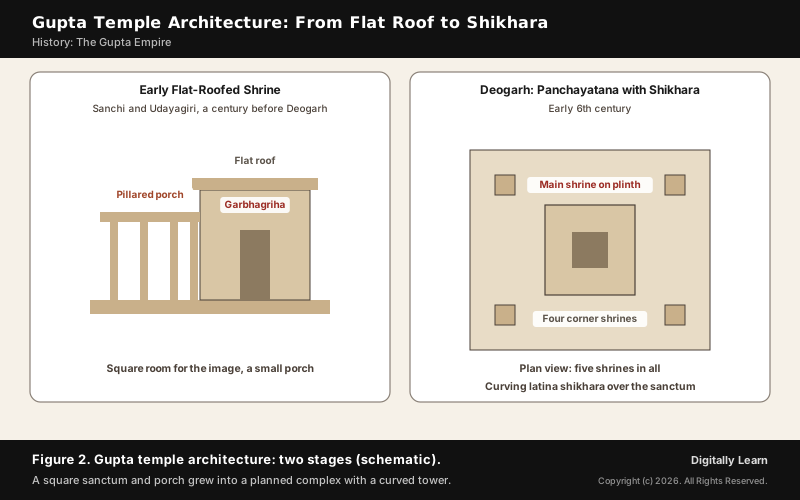
Some of the oldest surviving structural temples of the Gupta period are in Madhya Pradesh. They are modest shrines: four pillars support a small mandapa, a square porch before an equally small room that served as the garbhagriha. Of the two that survive, one is at Udayagiri, part of a Hindu cave complex, and the other at Sanchi, a Buddhist site, so the same ideas were shaping the temples of both religions.
Temples such as Tigawa, of the early fifth century, and Sanchi Temple 17 are small but massively built stone buildings with a sanctuary and a columned porch. Both have flat roofs over the sanctuary, a feature that became uncommon by about the eighth century. Their plan is the most common basic plan, elaborated in later temples to the present day.
Other early sites are Eran, Nachna-Kuthara and Deogarh. These are simple structures of a veranda, a hall and a shrine at the rear. Each temple had a principal image of a god, and myths from the Puranas became part of the carved narrative on its walls.
Gupta Temples: Deogarh, Bhitargaon and Nachna
The Dashavatara temple at Deogarh, in Lalitpur district of Uttar Pradesh in the Betwa valley, was built in the early sixth century CE, about a hundred years after the small shrines of Sanchi and Udayagiri. It follows the panchayatana plan: the main shrine stands on a rectangular plinth with four smaller shrines at the corners, five in all. Its tall, curving latina shikhara makes it an early example of the classic Nagara temple.
The temple faces west, unusual since most face east or north, and has a grand doorway with Ganga on the left and Yamuna on the right. Three large reliefs of Vishnu cover the other walls: Sheshashayana, Vishnu reclining on the serpent Ananta, on the south; Nara-Narayana on the east; and Gajendramoksha on the west. Because Vishnu appears in many forms it was taken to be a temple of the ten avatars, but it is not known to whom the corner shrines were dedicated.
The temple at Bhitargaon, near Kanpur, is the largest Indian brick temple to survive from the Gupta age, dated to the late fifth century. It stands on a square plan with double-recessed corners, faces east, and has a tall pyramidal spire over the garbhagriha; terracotta panels on its walls show Shiva, Vishnu, Ganesha and Durga Mahishasuramardini.
The Parvati temple at Nachna, in Panna district of Madhya Pradesh, dated by some to about 465, though its dating is uncertain, stands on a raised, moulded plinth. Its square sanctum is surrounded by a circumambulation passage with perforated stone screen windows, Ganga and Yamuna flank the entrance, and its friezes are among the earliest in stone to narrate scenes from the Ramayana.
| Temple | Date | Key feature |
|---|---|---|
| Tigawa | Early 5th century | Flat roof, columned porch |
| Sanchi 17 | Early Gupta | Flat roof, Buddhist site |
| Nachna | About 465, uncertain | Parvati temple, Ramayana friezes |
| Bhitargaon | Late 5th century | Largest Gupta brick temple |
| Deogarh | Early 6th century | Panchayatana, latina shikhara |
Gupta Numismatic Art: Gold Coins, Their Decline and the Legacy
Gupta Coins: The Gold Dinara and Its Types
Coins are the one art form in which the Gupta family pictured itself; they did not otherwise advertise their link to the art made under them. The gold coinage, with its many types and its Sanskrit inscriptions, is regarded as the finest in a purely Indian style, and the earliest issues are remarkable for their purity.
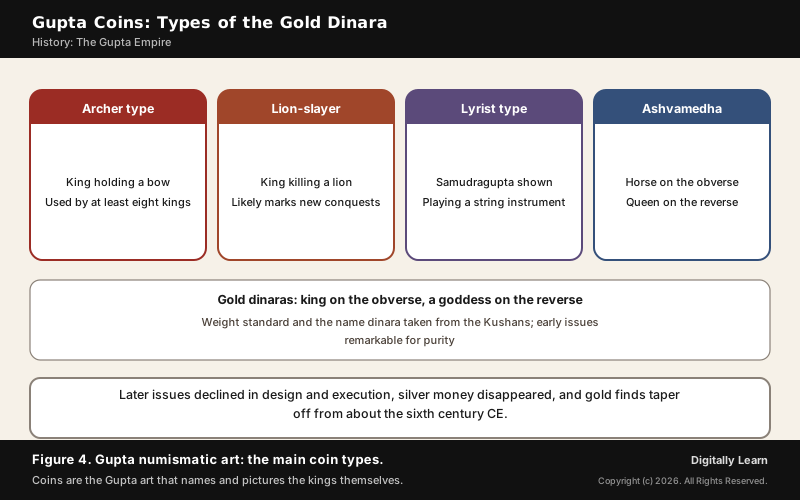
Gupta coinage began with Samudragupta (about 335/350 to 375 CE), or possibly at the end of the reign of his father Chandragupta I, of whom only one type is known, showing the king and his queen. It was first modelled on Kushan coinage, taking its weight standard, techniques and designs after Samudragupta's conquests in the north-west, and even the name dinara, which goes back to the Roman denarius aureus. The imagery soon became more Indian in style and subject. The king's reign is covered in Samudragupta and the Allahabad Prashasti.
- Layout: The king, usually full-length, standing, seated or on horseback on the obverse; a goddess, most often seated on a throne, on the reverse.
- Archer: The king standing with a bow, used by at least eight kings, perhaps to associate the king with Rama.
- Lion-slayer and tiger-slayer: The king hunting; such types very likely refer to new conquests in areas where those animals were found.
- Lyrist or veena player: Samudragupta playing a string instrument, wearing huge earrings but only a simple dhoti.
- Ashvamedha: The sacrificial horse on the obverse and the queen on the reverse.
- Silver and copper: After Chandragupta II overthrew the Western Satraps, his silver coins followed their model with the Gupta Garuda in place of their symbol; Kumaragupta I issued silver coins with Garuda in western India and with a peacock in the Ganges valley, and the peacock type became the later Gupta silver coin. Copper coins, mostly of Chandragupta II, usually carry Garuda and the king’s name.
Coins served trade as well as art. They made long-distance transactions easier, and the kings benefited from them; the wider economy is in Gupta administration and economy.
Why Gupta Numismatic Art Was Not Matched in Later Times
The high point of Gupta coinage came early. Later Gupta gold coins show a gradual deterioration in design and execution, and silver money disappears, evidence of the empire's shrinking territory. From about the sixth century CE, finds of gold coins taper off in north India.
Historians are divided on the reason. Some suggest that the collapse of the Western Roman Empire cut the long-distance trade that had enriched the states and regions taking part in it; others argue that new towns and networks of trade were emerging at the same time. This is the basis of the view that later coinage never matched the Gupta gold in purity, variety and craft.
- Purity: The early gold issues were remarkably pure.
- Variety: Many types, each showing the king as archer, hunter, musician or sacrificer.
- Craft: Full-length figures and Sanskrit legends in a purely Indian style.
- Decline: Weaker design, the end of silver money and fewer gold finds after the sixth century.
Legacy of Gupta Art: Post-Gupta Styles and South-East Asia
The Gupta style outlived the empire. It stayed in use across most of northern India until about 550, and arguably 650, followed by a Post-Gupta period with many of the same features. The sculptures at Sondani near Mandsaur, commissioned by Yasodharman about 525 CE to celebrate his victory over the Alchon Hun king Mihirakula, stand between the classical decorum of Gupta art and the medieval canons that subordinated the figure to religious purpose. The political end is in Gupta society, religion and decline.
- South-East Asia: Gupta and Post-Gupta art from eastern India shaped Hindu and Buddhist art there from the 6th century CE; Mon statues of Dvaravati in Thailand recall the faces and hair of Mathura.
- Western India: The Maitraka rulers of Vallabhi in Gujarat (6th to 8th century) carried the Gupta legacy forward in sculptures of soft bluish-green stone.
- Temple towers: The curving Nagara tower first seen at Deogarh had grown, by the 10th-century temples of Khajuraho, into shikharas rising in a curved pyramidal fashion.
- Pillars: Gupta pillars recorded the achievements of kings; unlike the smooth, polished Ashokan pillars, they had a rough surface often shaped into geometric facets.
Previous Year UPSC-CSE Questions
Previous Year UPSC-CSE Questions By the end you will be able to draft model answers for the following UPSC questions. Each question carries a collapsible framework showing how to approach it in the exam.
- UPSC Mains 2017 GS-IHow do you justify the view that the level of excellence of the Gupta numismatic art is not at all noticeable in later times?
Answer outline: how to structure the answer
What the question asks, the main arguments, relevant examples and the direction of the conclusion. This is not a full model answer.
Introduction: Introduce the gold dinaras of Samudragupta and his successors as the finest coins in a purely Indian style, with remarkably pure early issues.
Body (sub-themes to develop):
- Excellence: purity, the Kushan weight standard and many types (archer, lion-slayer, lyrist, ashvamedha) with Sanskrit legends.
- Art: full-length portraits of the king as warrior, hunter, musician and sacrificer.
- Decline within the dynasty: weaker design and execution; silver money disappears.
- After the Guptas: finds of gold coins taper off from about the sixth century CE.
- Reasons: the loss of Roman long-distance trade, or a shift to new towns and trade networks.
Conclusion: Conclude that Gupta coins mark a peak of purity and craft that the fragmented kingdoms after them did not reach.
- UPSC Mains 2022 GS-IDiscuss the main contributions of Gupta period and Chola period to Indian heritage and culture.
Answer outline: how to structure the answer
What the question asks, the main arguments, relevant examples and the direction of the conclusion. This is not a full model answer.
Introduction: Place the Gupta age (about 300 to 550 CE) as the classical peak of north Indian art and the Chola age as the peak of south Indian temple and bronze art.
Body (sub-themes to develop):
- Gupta sculpture: the Mathura and Sarnath Buddha, Udayagiri Varaha, the classical norm.
- Gupta painting: Ajanta and Bagh murals.
- Gupta architecture: the first structural temples, Deogarh's panchayatana and latina shikhara.
- Gupta metalwork and coins: the iron pillar, the Sultanganj Buddha, gold dinaras.
- Chola contributions: Dravida temples and bronzes (from the Chola material).
Conclusion: Conclude that the two periods set the classical models of north and south Indian art.
- UPSC Prelims 2010 Prelims-GSThere are only two known examples of cave paintings of the Gupta period in ancient India. One of these is paintings of Ajanta caves. Where is the other surviving example of Gupta paintings?
How to approach this Prelims question
Approach: Step 1: the only surviving examples of Gupta-period cave painting are at Ajanta and at Bagh, whose murals are close to Ajanta in style. Step 2: the other three caves belong to other periods: Lomas Rishi to the Mauryas, Nasik largely to the centuries around the turn of the era, Ellora to AD 600 to 1000.
Trap to watch: Ellora was probably begun only at the end of the period; the Lomas Rishi cave is Mauryan.
Key facts to recall:
- (a) Bagh caves: correct. The Bagh murals, close to Ajanta in style, are the other surviving Gupta-period paintings.
- (b) Ellora caves: wrong. Ellora's caves date from about AD 600 to 1000, after the Gupta age.
- (c) Lomas Rishi cave: wrong. It is a Mauryan rock-cut cave of the Ashokan period, made for the Ajivikas, without such paintings.
- (d) Nasik caves: wrong. They are Buddhist and Jain caves whose chaitya dates from the 1st century BCE, long before the Guptas.
Answer signal: Bagh caves, option (a).
- UPSC Prelims 2012 Prelims-GSThe Nagara, the Dravida and the Vesara are the
How to approach this Prelims question
Approach: Step 1: Nagara developed in the north and Dravida in the south; Vesara, a hybrid, became popular in regions such as Karnataka after the mid-seventh century. Step 2: the three terms are orders of temple architecture, not races, languages or gharanas.
Trap to watch: The terms are not racial, linguistic or musical categories.
Key facts to recall:
- (a) Three racial groups: wrong. The terms name temple styles, not peoples.
- (b) Three linguistic divisions: wrong. Indian languages are grouped into families, not into these three.
- (c) Three styles of Indian temple architecture: correct. Nagara in the north, Dravida in the south, Vesara a hybrid.
- (d) Three musical gharanas: wrong. Gharanas are schools of Hindustani music with their own names.
Answer signal: Three main styles of Indian temple architecture, option (c).
- UPSC Prelims 1997 Prelims-GSMatch List I with List II and select the correct answer using the code given below the lists:
- List I I. Gupta II. Chandella III. Chalukya IV. Pallava
- List II A) Badami B) Panamalai C) Khajuraho D) Deogarh
Codes:
How to approach this Prelims question
Approach: Step 1: Gupta with Deogarh, whose Dashavatara temple is an early Gupta shrine. Step 2: Chandella with Khajuraho, where Dhanga built the Lakshmana temple in 954. Step 3: Chalukya with Badami, the western Chalukya capital. Step 4: Pallava with Panamalai, a Pallava temple site. The code is I-D, II-C, III-A, IV-B.
Trap to watch: Panamalai is a Pallava site, not a Chalukya one.
Key facts to recall:
- (a) I-D, II-C, III-A, IV-B: correct. Deogarh, Khajuraho, Badami and Panamalai in that order.
- (b) I-D, II-B, III-C, IV-A: wrong. It gives Panamalai to the Chandellas and Badami to the Pallavas.
- (c) I-B, II-C, III-D, IV-A: wrong. Deogarh is a Gupta site, not a Chalukya one.
- (d) I-C, II-D, III-A, IV-B: wrong. Khajuraho is Chandella, not Gupta.
Answer signal: I-D, II-C, III-A, IV-B, option (a).
- UPSC Prelims 2014 Prelims-GSWith reference to the Indian history of art and culture, consider the following pairs: Famous work of sculpture – Site
- A grand image of Buddha’s Mahaparinirvana with numerous celestial musicians above and the sorrowful figures of his followers below – Ajanta
- A huge image of Varaha Avatar (boar incarnation) of Vishnu, as he rescues Goddess Earth from the deep and chaotic waters, sculpted on rock – Mount Abu
- “Arjuna’s Penance” / “Descent of Ganga” sculpted on the surface of huge boulders – Mamallapuram
Which of the pairs given above is/are correctly matched?
How to approach this Prelims question
Approach: Step 1: pair 1: the great Mahaparinirvana image is in Ajanta Cave 26; correct. Step 2: pair 2: the huge Varaha relief is at Udayagiri, not Mount Abu; wrong. Step 3: pair 3: Arjuna's Penance, or the Descent of the Ganga, is at Mamallapuram; correct.
Trap to watch: The famous rock-cut Varaha is at Udayagiri near Vidisha, not Mount Abu.
Key facts to recall:
- (a) 1 and 2 only: wrong. The Varaha relief is at Udayagiri, not Mount Abu.
- (b) 3 only: wrong. Pair 1 is also correct: the Mahaparinirvana is in Ajanta Cave 26.
- (c) 1 and 3 only: correct. Ajanta for the Mahaparinirvana and Mamallapuram for the Descent of the Ganga.
- (d) 1, 2 and 3: wrong. Pair 2 is wrong.
Answer signal: 1 and 3 only, option (c).
- UPSC Prelims 2016 Prelims-GSWhat is/are common to the two historical places known as Ajanta and Mahabalipuram?
- Both were built in the same period.
- Both belong to the same religious denomination.
- Both have rock-cut monuments.
Select the correct answer using the code given below.
How to approach this Prelims question
Approach: Step 1: statement 1: Ajanta's caves were mostly made under the Vakatakas (about 250 to 500), while Mahabalipuram's monuments are Pallava work named after Narasimhavarman I; different periods; wrong. Step 2: statement 2: Ajanta is Buddhist, Mahabalipuram Hindu; wrong. Step 3: statement 3: both have rock-cut monuments; correct.
Trap to watch: Both are famous cave sites, but they differ in period and in faith.
Key facts to recall:
- (a) 1 and 2 only: wrong. The two sites differ in both period and religion.
- (b) 3 only: correct. Rock-cut monuments are the only feature they share.
- (c) 1 and 3 only: wrong. They were not built in the same period.
- (d) None of the statements is correct: wrong. Statement 3 is correct.
Answer signal: 3 only, option (b).
Sources
- NCERT: An Introduction to Indian Art Part I (Class XI, Fine Arts)
- NCERT: Our Pasts I (Class VI), Buildings, Paintings and Books
- NCERT: Themes in Indian History I (Class XII), Kings, Farmers and Towns
- Archaeological Survey of India: Ajanta Caves
- National Museum, New Delhi: Gupta Art gallery
- National Museum, New Delhi: Coins gallery sheet
- PIB: India's World Heritage Sites, 2024
- Wikipedia: Gupta art
- Wikipedia: Ajanta Caves
- Wikipedia: Bagh Caves
- Wikipedia: Udayagiri Caves
- Wikipedia: Dashavatara Temple, Deogarh
- Wikipedia: Bhitargaon Temple
- Wikipedia: Nachna Hindu temples
- Wikipedia: Iron pillar of Delhi
- Wikipedia: Sultanganj Buddha
- Wikipedia: Descent of the Ganges (Mahabalipuram)
- UPSC: Civil Services Examination question papers
- Wikipedia: Chandragupta II
- Wikipedia: Kumaragupta I
Editorial Disclaimer
This article draws on the NCERT textbooks and the other sources listed on this page. Dates for many Gupta monuments are approximate and still debated.