


Overview
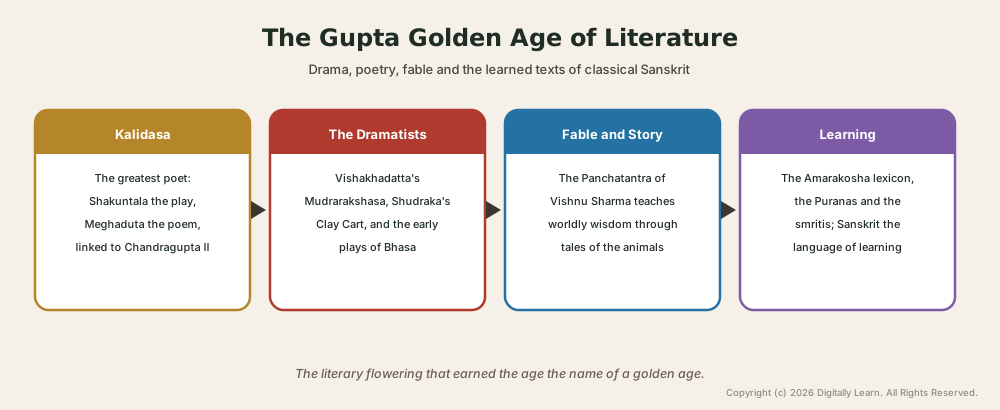
The Gupta Sanskrit literature of classical India reached a height so striking that the age is remembered as the golden age of letters. In this period Kalidasa, the greatest of the classical poets, wrote the play of Shakuntala and the cloud-poem of the Meghaduta; Vishakhadatta staged the court intrigues of the Mudrarakshasa, and Shudraka the love of the Mrichchhakatika. The age also prized the early animal fables of the Panchatantra, ordered the great Amarakosha lexicon, and shaped the Puranas and the books of law. This part covers Kalidasa, the other dramatists, the fable and the learned texts, the navaratna legend, and the exam focus.
The Flowering of Classical Sanskrit in the Gupta Age
Why the Gupta Age Became the Golden Age of Sanskrit Letters
What is the significance of the Gupta golden age of letters: a long peace, a wealthy court and the rise of Sanskrit as the common tongue of learning let classical literature reach a height that was never surpassed.
Royal patronage drew poets and scholars to the Gupta court, where the kings were themselves men of taste; Sanskrit became the language of the court, of the inscription and of learning, so that a work composed in one corner of the land could be read across it. The famous Allahabad prashasti of Samudragupta and the Junagadh inscription, both in polished classical Sanskrit, show how high the language had risen even in the chancery.
A settled and ordered world gave writers the leisure to perfect the ornate court style known as kavya, in which sound and sense are woven with the closest care. The result was a body of drama, poetry, fable and learned writing that later ages looked back upon as a model, and that the examination still treats as the literary face of the golden age.
The Legend of the Navaratnas and the Court of Vikramaditya
Distinguishing legend from history: a famous later tale gathers nine gems, the navaratnas, at the court of a king called Vikramaditya, but the figures it names did not in truth live together at one court.
The list of nine gems, which places Kalidasa, the lexicographer Amarasimha, the astronomer Varahamihira and others side by side, comes from a much later text and is treated by historians as a literary tradition rather than a record of fact. The scholars it names lived generations apart, as the part on Gupta science has already shown for Varahamihira and Brahmagupta.
One thread of the legend, however, holds firm: the strong tradition that links Kalidasa with a king titled Vikramaditya, most often identified with Chandragupta II, is the one association that the examination accepts. The legend is therefore worth knowing not as history, but because the examiner tests its single defensible claim and its several false ones.
Kalidasa, the Master of Classical Sanskrit
Kalidasa and the Question of His Age
What is the significance of Kalidasa: he is the supreme poet and dramatist of classical Sanskrit, the writer by whom the whole tradition is measured, and the one most firmly tied to the Gupta golden age.
The most widely held view places Kalidasa in the reign of Chandragupta II Vikramaditya, about 380 to 415 CE, though scholars are careful to add that his works cannot be dated with precision and that the evidence is indirect. He is the foremost of the so-called nine gems, and the examination treats the pairing of Kalidasa with Chandragupta II as the accepted one.
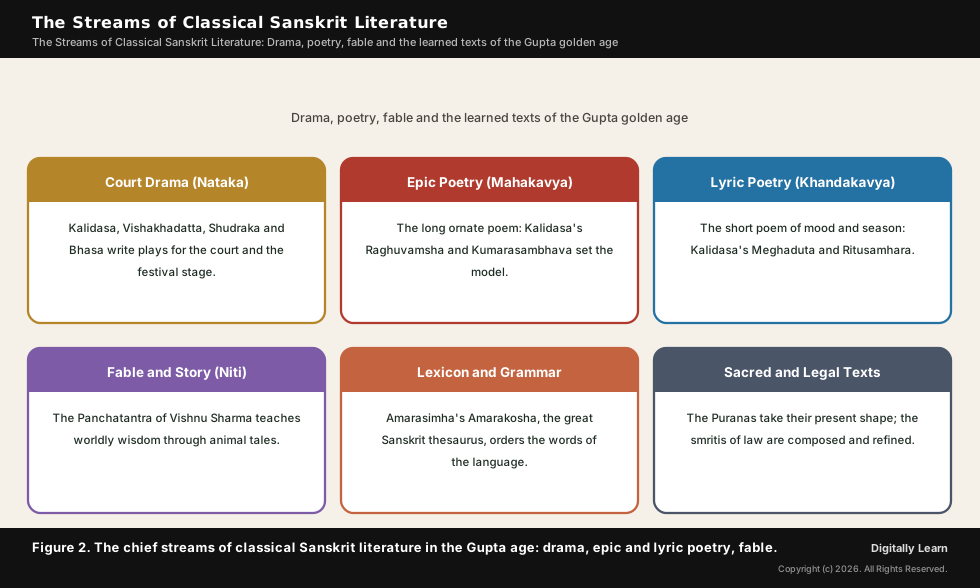
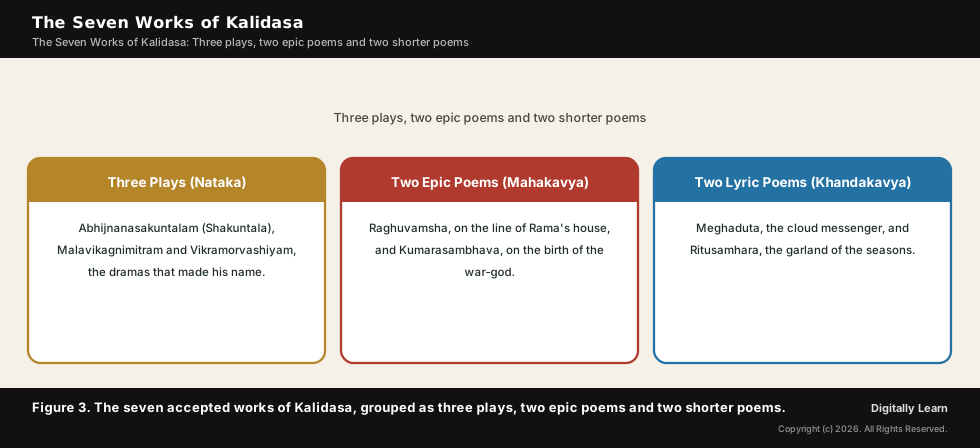
His command of the language, the grace of his images and the truth of his feeling set him above every other Sanskrit poet, so that later writers called him simply the poet, the kavi. Seven works are accepted as his, falling into three plays, two long epic poems and two shorter poems of mood and season.
The Seven Works of Kalidasa
Distinguishing the works: the canon of Kalidasa divides cleanly into the drama, the epic poem and the lyric, and an aspirant should be able to place each title in its kind.
The three plays are the Abhijnanasakuntalam, on the love of King Dushyanta and Shakuntala; the Malavikagnimitram, a court romance set in the age of the Shungas; and the Vikramorvashiyam, on the love of a king and a celestial nymph. The two epic poems, the mahakavyas, are the Raghuvamsha, on the royal line of Rama's house, and the Kumarasambhava, on the birth of the war-god Kumara.
The two shorter poems are the Meghaduta, the cloud messenger, in which an exiled yaksha sends word to his distant beloved by a passing cloud, and the Ritusamhara, a garland of verses on the six seasons of the Indian year. Together these seven works carry the whole range of the classical poet, from the stage to the lyric.
Shakuntala and Meghaduta: The Two Masterpieces
What is the significance of the two masterpieces: the Abhijnanasakuntalam and the Meghaduta are the works by which Kalidasa is best known, and the first carried his name beyond India.
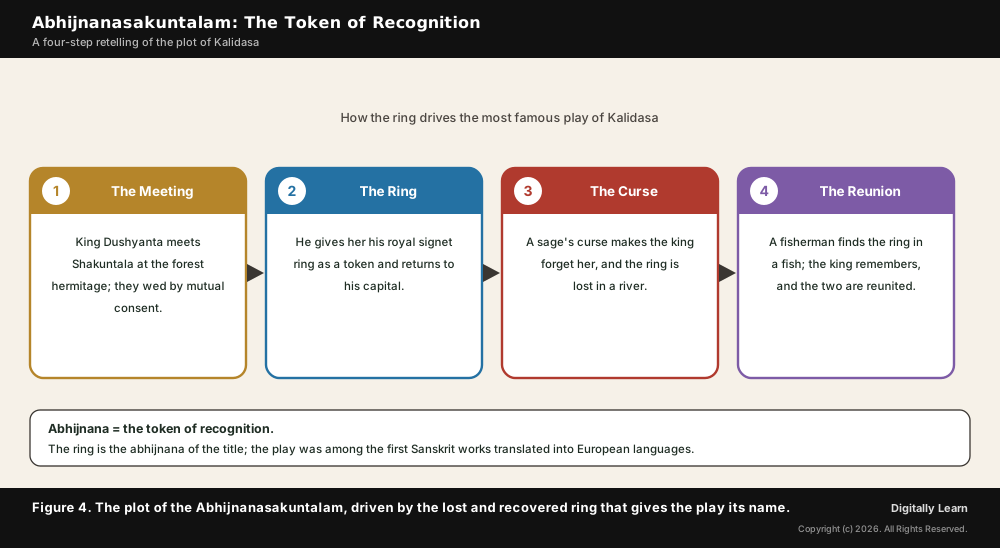
The Abhijnanasakuntalam, the recognition of Shakuntala, turns upon a signet ring. The king weds her at a forest hermitage and gives her the ring as a token; a sage's curse then makes him forget her, and the ring is lost in a river, until a fisherman finds it in a fish and his memory returns. The title itself names this token, for abhijnana means the mark of recognition; the play was among the first Sanskrit works rendered into European languages.
The Meghaduta, the cloud messenger, is a poem of separation and longing, in which a banished spirit asks a monsoon cloud to carry his message of love across the breadth of India to his wife in the Himalaya. Its tender mood and its long, exact picture of the land over which the cloud must travel make it a model of the lyric.
| Work of Kalidasa | Kind | What it tells |
|---|---|---|
| Abhijnanasakuntalam | Play | The love of Dushyanta and Shakuntala and the ring of recognition. |
| Malavikagnimitram | Play | A court romance set in the age of the Shungas. |
| Vikramorvashiyam | Play | The love of a king and the celestial nymph Urvashi. |
| Raghuvamsha | Epic poem | The royal line of Raghu, the house of Rama. |
| Kumarasambhava | Epic poem | The birth of Kumara, the war-god. |
| Meghaduta | Lyric poem | A yaksha sends word to his beloved by a cloud. |
| Ritusamhara | Lyric poem | A garland of verses on the six seasons. |
Drama, Fable and the Learned Texts Beyond Kalidasa
Vishakhadatta, Shudraka and the Early Drama of Bhasa
What is the significance of the other dramatists: the Gupta and surrounding age gave a whole company of playwrights besides Kalidasa, whose works the examination pairs with their authors.
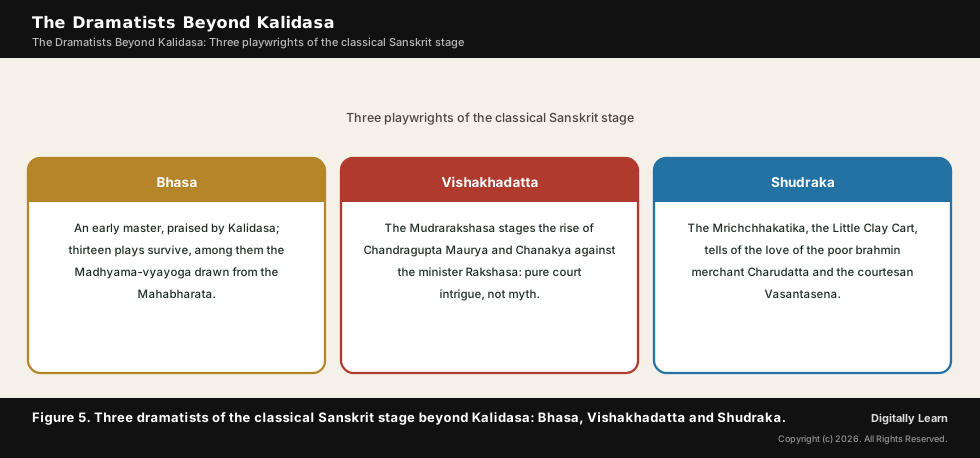
Vishakhadatta wrote the Mudrarakshasa, the signet of the minister, a play of pure statecraft that stages the rise of Chandragupta Maurya and his teacher Chanakya against the loyal minister Rakshasa. Its subject is the intrigue of the Mauryan court, not the gods and demons of myth, and it is among the few Sanskrit dramas built wholly on political cunning.
Shudraka is credited with the Mrichchhakatika, the little clay cart, which tells of the love of the poor but noble brahmin merchant Charudatta and the courtesan Vasantasena, set against a palace revolution. Bhasa, an earlier master whom Kalidasa himself praised, left a group of thirteen plays recovered in the south, among them the Madhyama-vyayoga drawn from the story of the Mahabharata.
Fable, the Lexicon, the Puranas and the Books of Law
Distinguishing the learned texts: beyond the drama and the poetry, the age treasured the fable, ordered the dictionary, and shaped the sacred story and the law, the books in which Sanskrit ordered its knowledge.
The Panchatantra, ascribed to Vishnu Sharma, is the great collection of animal fables in which the beasts teach the conduct of worldly life; an early work much loved in this age, it became one of the most translated books in the world. The Amarakosha of Amarasimha, counted in the legend among the nine gems of Chandragupta II, is the famous Sanskrit thesaurus that arranges words by their meaning and is learned by heart to this day.
The sacred and legal texts also took on the form they now hold. Many of the great Puranas, the books of old tradition, were compiled into their present shape in the Gupta age, and the smritis of law, among them the Yajnavalkya Smriti, were composed and refined. In this period too the epics, the Mahabharata and the Ramayana, are generally held to have reached their final form, while Nalanda, founded by Kumaragupta I, rose as a seat of Sanskrit learning.
| Author or text | Kind | What it gave |
|---|---|---|
| Vishakhadatta | Drama | The Mudrarakshasa, on the Mauryan court of Chandragupta and Chanakya. |
| Shudraka | Drama | The Mrichchhakatika, the love of the merchant Charudatta and Vasantasena. |
| Bhasa | Drama | Thirteen early plays, among them the Madhyama-vyayoga. |
| Vishnu Sharma | Fable | The Panchatantra, animal tales that teach worldly wisdom. |
| Amarasimha | Lexicon | The Amarakosha, the great Sanskrit thesaurus of words by meaning. |
| The Puranas | Sacred story | The books of old tradition, shaped into their present form. |
| The smritis | Law | The Yajnavalkya Smriti and the later books of sacred law. |
UPSC Relevance and Exam Focus
Where Gupta-Age Literature Fits in the UPSC-CSE Syllabus
This topic belongs to General Studies Paper I: ancient Indian history and culture, and the classical Sanskrit literature of the Gupta age is a favourite ground for Prelims author-and-text matching questions.
For Prelims, hold the firm pairings: Kalidasa with the Abhijnanasakuntalam and the Meghaduta, and with the reign of Chandragupta II; Vishakhadatta with the Mudrarakshasa; Shudraka with the Mrichchhakatika; Bhasa with the early plays such as the Madhyama-vyayoga; and Amarasimha with the Amarakosha. Remember that Amarasimha belongs to Chandragupta II, not to Harshavardhana, and that it was Patanjali, not Panini, who lived under Pushyamitra Shunga.
For Mains, Gupta-age literature is strong material for an answer on why the period is called a golden age, and on the achievements of classical Sanskrit.
Recurring linked concepts an aspirant should keep in working memory:
- Kalidasa: Shakuntala and Meghaduta; linked to Chandragupta II.
- Vishakhadatta: The Mudrarakshasa, on the Mauryan court.
- Shudraka: The Mrichchhakatika, the little clay cart.
- Amarasimha: The Amarakosha, the Sanskrit thesaurus.
- The navaratnas: A later legend, not a real court of nine.
A common Prelims trap is to give the Mudrarakshasa a subject of gods and demons; in truth it stages the court intrigue of Chandragupta Maurya and Chanakya. Another links Amarasimha with Harshavardhana, or Panini with Pushyamitra Shunga; the first belongs to Chandragupta II, and it was Patanjali, author of the Mahabhashya, who lived in the reign of Pushyamitra Shunga.
Previous Year UPSC-CSE Questions
Previous Year UPSC-CSE Questions By the end you will be able to draft model answers for the following UPSC questions. Each question carries a collapsible framework showing how to approach it in the exam.
- UPSC Prelims 2020 GS-IWith reference to the scholars and litterateurs of ancient India, consider the following statements:
- Panini is associated with Pushyamitra Shunga.
- Amarasimha is associated with Harshavardhana.
- Kalidasa is associated with Chandra Gupta II.
Which of the statements given above is/are correct?
How to approach this Prelims question
Approach: Judge each pairing in turn: Kalidasa with Chandragupta II is the accepted one (true); Amarasimha belongs to Chandragupta II, not Harsha (false); Panini is far earlier than Pushyamitra Shunga, under whom Patanjali lived (false). Only statement three is correct.
Trap to watch: Do not accept statement one: the grammarian linked to Pushyamitra Shunga is Patanjali, not Panini; and Amarasimha goes with Chandragupta II, not Harshavardhana.
Key facts to recall:
- Kalidasa is associated with Chandragupta II.
- Amarasimha (the Amarakosha) is a navaratna of Chandragupta II, not of Harsha.
- Patanjali, not Panini, lived under Pushyamitra Shunga.
Answer signal: 3 only.
- UPSC Prelims 2003 GS-I'Mrichchhakatika' an ancient Indian book written by Shudraka deals with
How to approach this Prelims question
Approach: Recall that the Mrichchhakatika of Shudraka is a love story of the merchant Charudatta and the courtesan Vasantasena, which matches the option on the love of a rich merchant and a courtesan's daughter.
Trap to watch: The distractors borrow real Gupta events (the Saka war, Samudragupta's conquests); the play is a romance, not a chronicle.
Key facts to recall:
- The Mrichchhakatika is by Shudraka.
- Its hero is the merchant Charudatta and its heroine the courtesan Vasantasena.
- It is the little clay cart, a love story, not a dynastic record.
Answer signal: The love affair of a rich merchant with the daughter of a courtesan.
- UPSC Prelims 2024 GS-IWhich one of the following is a work attributed to playwright Bhasa?
How to approach this Prelims question
Approach: Recall that Bhasa is the dramatist; among his recovered plays is the Madhyama-vyayoga, so that is the answer.
Trap to watch: The other titles are famous but belong to others: the Natyashastra to Bharata and the Mahabhashya to Patanjali; only the Madhyama-vyayoga is a play of Bhasa.
Key facts to recall:
- Bhasa wrote the Madhyama-vyayoga, a play on a Mahabharata theme.
- The Natyashastra is Bharata's treatise on drama.
- The Mahabhashya is Patanjali's work on grammar.
Answer signal: Madhyama-vyayoga.
Sources and Further Reading
Editorial Disclaimer
This article is for UPSC preparation. The dates of Kalidasa and some other classical authors are approximate, and the attributions follow the standard accounts of the history of Sanskrit literature.