


Overview
The Delhi Sultanate was the state ruled from Delhi by five successive dynasties of sultans from 1206 to 1526: the Mamluk or Slave dynasty, the Khaljis, the Tughlaqs, the Sayyids and the Lodis. It was founded by Qutb-ud-din Aibak, a former slave of Muhammad Ghori, reached its farthest extent under Muhammad bin Tughlaq and ended when Babur defeated Ibrahim Lodi at Panipat in 1526.
Delhi Sultanate Time Period, Founder and the Five Dynasties
What Was the Delhi Sultanate and Who Founded It
Delhi first became the capital of a kingdom under the Tomara Rajputs, who were defeated in the middle of the twelfth century by the Chauhans of Ajmer. Those were the rulers of Delhi before the Sultanate. The change came with Muhammad Ghori, the Ghurid ruler, who routed a Rajput confederacy led by Prithviraj Chauhan near Tarain in 1192. When Ghori was assassinated in 1206, his Turkish slave-general Aibak took power in his Indian lands and became the first Sultan of Delhi.
Historians call the first line of rulers the Mamluk or Slave dynasty. A Mamluk was a soldier of slave origin, and Aibak, Iltutmish and Balban had all been slaves before they rose to command. The name covers three houses of slave origin that ruled from 1206 to 1290: the Qutbi, the first Ilbari and the second Ilbari. Persian was the language of administration throughout the Sultanate.
Delhi Sultanate Timeline: The Five Dynasties and Their Rulers
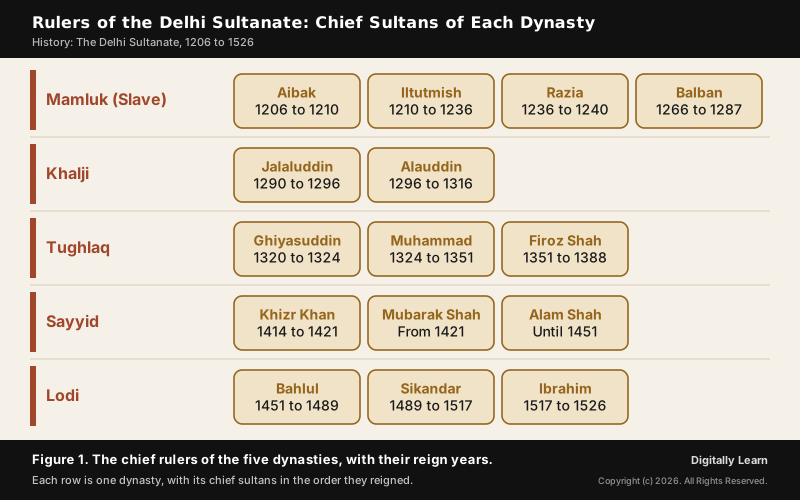
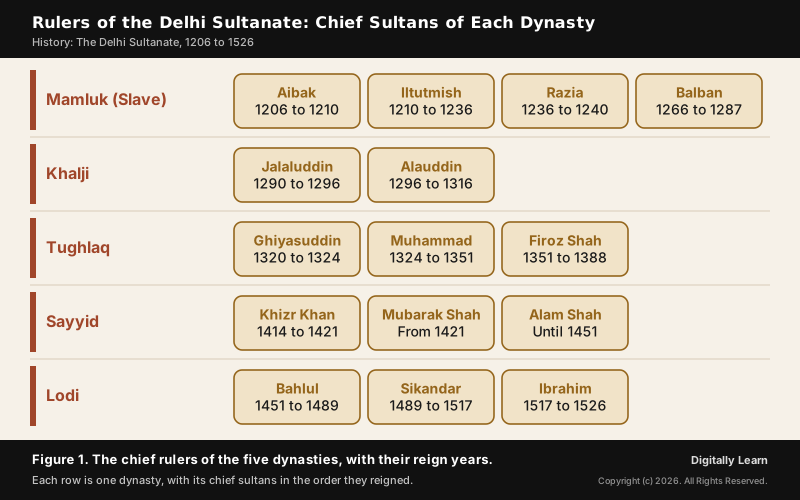
The five dynasties followed one another in this order: the Mamluks, the Khaljis, the Tughlaqs, the Sayyids and the Lodis. The Tughlaqs ruled longest, about 94 years, and the Khaljis for the shortest time, 30 years. Figure 1 shows the chief sultans of each line in the order they reigned, and the table gives each dynasty's years, founder and last ruler.
| Dynasty | Years | Founder | Last ruler |
|---|---|---|---|
| Mamluk | 1206 to 1290 | Qutb-ud-din Aibak | Kayumars |
| Khalji | 1290 to 1320 | Jalaluddin Khalji | Qutbuddin Mubarak Shah |
| Tughlaq | 1320 to 1414 | Ghiyasuddin Tughlaq | Nasiruddin Mahmud |
| Sayyid | 1414 to 1451 | Khizr Khan | Alam Shah |
| Lodi | 1451 to 1526 | Bahlul Lodi | Ibrahim Lodi |
Delhi Sultanate Rulers, Dynasty by Dynasty
Slave Dynasty: Aibak, Iltutmish, Razia and Balban
Aibak ruled for only four years, from 1206 to 1210, with his capital at Lahore. He laid the foundation of the Qutb Minar and died at Lahore in 1210, when he fell from his horse while playing chaugan, a form of polo, and the pommel of the saddle pierced his ribs.
His son-in-law Iltutmish (1210 to 1236) consolidated the Sultanate. A group of forty nobles, the Chahalgani or the Forty, invited him from Badaun to replace Aibak's successor Aram Shah, and Iltutmish made Delhi his capital. He drove out his rivals Yildiz and Qabacha, took Multan, Bengal and Ranthambore, completed the Qutb Minar and set up the Sultanate's coinage. In 1228 the Abbasid caliph sent him robes of honour, recognising his authority in India.
Iltutmish named his daughter Razia as his heir in preference to his sons. She ruled from 1236 to 1240, when the nobles removed her. Balban, who had himself been one of the Forty, ruled from 1266 to 1287 and broke the power of that group. He took the title Zil-i-Ilahi, the shadow of God, enforced the Persian court rituals of sijda (prostration) and paibos (kissing the sultan's feet), and repelled the Mongol raids. In 1290 Jalaluddin Khalji had the young sultan Kaiqubad killed, murdered the infant Kayumars and took the throne. The full story is in Aibak and Iltutmish and the later Slave sultans, Razia and Balban.
Khalji Dynasty: Alauddin Khalji's Army, Conquests and Market Control
The Khaljis, of Turko-Afghan origin, came to power in 1290 under Jalaluddin Khalji, who was about seventy at his accession. His nephew and son-in-law Alauddin had him murdered in 1296 and became the strongest ruler of the line (1296 to 1316). As governor of Kara he had already raided Malwa and Devagiri; as Sultan he took Gujarat and Rajputana and sent his general Malik Kafur deep into southern India.
The Mongol attacks of 1299/1300 and 1302-03 shaped his government. Alauddin raised the largest standing army of any Delhi ruler and was the first sultan to pay his soldiers fully in cash, 238 tankas, the Sultanate's silver coins, a year to a trooper. He had the soldiers' horses branded so that no poor horse could pass the muster, and he controlled prices in the Delhi markets so that the pay would stretch; the chroniclers praised his reign for cheap prices and steady supplies. The last Khalji, Qutbuddin Mubarak Shah, was killed by Khusrau Khan, whom Ghazi Malik overthrew in 1320. More in Alauddin Khalji's conquests and market control.
Tughlaq Dynasty: Muhammad bin Tughlaq, Firoz Shah and Timur's Invasion
Ghazi Malik ruled as Ghiyasuddin Tughlaq from 1320 and built the fort of Tughlaqabad near Delhi in 1321. Under his son Muhammad bin Tughlaq (1324 to 1351) the Sultanate reached its farthest extent, over most of the subcontinent. NCERT dates his accession to 1324, while other accounts give 1325. His bold schemes are the best remembered of any sultan's:
- A second capital: Devagiri, renamed Daulatabad, to which the residents of the old city of Delhi were sent.
- Token currency: Coins of base metal, issued from 1329 to 1332, which people forged easily; they had to be withdrawn.
- Transoxiana: A large army raised to attack the Mongols in Central Asia, then disbanded.
- Revolts: From 1327 onwards; Madurai broke away in 1335, Vijayanagara was founded in 1336 and the Bahmani Sultanate in 1347.
Firoz Shah Tughlaq (1351 to 1388) ruled for 37 years, a reign marked by prosperity. He dug five major canals, including a renovated Western Yamuna Canal, built his own city of Firozabad and made iqtas, the revenue assignments held by his officers, hereditary. After his death the dynasty sank into civil war: his great-grandson Tughluq Khan ruled briefly as Ghiyasuddin Tughlaq Shah II, and by the 1390s two relatives, Nasiruddin Mahmud at Delhi and Nusrat Shah at Firozabad, both called themselves Sultan. Timur, the Turko-Mongol ruler of Samarkand, sacked Delhi on 17 December 1398. Nasiruddin Mahmud fled to Gujarat and returned as the last, nominal Tughlaq ruler. See the Tughlaq dynasty.
Sayyid Dynasty: Khizr Khan and a Shrinking Sultanate
The Sayyid dynasty had four rulers in 37 years. Its founder, Khizr Khan, had been governor of Multan under Firoz Shah. After the sack of Delhi, Timur made him his deputy at Multan, with charge of Lahore and Dipalpur, and he captured Delhi on 28 May 1414. He did not take the title of sultan: he ruled as Rayat-i-Ala, a vassal, first of Timur and then of his son Shah Rukh, whose name was recited in the khutba, the sermon at Friday prayers.
His son Mubarak Shah, who proclaimed himself sultan in 1421, dropped the allegiance to the Timurids and forced Hoshang Shah of Malwa to pay tribute, but could not recover the lost lands in Punjab. Under the Sayyids the Sultanate shrank to a minor power. By the time of the last of them, Alam Shah, a saying ran that the kingdom of the king of the world stretched from Delhi to Palam, a distance of about 13 kilometres. In 1451 Alam Shah gave up the throne to Bahlul Lodi.
Lodi Dynasty: Bahlul, Sikandar and Ibrahim Lodi
The Lodis were Afghans. Bahlul Lodi (1451 to 1489), governor of Sirhind in Punjab, held together a loose confederacy of Afghan and Turkish chiefs. He spent most of his reign fighting the Sharqi sultans of Jaunpur and finally annexed their kingdom, bringing the region from Delhi to Varanasi back under Delhi.
His son Sikandar Lodi (1489 to 1517) is the best known of the line, and his reign shows the Sultanate reviving:
- Conquest: He annexed Bihar from the Sharqis.
- A new capital: He re-founded Agra in 1504 and moved his court there from Delhi.
- Control of the nobles: He made his Afghan nobles submit their accounts to a state audit.
- Learning: He wrote Persian poetry under the pen name Gulrukhi and had Sanskrit works on medicine translated into Persian.
The last Lodi, Ibrahim (1517 to 1526), was a capable soldier but rash in politics, and he lacked the support of the Afghan and Persian nobles and the regional chiefs. Daulat Khan Lodi, the governor of Lahore, invited the Timurid ruler Babur to attack. Babur defeated and killed Ibrahim at the first battle of Panipat in 1526, which ended the Delhi Sultanate. Read the Sayyids, the Lodis and the fall of the Sultanate for the detail.
Mongol Invasions and the Expansion of the Delhi Sultanate
Mongol Invasions: From Chengiz Khan at the Indus to Timur
The Mongols were the Sultanate's gravest outside danger for over a century. In 1218 they destroyed the Khwarizmi empire of Central Asia, and in 1221 Chengiz Khan defeated its ruler Jalaluddin Mangburni at the battle of the Indus. This was in the reign of Iltutmish. Jalaluddin escaped into the Punjab and sought an alliance with Delhi; Iltutmish turned him down, and seems to have kept to Chengiz Khan's wish that he should not help the prince.
The most serious attacks came under Alauddin Khalji. In 1299 a Mongol force under Qutlugh Khwaja cut Delhi off from the surrounding country and even entered many streets of the city, the first serious Mongol campaign to take Delhi itself. In 1302-03 the Mongols came again and camped facing Alauddin for two months while he held his new garrison town of Siri. Both times they withdrew. Alauddin then raised a large army and repaired the forts near the Beas, and the later raids were beaten back.
Under Muhammad bin Tughlaq the balance tipped further. When the Mongols under Tarmashirin burst into Sindh and reached Meerut, about 65 km from Delhi, the Sultan defeated them near the Jhelum, occupied Kalanaur and for some time extended his power to Peshawar, beyond the Indus. The last great blow came from Timur, who sacked Delhi in 1398 under Nasiruddin Mahmud. The detail is in the Mongol invasions and the conquest of the Deccan.
Delhi Sultanate Map and Expansion: Internal and External Frontiers
In the early thirteenth century the Sultans controlled little beyond fortified garrison towns, and they depended on trade, tribute or plunder for supplies. The Sultanate expanded mainly under Balban, Alauddin Khalji and Muhammad bin Tughlaq, in two directions:
- Internal frontier: Campaigns to secure the lands around the garrison towns. Forests in the Ganga-Yamuna doab were cleared, the land given to peasants, and new forts and towns built along trade routes.
- External frontier: Expeditions into southern India, begun under Alauddin Khalji and carried furthest by Muhammad bin Tughlaq, which brought back elephants, horses, slaves and precious metals.

Control was never complete. Bengal was hard to hold from Delhi, the south broke away soon after it was annexed, and even in the Gangetic plain there were forests the Sultan's armies could not enter. The traveller Ibn Battuta described chieftains who fortified themselves in bamboo groves so dense that only a powerful army cutting its way in could subdue them.
Delhi Sultanate Administration, Economy and Technology
Central Administration: The Sultan, the Wazir and the Departments
The Sultan was the centre of the state. No clear law of succession ever developed, so military strength usually decided who ruled, and the Sultan kept command of the army in his own hands. He governed through ministers he chose, and by the end of the thirteenth century a settled pattern of departments had emerged, shown in Figure 3.
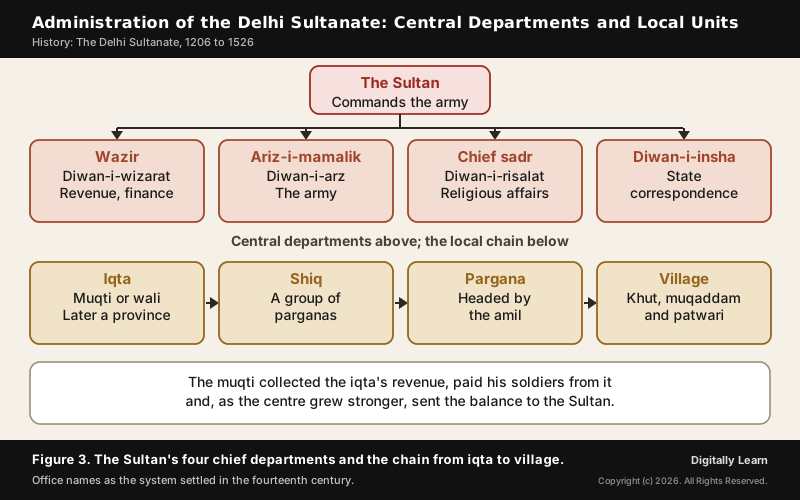
- Wazir: Head of the revenue department, the diwan-i-wizarat. The early wazirs were military leaders; by the fourteenth century the wazir was an expert in revenue, with an auditor general and an accountant general under him.
- Ariz-i-mamalik: Head of the diwan-i-arz, the military department, which recruited, equipped and paid the army. Balban first set it up as a separate department.
- Chief sadr: Head of the diwan-i-risalat, which dealt with religious matters, pious foundations and stipends to scholars; he was usually also the chief qazi, the head of justice.
- Diwan-i-insha: The department of state correspondence, formal or confidential.
Intelligence agents called barids kept the ruler informed from every part of the empire. Firoz Shah Tughlaq added a department of slaves and a department of public works, which built his canals and buildings.
Iqta System of the Delhi Sultanate: Muqti, Amil and Land Revenue
When the Turks conquered the country, they divided it into tracts called iqtas and parcelled them out among their leading nobles. An iqta was an Islamic practice that the Turks brought with them: the revenue of a tract of land was assigned to a military officer in place of a salary. Its holder, the muqti or wali, kept order and collected the revenue, paid his soldiers out of it and kept the rest. These tracts later became the provinces.
As the central government grew stronger, it worked out each iqta's real income, fixed the salaries of the muqti and his soldiers in cash and made him send the balance to the centre. That surplus was called the fawazil, and state accountants audited the muqtis' books. Below the iqta came the shiq and the pargana, which was headed by the amil, the officer in charge of revenue collection. In the village the leading people were the khut (landowners) and the muqaddam (headman), with the patwari keeping the accounts.
The early Sultans, especially Iltutmish, preferred to rule through bandagan, slaves bought and trained for military service, because they depended wholly on their master. Alauddin Khalji brought the assessment and collection of land revenue under the state's own control and levied three taxes: kharaj on cultivation, about half of the peasant's produce, a tax on cattle and a tax on houses. The full working is in the administration of the Delhi Sultanate.
Delhi Sultanate Coins: Tanka, Jital and Token Currency
Iltutmish gave the Sultanate its coinage. The basic units were the silver tanka, weighing one tola of 96 rattis (11.2 grams), and the jital, a coin of copper mixed with a little silver; 48 jitals made one tanka. His silver tankas carried the name of the Abbasid caliph alongside his own titles, a sign of how much the early sultans valued the caliph's recognition.
Alauddin's prices were set in this money: wheat at 7½ jitals a man (about 15 kg) and rice at 5, and a trooper's pay of 238 tankas a year. Muhammad bin Tughlaq then tried his token currency. Short of precious metal, he issued coins of copper and brass, from 1329 to 1332, in place of gold and silver. People did not trust them: they saved their gold and silver and paid their taxes in tokens, which could also be forged easily, and the scheme had to be withdrawn. Trade, crafts and money are covered in the economy of the Delhi Sultanate.
Technology in the Delhi Sultanate Period: Rahat, Paper, Spinning Wheel, Arch and Dome
The Turks introduced or popularised a number of new crafts and techniques, and these reshaped work in the fields, the workshops and the army. Not all of them were new, but their spread and improvement, built on the skill of Indian craftsmen, changed daily life.
- Irrigation: An improved rahat, a wheel that lifted water from a deeper level, so that more land could be watered.
- Textiles: The spinning wheel and an improved loom; the cotton carder’s bow, the dhunia, cleaned cotton faster and better.
- Paper: Paper-making was one of the new crafts the Turks introduced, which made records and books easier to produce.
- Building: A superior mortar that let the Turks raise great buildings on the true arch and the dome.
- Cavalry and arms: The iron stirrup and armour for horse and rider, which fed a growing metal industry; at the very end of the period, Babur’s cannons decided the first battle of Panipat.
Together with the growth of farming, the spread of these crafts made the second half of the fourteenth century a time of growth and relative affluence. The change shows in the busier workshops, in better-watered fields and in the new buildings of arch and dome.
Delhi Sultanate Architecture, Monuments and Culture
Delhi Sultanate Monuments in Order of Building
Indo-Islamic architecture began under the Sultans. The new buildings rested on the true arch and the dome, and each dynasty left its mark on Delhi. In the order in which they were built:
| Monument | Built | Dynasty |
|---|---|---|
| Quwwat-ul-Islam mosque | 1198, by Aibak | Mamluk |
| Qutb Minar, 72.5 m | Begun 1199; Iltutmish added storeys | Mamluk |
| Alai Darwaza | 1311, by Alauddin | Khalji |
| Tughlaqabad fort | 1321, by Ghiyasuddin | Tughlaq |
| Firozabad (Kotla) | 1354, by Firoz Shah | Tughlaq |
| Muhammad Shah's tomb | 1444 | Sayyid |
| Sikandar Lodi's tomb | 1517 to 1518 | Lodi |
The Quwwat-ul-Islam is the earliest surviving mosque of the Delhi Sultans. Aibak laid the foundation of the Qutb Minar and raised its first storey, Iltutmish added three more, and Firoz Shah Tughlaq and Sikandar Lodi later repaired it. Alauddin's Alai Darwaza, the southern gateway of the mosque, is the first building to use Islamic principles of construction and ornament; his plan for a minar twice the size of the Qutb stopped at the first storey. The Lodi Gardens in Delhi hold the tombs of the last two dynasties, and the Qutb Minar and its monuments are a UNESCO World Heritage Site. The buildings are studied in detail in the Indo-Islamic architecture of the Delhi Sultanate.
Persian, Hindavi and Amir Khusrau: Language and Literature
Persian was the language of administration and of the court histories, and the Sultanate drew India into the wider Islamic world. One result of that contact was the growth of the Hindustani language. The finest writer of the age was Amir Khusrau (1253 to 1325), court poet and disciple of the Sufi Nizamuddin Auliya of Delhi.
Khusrau wrote mainly in Persian but also in Hindavi, in many verse forms, and did much to develop the ghazal. He is regarded as the father of qawwali, the devotional singing of the Sufis, and introduced the ghazal style of song into India. His eloquence earned him the name Tuti-i-Hind, the parrot of India. Literature at the Lodi court leaned the same way: Sikandar Lodi wrote Persian verse and had Sanskrit medical works translated into Persian. Religion, the Sufis and the Bhakti saints of the period are covered in society and religion under the Sultanate.
Sources of Delhi Sultanate History
Persian Tawarikh, Barani and the Travellers' Accounts
Inscriptions, coins and buildings tell us a great deal, but the richest sources are the histories, the tawarikh (singular tarikh), written in Persian. Their authors were secretaries, administrators, poets and courtiers. They lived in cities, mainly Delhi, often wrote for the Sultans in the hope of rich rewards, and urged an ideal social order based on birthright and on distinctions of gender.
That outlook colours what they wrote. Minhaj-i Siraj accepted that Razia was more able than her brothers but was uneasy at a queen. Ziauddin Barani treated Muhammad bin Tughlaq's appointment of a wine distiller, a barber and a cook to high posts as a sign of lost judgement; he wrote his chronicle first in 1356 and again two years later, and the first version came to light only in 1971. Fakhr-i Mudabbir set out the circle of justice: a king needs soldiers, soldiers need salaries, salaries come from revenue, and peasants can pay only when they prosper under just rule.
Barani also explains a basic feature of the state. The Sultans had to add to the Muslim law regulations of their own, the zawabit; Alauddin told the chief qazi that he framed his laws to suit the needs of the state. For this reason Barani refused to call the state truly Islamic. Travellers add an outside view, above all Ibn Battuta of Morocco, whom Muhammad bin Tughlaq appointed a qadi, a judge, at Delhi.
Decline of the Delhi Sultanate and the Rise of the Mughals
Causes of Decline: Overreach, Nobility, Timur and Regional States
The decline began at the height of the Sultanate's power, under Muhammad bin Tughlaq, and ran for almost two centuries. Its main causes were:
- Overreach and revolt: The shift to Daulatabad and the failed token currency bred discontent, revolts broke out from 1327, and the south broke away as Madurai, Vijayanagara and the Bahmani Sultanate.
- An unstable nobility: Slaves and clients were loyal to their master but not to his heirs, so every succession invited conflict; Firoz Shah’s hereditary iqtas weakened the centre’s hold further.
- Timur’s invasion: The sack of Delhi in 1398 left the Sultanate in anarchy.
- Regional states: By the fifteenth century Jaunpur, Bengal, Malwa, Gujarat, Rajasthan and the whole of the south had rulers of their own.
- The last Lodi: Ibrahim alienated his nobles, one of whom invited Babur, who won at Panipat in 1526.
Difference Between Delhi Sultanate and Mughal Empire
The Mughal Empire began where the Sultanate ended, at Panipat in 1526, and it built on much that the Sultans had made. The two states differed in their rulers, their nobility and how they paid their officers:
| Point | Delhi Sultanate | Mughal Empire |
|---|---|---|
| Period | 1206 to 1526 | From 1526, under Babur |
| Rulers | Five dynasties in turn | One family, from Timur |
| Nobles | Bandagan and clients | Mansabdars ranked by zat |
| Assignment | Iqta, run by its muqti | Jagir, revenue only |
| Provinces | Iqtas under muqtis | Subas under subadars |
| Capital | Delhi; Agra under the Lodis | Agra; Fatehpur Sikri, 1571 |
The sharpest contrast lies in the revenue assignment. A Mughal noble, the mansabdar, held a rank fixed by a number called zat and was paid through a jagir, an assignment somewhat like an iqta. But unlike the muqti, who lived in his iqta and governed it, most mansabdars did not live in or administer their jagirs; they only drew its revenue, which their servants collected.
Previous Year UPSC-CSE Questions
Previous Year UPSC-CSE Questions By the end you will be able to draft model answers for the following UPSC questions. Each question carries a collapsible framework showing how to approach it in the exam.
- UPSC Mains 2023 GS-IWhat were the major technological changes introduced during the Sultanate period? How did those technological changes influence the Indian society?
Answer outline: how to structure the answer
What the question asks, the main arguments, relevant examples and the direction of the conclusion. This is not a full model answer.
Introduction: Open with the Turks introducing or popularising new crafts and techniques, built on the skill of Indian craftsmen.
Body (sub-themes to develop):
- Irrigation: the improved rahat lifted water from deeper levels; more land watered, more produce.
- Textiles: spinning wheel, improved loom and the carder's bow (dhunia); more and cheaper cloth, a larger weaving craft.
- Paper-making: records, books and the Persian chronicles easier to produce.
- Building: a superior mortar made the true arch and dome possible; Qutb Minar to the Lodi tombs.
- Warfare: iron stirrup and armour fed metal crafts; Babur's cannons at Panipat, 1526.
Conclusion: Conclude that, with agricultural growth, these crafts made the second half of the fourteenth century a period of growth and relative affluence, though most of them spread an older skill rather than invent a new one.
- UPSC Mains 2020 GS-IPersian literary sources of medieval India reflect the spirit of the age. Comment.
Answer outline: how to structure the answer
What the question asks, the main arguments, relevant examples and the direction of the conclusion. This is not a full model answer.
Introduction: Open with the tawarikh, the Persian histories written by secretaries, administrators, poets and courtiers, as the main literary sources of the Sultanate.
Body (sub-themes to develop):
- Authors: city-based courtiers, mostly in Delhi, writing for the Sultans in hope of rewards.
- Ideals: an order based on birthright and gender; Fakhr-i Mudabbir's circle of justice.
- Examples: Minhaj-i Siraj uneasy at Razia as queen; Barani scornful of low-born officials.
- The state: Barani on the zawabit, laws framed for the needs of the state, so not truly Islamic.
- Limits: little on villages and peasants; inscriptions, coins and Ibn Battuta as a check.
Conclusion: Conclude that the sources reflect the courtly, hierarchical spirit of the ruling class more than of society as a whole, and that this bias is itself evidence of the age.
- UPSC Prelims 1997 Prelims-GSAfter consolidating his power, Balban assumed the grand title of
How to approach this Prelims question
Approach: Step 1: Balban built his kingship on the awe of the throne. Step 2: he called himself the shadow of God, Zil-i-Ilahi. Step 3: the other three titles belong to a poet, to no sultan and to Akbar.
Trap to watch: Zil-i-Ilahi and Din-i-Ilahi look alike; only the first is Balban's.
Key facts to recall:
- (a) Tute-i-Hind: wrong. Tuti-i-Hind, the parrot of India, was Amir Khusrau's sobriquet, not a sultan's title.
- (b) Kaisr-i-Hind: wrong. It was never the title of a Delhi sultan.
- (c) Zil-i-Ilahi: right. Balban called himself the shadow of God.
- (d) Din-i-Ilahi: wrong. It was the religious path Akbar founded three centuries later.
Answer signal: Zil-i-Ilahi: option (c), the official answer, because Balban styled himself the shadow of God.
- UPSC Prelims 1998 Prelims-GSConsider the following Assertion (A) and Reason (R):
- Assertion (A): At first the Turkish administration in India was essentially military.
- Reason (R): The country was parcelled out as ‘Iqta’s among leading military leaders.
Select the correct answer using the code given below.
How to approach this Prelims question
Approach: Step 1: the assertion: the first Turkish government was military in character; true. Step 2: the reason: the land was parcelled out as iqtas among military leaders; true. Step 3: the iqtas made military commanders the rulers of the country, so the reason explains the assertion.
Trap to watch: Both statements are true; the trap is to treat the reason as unconnected.
Key facts to recall:
- (a) Both true, R explains A: right. Government by iqta-holding commanders is what made it military.
- (b) Both true, R does not explain A: wrong. The iqta is the very reason the administration was military.
- (c) A true, R false: wrong. The land was in fact parcelled out as iqtas among the leading nobles.
- (d) A false, R true: wrong. The early administration was military; even the early wazirs were soldiers.
Answer signal: Option (a), the official answer: both are true and the iqta system explains the military character.
- UPSC Prelims 1998 Prelims-GSConsider the following:
- I. Tughluqabad Fort.
- II. Lodi Garden.
- III. Qutub Minar.
- IV. Fatehpur Sikri.
The correct chronological order in which they were built is:
How to approach this Prelims question
Approach: Step 1: Qutb Minar, begun by Aibak in 1199 (III). Step 2: Tughlaqabad, built by Ghiyasuddin Tughlaq in 1321 (I). Step 3: the tombs in the Lodi Garden, 1444 and 1517-18 (II). Step 4: Fatehpur Sikri, Akbar's capital from 1571 (IV). Order: III, I, II, IV.
Trap to watch: Tughlaqabad is listed first in the question but was built more than a century after the Qutb Minar.
Key facts to recall:
- (a) III, I, IV, II: wrong. Fatehpur Sikri (1571) comes after the Lodi tombs, not before.
- (b) III, I, II, IV: right. 1199, 1321, the fifteenth and early sixteenth centuries, then 1571.
- (c) I, III, II, IV: wrong. The Qutb Minar (1199) is older than Tughlaqabad (1321).
- (d) I, III, IV, II: wrong. It puts Tughlaqabad first and Fatehpur Sikri before the Lodi tombs.
Answer signal: III, I, II, IV: option (b), the official answer, the order of building from Mamluk to Mughal.
- UPSC Prelims 1998 Prelims-GSFawazil in the Sultanate period meant
How to approach this Prelims question
Approach: Step 1: the muqti collected his iqta's revenue and paid himself and his troops. Step 2: what was left over had to go to the centre. Step 3: that surplus paid to the treasury was the fawazil.
Trap to watch: Option (b) describes the iqta itself, not the fawazil.
Key facts to recall:
- (a) Extra payment made to the nobles: wrong. The fawazil flowed from the iqtadar to the treasury, not to nobles.
- (b) Revenue assigned in lieu of salary: wrong. That is the iqta itself.
- (c) Excess amount paid to the exchequer by the iqtadars: right. It was the surplus above pay and troops.
- (d) Illegal exactions extracted from the peasants: wrong. The fawazil was a lawful remittance to the centre.
Answer signal: Option (c), the official answer: the fawazil was the iqtadar's surplus sent to the treasury.
- UPSC Prelims 1998 Prelims-GSThe Sultan of Delhi who is reputed to have built the biggest network of canals in India was
How to approach this Prelims question
Approach: Step 1: canals call for a builder sultan with a long, peaceful reign. Step 2: Firoz Shah Tughlaq ruled 37 years and dug five major canals. Step 3: the other three are known for other works.
Trap to watch: Ghiyasuddin Tughlaq built a great fort, not a canal network.
Key facts to recall:
- (a) Iltutmish: wrong. He completed the Qutb Minar and set up the coinage; no canal network is his.
- (b) Ghiyasuddin Tughlaq: wrong. His work was the fort of Tughlaqabad.
- (c) Feroz Shah Tughlaq: right. Five major canals, including the Western Yamuna Canal.
- (d) Sikandar Lodi: wrong. He is remembered for re-founding Agra, not for canals.
Answer signal: Feroz Shah Tughlaq: option (c), the official answer, because of his five canals.
- UPSC Prelims 2000 Prelims-GSConsider the following events:
- I. Reign of Krishna Deva Raya of Vijayanagara.
- II. Construction of Qutab Minar.
- III. Arrival of Portuguese in India.
- IV. Death of Firoz Tughlaq.
Which one of the following is the correct chronological sequence of the above events?
How to approach this Prelims question
Approach: Step 1: Qutb Minar, begun 1199 (II). Step 2: death of Firoz Tughlaq, 1388 (IV). Step 3: Vasco da Gama reached Kozhikode in 1498 (III). Step 4: Krishna Deva Raya ruled from 1509 (I). Order: II, IV, III, I.
Trap to watch: Krishna Deva Raya is the best-known Vijayanagara king, but he came after the Portuguese arrived.
Key facts to recall:
- (a) II, IV, III, I: right. 1199, 1388, 1498, 1509.
- (b) II, IV, I, III: wrong. Krishna Deva Raya (1509) came after the Portuguese (1498).
- (c) IV, II, I, III: wrong. The Qutb Minar is older than Firoz's death, and the last two are reversed.
- (d) IV, II, III, I: wrong. Firoz died in 1388, long after the Qutb Minar was begun.
Answer signal: II, IV, III, I: option (a), the official answer.
- UPSC Prelims 2001 Prelims-GSThe Mongols under Genghis Khan invaded India during the reign of
How to approach this Prelims question
Approach: Step 1: Chengiz Khan reached the Indus in 1221 and died in 1227. Step 2: the sultan of Delhi between 1210 and 1236 was Iltutmish. Step 3: the other three ruled after Chengiz Khan's death.
Trap to watch: Balban fought the Mongols too, but decades after Chengiz Khan.
Key facts to recall:
- (a) Balban: wrong. He ruled from 1266, decades after Chengiz Khan died in 1227.
- (b) Feroze Tughlaq: wrong. He ruled from 1351.
- (c) Iltutmish: right. Chengiz Khan reached the Indus in 1221, in his reign.
- (d) Muhammad bin Tughlaq: wrong. He ruled from 1324; his Mongol foe was Tarmashirin.
Answer signal: Iltutmish: option (c), the official answer, because 1221 falls in his reign.
- UPSC Prelims 2002 Prelims-GSThe historian Barani refused to consider the state in India under Delhi Sultans as truly Islamic because
How to approach this Prelims question
Approach: Step 1: Barani judged the state by its law. Step 2: the Sultans supplemented the sharia with their own zawabit, made for the needs of the state. Step 3: a state run on such worldly regulations was, in his eyes, not truly Islamic.
Trap to watch: Several options are true facts about the Sultanate; only one is Barani's stated reason.
Key facts to recall:
- (a) Most people did not follow Islam: wrong as his reason. It was true, but Barani's objection was to the law.
- (b) Theologians were often disregarded: wrong as his reason. Iltutmish's wazir did turn the divines away, but the point was the Sultan's own regulations.
- (c) The Sultan supplemented Muslim law with his own regulations: right. These were the zawabit.
- (d) Religious freedom for non-Muslims: wrong as his reason. Their protected status went back to the Arab conquest of Sindh.
Answer signal: Option (c), the official answer: the zawabit made the state worldly in Barani's view.
- UPSC Prelims 2003 Prelims-GSHow did Sultan Qutb-ud-din Aibak die?
How to approach this Prelims question
Approach: Step 1: Aibak ruled only four years, 1206 to 1210. Step 2: he died in an accident at Lahore while playing chaugan, a form of polo. Step 3: the battle and siege options name real events of his life, but not his death.
Trap to watch: Yildiz and Kalinjar both belong to Aibak's career, which makes them tempting.
Key facts to recall:
- (a) Stabbed by an ambitious noble: wrong. No noble killed him; he died in an accident.
- (b) Killed in battle with Yildiz: wrong. He fought Yildiz after 1206, but did not die at his hands.
- (c) Injured besieging Kalinjar: wrong. He besieged Kalinjar in 1202 and survived it.
- (d) A fall from his horse while playing chaugan: right. At Lahore, in 1210.
Answer signal: Option (d), the official answer: the chaugan accident at Lahore.
- UPSC Prelims 2004 Prelims-GSWho was the last ruler of the Tughlaq dynasty of the Delhi Sultanate?
How to approach this Prelims question
Approach: Step 1: Firoz Shah died in 1388 and the line broke into civil war. Step 2: Timur sacked Delhi in 1398 under Nasiruddin Mahmud. Step 3: Nasiruddin returned and ruled in name until the Sayyids took Delhi in 1414.
Trap to watch: Firoz Shah was the last strong Tughlaq, not the last Tughlaq.
Key facts to recall:
- (a) Firoj Shah Tughlaq: wrong. Others followed him after his death in 1388.
- (b) Ghiyas-ud-din Tughlaq Shah II: wrong. He succeeded Firoz and died in the civil war soon after.
- (c) Nasir-ud-din Mahmud: right. He returned after Timur's sack and ruled as the last, nominal Tughlaq.
- (d) Nasrat Shah: wrong. He was Nasiruddin's rival sultan at Firozabad, not the last of the line.
Answer signal: Nasir-ud-din Mahmud: option (c), the official answer.
- UPSC Prelims 2006 Prelims-GSWhich one of the following is the correct chronological order of the Afghan rulers to the throne of Delhi?
How to approach this Prelims question
Approach: Step 1: Bahlul founded the Lodi dynasty in 1451. Step 2: his son Sikandar, here Sikandar Shah, ruled from 1489. Step 3: Ibrahim, the last, lost at Panipat in 1526.
Trap to watch: Sikandar Shah is Sikandar Lodi, the middle ruler.
Key facts to recall:
- (a) Sikandar Shah, Ibrahim Lodi, Bahlol Khan Lodi: wrong. The founder Bahlul comes first, not last.
- (b) Sikandar Shah, Bahlol Khan Lodi, Ibrahim Lodi: wrong. Sikandar was Bahlul's son, so he followed him.
- (c) Bahlol Khan Lodi, Sikandar Shah, Ibrahim Lodi: right. Founder, son, grandson.
- (d) Bahlol Khan Lodi, Ibrahim Lodi, Sikandar Shah: wrong. Ibrahim was the last Lodi.
Answer signal: Option (c), the official answer: Bahlul, Sikandar, Ibrahim.
- UPSC Prelims 2019 Prelims-GSConsider the following statements:
- In the revenue administration of Delhi Sultanate, the in-charge of revenue collection was known as ‘Amil’.
- The Iqta system of Sultans of Delhi was an ancient indigenous institution.
- The office of ‘Mir Bakshi’ came into existence during the reign of Khalji Sultans of Delhi.
Which of the statements given above is/are correct?
How to approach this Prelims question
Approach: Step 1: statement 1: the amil headed the pargana and collected the revenue; correct. Step 2: statement 2: the iqta was an Islamic practice brought by the Turks, not an ancient Indian one; incorrect. Step 3: statement 3: the Mir Bakhshi headed the Mughal military ministry, not a Khalji office; incorrect. Step 4: 1 only.
Trap to watch: Mir Bakhshi sounds like the Sultanate's ariz-i-mamalik, but the office is Mughal.
Key facts to recall:
- (a) 1 only: right. Only the amil statement is correct.
- (b) 1 and 2 only: wrong. The iqta was not an ancient indigenous institution.
- (c) 3 only: wrong. The Mir Bakhshi was a Mughal office.
- (d) 1, 2 and 3: wrong. Statements 2 and 3 are incorrect.
Answer signal: 1 only: option (a), the official answer.
- UPSC Prelims 2021 Prelims-GSConsider the following statements:
- It was during the reign of Iltutmish that Chengiz Khan reached the Indus in pursuit of the fugitive Khwarezm prince.
- It was during the reign of Muhammad bin Tughluq that Taimur occupied Multan and crossed the Indus.
- It was during the reign of Deva Raya II of Vijayanagara Empire that Vasco da Gama reached the coast of Kerala.
Which of the statements given above is/are correct?
How to approach this Prelims question
Approach: Step 1: statement 1: 1221, Chengiz Khan at the Indus chasing Jalaluddin Mangburni, in Iltutmish's reign; correct. Step 2: statement 2: Timur came in 1398, under Nasiruddin Mahmud, not Muhammad bin Tughlaq, who died in 1351; incorrect. Step 3: statement 3: Vasco da Gama reached Kerala in 1498, after Deva Raya II's reign ended in 1446; incorrect. Step 4: 1 only.
Trap to watch: Each statement pairs a real event with a ruler; only the dates show which pairs are true.
Key facts to recall:
- (a) 1 only: right. Only the Chengiz Khan statement matches its reign.
- (b) 1 and 2: wrong. Timur came in 1398, almost fifty years after Muhammad bin Tughlaq died.
- (c) 3 only: wrong. Deva Raya II died in 1446; Vasco da Gama came in 1498.
- (d) 2 and 3: wrong. Both statements misdate their events.
Answer signal: 1 only: option (a), the official answer.
- UPSC Prelims 2022 Prelims-GSWith reference to Indian history, consider the following statements :
- The first Mongol invasion of India happened during the reign of Jalal-ud-din Khalji.
- During the reign of Ala-ud-din Khalji, one Mongol assault marched up to Delhi and besieged the city.
- Muhammad-bin-Tughlaq temporarily lost portions of north-west of his kingdom to Mongols.
Which of the statements given above is/are correct ?
How to approach this Prelims question
Approach: Step 1: statement 1: the first Mongol invasion came in 1221 under Iltutmish, not Jalaluddin Khalji; incorrect. Step 2: statement 2: in 1299 the Mongols besieged Delhi under Alauddin; correct. Step 3: statement 3: Muhammad bin Tughlaq defeated the Mongols near the Jhelum and reached Peshawar, he did not lose the north-west to them; incorrect. Step 4: 2 only.
Trap to watch: Statement 3 sounds plausible because the Mongols did burst into Sindh under Muhammad bin Tughlaq; he drove them back.
Key facts to recall:
- (a) 1 and 2: wrong. The first Mongol invasion was under Iltutmish.
- (b) 2 only: right. The Mongol assault on Delhi came under Alauddin.
- (c) 1 and 3: wrong. Both statements are incorrect.
- (d) 3 only: wrong. Muhammad bin Tughlaq pushed the Mongols back.
Answer signal: 2 only: option (b), the official answer.
Sources
- NCERT: Our Pasts II (Class VII), The Delhi Sultans and The Mughal Empire
- NCERT: Medieval India (Satish Chandra), The Delhi Sultanat and its government
- NCERT: Themes in Indian History II (Class XII), An Imperial Capital: Vijayanagara
- Archaeological Survey of India: Qutb Minar and its Monuments
- UNESCO World Heritage Centre: Qutb Minar and its Monuments, Delhi
- Incredible India (Ministry of Tourism): Qutub Minar
- Wikipedia: Delhi Sultanate
- Wikipedia: Mamluk dynasty (Delhi)
- Wikipedia: Khalji dynasty
- Wikipedia: Tughlaq dynasty
- Wikipedia: Sayyid dynasty
- Wikipedia: Lodi dynasty
- Wikipedia: Qutb ud-Din Aibak
- Wikipedia: Iltutmish
- Wikipedia: Ghiyas ud din Balban
- Wikipedia: Muhammad bin Tughluq
- Wikipedia: Firuz Shah Tughlaq
- Wikipedia: Sack of Delhi (1398)
- Wikipedia: First Battle of Panipat
- Wikipedia: Iqta'
- Wikipedia: Tanka (coin)
- Wikipedia: Jital
- Wikipedia: Alai Darwaza
- Wikipedia: Tughlaqabad Fort
- Wikipedia: Feroz Shah Kotla
- Wikipedia: Lodi Gardens
- Wikipedia: Tomb of Sikandar Lodi
- Wikipedia: Fatehpur Sikri
- Wikipedia: Mughal Empire
- Wikipedia: Amir Khusrau
- Wikipedia: Ibn Battuta
- Wikipedia: Vijayanagara Empire
- Wikipedia: Vasco da Gama
- UPSC: Civil Services Examination question papers
Editorial Disclaimer
Reign dates follow the NCERT textbooks; other accounts may differ by a year. This article draws on the sources listed on this page.


