


Overview
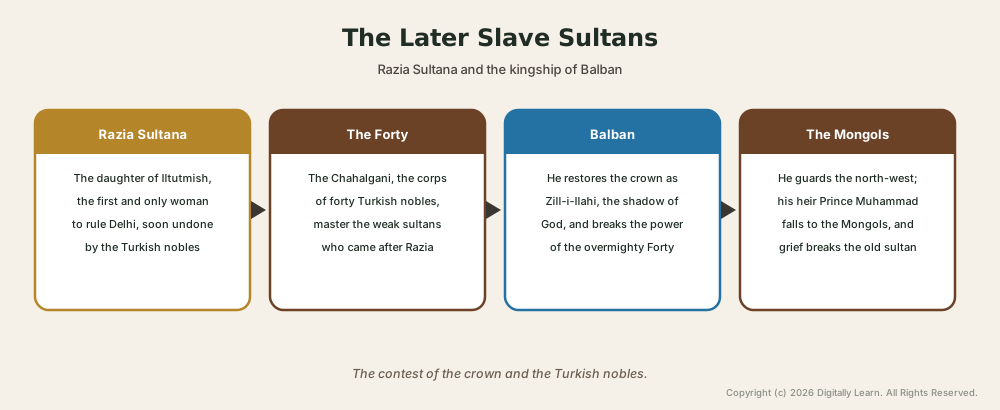
After the death of Iltutmish, the throne of Delhi passed first to his daughter Razia Sultana, the first and only woman to rule the Sultanate. Yet the Turkish nobles, the corps of forty known as the Chahalgani, would not long suffer a woman's rule, and after a short reign she was overthrown and killed. For a generation the Forty mastered a line of weak sultans, until Balban seized the throne and restored the crown's power. He raised the sultan to the rank of Zill-i-Ilahi, the shadow of God, broke the Forty, and guarded the realm against the Mongols. This part covers Razia Sultana, the rule of the Forty, Balban's theory of kingship and iron rule, and the exam focus.
The Throne after Iltutmish
Razia Sultana, the First Woman on the Throne
What is the significance of Razia Sultana: she was the first and only woman to rule the Delhi Sultanate, raised to the throne by her father's own choice over his sons.
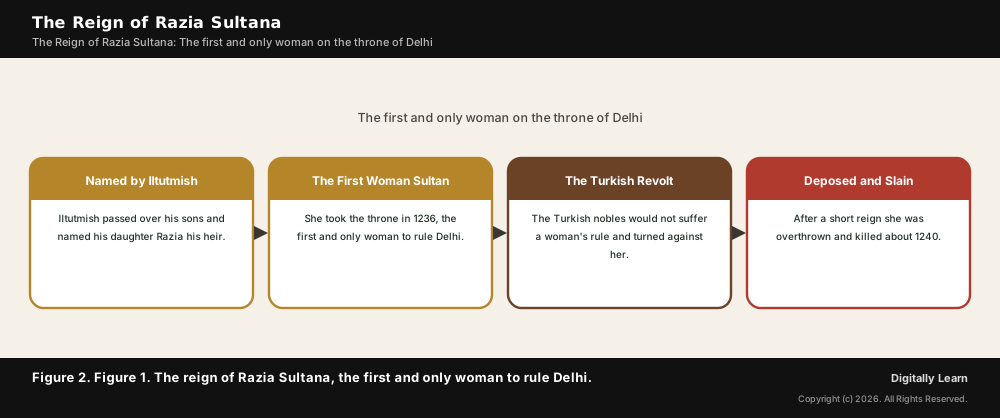
Iltutmish judged his sons unworthy, and on his death in 1236 he had named his daughter Razia as his heir. She took the throne and ruled as sultan in her own right, the first and only woman ever to rule Delhi. She put aside the veil, held open court, and led her armies in the field, and by the testimony of the chronicles she had every gift a ruler needs but her sex.
Yet her rule was brief. The Turkish nobles would not long obey a woman, and her favour to Jamal-ud-din Yaqut, a noble from outside their circle, gave them their pretext. They rose against her, and after a reign of some three years Razia was overthrown and, about 1240, put to death. The figure below sets out the course of her short reign.
The Rule of the Forty (Chahalgani)
Distinguishing the years that followed: the throne now fell under the shadow of the Forty, the corps of Turkish nobles whom Iltutmish had raised, and the crown grew weak in their hands.
The Chahalgani, the group of forty great Turkish nobles, had been bound together by Iltutmish as the pillar of his power. After Razia they became its master. A line of weak sultans, Bahram Shah, Masud Shah and at last Nasiruddin Mahmud, sat on the throne while the Forty shared out the offices of state and made and unmade kings at will.
It was in this time that Balban rose. He was himself one of the Forty, and under the mild Nasiruddin Mahmud he became the naib, the deputy who held the real power of the state. The table below sets out the sultans of the Slave dynasty from Iltutmish to Balban.
| Sultan | Reign | Note |
|---|---|---|
| Iltutmish | 1211 to 1236 | The consolidator, who named Razia his heir. |
| Razia Sultana | 1236 to 1240 | The first and only woman to rule Delhi. |
| Bahram and Masud Shah | 1240 to 1246 | Weak sultans under the rule of the Forty. |
| Nasiruddin Mahmud | 1246 to 1266 | A mild king; Balban ruled as his naib. |
| Balban | 1266 to 1287 | Who broke the Forty and restored the crown. |
Balban and the Theory of Kingship
Balban's Rise and the Restoration of the Crown
What is the significance of Balban: he restored the power and the awe of the crown, which the Forty had brought low, and made the sultan once more the true master of the state.
Balban had begun, like the first sultans, as a slave, and had risen through the Forty to be the naib of Nasiruddin Mahmud. On the death of that mild king in 1266 he took the throne himself, as Ghiyas-ud-din Balban, and set himself to one great task: to raise the crown again above the nobles who had so long mastered it.
His whole policy turned on this aim. He would not share his power, nor let the Forty stand as his equals; he surrounded the throne with a new majesty, and he met every challenge to its authority with a heavy hand. The next sub-section sets out the theory of kingship by which he clothed the crown in awe.
Zill-i-Ilahi: The Sultan as the Shadow of God
Distinguishing his theory of kingship: Balban held that the sultan was the shadow of God on earth, and he ringed the throne with a Persian ceremony that set the king far above ordinary men.
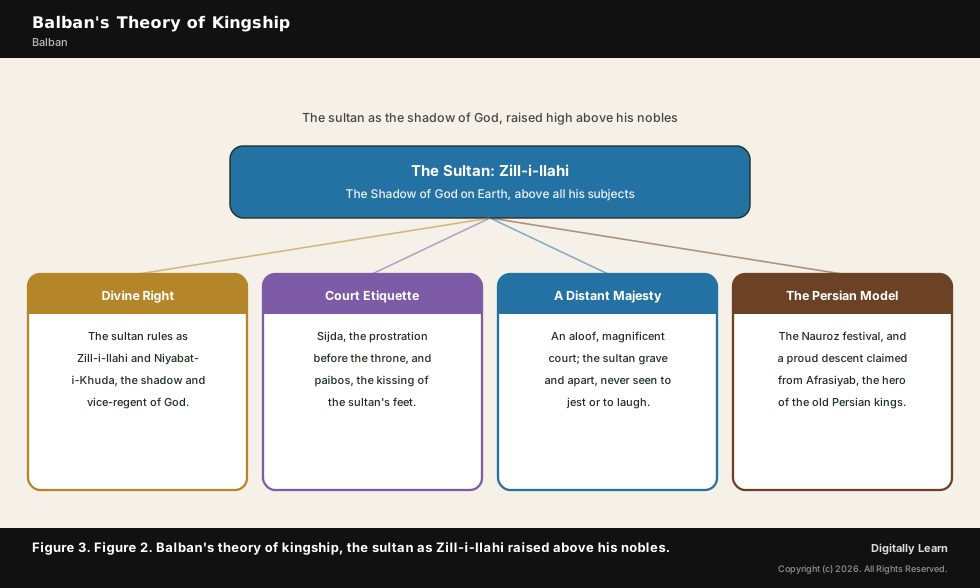
He took the grand title of Zill-i-Ilahi, the shadow of God, and called himself the Niyabat-i-Khuda, the vice-regent of God. At his court he enforced the Persian usages of sijda, the prostration before the throne, and paibos, the kissing of the sultan's feet, so that all who came before him should feel the distance between the king and his subjects.
He kept a grave and aloof majesty. He was never seen to jest or to laugh in the open court, kept a magnificent state, and claimed a proud descent from Afrasiyab, the legendary hero of the old kings of Persia. The figure below sets out the supports on which his theory of kingship rested.
Balban's Iron Rule and the Mongol Defence
Blood and Iron: The Breaking of the Forty
What is the significance of his iron rule: Balban broke the overmighty Forty and crushed every revolt, so that the crown's writ once more ran unchallenged through the land.
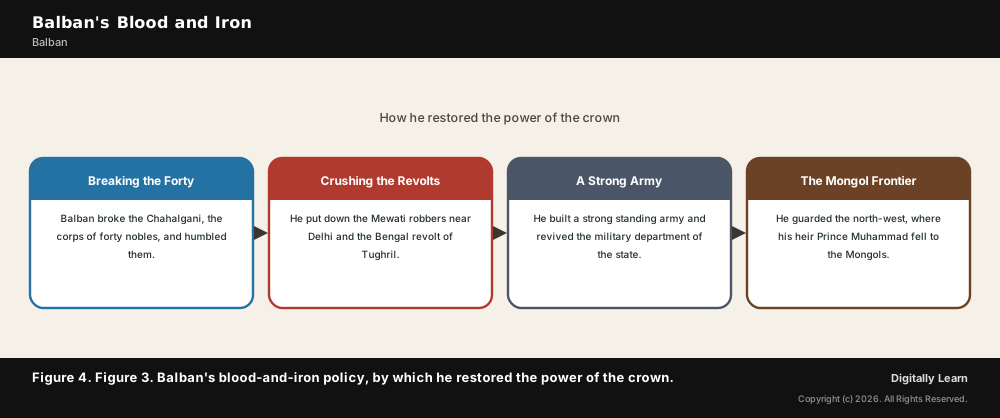
He broke the Chahalgani. The forty nobles who had ruled in his own rise he now humbled, by death, by disgrace and by setting one against another, until the corps was no longer a power in the state. He ruled with a famed iron hand, and put down the Mewati robbers who infested the roads near Delhi itself.
The gravest revolt came from the east, where Tughril Khan, the governor of Bengal, threw off his allegiance. Balban marched against him, crushed the rising, and punished the rebels without mercy, a warning to all who might defy the crown. The figure below sets out the parts of his blood-and-iron policy.
The Shield against the Mongols
Distinguishing his greatest care: the defence of the north-west against the Mongols was the constant labour of Balban's reign, and it cost him his heir and his peace.
The Mongol danger still hung over the frontier. Balban built a strong standing army, revived the military department of the state, and fortified the north-west against the raiders. He set his able and beloved son, Prince Muhammad, to guard that frontier, and the young prince held it well.
But in 1285 Prince Muhammad fell fighting the Mongols, and the loss broke the old sultan's spirit. Balban himself died in 1287, and the throne soon passed from the house of the Slave kings to a new line, the Khaljis, whose story is the next part.
UPSC Relevance and Exam Focus
Where the Later Slave Sultans Fit in the UPSC-CSE Syllabus
This topic belongs to General Studies Paper I: medieval Indian history, and the later Slave sultans, above all Balban, are a regular ground for questions.
The questions most often test Razia Sultana as the first woman ruler, and Balban for his theory of kingship: the title Zill-i-Ilahi, the usages of sijda and paibos, and the breaking of the Forty.
Several linked points recur and are worth holding in working memory:
- Razia Sultana: The first and only woman to rule Delhi, named heir by Iltutmish.
- The Chahalgani: The corps of forty Turkish nobles who mastered the weak sultans.
- Zill-i-Ilahi: Balban’s grand title, the shadow of God on earth.
- Sijda and paibos: The prostration and foot-kissing of Balban’s Persian court.
- Prince Muhammad: Balban’s heir, who fell fighting the Mongols in 1285.
A 1997 question asked the grand title that Balban assumed after consolidating his power; the answer is Zill-i-Ilahi, the shadow of God, and the distractors (Tuti-i-Hind, Kaisar-i-Hind and Din-i-Ilahi) belong elsewhere, the last of them to Akbar.
A common trap credits Balban with the title Din-i-Ilahi; that was Akbar's later religious order, not Balban's title, which was Zill-i-Ilahi. Another forgets that Razia was named heir by Iltutmish himself, not a usurper.
Previous Year UPSC-CSE Questions
Previous Year UPSC-CSE Questions By the end you will be able to draft model answers for the following UPSC questions. Each question carries a collapsible framework showing how to approach it in the exam.
- UPSC Prelims 1997 GS-IAfter consolidating his power, Balban assumed the grand title of
How to approach this Prelims question
Approach: Recall the core of Balban's kingship: he called himself Zill-i-Ilahi, the shadow of God, and Niyabat-i-Khuda, the vice-regent of God.
Trap to watch: Do not confuse Zill-i-Ilahi with Din-i-Ilahi, which was Akbar's later religious order, nor with Tuti-i-Hind, which was Amir Khusrau's sobriquet.
Key facts to recall:
- Balban took the title Zill-i-Ilahi, the shadow of God.
- He enforced sijda and paibos at his Persian-style court.
- Din-i-Ilahi was Akbar's later order, not Balban's title.
Answer signal: Zil-i-Ilahi.
Sources and Further Reading
Editorial Disclaimer
This article is for UPSC preparation. The story of the later Slave sultans rests on the Persian chronicles, and the account follows the standard scholarship on the period.