


Overview
The iqta system was the way the Delhi Sultans paid and controlled their nobles. A territory, the iqta, was assigned to a noble, the muqti or iqtadar, who collected its land revenue, kept the soldiers he had to maintain, and sent the balance to the Sultan's treasury. Above the iqtas stood a central government headed by the Sultan, with the wazir for revenue, the diwan-i-arz for the army, and departments for religion, correspondence and intelligence.
The Sultan and the Nature of the Delhi Sultanate
Position of the Sultan: The Caliph, Succession and Justice
The Sultan held absolute authority as the political and military head of the state. Contemporary chronicles listed his duties as defending the territories of Islam, collecting fees and taxes, and keeping in touch with the condition of the people. He was the commander-in-chief, appointed the judges, heard appeals from them, and could be petitioned directly against any official.
Many Sultans called themselves lieutenants of the Abbasid Caliph at Baghdad and read his name in the Friday prayer. This did not make the Caliph their ruler. He had only a moral position, and the Sultans used his name to show that they belonged to the Islamic world.
No clear law of succession developed. Any son of a successful ruler could claim the throne, and some Sultans nominated an heir; Iltutmish even chose his daughter over his sons. The nobles had to accept the choice, so military strength decided most successions. Public opinion still counted. For fear of it, the Khaljis kept out of Delhi for a long time after deposing Balban's successors and built a new town, Siri.
Nature of the Sultanate State: Militaristic, Aristocratic, Formally Islamic
The Turkish state in India was militaristic and aristocratic. At first the Turkish nobles tried to keep the high offices to themselves, shutting out Tajiks, Afghans and other non-Turks; the nobility widened under the Tughlaqs, but noble birth stayed a key qualification. Most Muslims and Hindus therefore had little chance of high office.
In form the state was Islamic. The Sultans did not allow open violation of Islamic law and gave posts and revenue-free land to Muslim divines, but they did not let the divines dictate policy. They added their own regulations, the zawabit, to the Muslim law. Alauddin Khalji told the leading qazi of Delhi that he framed laws to meet the needs of the state, which is why Barani called the state one of worldly considerations (jahandari).
The state rested on a tacit sharing of power. Hindus dominated trade, formed the rural aristocracy and filled the lower administration, without whose cooperation the state could not work, and the local machinery of government remained almost entirely in their hands.
Delhi Sultanate Administration: The Central Departments
The Wazir: Head of Revenue and Finance
The wazir was the key figure in the administration. In the early years wazirs were mainly military leaders, but by the fourteenth century the wazir was seen as an expert in revenue affairs, heading a large department that dealt with both income and expenditure. An Auditor General scrutinised expenditure and an Accountant General inspected income under him.
Muhammad bin Tughlaq paid close attention to the revenue department, and his wazir, Khwaja Jahan, was left in charge of the capital when the Sultan went out against rebels. Firuz Tughlaq's wazir, Khan-i-Jahan, a converted Telugu brahmana, held the post for eighteen years, the high-water mark of the wazir's influence.
Under Firuz's policy of making offices hereditary, Khan-i-Jahan was succeeded by his son, Khan-i-Jahan II. The son's attempt to play king-maker after Firuz's death failed and set the office back, and the wazir's importance revived only under the Mughals.
The Sultans also tried to standardise the currency in which revenue was reckoned, with the tanka as the unit of account and the jital as the smaller coin, and the money economy expanded considerably.
Diwan-i-Arz: The Military Department of the Sultanate
The diwan-i-arz, the military department, was the most important department after the wazir's. Its head, the ariz-i-mamalik, was not the commander-in-chief, since the Sultan commanded all the armed forces himself; no king could have kept his throne if he gave the chief command to someone else. The department recruited, equipped and paid the army.
Balban was the first to set up a separate ariz's department in India, and he and later Alauddin Khalji paid close attention to it. Alauddin insisted on a regular muster, introduced the branding (dagh) of horses so that soldiers could not bring poor horses to the muster, and kept a descriptive roll of each soldier.
- Largest army: Alauddin had the largest standing army of the Delhi rulers; Barani's figure of 3,00,000 seems an exaggeration.
- Cash salaries: Alauddin was the first Sultan to pay his soldiers fully in cash, 238 tankas a year to a trooper; earlier, soldiers had been assigned villages in the doab.
- Training: Balban kept his army fit with long marches on the pretext of hunting.
- Other arms: The army also kept trained war elephants and a corps of sappers and miners to clear its road.
- Who served: Turks and Afghans dominated the prestigious cavalry; Hindus served mostly in the infantry.
Diwan-i-Risalat, Diwan-i-Insha and the Barids
Other departments handled religion, correspondence, intelligence and the royal household. The diwan-i-risalat dealt with religious matters, pious foundations and stipends to scholars and men of piety. It was headed by the chief sadr, usually a leading qazi and often also the chief qazi, who headed the department of justice.
Qazis across the empire dispensed civil law based on the sharia. Hindus were governed by their own personal laws, applied by panchayats in the villages and by caste leaders in the cities, and criminal law rested on regulations framed by the rulers.
The diwan-i-insha handled state correspondence, formal or confidential, with other rulers and with the Sultan's own officials. The rulers also posted intelligence agents, the barids, across the empire, and only a noble who had the ruler's fullest confidence was made chief barid. The royal household was another important department, running the karkhanas that stored and made goods for the Sultan; its officer, the wakil-i-dar, also kept the decorum of the court.
| Department | Work |
|---|---|
| Wazir's department | Revenue, income and expenditure |
| Diwan-i-arz | Recruitment, equipment and pay of the army |
| Diwan-i-risalat | Religious matters, pious grants and stipends |
| Diwan-i-insha | State correspondence |
| Barids | Intelligence from every part of the empire |
| Royal household | The Sultan's needs, the karkhanas and court decorum |

Iqta System of Delhi Sultanate
What Is the Iqta System? Meaning, Origin and the Muqti
The iqta gave its holder the right to collect the revenue of a territory, and the post was not meant to be hereditary, so the system created a network of local administrators loyal to the centre. Its holder, the muqti, also called the wali or iqtadar, had three duties in his iqta.
- Lead the army: He led military campaigns from his iqta and kept the number of soldiers the state required.
- Keep order: He maintained law and order in his tract.
- Collect revenue: He collected the land revenue due to the government, as his salary and to pay his soldiers.
The iqta was not an Indian invention. It grew up in the Islamic world, where the Buyids in Persia organised land into iqtas, and under the Seljuks the Persian minister Nizam al‑Mulk systematised it. The Turks brought it to India. When they conquered north India, they divided it into tracts called iqtas and parcelled them out among the leading Turkish nobles.
How the Iqta System Worked: Revenue, Soldiers and Fawazil
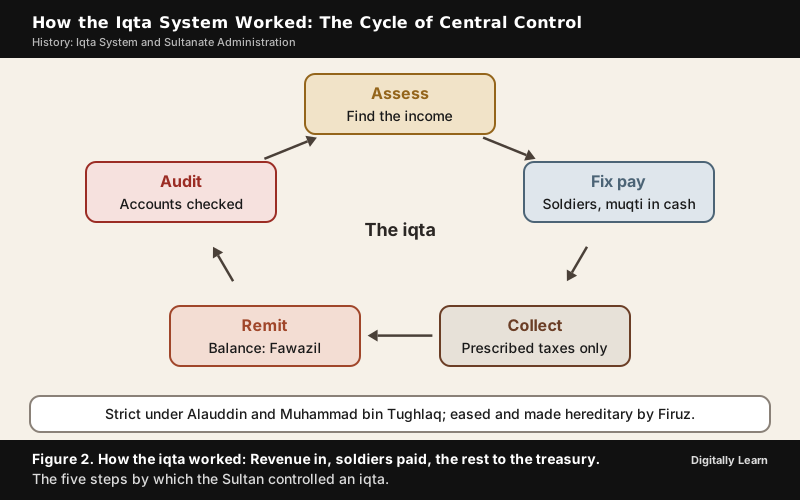
At first the muqtis were almost independent. They kept order, collected the land revenue, paid their soldiers' salaries out of it and kept the rest. As the central government grew stronger and more experienced, it began to control them closely, and the iqta came to work in a set order.
- Assess: The state tried to find out the actual income of each iqta.
- Fix pay: It fixed the salaries of the soldiers and of the muqti himself in cash.
- Collect: The muqti collected only the taxes the state prescribed.
- Remit: He sent the balance after expenses to the centre; this surplus was called the fawazil.
- Audit: Accountants appointed by the state checked his accounts every few years.
The audits were often harsh, with muqtis tortured or imprisoned for shortfalls, until Firuz Tughlaq relaxed them. Control worked best when the office was not inheritable and muqtis held an iqta for a short time before being transferred. These hard conditions were imposed most strictly under Alauddin Khalji and Muhammad bin Tughlaq.
Iqta System over Time: From Alauddin Khalji to Firuz Tughlaq
The iqta changed with the strength of the Sultan. Muqtis on the frontier commanded large forces, and one could take the throne itself. In 1320 Ghazi Malik, the governor of Dipalpur in the Punjab, marched on Delhi and became Sultan as Ghiyasuddin Tughlaq. Strong Sultans tightened control. Alauddin made the doab pay its revenue directly to the state, so no iqta was given there, and he ended the soldiers' village assignments by paying them in cash.
Firuz Tughlaq reversed the trend. He made offices and iqtas hereditary, which pleased the nobles but in the long run was harmful, and he eased the audits. He also kept his nobles close. At his new fort-city of Hisar, founded in 1354, the nobles and amirs were directed to build their residences. The iqtas themselves later became the provinces, or subas, of the Sultanate.
| Land assignment | Ruling power | What it was |
|---|---|---|
| Iqta | Delhi Sultans | Revenue of a territory assigned to a noble for service |
| Jagir | Mughals | Revenue assignment paying a mansabdar's salary |
| Amaram | Vijayanagara | Territory given to an amara-nayaka, a military commander, who kept troops |
| Mokasa | Marathas | Share of the chauth left to sardars to maintain troops |
Provincial and Local Administration of the Delhi Sultanate
Provinces, Shiqs, Parganas and Villages under the Sultanate
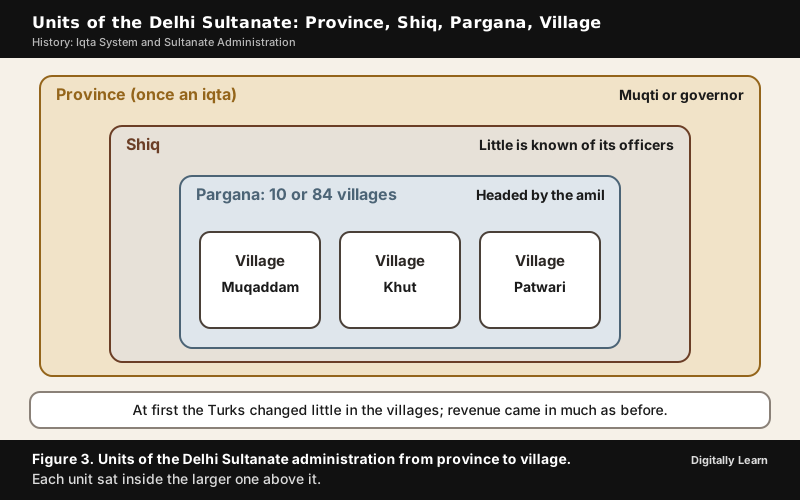
Below the provinces came the shiqs, and below them the parganas. Little is known about how these units were run. Villages were grouped into larger units, such as the chaurasi of 84 villages, and these groups must have been the basis of the parganas. The pargana was headed by the amil, who collected the revenue.
In the village the most important people were the khuts, the landowners, and the muqaddam, the headman, with the patwari, the village accountant. The village was perhaps left alone as long as it paid its land revenue. At first the Turks changed little at the local level. Revenue was collected in much the same way, by much the same people, which helped them establish their rule in the countryside quickly.
Change came from Alauddin Khalji onwards, at the start of the fourteenth century. His measurement of land and his curbs on the khuts and muqaddams, part of his land revenue system, led to conflicts, including peasant rebellions.
Legacy of Sultanate Administration for the Mughals and Others
The Sultanate broke up early in the fifteenth century into independent states, but its administrative system shaped many of them and influenced the Mughal system of the sixteenth century. The Vijayanagara Empire's amara-nayaka system was probably derived in many features from the iqta. Its commanders governed territories, kept part of the revenue and maintained troops.
The Mughals kept the idea of paying nobles with revenue assignments, called jagirs, but separated the right to revenue from the right to govern. The wazir's office revived under them, and military matters went to Akbar's Mir Bakhshi.
Previous Year UPSC‑CSE Questions
Each question is explained option by option.
- UPSC Prelims 2019Consider the following statements:
- In the revenue administration of Delhi Sultanate, the in-charge of revenue collection was known as 'Amil'.
- The Iqta system of Sultans of Delhi was an ancient indigenous institution.
- The office of 'Mir Bakshi' came into existence during the reign of Khalji Sultans of Delhi.
Which of the statements given above is/are correct?
How to approach this Prelims question
Approach: Test each statement against what the Sultanate's revenue system and offices actually were.
- Step 1: Statement 1 is correct. The pargana was headed by the amil, who collected the revenue.
- Step 2: Statement 2 is wrong. The iqta came from the Islamic world, where the Buyids and Seljuks used it.
- Step 3: Statement 3 is wrong. The Mir Bakhshi was a Mughal office, introduced under Akbar.
Trap to watch: Students who take the iqta for an old Indian land grant accept statement 2 and pick (b), but the iqta was brought from West Asia.
Why each option is right or wrong:
- (a) 1 only: Correct. Only the amil statement is right.
- (b) 1 and 2 only: Wrong. The iqta was not an ancient indigenous institution.
- (c) 3 only: Wrong. The Mir Bakhshi was Mughal, under Akbar.
- (d) 1, 2 and 3: Wrong. Statements 2 and 3 are false.
Answer: (a) 1 only. The amil collected the pargana's revenue, while the iqta came from West Asia and the Mir Bakhshi was a Mughal office.
- UPSC Prelims 2002With reference to medieval Indian rulers, which one of the following statements is correct?
How to approach this Prelims question
Approach: Match each measure with the Sultan who introduced it, then check the succession claim.
- Step 1: Check each measure against its Sultan. Balban first set up a separate ariz's department, and Alauddin Khalji introduced the branding of horses, so (a) and (b) swap the two.
- Step 2: Muhammad bin Tughlaq was succeeded by his cousin Firuz, not an uncle.
- Step 3: Firuz Tughlaq did set up a separate department of slaves.
Trap to watch: Options (a) and (b) name two real military measures but swap their Sultans, since Balban set up the ariz's department and Alauddin Khalji brought in the branding of horses.
Why each option is right or wrong:
- (a) Alauddin Khalji first set up a separate Ariz's department: Wrong. Balban first set it up; Alauddin paid close attention to it later.
- (b) Balban introduced the branding system of horses of military: Wrong. Alauddin Khalji introduced the branding (dagh).
- (c) Muhammad bin Tughlaq was succeeded by his uncle to the Delhi throne: Wrong. He was succeeded by his cousin, Firuz Tughlaq.
- (d) Firuz Tughlaq set up a separate department of slaves: Correct. This is the one accurate statement.
Answer: (d) Firuz Tughlaq set up a separate department of slaves. Each of the other three statements pairs a measure or a succession with the wrong ruler.
- UPSC Prelims 2000Match List I with List II and select the correct answer using the codes given below the Lists:List I
- I. Iqta
- II. Jagir
- III. Amaram
- IV. Mokasa
List II
- A) Marathas
- B) Delhi Sultans
- C) Mughals
- D) Vijayanagara
Codes:
How to approach this Prelims question
Approach: Place each land assignment with the state that used it, starting with the two best known.
- Step 1: Iqta goes with the Delhi Sultans and jagir with the Mughals (I‑B, II‑C).
- Step 2: Mokasa was the share of the chauth left to Maratha sardars (IV‑A).
- Step 3: That leaves amaram, the territory of Vijayanagara's amara-nayakas (III‑D). The code is I‑B, II‑C, III‑D, IV‑A.
Trap to watch: Options (b) and (c) differ only on amaram and mokasa; the Maratha mokasa settles it.
Why each option is right or wrong:
- (a) I‑C, II‑B, III‑A, IV‑D: Wrong. The iqta was the Sultans', not the Mughals'.
- (b) I‑B, II‑C, III‑D, IV‑A: Correct. Iqta, Sultans; jagir, Mughals; amaram, Vijayanagara; mokasa, Marathas.
- (c) I‑B, II‑C, III‑A, IV‑D: Wrong. Mokasa was Maratha, not Vijayanagara.
- (d) I‑C, II‑B, III‑D, IV‑A: Wrong. It swaps the iqta and the jagir.
Answer: (b) I‑B, II‑C, III‑D, IV‑A. The iqta was the Delhi Sultans', the jagir the Mughals', the amaram Vijayanagara's and the mokasa the Marathas'.
- UPSC Prelims 1998
- Assertion (A): At first the Turkish administration in India was essentially military.
- Reason (R): The country was parcelled out as 'Iqta's among leading military leaders.
How to approach this Prelims question
Approach: Judge the assertion and the reason separately, then ask whether the reason explains the assertion.
- Step 1: The assertion is true. The Turkish state in India was militaristic and aristocratic.
- Step 2: The reason is true. On conquest the country was divided into iqtas parcelled out among the leading Turkish nobles, who led troops.
- Step 3: The reason explains the assertion, because government in the provinces lay with military commanders holding iqtas.
Trap to watch: Students who see the military character as the result of constant war with the Mongols pick (b), but it came from the way the conquered land was shared out, as iqtas held by commanders.
Why each option is right or wrong:
- (a) Both A and R are true, and R is the correct explanation of A: Correct. Iqtas held by military commanders made the early administration military.
- (b) Both A and R are true, but R is NOT a correct explanation of A: Wrong. The parcelling out of iqtas is the reason the rule was military.
- (c) A is true, but R is false: Wrong. The country was indeed parcelled out as iqtas among leading nobles.
- (d) A is false, but R is true: Wrong. The early Turkish state was militaristic, so A is true.
Answer: (a) Both A and R are true, and R is the correct explanation of A. Iqtas held by military commanders made the early administration military.
- UPSC Prelims 1998Fawazil in the Sultanate period meant
How to approach this Prelims question
Approach: Follow the iqta's revenue from collection to the treasury and see which payment the term names.
- Step 1: The muqti collected the revenue of his iqta, met his own salary and his soldiers' pay, and sent the balance to the centre.
- Step 2: That surplus sent to the treasury was the fawazil.
Trap to watch: Students who read fawazil as an extra payment to nobles pick (a), but the money flowed the other way, from the iqtadar to the treasury.
Why each option is right or wrong:
- (a) Extra payment made to the nobles: Wrong. The fawazil flowed from the iqtadar to the treasury.
- (b) Revenue assigned in lieu of salary: Wrong. That describes the iqta itself, not the fawazil.
- (c) Excess amount paid to the exchequer by the iqtadars: Correct. The surplus after expenses was sent to the treasury.
- (d) Illegal exactions extracted from the peasants: Wrong. Muqtis were to collect only the prescribed taxes.
Answer: (c) Excess amount paid to the exchequer by the iqtadars. The fawazil was the surplus an iqtadar sent to the treasury after meeting his expenses.
Sources
- NCERT: Exploring Society, India and Beyond (Class VIII), Reshaping India's Political Map
- NCERT: Themes in Indian History Part II (Class XII), An Imperial Capital: Vijayanagara
- Wikipedia: Ghiyath al‑Din Tughluq
- Delhi Tourism (Govt of NCT of Delhi): Eight Cities of Delhi, Siri and Tughlakabad
- District Hisar (Govt of Haryana): History
- Reserve Bank of India: Medieval India coinage
- Wikipedia: Iqta
- Wikipedia: Delhi Sultanate
- Wikipedia: Jagir
- Wikipedia: Chauth
- Wikipedia: Bakhshi (Mughal Empire)
- Wikipedia: Revenue reforms of Alauddin Khalji
- UPSC: Civil Services Examination question papers
Editorial Disclaimer
This article draws on the NCERT history textbooks and the other sources listed. Little is known about the working of the smaller units of Sultanate administration.
See more of our UPSC articles in Google Search
Add to Preferred Sources