


Overview
The Slave dynasty, also called the Mamluk dynasty, was the first ruling line of the Delhi Sultanate, from 1206 to 1290. It was founded by Qutb-ud-din Aibak, a slave-general of Muhammad of Ghor, who became the first sultan when his master was killed in 1206. Its name comes from the fact that Aibak, his successor Iltutmish and the later sultan Balban had all begun as military slaves. Aibak founded the Sultanate; Iltutmish, who ruled from 1211 to 1236, made it a lasting state with Delhi as its capital.
Slave Dynasty and the Foundation of the Delhi Sultanate at a Glance
Who Founded the Slave Dynasty and the Delhi Sultanate
The Slave dynasty was founded by Qutb-ud-din Aibak in 1206, and with it began the Delhi Sultanate. Aibak had been a military slave of Muhammad of Ghor, the Ghurid ruler whose armies conquered northern India between 1175 and 1206. When Ghori was killed in 1206, Aibak became the independent ruler of the Ghurid lands in India, and the three houses of slave origin that followed him ruled at Delhi until 1290.
The dynasty has three names, and each tells you something:
- Slave dynasty: Aibak, Iltutmish and Balban had all been bought as slaves and trained as soldiers.
- Mamluk dynasty: A mamluk was a soldier of slave origin, a military class that held power in several Muslim societies, most famously in Egypt.
- Early Turkish rulers: The name used in the NCERT list of the rulers of Delhi, since the sultans were Turks from Central Asia.
The Slave dynasty was the first of five dynasties of the Delhi Sultanate before the Mughals:
| Dynasty | Years | A ruler to remember |
|---|---|---|
| Early Turkish (Slave or Mamluk) | 1206 to 1290 | Qutb-ud-din Aibak, Iltutmish, Balban |
| Khalji | 1290 to 1320 | Alauddin Khalji |
| Tughluq | 1320 to 1414 | Muhammad Tughluq |
| Sayyid | 1414 to 1451 | Khizr Khan |
| Lodi | 1451 to 1526 | Bahlul Lodi |
Slave Dynasty Rulers List, 1206 to 1290
Ten sultans ruled in the Slave dynasty, grouped into three houses. The Qutbi house was Aibak's; the Shamsi or first Ilbari house was Iltutmish's, named after his Turkish tribe; and the second Ilbari house was Balban's.
| Sultan | Reign | What to remember |
|---|---|---|
| Qutb-ud-din Aibak | 1206 to 1210 | Founder; ruled from Lahore; died after a fall at chaugan |
| Aram Shah | 1210 to 1211 | Chosen by the nobles at Lahore; deposed by Iltutmish |
| Iltutmish | 1211 to 1236 | Made Delhi the capital; the real consolidator |
| Ruknuddin Firuz | 1236 | Iltutmish's son; killed with his mother Shah Turkan after seven months |
| Razia | 1236 to 1240 | Iltutmish's daughter; the first woman to rule the Sultanate |
| Bahram Shah | 1240 to 1242 | Mongols sacked Lahore in his reign |
| Masud Shah | 1242 to 1246 | A puppet of the Forty |
| Nasiruddin Mahmud | 1246 to 1266 | Grandson of Iltutmish; Balban ran the state as his deputy |
| Balban | 1266 to 1287 | Broke the power of the Forty |
| Kaiqubad and Kayumars | 1287 to 1290 | The last rulers; replaced by the Khaljis in 1290 |
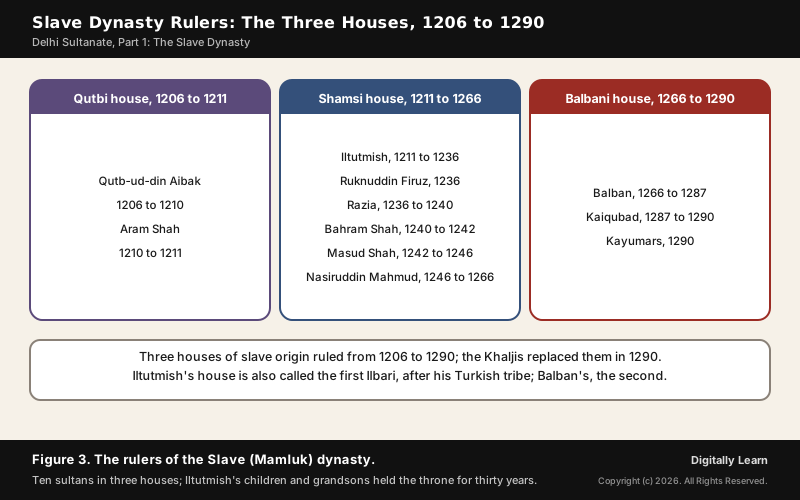
Put simply, the founder of the Slave dynasty was Qutb-ud-din Aibak; its greatest ruler was Iltutmish; after Iltutmish came his son Ruknuddin Firuz and then his daughter Razia; and its last ruler was the child Kayumars, set aside when Jalaluddin Khalji took the throne in 1290.
The Ghurid Conquest of North India: Muhammad of Ghor
Muhammad of Ghor's Campaigns and the Battles of Tarain
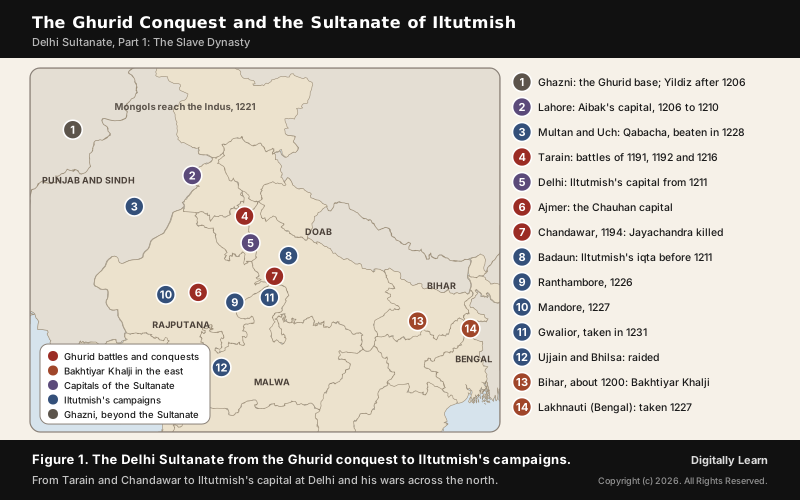
Before the Sultanate, Delhi was a Rajput city. It first became a capital under the Tomaras, who were defeated in the middle of the twelfth century by the Chauhans of Ajmer, and under both it grew into a trading centre whose coins, the dehliwal, circulated widely. Muhammad of Ghor, ruling from Ghazni in Afghanistan, broke into this world in a series of campaigns:
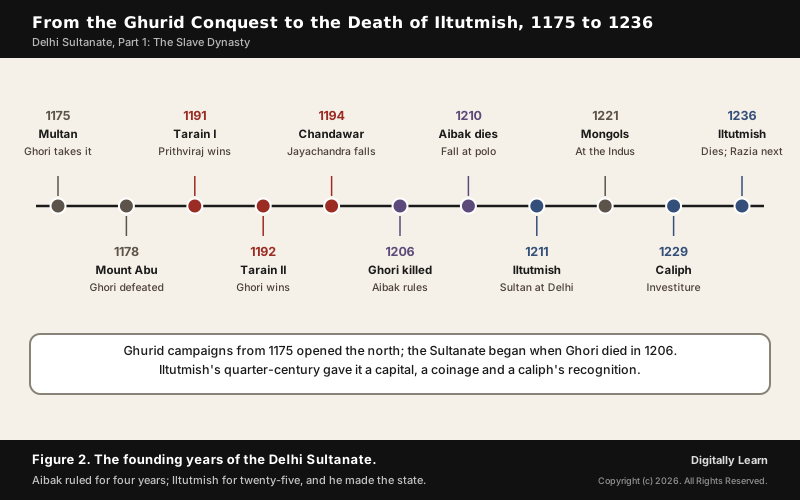
- 1175: He crossed the Indus and took Multan and Uch.
- 1178: Trying to enter Gujarat through the Thar desert, he was routed near Mount Abu by the Chaulukya king Mularaja II, and turned to the Punjab route instead.
- 1191, first battle of Tarain: He was defeated and wounded by the Rajput confederacy of Prithviraj Chauhan near Tarain, today’s Taraori in Haryana.
- 1192, second battle of Tarain: He returned with a large army of mounted archers and won. Prithviraj fled, was captured, and was later killed.
- 1194, Chandawar: He defeated and killed the Gahadavala king Jayachandra of Kanauj near Firozabad on the Yamuna.
Bakhtiyar Khalji in Bihar and Bengal
While Aibak held the centre, another of Ghori's commanders carried Ghurid arms east. Bakhtiyar Khalji, a Turko-Afghan general, subdued much of Bihar around 1200 and then took northern and western Bengal, where he and his successors ruled from Lakhnauti from 1203 to 1227.
His campaigns destroyed the great Buddhist monasteries of Odantapuri and Vikramashila. Many historians also hold him responsible for the sack of Nalanda, while others argue that Nalanda may not have been destroyed by him. He led an ill-fated expedition into Tibet in 1206 and was assassinated on his return to Bengal. Bengal then went its own way until Iltutmish brought it back under Delhi in 1227.
The Death of Muhammad of Ghor and the Three Slave-Generals
Muhammad of Ghor was assassinated on the bank of the Indus on 15 March 1206. He had no male heir and had come to trust his slaves more than his family, so his Indian conquests passed to three slave-generals:
- Ghazni: Taj-ud-din Yildiz took it and claimed to be Ghori’s true successor.
- Multan and Uch: Nasir-ud-din Qabacha held the Indus valley.
- Lahore and Delhi: Qutb-ud-din Aibak held the Punjab and the conquests in the Ganga plain.
The three were tied by marriage as well as rivalry: Yildiz was Aibak's father-in-law, and Qabacha married two of Aibak's daughters in turn. Ghori's nephew and successor, Ghiyasuddin Mahmud, recognised Aibak as ruler of Hindustan, sent him a ceremonial parasol, and styled him Sultan. That recognition is why 1206 is taken as the founding year of the Delhi Sultanate.
Qutb-ud-din Aibak: Founder of the Slave Dynasty, 1206 to 1210
From Slave to Sultan: Aibak's Early Career
Aibak was a Turk from Turkestan, sold into slavery as a child. At Nishapur in Persia he was bought by a qazi, Fakhruddin Abdul Aziz Kufi, in whose household he learned archery and riding. He was later sold to Muhammad of Ghor at Ghazni and rose to be Amir-i Akhur, the officer in charge of the royal stables.
After Tarain, Ghori left Aibak in charge of his Indian conquests, first at Kuhram in the Punjab. From there Aibak extended Ghurid power:
- He drove Prithviraj’s brother Hariraja out of Ranthambore and Ajmer and placed Ajmer under a Muslim governor.
- In 1197 he invaded Gujarat, defeated the Chaulukya king Bhima II and sacked the capital Anhilwara, avenging Ghori’s defeat of 1178.
- He helped Ghori crush a rebellion of the Khokhar chiefs of the Lahore region in 1205 and 1206.
Aibak's Reign: Lahore, Yildiz and the Fall at Chaugan
As sultan, Aibak ruled from Lahore, not Delhi. His four years went into holding what he had rather than conquering more. He fought Yildiz for the Punjab, drove him back and even advanced as far as Ghazni before retreating to Lahore. He kept the khutba and struck coins in the name of Ghiyasuddin Mahmud, and received from him a deed of investiture, and possibly one of manumission, freeing him from slavery.
The chroniclers remember him as loyal, generous and just. His generosity earned him the title lakh-bakhsh, the giver of lakhs. In 1210, while playing chaugan, a form of polo on horseback, at Lahore, he fell from his horse and died at once when the pommel of the saddle pierced his ribs. His tomb stands in the Anarkali bazaar of Lahore.
Aibak had named no heir. The nobles at Lahore raised Aram Shah to the throne, but other nobles invited Aibak's son-in-law, the governor of Badaun, and within eight months Aram Shah was gone.
Aibak's Buildings: Quwwat-ul-Islam, Qutb Minar and Adhai Din Ka Jhonpra
Aibak began the first monuments of the Delhi Sultanate, and each was finished or enlarged by Iltutmish:
- Quwwat-ul-Islam mosque, Delhi: The earliest surviving mosque of the Delhi Sultans, built in the 1190s in what the chronicles call Dehli-i kuhna, the old city. Its inscriptions record that material from 27 Hindu and Jain temples was used. Iltutmish and Alauddin Khalji enlarged it.
- Qutb Minar, Delhi: Aibak laid its foundation in 1199, for the muezzin’s call to prayer, and built the first storey; Iltutmish added three more. After lightning damaged the top in 1369, Firuz Shah Tughluq replaced that storey and added one more. Built of red and buff sandstone, it rises to 72.5 metres.
- Adhai Din Ka Jhonpra, Ajmer: A mosque commissioned by Aibak in 1192 and completed in 1199, built partly from materials of earlier temples and enlarged by Iltutmish in 1213.
The name of the Qutb Minar is itself debated. It is usually taken to honour Qutb-ud-din Aibak, who began it, but it may be named after the Sufi saint Qutbuddin Bakhtiar Kaki, to whom Iltutmish was devoted. The Qutb complex became a UNESCO World Heritage Site in 1993.
Iltutmish: The Real Consolidator of the Delhi Sultanate, 1211 to 1236
Who Was Iltutmish: An Ilbari Turk and a Slave of a Slave
Shams-ud-din Iltutmish was born into a leading family of the Ilbari Turkish tribe; his jealous brothers sold him into slavery. He was brought to Delhi, where Aibak bought him for 100,000 jitals, so that Iltutmish became, in the old phrase, the slave of a slave. He rose quickly:
- Amir-i Shikar: Superintendent of the hunt in Aibak’s household.
- Governor: Amir of Gwalior after its conquest in 1200, then holder of the iqta of Baran and finally of Badaun, the most important iqta of the Sultanate.
- Freed: His troops’ success against the Khokhars in 1205 and 1206 so impressed Muhammad of Ghor that Ghori freed him even before Aibak was freed.
- Son-in-law: He married one of Aibak’s daughters.
In 1211 Iltutmish marched to Delhi, seized power and defeated Aram Shah's forces at Jud near the city. He made Delhi his capital in place of Lahore, and so became the first Muslim sovereign to rule from Delhi.
Iltutmish's Wars: Yildiz, Qabacha, Bengal and the Rajput Chiefs
When Iltutmish took the throne, the Ghurid lands in India were split among rivals and the Rajput chiefs had thrown off Delhi's control. He won them back one by one:
- 25 January 1216: He defeated Yildiz at Tarain, and took Lahore in the winter of 1216 and 1217.
- 1225 to 1227: He forced Ghiyasuddin Iwaz Khalji of Bengal to pay tribute; in 1227 his son Nasiruddin Mahmud took Lakhnauti and Iwaz was executed.
- 1226 and 1227: He reasserted his authority over Ranthambore and Mandore.
- 1228: He invaded the Indus valley and besieged Uch; Qabacha drowned in the Indus trying to escape, and much of the Punjab and Sindh was annexed.
- 1231: He took Gwalior, and his armies raided Bhilsa and Ujjain in Malwa.
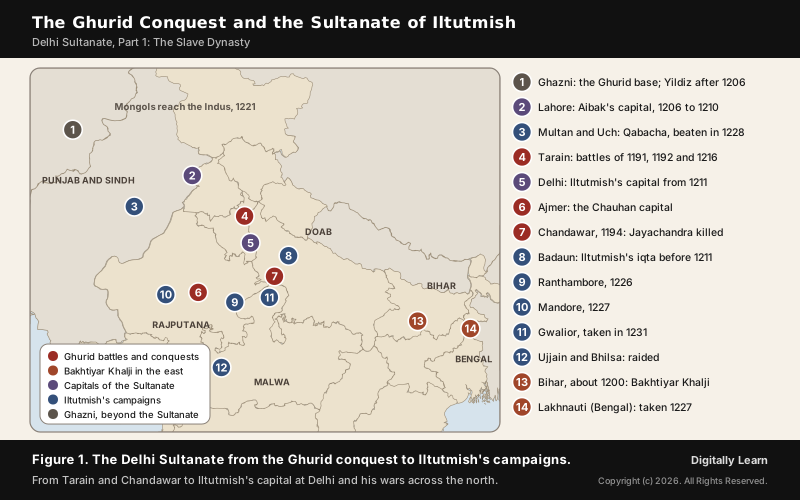
Not every campaign succeeded. An attempt to expand into Mewar ended in defeat by its ruler Jaitra Singh, which checked the Sultanate's advance into that region for years. Even so, by the end of his reign Iltutmish ruled the north from the Indus to Bengal, though mostly through fortified garrison towns rather than the countryside around them.
Genghis Khan at the Indus: How Iltutmish Kept the Mongols Out
The gravest danger of Iltutmish's reign came from Central Asia. In 1220 the Mongols of Genghis Khan overran the empire of the Khwarazm Shah, and in 1221 they defeated the Khwarazmian prince Jalal-ud-din Mangburni at the Battle of the Indus. Jalal-ud-din fled into the Punjab and asked Iltutmish for an alliance and a place to stay.
Iltutmish saw the risk of drawing the Mongols after him. According to the Persian historian Juvayni, he refused the request on the excuse that no place in his kingdom had a climate fit for a king. Genghis Khan sent envoys to ask permission to return home through India, then abandoned the plan, and the young Sultanate was spared the destruction the Mongols carried across Central Asia.
Iltutmish's Administration: Iqta, Tanka, Jital and the Forty
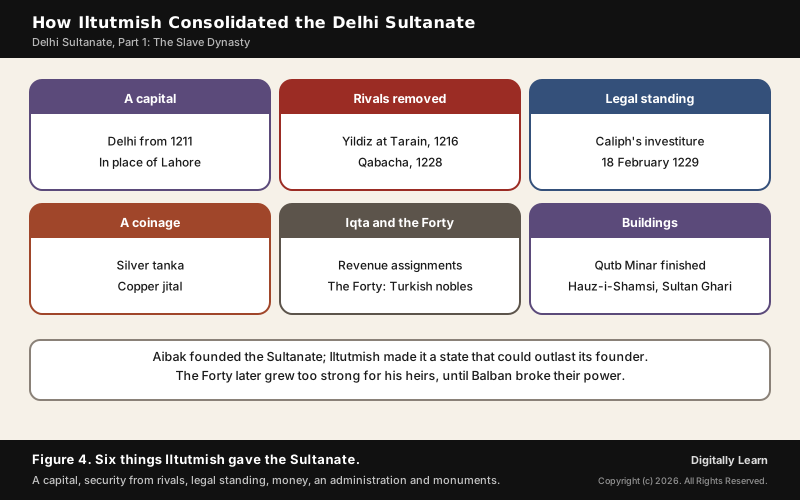
Iltutmish gave the Sultanate the institutions that let it outlive him. The early Turkish administration was essentially military, and its core was the iqta:
- The iqta: Military commanders were appointed as governors of territories called iqtas. The holder, the muqti or iqtadar, led campaigns and kept order, and collected the revenue of his iqta as his salary, paying his soldiers from it.
- The bandagan: Instead of relying on aristocrats and local chiefs, Iltutmish favoured special slaves bought for military service and trained for high office, because they depended wholly on him.
- The coinage: He introduced the silver tanka and the copper jital, the two basic coins of the Sultanate, struck to a standard weight of 175 grains.
- The Forty: A corps of leading Turkish nobles, the Chihalgani, grew up around him and became the most powerful group at court after his death.
He also won the Sultanate legal standing in the Muslim world. The Abbasid Caliph al-Mustansir recognised his authority in India, and on 18 February 1229 an embassy reached Delhi with a deed of investiture and the title Nasir Amir al-Mu'minin. Iltutmish then put the Caliph's name on his coins, including the new silver tanka.
Iltutmish's Tomb, Sultan Ghari and Hauz-i-Shamsi
Iltutmish was a great builder in Delhi. Besides completing the Qutb Minar and enlarging the Quwwat-ul-Islam mosque, he commissioned:
- Hauz-i-Shamsi: A large reservoir south of the Qutb Minar, built in 1230, with a madrasa around it.
- Sultan Ghari: The tomb of his eldest son, Nasiruddin Mahmud, who died in 1229; it is regarded as the first Islamic mausoleum in India.
- Gandhak ki Baoli: A stepwell built for the Sufi saint Qutbuddin Bakhtiar Kaki.
- The tomb of Iltutmish: Built in 1235 inside the Qutb complex at Mehrauli, beside the mosque he had enlarged.
These buildings show how firmly Iltutmish tied the new state to Delhi. Lahore had been a frontier headquarters; Delhi, with its mosques, reservoir and royal tombs, became the centre of the new state.
Who Ruled After Iltutmish: Ruknuddin Firuz and Razia
Iltutmish had groomed his eldest son, Nasiruddin Mahmud, as his successor, but the prince died in 1229. When Iltutmish left for Gwalior in 1231 he put his daughter Razia in charge of Delhi, and her able administration led him to declare her his heir. Shortly before his death, however, he seems to have chosen his eldest surviving son, Ruknuddin Firuz, instead.
Iltutmish died on 30 April 1236. The nobles raised Ruknuddin, but his mother Shah Turkan ran the state and made many enemies, and on 9 November 1236 both were killed. Razia then took the throne and ruled until 1240, the first woman to rule the Delhi Sultanate. The chronicler Minhaj-i Siraj thought a queen's rule went against the social order, yet on her coins and inscriptions Razia proudly called herself the daughter of Sultan Iltutmish. Her reign, the struggle with the Forty and Balban's rise are the subject of Part 2.
Why the Slave Dynasty Mattered
Significance of the Slave Dynasty for the Delhi Sultanate
The Slave dynasty turned a set of Ghurid garrisons into an Indian state. Its achievements can be counted in four steps:
- A capital: Delhi, chosen by Iltutmish, remained the seat of the Sultanate under the Khaljis and Tughluqs; only Sikandar Lodi moved the court to Agra.
- Independence: The Sultanate broke from Ghazni and stood on its own, recognised by the Caliph.
- Institutions: The iqta, the tanka and jital, and the reliance on trained slaves became the working parts of the Sultanate for two centuries.
- Survival: Iltutmish’s refusal to shelter Jalal-ud-din kept the Mongols of Genghis Khan out.
Its weakness was just as lasting. In the early thirteenth century Delhi's control rarely went beyond heavily fortified towns, and governors rebelled at any sign of weakness. Slaves and clients were loyal to their master but not to his heirs, so every succession brought conflict between old nobles and new, the struggle that dominated the thirty years after Iltutmish until Balban broke the power of the Forty.
Persian Sources for the Slave Dynasty: Minhaj-i Siraj and the Tawarikh
Much of what we know about the Slave dynasty comes from histories written in Persian, the language of administration under the Delhi Sultans. A history of this kind was called a tarikh, plural tawarikh. Its authors were learned men, secretaries, administrators, poets and courtiers, who recounted events and also advised rulers on how to govern, stressing the importance of just rule.
- Minhaj-i Siraj: His Tabaqat-i Nasiri, completed in 1260 and named after Sultan Nasiruddin Mahmud, is the main account of Aibak, Iltutmish and Razia.
- Hasan Nizami: A contemporary chronicler who, like Minhaj, called Aibak a Sultan.
- Fakhr-i Mudabbir: A thirteenth-century writer whose circle of justice runs: a king needs soldiers, soldiers need salaries, salaries come from revenue, and peasants can pay only when justice makes them prosperous.
- Juvayni: The Persian historian of the Mongols, whose account records Iltutmish’s refusal to shelter Jalal-ud-din.
These sources reflect the spirit of their age as much as its events. Their authors lived in the cities, mainly Delhi, and hardly ever in villages; they often wrote for sultans in the hope of rich rewards; and they urged rulers to preserve an ideal social order based on birthright and gender distinctions. That is why Minhaj, who admitted Razia was more able than all her brothers, was still uncomfortable with a queen on the throne.
Slave Dynasty in UPSC Previous Year Questions
What UPSC Has Asked About Aibak, Iltutmish and the Early Sultanate
UPSC's objective questions on the Slave dynasty test precise facts about its two founders and the character of the early Turkish state, and the four set so far are answered by the sections above. Two patterns stand out. The question on Aibak asked about his death; those on Iltutmish asked about the Mongols of 1221 and the iqta. A statement that gives Aibak credit for what Iltutmish did is the commonest trap.
| Year | What the question asked | The point being tested |
|---|---|---|
| 1998 | Whether the first Turkish administration was essentially military because the country was parcelled out as iqtas | Both true; the iqta explains the military character |
| 2001 | In whose reign the Mongols under Genghis Khan invaded India | Iltutmish |
| 2003 | How Qutb-ud-din Aibak died | A fall from his horse while playing chaugan |
| 2021 | Three statements on invaders and visitors; the first on Genghis Khan reaching the Indus | Only the Iltutmish statement is true |
The 2020 GS Paper I question on whether Persian literary sources reflect the spirit of the age draws on the chroniclers of this period, Minhaj-i Siraj above all, and on what their position at court led them to record and to leave out.
Previous Year UPSC-CSE Questions
Previous Year UPSC-CSE Questions By the end you will be able to draft model answers for the following UPSC questions. Each question carries a collapsible framework showing how to approach it in the exam.
- UPSC Mains 2020 GS-IPersian literary sources of medieval India reflect the spirit of the age. Comment.
How to structure the answer in the exam
Introduction: Open with Persian as the language of administration and the tawarikh as the main sources for the Sultanate.
Body (sub-themes to develop):
- Who wrote them: secretaries, administrators, poets and courtiers, mostly in Delhi and for royal patrons.
- What they reflect: court politics, the ideal of just rule (Fakhr-i Mudabbir's circle of justice), and a social order based on birthright.
- Example: Minhaj-i Siraj's Tabaqat-i Nasiri admires Razia's ability yet objects to a woman ruling.
- Limits: little about villages and peasants; praise for patrons; the need to read them against coins, inscriptions and buildings.
Conclusion: Conclude that the Persian sources are indispensable and also a mirror of the elite outlook of their time.
- UPSC Prelims 1998 Prelims-GSConsider the following Assertion (A) and Reason (R):
- Assertion (A): At first the Turkish administration in India was essentially military.
- Reason (R): The country was parcelled out as ‘Iqta’s among leading military leaders.
Select the correct answer using the codes given below.
How to approach this Prelims question
Approach: Test each statement, then ask whether the reason explains the assertion.
Trap to watch: Both statements are true; the trap is to call the reason unrelated.
Key facts to recall:
- Iqtas were assigned to military commanders, who collected their revenue as salary
- The early sultans relied on military slaves for governors
Answer signal: Both true and the reason explains the assertion, option (a).
- UPSC Prelims 2001 Prelims-GSThe Mongols under Genghis Khan invaded India during the reign of
How to approach this Prelims question
Approach: Tie Genghis Khan (1221) to the sultan then ruling.
Trap to watch: Balban also fought the Mongols, but later, against Genghis Khan's successors.
Key facts to recall:
- Battle of the Indus, 1221
- Iltutmish refused Jalal-ud-din Mangburni shelter
Answer signal: Iltutmish, option (c).
- UPSC Prelims 2003 Prelims-GSHow did Sultan Qutb-ud-din Aibak die?
How to approach this Prelims question
Approach: Recall the chaugan accident at Lahore in 1210.
Trap to watch: Yildiz was Aibak's rival, but Aibak drove him back; he did not die in battle with him.
Key facts to recall:
- Aibak died in 1210 at Lahore
- The pommel of the saddle pierced his ribs
Answer signal: A fall from his horse while playing chaugan, option (d).
- UPSC Prelims 2021 Prelims-GSConsider the following statements:
- It was during the reign of Iltutmish that Chengiz Khan reached the Indus in pursuit of the fugitive Khwarezm prince.
- It was during the reign of Muhammad bin Tughluq that Taimur occupied Multan and crossed the Indus.
- It was during the reign of Deva Raya II of Vijayanagara Empire that Vasco da Gama reached the coast of Kerala.
Which of the statements given above is/are correct?
How to approach this Prelims question
Approach: Date each event and match it to the ruler of the time.
Trap to watch: Timur came in 1398, not under Muhammad bin Tughluq (died 1351); Vasco da Gama came in 1498, after Deva Raya II (reign ended 1446).
Key facts to recall:
- Genghis Khan reached the Indus in 1221, in Iltutmish's reign
Answer signal: Only statement 1 is correct, option (a).
Sources
- NCERT: Our Pasts II (Class VII), The Delhi Sultans
- Wikipedia: Delhi Sultanate
- Wikipedia: Mamluk dynasty (Delhi)
- Wikipedia: Qutb ud-Din Aibak
- Wikipedia: Iltutmish
- Wikipedia: Muhammad of Ghor
- Wikipedia: First Battle of Tarain
- Wikipedia: Second Battle of Tarain
- Wikipedia: Battle of Chandawar
- Wikipedia: Bakhtiyar Khalji
- Wikipedia: Taj al-Din Yildiz
- Wikipedia: Nasir ad-Din Qabacha
- Wikipedia: Qutb Minar
- Wikipedia: Quwwat-ul-Islam Mosque
- Wikipedia: Adhai Din Ka Jhonpra
- Wikipedia: Sultan Ghari
- Wikipedia: Iqta%27
- Wikipedia: Tanka (coin)
- Wikipedia: Aram Shah
- Wikipedia: Razia Sultana
- Wikipedia: Rukn ud din Firuz
- Wikipedia: Iwaz Khalji
- Wikipedia: Hauz-i-Shamsi
- Wikipedia: Tabaqat-i Nasiri
- Wikipedia: Sack of Delhi (1398)
- Wikipedia: Deva Raya II
- Wikipedia: Vasco da Gama
- Wikipedia: Muhammad bin Tughluq
- Archaeological Survey of India: Qutb Minar and its Monuments, Delhi
- Delhi Tourism (Government of NCT of Delhi): Qutab Minar
- Incredible India (Ministry of Tourism): Qutub Minar
- UPSC: Civil Services Examination question papers
Editorial Disclaimer
This article is for UPSC preparation. The early history of the Sultanate rests on the Persian chronicles, and the account follows the standard scholarship on the period.