


Overview
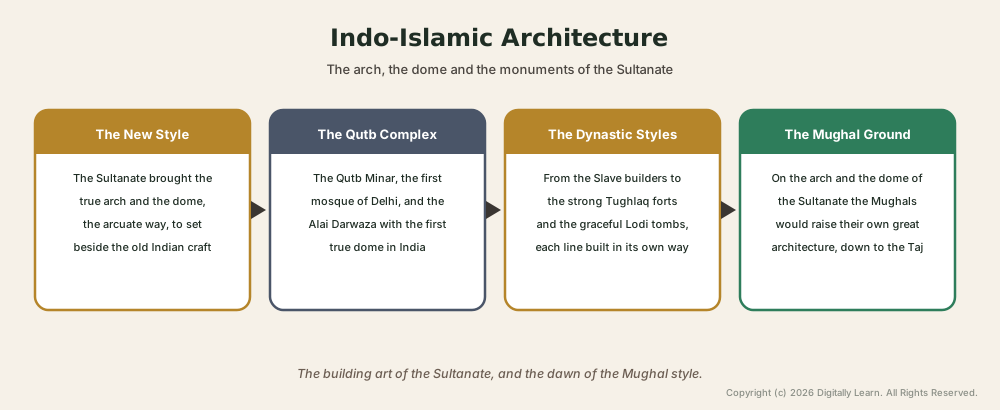
The Delhi Sultanate gave India a new architecture, the Indo-Islamic style, in which the forms of Islam, the arch, the dome, the minaret and the mosque, were raised by the hands and in the materials of Indian craftsmen. Its greatest gift was the true arch and the dome, the arcuate way of building, which came in by about 1300 in place of the older corbelled stone. Its first works still stand at the Qutb complex in Delhi, the Qutb Minar and the Alai Darwaza; and each dynasty, the Tughlaqs with their strong forts and the Lodis with their graceful tombs, built in its own way. This part covers the new style, the Qutb complex, the dynastic styles and the exam focus.
The Indo-Islamic Style
The Marriage of Two Building Traditions
What is the significance of the Indo-Islamic style: it was a new architecture, born of the meeting of the forms of Islam with the craft of India, and it changed the face of building in the land.
The new rulers brought new forms: the arch, the dome, the minaret and the mosque, which the architecture of Islam had perfected. But these were raised by Indian craftsmen, in Indian stone, with the chisel-work and the ornament that Indian hands knew best, so that the style that grew was neither wholly of Persia nor wholly of India, but a marriage of the two.
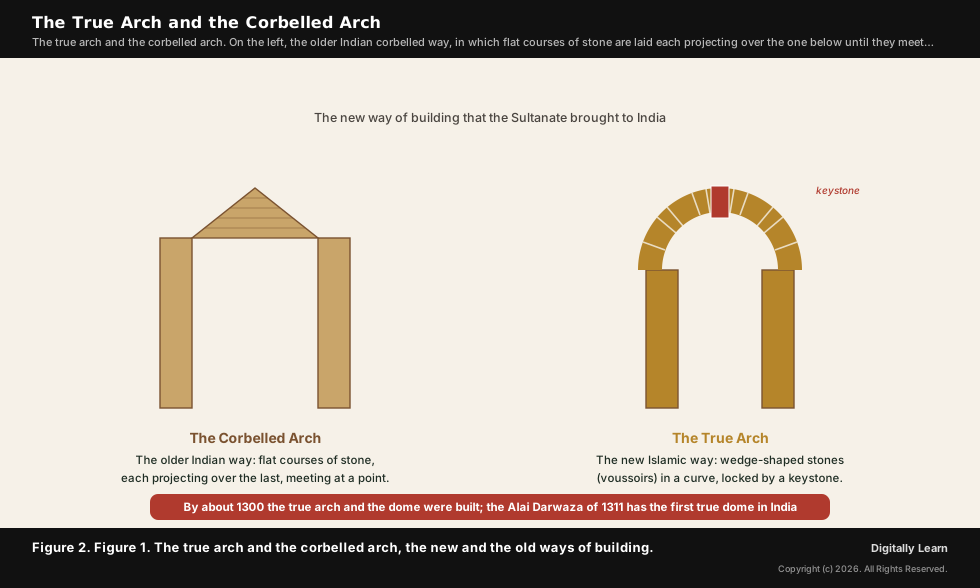
Its greatest novelty was the true arch. In place of the older Indian way, the corbelled arch and the beam and bracket, the new builders raised the true arch of wedge-shaped stones and the dome above it, the arcuate way, which came in by about 1300.
The surfaces too were new. The builders covered their walls with arabesque and with the words of the Quran, for the figure of man or beast was shunned in the mosque. The figure below sets out the two ways of the arch.
The Qutb Complex at Delhi
The Qutb Minar, the Mosque and the Alai Darwaza
What is the significance of the Qutb complex: it holds the first great works of the Sultanate, from the founding age to the Khaljis, and is today a World Heritage site.
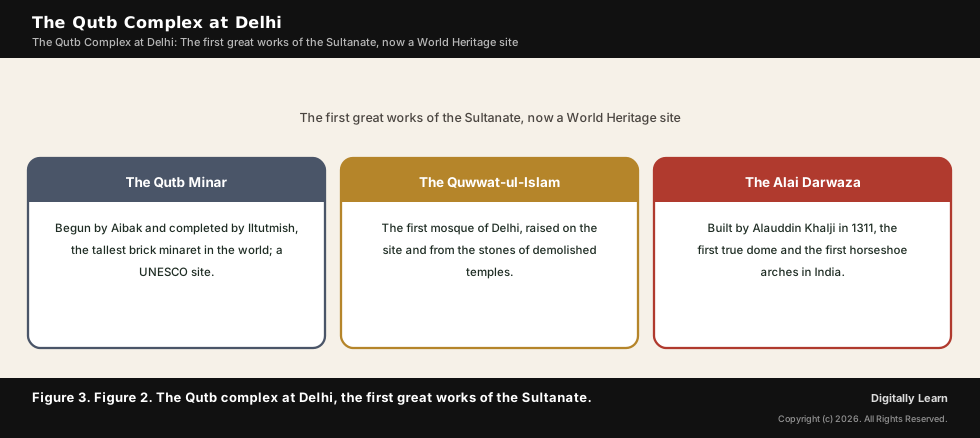
The first works rose under the Slave kings. The great Qutb Minar, the tower of victory, was begun by Qutb-ud-din Aibak and completed by Iltutmish; it is the tallest brick minaret in the world and is now a UNESCO World Heritage site. Beside it Aibak raised the Quwwat-ul-Islam, the first mosque of Delhi, built on the site and from the stones of demolished temples, so that Indian carving can still be seen in its pillars.
The Khaljis added the masterpiece. In 1311 Alauddin Khalji built the Alai Darwaza, the southern gateway of the mosque, which carries the first true dome and the first horseshoe arches in India, the full flowering of the arcuate style. The figure below sets out the works of the Qutb complex.
The Styles of the Dynasties
From the Slave to the Lodi Builders
What is the significance of the dynastic styles: each line of sultans built in its own manner, so that the architecture of the Sultanate can be read as a story of changing styles.
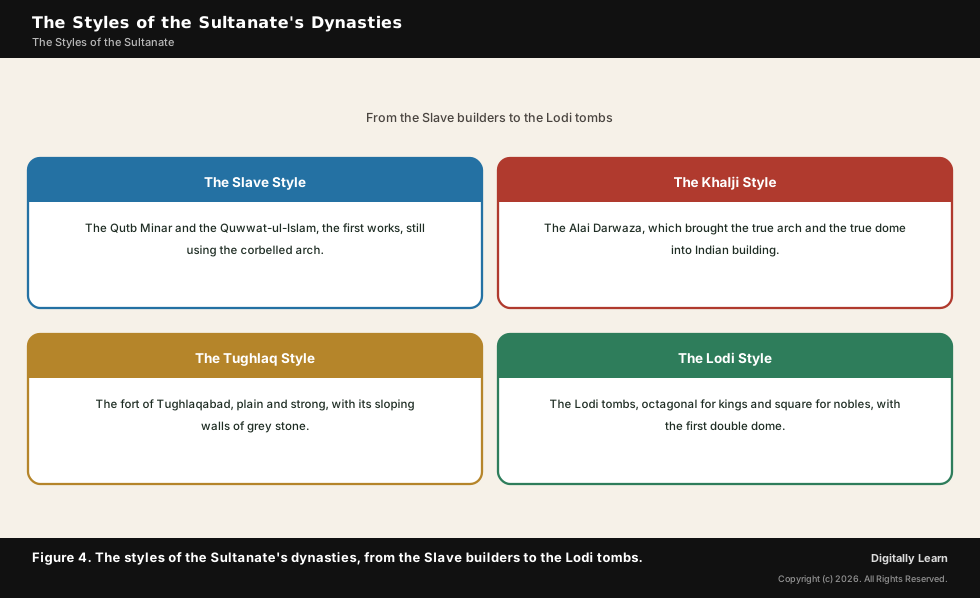
The styles changed with the dynasties. The Slave kings raised the Qutb Minar and the first mosque, still using the corbelled arch; the Khaljis brought in the true arch and dome with the Alai Darwaza; and the Tughlaqs built plain and strong, their fortress of Tughlaqabad rising in grey stone with the sloping walls that mark their work.
The last great style was the Lodi. The Lodi sultans and nobles raised the fine tombs that still stand in the gardens of Delhi, octagonal in plan for the kings and square for the nobles, and it was in these tombs that the double dome, a shell within a shell, was first built in India. The table below sets out the chief monuments by dynasty, and the figure the styles.
| Dynasty | Monument | Mark |
|---|---|---|
| Slave | The Qutb Minar; the Quwwat-ul-Islam mosque. | The first works; the corbelled arch. |
| Khalji | The Alai Darwaza, in 1311. | The first true dome and horseshoe arch in India. |
| Tughlaq | The fort of Tughlaqabad. | Plain and strong, with sloping walls. |
| Lodi | The Lodi tombs in the gardens of Delhi. | The first double dome in India. |
UPSC Relevance and Exam Focus
Where the Architecture of the Sultanate Fits in the UPSC-CSE Syllabus
This topic belongs to General Studies Paper I: medieval Indian art and architecture, and the monuments of the Sultanate, above all the Qutb Minar and the Alai Darwaza, are a regular ground for questions.
The questions most often test the Qutb Minar and its builders, the Alai Darwaza as the first true dome, and the chronological order of the great monuments.
Several linked points recur and are worth holding in working memory:
- The Qutb Minar: Begun by Aibak, completed by Iltutmish; a UNESCO World Heritage site.
- The Quwwat-ul-Islam: The first mosque of Delhi, raised from the stones of temples.
- The Alai Darwaza: Built by Alauddin in 1311, the first true dome in India.
- The Tughlaq style: Plain and strong, with the sloping walls of Tughlaqabad.
- The Lodi tombs: Octagonal and square, with the first double dome in India.
A 1998 question asked the order in which four monuments were built; the answer is the Qutub Minar first, then Tughlaqabad, then the Lodi Garden, and last the Mughal Fatehpur Sikri, so the code is Qutub Minar, Tughlaqabad Fort, Lodi Garden, Fatehpur Sikri.
A 2000 question placed the building of the Qutub Minar in a wider chronology, before the death of Firoz Tughlaq, the coming of the Portuguese and the reign of Krishna Deva Raya; the tower of the early Sultanate comes first of the four. So this part, which closes our cluster on the Delhi Sultanate, returns to the very monument with which its story began.
Previous Year UPSC-CSE Questions
Previous Year UPSC-CSE Questions By the end you will be able to draft model answers for the following UPSC questions. Each question carries a collapsible framework showing how to approach it in the exam.
- UPSC Prelims 1998 GS-IConsider the following monuments and their order of building: I. Tughluqabad Fort, II. Lodi Garden, III. Qutub Minar, IV. Fatehpur Sikri.
- Tughluqabad Fort
- Lodi Garden
- Qutub Minar
- Fatehpur Sikri
The correct chronological order in which they were built is:
How to approach this Prelims question
Approach: Order by dynasty: the Qutub Minar (Slave) first, then Tughlaqabad (Tughlaq), then the Lodi Garden (Lodi), then Fatehpur Sikri (Mughal).
Trap to watch: Do not put Tughlaqabad before the Qutub Minar; the Qutub Minar of the Slave age is the earliest, and Fatehpur Sikri of the Mughals the latest.
Key facts to recall:
- The Qutub Minar was begun in the Slave age, the earliest.
- Tughlaqabad is Tughlaq; the Lodi Garden is Lodi.
- Fatehpur Sikri is Mughal, the latest of the four.
Answer signal: III, I, II, IV.
- UPSC Prelims 2000 GS-IConsider the following events in chronological order: I. Reign of Krishna Deva Raya of Vijayanagara, II. Construction of Qutab Minar, III. Arrival of Portuguese in India, IV. Death of Firoz Tughlaq.
- Reign of Krishna Deva Raya of Vijayanagara
- Construction of Qutab Minar
- Arrival of Portuguese in India
- Death of Firoz Tughlaq
Which one of the following is the correct chronological sequence of the above events?
How to approach this Prelims question
Approach: Anchor on the Qutub Minar (II) as the earliest (13th century); then Firoz Tughlaq's death (IV, 1388), the Portuguese (III, 1498) and Krishna Deva Raya (I, early 16th century).
Trap to watch: Do not place the Qutub Minar after Firoz Tughlaq; the tower belongs to the founding age of the Sultanate, the earliest of the four.
Key facts to recall:
- The Qutub Minar was built in the 13th century, the earliest.
- Firoz Tughlaq died in 1388; the Portuguese came in 1498.
- Krishna Deva Raya reigned in the early 16th century, the latest.
Answer signal: II, IV, III, I.
Sources and Further Reading
Editorial Disclaimer
This article is for UPSC preparation. The architectural history of the Sultanate rests on the standing monuments and the standard scholarship on Indo-Islamic art.