


Overview
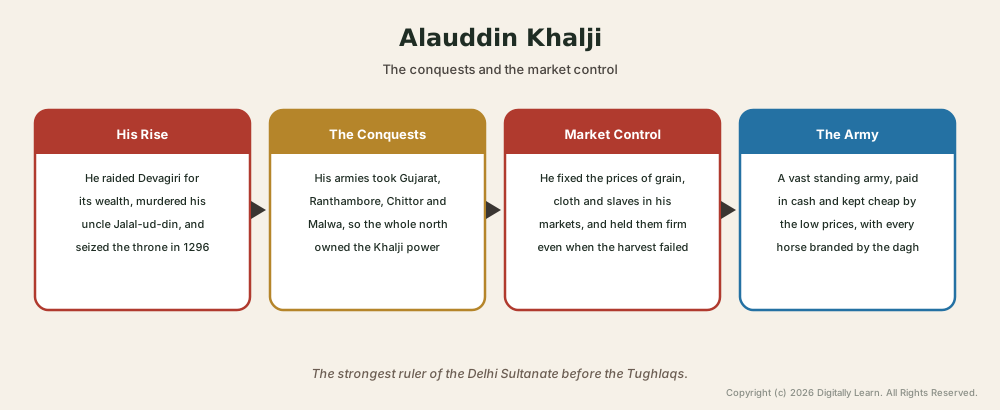
Alauddin Khalji was the greatest of the Khalji sultans and the strongest ruler of the Delhi Sultanate before the Tughlaqs. He seized the throne in 1296 by murdering his uncle Jalal-ud-din, the founder of the dynasty, and then conquered the whole of the north, taking Gujarat, the great Rajput forts of Ranthambore and Chittor, and Malwa. To pay for a vast standing army that could hold off the Mongols, he set up a famous market control, fixing the price of every grain, cloth and animal in the markets of Delhi. This part covers his rise, the conquests of the north, the market control and the standing army, and the exam focus. The Deccan campaigns and the Mongol invasions in depth follow in Part 4.
The Khalji Revolution
Jalal-ud-din and the Accession of Alauddin
What is the significance of the Khalji revolution: it passed the throne from the old Turkish nobility to a new line, and raised in Alauddin the strongest sultan the Delhi throne had yet seen.
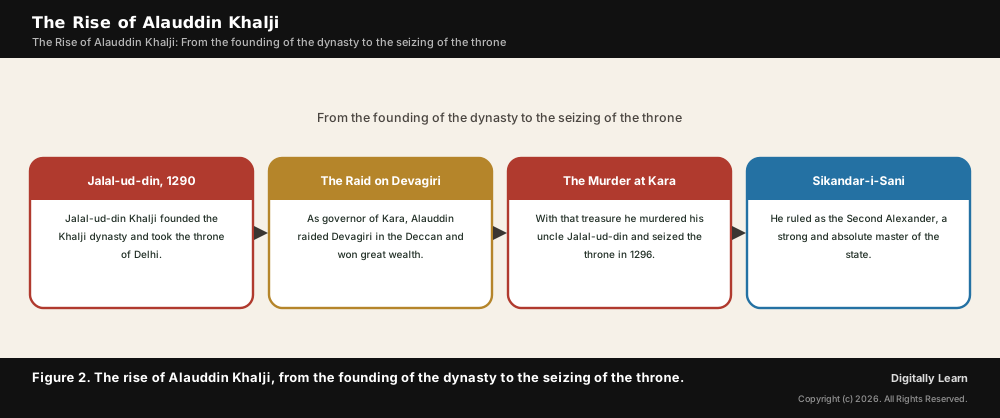
The Khalji dynasty was founded in 1290 by Jalal-ud-din Firuz Khalji, an old and mild ruler. His ambitious nephew and son-in-law Alauddin, the governor of Kara, longed for the throne. In 1296 he led a daring raid far south to Devagiri in the Deccan and came back laden with its treasure.
With that wealth Alauddin bought men and arms, and then, under the show of friendship, he murdered Jalal-ud-din at Kara and seized the throne for himself in 1296. He ruled as the second great founder of the Khalji power, a hard and absolute master. The figure below sets out his rise.
Sikandar-i-Sani: Alauddin's Imperial Ambition
Distinguishing his rule: Alauddin governed as an absolute autocrat, who would suffer no rival to his power, and who dreamed of conquest on the scale of Alexander.
He styled himself Sikandar-i-Sani, the Second Alexander, and stamped the title on his coins. He would let no noble grow strong enough to challenge him: he forbade the nobles to drink, to feast together or to wed among themselves without his leave, and he set a network of spies over them, so that no plot could ripen.
To hold so vast a state by his own will, Alauddin needed two things above all: armies to conquer and to guard the frontier, and the money to pay them. His conquests of the north and his famous market control, which the next sections describe, were the two halves of this single design.
The Conquests of the North
Gujarat, Ranthambore, Chittor and Malwa
What is the significance of the conquests: Alauddin brought the whole of northern India and the great Rajput forts under the Sultanate, a reach no sultan before him had won.
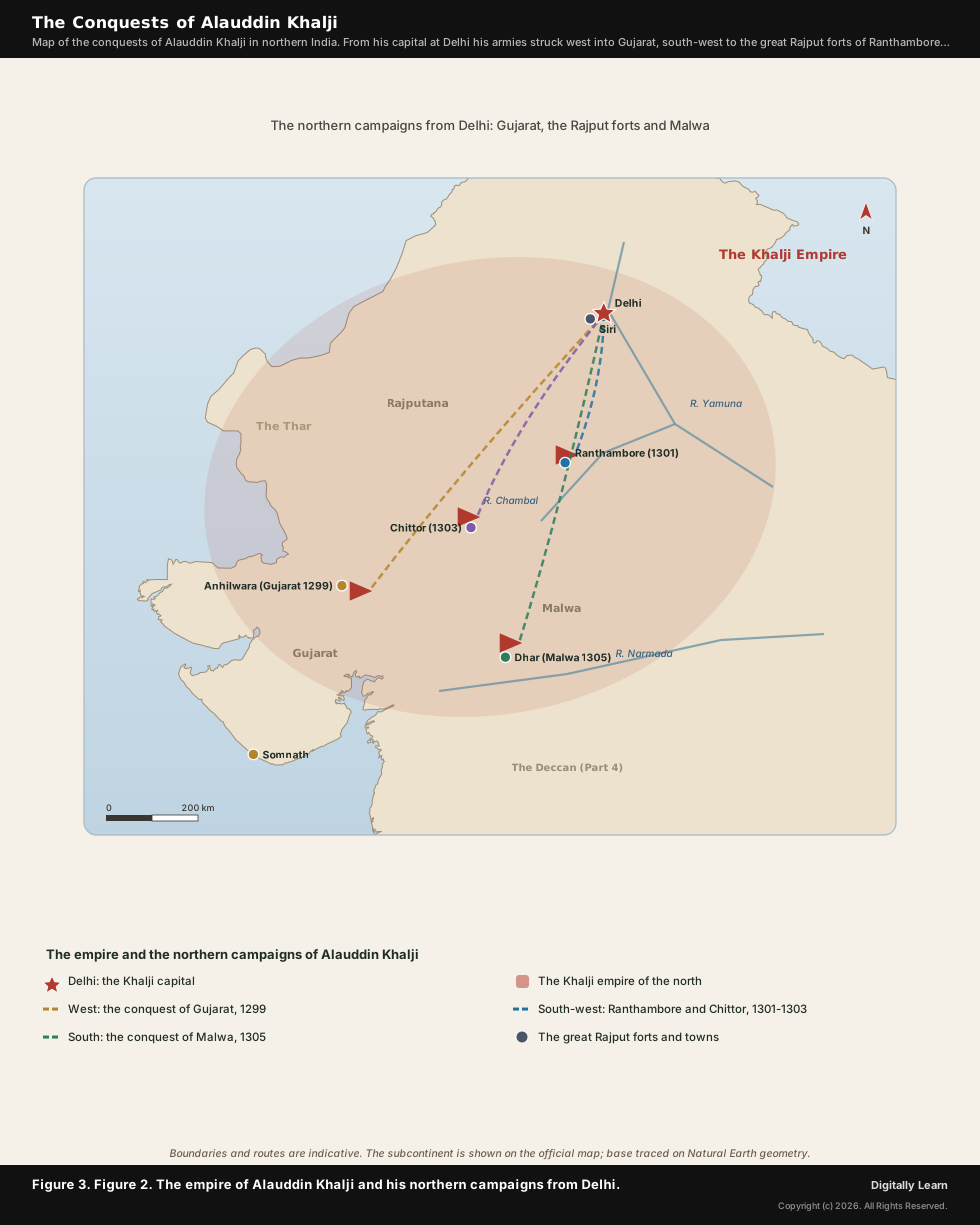
His armies struck on every side. In 1299 his generals Ulugh Khan and Nusrat Khan conquered the rich land of Gujarat. Then he turned on the great Rajput strongholds: Ranthambore fell in 1301, and Chittor, after a siege of some eight months, in 1303. In 1305 his army took Malwa, where the Paramara king was slain.
So the north was won, from Gujarat in the west to the gate of the Deccan in the south. The table below sets out the chief conquests of Alauddin Khalji in the north by their year and their seat.
| Conquest | Year | Note |
|---|---|---|
| Gujarat | 1299 | Taken by Ulugh Khan and Nusrat Khan, a rich and trading land. |
| Ranthambore | 1301 | The great Rajput fort of the Chauhans, taken by siege. |
| Chittor | 1303 | The famed Rajput fort of Mewar, taken after some eight months. |
| Malwa | 1305 | The central plateau, where the Paramara king was slain. |
The Empire of Alauddin in the North
Distinguishing the reach of the empire: from Delhi the Khalji power now ran west to the sea, south-west over Rajputana, and south to the edge of the Deccan plateau.
The heart of the empire was Delhi, where Alauddin raised the new fort and city of Siri. From it his arms reached out along the routes the map below sets out: west to Gujarat and the sea, south-west to the Rajput forts of Ranthambore and Chittor, and south to Malwa on the way to the Deccan.
The Deccan itself he did not yet annex, but raided and made tributary through his general Malik Kafur; that great southern adventure, and the Mongol invasions he turned back at Delhi, are the subject of the next part. The map shows the northern empire and the campaigns that won it.
The Market Control and the Standing Army
The Three Markets and the Fixing of Prices
What is the significance of the market control: it was the most famous economic experiment of the Sultanate, a sweeping attempt to fix by the state the price of every needful thing.
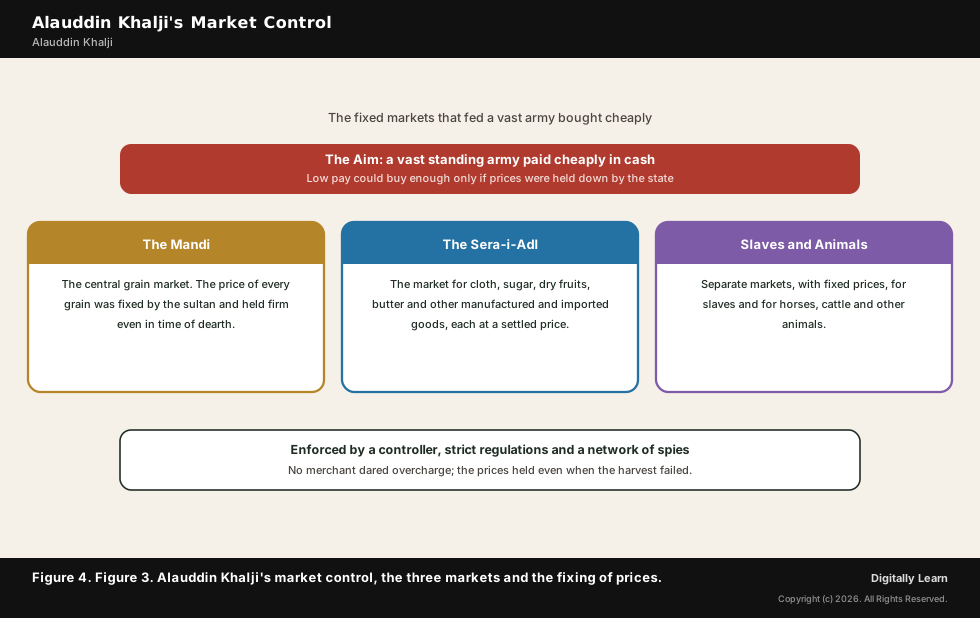
Alauddin set up special markets at Delhi and fixed in each the price of every article. The chief was the Mandi, the grain market, where the price of every grain was settled and held firm. Beside it stood the Sera-i-Adl, the market for cloth, sugar, dry fruits and other manufactured and imported goods, and there were separate markets, also at fixed prices, for slaves and for animals.
The prices were enforced with an iron hand. A controller and his officers watched over the grain market, strict regulations governed every sale, and a network of spies reported any breach, so that no merchant dared overcharge and the price held firm even when the harvest failed. The figure below sets out the markets and their control.
A Large Army Bought Cheaply
Distinguishing the purpose: the market control was not a measure of charity but of war; its true aim was to keep a vast standing army at a cost the treasury could bear.
The chronicler Barani is plain on this. Alauddin held down the prices so that low cash salaries would still buy his soldiers enough to live, and he could thus maintain a great standing army without emptying his treasury. The market control was the servant of the army, not of the poor; it was a measure of state power, not of welfare.
That army he kept under a strict eye. He had every war-horse branded, the dagh, and kept a written description of every soldier, the chehra, so that no commander could cheat the muster with borrowed men. He took the land tax, the kharaj, at half the produce, and with these revenues and this discipline he held both the Mongols and his own nobles in check.
UPSC Relevance and Exam Focus
Where Alauddin Khalji Fits in the UPSC-CSE Syllabus
This topic belongs to General Studies Paper I: medieval Indian history, and Alauddin Khalji, above all his market control, is one of the most heavily tested rulers of the Sultanate.
The questions most often test the market control and its purpose, the great conquests of Gujarat and the Rajput forts, and the Mongol invasions that Alauddin turned back at Delhi.
Several linked points recur and are worth holding in working memory:
- The market control: To keep a large standing army cheaply, not for the relief of the poor.
- The Mandi and Sera-i-Adl: The fixed markets for grain and for manufactured goods.
- The conquests: Gujarat (1299), Ranthambore (1301), Chittor (1303) and Malwa (1305).
- The dagh and chehra: The branding of horses and the descriptive roll of soldiers.
- The Mongols: Repelled by Alauddin when they marched up to Delhi itself.
A 2022 question tested the Mongol invasions: that the first invasion was not under Jalal-ud-din Khalji but earlier under Iltutmish (Part 1), that under Alauddin a Mongol assault did march up to Delhi and besiege it, and that the third claim, about Muhammad bin Tughlaq, was not correct; so only the second statement was right.
A common trap reads the market control as a welfare measure for the poor; in truth its aim was to pay a great army cheaply. Another forgets that the deep conquest of the Deccan came through Malik Kafur and belongs to the next part, not to these northern campaigns.
Previous Year UPSC-CSE Questions
Previous Year UPSC-CSE Questions By the end you will be able to draft model answers for the following UPSC questions. Each question carries a collapsible framework showing how to approach it in the exam.
- UPSC Prelims 2022 GS-IWith reference to Indian history, consider the following statements about the Mongol invasions of India:
- The first Mongol invasion of India happened during the reign of Jalal-ud-din Khalji.
- During the reign of Ala-ud-din Khalji, one Mongol assault marched up to Delhi and besieged the city.
- Muhammad-bin-Tughlaq temporarily lost portions of north-west of his kingdom to Mongols.
Which of the statements given above is/are correct?
How to approach this Prelims question
Approach: Test each statement against the reign it names: the first invasion was under Iltutmish (not Jalal-ud-din); the assault on Delhi was under Alauddin (correct); the Tughlaq claim is not correct.
Trap to watch: Do not credit the first Mongol invasion to Jalal-ud-din Khalji; Genghis Khan reached the Indus far earlier, in Iltutmish's reign.
Key facts to recall:
- The first Mongol invasion was under Iltutmish (Genghis Khan, 1221).
- Under Alauddin Khalji a Mongol assault besieged Delhi and was repelled.
- Only statement 2 is correct, so the answer is 2 only.
Answer signal: 2 only.
Sources and Further Reading
Editorial Disclaimer
This article is for UPSC preparation. The reign of Alauddin Khalji rests on the chronicle of Barani and other Persian sources, and the account follows the standard scholarship on the period.