


Overview
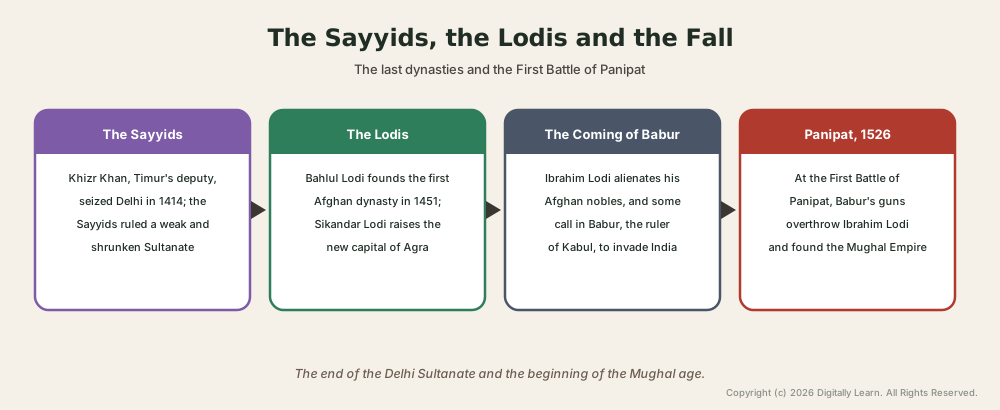
The last age of the Delhi Sultanate belonged to two weak dynasties, the Sayyids and the Lodis, and ended on the field of Panipat. The Sayyids, founded by Khizr Khan after the invasion of Timur, ruled a shrunken state; the Lodis, the first Afghan dynasty, restored some of its strength under Bahlul and Sikandar Lodi, who founded Agra. But the last sultan, Ibrahim Lodi, quarrelled with his Afghan nobles, and in 1526 he was overthrown at the First Battle of Panipat by Babur, the ruler of Kabul, who founded the Mughal Empire. This part covers the Sayyids, the Lodis, the coming of Babur and the fall, and the exam focus.
The Sayyids and the Lodis
The Sayyid Dynasty after Timur
What is the significance of the Sayyids: they held the throne of Delhi in the weakest days of the Sultanate, after the sack of Timur had broken its power.
The Sayyid dynasty rose out of the ruin that Timur left behind. Khizr Khan, who had been Timur's deputy in the Punjab, seized Delhi in 1414 and founded the line; its sultans claimed descent from the Prophet, from which the dynasty took its name. But their rule was weak and their realm was small, little more than Delhi and its neighbourhood.
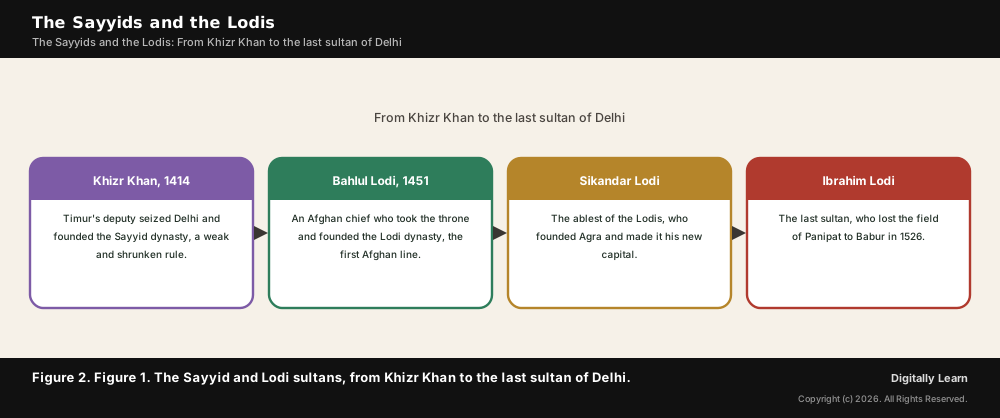
For a generation the Sayyids clung to the shrunken throne, while the provinces went their own way. In 1451 the last of them gave place to a stronger hand, the Afghan chief Bahlul Lodi, and with him began the final dynasty of the Sultanate. The figure below sets out the line of the Sayyid and Lodi sultans.
The Lodi Dynasty: Bahlul, Sikandar and Ibrahim
Distinguishing the Lodis: they were the first Afghan dynasty to rule Delhi, and under their ablest king the Sultanate found a brief new strength before its fall.
The Lodis were Afghans, and their kingship was of an Afghan kind, in which the sultan was held to be the first among equals of his clansmen rather than an absolute lord. Bahlul Lodi, the founder, took the throne in 1451 and won back some of the lost lands; his son Sikandar Lodi, the ablest of the line, ruled well, kept his nobles in hand, and about 1504 founded the new city of Agra, which he made his capital.
The last of the line was Ibrahim Lodi, under whom the old Afghan temper broke into open quarrel. The table below sets out the three Lodi sultans, their reigns and their marks.
| Sultan | Reign | Note |
|---|---|---|
| Bahlul Lodi | 1451 to 1489 | The Afghan founder, who won back lost lands. |
| Sikandar Lodi | 1489 to 1517 | The ablest Lodi, who founded the capital of Agra. |
| Ibrahim Lodi | 1517 to 1526 | The last sultan, defeated and slain at Panipat. |
The Coming of Babur
Ibrahim Lodi and the Discontent of the Afghans
What is the significance of Ibrahim's quarrel: his attempt to rule as an absolute king broke the loyalty of his Afghan nobles, and it was they who opened the gate to Babur.
Ibrahim Lodi would not rule in the old Afghan way. He sought to be an absolute master and humbled the proud nobles who thought themselves his equals, until many of them turned against him in fear and anger. Some rose in open revolt, and the most dangerous of these was Daulat Khan Lodi, the powerful governor of the Punjab.
It was the disaffected who called in the conqueror. Daulat Khan, and Alam Khan, an uncle of Ibrahim who claimed the throne for himself, invited Babur, the Timurid ruler of Kabul, to come down into India against the sultan. Babur, who had long looked upon the wealth of Hindustan, needed no second asking.
The Descent of Babur from Kabul
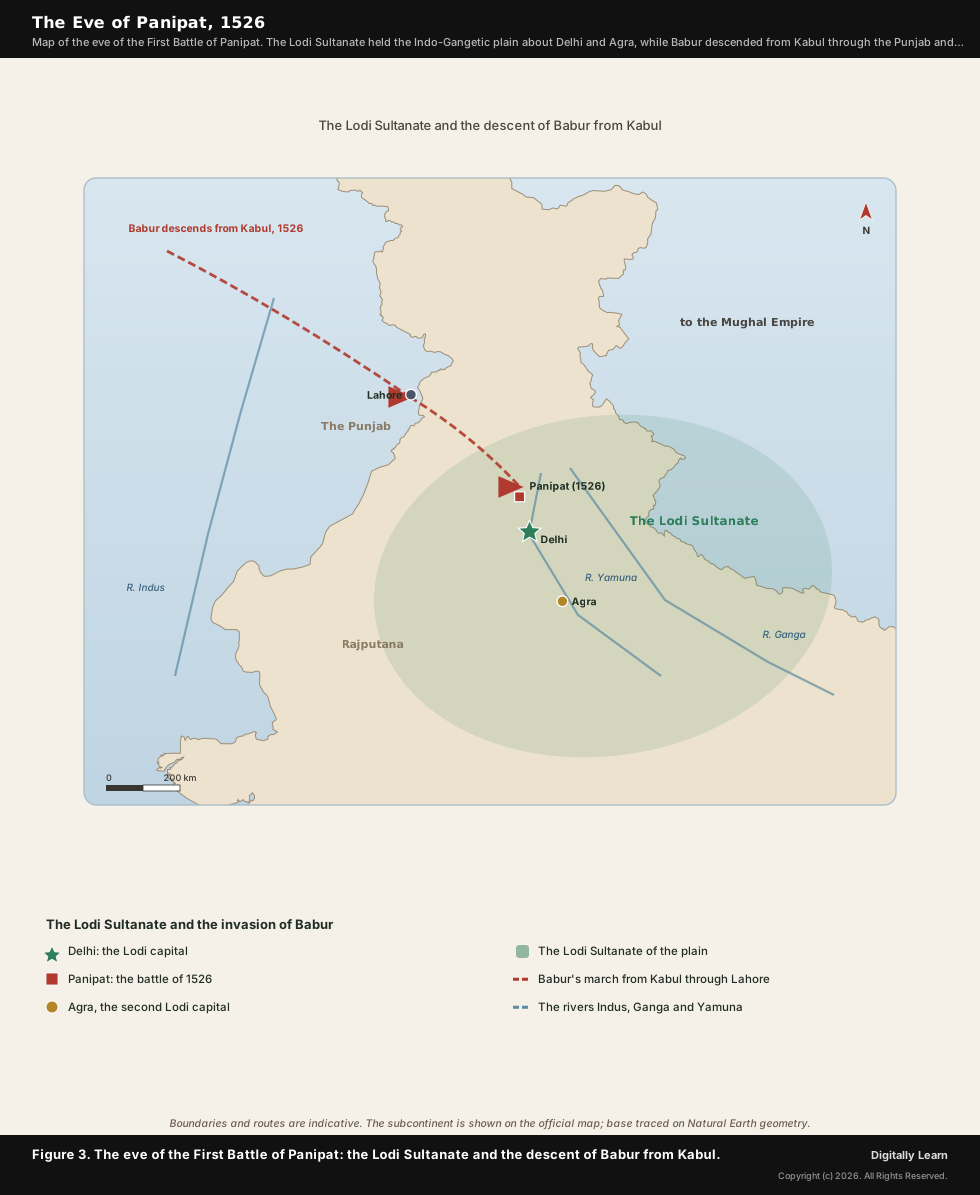
Distinguishing the road of the invader: Babur came down by the old north-western road, through the Punjab to the plain of Panipat, where the way to Delhi lay open.
Babur was the ruler of Kabul, a prince of the house of Timur on his father's side and of Genghis Khan on his mother's. He had tried the passes of India before, and now, in 1526, he came down in earnest through the Punjab, brushing aside Daulat Khan, who had hoped to use him and not to be used.
He marched on toward Delhi, and Ibrahim Lodi came out to meet him with a great host. The two armies faced each other on the historic field of Panipat, north of Delhi, where so many of the fates of India would be decided. The map below sets out the Lodi Sultanate and the road by which Babur came.
The First Battle of Panipat and the Fall of the Sultanate
Babur's Guns and the Defeat of Ibrahim Lodi
What is the significance of Panipat: it was the battle that ended the Delhi Sultanate and set the Mughals upon the throne, won by a new way of war.
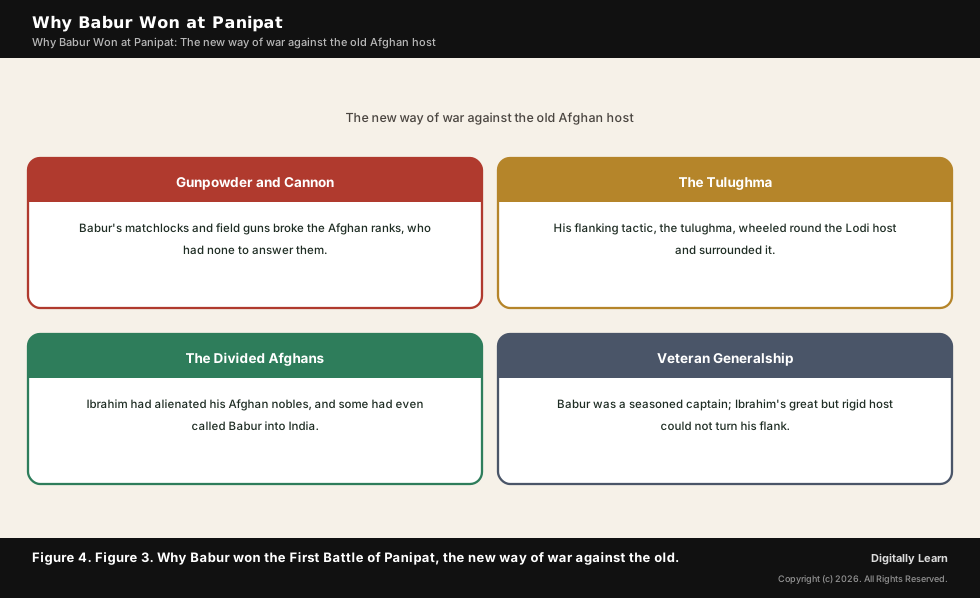
The First Battle of Panipat was fought in 1526. Ibrahim Lodi had by far the greater numbers, but Babur had what the Afghans lacked: gunpowder. His field guns and matchlock men broke the charge of the Lodi host, while his horsemen, by the flanking tactic called the tulughma, wheeled round and surrounded it. Ibrahim Lodi fell on the field, and with him fell some twenty thousand of his men.
The victory was complete. The road to Delhi and Agra lay open, and Babur took both. The new way of war, the gun against the sword, had overthrown the old. The figure below sets out the reasons for Babur's victory at Panipat.
The End of the Sultanate and the Rise of the Mughals
Distinguishing the meaning of the fall: with the death of Ibrahim Lodi the Delhi Sultanate came to its end, after more than three hundred years, and the Mughal age of India began.
The Sultanate was no more. From its founding under Qutb-ud-din Aibak in 1206 to the fall of Ibrahim Lodi in 1526, it had lasted some three hundred and twenty years, through five dynasties and many storms. Now it passed away, and in its place rose the empire of the Mughals, which Babur founded and his descendants would raise to a yet greater height.
Yet much of it endured. The institutions, the cities, the Persian culture and the Indo-Islamic art of the Sultanate, which the later parts of this series describe, were the ground on which the Mughals built. The Sultanate had made the framework of a Muslim empire in India, and that framework outlived it.
UPSC Relevance and Exam Focus
Where the Fall of the Sultanate Fits in the UPSC-CSE Syllabus
This topic belongs to General Studies Paper I: medieval Indian history, and the Lodis and the First Battle of Panipat are a regular ground for questions on the end of the Sultanate.
The questions most often test the order of the Lodi sultans, the founding of Agra by Sikandar Lodi, and the First Battle of Panipat, where Babur overthrew Ibrahim Lodi.
Several linked points recur and are worth holding in working memory:
- Khizr Khan: The founder of the Sayyid dynasty, who took Delhi in 1414 after Timur.
- The Lodis: The first Afghan dynasty; Bahlul, then Sikandar, then Ibrahim.
- Sikandar Lodi: The ablest Lodi, who founded the city of Agra about 1504.
- The First Battle of Panipat: In 1526, where Babur defeated and killed Ibrahim Lodi.
- The Mughal Empire: Founded by Babur on the ruin of the Sultanate.
A 2006 question asked the order of the Afghan rulers of Delhi; the answer is Bahlul, then Sikandar, then Ibrahim Lodi, and a common trap puts Sikandar before Bahlul or after Ibrahim.
A 2003 question asked who Alam Khan was, among those who invited Babur into India; he was an uncle of Ibrahim Lodi and a pretender to the throne of Delhi, to be told apart from Daulat Khan, the discontented governor of the Punjab.
Previous Year UPSC-CSE Questions
Previous Year UPSC-CSE Questions By the end you will be able to draft model answers for the following UPSC questions. Each question carries a collapsible framework showing how to approach it in the exam.
- UPSC Prelims 2006 GS-IWhich one of the following is the correct chronological order of the Afghan rulers to the throne of Delhi?
How to approach this Prelims question
Approach: Recall the Lodi succession: Bahlul Lodi (the founder), then his son Sikandar Lodi, then Ibrahim Lodi (the last).
Trap to watch: Do not put Sikandar before Bahlul (Bahlul was the founder) or Ibrahim before Sikandar (Ibrahim was the last).
Key facts to recall:
- Bahlul Lodi founded the dynasty in 1451.
- Sikandar Lodi, his son, founded Agra.
- Ibrahim Lodi was the last, defeated at Panipat in 1526.
Answer signal: Bahlol Khan Lodi-Sikandar Shah-Ibrahim Lodi.
- UPSC Prelims 2003 GS-IAlam Khan, one of those who invited Babar to invade India was
How to approach this Prelims question
Approach: Recall the two who called in Babur: Alam Khan (an uncle of Ibrahim Lodi, a pretender to the throne) and Daulat Khan Lodi (the governor of the Punjab).
Trap to watch: Do not confuse Alam Khan (the uncle and pretender) with Daulat Khan (the discontented Punjab governor), who is the fourth option.
Key facts to recall:
- Alam Khan was an uncle of Ibrahim Lodi and a pretender to the throne.
- Daulat Khan was the governor of the Punjab.
- Both invited Babur into India against Ibrahim Lodi.
Answer signal: An uncle of Ibrahim Lodi and a pretender to the throne of Delhi.
Sources and Further Reading
Editorial Disclaimer
This article is for UPSC preparation. The fall of the Sultanate rests on the Persian chronicles and on Babur's own memoirs, and the account follows the standard scholarship on the period.