


Overview
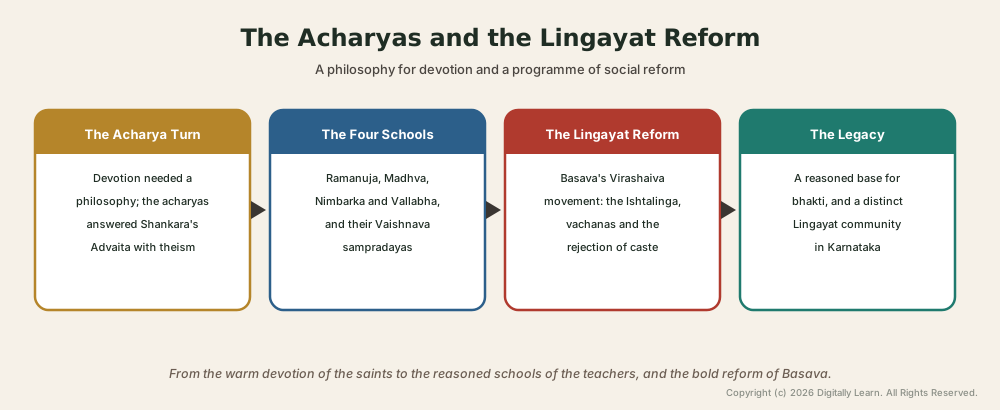
The Vedanta acharyas were the teacher-philosophers who gave the Bhakti movement its reasoned foundation, and the Lingayat reform of Basava was the boldest social turn that devotion took in the medieval south. Where the Tamil saints had sung their love of God, the acharyas Ramanuja, Madhva, Nimbarka and Vallabha built ordered schools of the Vedanta in which a personal, loving God is the highest reality, each answering the stern non-dualism of Shankara's Advaita. Each founded a sampradaya, with its own texts, centre and line of teachers, so that devotion gained both a philosophy and an institution. In twelfth-century Karnataka, Basavanna carried the same devotional spirit into a sweeping reform: his Lingayat or Virashaiva movement rejected caste, the temple idol and Brahmin priesthood, set every devotee to worship Shiva as the Ishtalinga on the body, and made honest work a form of worship.
From the Bhakti Hymn to Vedanta Philosophy: The Coming of the Acharyas
Why Devotion Needed a Reasoned Philosophy
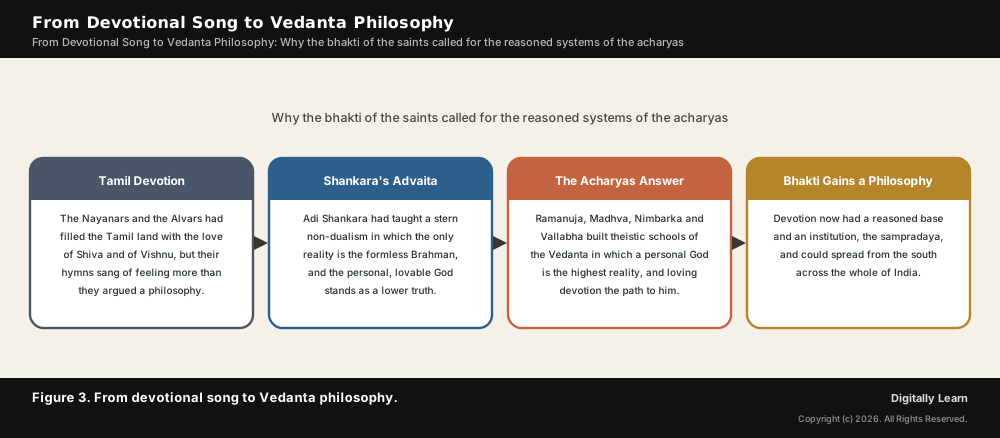
Devotion alone was not enough to win the learned, and so the warm bhakti of the Tamil saints had in time to be given a reasoned philosophy.
The Nayanars and Alvars of the previous part had sung their love of Shiva and of Vishnu in hymns of great beauty, but they had argued no system of thought. To hold its own against the great schools of the age, devotion needed a base in the Vedanta, the body of thought built upon the Upanishads. The teachers who gave it that base are called the acharyas, and the schools they founded are the subject of this part. The map below sets out their chief centres, from Srirangam in the Tamil country to Nathdwara in Rajasthan, together with the seats of the Lingayat reform.
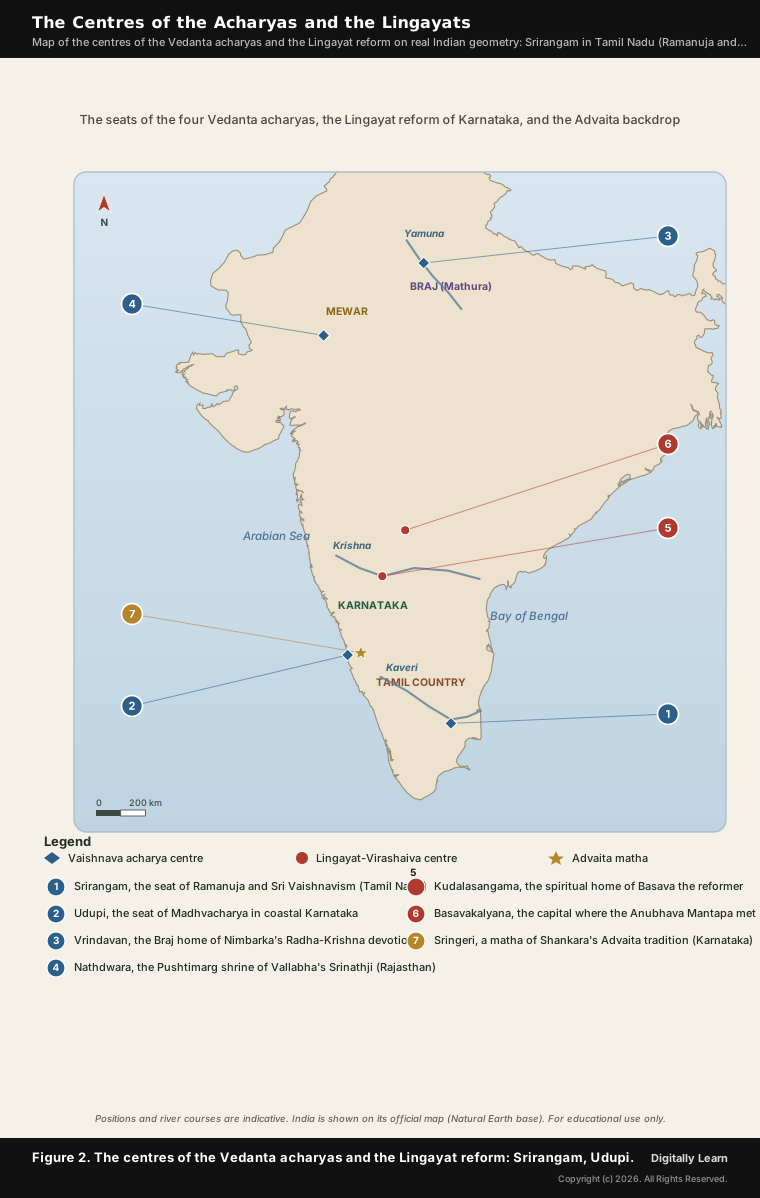
The Vedanta belonged to the wider world of Indian philosophy, which the tradition counts as six orthodox schools, the shaddarshanas: Nyaya and Vaisheshika, Samkhya and Yoga, and Mimamsa and Vedanta. The Vedanta, also called Uttara Mimamsa, rests on three sources, the Upanishads, the Brahma Sutras and the Bhagavad Gita, and it was on these that every acharya wrote his commentary to set out his school. Schools such as the materialist Lokayata or the Kapalika ascetics lay wholly outside this orthodox six.
Acharya and Saint: The Systematiser and the Singer
An acharya is not the same as a singing saint, and the distinction is worth holding clearly from the start.
A saint, like an Alvar or a later Kabir, pours out devotion in song and lives the life of love; a sampradaya, by contrast, is led by an acharya who reasons out a philosophy, writes its texts, settles its forms of worship and heads its line of teachers. The two are bound together, for the acharyas built their systems upon the devotion the saints had sung. Ramanuja, as the previous part showed, raised his philosophy squarely on the Tamil hymns of the Alvars, gathered before him by Nathamuni and Yamunacharya.
This part therefore takes up the work of the four great theistic acharyas of the Vedanta, and then the very different reform of the Lingayats, where a teacher, Basava, led not a quiet school but a mass movement of social change. The figure below traces how devotion passed from the Tamil hymn into the reasoned schools of the teachers.
Shankara's Advaita and the Theistic Answer of the Acharyas
Shankara's Advaita: Non-Dualism and the Formless Brahman
Adi Shankara is the backdrop against which the theistic acharyas must be read, for it was his philosophy that they set out to answer.
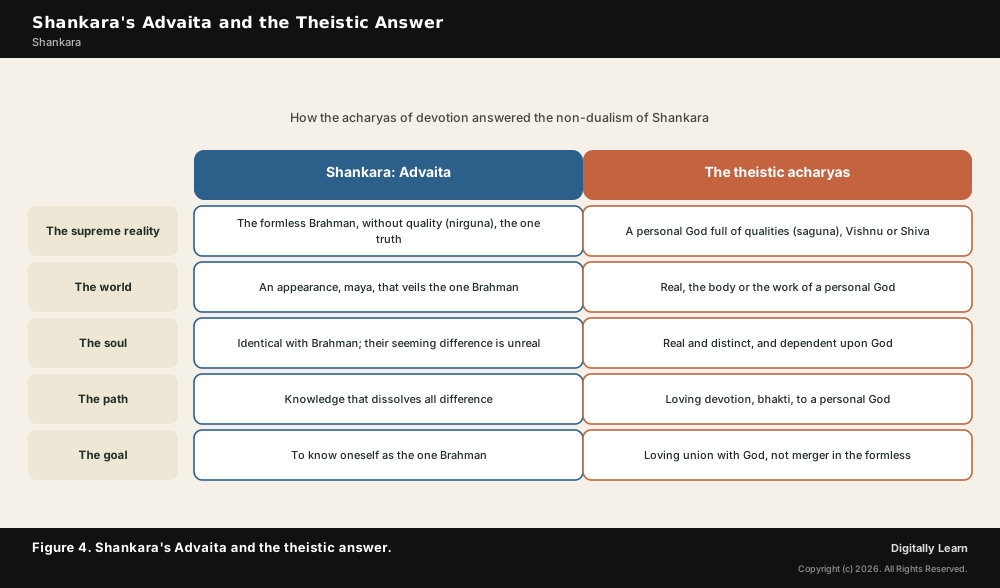
Shankara, traditionally placed in the eighth century, was the great teacher of Advaita, or non-dualism, the most rigorous school of the Vedanta. He taught that the only reality is Brahman, the one absolute, which is without form or quality, that is, nirguna. The world of many things, and the personal God who is worshipped within it, belong to a lower order of truth; at the highest level the individual soul is not the servant of God but is itself identical with the one Brahman.
On this view the warm, personal love of a saint for Vishnu or Shiva, however beautiful, could only be a step on the way, not the final truth, since in the end all difference between the worshipper and the worshipped dissolves. Shankara founded mathas, monasteries, at the four corners of India to carry his teaching, among them the seat at Sringeri in Karnataka shown on the map. It was against this powerful non-dualism that the acharyas of devotion had to make their case.
How the Theistic Acharyas Answered Advaita
The theistic acharyas gave devotion the last word, not the first, by teaching that a personal God is the highest reality and that loving union with him, not merger in a formless absolute, is the goal.
Each of the four acharyas of this part, in his own way, held that Brahman is not a quality-less absolute but a personal God full of perfections, a saguna God, most often Vishnu. The world is not an empty appearance but the real work or body of God; the soul is real and remains distinct from God even in salvation, so that it may love him for ever. On such a footing, bhakti is no mere stepping-stone but the very means of salvation and its crown.
Their differences lay in how closely they bound the soul and the world to God: from the qualified oneness of Ramanuja, through the firm separation of Madhva, to the more delicate positions of Nimbarka and Vallabha. The figure below sets the non-dualism of Shankara beside the common ground of these theistic acharyas.
The Four Theistic Acharyas of Vedanta and Their Schools
Ramanuja and Vishishtadvaita: Qualified Non-Dualism
Ramanuja is the first and the greatest of the theistic acharyas, the teacher who gave loving devotion its firmest philosophical base.
Ramanuja, whom the tradition places between the eleventh and the twelfth centuries (the dates are often given as about 1017 to 1137, though some modern scholars prefer 1077 to 1157), taught at Srirangam and led the Sri Vaishnava tradition, also called the Sri Sampradaya. His philosophy is Vishishtadvaita, qualified non-dualism. He agreed with Shankara that there is one Brahman, but held that this Brahman is a personal God, Vishnu, who is qualified by the world and the souls as a body qualifies a self. The soul is real and distinct, yet wholly dependent on God, as a part is of the whole.
As the previous part showed, Ramanuja built his system on the devotion of the Alvars, gathered before him by Nathamuni and his grandson Yamunacharya, the teacher at Srirangam whom Ramanuja set out to meet, though the older man died before they could speak. He set down his thought in the Sri Bhashya, his great commentary on the Brahma Sutras, and in the Vedartha Sangraha. For Ramanuja, loving devotion, bhakti, is the means to salvation, and his successors developed from it the gentle path of prapatti, of total self-surrender to the grace of God.
Madhvacharya and Dvaita: The Realist Dualism of Udupi
Madhvacharya carried the defence of devotion to its boldest point, teaching a flat dualism in which God and the soul are eternally and really distinct.
Madhva, whom the tradition commonly places from 1238 to 1317, though the year of his birth is not certain and other dates are given, was born at Pajaka near Udupi in coastal Karnataka. His philosophy is Dvaita, dualism, also called Tattvavada, the way of realism. Against Shankara he held that the difference between God and the soul, and between one soul and another, is not an illusion but the deepest truth: God is supreme and wholly independent, while souls and the world depend on him and are never merged in him.
Madhva joined the Brahma Sampradaya under his teacher Achyutapreksha, and at Udupi he is said to have set up the worship of Krishna with an image he had brought from Dwarka, founding the Krishna temple that remains the heart of his school to this day. His was the most thoroughgoing answer to Advaita, and his tradition has remained strong in Karnataka through the centuries.
Nimbarka and Dvaitadvaita: Dualistic Non-Dualism and Radha-Krishna
Nimbarka held the soul to be both one with God and other than him, in a philosophy that sought a middle path between Shankara and Madhva.
The dates of Nimbarka are among the most uncertain of any teacher in this part: the tradition often places him in the twelfth or thirteenth century, but scholars have argued for times as early as the seventh century and as late as the fourteenth, and his date must be given as genuinely unsettled. His philosophy is Dvaitadvaita, dualistic non-dualism, also called Svabhavika Bhedabheda, the natural difference and non-difference. He taught that the soul and the world are at once distinct from Brahman and not distinct from it, as the wave is both other than the sea and one with it.
Nimbarka led the Kumara Sampradaya, also called the Sanakadi Sampradaya after the four boy-sages, the Kumaras, from whom it claims descent. He is remembered above all for spreading the worship of the divine pair, Radha and Krishna, together, a devotion that would later flower across the north and that links his school to the Krishna bhakti of the Braj country around Mathura and Vrindavan.
Vallabhacharya, Shuddhadvaita and the Pushtimarg Path of Grace
Vallabhacharya made the grace of God the whole of the religious life, founding a path of pure devotion to Krishna that is followed to this day.
Vallabha, who lived from about 1479 to 1531 (the dates are also given as 1478 to 1530), taught a philosophy called Shuddhadvaita, pure non-dualism. He agreed with Shankara that the soul is one with Brahman, but he denied that the world is an illusion: for Vallabha the world is wholly real, the true outpouring of God, and the soul is a real spark of Brahman, pure and untouched by any falsehood. From this he drew his teaching of grace.
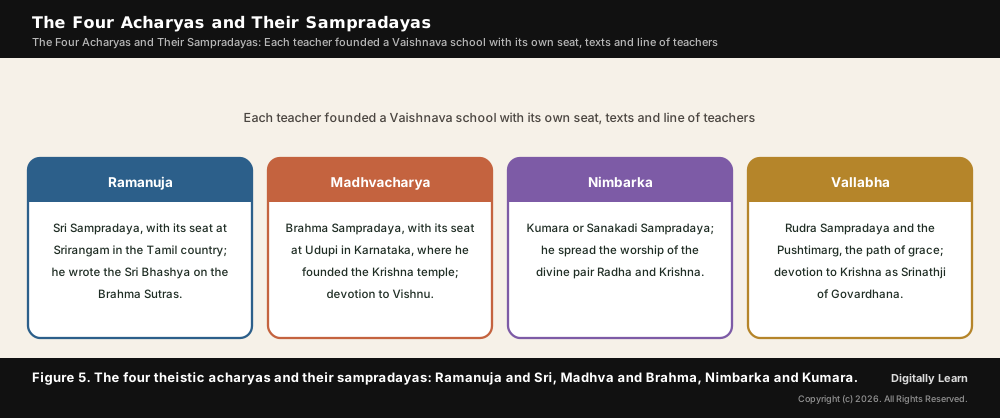
Vallabha founded the Pushtimarg, the path of grace (pushti), and led the Rudra Sampradaya, the school traced to the teacher Vishnuswami. He held that the soul reaches God not by its own effort or knowledge but only by the free grace of Krishna, freely given and freely received. He began the formal worship of Krishna as Srinathji upon Govardhana Hill in the Braj country; the image of Srinathji was in a later age enshrined at Nathdwara in Rajasthan, which remains the chief shrine of the Pushtimarg. The figure below sets the four acharyas and their schools side by side.
The Five Schools of Vedanta Compared: Avoiding the Swap-Trap
The pairing of each school to its founder is a frequent point of confusion, and the examiner sets traps by swapping them, so the table below must be held exactly.
Read across the five schools, the single thread is the relation of the soul to Brahman: identical in Shankara, qualified in Ramanuja, wholly separate in Madhva, both at once in Nimbarka, and a pure part in Vallabha. The names rhyme and run together, so the surest guard is to fix each school with its one founder and its one idea of the soul.
| School of Vedanta | Acharya | Relation of the soul to Brahman |
|---|---|---|
| Advaita (non-dualism) | Adi Shankara | The soul is identical with the one, formless Brahman; their difference is unreal. |
| Vishishtadvaita (qualified non-dualism) | Ramanuja | The soul is real and distinct, but a part of the body of a personal God. |
| Dvaita (dualism) | Madhvacharya | The soul is eternally separate from and dependent upon God. |
| Dvaitadvaita (dualistic non-dualism) | Nimbarka | The soul is at once different from and non-different from Brahman. |
| Shuddhadvaita (pure non-dualism) | Vallabha | The soul is a pure part of Brahman, without the taint of illusion. |
Three of these schools founded the great Vaishnava sampradayas of the medieval centuries: Ramanuja the Sri Sampradaya, Madhva the Brahma Sampradaya, and Vallabha the Rudra Sampradaya, while Nimbarka led the Kumara or Sanakadi Sampradaya. The tradition of the Padma Purana counts exactly these four as the authorised lines of Vaishnava devotion.
The Lingayat-Virashaiva Reform of Basava
Basavanna and the Twelfth-Century Lingayat Movement
Basavanna turned devotion to Shiva into a movement of social reform, the boldest that medieval India produced.
Basava, also called Basavanna and Basaveshwara, lived in the twelfth century, from about 1131 to 1196, in the Kannada country. He served as the chief minister of King Bijjala II of the Kalachuri line, whose capital was at Kalyana, the modern Basavakalyana. From this high office Basava led a great religious and social movement, whose followers are the Lingayats or Virashaivas, the heroic devotees of Shiva. He had grown up at Kudalasangama, the meeting of the rivers Krishna and Malaprabha, and it was to the lord of that place that he addressed his verses.
The movement Basava led was not a quiet school of philosophy but a faith of the people, open to the labourer and the outcaste as much as to the learned. It set the love of Shiva, worshipped within the heart and upon the body, against the whole apparatus of caste, temple and priest, and so became one of the great reforming forces in the religious history of the Deccan.
The Anubhava Mantapa: A Parliament of Free Debate
The Anubhava Mantapa was the meeting-place of the reform, a hall where men and women of every rank debated the things of the spirit as equals.
At Kalyana, Basava founded the Anubhava Mantapa, the hall of spiritual experience, which the tradition remembers as a kind of religious parliament. It drew the devotees, the sharanas, from across the Kannada land and beyond, and it was open without distinction to men and women, to Brahmin and outcaste alike, who came together to discuss the deepest questions of faith and life in the open.
Over this assembly presided not Basava himself but the mystic Allama Prabhu, the most searching of the Lingayat saints, while Basavanna, the woman saint Akka Mahadevi, and Channabasavanna were among its leading voices. In an age of rigid hierarchy, a hall in which the washerwoman and the minister sat and argued as equals was a thing without parallel, and it gave the reform both its method and its message.
Vachana Literature in Kannada
The Lingayat reform spoke in the vachana, the short, free Kannada poem that became one of the great forms of Indian devotional literature.
The vachanas were short prose-poems in plain Kannada, the speech of the people, not the Sanskrit of the learned. Each was a saying addressed to Shiva, simple in form yet often deep in thought, and the saints signed them with the name of their chosen form of the god. Through the vachana the teaching of the reform reached every listener directly, without the screen of a learned tongue or a priestly class.
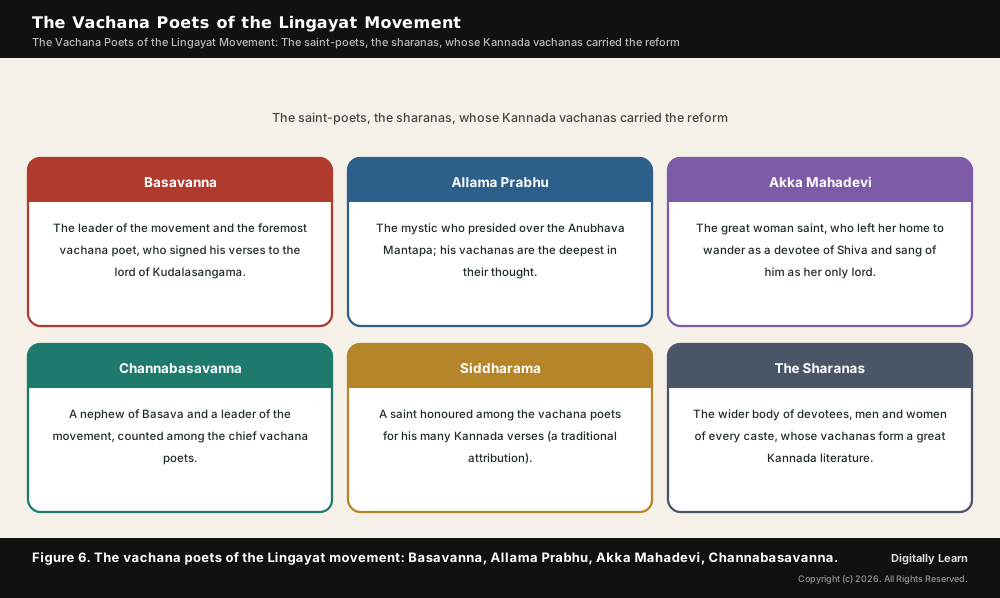
The chief composers, the vachanakaras, were Basavanna himself, the mystic Allama Prabhu, the woman saint Akka Mahadevi, and Channabasavanna, with Siddharama and many others among the wider body of sharanas. Their verses attacked empty ritual and the pride of caste, and praised honest work and the love of Shiva, and together they form a literature that is treasured in Kannada to this day. The figure below presents the chief vachana poets of the movement.
Akka Mahadevi and Women in the Sharana Movement
The Lingayat reform gave women a place of honour, and none shows this more clearly than the great saint Akka Mahadevi.
Akka Mahadevi left the ordinary life of a married woman to give herself wholly to the love of Shiva, and she wandered as a devotee, composing vachanas of a rare intensity. That she was honoured at the Anubhava Mantapa as the equal of the men, her verses weighed beside theirs, marks how far the reform had broken with the customs of the age.
She was not alone. The movement counted many women among its sharanas, who worked, worshipped and composed alongside the men, and whose vachanas survive. In raising the worth of women, as in lowering the bars of caste, the Lingayat reform pressed the equality of all devotees before Shiva further than almost any movement of its time, a theme that the women saints of the later Bhakti movement, treated in a later part of this series, would carry forward.
Lingayat Belief and Social Radicalism
Ishtalinga, Sthavara and Jangama: A Portable and Living Faith
The Lingayat carries his god upon his body, in the Ishtalinga, and so needs neither temple nor priest to come before Shiva.
The mark of the Lingayat is the Ishtalinga, a small image of the Shiva linga, worn in a casket upon a thread about the body. Each devotee worships this personal linga himself, at any time and in any place, as a constant reminder of his devotion to Shiva. By this one practice the whole machinery of the great temple, with its fixed idol and its Brahmin priesthood, was quietly set aside, for the god was now carried in the hand of every believer.
Behind this lies the Lingayat contrast between the sthavara and the jangama. The sthavara is the fixed and immovable, the idol set in stone within a temple; the jangama is the living and moving, the wandering devotee and teacher in whom the divine is held to dwell. The reform turned away from the sthavara, the dead stone, toward the jangama, the living person, and so toward a faith of people rather than of places.
Ashtavarana, Panchachara and Shatsthala: The Codes of the Faith
The Lingayat life is shaped by three sets of rules, the eight shields, the five codes and the six stages, which together order the devotee's whole path.
The Ashtavarana, the eightfold armour, names the eight supports that shield the devotee from harm and keep him fixed on Shiva. The Panchachara sets out five codes of right conduct that govern his daily life. The Shatsthala describes the six stages by which the soul rises, through devotion and the grace of Shiva, from the first turning toward god to the final union with him. The figure below gives the three codes together, and the list that follows names their parts.
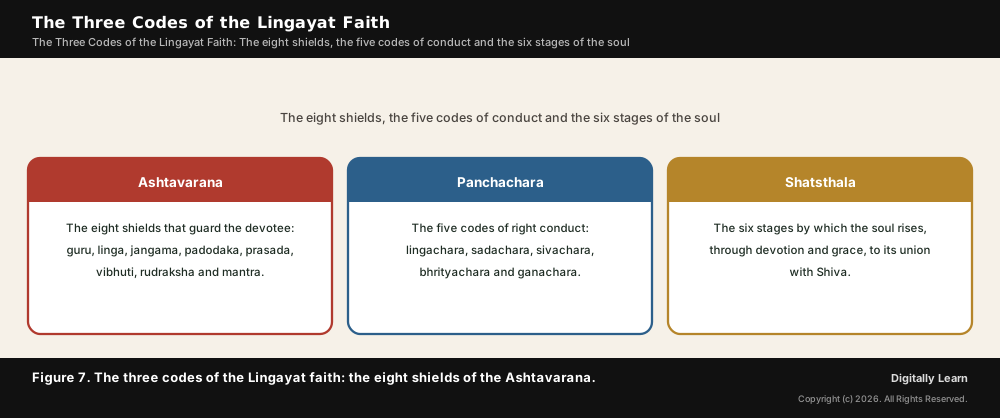
- Ashtavarana, the eight shields: guru, linga, jangama, padodaka, prasada, vibhuti (sacred ash), rudraksha (the bead) and mantra.
- Panchachara, the five codes of conduct: lingachara, sadachara, sivachara, bhrityachara and ganachara.
- Shatsthala, the six stages of the soul: the rise through devotion and grace to union with Shiva and final release.
Kayaka and Dasoha: Work as Worship, Sharing as Service
The Lingayat reform made honest labour holy, in the twin ideals of Kayaka and Dasoha.
By Kayaka, the reform held that one's daily work, of whatever kind, is itself a form of worship, so that the labour of the weaver or the washerman is as sacred as any rite. Basava's own saying, that work is heaven, fixed this idea at the heart of the faith. No honest calling was held low, and idleness, not labour, was the disgrace.
By Dasoha, the fruit of that work was to be shared, given freely in service to the community of devotees and to those in need. Taken together, Kayaka and Dasoha made the Lingayat ideal one of dignified work and open generosity, and gave the movement a social teaching far ahead of its age, in which the worth of a person lay in honest service and not in the accident of birth.
The Rejection of Caste, Ritual and Untouchability
At its heart the Lingayat reform was a revolt against the order of caste, and against the ritual and the priesthood that upheld it.
The Lingayats taught that no one is high or low by birth, and that the priest, the potter and the outcaste stand wholly equal before Shiva. They rejected the bars of caste and the cruelty of untouchability, and at the Anubhava Mantapa they put this teaching into practice, sharing food and worship across the lines that the old society held sacred. They set aside the authority of the Brahmin priesthood, the worship of the temple idol, and the round of Vedic ritual, and even questioned the standing of the Vedas themselves.
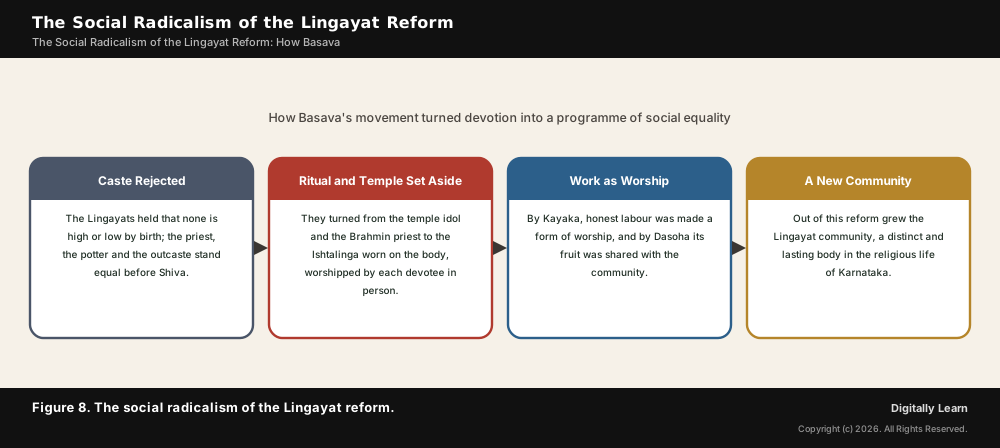
In the place of all this they set the simple, inward worship of the Ishtalinga, the honest labour of Kayaka, and the open table of Dasoha. The reform was radical in the true sense, striking at the root of the social order of its day. The figure below traces this social radicalism, from the rejection of caste to the rise of a new community of devotees.
The Lingayats as a Distinct Modern Community
The Lingayat reform did not pass away with its age, but grew into a distinct and enduring community in the life of Karnataka.
From the movement of Basava there grew a settled community, the Lingayats, who remain to this day one of the largest and most influential groups in Karnataka. The names Lingayat and Virashaiva have long been used for the same people, though in recent times there has been much public debate over whether they form one community or two, and over the community's exact standing, a debate that shows how living the legacy of Basava still is.
This long passage, from a twelfth-century reform of devotion to a named community with its own identity and its own place in public life, makes the Lingayats a clear example of the way a sect, a sampradaya born of religious reform, can harden over the centuries into a distinct social group, set beside the older divisions of caste, region and language. The wider Bhakti and Sufi currents, including the Sufis and the Bhakti movement under the Delhi Sultanate, show the same power of devotional movements to reshape society.
UPSC Relevance and Previous-Year Questions
Where the Acharyas and Lingayats Fit in the UPSC-CSE Syllabus
This topic belongs to General Studies Paper I: medieval Indian history and culture, and the Vedanta acharyas and the Lingayat reform are a recurring theme, tested both as fine factual pairings in Prelims and as themes of religion and society in Mains.
The questions most often test the pairing of each school to its acharya, the names of their sampradayas and centres, and the character of the Lingayat reform as a social movement. The following points are worth holding in working memory:
- School and founder: Vishishtadvaita is Ramanuja, Dvaita is Madhva, Dvaitadvaita is Nimbarka, Shuddhadvaita is Vallabha, and Advaita is Shankara.
- The four sampradayas: Sri (Ramanuja), Brahma (Madhva), Rudra (Vallabha) and Kumara or Sanakadi (Nimbarka).
- The Pushtimarg: the path of grace was founded by Vallabhacharya, not by Madhva, in the worship of Krishna as Srinathji.
- Basava and the Lingayats: a twelfth-century minister of Bijjala II, the Anubhava Mantapa, the Ishtalinga, and the rejection of caste and ritual.
- The Lingayat codes: the Ashtavarana (eight shields), the Panchachara (five codes) and the Shatsthala (six stages), with Kayaka and Dasoha.
A 2014 Prelims question asked candidates to judge two statements, that the Bijak records the teachings of Dadu Dayal, and that the philosophy of the Pushti Marg was propounded by Madhvacharya. This part teaches directly why both are wrong: the Pushtimarg, the path of grace, was founded not by Madhva but by Vallabhacharya, as the section on Vallabha sets out, so the correct answer is that neither statement is correct. The school-to-founder table is built to guard against just this kind of swap.
A second 2014 Prelims question asked which pair does not belong to the six orthodox systems of Indian philosophy. This part names those six, Nyaya and Vaisheshika, Samkhya and Yoga, and Mimamsa and Vedanta, and explains that the Vedanta is the school within which all the acharyas wrote; the materialist Lokayata and the Kapalika ascetics, by contrast, lie outside the orthodox six, which is the pairing the question marks out.
A Mains question of 2022 asked candidates to analyse the salience of the sect in Indian society, set beside caste, region and religion. The acharyas and the Lingayats supply a strong historical strand for such an answer: the four Vaishnava sampradayas are sects in the precise sense, schools of devotion with their own teachers and forms of worship, while the Lingayat movement shows how a sect born of religious reform can harden over centuries into a distinct social community in Karnataka. This part teaches that material directly, though a full answer would draw also on the wider sociology of sect and community in modern India.
Previous Year UPSC-CSE Questions
Previous Year UPSC-CSE Questions By the end you will be able to draft model answers for the following UPSC questions. Each question carries a collapsible framework showing how to approach it in the exam.
- UPSC Prelims 2014 GS-IConsider the following statements:
- ‘Bijak’ is a composition of the teachings of Saint Dadu Dayal.
- The Philosophy of Pushti Marg was propounded by Madhvacharya.
Which of the statements given above is/are correct?
How to approach this Prelims question
Approach: Test each statement against the correct attribution. The Pushti Marg was founded by Vallabhacharya, not Madhvacharya; the Bijak records the teachings of Kabir, not Dadu Dayal. Both statements are therefore false.
Trap to watch: The classic swap of Vallabha and Madhva. Madhva taught Dvaita and led the Brahma Sampradaya at Udupi; Vallabha taught Shuddhadvaita and founded the Pushtimarg. Do not let the two Krishna-devotee acharyas be confused.
Key facts to recall:
- The Pushti Marg (path of grace) was founded by Vallabhacharya, who taught Shuddhadvaita.
- Madhvacharya taught Dvaita and led the Brahma Sampradaya, and did not found the Pushti Marg.
- The Bijak is the well-known collection of the verses of Kabir, not of Dadu Dayal.
Answer signal: Neither statement 1 nor statement 2 is correct.
- UPSC Prelims 2014 GS-IWhich one of the following pairs does not form part of the six systems of Indian Philosophy?
How to approach this Prelims question
Approach: Recall the six orthodox (astika) systems and test each pair against the list; the pair that contains schools outside the orthodox six is the answer.
Trap to watch: Three of the four options each name a genuine pair of the six orthodox systems. Lokayata is the heterodox materialist school and Kapalika a tantric Shaiva sect, so neither belongs to the orthodox six.
Key facts to recall:
- The six orthodox systems are Nyaya, Vaisheshika, Samkhya, Yoga, Mimamsa and Vedanta.
- Lokayata (Charvaka) is a heterodox materialist school, not one of the six.
- Kapalika is an ascetic Shaiva sect, not one of the six orthodox systems.
Answer signal: Lokayata and Kapalika is the pair that does not form part of the six systems.
- UPSC Mains 2022 GS-IAnalyse the salience of ‘sect’ in Indian society vis-a-vis caste, region and religion.
How to structure the answer in the exam
Introduction: The sect, or sampradaya, a body of devotion within a wider religion, has long been a real axis of Indian social life, at times cutting across caste and region and at times hardening into a community of its own.
Body (sub-themes to develop):
- The sect as a distinct social form: the four Vaishnava sampradayas (Sri, Brahma, Rudra, Kumara) and the Lingayat-Virashaiva tradition show sects with their own teachers, texts and worship.
- Sect against caste: reform sects like the Lingayats challenged caste, yet a sect can itself harden into a caste-like community over time.
- Sect against region: some sects are tied to a region (the Lingayats to Karnataka), while others spread across regions.
- Sect against religion: the sect sits within a religion but can develop a distinct identity, as the modern Lingayat-Virashaiva debate shows.
- Contemporary salience: sect identity shapes community organisation, politics and claims to distinct status in present-day India.
Conclusion: The sect thus remains a salient axis of Indian society, neither reducible to caste, region or religion nor wholly separate from them, and at times a powerful force of both reform and identity.
Sources and Further Reading
- NCERT, Themes in Indian History and Medieval India (the bhakti acharyas and the Virashaiva tradition)
- Wikipedia: Ramanuja
- Wikipedia: Madhvacharya
- Wikipedia: Vallabha (Vallabhacharya and the Pushtimarg)
- Wikipedia: Nimbarka
- Wikipedia: Sampradaya (the four Vaishnava sampradayas)
- Wikipedia: Basava
- Wikipedia: Lingayatism (the Ashtavarana, Panchachara and Shatsthala)
- Wikipedia: Anubhava Mantapa
- Ministry of Culture, Indian Culture portal: the saints and acharyas of the bhakti tradition
- Sahitya Akademi (the vachana literature of Kannada)
- Indira Gandhi National Centre for the Arts (IGNCA): the bhakti and Virashaiva traditions
- Press Information Bureau (Government of India): Basaveshwara and the Anubhava Mantapa
Editorial Disclaimer
This article is for UPSC preparation. The account of the Vedanta acharyas and the Lingayat reform follows the standard scholarship on medieval Indian religion. Several dates of the acharyas, the dates of Nimbarka above all, are traditional and contested, and are given as such.