


Overview
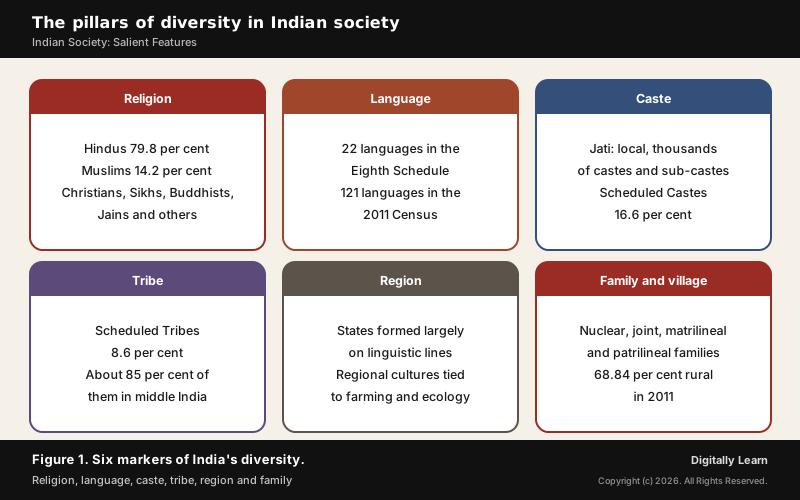
The salient features of Indian society are the traits that mark it out: great diversity of religion, language, caste, tribe and region held together as unity in diversity; caste, which is special to India; a family system of joint, nuclear, patrilineal and matrilineal forms; a largely rural, agrarian base; and a steady mix of continuity and change through processes such as Sanskritisation and modernisation.
Salient Features of Indian Society and Unity in Diversity
What Are the Salient Features of Indian Society?
Indian society is a society of communities: people are born into a family, a caste or tribe, a religion, a language and a region, and these ascriptive identities, fixed by the accident of birth, give them a deep sense of security and belonging. What marks Indian society out is how many such communities live together, and how old institutions keep changing without disappearing. Its main features are these:
- Diversity: Many kinds of social groups and communities, defined by cultural markers such as language, religion, sect, race or caste.
- Unity in diversity: A strong national identity built by accepting this variety rather than erasing it.
- Caste: An institution uniquely associated with the Indian sub-continent, which has spread even to non-Hindu communities.
- Tribes: Among the oldest inhabitants of the sub-continent, with their own languages, livelihoods and ways of life.
- Family and kinship: Nuclear and joint families, patrilineal and matrilineal descent, with patriarchy as the common pattern.
- A rural, agrarian base: Most Indians still live in villages, and many festivals celebrate the harvest.
- Continuity and change: Tradition is constantly reinterpreted, so one person can be modern in some ways and traditional in others.
Unity in Diversity: How India Became a State-Nation
The idea of unity in diversity came from the national movement. Its leaders held that India could be unified only by accepting its immense diversity, so differences of language, culture, religion and ethnicity were treated as sources of strength rather than obstacles. As Nehru wrote in 1951, there was absolutely no reason to regiment India after a single pattern. The same leaders knew diversity could also be used for divisive ends, as communalism, casteism and linguistic or regional exclusiveness.
Most modern states distrust diversity and try to reduce it. India chose a different path, which the United Nations Development Programme called a state-nation: a single state in which many ethnic, religious, linguistic and indigenous identities co-exist and citizens identify with both their country and their community.
| Approach | What the state does | Where India stands |
|---|---|---|
| Assimilation | Persuades or forces all citizens to adopt the dominant group's values and norms | Ruled out from the very beginning |
| Integration | Keeps the public culture to one national pattern and pushes other cultures into private life | Not followed: religion and language stay in public life and are recognised |
| State-nation | Lets many identities co-exist and builds loyalty to both country and community | India's constitutional model, with strong protection for minorities |
Comparative surveys of long-standing democracies show that India has been very cohesive despite its diversity, and that its citizens are deeply committed to the country and to democracy. Its problems have lain more in implementation than in laws or principles.
Religious and Linguistic Diversity of India
Religious Pluralism in India: Census 2011 and the Minorities
India is home to followers of many religions. In the 2011 Census, 79.8 per cent of the population followed Hinduism, 14.2 per cent Islam, 2.3 per cent Christianity, 1.7 per cent Sikhism, 0.7 per cent Buddhism and 0.4 per cent Jainism. India has the largest Muslim population outside Muslim-majority countries. The majority is not uniform either: Hindus are regionally specific, plural in beliefs and practices, and divided by caste and language.
- Regional concentration: Christians form large majorities in Nagaland, Mizoram and Meghalaya, and Sikhs are a majority in Punjab.
- Minority in the social sense: A minority is more than a smaller number; it is a group with a sense of disadvantage and strong solidarity, which is why religious minorities need special protection in a democracy where a numerical majority can become political power.
- Secular state: India has no official religion; the Constitution protects the freedom to profess, practise and propagate any religion, and it lets the state intervene to ensure equality within religions, as in banning untouchability.
Linguistic Diversity and the Eighth Schedule Languages
Language is one of the clearest markers of India's diversity. The 2011 Census sorted 19,569 raw returns into 1,369 rationalised mother tongues and grouped those with 10,000 or more speakers into 121 languages, of which 22 are in the Eighth Schedule of the Constitution. The Schedule began with 14 languages in 1950 and grew by amendment:
| Stage | Languages added | Total |
|---|---|---|
| Original list, 1950 | Assamese, Bengali, Gujarati, Hindi, Kannada, Kashmiri, Malayalam, Marathi, Odia, Punjabi, Sanskrit, Tamil, Telugu, Urdu | 14 |
| 21st Amendment, 1967 | Sindhi | 15 |
| 71st Amendment, 1992 | Konkani, Manipuri, Nepali | 18 |
| 92nd Amendment, 2003 | Bodo, Dogri, Maithili, Santali | 22 |
Language also shaped the map. Potti Sriramulu died in 1953 after a fast for a Telugu state, which led to Andhra Pradesh and to the States Reorganisation Commission, whose report was implemented on 1 November 1956. Nehru and others feared linguistic states would split India; instead they strengthened it, since one can be Tamil and Indian at once. The story is told in the linguistic reorganisation of States.
Caste System in Indian Society: Features, Colonial Change and Politics
Varna and Jati: Meaning and Defining Features of Caste
The English word caste comes from the Portuguese casta, meaning pure breed. Indian languages use two terms. Varna, literally colour, is a four-fold division into brahmana, kshatriya, vaishya and shudra, which left out the outcastes and others sometimes called the panchamas. Jati is the word most used in daily life; it is a regional or local grouping of hundreds or even thousands of castes and sub-castes. The four-varna classification is roughly three thousand years old, but in the late Vedic period it was not rigid or fixed by birth (Vedic society and the varnas); caste became rigid only after the Vedic period.
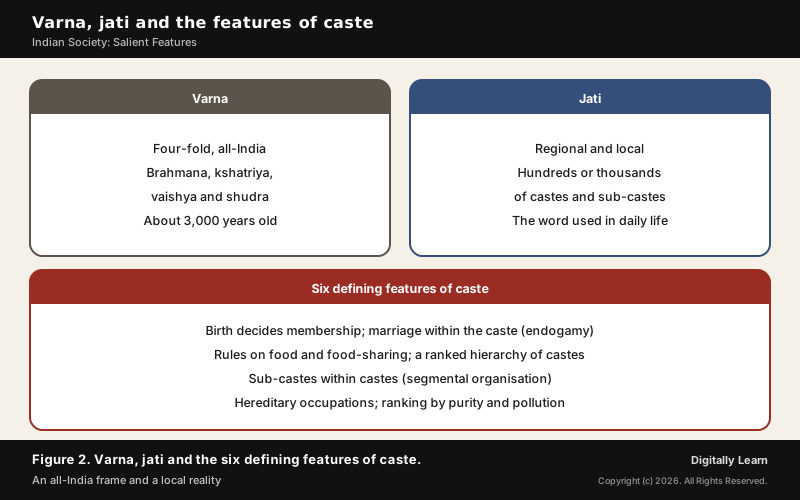
- Birth: A child is born into the caste of its parents; caste is never a matter of choice.
- Endogamy: Marriage is restricted to members of the group.
- Food rules: What may be eaten, and with whom food may be shared, is prescribed.
- Hierarchy: Castes are ranked, and the ranking rests on the distinction between purity and pollution.
- Segmental organisation: Castes have sub-castes, and sub-castes may have sub-sub-castes.
- Hereditary occupation: Each caste was linked to an occupation, so the system worked as a division of labour that allowed no mobility.
These are the rules of the scriptures, and they were not always practised. Caste combined two principles: difference and separation, which kept castes apart in marriage, food and occupation, and wholism and hierarchy, which placed each caste in a ladder-like order within the whole society.
Caste Under Colonialism: Census, Land Rights and the Schedules
Some scholars argue that caste as we know it today is more a product of colonialism than of ancient tradition. The British tried to understand caste in order to govern, and the census, a regular ten-yearly exercise from 1881, became the main tool. The 1901 Census under Herbert Risley tried to record the social hierarchy of castes, and hundreds of petitions from castes claiming a higher rank followed.
- Hardened identities: Before the census caste identities had been much more fluid; once counted and recorded, caste took on a new life.
- Land settlements: Colonial land revenue laws gave legal recognition to the customary rights of upper castes, who became landowners in the modern sense.
- The Schedules: The Government of India Act of 1935 gave legal recognition to lists, or schedules, of castes and tribes for special treatment, which is how the terms Scheduled Castes and Scheduled Tribes came into being.
Reformers attacked caste from both ends of the spectrum: Jyotirao Phule, who founded the Satyashodhak Samaj in 1873, B. R. Ambedkar, Ayyankali, Sri Narayana Guru and Periyar. Gandhi and Ambedkar both led protests against untouchability from the 1920s. The movement is traced in caste, reservation and the Dalit movement.
Caste in Contemporary India: Politics, Dominant Castes and Invisible Privilege
Independence was only a partial break. The Constitution abolished untouchability (Article 17) and forbade its practice in any form, but the state did not push through reforms that would have undermined the economic basis of caste inequality. Modern industry, cities and education loosened caste rules, yet caste proved remarkably resilient. It is strongest in marriage: most marriages still take place within caste boundaries.
- Politics: Democratic politics has been deeply conditioned by caste, and explicitly caste-based parties emerged in the 1980s. It is less that politics gets caste-ridden than that caste gets politicised: castes merge with neighbouring sub-castes, form coalitions, and new groupings such as backward and forward castes appear.
- Dominant caste: M. N. Srinivas used this term for numerous intermediate castes that gained land under the partial land reforms and then political power, such as the Yadavs of Bihar and Uttar Pradesh, the Vokkaligas of Karnataka, the Marathas of Maharashtra, the Jats of Punjab, Haryana and western Uttar Pradesh, and the Patidars of Gujarat.
- Invisible and visible caste: For the upper-caste urban middle class, caste seems to have declined because it has already done its job of securing education and jobs; for Scheduled Castes, Scheduled Tribes and backward castes it has become all too visible, since reservation, their lifeline, makes caste the aspect of identity the world recognises.
- Caste and economic status: Every caste now has rich and poor members, but average economic status still follows the old hierarchy.
Scheduled Castes made up about 16.6 per cent of India's population in the 2011 Census. How the state answers caste disadvantage is explained on the reservation in India page.
Tribal Communities in India: Classification, Development and Identity
Scheduled Tribes: Distribution, Languages and Classification
Tribe is a modern term, introduced in the colonial era, for communities that are among the oldest inhabitants of the sub-continent. Tribes were long defined by what they were not: without a religion based on a written text, without a state of the usual kind, without sharp class divisions, and above all without caste. The Scheduled Tribes made up about 8.6 per cent of the population in the 2011 Census, and the Constitution (Scheduled Tribes) Order, 1950 lists 744 tribes across 22 states.
- Where tribes live: About 85 per cent of the tribal population lives in middle India, a band from Gujarat and Rajasthan to West Bengal and Orissa; over 11 per cent lives in the North-East, where most states are more than 30 per cent tribal.
- Language: Tribes speak languages of four families; Austric languages are spoken only by tribals, and over 80 per cent of Tibeto-Burman speakers are tribal.
- Size: From about seven million people to some Andamanese groups of fewer than a hundred; the Gonds, Bhils, Santhals, Oraons, Minas, Bodos and Mundas are each at least a million strong.
- Acquired traits: By livelihood, tribes are fishermen, food gatherers and hunters, shifting cultivators, peasants, or plantation and industrial workers; the dominant classification is the degree of assimilation into Hindu society.
Tribe and Caste Debate, Development and Tribal Identity Today
In the 1960s scholars debated whether tribes were one end of a continuum with caste-peasant society or wholly different, since they had no notion of purity and pollution. By the 1970s every major definition had been shown to be faulty: Santhals, Gonds and Bhils are large and widely spread, and Mundas and Hos long ago took to settled farming. Tribes were never simply isolated or primitive; there were Gond kingdoms in Central India such as Garha Mandla and Chanda.
Tribals have paid a disproportionate price for national development. Their regions are rich in minerals and forests, so large dams, factories and mines took their land and forests, as with the dams on the Narmada. Heavy in-migration of non-tribals followed; Tripura's tribal share of population was halved within a single decade.
- Statehood: Jharkhand and Chhattisgarh were won after a long struggle.
- A tribal middle class: Education and reservation have created an urbanised professional class, most visible in the North-East.
- Two issues: Tribal movements turn on control over land and forests, and on ethnic-cultural identity.
Family, Kinship and Gender in Indian Society
Nuclear and Joint Family in India: Forms and Change
A nuclear family consists of one set of parents and their children. An extended or joint family has more than one couple, and often more than two generations, living together, such as brothers with their families. The joint family is often seen as typical of India, but it was never the dominant form; it was confined to certain sections and regions, and nuclear families have always existed, especially among deprived castes and classes.
- Economic forces: In one study of Delhi’s Multani Lohar karkhanedars, a household of three married brothers split into two when a new business opportunity arose: two karkhanas were set up, the youngest brother getting his own on condition that he set up a separate household.
- Longer lives: The sociologist A. M. Shah argued that the joint family has steadily increased since Independence because rising life expectancy means more elderly people live in joint households.
- New needs: When both parents work, as in the software industry, grandparents move in as care-givers, and a joint household re-forms.
- Migration: When men migrate from Himalayan villages, women head many households; among the Kolams of Maharashtra and Andhra Pradesh a female-headed household is the accepted norm.
Patriarchy, Matriliny and the Status of Women
Families differ in residence: in matrilocal societies a newly married couple lives with the woman's parents, in patrilocal ones with the man's. They differ in inheritance: matrilineal societies pass property from mother to daughter, patrilineal ones from father to son. Most of India is patrilineal, but the Khasis of Meghalaya are still matrilineal, as the Nairs of Kerala used to be.
Matriliny is not matriarchy. There is no historical or anthropological evidence of a society in which women exercise dominance. Among the Khasis, inheritance passes from mother to daughter, while control passes from maternal uncle to nephew, and women possess only token authority. The Meghalaya Succession Act, which received the President's assent in 1986, let a Khasi or Jaintia dispose of self-acquired property by will.
A patriarchal family is one in which men exercise authority and dominance. Gender inequality is often treated as natural, but it is social: there is no biological reason why so few women hold public power, or why women receive a smaller share of family property. In most regions women are excluded from land ownership by patrilineal inheritance, and by law they should have an equal share but in practice have only limited rights.
- Son preference: Families invest more in sons, and female foeticide has lowered the child sex ratio, most gravely in prosperous states such as Punjab and Haryana; the overall sex ratio stood at 943 females per 1,000 males in 2011.
- Political voice: One-third of seats in panchayats and municipalities are reserved for women, and Article 332A, added by the 106th Amendment of 2023, reserves one-third of directly elected seats in State Legislative Assemblies for women, taking effect after the delimitation that follows the first census after that amendment.
Rural and Urban India: Agrarian Society and the City
Rural India, Agrarian Structure and Urbanisation
Indian society is primarily a rural society, though urbanisation is growing: in 2011, 68.84 per cent of Indians lived in rural areas and 31.16 per cent in towns and cities. Agriculture is not only a livelihood but a way of life, and many New Year festivals, such as Pongal, Bihu, Baisakhi and Ugadi, celebrate the main harvest. Villages also had artisans such as potters, carpenters, weavers, ironsmiths and goldsmiths, and the diversity of rural occupations was reflected in the caste system.
- Unequal land: Landholding is highly unequal; in some areas 40 to 50 per cent of families own no land at all and depend on agricultural labour.
- Caste and class: Because land is the most important productive resource, access to it shapes the rural class structure, and it often overlaps with caste.
- The city: Collective living in cities makes caste segregation hard to sustain, though prejudice has not vanished there.
How the balance between village and city is shifting is covered on the urbanisation in India page.
Social Change in Indian Society: Continuity and Change
Sanskritisation, Westernisation, Modernisation and Secularisation
Sociologists describe four processes of cultural change in India. Sanskritisation pre-dates colonial rule; the other three can be understood as complex responses to the changes colonialism brought. They overlap and co-exist, and it is not surprising to find the same person modern in some ways and traditional in others.
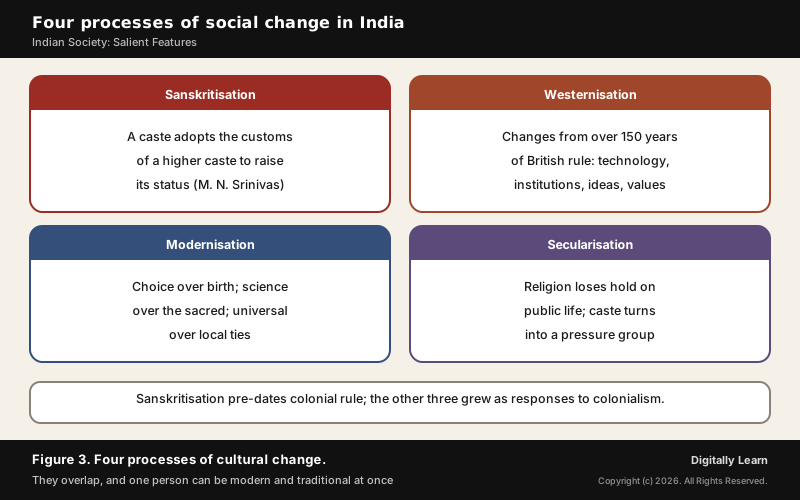
- Sanskritisation: Coined by M. N. Srinivas: a low caste, tribe or other group takes over the customs, ritual, beliefs and style of life of a high, twice-born caste, adopting vegetarianism or wearing the sacred thread. It usually follows a rise in economic status.
- Westernisation: Srinivas defined it as the changes brought about in Indian society and culture by over 150 years of British rule, in technology, institutions, ideology and values. It can mean imitating external forms of culture without adopting democracy and equality, and today it is increasingly Americanisation.
- Modernisation: Local ties give way to universal commitments, science to the sacred, and identity is chosen and achieved rather than ascribed.
- Secularisation: In the West, a decline in the influence of religion; in India, caste itself has been secularised, working as a political pressure group through caste associations and parties.
Continuity and Change: How Indian Society Sustains Its Culture
Tradition in India is not fixed; plurality and a tradition of argument are themselves defining features, and tradition is constantly redefined. The poet A. K. Ramanujan described his father as a south Indian Brahmin who wore a Sri Vaisnava caste mark with Tootal ties and English serge jackets over a traditional dhoti. The sari as most middle-class women wear it today combines the traditional garment with the western petticoat and blouse.
- Syncretism: The Bhakti and Sufi movements left a shared devotional heritage.
- Ritual adapts: Rituals and festivals change with city life and take on social and status meaning, while online pujas bring temples to devotees abroad.
- Old institutions in new forms: Caste works through elections and associations, and the joint family returns when grandparents are needed.
- Identity through festivals: Tribal festivals have become an emphatic projection of a unified tribal identity in response to fears of cultural loss.
Challenges to Unity in Diversity: Communalism, Casteism and Regionalism
Fault Lines of a Plural Society and Why India Holds Together
Cultural diversity becomes a challenge when communities compete for scarce resources such as river waters, jobs or government funds, and when cultural differences overlap with economic inequality. Community identities arouse intense passions precisely because they are ascriptive and deeply felt. The main fault lines are these:
- Communalism: Religion turned into a hostile political identity; the most contentious aspect of cultural diversity.
- Casteism: The belief that caste is the sole basis of social community, which can divert attention from poverty, development and corruption.
- Regionalism: Rooted in India’s diversity of languages, cultures, tribes and religions, concentrated in particular regions and fuelled by a sense of regional deprivation.
- Regional inequality: Since liberalisation, private investment flows to developed States, so the gap between developed and backward regions can widen.
India has held together because it accommodated these identities. Federalism absorbed regional sentiment: Chhattisgarh, Uttaranchal and Jharkhand were created in 2000 on a mix of tribal identity, regional deprivation and ecology. The contrast is Ceylon, which in 1956 made Sinhala its sole official language despite Tamil protests, and Pakistan, divided in 1971 because its western wing would not respect the Bengalis of the east. Regional movements are covered in regionalism, separatism and insurgency.
Previous Year UPSC-CSE Questions
Previous Year UPSC-CSE Questions By the end you will be able to draft model answers for the following UPSC questions. Each question carries a collapsible framework showing how to approach it in the exam.
- UPSC Mains 2026 GS-IUnity in diversity remains the defining feature of Indian society despite the challenges from communalism and regionalism. Comment.
Answer outline: how to structure the answer
What the question asks, the main arguments, relevant examples and the direction of the conclusion. This is not a full model answer.
Introduction: India is diverse in religion, language, caste, tribe and region, yet it has remained cohesive as a state-nation.
Body (sub-themes to develop):
- Challenges: communalism turns religion into a hostile political identity; regionalism feeds on regional deprivation.
- Why unity holds: linguistic States, federalism, minority rights and a secular Constitution accommodate identities.
- Evidence: linguistic States strengthened unity, unlike Sri Lanka's 1956 language policy or Pakistan's split in 1971.
Conclusion: Conclude that unity in diversity remains the defining feature because India recognises diversity rather than suppressing it.
- UPSC Mains 2019 GS-IWhat makes the Indian society unique in sustaining its culture? Discuss.
Answer outline: how to structure the answer
What the question asks, the main arguments, relevant examples and the direction of the conclusion. This is not a full model answer.
Introduction: Indian society sustains its culture by redefining tradition rather than abandoning it.
Body (sub-themes to develop):
- Ascriptive identities of family, caste and community give deep belonging.
- Tolerance and syncretism: the Bhakti and Sufi heritage; a plural tradition of argument.
- Adaptation: joint families re-form, rituals take new forms, tribal festivals assert identity.
Conclusion: Conclude that the capacity to absorb change is what keeps the culture alive.
- UPSC Mains 2021 GS-IHow does Indian society maintain continuity in traditional social values? Enumerate the changes taking place in it.
Answer outline: how to structure the answer
What the question asks, the main arguments, relevant examples and the direction of the conclusion. This is not a full model answer.
Introduction: Indian society changes without erasing its traditions.
Body (sub-themes to develop):
- Continuity: endogamy, the family, festivals and ritual carry traditional values.
- Change: Sanskritisation and westernisation reshape status and custom.
- Change: modernisation, secularisation of caste and urbanisation loosen old controls.
- Synthesis: modern institutions often work through traditional identities.
Conclusion: Conclude that continuity and change co-exist.
- UPSC Mains 2020 GS-IIs diversity and pluralism in India under threat due to globalisation? Justify your answer.
Answer outline: how to structure the answer
What the question asks, the main arguments, relevant examples and the direction of the conclusion. This is not a full model answer.
Introduction: Globalisation brings both pressure towards uniformity and new assertions of identity.
Body (sub-themes to develop):
- Threat: imitation of external western forms; market-led regional inequality.
- Resilience: festivals and identities are reasserted; caste and family adapt.
- Plural institutions: linguistic States, federalism and minority rights protect diversity.
Conclusion: Conclude that diversity is being reshaped rather than erased.
- UPSC Mains 2015 GS-IDescribe any four cultural elements of diversity in India and rate their relative significance in building a national identity.
Answer outline: how to structure the answer
What the question asks, the main arguments, relevant examples and the direction of the conclusion. This is not a full model answer.
Introduction: India's diversity rests on cultural markers such as language, religion, caste and region.
Body (sub-themes to develop):
- Language: 22 Eighth Schedule languages; linguistic States strengthened unity.
- Religion: pluralism under a secular state; syncretic traditions.
- Region and tribe: regional cultures tied to agriculture; tribal identities.
- Rating: language with regional identity has been the strongest basis of identity; accommodated, it built national unity.
Conclusion: Conclude that recognising each element strengthened the national identity.
- UPSC Mains 2020 GS-IHas caste lost its relevance in understanding the multi-cultural Indian Society? Elaborate your answer with illustrations.
Answer outline: how to structure the answer
What the question asks, the main arguments, relevant examples and the direction of the conclusion. This is not a full model answer.
Introduction: Caste has changed but has not lost its relevance in understanding Indian society.
Body (sub-themes to develop):
- Weakened: urban life, modern jobs and education loosened caste rules.
- Still relevant: endogamy, caste in politics, dominant castes such as Jats and Vokkaligas.
- Visible and invisible caste: privilege for some, identity for the disadvantaged.
Conclusion: Conclude that caste remains a key lens, though its form has changed.
- UPSC Mains 2014 GS-IThe life cycle of a joint family depends on economic factors rather than social values. Discuss.
Answer outline: how to structure the answer
What the question asks, the main arguments, relevant examples and the direction of the conclusion. This is not a full model answer.
Introduction: The joint family forms, splits and re-forms over its life cycle.
Body (sub-themes to develop):
- Economic: new business opportunity split a Multani Lohar household; working parents bring grandparents in.
- Demographic: longer life expectancy increases joint households (A. M. Shah).
- Social values: care of the elderly and kinship obligations still matter.
Conclusion: Conclude that economic factors largely set the life cycle, working through social values.
- UPSC Prelims 2008 Prelims-GSUnder which one of the following Constitution Amendment Acts, four languages were added to the languages under the Eighth Schedule of the Constitution of India, thereby raising their number to 22?
How to approach this Prelims question
Approach: Recall which amendment took the Eighth Schedule to 22 languages. The 92nd Amendment of 2003 added Bodo, Dogri, Maithili and Santali, raising the number from 18 to 22.
Trap to watch: The 71st Amendment added three languages; the 92nd added four.
Key facts to recall:
- (a) Ninetieth Amendment: wrong. The four languages came with the 92nd Amendment.
- (b) Ninety-first Amendment: wrong. The four languages came with the 92nd Amendment.
- (c) Ninety-second Amendment: right. It added Bodo, Dogri, Maithili and Santali in 2003.
- (d) Ninety-third Amendment: wrong. The four languages came with the 92nd Amendment.
Answer signal: Option (c): the 92nd Amendment raised the number to 22.
- UPSC Prelims 2024 Prelims-GSThe Constitution (71st Amendment) Act, 1992 amends the Eighth Schedule to the Constitution to include which of the following languages?
- Konkani
- Manipuri
- Nepali
- Maithili
Select the correct answer using the code given below:
How to approach this Prelims question
Approach: Separate the two amendments. The 71st Amendment of 1992 added Konkani, Manipuri and Nepali; Maithili came later, with the 92nd Amendment of 2003.
Trap to watch: Maithili was added in 2003 by the 92nd Amendment, not in 1992.
Key facts to recall:
- (a) 1, 2 and 3: right. Konkani, Manipuri and Nepali were added in 1992.
- (b) 1, 2 and 4: wrong. Maithili was added in 2003, not 1992.
- (c) 1, 3 and 4: wrong. Maithili came with the 92nd Amendment, and Manipuri is left out.
- (d) 2, 3 and 4: wrong. Maithili came later, and Konkani is left out.
Answer signal: Option (a): Konkani, Manipuri and Nepali.
Sources and Further Reading
- NCERT: Indian Society (Class XII Sociology), Chapter 3, Social Institutions: Continuity and Change
- NCERT: Indian Society (Class XII Sociology), Chapter 5, Patterns of Social Inequality and Exclusion
- NCERT: Indian Society (Class XII Sociology), Chapter 6, The Challenges of Cultural Diversity
- NCERT: Social Change and Development in India (Class XII Sociology), Chapter 2, Cultural Change
- NCERT: Social Change and Development in India (Class XII Sociology), Chapter 4, Change and Development in Rural Society
- NCERT: Introducing Sociology (Class XI), Chapter 3, Understanding Social Institutions
- NCERT: Democratic Politics II (Class X), Chapter 3, Gender, Religion and Caste
- Legislative Department: The Constitution of India
- Department of Official Language: Languages included in the Eighth Schedule
- PIB: Cabinet approves caste enumeration in the upcoming Census (30 April 2025)
- Wikipedia: Religion in India
- Wikipedia: Languages of India
- Wikipedia: Eighth Schedule to the Constitution of India
- Wikipedia: Scheduled Castes and Scheduled Tribes
- Wikipedia: Demographics of India
- Wikipedia: 2027 census of India
- UPSC: Previous year question papers
Editorial Disclaimer
This article explains the salient features of Indian society from the NCERT sociology textbooks, standard histories of modern India, the Constitution and the census figures listed below. It describes social institutions, not any community.


