


Overview
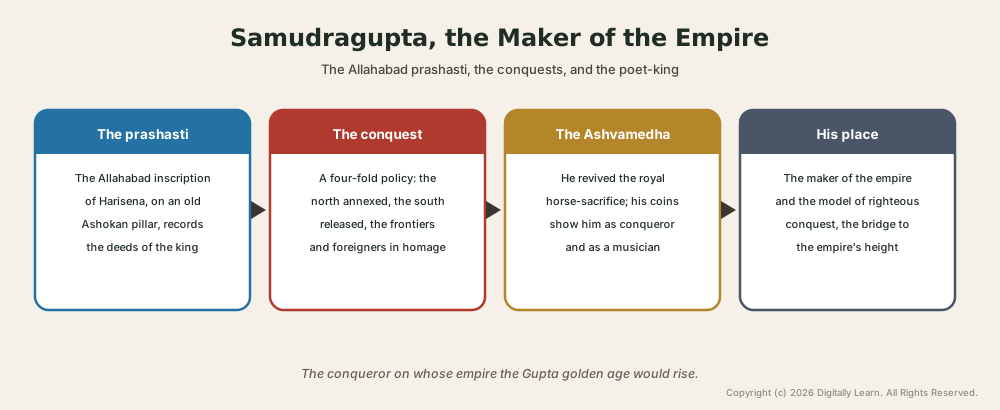
Samudragupta, the son of Chandragupta I, was the greatest conqueror of the Gupta line and the true maker of the empire. His deeds are known above all from the Allahabad prashasti, a long eulogy composed by his court poet Harisena and engraved on a pillar that had once carried the edicts of Ashoka. It tells of a four-fold conquest: the kings of the north uprooted and their lands annexed, the kings of the south defeated and then released, and the frontier states and foreign powers brought to tribute and homage. He revived the ancient horse-sacrifice, the Ashvamedha, and struck a fine gold coinage. This part covers the prashasti, the four-fold conquest, the Ashvamedha and the coins, and his place in history.
Samudragupta and the Allahabad Prashasti
The Prayaga Prashasti of Harisena
What is the significance of the prashasti: almost all we know of Samudragupta comes from a single great inscription, the Allahabad or Prayaga prashasti.
The prashasti was composed by Samudragupta's court poet and minister Harisena, and was engraved on a stone pillar at Prayaga that had once borne the edicts of Ashoka, six centuries before. It is a work of high poetry and royal praise, and lists the king's conquests in detail; because it is a panegyric, it must be read with some care, but it remains the central document for his reign.
Samudragupta, Son of Chandragupta I
Distinguishing the king: Samudragupta was the son of Chandragupta I and the Lichchhavi princess, chosen by his father to carry the empire forward.
Samudragupta, who ruled in the middle of the fourth century CE, was the son of Chandragupta I and Kumaradevi, and is proudly called the Lichchhavi-dauhitra, the son of the Lichchhavi daughter. The prashasti says his father chose him from among his sons to succeed, and he proved the choice right, turning a small kingdom into a great empire by a lifetime of war.
The Conquests: The Four-Fold Policy of Digvijaya
The Four Different Kinds of Conquest
What is the significance of the four-fold policy: Samudragupta treated different kingdoms in different ways, and this careful policy is the key to his empire.
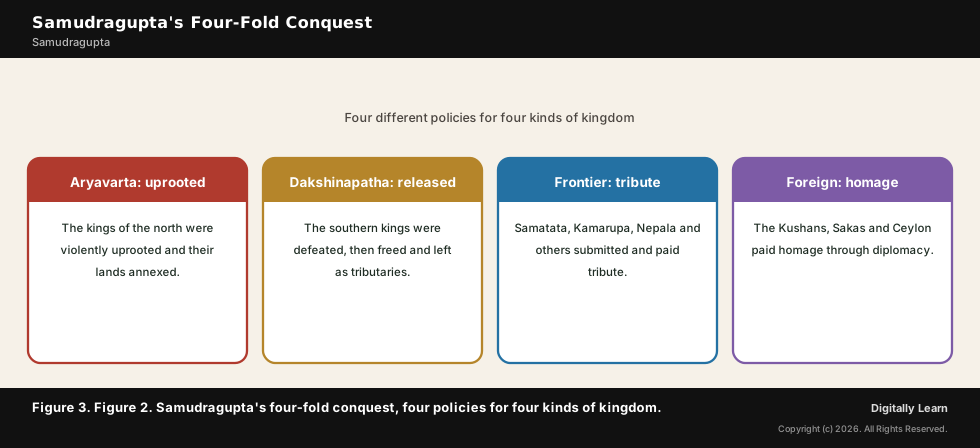
The prashasti shows four distinct treatments. The kings of Aryavarta, the northern plain, were violently uprooted and their kingdoms taken into the empire. The kings of the Dakshinapatha, the south, were defeated but then released and left on their thrones as tributaries. The frontier states paid tribute, and the foreign powers paid homage, so that the empire was ringed by lands that owned his overlordship.
Aryavarta and the Long Campaign to the South
Distinguishing the campaign: the most remarkable of his wars was a long march down the eastern country to the far south.
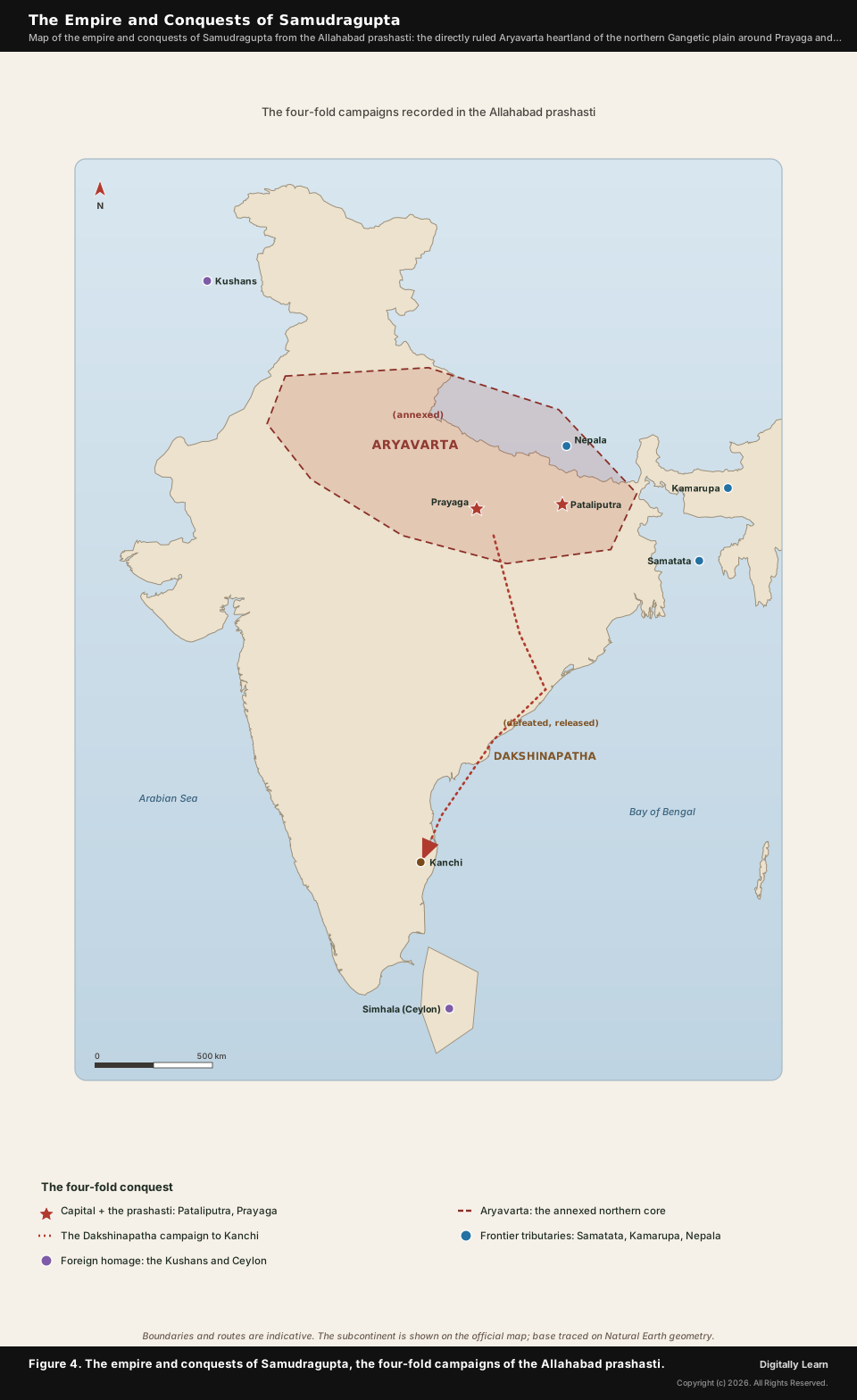
In the north Samudragupta crushed and annexed the kingdoms of Aryavarta, making the Gangetic plain the solid core of the empire. In the south he led a long campaign down the east of the peninsula, the Dakshinapatha, defeating a string of kings as far as Kanchi, the seat of Vishnugopa, in the deep south. Yet he did not annex these distant lands; he defeated their kings and then restored them, a policy of righteous conquest, or dharmavijaya.
The Frontier States and the Foreign Powers
Distinguishing the wider homage: beyond the conquered lands lay a ring of states that bowed to Samudragupta without being conquered.
The frontier kingdoms, Samatata in the east, Kamarupa in Assam, Nepala and others, submitted and paid tribute. Further off, the great foreign powers paid him homage by diplomacy: the remnants of the Kushans, who styled themselves Daivaputra-Shahi, the Saka rulers, and Meghavarman, the king of Simhala or Ceylon, who is said to have sought leave to build a monastery at Bodh Gaya.
| Tier | How treated | Who |
|---|---|---|
| Aryavarta (the north) | Uprooted and annexed | The kings of the Gangetic plain. |
| Dakshinapatha (the south) | Defeated, then released | Twelve kings, as far as Kanchi (Vishnugopa). |
| The frontier states | Tribute | Samatata, Davaka, Kamarupa, Nepala, Kartripura. |
| The foreign powers | Homage by diplomacy | The Kushans, the Sakas, and Ceylon. |
The Ashvamedha and the Coinage of Samudragupta
The Horse-Sacrifice and Paramount Sovereignty
What is the significance of the Ashvamedha: to crown his conquests, Samudragupta revived an ancient and solemn royal rite.
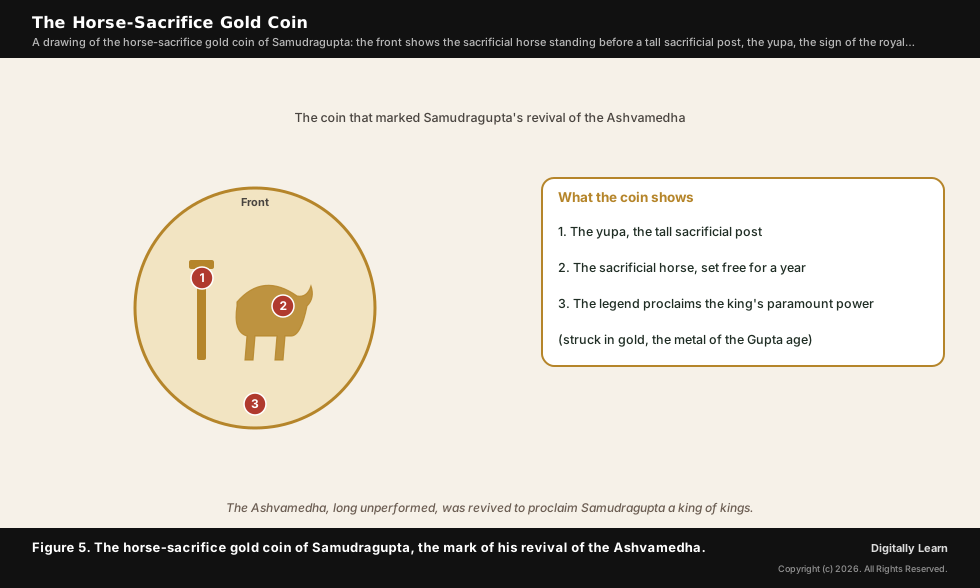
Samudragupta revived the Ashvamedha, the horse-sacrifice, a great Vedic rite long unperformed, by which a king proclaimed himself a paramount sovereign over all rivals. A sacrificial horse was set free to wander for a year, and the lands it crossed were claimed for the king. He struck a special Ashvamedha gold coin to mark the rite, showing the horse before the sacrificial post.
The Gold Coins: the Conqueror and the Poet-King
Distinguishing the coinage: the gold coins of Samudragupta are among the finest of ancient India, and they show many sides of the king.
His coins picture him as a warrior, an archer with the bow, and a hero with the battle-axe; but the most famous shows him seated and playing the vina, the lyre, a sign of his love of music and of his title Kaviraja, the king of poets. So the coinage shows him at once as conqueror, sacrificer and artist.
| Coin type | What it shows | What it signifies |
|---|---|---|
| The archer (standard) type | The king with a bow | The conquering warrior. |
| The battle-axe type | The king with a battle-axe | The hero in war. |
| The lyrist type | The king playing the vina | The poet-king, Kaviraja. |
| The Ashvamedha type | The sacrificial horse and post | The paramount sovereign. |
The Place of Samudragupta in History
The 'Napoleon of India' and the Verdict of History
What is the significance of his place: Samudragupta is reckoned among the greatest of ancient kings, though a famous label for him needs care.
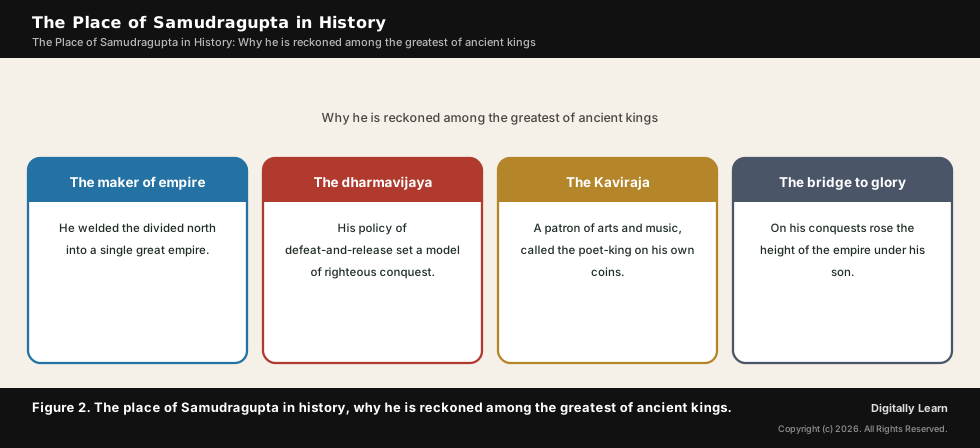
The historian V.A. Smith called Samudragupta the Napoleon of India, for the sweep of his conquests; but this is a modern comparison, not an ancient title, and historians today use it with caution. His true greatness lies in welding the divided north into a single empire, in the model of righteous conquest he set in the south, and in the peace on which his son would raise the golden age of the Guptas.
UPSC Relevance and Exam Focus
Where Samudragupta Fits in the UPSC-CSE Syllabus
This topic belongs to General Studies Paper I: ancient Indian history and culture, and Samudragupta, with the Allahabad prashasti, is among the most examined of the Gupta rulers.
For Prelims, hold the firm facts: the Allahabad prashasti was composed by Harisena and engraved on an Ashokan pillar; Samudragupta's conquest had four tiers, the north annexed, the south defeated and released, the frontiers in tribute and the foreigners in homage; the southern campaign reached Kanchi; he revived the Ashvamedha; and his coins include the lyrist type, the mark of his title Kaviraja.
For Mains, the four-fold policy is a fine example of statecraft, and the prashasti a case study in reading a royal eulogy as history.
Recurring linked concepts an aspirant should keep in working memory:
- The Allahabad prashasti: By Harisena, on an Ashokan pillar.
- The four-fold policy: Annex, release, tribute, homage.
- Dakshinapatha: The south defeated and released; the campaign to Kanchi.
- The Ashvamedha: The revived horse-sacrifice of paramount sovereignty.
- The lyrist coin: The mark of his title Kaviraja, the poet-king.
A common Prelims trap is to say Samudragupta annexed the south; in fact the southern kings were defeated and then released, a dharmavijaya, while only the northern Aryavarta kingdoms were annexed. Another is to treat the Napoleon of India as a contemporary title; it is a modern comparison by V.A. Smith.
Previous Year UPSC-CSE Questions
Previous Year UPSC-CSE Questions By the end you will be able to draft model answers for the following UPSC questions. Each question carries a collapsible framework showing how to approach it in the exam.
- UPSC Prelims 2006 GS-IThe Allahabad Pillar inscription is associated with which one of the following?
How to approach this Prelims question
Approach: Distinguish the pillar (Ashokan) from the inscription in question (Samudragupta's prashasti by Harisena).
Trap to watch: Ashoka is the trap: the pillar is an Ashokan pillar, but the famous Allahabad prashasti inscription on it records Samudragupta's conquests.
Key facts to recall:
- The Allahabad prashasti was composed by Harisena for Samudragupta.
- It was engraved on a re-used Ashokan pillar.
Answer signal: Samudragupta.
Sources and Further Reading
Editorial Disclaimer
This article is for UPSC preparation. The Allahabad prashasti is a royal eulogy, and the dates and details of Samudragupta's reign are reconstructed by historians; the conventional accounts are given here.