


Overview
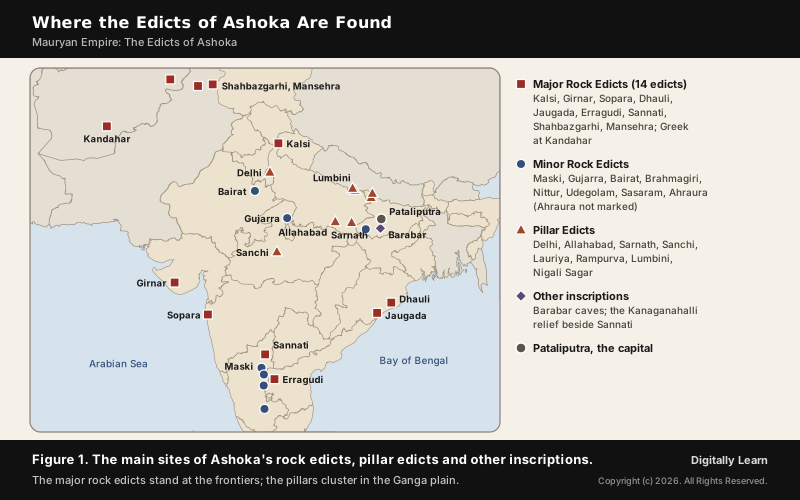
The edicts of Ashoka are the inscriptions that the Mauryan emperor Ashoka (c. 268 to 232 BCE) had carved on natural rocks, polished stone pillars and cave walls across his empire, from Afghanistan to Karnataka. They fall into six groups: the fourteen Major Rock Edicts, the Minor Rock Edicts, the two Separate Kalinga Edicts, the seven Major Pillar Edicts, the Minor Pillar Edicts and the cave inscriptions at Barabar. Most are in Prakrit in the Brahmi script, and they are the first known inscriptions in India after the Harappan civilisation.
Edicts of Ashoka at a Glance: What They Are and How Many
Edict, Dhamma and the Royal Title Devanampiya Piyadasi
An edict is an order or proclamation issued by a ruler. Ashoka was the first Indian ruler to carve his messages to his subjects and officials on stone, on natural rocks and on polished pillars, and he used them to proclaim what he understood to be dhamma: respect towards elders, generosity towards Brahmanas and those who had renounced the world, kind treatment of slaves and servants, and respect for religions and traditions other than one's own.
The edicts rarely name Ashoka. They speak in the name of Devanampiya Piyadasi, usually translated as "beloved of the gods" and "pleasant to behold". Because virtually the same message is engraved from the north-west of today's Pakistan to Andhra Pradesh, Odisha and Uttarakhand, the edicts are also the best guide to how far his empire reached.
How Many Edicts of Ashoka: The Six Groups
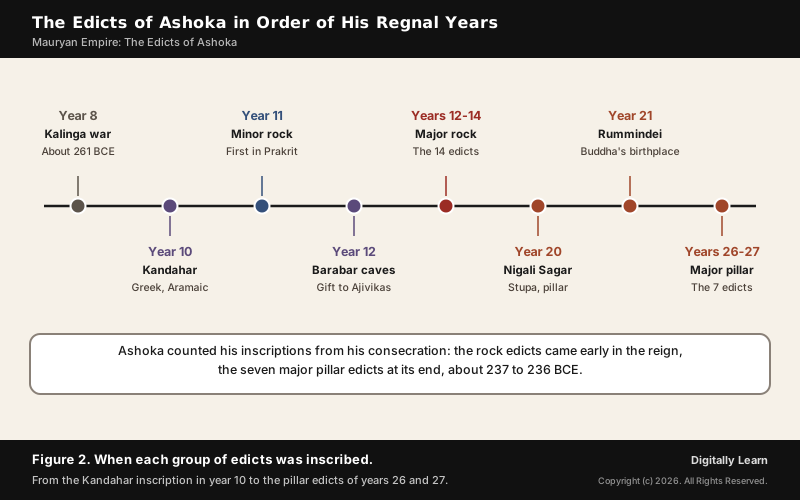
The edicts are grouped by what they are carved on and how long they are. The table gives each group, its number and where it is found; the timeline after it shows when each was inscribed, counted in years from Ashoka's consecration.
| Group | How many | Where | When (regnal year) |
|---|---|---|---|
| Major Rock Edicts | 14 edicts, repeated at 10 sites | Frontier sites: Kalsi, Girnar, Sopara, Dhauli, Jaugada, Erragudi, Sannati, Shahbazgarhi, Mansehra; Greek at Kandahar | 12 to 14 |
| Separate Kalinga Edicts | 2 edicts | Dhauli and Jaugada in Odisha, in place of edicts XI to XIII | 13 and 14 |
| Minor Rock Edicts | 2 edicts, at many sites | Maski, Gujarra, Bairat, Brahmagiri, Rupnath, Sasaram and others | 11 onwards |
| Major Pillar Edicts | 7 edicts | Delhi-Topra, Delhi-Meerut, Allahabad, Lauriya-Araraj, Lauriya-Nandangarh, Rampurva | 26 and 27 |
| Minor Pillar Edicts | 5 edicts | Sarnath, Sanchi, Allahabad, Rummindei (Lumbini), Nigali Sagar | 12 onwards |
| Cave inscriptions | 3 dedications | Barabar hills, Bihar, for the Ajivikas | 12 and 19 |
Major Rock Edicts of Ashoka: The Fourteen Edicts
Contents of the 14 Major Rock Edicts
The fourteen Major Rock Edicts form one set, repeated with small variations at ten places. They set out dhamma as a code of social and moral conduct and never mention the Buddha or the Sangha. Each edict has its own subject:
- Edict I: Bans the killing of animals for sacrifice and certain festive gatherings.
- Edict II: Provides medical care for people and animals, and names the southern kingdoms of the Cholas, Pandyas, Satyaputras and Keralaputras and the Greek king Antiochus.
- Edict III: Asks for generosity to Brahmanas and sramanas and orders the Yuktas, Rajukas and Pradesikas to tour every five years to teach dhamma.
- Edict IV: Replaces bherighosha, the sound of the war drum, with dhammaghosha, the sound of dhamma.
- Edict V: Records the appointment of the dhamma mahamattas in the thirteenth year of the reign.
- Edict VI: Says the king is ready to hear reports on the people’s affairs at all times.
- Edict VII: Asks for self-control and purity of mind among all sects.
- Edict VIII: Describes the king’s dhamma tour to Sambodhi, that is Bodh Gaya.
- Edict IX: Condemns empty ceremonies and praises the ceremony of dhamma.
- Edict X: Condemns the desire for fame and glory except through dhamma.
- Edict XI: Explains dhamma as courtesy, liberality and right conduct.
- Edict XII: Asks for respect for all sects and warns against praising one’s own sect at the expense of others.
- Edict XIII: Records the conquest of Kalinga, the king’s remorse and the victory of dhamma.
- Edict XIV: Explains why and how the edicts were engraved.
Major Rock Edict XIII: The Kalinga War and the Victory of Dhamma
The longest and most quoted edict of the set, Major Rock Edict XIII, says Ashoka conquered Kalinga eight years after his consecration, that 100,000 were killed in action, many times that number died, and 150,000 were carried away as captives. The king records his deep remorse and declares that the only true conquest is the conquest by dhamma.
The edict then lists the places where that conquest has succeeded. It names five Greek kings, identified with Antiochus II of the Seleucid empire, Ptolemy III of Egypt, Antigonus of Macedonia, Magas of Cyrene and Alexander of Epirus, and in the south the Cholas and Pandyas as far as Sri Lanka.
Where the Major Rock Edicts Are Found, State by State
The Major Rock Edicts stand not in the Mauryan heartland of Bihar but at the frontiers of the empire, along roads and rivers where travellers would see them:
- Uttarakhand: Kalsi, near Dehradun.
- Gujarat: Girnar, near Junagadh.
- Maharashtra: Sopara, near Mumbai, where fragments of edicts VIII and IX were found in 1882.
- Odisha: Dhauli, near Bhubaneswar, and Jaugada in Ganjam district, the ancient land of Kalinga.
- Andhra Pradesh: Erragudi in Kurnool district.
- Karnataka: Sannati, on the Bhima river.
- Pakistan: Shahbazgarhi and Mansehra, in the Kharosthi script.
- Afghanistan: Kandahar, where parts of edicts XII and XIII survive in Greek.
At Dhauli and Jaugada, in newly conquered Kalinga, edicts XI to XIII were left out and two Separate Kalinga Edicts were carved instead. They are addressed to the officials of Tosali and Samapa: the first asks for fair and prompt justice, and the second asks the officials to convince the unconquered tribes on the border that the king means them no harm.
Minor Rock Edicts and Where the Name Ashoka Appears
Minor Rock Edicts: The Earliest Edicts in an Indian Language
The Minor Rock Edicts are the earliest of Ashoka's inscriptions in an Indian language, carved from the eleventh year of his reign, about two and a half years after he became a lay Buddhist. They are shorter than the major edicts and more openly Buddhist in tone. Minor Rock Edict I appears alone at sites such as Maski, Bairat, Gujarra, Sasaram and Rupnath, and together with Minor Rock Edict II at sites such as Brahmagiri, Erragudi, Udegolam and Nittur in the south.
A few inscriptions in Greek or Aramaic in Afghanistan are sometimes counted with this group. The earliest of all is the Kandahar bilingual inscription, in Greek and Aramaic, carved in the tenth year of the reign, about 260 BCE, and found under rubble near Kandahar in 1958.
Maski, Gujarra and Kanaganahalli: Where the Name Ashoka Appears
For decades after the edicts were read, scholars could not be sure who Piyadasi was. Buddhist chronicles such as the Dipavamsa linked the name Ashoka with Piyadasi, but the inscriptions themselves used only the titles. The proof came from the south:
- Maski (Karnataka): In 1915 a mining engineer, C. Beadon, found a Minor Rock Edict at Maski in Raichur district that calls the king Devanampiya Asoka. It was the first edict found with the name Ashoka in it.
- Gujarra (Madhya Pradesh): Its Minor Rock Edict joins the name and the titles: Devanampiya Piyadasi Asokaraja.
- Kanaganahalli (Karnataka): Excavations of 1994 to 1998 near Sannati found a relief portrait of the king labelled in Brahmi Raya Asoko, King Ashoka.
Having matched these inscriptions with the rest in content, style, language and palaeography, epigraphists concluded that all of them were issued by the same ruler.
Pillar Edicts of Ashoka: Major and Minor
The Seven Major Pillar Edicts
The seven Major Pillar Edicts were inscribed at the end of the reign, in the 26th and 27th years, about 237 to 236 BCE, and are the most finely engraved of all his inscriptions. All are in Prakrit in the Brahmi script. They are found on pillars at Delhi (two, brought from Topra and Meerut by Firuz Shah Tughlaq in the fourteenth century), Allahabad (originally at Kausambi), Lauriya-Araraj, Lauriya-Nandangarh and Rampurva. Their subjects run as follows:
- Pillar Edict I: The king’s principle of protecting his people.
- Pillar Edict II: Defines dhamma as few sins, many good deeds, compassion, liberality, truthfulness and purity.
- Pillar Edict III: Warns against harshness, cruelty, anger and pride.
- Pillar Edict IV: Sets out the duties of the Rajukas.
- Pillar Edict V: Lists animals and birds that must not be killed, and records 25 releases of prisoners in 26 years.
- Pillar Edict VI: Explains the policy of dhamma.
- Pillar Edict VII: Sums up the king’s work for dhamma; it appears only on the Delhi-Topra pillar.
Minor Pillar Edicts: Schism Edict, Queen's Edict, Rummindei and Nigali Sagar
The five Minor Pillar Edicts are short and have a clear Buddhist purpose:
- Schism Edict: Orders that any monk or nun who splits the Sangha be dressed in white and made to live apart from the Order; found at Sarnath, Sanchi and Allahabad.
- Queen’s Edict: Orders that gifts made by the second queen, Karuvaki, mother of Tivala, be credited to her; found on the Allahabad pillar.
- Rummindei (Lumbini, Nepal): Records Ashoka’s visit in the 21st year of his reign to the birthplace of the Buddha, calls the Buddha Sakyamuni, exempts the village of Lumbini from the land tax and reduces its revenue tax to one-eighth.
- Nigali Sagar (Nepal): Records that he enlarged the stupa of the earlier Buddha Konakamana in his 14th year and set up the pillar during a visit in his 20th year.
The Pillars of Ashoka: Monolithic, Polished and Free-Standing
About twenty of Ashoka's pillars survive. Each shaft is a single piece of stone, a monolith, tapering towards the top and given the high Mauryan polish. Most are of buff sandstone from Chunar near Varanasi, a few of red and white sandstone from the Mathura region. The pillars stood on their own in open places; they were not parts of buildings. Some were crowned with animal capitals, and the finest, the Lion Capital of Sarnath, became the model for India's State Emblem when the Constituent Assembly adopted the resolution on 11 December 1947.
Later rulers valued the pillars too. The Allahabad pillar carries Ashoka's edicts, the Sanskrit praise of the Gupta emperor Samudragupta composed by Harishena, and an inscription of the Mughal emperor Jahangir.
Barabar Caves and the Greek and Aramaic Inscriptions
Barabar Cave Inscriptions and the Edicts in Afghanistan
Ashoka's gifts to other faiths are recorded in the Barabar hills of Bihar. In the twelfth year of his reign he dedicated the Sudama and Visvakarma caves to the Ajivikas, a sect of ascetics founded by Makkhali Gosala, and in the nineteenth year the Karna Chopar cave. These are the oldest surviving rock-cut caves in India.
At the western edge of the empire, in today's Afghanistan, Ashoka addressed his Greek- and Aramaic-speaking subjects in their own languages:
- Kandahar, in Greek and Aramaic: Greek and Aramaic, about 260 BCE, the earliest of his inscriptions; it renders dhamma as eusebeia, piety, in Greek.
- Kandahar Greek edict: Parts of Major Rock Edicts XII and XIII in Greek, on a stone plaque from a building.
- Laghman inscriptions: Aramaic texts on natural rock in the Laghman area.
Languages, Scripts and Decipherment of the Edicts of Ashoka
Prakrit in Brahmi and Kharosthi, Greek and Aramaic
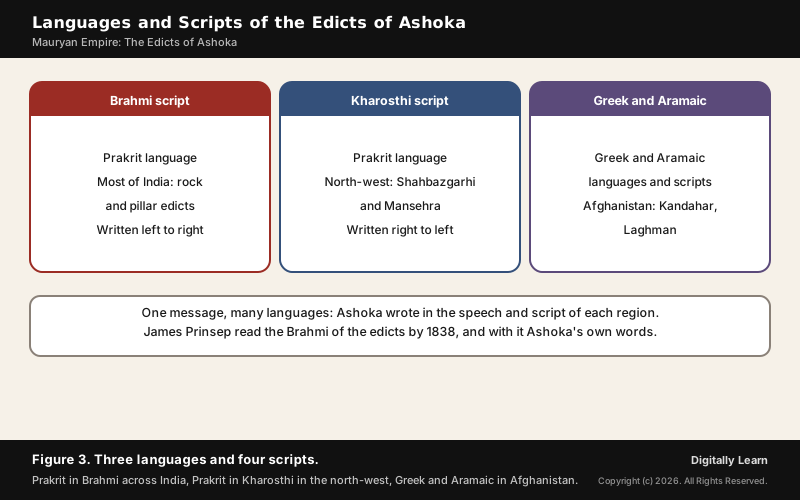
The edicts use three languages and four scripts. Most are in Prakrit, the spoken language of the time, so that ordinary people could have them read out and understand them. The script depends on the region:
- Brahmi script: Prakrit written from left to right, used across most of India. Most scripts used for modern Indian languages derive from it.
- Kharosthi: Prakrit written from right to left, used in the north-west at Shahbazgarhi and Mansehra.
- Greek and Aramaic: Both language and script, used in Afghanistan at Kandahar and Laghman.
James Prinsep and the Decipherment of the Ashokan Inscriptions
For centuries nobody could read the edicts. James Prinsep, an officer in the East India Company's mint and secretary of the Asiatic Society of Bengal in Calcutta, deciphered the Brahmi script in a series of articles in the Society's journal between 1836 and 1838, building on the work of earlier scholars. Scholars had assumed the inscriptions were in Sanskrit; they were in fact in Prakrit, and Prinsep was able to read Ashokan Brahmi by 1838.
Kharosthi was read another way. Coins of the Indo-Greek kings carried their names in both Greek and Kharosthi, so scholars who knew Greek could match the letters, and once Prinsep identified the language as Prakrit, longer Kharosthi inscriptions could be read too. Prinsep found that most of these inscriptions spoke of a king called Piyadasi; the Maski edict of 1915 later settled that Piyadasi was Ashoka.
Why the Edicts of Ashoka Matter for Mauryan History
What Ashokan Inscriptions Reveal About Mauryan History, and Their Limits
Ashoka's inscriptions are among the most valuable sources for the Mauryan empire because they are the ruler's own words, dated by his regnal years and placed across his whole territory. They tell us about:
- The extent of the empire: Their spread from Kandahar to Karnataka and from Gujarat to Odisha marks the lands Ashoka ruled or reached.
- Administration: Five political centres named in the inscriptions, the capital Pataliputra and the provincial centres of Taxila, Ujjayini, Tosali and Suvarnagiri, and officials such as the Yuktas, Rajukas, Pradesikas and the dhamma mahamattas.
- The king’s policy: The content of dhamma, the turn from war after Kalinga, and welfare work such as medical care for people and animals.
- Religious policy: Respect for all sects, gifts to the Ajivikas, and the king’s closeness to the Buddhist Sangha in the Schism Edict and at Lumbini.
- Foreign relations: The Greek kings and southern kingdoms named in Edicts II and XIII.
- Language and writing: The first known inscriptions after the Harappan civilisation, in Brahmi, the parent of most Indian scripts.
Inscriptions also have limits. Most do not name the ruler, and historians must judge whether each claim is true, plausible or an exaggeration: Ashoka says, for example, that earlier rulers had no arrangement to receive reports, which cannot simply be taken at his word. They record what the king wished to say, not what his subjects experienced, so they must be read alongside Megasthenes, the Arthashastra, Buddhist texts and archaeology.
Edicts of Ashoka in UPSC Previous Year Questions
What UPSC Has Asked About Ashoka's Inscriptions
UPSC's objective questions on the edicts test precise facts: which site is in which state, which edict carries the king's name, which edicts name the southern kingdoms and who deciphered the script. Learning the six groups, the sites by state and the few exceptional inscriptions answers nearly all of them.
| Year | What the question asked | The point being tested |
|---|---|---|
| 1997 | Which statement about Ashokan pillars is incorrect | They were free-standing, not parts of buildings |
| 1997 | Which edict mentions Ashoka's personal name | Maski |
| 1998 | Which Major Rock Edicts tell us about the Sangam kingdoms | II and XIII |
| 2006 | With whom the Allahabad pillar inscription is associated | Samudragupta |
| 2016 | Who first deciphered the edicts of Ashoka | James Prinsep |
| 2019 | Where a relief names King Ashoka beside his portrait | Kanaganahalli |
| 2022 | Four pairs of edict sites and states | Only Dhauli and Erragudi were right |
The 2026 GS Paper I question asked candidates to analyse the importance of Ashokan inscriptions for reconstructing Mauryan history, the subject of the section above.
Previous Year UPSC-CSE Questions
Previous Year UPSC-CSE Questions By the end you will be able to draft model answers for the following UPSC questions. Each question carries a collapsible framework showing how to approach it in the exam.
- UPSC Mains 2026 GS-IAnalyze the importance of Ashokan inscriptions for reconstructing Mauryan history.
Answer outline: how to structure the answer
What the question asks, the main arguments, relevant examples and the direction of the conclusion. This is not a full model answer.
Introduction: Open with Ashoka as the first Indian ruler to address his subjects on stone, and Prinsep's decipherment.
Body (sub-themes to develop):
- Extent of the empire from the distribution of the edicts, Kandahar to Karnataka.
- Administration: Pataliputra, Taxila, Ujjayini, Tosali, Suvarnagiri; Yuktas, Rajukas, Pradesikas, dhamma mahamattas.
- Policy and religion: dhamma, Kalinga and Edict XIII, tolerance of sects, the Schism Edict, Lumbini.
- Foreign relations: Greek kings and southern kingdoms in Edicts II and XIII.
- Limits: royal voice, titles instead of the name, claims to be tested against other sources.
Conclusion: Conclude that the inscriptions are the backbone of Mauryan history, read critically with texts and archaeology.
- UPSC Prelims 1997 Prelims-GSWhich one of the following statements regarding Asokan stone pillars is incorrect?
How to approach this Prelims question
Approach: Test each feature of the pillars.
Trap to watch: The pillars were free-standing; only the wrong option makes them parts of buildings.
Key facts to recall:
- (a) Highly polished: wrong as the answer. The pillars are polished, so the statement is correct.
- (b) Monolithic: wrong as the answer. Each shaft is a single stone, so the statement is correct.
- (c) Tapering shaft: wrong as the answer. The shafts do taper, so the statement is correct.
- (d) Parts of architectural structures: right. The pillars stood free; this is the incorrect statement asked for.
Answer signal: Option (d).
- UPSC Prelims 1997 Prelims-GSWhich one of the following edicts mentions the personal name of Asoka?
How to approach this Prelims question
Approach: Recall where the name Ashoka, not only Piyadasi, appears.
Trap to watch: Rummindei and the Kalinga edicts use the royal titles, not the personal name.
Key facts to recall:
- (a) Kalsi: wrong. Kalsi carries the Major Rock Edicts, which use Ashoka's title, not his name.
- (b) Rummindei: wrong. The Rummindei pillar marks Lumbini; it does not give his personal name.
- (c) Special Kalinga Edict: wrong. The Separate Kalinga Edicts at Dhauli and Jaugada do not carry his name.
- (d) Maski: right. The Maski edict was the first found with Ashoka's name.
Answer signal: Maski, option (d).
- UPSC Prelims 1998 Prelims-GSThe Asokan major rock edicts which tell us about the Sangam Kingdom include rock edicts
How to approach this Prelims question
Approach: Ask which edicts name the Cholas and Pandyas.
Trap to watch: Edict XIV only explains the engraving of the edicts.
Key facts to recall:
- (a) I and X: wrong. Edict I bans animal sacrifice and Edict X condemns the desire for fame; neither names the southern kingdoms.
- (b) I and XI: wrong. Edict XI explains dhamma as courtesy and right conduct.
- (c) II and XIII: right. Edict II names the Cholas, Pandyas, Satyaputras and Keralaputras; Edict XIII names the Cholas and Pandyas.
- (d) II and XIV: wrong. Edict XIV only explains why the edicts were engraved.
Answer signal: II and XIII, option (c).
- UPSC Prelims 2006 Prelims-GSThe Allahabad Pillar inscription is associated with which one of the following?
How to approach this Prelims question
Approach: Remember the three sets of inscriptions on the Allahabad pillar.
Trap to watch: The pillar is Ashokan, but 'the Allahabad Pillar inscription' means Samudragupta's praise by Harishena.
Key facts to recall:
- (a) Mahapadma Nanda: wrong. No inscription of the Nandas is on the pillar.
- (b) Chandragupta Maurya: wrong. The pillar's edicts are his grandson Ashoka's.
- (c) Ashoka: wrong as the answer. The pillar carries Ashoka's edicts, but the Allahabad pillar inscription in the usual sense is Samudragupta's praise.
- (d) Samudragupta: right. His praise was added to Ashoka's pillar at Allahabad.
Answer signal: Samudragupta, option (d).
- UPSC Prelims 2016 Prelims-GSWho of the following had first deciphered the edicts of Emperor Ashoka?
How to approach this Prelims question
Approach: Link the decipherment of Brahmi to the Asiatic Society of Bengal.
Trap to watch: William Jones founded the Asiatic Society but did not read Brahmi.
Key facts to recall:
- (a) Georg Buhler: wrong. The first to read the edicts was James Prinsep.
- (b) James Prinsep: right. He read the Brahmi of the edicts by 1838.
- (c) Max Muller: wrong. The first to read the edicts was James Prinsep.
- (d) William Jones: wrong. The first to read the edicts was James Prinsep.
Answer signal: James Prinsep, option (b).
- UPSC Prelims 2019 Prelims-GSIn which of the following relief sculpture inscriptions is 'Ranyo Ashoka' (King Ashoka) mentioned along with the stone portrait of Ashoka?
How to approach this Prelims question
Approach: Recall the relief portrait labelled with the king's name.
Trap to watch: Shahbazgarhi has an edict but no portrait; Sanchi has reliefs but not this label.
Key facts to recall:
- (a) Kanaganahalli: right. A relief there is labelled King Ashoka beside his stone portrait.
- (b) Sanchi: wrong. Sanchi has a Minor Pillar Edict but no portrait of Ashoka with his name.
- (c) Shahbazgarhi: wrong. It carries the Major Rock Edicts, not a portrait relief.
- (d) Sohgaura: wrong. It is not the relief that names Ashoka beside his portrait.
Answer signal: Kanganahalli, option (a).
- UPSC Prelims 2022 Prelims-GSConsider the following pairs: Site of Ashoka's major rock edicts : Location in the State of
- Dhauli : Odisha
- Erragudi : Andhra Pradesh
- Jaugada : Madhya Pradesh
- Kalsi : Karnataka
How many pairs given above are correctly matched?
How to approach this Prelims question
Approach: Place each site in its state.
Trap to watch: Jaugada is in Odisha with Dhauli; Kalsi is in Uttarakhand.
Key facts to recall:
- (a) Only one pair: wrong. Two pairs match: Dhauli with Odisha and Erragudi with Andhra Pradesh.
- (b) Only two pairs: right. Jaugada is in Odisha and Kalsi in Uttarakhand, so pairs 3 and 4 fail.
- (c) Only three pairs: wrong. Both Jaugada and Kalsi are placed in the wrong state.
- (d) All four pairs: wrong. Pairs 3 and 4 are mismatched.
Answer signal: Only two pairs, option (b).
Sources
- NCERT: Themes in Indian History Part I (Class XII), Kings, Farmers and Towns
- District Junagadh (Government of Gujarat): Ashok Shilalekh
- Odisha Tourism (Government of Odisha): Jaugada, Ashokan Major Rock Edict
- Incredible India (Ministry of Tourism): Sarnath
- Wikipedia: Edicts of Ashoka
- Wikipedia: Major Rock Edicts
- Wikipedia: Minor Rock Edicts
- Wikipedia: Major Pillar Edicts
- Wikipedia: Minor Pillar Edicts
- Wikipedia: Pillars of Ashoka
- Wikipedia: Barabar Caves
- Wikipedia: Kandahar Bilingual Rock Inscription
- Wikipedia: Kandahar Greek Edicts of Ashoka
- Wikipedia: Lumbini pillar inscription
- Wikipedia: Nigali Sagar
- Wikipedia: Brahmi script
- Wikipedia: Kharosthi
- Wikipedia: James Prinsep
- Wikipedia: Maski
- Wikipedia: Kanaganahalli
- Wikipedia: Lion Capital of Ashoka
- Wikipedia: Allahabad pillar
- Wikipedia: Delhi-Topra pillar
- Wikipedia: Aramaic inscription of Laghman
- UPSC: Civil Services Examination question papers
Editorial Disclaimer
This article is for UPSC preparation. The number and classification of the edicts and the readings of their texts follow the standard scholarly accounts, and a few details rest on later tradition.