

Overview
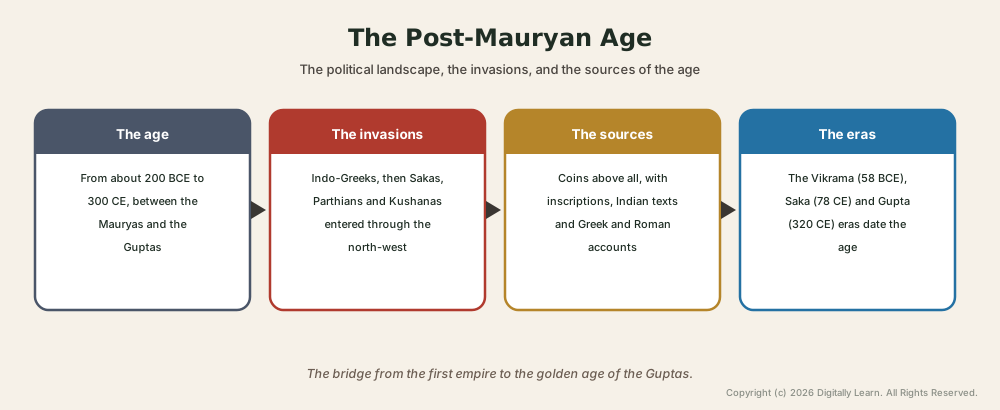
The post-Mauryan age, from about 200 BCE to 300 CE, is the period of Indian history between the fall of the Mauryan empire and the rise of the Guptas. It was a time of political fragmentation in the north, where the Shungas and Kanvas gave way to waves of invaders from Central Asia, the Indo-Greeks, the Sakas, the Parthians and the Kushanas, while in the Deccan the Satavahanas built a great regional empire. Far from a dark age, these were among the most creative centuries in Indian history, giving the country its first portrait coins, its first images of the Buddha and a booming trade with Rome. Because written histories are few, the age is read above all from its coins and inscriptions. This part frames the period: its political map, the invasions, the sources and the eras.
The Post-Mauryan Age between the Mauryas and the Guptas
The Span and Significance of the Post-Mauryan Centuries
What is the significance of the post-Mauryan age: it is the bridge between India's first empire and its golden age, and a period the examiner treats as a unit of sources, invasions and dynasties.
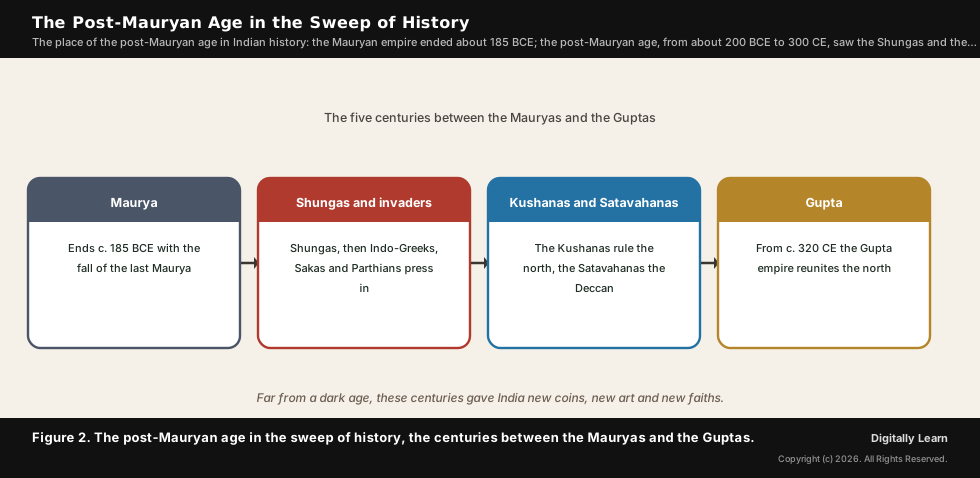
The five centuries from about 200 BCE to 300 CE lie between the fall of the Mauryas and the rise of the Guptas. Older writers once called this a dark or confused age, because no single empire ruled the whole land and the political picture kept changing. That judgement is now rejected.
These were in fact among the most creative centuries in Indian history, giving the country its first portrait coins, the first images of the Buddha, a flourishing trade with the Roman world and the rise of Mahayana Buddhism.
The Political Map: A Fragmented North and an Imperial Deccan
Distinguishing the political geography: the age is best grasped as three broad zones, each with its own history.
In the north, the Mauryas were followed by the Shungas and Kanvas, but the real story was the series of invasions from the north-west that planted Indo-Greek, Saka and Kushana rulers on Indian soil. In the Deccan, the Satavahanas rose to build the first great empire south of the Vindhyas.
In the far south, beyond the reach of these powers, the Tamil kingdoms of the Sangam age flourished, the subject of a separate study. No one power held all three zones together.
The Waves of Central-Asian Invasion through the North-West
The Sequence: Indo-Greeks, Sakas, Parthians and Kushanas
What is the significance of the invasions: the order of the central-Asian invaders is one of the most frequently tested facts of the whole period, and it must be held exactly.
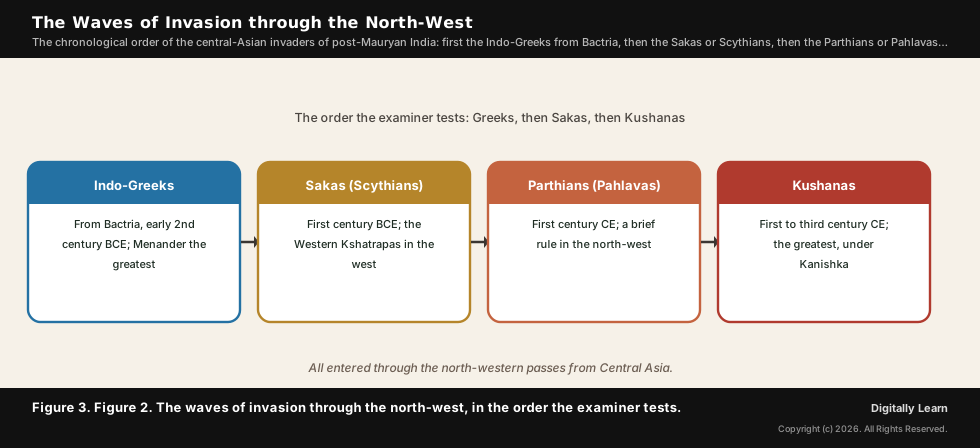
As the Mauryan hold on the north-west broke, a chain of peoples pushed through the passes from Central Asia, each displacing the last. First came the Indo-Greeks, the Bactrian Greeks, in the early second century BCE.
They were followed by the Sakas, or Scythians, in the first century BCE, then briefly by the Parthians, the Pahlavas, in the first century CE, and finally by the Kushanas, who built the greatest empire of them all. The order to remember is Greeks, then Sakas, then Kushanas.
Mapping the Powers and the Invasion Routes
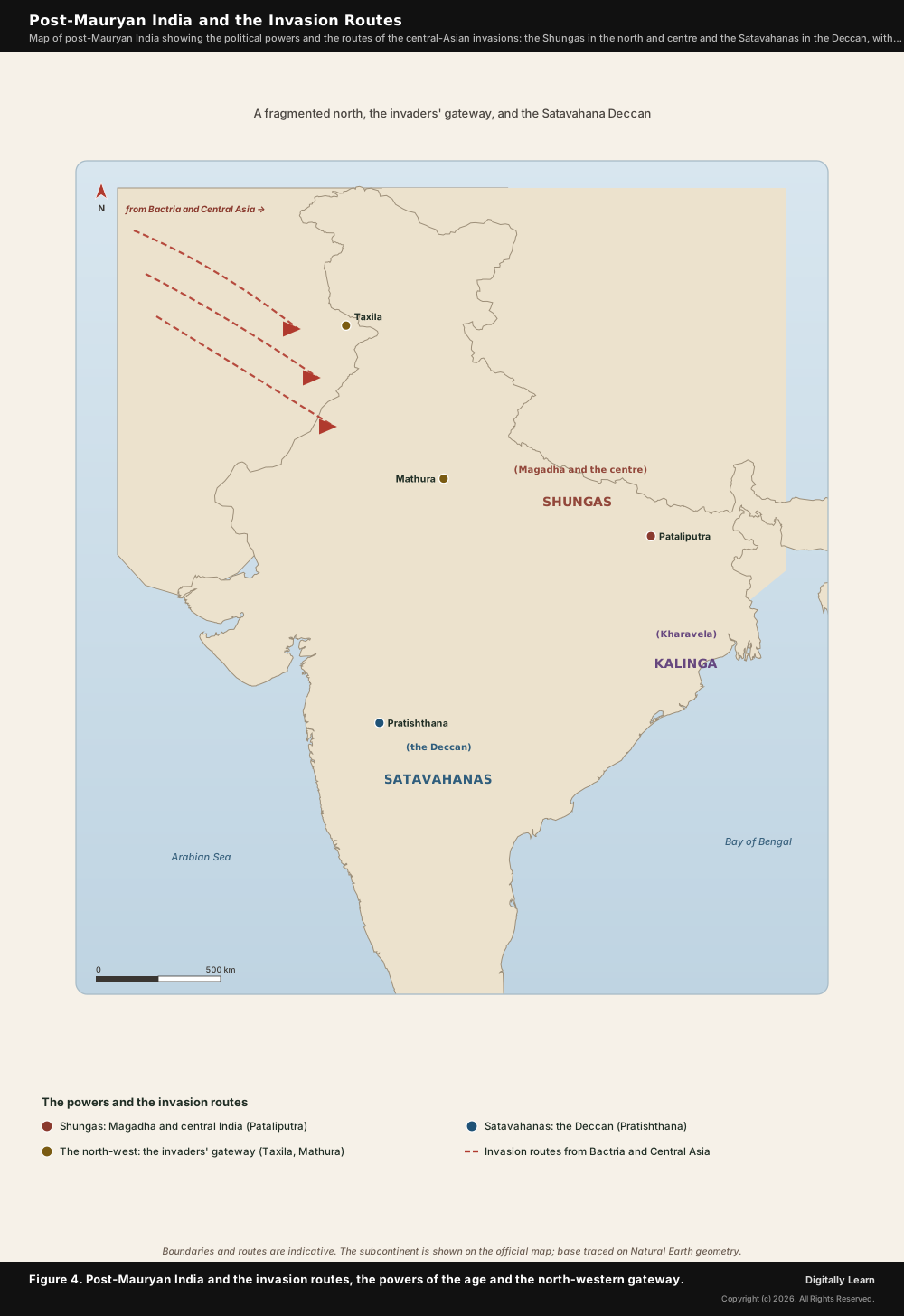
Distinguishing the geography of the invasions: every one of these peoples entered India by the same road, through the north-western passes, which is why that frontier shaped the age.
The map shows the political powers of the age and the routes of invasion. The Shungas held Magadha and the centre, the Satavahanas the Deccan, and Kalinga stood apart under Kharavela. Across the top left, the arrows mark the north-western passes through which the Indo-Greeks, Sakas and Kushanas came from Bactria and Central Asia, making the north-west the gateway and the meeting-place of India and the wider world.
The Sources for the Post-Mauryan Age
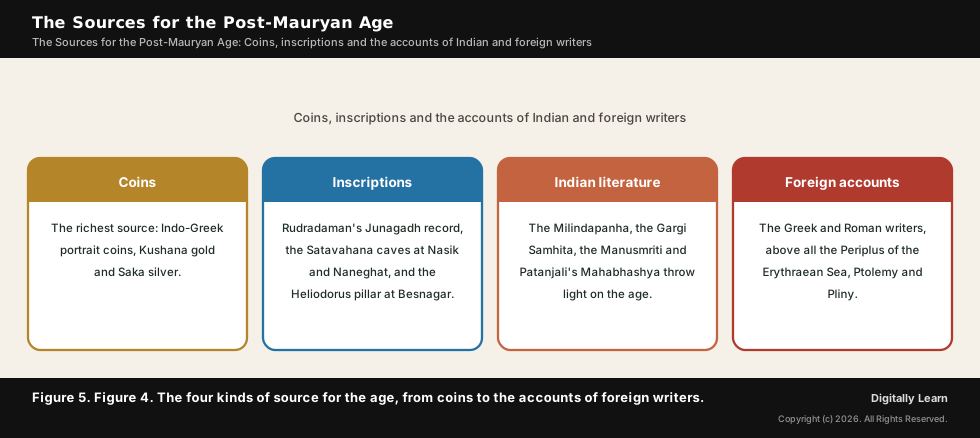
Coins: The Richest Source of the Age
What is the significance of the coins: for no earlier period are coins so important a source, and the post-Mauryan coinage is a subject in its own right.
The Indo-Greeks were the first rulers in India to issue coins that can be assigned with certainty to named kings, bearing the king's portrait and a legend in two scripts. The Kushanas issued India's first substantial gold coinage, the Sakas issued silver, and the Satavahanas issued lead and copper. From these coins, struck in their thousands, we recover the names, the dates, the portraits and even the religion of rulers about whom the texts are silent.
Inscriptions: Junagadh, Nasik, Naneghat and Besnagar
Distinguishing the inscriptions: a handful of long inscriptions anchor the chronology and the religion of the age.
The Junagadh rock inscription of the Saka ruler Rudradaman, of about 150 CE, is famous as the first long inscription in chaste literary Sanskrit, and it records the repair of the old Sudarshana lake. The Satavahana caves at Nasik and Naneghat preserve the records of Gautamiputra Satakarni and the queen Naganika.
The Heliodorus pillar at Besnagar, set up by a Greek ambassador who had become a devotee of Vishnu, is precious evidence of the early Bhagavata cult and of how readily the foreigners took to Indian ways.
Indian Literature and the Accounts of Foreign Writers
What is the significance of the texts: Indian works and foreign accounts together fill out what the coins and inscriptions leave unsaid, above all about religion, law and trade.
Among Indian works, the Milindapanha records the questions of the Greek king Menander, the Gargi Samhita remembers the Yavana invasion, the Manusmriti sets down the law of the age, and Patanjali's Mahabhashya reflects the reign of Pushyamitra. From outside India came the priceless Greek and Roman accounts, above all the Periplus of the Erythraean Sea, a sailor's guide to the Indian Ocean trade, with Ptolemy's geography and Pliny's complaint about the gold draining east to buy Indian goods.
| Kind of source | Examples | What it tells us |
|---|---|---|
| Coins | Indo-Greek portrait coins; Kushana gold; Saka silver | Names, dates, portraits and the religion of rulers |
| Inscriptions | Junagadh (Rudradaman); Nasik, Naneghat; Heliodorus pillar | Chronology, royal deeds, religion and the Bhagavata cult |
| Indian texts | Milindapanha; Gargi Samhita; Manusmriti; Mahabhashya | Religion, law and the memory of the invasions |
| Foreign accounts | Periplus of the Erythraean Sea; Ptolemy; Pliny | The Indo-Roman trade, ports and goods |
Dating the Age: The Eras of Post-Mauryan India
The Vikrama, Saka and Gupta Eras
What is the significance of the eras: the dates of the age are reckoned in several eras, and matching each era to its starting year is a recurring test.
The two eras that matter most for this period are the Vikrama era, which begins in 58 BCE, and the Saka era, which begins in 78 CE. The Saka era, conventionally linked to the accession of the Kushana king Kanishka though its true origin is debated, is the most important of all, for it became the basis of the national calendar of India.
The later Gupta era begins in 320 CE. Holding these epochs firmly is essential to placing the rulers of the age.
| Era | Begins in | Associated with |
|---|---|---|
| Vikrama era | 58 BCE | Tradition links it to a king Vikramaditya |
| Saka era | 78 CE | Conventionally Kanishka; the national calendar |
| Gupta era | 320 CE | The accession of Chandragupta I (the Guptas) |
| Kali era | 3102 BCE | The traditional start of the Kaliyuga |
UPSC Relevance and Exam Focus
Where the Post-Mauryan Age Fits in the UPSC-CSE Syllabus
This topic belongs to General Studies Paper I: ancient Indian history and culture, and the post-Mauryan age, with its invasions, coins and eras, is a steady source of questions.
For Prelims, hold the firm facts: the age runs from about 200 BCE to 300 CE; the order of the invaders is Indo-Greeks, then Sakas, then Kushanas; coins are the richest source, and gold coins appear only in this age; the Vikrama era begins in 58 BCE and the Saka era in 78 CE; and the Junagadh inscription of Rudradaman is the first long record in chaste Sanskrit.
For Mains, the age is valuable for the theme of India's contact with Central Asia and the Roman world and for the creativity that contact released.
Recurring linked concepts an aspirant should keep in working memory:
- The invasion order: Indo-Greeks, then Sakas, then Kushanas.
- Coins: The richest source; gold coins begin in this age.
- The eras: Vikrama (58 BCE) and Saka (78 CE).
- Junagadh inscription: Rudradaman; first long chaste-Sanskrit record.
- Foreign accounts: The Periplus of the Erythraean Sea on the trade.
A common Prelims trap is to mis-order the invaders; the chain is Greeks, then Sakas, then Kushanas. Another is to confuse the eras; the Vikrama era starts in 58 BCE and the Saka era in 78 CE, not the other way round.
Previous Year UPSC-CSE Questions By the end you will be able to draft model answers for the following UPSC questions. Each question carries a collapsible framework showing how to approach it in the exam.
- UPSC Prelims 2006 GS-IWith reference to the invaders in ancient India, which one of the following is the correct chronological order?
How to approach this Prelims question
Approach: Recall the sequence of invasions through the north-west: Greeks, Sakas, Parthians, Kushanas.
Trap to watch: The Greeks (Indo-Greeks) came first, the Sakas next and the Kushanas last; the other orders reverse this sequence.
Key facts to recall:
- The invaders came in the order Indo-Greeks, Sakas, Parthians, Kushanas.
- The Kushanas built the greatest of these empires and came last.
Answer signal: Greeks – Sakas – Kushans.
- UPSC Prelims 1995 GS-IMatch List I (Eras) with List II (Reckoned from) and select the correct answer using the codes below.
- Vikrama era
- Saka era
- Gupta era
- Kali era
Codes: A) 3102 B.C. B) 320 A.D. C) 78 A.D. D) 58 B.C. E) 248 A.D.
How to approach this Prelims question
Approach: Fix each era's epoch: Vikrama 58 BCE, Saka 78 CE, Gupta 320 CE, Kali 3102 BCE.
Trap to watch: Do not swap the Vikrama (58 BCE) and Saka (78 CE) eras; the Gupta era is 320 CE and the Kali era 3102 BCE, leaving 248 CE unused.
Key facts to recall:
- Vikrama era = 58 BCE; Saka era = 78 CE.
- Gupta era = 320 CE; Kali era = 3102 BCE.
Answer signal: I-D, II-C, III-B, IV-A.
- UPSC Prelims 1998 GS-IWhat is the correct chronological order in which the following appeared in India?
- Gold coins
- Punch-marked silver coins
- Iron plough
- Urban culture
Select the correct answer using the codes given below.
How to approach this Prelims question
Approach: Place each: urban culture (Harappan) earliest, then the iron plough, then punch-marked silver coins, then gold coins.
Trap to watch: Gold coins are the LAST to appear, a post-Mauryan development; the punch-marked silver coins are older, going back to the sixth century BCE.
Key facts to recall:
- Gold coins appeared last, in the post-Mauryan age.
- Punch-marked silver coins are far older than gold coins in India.
Answer signal: IV, III, II, I.
Prelims MCQ practice
Each question below tests one specific concept on the topic. Click to reveal the answer and a full option-wise explanation.
Q1. Consider the following invaders of post-Mauryan India:
- Kushanas
- Indo-Greeks
- Sakas
Which is the correct chronological order in which they invaded India?
- Indo-Greeks, Sakas, Kushanas
- Sakas, Indo-Greeks, Kushanas
- Kushanas, Sakas, Indo-Greeks
- Indo-Greeks, Kushanas, Sakas
Show answer and explanation
Answer: Indo-Greeks, Sakas, Kushanas
Explanation.
Option (a) is correct. The invaders came in the order Indo-Greeks, then Sakas, then Kushanas (the Parthians coming briefly before the Kushanas). Hence option (a).
Q2. Which of the following was the first ruling power in India to issue coins bearing the portrait and name of the king?
- The Mauryas
- The Indo-Greeks
- The Kushanas
- The Satavahanas
Show answer and explanation
Answer: The Indo-Greeks
Explanation.
Option (b) is correct. The Indo-Greeks were the first to issue coins that can be assigned to named kings, with the king's portrait and a bilingual legend. Hence option (b).
Q3. The first long inscription in chaste literary Sanskrit, recording the repair of the Sudarshana lake, is the:
- Hathigumpha inscription of Kharavela
- Junagadh inscription of Rudradaman
- Nasik inscription of Gautami Balashri
- Allahabad inscription of Samudragupta
Show answer and explanation
Answer: Junagadh inscription of Rudradaman
Explanation.
Option (b) is correct. The Junagadh rock inscription of the Saka ruler Rudradaman (c. 150 CE) is the first long inscription in chaste Sanskrit. Hence option (b).
Q4. The Saka era, which forms the basis of the national calendar of India, begins in:
- 58 BCE
- 78 CE
- 320 CE
- 248 CE
Show answer and explanation
Answer: 78 CE
Explanation.
Option (b) is correct. The Saka era begins in 78 CE and is the basis of the Indian national calendar; the Vikrama era begins in 58 BCE. Hence option (b).
Q5. The Heliodorus pillar at Besnagar is important chiefly as evidence of:
- Ashoka's Dhamma policy
- The early Bhagavata (Vaishnava) cult
- The Gandhara school of art
- Roman trade with India
Show answer and explanation
Answer: The early Bhagavata (Vaishnava) cult
Explanation.
Option (b) is correct. The Heliodorus pillar, set up by a Greek ambassador who became a devotee of Vishnu, is key evidence of the early Bhagavata cult. Hence option (b).
Q6. Which Greek and Roman work is the most important foreign account of the Indian Ocean trade in the post-Mauryan age?
- The Indica of Megasthenes
- The Periplus of the Erythraean Sea
- The Geographia of Strabo
- The Histories of Herodotus
Show answer and explanation
Answer: The Periplus of the Erythraean Sea
Explanation.
Option (b) is correct. The Periplus of the Erythraean Sea, a first-century-CE Greek sailor's guide, is the key foreign account of the Indo-Roman trade. Hence option (b).
Sources and Further Reading
Editorial Disclaimer
This article is for UPSC preparation. The chronology of the post-Mauryan invaders and the origin of the Saka era are debated among historians, and the conventional accounts are given here.


