


Overview
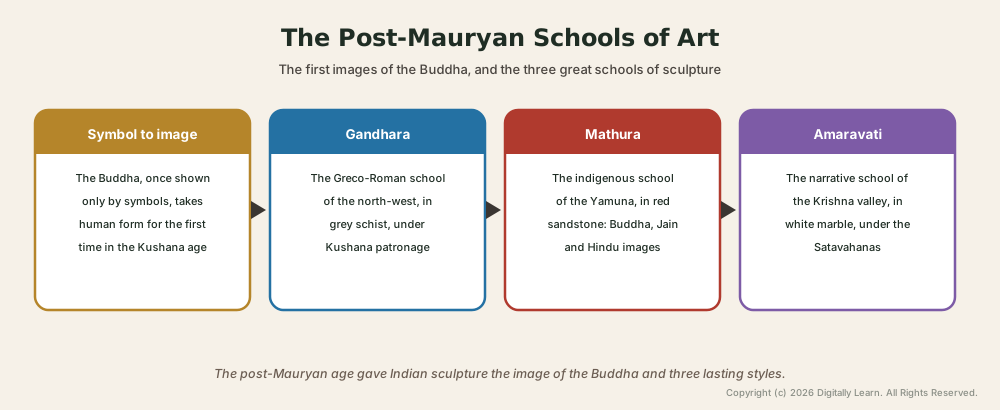
The post-Mauryan age, under the Kushanas in the north and the Satavahanas in the Deccan, was a great age of Indian sculpture. It gave India the first images of the Buddha in human form, where before he had been shown only by symbols, and it produced three great schools of art. The Gandhara school of the north-west worked in a Greco-Roman style; the Mathura school of the Yamuna country worked in an indigenous Indian style; and the Amaravati school of the Krishna valley carved narrative reliefs for its stupas. This part covers the change from symbol to image, the Gandhara, Mathura and Amaravati schools, their comparison, and the question of who made the first image of the Buddha.
From Symbol to Image: The Birth of the Buddha Figure
The Aniconic Phase: Worship Without an Image
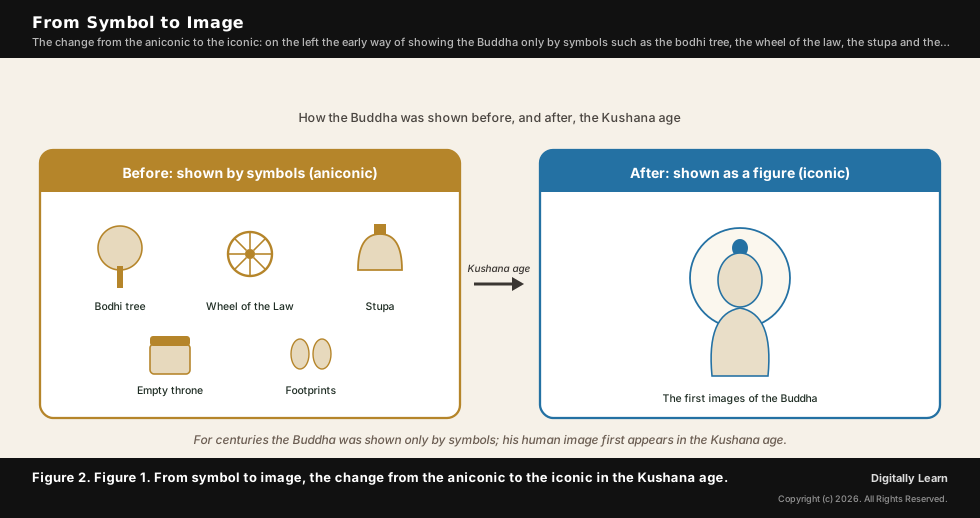
What is the significance of the aniconic phase: for centuries the Buddha was never shown in human form, but only by symbols that stood for the great moments of his life.
In the early art of Bharhut and Sanchi, the Buddha himself never appears. His presence was suggested by signs: the bodhi tree for his enlightenment, the wheel for his first sermon, the stupa for his death, and the empty throne or the footprints for his person. This way of showing the unseen Buddha is called the aniconic phase.
| Symbol | What it stood for |
|---|---|
| The bodhi tree | The Buddha's enlightenment at Bodh Gaya. |
| The wheel (dharmachakra) | His first sermon, the turning of the wheel of the law. |
| The stupa | His death, the great decease or mahaparinirvana. |
| The footprints and the empty throne | His unseen presence among his followers. |
| The lotus | His birth and his purity. |
The First Images of the Buddha in the Kushana Age
Distinguishing the change: the great change of the post-Mauryan age was the making of the first image of the Buddha in human form.
In the Kushana age, in about the first and second centuries CE, the Buddha was for the first time carved as a human figure. This happened in two places at once, in the Gandhara school of the north-west and the Mathura school of the Yamuna country, and scholars still debate which of the two made the very first image. With the image came a new and richer Buddhist art, and the three great schools of the age.
The Gandhara School: Greco-Roman Art on Indian Soil
Region, Patrons and the Greco-Roman Encounter
What is the significance of Gandhara: it was the meeting of the Greek and Roman art of the west with the Buddhist faith of India, a true Greco-Roman art on Indian soil.
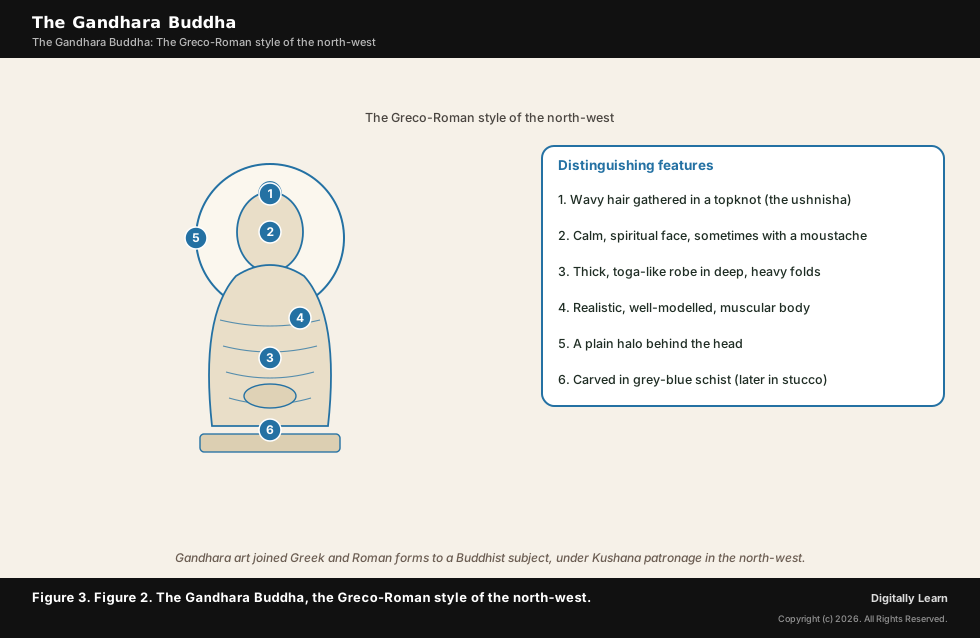
The Gandhara school grew in the north-west, around Peshawar and Taxila, under the patronage of the Kushanas. Long open to the west, the region had taken in Greco-Bactrian and Central Asian forms, and through Roman trade it took in Roman ones too. Its artists gave the Buddha the body and dress of a Greco-Roman god: a realistic figure, wavy hair in a topknot, and a robe in deep, heavy folds. For this reason it is also called the Greco-Buddhist school.
It was carved chiefly in a grey-blue schist, and in its later phase in stucco and lime plaster. Its mood is calm and spiritual, and it made many images of the standing Buddha and of the Bodhisattvas, the future Buddhas, richly adorned as princes.
The Features of the Gandhara Buddha
Distinguishing the Gandhara Buddha: the foreign hand is plain in every feature of the figure, from the hair to the fall of the robe.
The standing Buddha of Gandhara wears a heavy monastic robe that covers both shoulders and falls in thick, rope-like folds, in the manner of a Roman toga. The face is calm and meditative, sometimes with a moustache, the wavy hair is drawn up into the ushnisha, and the body is modelled with a realism learned from the classical west.
The Mathura School: The Indigenous Indian Tradition
Region, Patrons and the Indian Roots
What is the significance of Mathura: unlike Gandhara, it was a wholly indigenous school, growing from the older Indian tradition of the yaksha figures.
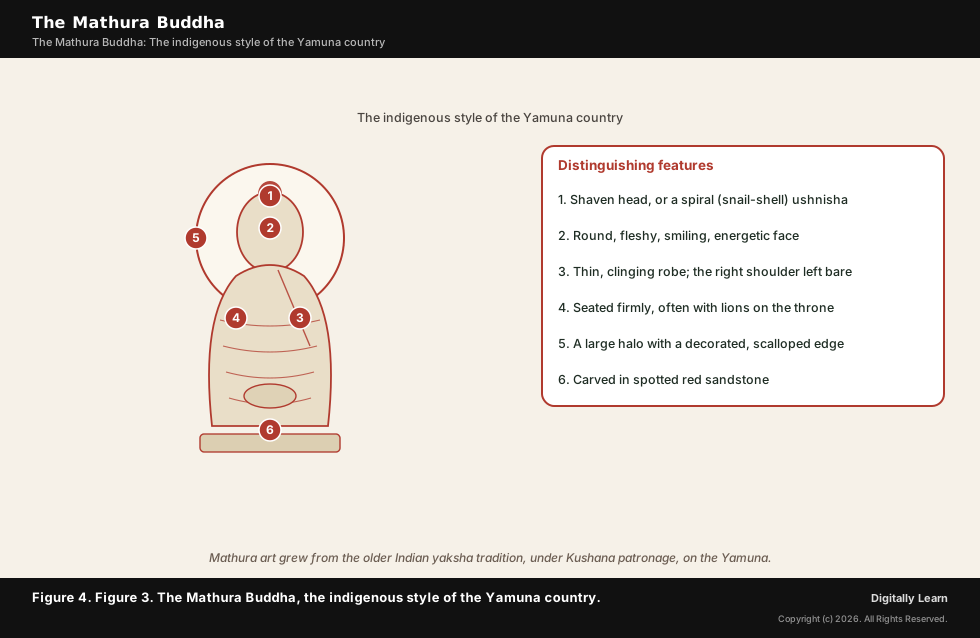
The Mathura school grew at Mathura on the Yamuna, again under Kushana patronage, but its roots were Indian, in the robust folk images of the yakshas and yakshis. It worked in a distinctive spotted red sandstone, quarried nearby. Its Buddha is not the calm Greek god of Gandhara but a round, fleshy, smiling and energetic figure, full of life, seated with the right hand raised in the gesture of reassurance.
The Features of the Mathura Buddha
Distinguishing the Mathura Buddha: its features are Indian through and through, from the shaven head to the lions of the throne.
The seated Buddha of Mathura is carved with the right hand raised in the abhaya mudra, the gesture of reassurance, and the left resting on the thigh. The thin robe clings to the body and leaves the right shoulder bare, the face is full and smiling, and a lion often supports the throne, a sign of the Buddha as the lion of the Shakyas.
The Range of Mathura: Buddhist, Jain, Brahmanical and Royal
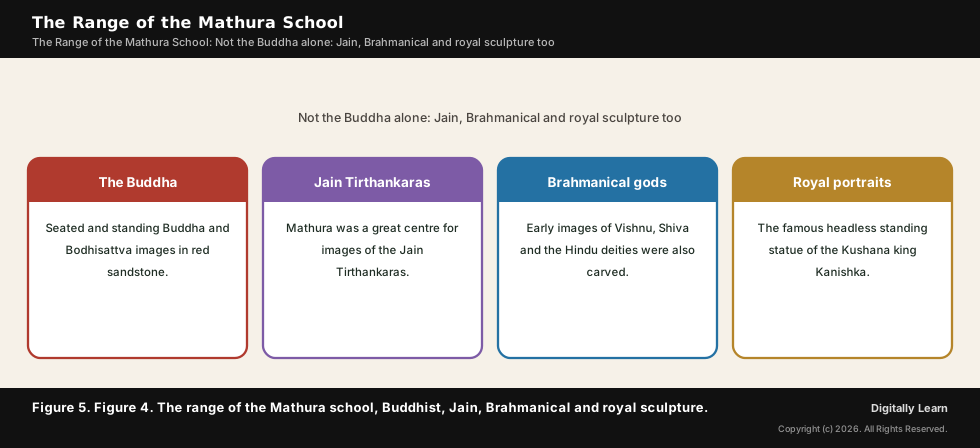
Distinguishing the range: Mathura was not a school of the Buddha alone, but the great workshop of every faith and even of the royal house.
Besides the Buddha, the Mathura artists carved the Jain Tirthankaras, of whom Mathura was a great centre, and the early images of the Brahmanical gods, Vishnu, Shiva and Surya. They also made royal portraits, the most famous being the headless standing statue of the Kushana king Kanishka, an image of imperial power in stone.
The Amaravati School: Narrative Art of the Krishna Valley
Region, Patrons and the White-Marble Reliefs
What is the significance of Amaravati: it was the third great school, of the southern Deccan, famous above all for the storytelling of its reliefs.
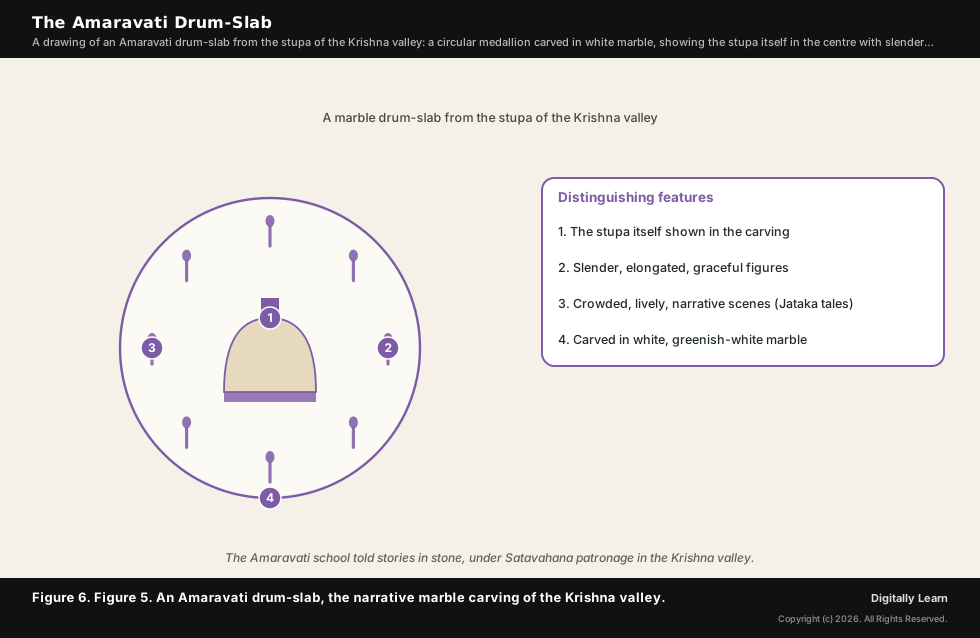
The Amaravati school grew in the lower Krishna valley, in the Andhra country, under the patronage of the Satavahanas and, later, the Ikshvakus. It worked in a fine white and greenish-white limestone, often called marble. Its sculpture was carved not as free images but as relief, on the drum-slabs, casing slabs and railings of the great stupas, above all the stupa of Amaravati itself.
The Narrative Style of the Amaravati Reliefs
Distinguishing the Amaravati style: its mark is a crowded, flowing scene full of slender figures in vigorous movement, telling a story in stone.
The Amaravati reliefs are alive with slender, elongated and graceful figures, set in crowded, dynamic compositions that tell the stories of the Buddha's lives, the Jataka tales. This narrative art is the hallmark of the school, and its influence travelled by sea to Sri Lanka and South-East Asia.
Comparing the Three Schools of Art
Gandhara, Mathura and Amaravati: A Comparison
Distinguishing the three schools: each is told apart at once by its region, its patron, its stone and its style, the points the examination most often tests.
Read across the table, a clear pattern appears. Two of the schools, Gandhara and Mathura, belong to the Kushana north and carved free-standing images; the third, Amaravati, belongs to the Satavahana south and worked in narrative relief. The surest way to tell them apart is by their stone: grey schist, red sandstone and white marble.
| Feature | Gandhara | Mathura | Amaravati |
|---|---|---|---|
| Region | North-west (Peshawar, Taxila) | Mathura, on the Yamuna | Lower Krishna valley (Andhra) |
| Patrons | The Kushanas | The Kushanas | The Satavahanas and Ikshvakus |
| Material | Grey-blue schist (later stucco) | Spotted red sandstone | White, greenish-white marble |
| Influence and style | Greco-Roman, realistic | Indigenous Indian, fleshy and lively | Indigenous, narrative relief |
| Hallmark | Wavy hair, deep drapery folds | Smiling face, thin clinging robe | Slender figures in crowded scenes |
Who Made the First Image of the Buddha?
Distinguishing the debate: one of the lasting questions of Indian art is whether Gandhara or Mathura made the very first image of the Buddha.
Both the Gandhara and the Mathura schools began to carve the Buddha in human form in about the same age, the first to second centuries CE, in wholly different styles. Some scholars hold that the foreign-inspired Gandhara made the first image, others that the indigenous Mathura did; the safest position is that the image arose in both, independently, in the Kushana age. The Amaravati school kept longer to the older symbolic way.
UPSC Relevance and Exam Focus
Where the Schools of Art Fit in the UPSC-CSE Syllabus
This topic belongs to General Studies Paper I: Indian art and culture, and the three schools of post-Mauryan sculpture are among the most examined themes in the art-and-culture portion of the syllabus.
For Prelims, hold the firm contrasts: Gandhara was Greco-Roman, in grey schist, in the north-west, under the Kushanas; Mathura was indigenous, in red sandstone, on the Yamuna, under the Kushanas, and carved Jain and Hindu and royal images too; Amaravati was a narrative school, in white marble, in the Krishna valley, under the Satavahanas; and the first images of the Buddha were made in the Gandhara and Mathura schools in the Kushana age.
For Mains, the foreign elements in Gandhara art are a favourite theme, since the school joined Greek, Roman and Central Asian forms to a Buddhist subject.
Recurring linked concepts an aspirant should keep in working memory:
- Gandhara: Greco-Roman; grey schist; north-west; Kushana patronage.
- Mathura: Indigenous; red sandstone; Yamuna; Buddha, Jain, Hindu and royal images.
- Amaravati: Narrative relief; white marble; Krishna valley; Satavahana patronage.
- Aniconic to iconic: From symbols to the first Buddha image in the Kushana age.
- The first image: Made in both Gandhara and Mathura, independently.
A common Prelims trap is to swap the materials of the schools; remember schist for Gandhara, red sandstone for Mathura, and white marble for Amaravati. A second trap credits all early Buddha images to Gandhara alone; the Mathura school made them too, in its own indigenous style.
Previous Year UPSC-CSE Questions
Previous Year UPSC-CSE Questions By the end you will be able to draft model answers for the following UPSC questions. Each question carries a collapsible framework showing how to approach it in the exam.
- UPSC Mains 2019 GS-IHighlight the Central Asian and Greco-Bactrian elements in the Gandhara art.
How to structure the answer in the exam
Introduction: Locate the Gandhara school in the north-west under Kushana patronage, a region long open to the Hellenistic and Central Asian worlds, where Greek, Bactrian and Central Asian forms met the Buddhist subject.
Body (sub-themes to develop):
- Greco-Bactrian (Hellenistic) elements: the realistic, muscular body; wavy hair gathered in a topknot, like a Greek god; the thick, toga-like robe in deep naturalistic folds.
- Central Asian elements: the patronage of the Kushanas, themselves a Central Asian (Yuezhi) people, and motifs and dress carried along the trade routes they controlled.
- The Buddhist subject given a Greco-Roman form: the standing Buddha and the princely Bodhisattvas, carved in grey schist and later in stucco.
- The result: a true Greco-Buddhist art, foreign in form but Indian in faith.
Conclusion: Conclude that Gandhara art is the clearest example of the fusion of Central Asian and Hellenistic form with Indian devotion, a product of the cosmopolitan Kushana north-west.
- UPSC Mains 2014 GS-IGandhara sculpture owed as much to the Romans as to the Greeks. Explain.
How to structure the answer in the exam
Introduction: State that Gandhara art is rightly called Greco-Roman, for it drew on both the Greek (Hellenistic) tradition inherited from the Bactrian Greeks and the Roman tradition carried by the Indo-Roman trade of the Kushana age.
Body (sub-themes to develop):
- The Greek debt: the idealised, god-like body and the wavy hair and calm features in the Hellenistic manner inherited through Bactria.
- The Roman debt: the realistic portraiture, the heavy, deeply cut toga-like drapery and the use of stucco, features carried by Roman trade and craftsmen.
- The Kushana setting: a cosmopolitan north-west on the trade routes, where both traditions could meet the Buddhist subject.
- The product: a single Greco-Roman Buddhist style, owing to Rome as much as to Greece.
Conclusion: Conclude that Gandhara sculpture fused the Greek and the Roman inheritance alike, so the statement is justified.
Sources and Further Reading
- NCERT, Ancient India / An Introduction to Indian Art (NCERT-inspired grounding)
- Wikipedia: Gandhara
- Wikipedia: Greco-Buddhist art
- Wikipedia: Mathura art
- Wikipedia: Amaravati school (Amaravati Marbles)
- Wikipedia: Buddhist art (aniconism)
- Wikipedia: Kushan Empire (patronage)
- Wikipedia: Statue of Kanishka the Great
Editorial Disclaimer
This article is for UPSC preparation. The question of which school made the first image of the Buddha is debated among art historians, and the conventional accounts are given here.