


Overview
The Western Kshatrapas, also called the Western Satraps, were Saka rulers who governed Saurashtra, Gujarat, Malwa and parts of Maharashtra for nearly four centuries, until the Gupta emperor Chandragupta II ended their rule. The Sakas, whom the Greeks called Scythians, were Iranian-speaking nomads of the Central Asian steppe. The Parthians, called Pahlavas in Indian texts, were an Iranian people whose Indo-Parthian kingdom rose in the north-west in the first century CE. Both peoples entered India after the Indo-Greeks, in the long age of foreign rule that followed the Mauryas.
Saka Origins and Routes into India
Central Asian Origins and the Yuezhi Push
The Sakas were part of the wide belt of steppe nomads that stretched from Siberia to the Black Sea. Saka is an Iranian word equivalent to the Greek Scythes, and these were horse-riding peoples who fought from chariots, sacrificed horses and buried their dead in mounds called kurgans.
Their move towards India began with a chain of displacements recorded in Chinese chronicles. The Xiongnu defeated the Yuezhi and drove them out of their homeland around 175 BCE. The Yuezhi moved west to the Ili region and pushed the Saka (the Chinese "Sai") south into Ferghana and Sogdiana. A later defeat of the Yuezhi, after 155 BCE, displaced the Sakas again, towards Bactria and Afghanistan and towards Parthia. Some settled in the region south-west of Afghanistan that came to be called Sakastan, the land of the Saka, now Sistan.
The Yuezhi did not disappear from the story. Their descendants, the Kushanas, later conquered northern India.
Maues, Azes and the Saka Kingdoms of Taxila and Mathura
Maues, who ruled in the first century BCE, was the first Indo-Scythian king. The Han chronicle says that the Sai crossed the "Suspended Crossing", a route from the Pamirs into the Gilgit valley, and petroglyphs and inscriptions left by Saka soldiers at Chilas and on the Sacred Rock of Hunza mark that mountain road. Maues used it to take Taxila from the Indo-Greek king Apollodotus II and went on to seize Pushkalavati, the capital of Gandhara.
The Indo-Greeks had ruled the north-west since about 200 BCE. Alexander's retreating army had left satraps behind, and the Greek rulers who followed became known as Indo-Greeks. They issued coins in gold, silver, copper and nickel, some showing Indian deities such as Vasudeva-Krishna and Lakshmi, and their rule ended with the Saka invasions.
Maues's kingdom broke up after his death, but Azes I later took control of the north-west by defeating the Indo-Greek king Hippostratos. Saka satraps also held the Mathura region from about 60 BCE, among them Hagamasha and Rajuvula.
Satrap System: Kshatrapa Titles and Ranks
A Kshatrapa is the Indian form of the Iranian title satrap, meaning the governor of a province. The word descends from the Median xshathrapavan, a viceroy or governor of a province, and in India it was used for governors who served a "king of kings". The Western Kshatrapas used two ranks: Mahakshatrapa (Great Satrap) for the ruling satrap and Kshatrapa for the heir apparent.
The satrap was already familiar in the north-west before the Sakas came. Alexander left satraps behind when he retreated from the Indus plains, and those regional rulers made themselves independent as the Indo-Greeks. The Sakas ruled through satraps in the same manner, one at Mathura in the east and another in Gujarat in the south-west. The title Kshatrapa on Saka coins is the reason the dynasty carries the name Western Satraps today, although Ptolemy still called them Indo-Scythians.
Three Saka Branches: Taxila, Mathura and Western India
The Saka power in India split into three main branches, each with its own region, rulers and fate.
| Branch | Region | Rulers and evidence | Fate |
|---|---|---|---|
| Taxila and Gandhara Sakas | North-west | Maues, Azes I; coins overstruck on Indo-Greek issues | Displaced by the Indo-Parthian ruler Gondophares |
| Northern Satraps | Mathura | Hagamasha, Rajuvula; Mathura lion capital (1 to 10 CE) | Later vassals of the Kushanas |
| Western Kshatrapas | Saurashtra, Gujarat, Malwa | Kshaharata house, then Kardamaka house | Conquered by Chandragupta II |
The Mathura lion capital is a sandstone pillar capital with Kharoshthi inscriptions. It records the gift of a stupa with a relic of the Buddha by the queen of the satrap Rajuvula, which shows Saka rulers in Mathura supporting Buddhism. The Northern Satraps Kharapallana and Vanaspara are known from a Sarnath inscription of the third year of Kanishka, in which they pledged allegiance to the Kushanas.
Kshaharata Kshatrapas of Western India: Nahapana
Nahapana, Ushavadata and the Kshaharata Territory
The Kshaharata house was the first line of Western Kshatrapas. Its earliest known member is Abhiraka, known from rare coins, followed by Bhumaka, who used only the title of satrap. Bhumaka's son Nahapana became a very powerful ruler who held Malwa, southern Gujarat, northern Konkan, and the Nasik and Poona districts.
Nahapana's son-in-law Ushavadata, called Rishabhadatta in Sanskrit and married to Nahapana's daughter Dakshamitra, acted as his viceroy in the south of the territory. His inscriptions at Nasik, Karle and Junnar record gifts and public works such as rest-houses, gardens and tanks at Bharukachchha (Bharuch), Dashapura (Mandasor), Govardhana near Nasik and Shorparaga (Sopara). A Nasik inscription also records an expedition in which he rescued the Uttamabhadras from the Malayas (Malavas).
When Nahapana ruled is disputed. His inscriptions are dated in years 41 to 46 of an era that is not named. If it is the Saka era, his reign falls in 119 to 124 CE, but other scholars place him between 24 and 70 CE or around 66 to 71 CE, and one scholar ends his reign in 78 CE.
Barygaza Trade and Buddhist Caves
Nahapana's kingdom lay on a major trade coast of the age. The Periplus of the Erythraean Sea, a Greek sailors' guide, names a ruler Nambanus, identified with Nahapana, as ruler of the area around Barygaza (modern Bharuch), a land whose metropolis was Minnagara. Under the Western Satraps, Barygaza was one of the main centres of Roman trade with India. Goods came down to the port from Ozene (Ujjain), among them agate, carnelian, muslins and ordinary cloth.
The Kshaharatas also patronised Buddhism and Brahmanical religion together. The Great Chaitya at Karla, the largest chaitya cave complex in South Asia, was dedicated in 120 CE by Nahapana. At Nasik, cave 10, the Nahapana vihara with sixteen rooms, was gifted to the Buddhist Sangha by Ushavadata. The Karla inscription of Ushavadata also lists gifts of cows and villages to Brahmanas, and the grant of a village to support ascetics living in the caves "without any distinction of sect or origin".
Gautamiputra Satakarni's Victory Over Nahapana
Nahapana's advance ended against the Satavahana king Gautamiputra Satakarni. Gautamiputra drove the Sakas out of Malwa and western Maharashtra and forced Nahapana back towards Gujarat. Two kinds of evidence record the victory.
The first is the Nasik prashasti, the inscription on cave 3 at Nasik, issued by his mother Gautami Balashri. It says that he destroyed the Sakas, Yavanas and Pahlavas and rooted out the Khakharata (Kshaharata) family. The second is numismatic. A hoard at Jogalthambi in Nashik district contains coins of Nahapana that Gautamiputra restruck, which suggests that he defeated Nahapana.
Historians agree that the two kings were contemporaries, but not on the date. M. K. Dhavalikar places the victory around 124 CE, while others put it after 71 CE or at the start of the Saka era in 78 CE. Earlier, James Burgess had argued for a gap of as much as a century between them.
Kardamaka Kshatrapas: Chastana and Rudradaman I
Chastana and the Kardamaka House at Ujjain
The Kardamaka house, also called the Bhadramukhas, was founded by Chastana, who ruled as satrap of Ujjain from 78 CE to about 130 CE. Many scholars link the beginning of the Saka era to his accession, since his descendants dated their coins and inscriptions in that era. Ptolemy mentions him as Tiastanes, and names Ozene (Ujjain) as the capital of his kingdom, which stretched from Patalene on the Indus to Ujjain in the east and beyond Barygaza in the south.
Two Kutch inscriptions from Andhau, dated in years 11 and 52 of the era (89 CE and 130 CE), carry his name. His coins show a bust with a corrupted Greek legend on the obverse and a Brahmi legend on the reverse around a symbol of three hills and a river, with the sun and two moons.
The relationship of the Western Kshatrapas with the Kushanas is debated. A statue found at Mathura bears the name Shastana, often attributed to Chastana and placed with statues of Kanishka and Vima Taktu, and the Rabatak inscription claims Ujjain for Kanishka, so some historians treat Chastana as a Kushana feudatory.
Rudradaman I: Titles, Territory and Conquests
Rudradaman I (reigned 130 to 150 CE), grandson of Chastana, was the greatest Western Kshatrapa. He took the title Mahakshatrapa, "Great Satrap", and recovered all the former territories of Nahapana except the southern areas of Poona and Nasik.
His Junagadh inscription lists the lands he ruled, among them eastern and western Akaravanti (Malwa), Anupa, Anarta, Surashtra, Svabhra (northern Gujarat), Maru (Marwar), Kachchha (Kutch), Sindhu-Sauvira (Sindh and the Multan area), Kukura, Aparanta (northern Konkan) and Nishada. It also records that he destroyed by force the Yaudheyas of present-day Haryana, a republic proud of its title of "heroes among all Kshatriyas". The Yaudheyas re-established their independence afterwards.
Whether he ruled from Ujjain is not certain. Ptolemy, writing around 160 CE, still names Chastana as king of Avanti, and some scholars argue that the inscription's Akaravanti means eastern Malwa only, so Ujjain as his seat is an inference, not a proved fact.
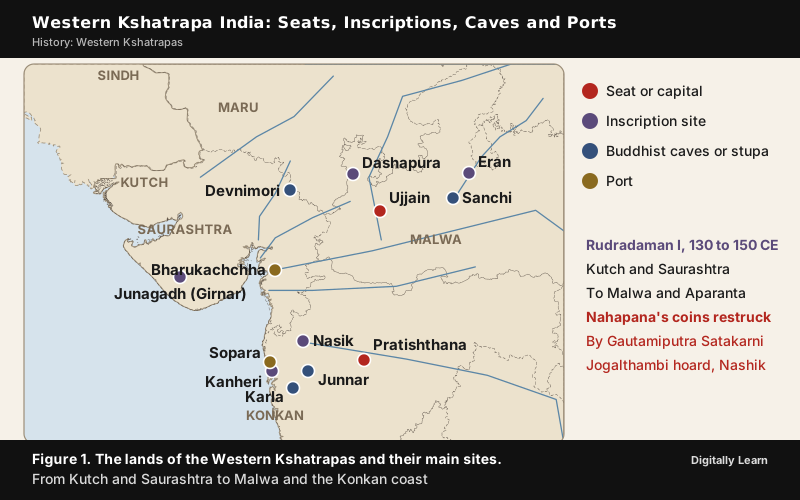
Junagadh (Girnar) Inscription and Sudarshana Lake
The Junagadh rock inscription of Rudradaman, also called the Girnar inscription, is a Sanskrit prose record cut near Girnar hill, in the Kathiawar region of Gujarat. It is dated to about 150 CE. The same rock carries three records: Ashoka's Major Rock Edicts in Prakrit, Rudradaman's Sanskrit inscription and, later, an inscription of the Gupta emperor Skandagupta in the fifth century CE, so one rock spans the Maurya, Western Satrap and Gupta dynasties across about 700 years.
The inscription is a history of one lake. Sudarshana lake was an artificial reservoir whose dam was built under Chandragupta Maurya by his governor Pushyagupta, and a Yavana king named Tushaspha later added conduits under Ashoka. A violent storm broke the embankments and the water gushed out. Rudradaman had the lake repaired with his own resources and without imposing any tax on his subjects. Skandagupta's inscription records a further restoration after severe damage.
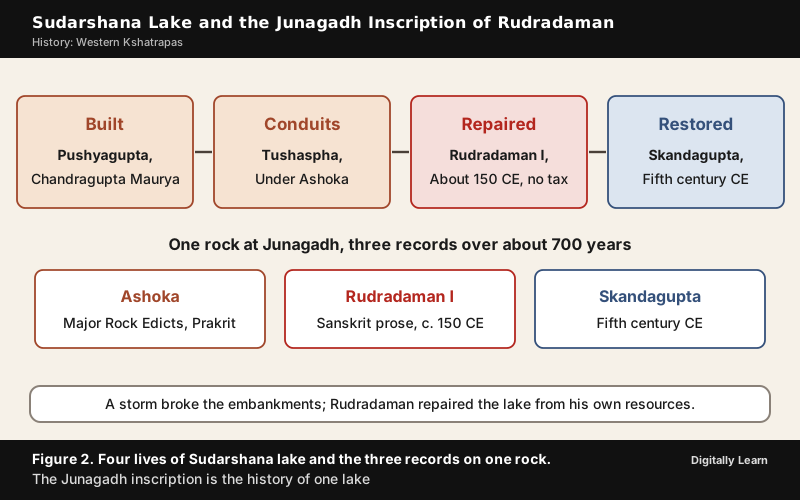
James Prinsep first edited and translated the inscription in April 1838. The first eight lines treat the history of the lake and the last twelve praise the king, whose name means "garland of Rudra". The inscription also gives the ancient name of Junagadh as Girinagara and of Girnar as Urjayat.
Rudradaman and the Satavahanas: War and Marriage
Rudradaman fought the Satavahanas for control of the western Deccan and Aparanta. His Junagadh record claims that he twice defeated Satakarni, lord of Dakshinapatha, and spared him because of the nearness of their connection. That connection was a marriage tie. A Kanheri inscription records a queen who was the daughter of a Mahakshatrapa Ru(dra...) and the wife of Satakarni Vasishthiputra, of the "race of Karddamaka kings". Historians identify the husband as Vashishtiputra Satakarni (the identity of the defeated Satakarni is itself debated), and Aparanta is said to have passed to him as dowry.
The marriage did not end the contest. In the late second century CE the Satavahana Yajna Sri Satakarni recovered much of the southern territory, which started the decline of Western Kshatrapa power in the Deccan.
Silver Coinage, Later Kshatrapas and the Gupta Conquest
Silver Coinage of the Western Kshatrapas
The Western Kshatrapas issued a rich silver coinage, and Kshatrapa coins are the main source for their chronology. Nahapana established the silver coinage, modelled on Indo-Greek coins. The obverse shows the ruler's bust with a Greek or pseudo-Greek legend, and the early reverse shows a thunderbolt and an arrow. Later reverses show a chaitya or three-arched hill with a river, a crescent and the sun, within a Brahmi legend.
Western Kshatrapa coins are unusually informative. They give the king's name, his father's name and the date of issue. From the reigns of Jivadaman and Rudrasimha I, the minting date reckoned in the Saka era appears in Brahmi numerals behind the king's head. Jivadaman's first coins, dated Saka year 100, correspond to 178 CE. Kharoshthi is dropped from Chastana's time, and from then on only Brahmi and the pseudo-Greek script remain. By the fourth century the Greek legend had become meaningless decoration.
The design travelled. The Satavahanas and the Guptas imitated these coins, and the silver coins of Chandragupta II and Kumaragupta I adopted the Western Satrap design with the bust of the ruler, replacing the chaitya hill by the royal eagle, Garuda.
Later Western Kshatrapas to Rudrasimha III
After Rudradaman, the dynasty continued for about two and a half centuries. Rudrasimha I (178 to 197 CE) was his son. The Setkhedi inscription of 185 CE in Shajapur district, dated in year 107 of the Saka era, shows the Kshatrapas expanding east at that date. Rudrasena II (256 to 278 CE) led the dynasty to a high level of prosperity. His reign saw a marriage alliance with the Andhra Ikshvakus of Nagarjunakonda, probably through a daughter of "the ruler of Ujjain", and the recapture of the Sanchi-Vidisha region from the Satavahanas.
Visvasena (293 to 304 CE) was the last ruler of Chastana's family. A new line began with Rudrasimha II (304 to 348 CE), whose coins name his father Jivadaman. Under Rudrasimha II the Kshatrapas still held the Vidisha-Sanchi-Eran region, as the Kanakerha inscription at Sanchi shows.
The Buddhist site of Devnimori in Gujarat belongs to this late phase. Coins of Rudrasimha were found inside its stupa, and its Buddha images show the influence of Greco-Buddhist Gandhara art.
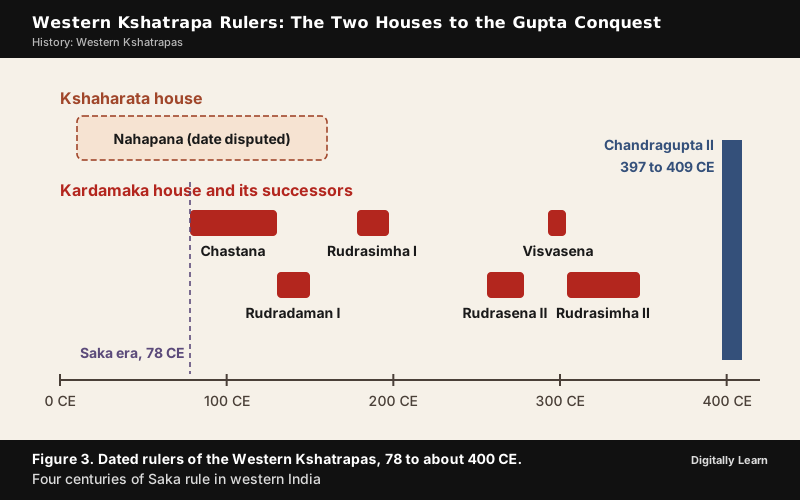
Chandragupta II and the End of Saka Rule
The Gupta advance against the Kshatrapas began with Samudragupta. His Allahabad pillar inscription lists the "Shaka-Murundas" among the kings who tried to appease him, and a monument at Eran suggests that he may have ousted the Saka ruler Sridharavarman from central India. Chandragupta II then ended Saka rule completely.
The exact date of Chandragupta's victory is not known and can be placed tentatively between 397 and 409 CE. The last Kshatrapa coin, that of Rudrasimha III, is dated Saka year 310 or 319 (388 or 397 CE), while Chandragupta's own silver coins of 409 copy the Kshatrapa design and replace the vihara symbol with Garuda. His victory inscription of 412‑413 CE stands on the railing near the eastern gateway of the Great Stupa at Sanchi. These campaigns closed nearly four centuries of Saka rule in the subcontinent.
The Sanskrit play Devichandraguptam tells how Chandragupta's elder brother Ramagupta agreed to give his queen Dhruvadevi to a Saka enemy when besieged, and how Chandragupta entered the enemy camp disguised as the queen and killed the Saka chief. Whether the play reflects true events is debated among historians. Chandragupta II bore the title Vikramaditya, and several modern scholars think the later legends of a Vikramaditya who defeated the Sakas may rest on his victory.
Saka Era of 78 CE and the National Calendar
Origin of the Saka Era and Who Began It
The Saka era has its epoch in 78 CE. Its origin is controversial. The older view linked it to the accession of the Kushana king Kanishka, but research by Henry Falk dates Kanishka's accession to 127 CE, and Kanishka was a Kushana, not a Saka. The beginning of the era is now widely equated with the accession of the Saka satrap Chastana in 78 CE, a view that fits the fact that the Western Satraps were its earliest known users.
The name Shalivahana era, used in southern and western India, rests on a legend of a Satavahana victory over the Sakas. Dineshchandra Sircar considered it historically inaccurate, and noted that it appears to be based on the victory of the Satavahana ruler Gautamiputra Satakarni over some Saka kings. The era spread widely. By the sixth and seventh centuries it appears in the works of Varahamihira and Brahmagupta, and in Southeast Asia it survives in the Balinese Saka calendar.
Saka Era in the Indian National Calendar
India adopted the Saka era as the era of its national calendar in 1957. The Calendar Reform Committee, formed in 1952 under the astrophysicist Meghnad Saha, studied about thirty calendars in use and recommended in 1954 a fixed tropical solar calendar for civil use. The Indian national calendar is used with the Gregorian calendar in the Gazette of India, in news broadcasts of All India Radio and in official communications of the Government of India.
Its structure is simple. Chaitra is the first month and begins on or near the March equinox, on 22 March in a normal year and on 21 March in a leap year. Chaitra has 30 days, or 31 in a leap year. A Saka year is 78 years behind the Gregorian year, except from January to March, when the difference is 79. To tell whether a Saka year is a leap year, add 78 and check whether the result is a Gregorian leap year.
Saka Era and Vikrama Era Compared
The Saka era is often confused with the Vikrama era, an older era that begins in 57 BCE. The Gupta and Kali eras are two more Indian eras with fixed epochs, so the four are best learnt together.
| Era | Epoch | Associated tradition | Present use |
|---|---|---|---|
| Vikrama (Vikram Samvat) | 57 BCE (traditionally 58 BCE) | King Vikramaditya who drove out the Sakas; origin debated | Religious dates in India; civil calendar of Nepal |
| Saka | 78 CE | Chastana of the Kardamaka house; Kanishka and Shalivahana views | Indian national calendar since 1957 |
| Gupta | About 319 to 320 CE | Gupta kings; the most prevalent theory credits Chandragupta I | Gupta inscriptions |
| Kali | 3102 BCE | Puranic reckoning from the death of Krishna | Traditional reckoning |
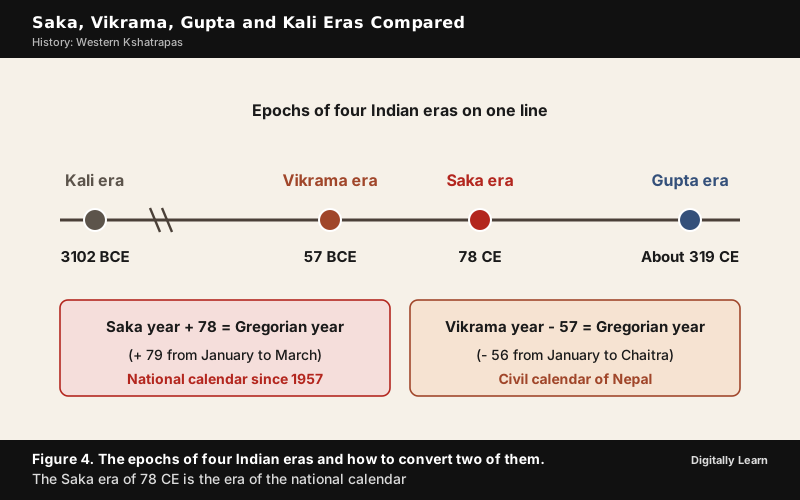
The tradition is that Vikramaditya of Ujjain, a king whose father had been defeated by a Saka ruler, drove the Sakas out of Ujjain and began the Vikrama era to mark it. Historians doubt this story. The name Vikrama is not found in the historical record before the ninth century, and earlier inscriptions call the same era Krita or Malava. Colonial scholars believed the era commemorated the expulsion of the Sakas, but later epigraphic evidence suggests that this theory has no historical basis.
Parthians in India: Gondophares and the Indo-Parthians
Parthians and Pahlavas in Indian Sources
The Parthians were an Iranian people, and Indian texts call the Parthian rulers of the north-west Pahlavas. The Puranas and the Mahabharata use that name for the dynasty of Gondophares. In the Sakas' story the two peoples are closely linked. The Sakas defeated and killed the Parthian king Phraates II in 126 BCE, and the Parthian king Mithridates II later vanquished the Sakas of Sakastan and set up his own satraps there. Gautamiputra's mother's inscription lists the Sakas, Yavanas and Pahlavas together as his enemies.
The Indo-Parthians were the third foreign power in the north-west after the Indo-Greeks and the Sakas, and their Indian territories were soon lost to the Kushanas. Their empire was a loose framework in which many smaller dynasts, among them Indo-Scythian satraps such as Rajuvula, kept their positions in exchange for recognising the king of kings.
Gondophares and the Indo-Parthian Kingdom
The Indo-Parthian kingdom was founded by Gondophares I about 19 or 20 CE. He was the governor of Drangiana (Sakastan) who declared independence from the Parthian Empire and then took the Kabul valley, the Punjab and Sindh from the Indo-Scythian king Azes. His name is known mainly from silver and copper coins, and his reign is generally dated from about 19 to 46 CE. His capital was the Gandharan city of Taxila.
Gondophares called himself "King of Kings", a Parthian title, though his empire fragmented soon after his death. His successors included Sarpedones (Gondophares II), Abdagases and Sases (Gondophares IV). From the middle of the first century CE the Kushanas under Kujula Kadphises began to absorb the Indian part of the kingdom. In the west, the Indo-Parthians kept Sakastan until the Sasanians under Ardeshir I took it around 230 CE, and the Paratarajas of Baluchistan survived until the late third century.
Takht-i-Bahi and the St Thomas Tradition
Takht-i-Bahi near Mardan, now in Pakistan, is the best-known Indo-Parthian monument. The Buddhist monastery was founded in the early first century CE and was in use until the seventh century, and an inscription bearing the name of Gondophares has been found there. UNESCO listed it as a World Heritage Site in 1980.
The Acts of Thomas, an apocryphal Christian text, tells of the apostle St Thomas visiting the court of a king named Gudnaphar in northern India. This is a tradition, not an established fact. Gudnaphar has usually been identified with Gondophares I, who was therefore dated after the advent of Christianity, but there is no evidence for that assumption: Robert Senior's research shows that Gondophares I could even be dated before 1 CE. If the account is historical at all, the apostle may have met one of the later kings who bore the same title.
Assimilation of Foreign Rulers and Cultural Impact
Foreign Rulers in the Indian Social Order
The Brahmanical tradition regarded the Sakas as mlechchhas, outsiders or barbarians, so the foreign conquerors had no natural place in the varna order. Yet Rudradaman, the best-known Saka ruler, left one of the earliest long Sanskrit inscriptions, which shows that powerful mlechchhas were familiar with Sanskritic traditions. Their social origins were often obscure, and, like the Satavahanas, they used long-distance trade revenue and political power to claim status.
Indian names and customs show assimilation in action. Nahapana's son-in-law Ushavadata, a Saka, bears the Sanskrit name Rishabhadatta, and Rudradaman's name means "garland of Rudra". Nahapana's family made gifts to Brahmanas and Buddhist monks alike, and Rudradaman's family married into the Satavahana house. The Karla inscription records gifts for ascetics "without any distinction of sect or origin".
Buddhist Caves, Gandhara Art and Sanskrit
The Western Kshatrapas are known for dedicating many Buddhist caves in Maharashtra and Gujarat. Karla, Nasik and Junnar carry inscriptions of the Nahapana family, and Greeks (Yavanas) also left donative inscriptions at Nasik, Karla, Lenyadri and Manmodi caves. In Gujarat, the stupa and viharas of Devnimori show Gandhara influence on Western Indian Buddhist art, and the Western Satraps may have helped carry Gandhara art to the western Deccan.
Learning flourished in the same age. The Yavanajataka, a Sanskrit rendering of a Greek astrological work by Yavanesvara and the earliest Sanskrit work on horoscopy, is associated with Rudradaman's reign. Barygaza's trade also brought Greek, Roman and Arab goods to India and carried Indian cotton cloth, spikenard, ivory and long pepper abroad.
The Saka ruling houses thus acted as a bridge. They received the Indo-Greek coin design and the Iranian title of satrap, and they passed on to the Guptas a silver coin design and, in the Junagadh inscription, a prototype of the Sanskrit royal eulogy.
Sakas and Parthians Compared: Chronology and Records
Sakas, Parthians and Western Kshatrapas Side by Side
The foreign powers of the north-west came in a clear order: The Indo-Greeks from about 200 BCE, the Sakas in the first century BCE, the Indo-Parthians in the first century CE and then the Kushanas, who absorbed the Indo-Parthian lands. The Western Kshatrapas ran alongside all of them in western India until about 400 CE. The Sakas and the Parthians are easily mixed up, so they are best revised side by side.
| Point | Sakas (Western Kshatrapas) | Parthians (Indo-Parthians) |
|---|---|---|
| Origin | Central Asian steppe nomads (Scythians) | Iranian people of Parthia, via Sakastan |
| Indian name | Sakas, Kshatrapas | Pahlavas |
| First king in India | Maues (first century BCE) | Gondophares I (about 19 to 46 CE) |
| Region | Taxila, Mathura, Saurashtra, Gujarat, Malwa | Taxila, Punjab, Sindh, Kabul valley |
| Best-known record | Junagadh inscription of Rudradaman | Takht-i-Bahi inscription of Gondophares |
| Era or legacy | Saka era; dated silver coinage | Takht-i-Bahi monastery |
| End | Chandragupta II, around 400 CE | Kushanas from the mid first century CE; Sakastan to the Sasanians |
Previous Year UPSC‑CSE Questions
Each question comes with an explanation of how to approach it.
- UPSC Prelims 2006With reference to the invaders in ancient India, which one of the following is the correct chronological order?
How to approach this Prelims question
Approach: Order the three peoples by when each first ruled in the north-west. The Indo-Greeks came first, from about 200 BCE. Maues, the first Indo-Scythian king, ruled in the first century BCE and took Taxila from an Indo-Greek king. The Kushanas came after the Indo-Parthians and absorbed their Indian lands from the middle of the first century CE.
Trap to watch: Placing the Kushanas before the Sakas because Kanishka is better known.
Why each option is right or wrong:
- (a) Greeks – Sakas – Kushans: Correct. Indo-Greeks from about 200 BCE, Sakas under Maues in the first century BCE, Kushanas from the first century CE.
- (b) Greeks – Kushans – Sakas: Wrong. Kushana rule in the north-west began after the Saka and Indo-Parthian kingdoms.
- (c) Sakas – Greeks – Kushans: Wrong. Maues took Taxila from the Indo-Greek king Apollodotus II, so the Greeks came first.
- (d) Sakas – Kushans – Greeks: Wrong. The Indo-Greek kingdom was founded about 200 BCE and ended with the Saka invasions.
Answer: (a) Greeks – Sakas – Kushans. Indo-Greeks, then Sakas under Maues, then Kushanas.
- UPSC Prelims 2014Chaitra 1 of the national calendar based on the Saka Era corresponds to which one of the following dates of the Gregorian calendar in a normal year of 365 days?
How to approach this Prelims question
Approach: The Indian national calendar, based on the Saka era and adopted in 1957, begins with Chaitra, which starts on or near the March equinox. In a normal year Chaitra 1 falls on 22 March, and in a leap year, when Chaitra has 31 days, on 21 March.
Trap to watch: Choosing a date in April because many regional new years fall then.
Why each option is right or wrong:
- (a) 22nd March (or 21st March): Correct. Chaitra 1 is 22 March in a normal year and 21 March in a leap year.
- (b) 15th May (or 16th May): Wrong. Chaitra begins on or near the March equinox, so May is far too late.
- (c) 31st March (or 30th March): Wrong. These dates fall inside Chaitra, which has already begun on 22 March.
- (d) 21st April (or 20th April): Wrong. Chaitra has 30 days in a normal year, so 21 April is the start of the next month.
Answer: (a) 22nd March (or 21st March). Chaitra 1 is 22 March in a normal year and 21 March in a leap year.
- UPSC Prelims 1995Match List I with List II and select the correct answer by using the codes given below the lists:List I (Eras)
- I. Vikrama era
- II. Saka era
- III. Gupta era
- IV. Kali era
- A) 3102 B.C.
- B) 320 A.D.
- C) 78 A.D.
- D) 58 B.C.
- E) 248 A.D.
How to approach this Prelims question
Approach: Match each era to its epoch. The Vikrama era counts from 58 BCE in the traditional reckoning, the Saka era from 78 CE, the Gupta era from about 320 CE and the Kali era from 3102 BCE: Vikrama with D, Saka with C, Gupta with B and Kali with A.
Trap to watch: Swapping the Vikrama and Saka epochs, the two eras most often confused.
Why each option is right or wrong:
- (a) I‑B, II‑D, III‑E, IV‑A: Wrong. It gives Vikrama the Gupta epoch of 320 CE and the Saka era the Vikrama epoch of 58 BCE.
- (b) I‑A, II‑C, III‑B, IV‑D: Wrong. It gives Vikrama the Kali epoch of 3102 BCE and Kali the Vikrama epoch of 58 BCE.
- (c) I‑D, II‑E, III‑B, IV‑C: Wrong. The Saka era is not reckoned from 248 CE, and the Kali era is not reckoned from 78 CE.
- (d) I‑D, II‑C, III‑B, IV‑A: Correct. Vikrama 58 BCE, Saka 78 CE, Gupta about 320 CE, Kali 3102 BCE.
Answer: (d) I‑D, II‑C, III‑B, IV‑A. Vikrama 58 BCE, Saka 78 CE, Gupta about 320 CE, Kali 3102 BCE.
Sources
- NCERT: Class 12 Themes in Indian History Book 1, Chapter 2
- NCERT: Class 12 Themes in Indian History Book 1, Chapter 3
- NCERT: Class 9 Understanding Society: India and Beyond Book 1, Chapter 5
- NCERT: Class 7 Exploring Society: India and Beyond Book 1, Chapter 6
- Wikipedia: Western Satraps
- Wikipedia: Indo-Scythians
- Wikipedia: Maues
- Wikipedia: Mathura lion capital
- Wikipedia: Nahapana
- Wikipedia: Gautamiputra Satakarni
- Wikipedia: Chastana
- Wikipedia: Rudradaman I
- Wikipedia: Junagadh rock inscription of Rudradaman
- Wikipedia: Rudrasimha I
- Wikipedia: Chandragupta II
- Wikipedia: Saka era
- Wikipedia: Indian national calendar
- Wikipedia: Vikram Samvat
- Wikipedia: Gupta era
- Wikipedia: Kali Yuga
- Wikipedia: Indo-Parthian Kingdom
- Wikipedia: Gondophares
- Wikipedia: Takht-i-Bahi
- Wikipedia: Indo-Greek Kingdom
- Wikipedia: Devni Mori
- Wikipedia: Yuezhi
- Wikipedia: Barygaza
- Archaeological Survey of India, Bharat SHRI: About Epigraphy
- India Meteorological Department, Positional Astronomy Centre: Indian Calendars
- UNESCO World Heritage Centre: Buddhist Ruins of Takht-i-Bahi and Sahr-i-Bahlol
- UPSC: Civil Services Examination question papers
Editorial Disclaimer
This article draws on the current NCERT textbooks and the other sources listed in the Sources section. Where accounts give different dates, NCERT's are used.