


Overview
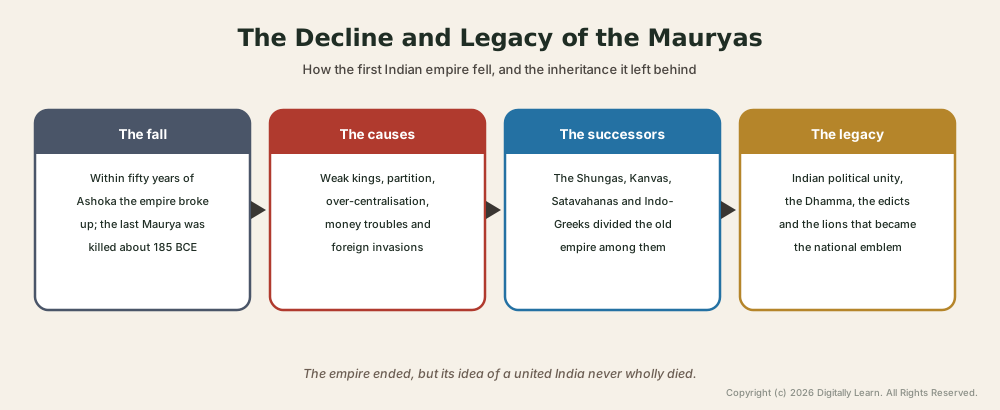
The decline and legacy of the Mauryan empire close the story of India's first great state. Within about fifty years of the death of Ashoka, the empire that had stretched from the Hindu Kush to the Deccan broke apart, and in about 185 BCE the last Mauryan king, Brihadratha, was assassinated by his commander Pushyamitra Shunga. Historians have long debated why so mighty an empire fell so fast, pointing to weak successors, the division of the realm, over-centralisation, financial strain and the invasions of the north-west. Yet the Mauryan legacy endured: the idea of a politically united India, the administrative model of the Arthashastra, the spread of Buddhism through Ashoka's Dhamma, and the Sarnath lions that India chose as its State Emblem. This part covers the fall of the empire, the debate over its causes, the successor states and the Mauryan legacy.
The Rapid Decline of the Empire after Ashoka
The Swift Collapse of the Empire and Its Significance
What is the significance of the decline: the speed of the Mauryan fall is one of the great problems of ancient Indian history, and the long argument over its causes is a favourite of the examiner.
The Mauryan empire reached its height under Ashoka, who died about 232 BCE. Within roughly half a century of his death the vast empire had broken apart, and by about 185 BCE the dynasty was gone. That so strong and so well-governed a state should collapse so quickly is striking, and historians have offered many explanations, none of which stands entirely alone.
Ashoka's Weak Successors and the Division of the Empire
Distinguishing the immediate cause: the most visible reason for the fall was the want of a strong hand at the centre after Ashoka.
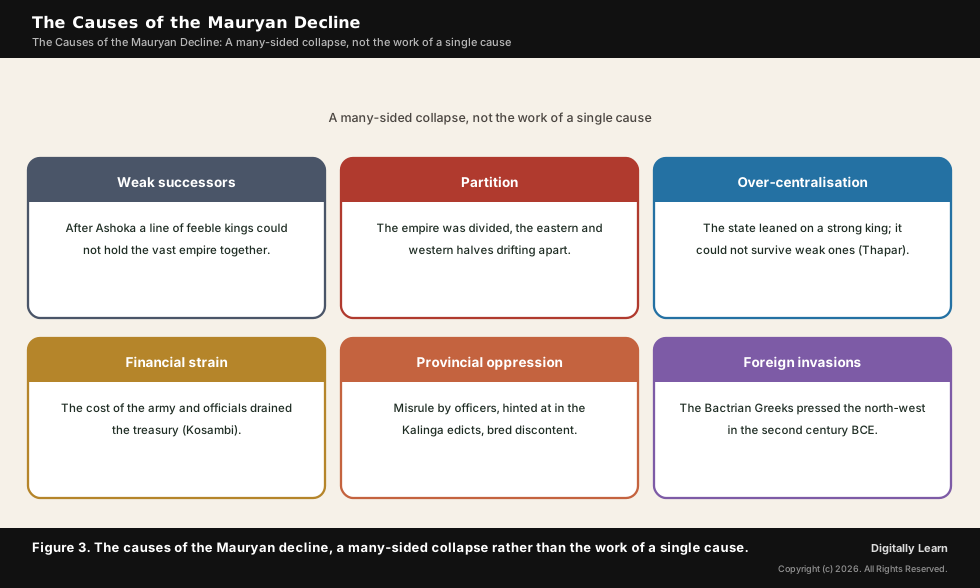
Ashoka was followed by a line of weak successors, among them Dasharatha and Samprati, none of whom had his ability or authority. The empire seems to have been divided, with the eastern part ruled from Pataliputra and the western provinces under other princes, and a divided, weakly led empire could not hold its distant frontiers and provinces together.
The End of the Mauryas and the Rise of the Shungas
Brihadratha, Pushyamitra Shunga and the Coup of c. 185 BCE
What is the significance of the coup: the empire ended not in a great battle but in a palace coup, when the army commander seized the throne from his king.
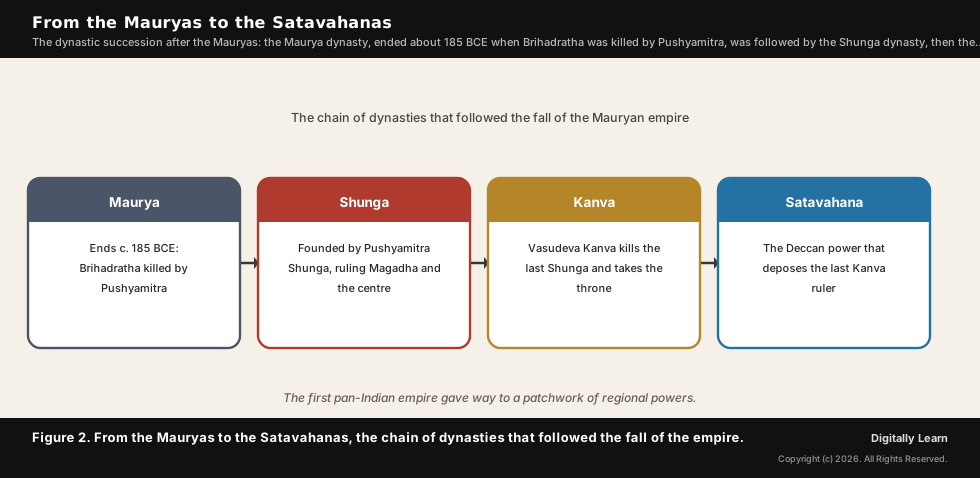
The last Mauryan ruler was Brihadratha. About 185 BCE he was assassinated by his own commander-in-chief, Pushyamitra Shunga, who took the throne and founded the Shunga dynasty. The Shungas were followed in turn by the Kanvas, and the Kanvas by the Satavahanas of the Deccan, so that the Mauryan empire gave way to a succession of new dynasties.
The Causes of the Mauryan Decline
Weak Successors, Partition and Over-Centralisation
What is the significance of the structural causes: the deepest explanations of the fall look not at persons but at the structure of the Mauryan state itself.
The empire was a highly centralised state that depended on a strong king and a vast bureaucracy radiating from the centre. As Romila Thapar has argued, such a structure could flourish under a Chandragupta or an Ashoka but could not survive a run of weak kings, and the partition of the empire only hastened the collapse. The very strength of the centralised model became its weakness once the centre faltered.
The Historians' Debate: Brahmanical Reaction, Economy and Pacifism
Distinguishing the great debate: several famous explanations of the fall are much argued over, and a careful student knows them as views, not settled facts.
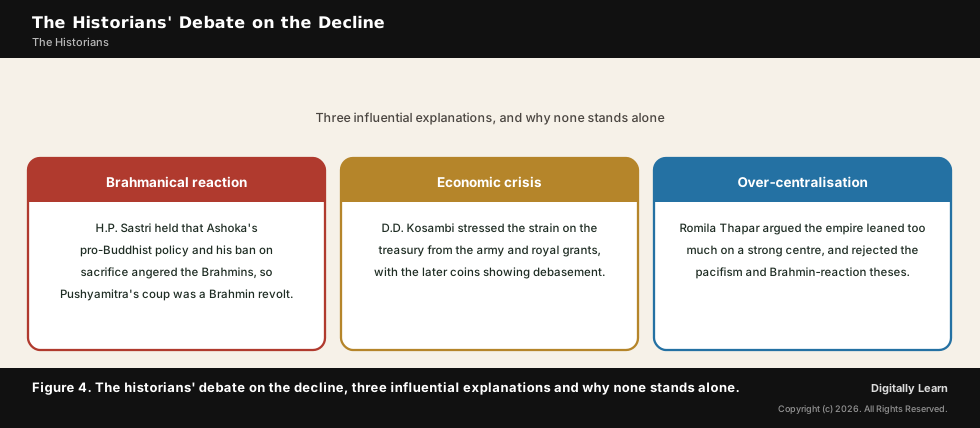
One old view, associated with H.P. Sastri, held that Ashoka's support of Buddhism and his ban on animal sacrifice angered the Brahmins, so that the coup of the Brahmin Pushyamitra was a Brahmanical reaction. A related claim was that Ashoka's pacifism weakened the empire's military spirit.
Both views are disputed: Romila Thapar points out that Ashoka was tolerant of the Brahmins and never disbanded his army. Others, such as D.D. Kosambi, stressed economic strain on the treasury, with the later coinage showing signs of debasement.
Provincial Oppression and the North-West Invasions
What is the significance of the frontier: while the centre weakened, pressure built on the borders, above all in the exposed north-west.
The Mauryan provinces had long been hard to govern, and the Kalinga edicts themselves warn against oppressive officials, the dushtamatyas, whose misrule bred discontent. As the empire weakened, the north-west, always its most vulnerable frontier, was invaded by the Bactrian Greeks, the Indo-Greeks, in the early second century BCE. Their kingdom, set up in north Afghanistan in Bactria, pressed into the Punjab under kings such as Demetrius and Menander, and the old Mauryan hold on the frontier was broken.
The Successor States and the Post-Mauryan Age
The Shungas, Kanvas, Satavahanas and Indo-Greeks
What is the significance of the successor states: the fall of the Mauryas did not bring chaos but a new age of regional kingdoms, each with its own art and culture.
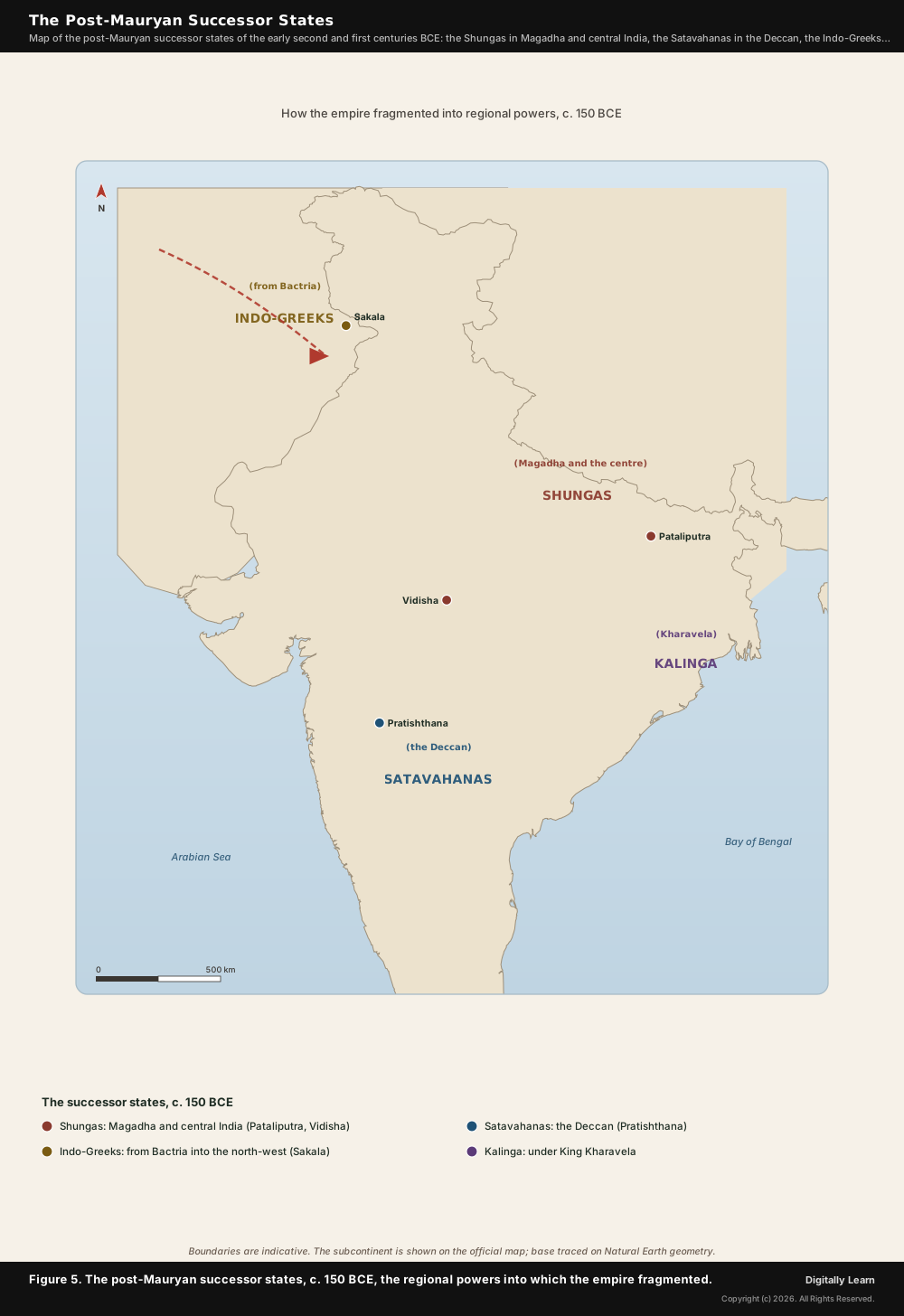
The Shungas ruled Magadha and central India from Pataliputra and Vidisha, and it was under them that the railings of Bharhut and the stone work of Sanchi were carved; the poet Kalidasa later set his play, the Malavikagnimitra, around Agnimitra, the son of the Shunga founder. The Kanvas followed them briefly. In the Deccan rose the Satavahanas, in the north-west the Indo-Greeks under Menander, and in the east Kalinga flourished under King Kharavela.
| Successor power | Region | Note |
|---|---|---|
| Shungas | Magadha and central India | Founded by Pushyamitra Shunga (c. 185 BCE) |
| Kanvas | Magadha | Vasudeva Kanva overthrew the last Shunga |
| Satavahanas (Andhras) | The Deccan | Deposed the last Kanva ruler |
| Indo-Greeks | The north-west | From Bactria; Menander (Milinda) |
| Cheti (Kharavela) | Kalinga | Known from the Hathigumpha inscription |
The Regional Kingdoms from the Punjab to the Deccan
Distinguishing the new map of India: the political geography of India after the Mauryas shows how the single empire dissolved into distinct regional powers.
The map sets out the successor states of about 150 BCE: the Shungas in the Gangetic plain and the centre, the Satavahanas across the Deccan, the Indo-Greeks pressing in from Bactria in the north-west, and Kalinga independent under Kharavela on the east coast. Where Ashoka had ruled one empire, there were now several kingdoms.
The Legacy of the Mauryan Empire
The Idea of Indian Unity and the Administrative Model
What is the significance of the legacy: though the empire fell, what it created outlived it, and some of its gifts are alive in India today.
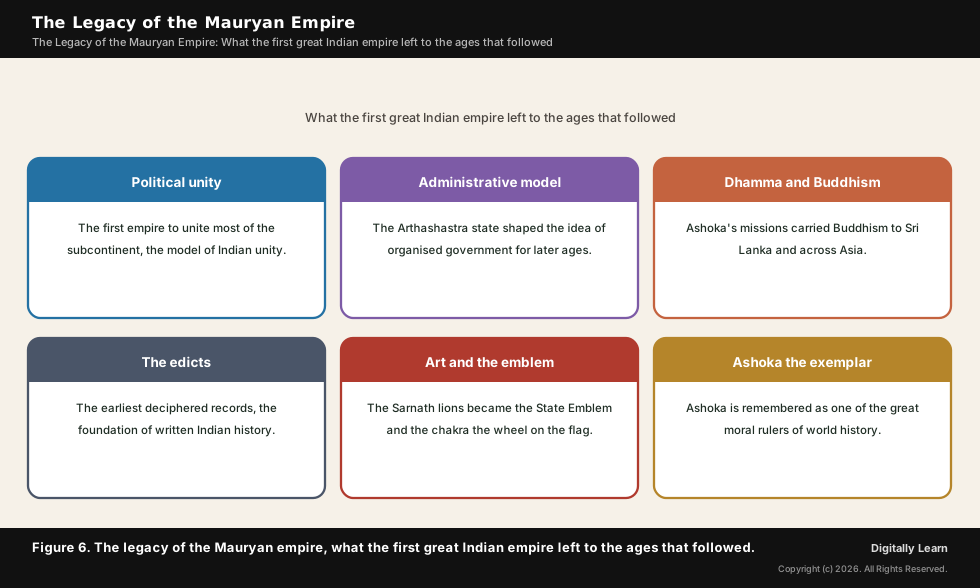
The Mauryas were the first to bring most of the subcontinent under a single rule, and they left behind the powerful idea of a politically united India, an idea to which later empires and the modern nation would return. Their administrative model, the organised, bureaucratic state set out in the Arthashastra, became a pattern of government for the ages that followed.
Ashoka, Dhamma and the National Inheritance
Distinguishing the moral and cultural legacy: the deepest part of the Mauryan inheritance is bound up with the figure of Ashoka and his Dhamma.
Ashoka's missions carried Buddhism beyond India to Sri Lanka and across Asia, shaping the religious history of half a continent. His edicts are the earliest deciphered records of Indian history, the very foundation of the subject.
And modern India chose its symbols from the Mauryan past: the Sarnath Lion Capital is the State Emblem, and the Ashoka Chakra is the wheel at the centre of the national flag, so that the first empire still speaks in the emblems of the republic.
UPSC Relevance and Exam Focus
Where the Decline and Legacy of the Mauryas Fit in the UPSC-CSE Syllabus
This topic belongs to General Studies Paper I: ancient Indian history and culture, and the fall of the Mauryas and the post-Mauryan age are a steady source of questions.
For Prelims, hold the firm facts: the last Maurya, Brihadratha, was killed about 185 BCE by Pushyamitra Shunga; the order of dynasties was Maurya, Shunga, Kanva, then Satavahana; the Indo-Greek kingdom of the north-west grew from Bactria; and the Mauryan legacy includes the State Emblem and the Ashoka Chakra of the flag.
For Mains, the causes of the Mauryan decline are a classic analytical theme, calling for a balanced weighing of the structural, economic and frontier explanations.
Recurring linked concepts an aspirant should keep in working memory:
- The fall: Brihadratha killed by Pushyamitra Shunga, c. 185 BCE.
- The succession: Maurya, then Shunga, then Kanva, then Satavahana.
- The causes: Weak kings, partition, over-centralisation, money troubles, invasions.
- The Indo-Greeks: From Bactria into the north-west under Menander.
- The legacy: Indian unity, Dhamma, the edicts and the national emblem.
A common Prelims trap is to misorder the successor dynasties; the sequence is Maurya, Shunga, Kanva and then the Satavahanas. A common Mains error is to pin the fall on a single cause, such as Ashoka's pacifism; the decline was many-sided, and the pacifism and Brahmanical-reaction theses are both disputed.
Previous Year UPSC-CSE Questions
Previous Year UPSC-CSE Questions By the end you will be able to draft model answers for the following UPSC questions. Each question carries a collapsible framework showing how to approach it in the exam.
- UPSC Prelims 2003 GS-IConsider the following statements:
- The last Mauryan ruler, Brihadratha was assassinated by his commander-in-chief, Pushyamitra Sunga.
- The last Sunga king, Devabhuti was assassinated by his Brahmana minister Vasudeva Kanva who usurped the throne.
- The last ruler of the Kanva dynasty was deposed by the Andhras.
Which of these statements is/are correct?
How to approach this Prelims question
Approach: Trace the chain Maurya to Shunga to Kanva to Satavahana, checking each transfer of power.
Trap to watch: All three statements are historically correct; the chain is Brihadratha-to-Pushyamitra (Shunga), Devabhuti-to-Vasudeva (Kanva), and the last Kanva to the Andhras (Satavahanas).
Key facts to recall:
- Pushyamitra Shunga killed the last Maurya Brihadratha.
- The sequence is Maurya, Shunga, Kanva, Satavahana.
Answer signal: 1, 2 and 3.
- UPSC Prelims 2016 GS-IWhich one of the following books of ancient India has the love story of the son of the founder of Sunga dynasty?
How to approach this Prelims question
Approach: Identify the Shunga founder (Pushyamitra) and his son (Agnimitra), the subject of the Malavikagnimitra.
Trap to watch: The founder of the Shunga dynasty is Pushyamitra Shunga; Kalidasa's Malavikagnimitra is about his son Agnimitra, not the Swapnavasavadatta or Ratnavali.
Key facts to recall:
- Pushyamitra Shunga founded the Shunga dynasty after the Mauryas.
- The Malavikagnimitra is about his son Agnimitra.
Answer signal: Malavikagnimitra.
- UPSC Prelims 1999 GS-IThe Indo-Greek kingdom set up in north Afghanistan in the beginning of the second century BC was
How to approach this Prelims question
Approach: Recall that the Indo-Greeks came from Bactria, in the north of Afghanistan.
Trap to watch: The Indo-Greek base in north Afghanistan was Bactria; Scythia, Aria and Zedrasia are not the Indo-Greek kingdom of this question.
Key facts to recall:
- The Indo-Greeks came from Bactria in north Afghanistan.
- They invaded the north-west after the Mauryan decline.
Answer signal: Bactria.
Sources and Further Reading
Editorial Disclaimer
This article is for UPSC preparation. The causes of the Mauryan decline are debated among historians, and the explanations given here are presented as competing scholarly views rather than settled conclusions.