


Overview
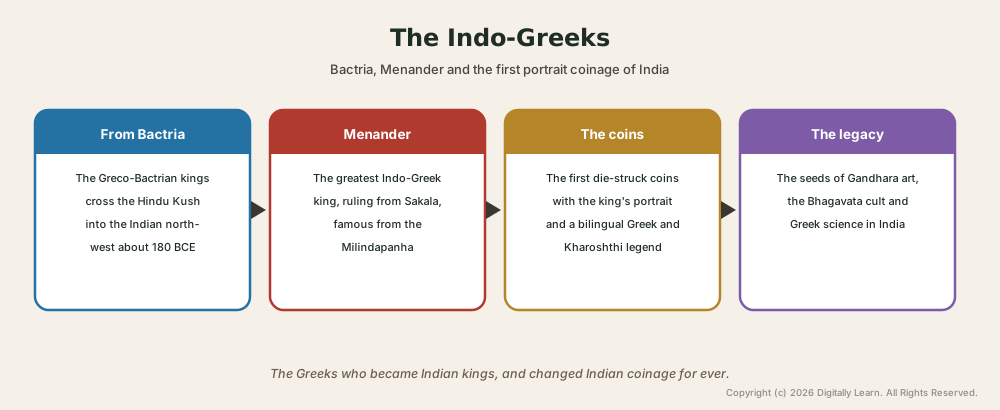
The Indo-Greeks were the Greek kings who, coming from Bactria in the north of Afghanistan, crossed the Hindu Kush about 180 BCE and ruled the Indian north-west for nearly two centuries. The greatest of them was Menander, known to Indian tradition as Milinda, who ruled from Sakala and whose dialogue with the Buddhist monk Nagasena is preserved in the famous text the Milindapanha. The Indo-Greeks are most important for their coins: they were the first rulers in India to issue die-struck coins bearing the king's portrait and a legend in two scripts, Greek and Kharoshthi, and from these coins alone we know the names of some forty kings. Their contact with India seeded the Gandhara school of art and the worship of Vishnu. This part covers their coming from Bactria, the reign of Menander, their coinage and their legacy.
From Bactria to India: The Coming of the Indo-Greeks
The Greco-Bactrian Kingdom and the Crossing of the Hindu Kush
What is the significance of the Indo-Greeks: they were the first of the foreign powers to rule deep in India, and the first to bring Greek ways into the Indian north-west.
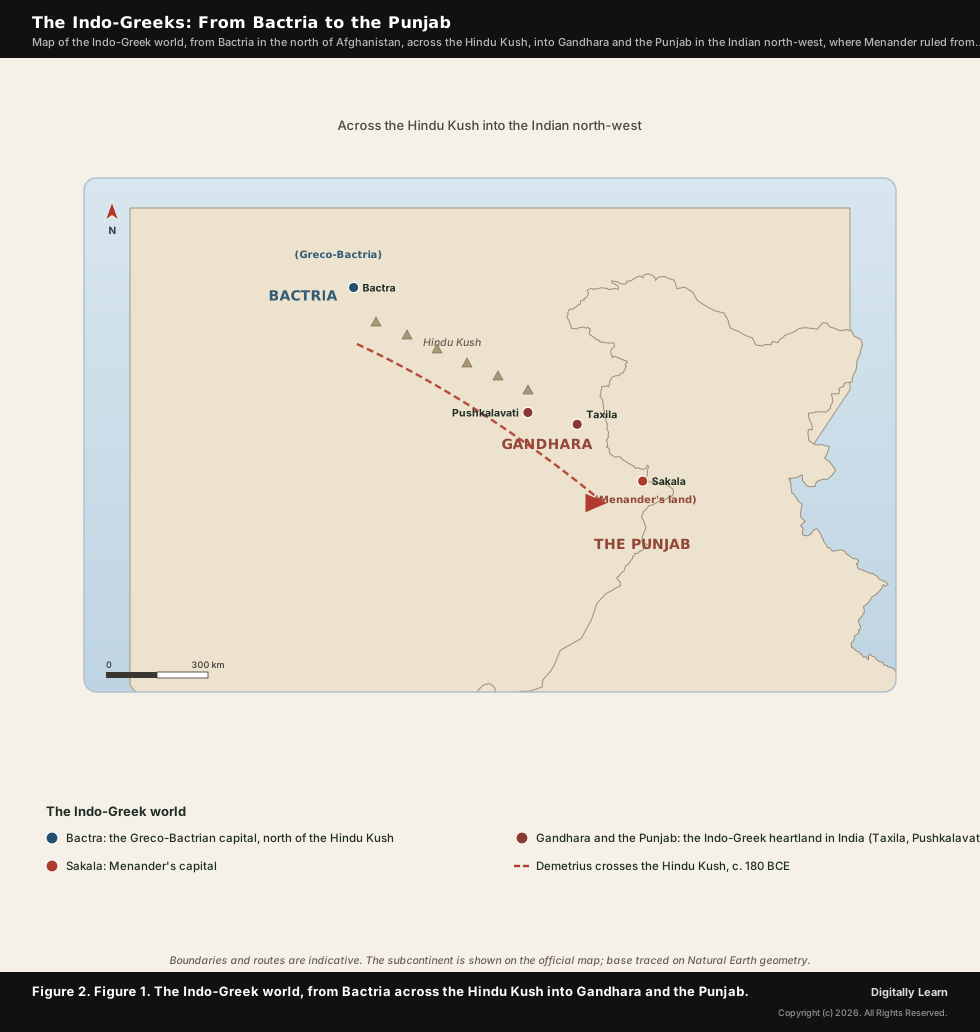
Far to the north-west, in Bactria in the north of present-day Afghanistan, a Greek kingdom had broken away from the Seleucid empire about 250 BCE. Around 180 BCE its kings crossed the Hindu Kush mountains and pushed into the Indian north-west, into Gandhara and the Punjab. The Greek kings who ruled on the Indian side of the mountains are called the Indo-Greeks, to distinguish them from the Greco-Bactrians who stayed in the north.
Demetrius, Menander and the Indo-Greek Kings
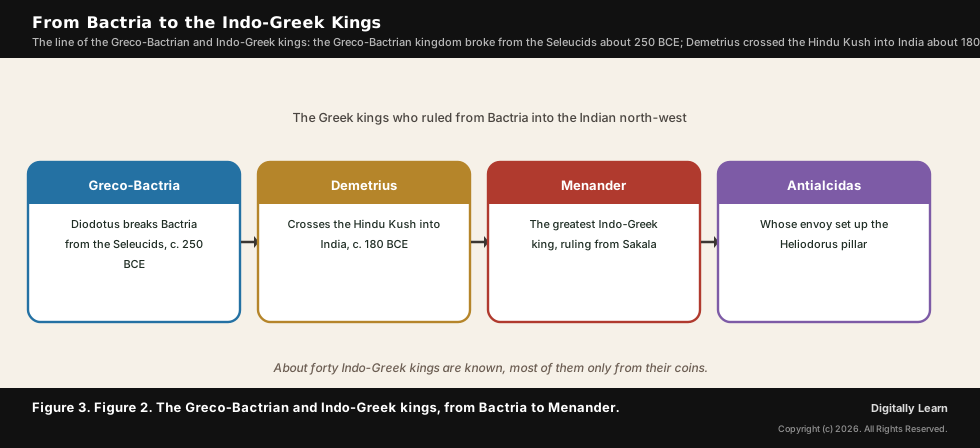
Distinguishing the kings: many Indo-Greek kings ruled in the two centuries that followed, and a few names stand out.
It was Demetrius who first led the Greeks across the Hindu Kush into India. The greatest of all was Menander, who built the largest Indo-Greek kingdom. Another, Antialcidas, is remembered because his ambassador set up the Heliodorus pillar at Besnagar. In all about forty Indo-Greek kings are known, and most of them are known only from their coins, which are the chief record of their rule.
Menander, the Milindapanha and Buddhism
Menander (Milinda): The Greatest Indo-Greek King
What is the significance of Menander: he is the one Indo-Greek king whom Indian tradition remembers, and the most powerful of his line.
Menander, who reigned in the second century BCE, ruled the widest of the Indo-Greek kingdoms from his capital at Sakala, the modern Sialkot in the Punjab. His coins are found over a vast area, from Afghanistan to the Ganga valley, a sign of how far his power and trade reached. To the Indians he was known as Milinda, and his fame outlived his kingdom.
The Milindapanha: A Greek King's Questions to a Buddhist Monk
Distinguishing the Milindapanha: the most famous record of Menander is not a coin but a book, a dialogue on the Buddhist faith.
The Milindapanha, the Questions of Milinda, is a Buddhist text in the form of a dialogue between King Menander and the learned monk Nagasena, who answers the king's searching questions on the doctrines of Buddhism. The text shows Menander drawn to the faith, and a tradition holds that he became a Buddhist.
It is a striking proof of how the Greek rulers entered into the religious life of India. Menander, it should be remembered, lived in the second century BCE, long after the Buddha and the kings of his own day.
The Coinage Revolution of the Indo-Greeks
The First Portrait Coins and Bilingual Legends
What is the significance of the coinage: the Indo-Greeks transformed Indian money, and their coins are the single most important record they left.
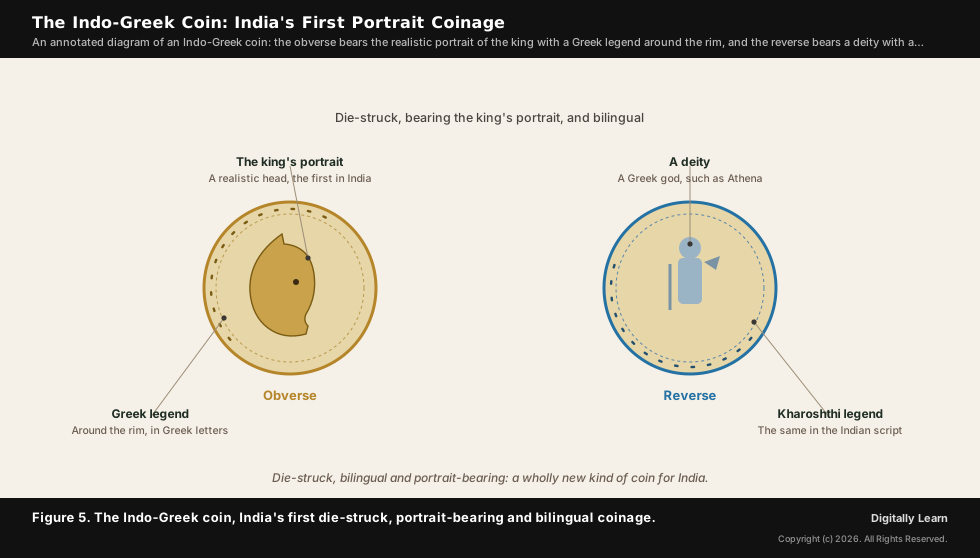
Before the Indo-Greeks, Indian coins were mostly the punch-marked pieces that bore only symbols. The Indo-Greeks introduced the Greek way of striking coins between two dies, and they were the first in India to put on the coin the king's portrait, a realistic likeness of his face, together with his name.
Their coins were bilingual, with a Greek legend on the one side and the same words in the Kharoshthi script on the other, so that both Greeks and Indians could read them.
What the Coins Tell Us about the Indo-Greeks
Distinguishing the coins as evidence: because the texts say so little about them, the coins are the historian's main source for the Indo-Greeks.
From the coins alone we recover the names and the order of some forty kings who are scarcely mentioned in any text. The portraits show their faces, the legends give their titles, and the gods they chose, Greek deities such as Athena and Zeus and, later, Indian ones, reveal their religion and how far they had taken to Indian ways. No other source tells us so much about a people who left almost no written history of their own.
| Feature of the coins | What it shows |
|---|---|
| Die-struck (not punch-marked) | The Greek technique, new to India |
| The king's portrait | A realistic likeness, the first in India |
| Bilingual: Greek and Kharoshthi | Made to be read by Greeks and Indians alike |
| The deities shown | The kings' religion and their move towards Indian gods |
The Indo-Greek Legacy: Art, Religion and Science
The Seeds of Gandhara Art and the Bhagavata Cult
What is the significance of the legacy: though their kingdoms were small and brief, the Indo-Greeks left a deep mark on Indian art and religion.
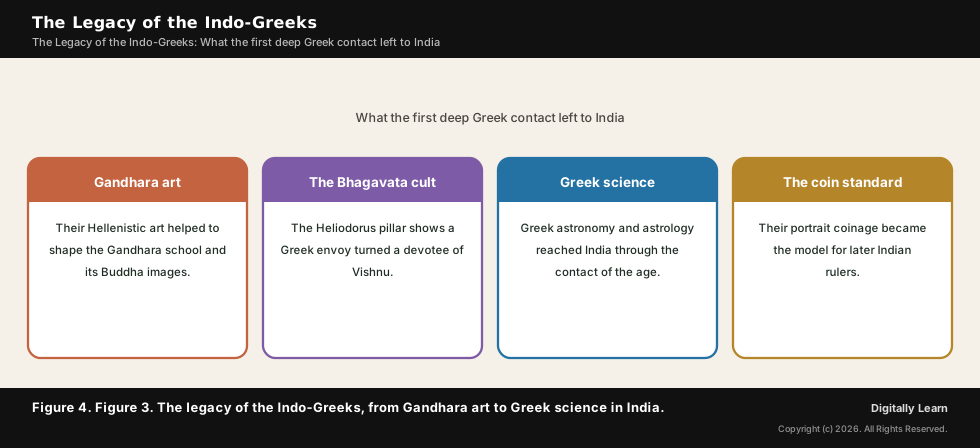
The Hellenistic art the Greeks brought to the north-west became one of the roots of the Gandhara school of sculpture, which would give the Buddha his first human image. In religion, the worship of Vishnu as Vasudeva drew in even the foreigners, as the Heliodorus pillar of a Greek convert shows. The meeting of the two worlds was as much a meeting of faiths and forms as of armies.
Greek Science and the Yavana Contact
Distinguishing the intellectual exchange: the contact with the Greeks brought new learning to India, above all in the study of the heavens.
Through the Yavanas, as the Indians called the Greeks, came new knowledge of astronomy and astrology, which later Indian astronomers acknowledged with respect. The word Yavana itself, first used for the Greeks, became a general name for the westerners who came after them. The Indo-Greek age thus opened a long traffic in ideas between India and the Mediterranean world that the trade of the coming centuries would deepen.
UPSC Relevance and Exam Focus
Where the Indo-Greeks Fit in the UPSC-CSE Syllabus
This topic belongs to General Studies Paper I: ancient Indian history and culture, and the Indo-Greeks, with their coins and the Milindapanha, are a recurring source of questions.
For Prelims, hold the firm facts: the Indo-Greeks came from Bactria and crossed the Hindu Kush under Demetrius; Menander (Milinda) was the greatest, ruling from Sakala, and is the king of the Milindapanha, his dialogue with Nagasena; the Indo-Greeks issued the first portrait and bilingual coins; and Menander lived in the second century BCE, not the age of the Buddha.
For Mains, the Indo-Greeks are valuable for the theme of cultural contact, in coinage, art and religion, between India and the Hellenistic world.
Recurring linked concepts an aspirant should keep in working memory:
- Bactria: The Greek homeland north of the Hindu Kush.
- Menander (Milinda): The greatest king; capital Sakala.
- Milindapanha: His dialogue with the monk Nagasena.
- The coins: First portrait coins; bilingual Greek and Kharoshthi.
- Legacy: The seeds of Gandhara art and the Bhagavata cult.
A common Prelims trap is to make Menander (Milinda) a contemporary of the Buddha; he lived in the second century BCE, centuries after the Buddha, Bimbisara and Prasenjit. Another is to credit the first portrait coins to the Mauryas; they are the work of the Indo-Greeks.
Previous Year UPSC-CSE Questions
Previous Year UPSC-CSE Questions By the end you will be able to draft model answers for the following UPSC questions. Each question carries a collapsible framework showing how to approach it in the exam.
- UPSC Prelims 1997 GS-IMilindapanho is in the form of a dialogue between the King Menander and the Buddhist monk
How to approach this Prelims question
Approach: Recall that Menander's dialogue partner in the Milindapanha is the monk Nagasena.
Trap to watch: Nagasena (not Nagarjuna, who is the later Mahayana philosopher) is Menander's interlocutor in the Milindapanha.
Key facts to recall:
- The Milindapanha is a dialogue between Menander (Milinda) and Nagasena.
- Nagarjuna is a different, later figure.
Answer signal: Nagasena.
- UPSC Prelims 2005 GS-IWho among the following was not a contemporary of the other three?
How to approach this Prelims question
Approach: Place each in time; Bimbisara, the Buddha and Prasenjit are sixth-fifth century BCE, while Milinda is second century BCE.
Trap to watch: Milinda (Menander) is centuries later than the other three; do not be misled by his Buddhist connection in the Milindapanha into making him a contemporary of the Buddha.
Key facts to recall:
- Bimbisara, the Buddha and Prasenjit were contemporaries (6th-5th century BCE).
- Menander (Milinda) was an Indo-Greek king of the 2nd century BCE.
Answer signal: Milinda.
Sources and Further Reading
Editorial Disclaimer
This article is for UPSC preparation. The dates and the order of the Indo-Greek kings rest largely on their coins and are reconstructed by historians, so some details remain uncertain.