


Overview
In situ and ex situ methods, laws and conventions
How India protects its plants, animals and ecosystems.

Biodiversity conservation is the protection of the variety of life at the genetic, species and ecosystem levels. It is done in situ, on site, by protecting whole ecosystems in national parks, sanctuaries and biosphere reserves, or ex situ, off site, in zoos, botanical gardens and seed banks. In India it rests on the Wild Life (Protection) Act, 1972, the Biological Diversity Act, 2002 and the Convention on Biological Diversity.
Biodiversity Conservation: Meaning, Threats and Need
What Is Biodiversity Conservation and Why Biodiversity Is Lost
Conserving biodiversity means protecting the variety of life at all three levels: genetic, species and ecosystem. India matters greatly here. It covers only 2.4 per cent of the Earth's land but is home to 7 to 8 per cent of all known species, and 1,02,718 animal and 54,733 plant species have been documented in its 10 biogeographic zones. It also has parts of 4 of the world's 34 biodiversity hotspots.
Species are now disappearing much faster than before, largely because of human activities. Four major causes, called the 'Evil Quartet', drive most of the loss:
- Habitat loss and fragmentation: The most important cause. Tropical rain forests once covered more than 14 per cent of the land surface and now cover no more than 6 per cent; when a habitat is broken into small fragments, animals that need large territories decline.
- Over-exploitation: When need turns to greed. Steller’s sea cow and the passenger pigeon were wiped out by over-exploitation in the last 500 years, and many marine fish are now over-harvested.
- Alien species invasions: The Nile perch in Lake Victoria led to the extinction of more than 200 species of cichlid fish. In India, carrot grass (Parthenium), Lantana and water hyacinth threaten native species, as does the illegally introduced African catfish.
- Co-extinctions: When a species dies out, species tied to it also vanish, such as the parasites of a host fish, or a plant and the pollinator that evolved with it.
How biodiversity varies across India is taught in Biodiversity Part 1, and the hotspots in Biodiversity Part 2 and Part 7.
Why Biodiversity Conservation Is Important: Three Arguments
The reasons for conserving biodiversity fall into three groups: narrowly utilitarian, broadly utilitarian and ethical. Some are obvious and some are not, but all are equally important.
| Argument | What it means |
|---|---|
| Narrowly utilitarian | Direct goods: food, fibre, firewood and medicines. More than 25 per cent of drugs sold worldwide come from plants, and 25,000 plant species are used in traditional medicine. |
| Broadly utilitarian | Ecosystem services: the Amazon forest is estimated to produce 20 per cent of the oxygen in the atmosphere, and bees, birds and bats pollinate crops. |
| Ethical | Every species has intrinsic value, and we have a moral duty to pass on our biological legacy to future generations. |
Bioprospecting, exploring genetic and species diversity for products of economic value, shows why the first argument is growing: countries rich in biodiversity can expect large benefits. That is why the benefit-sharing rules of the Biological Diversity Act matter.
In Situ and Ex Situ Conservation: Methods of Biodiversity Conservation
In Situ Conservation: Protected Areas, Hotspots and Sacred Groves
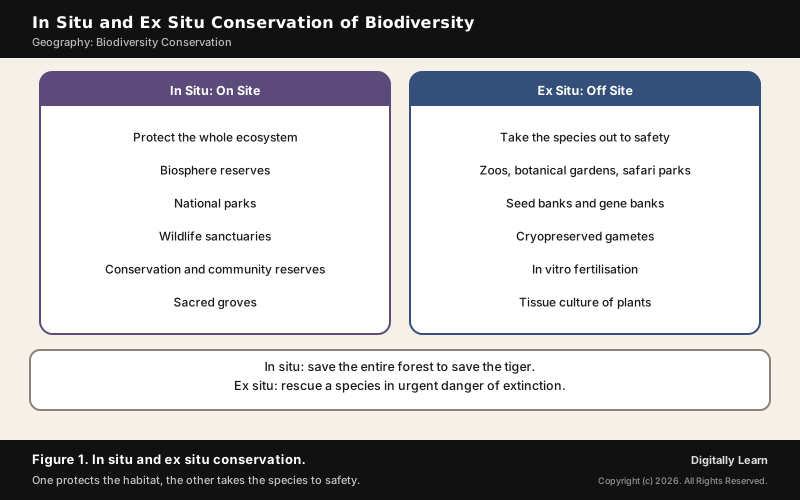
Protecting a species in its natural home, by conserving the whole ecosystem, is in situ (on site) conservation: we save the entire forest to save the tiger. When a species is in urgent danger of extinction, it is taken out to safety instead, which is ex situ (off site) conservation. These are the two basic biodiversity conservation methods.
There are never enough resources to save every species, so conservationists choose priorities. The 34 biodiversity hotspots, regions of very high species richness and endemism, together cover less than 2 per cent of the Earth's land, yet strict protection there could cut ongoing mass extinctions by almost 30 per cent. In India, protected areas under the Wild Life (Protection) Act are the main examples of in situ conservation:
- National parks: India’s first, Hailey National Park, now Jim Corbett, was set up in 1936.
- Wildlife sanctuaries: The most numerous category. The IUCN classes India’s sanctuaries as Category IV protected areas and its national parks as Category II.
- Conservation reserves: Government land used by communities for subsistence, usually a buffer or corridor between parks and sanctuaries; added by the 2002 amendment.
- Community reserves: Areas where part of the land is privately owned, run through local people and bodies such as the gram panchayat; also added in 2002.
- Tiger reserves: Built from national parks and sanctuaries, each with a strictly protected core and a buffer.
| Protected area | Number, November 2023 |
|---|---|
| National parks | 106 |
| Wildlife sanctuaries | 573 |
| Conservation reserves | 115 |
| Community reserves | 220 |
| Total, about 5.32 per cent of India | 1,014 |
By 2026 the network had grown to over 1,134 protected areas covering 1,87,592 square km. Long before these laws, communities protected sacred groves, tracts of forest where every tree and animal was venerated. They survive in the Khasi and Jaintia Hills of Meghalaya, the Aravalli Hills of Rajasthan, the Western Ghats of Karnataka and Maharashtra, and the Sarguja, Chanda and Bastar areas. In Meghalaya they are the last refuges of many rare and threatened plants; around 14,000 groves have been reported across India.
Biosphere Reserves of India: Core, Buffer and Transition Zones
A biosphere reserve protects a larger area than a national park or sanctuary and often contains one or more of them. It protects the people who live there and their ways of life along with the plants and animals. UNESCO launched the Man and the Biosphere (MAB) Programme in 1971, and its World Network now has 797 sites in 145 countries. Each reserve has three zones:
- Core area: A strictly protected ecosystem.
- Buffer zone: Surrounds or adjoins the core and is used for ecological practices.
- Transition area: The outer part, where most activity is allowed.

India has 18 biosphere reserves, and 13 of them are in UNESCO's World Network. The Nilgiri reserve joined first, in 2000, and the Cold Desert reserve of Himachal Pradesh most recently, in 2025. Five, among them Manas and the Great Rann of Kutch, are on the national list only.
Ex Situ Conservation: Zoos, Seed Banks and Cryopreservation
Off-site conservation takes threatened plants and animals out of their natural habitat and places them in special settings where they get special care: zoological parks, botanical gardens and wildlife safari parks. Many animals already extinct in the wild survive in zoos. Newer ex situ methods go beyond keeping animals in enclosures:
- Cryopreservation: Gametes of threatened species are preserved in a viable and fertile condition for long periods.
- In vitro fertilisation: Eggs are fertilised outside the body.
- Tissue culture: Plants are propagated from tissue in the laboratory.
- Seed banks: Seeds of different genetic strains of commercially important plants are kept for long periods. The national gene bank at the National Bureau of Plant Genetic Resources (NBPGR), Delhi, keeps unique accessions as base collections for posterity, mostly as seeds.
| Point | In situ | Ex situ |
|---|---|---|
| Where | Natural habitat | Outside the habitat |
| What is saved | Whole ecosystem | One species or its genes |
| When used | Lasting protection | Urgent rescue |
| Examples | Parks, sanctuaries, groves | Zoos, seed banks |
Laws for Biodiversity Conservation in India
Wild Life (Protection) Act 1972: Schedules and Amendments
Before 1972 India had only five national parks. The Wild Life (Protection) Act, 1972 protects wild animals, birds and plants, outlaws the hunting of listed species and provides for protected areas. Species are listed in schedules, which set the level of protection.
- Schedule I: The highest degree of protection. Rare and endangered species such as the tiger, snow leopard, Great Indian Bustard, Gangetic dolphin and dugong are listed here.
- 2002 amendment: In force from January 2003, it made penalties stricter, with three to seven years’ imprisonment for offences involving Schedule I animals, and created conservation and community reserves.
- 2006 amendment: Made the National Tiger Conservation Authority (NTCA) and the Wildlife Crime Control Bureau statutory bodies.
- 2022 amendment: In force from 1 April 2023, it rationalised the lists of animals in Schedules I and II and placed species listed in the CITES appendices in Schedule IV. It also recognised the Gangetic and Indus river dolphins as distinct species under Schedule I and gave the Indian Coast Guard enforcement powers.
Biological Diversity Act 2002: NBA, State Boards and BMCs
India passed the Biological Diversity Act, 2002 to meet its obligations under the Convention on Biological Diversity. The Act defines biodiversity as the variability among living organisms from all sources and the ecological complexes of which they are part. It ties the use of biological resources and traditional knowledge to the fair and equitable sharing of benefits.
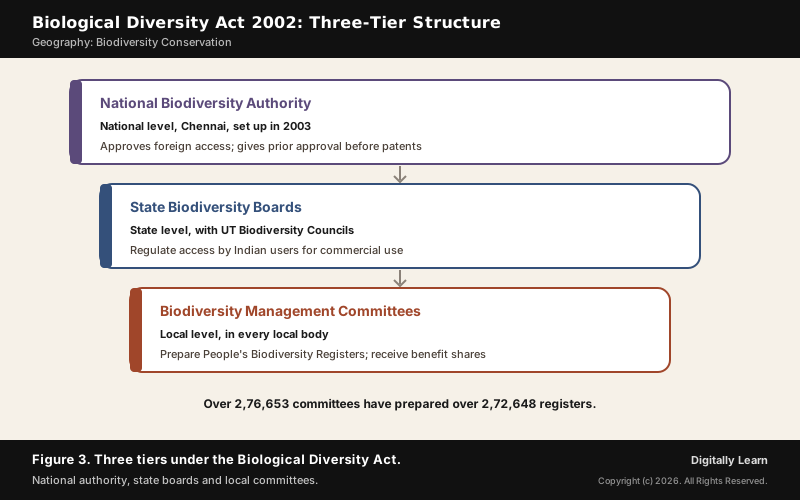
- National Biodiversity Authority (NBA): A statutory body in Chennai, set up in 2003. Foreigners, non-resident Indians and foreign companies need its permission to obtain biological resources or knowledge from India, and it takes steps to oppose patents abroad that are based on Indian resources.
- State Biodiversity Boards: Regulate access by Indian persons and companies, by granting or rejecting approvals; Union Territory Biodiversity Councils do the same in the UTs.
- Biodiversity Management Committees (BMCs): One in every local body, rural and urban. Each prepares a People’s Biodiversity Register, a record of local species, habitats, landraces, breeds and traditional knowledge. There are over 2,76,653 BMCs and over 2,72,648 registers.
- Biodiversity heritage sites: States may notify areas of biodiversity importance; 16 states had notified 44, from the Nallur Tamarind Grove in Bengaluru to Majuli in Assam, by August 2023.
- Benefit sharing: It can take the form of joint ownership of patents, transfer of technology, research units in the source area, or payments. By May 2026 nearly Rs 145 crore had reached around 11,000 BMCs.
The latest on the Act, the NBA and benefit sharing is in the current affairs page on India's Biological Diversity Act.
Biological Diversity (Amendment) Act 2023: What Changed
The Biological Diversity (Amendment) Act, 2023 was published in the Gazette in August 2023 and came into force on 1 April 2024. It eased access for Indian users and research while keeping the NBA's control over patents.
- Exemptions: Codified traditional knowledge, meaning knowledge from the authoritative books listed under the Drugs and Cosmetics Act, 1940, cultivated medicinal plants, local communities and registered AYUSH practitioners are exempt from giving prior intimation before access.
- Patents: Users must register with the NBA before seeking a patent based on Indian biological resources, and get its approval at the time of commercialisation. Filings rose from 857 in 2024-25 to 1,077 in 2025-26.
- Penalties: Contraventions now attract penalties of Rs 1 lakh to Rs 50 lakh, set by an adjudicating officer, and more where the damage is greater.
Environment Protection Act 1986 and the National Green Tribunal
Two more laws support conservation. The Environment (Protection) Act, 1986, in force from 19 November 1986, is widely seen as a response to the Bhopal gas leak. It is an umbrella law, passed under Article 253, that regulates industrial activity and specific activities in coastal and eco-sensitive areas.
- National Green Tribunal (NGT): Set up in 2010 under the NGT Act for the speedy disposal of environmental cases, with a mandate to dispose of them within six months.
- Benches: Headquarters in New Delhi and regional benches in Bhopal, Pune, Kolkata and Chennai.
- An example: In November 2016 its Kolkata bench banned construction activities in the Sunderban to protect wildlife.
The long debate over eco-sensitive areas in the Western Ghats is covered in Western Ghats Ecologically Sensitive Areas, and the forests these laws protect in Indian Forest Types.
International Conventions on Biodiversity Conservation
Convention on Biological Diversity: Objectives, Cartagena and Nagoya Protocols
The Convention on Biological Diversity (CBD) was opened for signature at the Earth Summit in Rio de Janeiro on 5 June 1992 and came into force on 29 December 1993. It has three goals: conserving biodiversity, using its components sustainably, and sharing fairly the benefits from genetic resources. The United States is the only UN member that has not ratified it.
| Instrument | Subject and dates |
|---|---|
| Cartagena Protocol | Safe movement of living modified organisms (biosafety); adopted 29 January 2000, in force 11 September 2003 |
| Nagoya Protocol | Access to genetic resources and benefit sharing; adopted 29 October 2010, in force 12 October 2014 |
| Kunming-Montreal framework | Goals for 2050 and targets for 2030; adopted December 2022 |
India applies the CBD at home through the Biological Diversity Act, and the Nagoya Protocol works through the NBA and the BMCs. India has submitted its first national report on the Nagoya Protocol and its seventh national report to the CBD.
Aichi Targets and the Kunming-Montreal Global Biodiversity Framework
The CBD's Strategic Plan for 2011 to 2020 set 20 Aichi Biodiversity Targets. Countries failed to meet them, because the targets lacked clarity, were hard to measure and were often unreported. Their successor, the Kunming-Montreal Global Biodiversity Framework, was adopted at the fifteenth Conference of the Parties on 19 December 2022.
- Goals and targets: Four goals for 2050 and 23 targets for 2030.
- 30 by 30: Target 3 asks countries to protect 30 per cent of land and water areas by 2030.
- Finance: It aims to close a biodiversity finance gap of $700 billion a year.
- Not binding: It is not a legally binding treaty, but it is expected to shape new national plans and regulations.
- India’s plan: India’s National Biodiversity Strategy and Action Plan for 2024 to 2030 is aligned with the framework.
Ramsar Convention, CITES and the Bonn Convention
The Ramsar Convention, signed in Ramsar, Iran, in 1971, is a treaty for the conservation and sustainable use of wetlands. Its guiding idea is wise use: a wetland is conserved and used sustainably at the same time, not sealed off.
- India’s Ramsar sites: 101, after Glaw Lake in Arunachal Pradesh, the state’s first, was added on 3 August 2026; there were 26 in 2014. The first two, Chilika Lake and Keoladeo National Park, joined on 1 October 1981.
- Records: Tamil Nadu has the most sites (20) and the Sunderban Wetland is the largest. India ranks third in the world, after the United Kingdom and Mexico, and first in Asia.
- Montreux Record: Keoladeo National Park and Loktak Lake are listed as sites where ecological changes have occurred or are likely.
- CITES: The Washington Convention of 3 March 1973, in force from 1 July 1975, controls international trade. Appendix I covers species threatened with extinction, Appendix II species whose trade must be controlled, and Appendix III species protected by one country that asks others for help.
- CMS (Bonn Convention): Signed in 1979 and in force from 1983, it conserves migratory species throughout their ranges.
India's wetlands and its newest sites are covered in Ramsar Sites of India.
Species Programmes and Challenges in Biodiversity Conservation
Project Tiger, Project Elephant and Other Species Programmes
The tiger is an apex predator and an umbrella species: protecting its habitat protects forests, rivers and countless other species. Project Tiger began on 1 April 1973 with nine reserves; there are now 58 tiger reserves in 18 states, covering about 84,500 square km, 2.56 per cent of India's area.
- Tiger numbers: India’s wild tigers rose from 1,411 in 2006 to 3,682 in 2022, nearly 70 per cent of the world’s wild tigers.
- Core and buffer: Each reserve has a core, or critical tiger habitat, with the highest protection, and a buffer that balances conservation with livelihoods; the NTCA approves each state’s Tiger Conservation Plan.
- Project Elephant: Launched in 1992; 33 elephant reserves across 14 states had been notified by 2023, and a DNA-based count put the wild population at 22,446 in 2025.
- Project Dolphin: Launched on 15 August 2020 for river and marine dolphins.
- Project Cheetah: African cheetahs from Namibia and South Africa were brought to Kuno National Park in September 2022; the Asiatic cheetah had died out in India, the last recorded killing being in 1947.
The latest on Project Tiger and Project Cheetah is in the current affairs pages on Project Tiger and the NTCA and Project Cheetah at Kuno.
Challenges to Biodiversity Conservation in India
Laws and reserves have not stopped every loss. The pressures are the causes of the Evil Quartet working in Indian conditions, together with a harder question: how to protect wildlife without shutting out the forest-dwelling communities who live beside it.
- Poaching and habitat loss: Project Tiger’s efforts are hampered by poaching, deforestation, construction and irregularities in the running of some reserves.
- Human-wildlife conflict: The National Human-Wildlife Conflict Mitigation Strategy and Action Plan (2021-26) aims to reduce conflict while conserving wildlife.
- Rights in the buffer: The Forest Rights Act, 2006 recognises the rights of forest-dwelling communities in buffer zones. Some experts fear more conflict and poaching; others argue that local people should share in decisions rather than be evicted.
- Invasive species: Parthenium, Lantana and water hyacinth keep spreading at the cost of native species.
- The 30 by 30 gap: Protected areas cover a little over 5 per cent of India, against the global target of 30 per cent by 2030.
Previous Year UPSC-CSE Questions
Previous Year UPSC-CSE Questions By the end you will be able to draft model answers for the following UPSC questions. Each question carries a collapsible framework showing how to approach it in the exam.
- UPSC Prelims 2011 Prelims-GSWhich one of the following is not a site for in-situ method of conservation of flora?
How to approach this Prelims question
Approach: Ask of each option whether the plant stays in its natural habitat.
Trap to watch: A botanical garden protects plants, but outside their habitat.
Key facts to recall:
- In situ: parks, sanctuaries, biosphere reserves
- Ex situ: botanical gardens, zoos, seed banks
Answer signal: Botanical Garden, option (b).
- UPSC Prelims 2012 Prelims-GSHow does National Biodiversity Authority (NBA) help in protecting the Indian agriculture?
- NBA checks the biopiracy and protects the indigenous and traditional genetic resources.
- NBA directly monitors and supervises the scientific research on genetic modification of crop plants.
- Application for Intellectual Property Rights related to genetic/biological resources cannot be made without the approval of NBA.
Which of the statements given above is/are correct?
How to approach this Prelims question
Approach: Test each statement against the NBA's actual functions under the Act.
Trap to watch: The NBA regulates access and benefit sharing, not genetic modification research.
Key facts to recall:
- NBA approval needed for patents on Indian biological resources
- NBA opposes misuse of Indian resources abroad
Answer signal: 1 and 3 only, option (c).
- UPSC Prelims 2010 Prelims-GSIndia is a party to the Ramsar Convention and has declared many areas as Ramsar Sites. Which of the following statements best describes how we should maintain these sites in the context of this Convention?
How to approach this Prelims question
Approach: Remember that Ramsar joins conservation with sustainable use.
Trap to watch: Options that seal sites off, or allow use only later, are not wise use.
Key facts to recall:
- Ramsar: conservation and sustainable use of wetlands
Answer signal: Conserve through an ecosystem approach and allow simultaneous sustainable use, option (d).
- UPSC Prelims 2017 Prelims-GSIn India, if a species of tortoise is declared protected under Schedule I of the Wild Life (Protection) Act, 1972, what does it imply?
How to approach this Prelims question
Approach: Recall what a schedule does: it sets the level of protection, nothing else.
Trap to watch: Schedule I says nothing about endemism or the species being beyond saving.
Key facts to recall:
- Schedule I: highest protection
- The tiger is a Schedule I animal
Answer signal: The same level of protection as the tiger, option (a).
- UPSC Mains 2018 GS-IIIHow does biodiversity vary in India? How is the Biological Diversity Act, 2002 helpful in conservation of flora and fauna?
How to structure the answer in the exam
Introduction: Open with India's share of species on a small share of land, and its biogeographic zones and hotspots.
Body (sub-themes to develop):
- Variation: 10 biogeographic zones and parts of 4 hotspots.
- The Act meets India's obligations under the CBD.
- Three tiers: NBA, State Biodiversity Boards, Biodiversity Management Committees.
- People's Biodiversity Registers, heritage sites and benefit sharing with local communities.
Conclusion: Conclude that the Act links conservation with local benefit, and note the 2023 amendment's easing of access for research and AYUSH.
Sources
- NCERT: Biology (Class XII), Biodiversity and Conservation
- PIB (MoEFCC): India's Biodiversity: Commitments and Achievements, 5 June 2026
- PIB (MoEFCC): India Leads the Wilderness in Tiger Conservation, 28 July 2026
- PIB (MoEFCC): Glaw Lake becomes India's 101st Ramsar Site, 3 August 2026
- PIB (MoEFCC): India's Wildlife Conservation Milestones, 3 March 2025
- PIB (MoEFCC): Rules under Section 49M of the Wild Life (Protection) Act, 6 March 2024
- PIB (MoEFCC): Biological Diversity Act, 7 August 2023
- PIB (MoEFCC): Reforms under the Biological Diversity (Amendment) Act, 1 April 2026
- Gazette of India: The Biological Diversity (Amendment) Act, 2023
- UNESCO: Man and the Biosphere (MAB) Programme
- Wikipedia: Protected areas of India
- Wikipedia: Biosphere reserves of India
- Wikipedia: Biological Diversity Act, 2002
- Wikipedia: Wildlife Protection Act, 1972
- Wikipedia: Convention on Biological Diversity
- Wikipedia: Nagoya Protocol
- Wikipedia: Kunming-Montreal Global Biodiversity Framework
- Wikipedia: CITES
- Wikipedia: List of Ramsar sites in India
- Wikipedia: Project Tiger
- UPSC: Civil Services Examination question papers
Disclaimer
This article draws on the NCERT Biology textbook, the Ministry of Environment, Forest and Climate Change through the Press Information Bureau, the Gazette of India and the other sources listed on this page. Counts of protected areas change as new sites are notified.