


Overview
Fifty years of saving India's wild tiger and the forests it represents
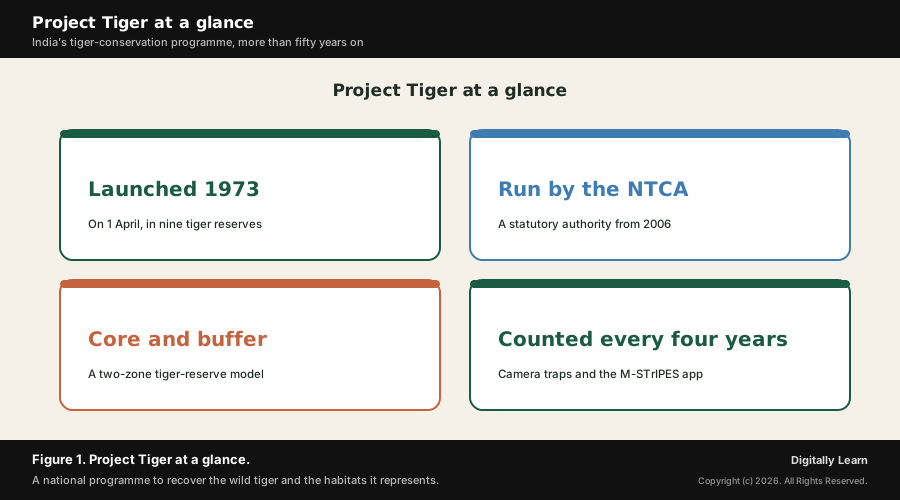
Project Tiger, launched on 1 April 1973 in nine reserves, is India's long-running effort to recover the wild tiger, now run through the statutory National Tiger Conservation Authority, a network of core and buffer reserves, and a four-yearly tiger estimation built on camera traps and the M-STrIPES application.
Project Tiger is the Government of India's flagship programme to save the wild tiger, launched on 1 April 1973 in nine tiger reserves after hunting and habitat loss had driven the species toward collapse. It works by setting aside tiger reserves on a two-zone design: an inviolate core, or critical tiger habitat, kept free of human use for breeding, ringed by a buffer where people and wildlife share the land. Since 2006 the programme has been steered by the National Tiger Conservation Authority, a statutory body created by amending the Wild Life (Protection) Act, 1972. Tigers are counted every four years through the All India Tiger Estimation, using camera traps and the M-STrIPES application, and India holds more than seventy per cent of the world's wild tigers.
What Project Tiger Is: India's Response to the Collapse of the Wild Tiger
The 1973 launch and the conservation crisis that prompted it
Project Tiger is the Government of India's long-running programme to save the wild tiger, launched on 1 April 1973 and run today by the Ministry of Environment, Forest and Climate Change. It answered a conservation emergency: sport hunting, the loss of forests and the killing of tigers as vermin had driven the species into steep decline, and a census in the early 1970s suggested only around 1,800 tigers survived.
The programme began in nine tiger reserves across the country, including Corbett, Kanha, Ranthambhore, Bandipur and the Sundarbans, chosen to represent the main tiger-bearing forest types from the Himalayan foothills to the mangrove delta. Each reserve was to be managed so that a secure tiger population could breed and recover, and the lessons learned could later be extended to other forests.
Why it matters is that the tiger was never meant to be saved for its own sake alone. The tiger sits at the top of the forest food chain and needs large, intact habitats, so protecting it protects the prey, the forests, the rivers and the many lesser-known species in its range. Project Tiger thus became a test of whether India could conserve a whole ecosystem through its most demanding resident.
The tiger as an umbrella and indicator species for whole ecosystems
Ecologists call the tiger an umbrella species, meaning the habitat it needs is so large that conserving it automatically shelters a vast range of other plants and animals under the same canopy. A forest big and undisturbed enough to support breeding tigers also supports its deer, its smaller cats, its birds and its insects, so the tiger acts as a single visible proxy for the health of the whole system.
The tiger is also an indicator species. Because it is sensitive to disturbance, poaching and the loss of prey, a stable or rising tiger population signals that a forest is functioning well, while a falling one warns that something deeper has gone wrong. This is why the tiger count is read not merely as a wildlife statistic but as a broad measure of ecological condition across India's forests.
Finally, the tiger is a powerful flagship species for public support. Its charisma draws attention, funds and political will that a less celebrated species could never command, and that support is then used to protect the wider landscape. Project Tiger rests on a deliberate logic: protect the one species the public most wants to save, and through it secure the forests, water and carbon on which millions of people also depend.
The National Tiger Conservation Authority: A Statutory Body Under the Wild Life Act
How the 2006 amendment to the Wild Life (Protection) Act created the NTCA
For its first three decades Project Tiger ran as an administrative scheme with no dedicated legal body behind it. That changed after a crisis at Sariska, whose local tiger population was found in 2004 to have been wiped out by poaching. A Tiger Task Force recommended a legally empowered institution, and in 2006 the Wild Life (Protection) Act, 1972 was amended to create the National Tiger Conservation Authority.
Because a statute creates it, the NTCA is a statutory body, not merely an executive committee, so it exercises binding legal powers rather than offering advice alone. It is chaired by the Union Minister for Environment, Forest and Climate Change, with the Minister of State as vice-chairperson, and includes Members of Parliament, relevant secretaries and wildlife experts, some with experience of tribal welfare, so conservation and forest-dwellers' concerns are represented together.
The Authority's legal teeth come from specific sections of the amended Act. The NTCA approves each State's tiger conservation plan, lays down standards for managing reserves, and must give prior approval before any reserve's core area is used in ways that could harm tigers. It also reviews new reserves and audits how central funds are used, so a single national body now holds every State to a common, enforceable standard.
The powers, oversight role and accountability the NTCA exercises over reserves
In practice the NTCA performs three broad functions. First, it sets the norms and standards for managing tiger reserves and for tourism, research and protection within them, so a reserve in one State follows the same rules as one in another. Second, it provides oversight, reviewing each reserve's performance and stepping in where protection is failing. Third, it channels and audits the central funding that flows to States.
The Authority also carries a statutory duty toward the people who live in and around reserves. The amended Act requires that the rights of forest-dwelling communities be respected and that any relocation from a core be voluntary and properly compensated, and that local agricultural and livelihood needs be addressed. This dual mandate, protecting tigers while safeguarding forest communities, is what makes the NTCA a body that must continually balance ecology against equity.
Alongside the NTCA, the 2006 amendment created the Wildlife Crime Control Bureau, a multi-agency body that gathers intelligence and coordinates enforcement against the illegal trade in tigers and other wildlife. Tiger parts feed a lucrative international black market, so curbing poaching needs not only guards on the ground but investigation across borders. Together the two bodies give India a stronger institutional answer than the early, scheme-only Project Tiger could offer.
The Tiger-Reserve Model: Core, or Critical Tiger Habitat, and the Buffer Zone
How a tiger reserve is built: the inviolate core and the multiple-use buffer
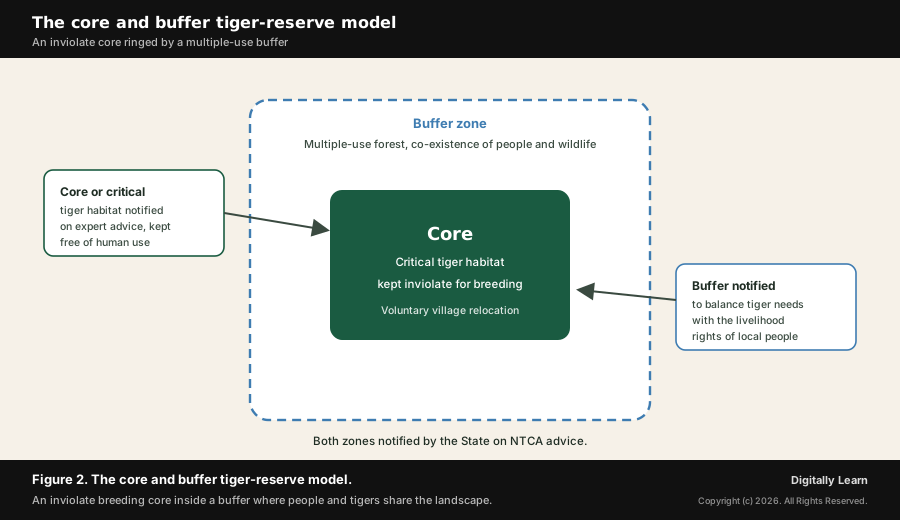
Every tiger reserve is built on a two-zone design that the law now defines precisely. At the centre lies the core, formally the critical tiger habitat, kept as inviolate as possible so tigers can breed and rear young without disturbance. Around it lies the buffer, a belt of forest and adjoining land where limited human use is allowed and the aim is the co-existence of wildlife and people.
The core or critical tiger habitat is identified on expert advice and notified by the State, on the basis that it must stay free of human use, while taking care not to extinguish the rights of Scheduled Tribes or other forest dwellers unfairly. The buffer is notified separately to supply habitat around the core while securing the livelihoods of the people there, so the reserve is not an island cut off from the surrounding land.
This layered design lets a reserve serve two goals at once. The inviolate core gives tigers the security they need to raise cubs and build up numbers, while the buffer absorbs the everyday give and take between a growing tiger population and the farms, grazing lands and villages at the forest edge. The table and figure below set out how the two zones differ and fit together.
| Feature | Core, or critical tiger habitat | Buffer zone |
|---|---|---|
| Primary aim | Inviolate space for tiger breeding | Co-existence of wildlife and people |
| Human use | Kept free of human use as far as possible | Limited, regulated use permitted |
| Notification | Notified by the State on expert advice | Notified separately by the State on NTCA advice |
| Communities | Voluntary relocation may be offered | Livelihood rights of residents secured |
| Role in the reserve | Source population that breeds and disperses | Supplementary habitat and a managed edge |
Voluntary village relocation and the creation of inviolate space
Creating an inviolate core often means villages living deep inside a critical tiger habitat are offered the chance to move out, and the law is clear that any such relocation must be voluntary. Under the scheme, families choose between a one-time cash settlement and a full rehabilitation package of land, housing and amenities at a new site, and no community is moved until its informed consent is obtained and its forest rights are settled.
The case for voluntary relocation is that a disturbance-free core sharply improves breeding success and reduces the friction of people and tigers sharing the same ground, while families that move gain roads, schools, health care and markets a remote hamlet cannot offer. Done well, it is meant to be a genuine win for both sides, more secure tigers and better-served citizens, rather than a forced eviction dressed up as conservation.
In practice the process is contested and slow. Tens of thousands of families still live inside reserves, relocation funds are limited, and critics warn that consent is not always truly free or that promised rehabilitation falls short. The honest position is that voluntary relocation works only when properly funded, lawfully conducted under the Forest Rights framework and demonstrably better for the families; where those conditions fail it becomes a grievance, not a model of co-existence.
Counting Tigers: The All India Tiger Estimation, Camera Traps and M-STrIPES
The four-yearly All India Tiger Estimation and its phased methodology
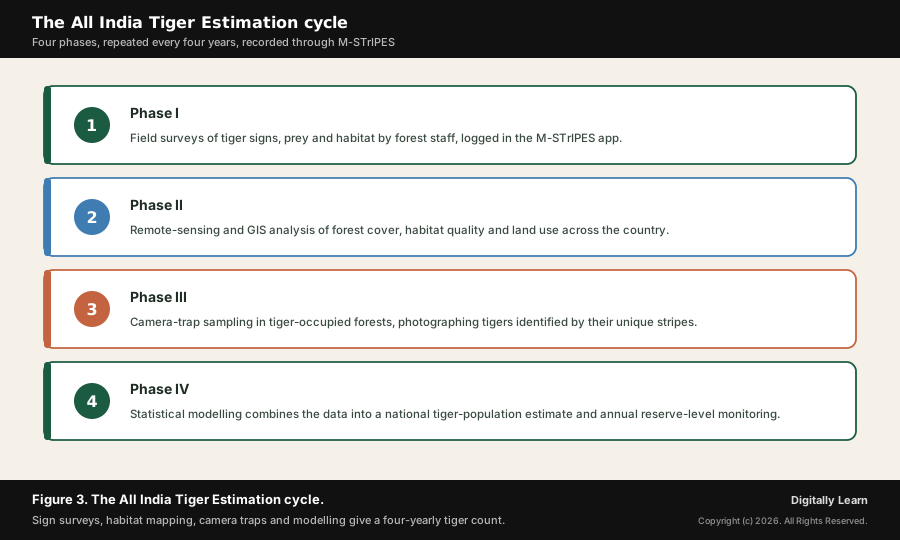
India counts its tigers through the All India Tiger Estimation, a nationwide exercise conducted once every four years by the National Tiger Conservation Authority with State forest departments and the Wildlife Institute of India. It has run in successive cycles since 2006, and over time it has moved from rough index-based guesses to a rigorous, science-based count, becoming the largest wildlife survey of its kind anywhere in the world.
The exercise is organised in phases. First, frontline forest staff walk fixed trails to record signs of tigers and prey, such as pug marks, scat and kills, and assess the habitat. Next, satellite remote sensing and geographic information systems analyse the extent and quality of forest. The third phase places camera traps in tiger-occupied forests, and the fourth combines the data through statistical modelling into a national population estimate.
Crucially, the estimate is not a simple head-count but a statistical inference. Tigers cannot all be seen, so the survey samples chosen areas, records the proportion detected, and uses established models to estimate the total, with a range of uncertainty rather than a single false-precise number. This is why official figures carry a lower and upper bound, and why methodology, not just the headline number, is what an informed reader should weigh.
M-STrIPES and camera-trap science: how individual tigers are identified
The tool that ties the modern estimation together is M-STrIPES, the Monitoring System for Tigers, Intensive Protection and Ecological Status. It is an Android-based application for forest staff, through which patrol routes, wildlife signs, prey sightings and threats are recorded directly in the field and uploaded for analysis. By replacing paper registers with geo-tagged digital records, it standardises data across hundreds of reserves and makes both daily patrolling and the national count more reliable.
At the heart of the count are camera traps, automatic cameras triggered by an animal's heat and motion, set in pairs so both flanks of a tiger are photographed. Because every tiger carries a unique stripe pattern, like a fingerprint, software matches the images and identifies individual animals, so the same tiger is not double-counted. Recent cycles placed tens of thousands of cameras and captured tens of millions of images, with artificial intelligence now used to sort them.
This camera-trap and stripe-recognition method is what gives the estimation its credibility, and it is exactly the science the well-known examination question on M-STrIPES points to. Knowing that M-STrIPES belongs to tiger-reserve monitoring, not to satellite navigation or highway security, is the precise association the count is built upon. Disciplined field protocols, a common digital platform and individual identification have together turned the tiger count into a genuine instrument of conservation science.
The Reserve Network: How Tiger Reserves Are Distributed Across India
Source populations across the Shivalik, central Indian, Western Ghats and north-eastern landscapes
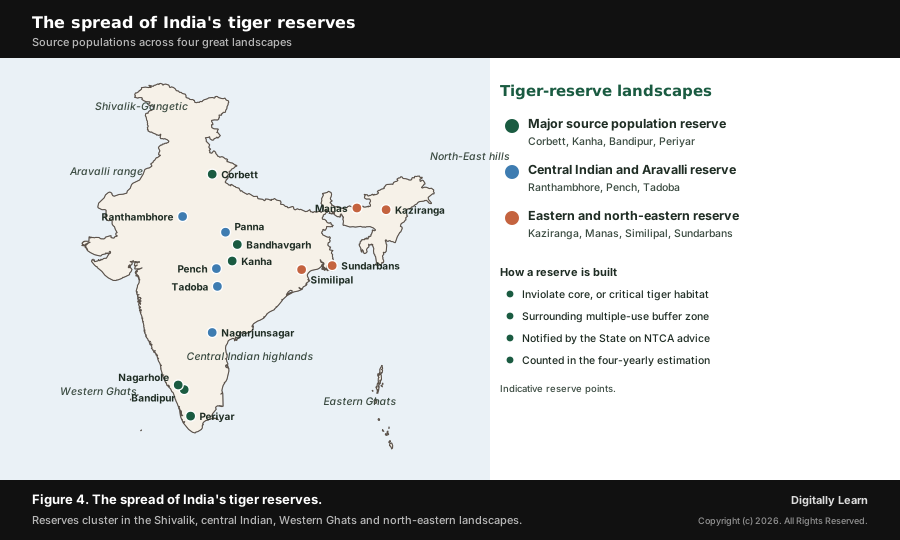
From the original nine, the network of tiger reserves has grown over five decades into a system of more than fifty reserves across the country's tiger-bearing States. These reserves are not scattered at random but cluster in a handful of great landscapes, each holding source populations from which tigers disperse, so the species' survival in India depends on keeping these landscapes and the corridors between them intact.
The Shivalik-Gangetic landscape of the north, with reserves such as Corbett, holds some of the densest tiger populations in the world. The central Indian highlands, with Kanha, Bandhavgarh, Pench and Tadoba, form the heartland, while the Western Ghats, with Bandipur, Nagarhole and Periyar, hold another stronghold. To the east, Similipal, the Sundarbans, and Kaziranga and Manas complete the picture.
What links these scattered reserves is the idea of a connected landscape. A single reserve, however well protected, is too small to hold a genetically healthy tiger population forever, so the long-term plan depends on habitat corridors that let young tigers move between reserves to find territory and mates. The map below locates the major reserves within these landscapes and shows why the gaps between them matter as much as the reserves.
Raising the Bar: CA|TS Accreditation, the Special Tiger Protection Force and Outcomes
Conservation Assured Tiger Standards and the Special Tiger Protection Force
To push reserves toward a common high standard, India has adopted CA|TS, the Conservation Assured Tiger Standards, an international accreditation agreed among the tiger range countries and launched in 2013. A reserve is independently assessed against a detailed checklist covering protection, monitoring, community relations and habitat, and is accredited only when it meets the benchmark, so the system turns a vague idea of quality into a verifiable seal of good practice that a growing number of Indian reserves hold.
On the ground, protection in the most vulnerable reserves is reinforced by the Special Tiger Protection Force, a dedicated, trained and armed force first funded in 2008 to guard against poaching. Raised with central assistance under the scheme, it is deployed in high-priority reserves and may be constituted on either a forest-department or a police model. Its purpose is to give reserves a professional anti-poaching capacity, distinct from ordinary forest staff, where the threat is gravest.
These two instruments work at different levels toward the same end. CA|TS drives up the overall quality of management by holding reserves to an external standard, while the Special Tiger Protection Force hardens the frontline defence of the animals themselves. Together with the NTCA's oversight and the four-yearly estimation, they form a layered system in which standards, enforcement and measurement reinforce one another rather than standing alone.
Outcomes after fifty years: tiger recovery and India's global share
Measured against the crisis of the early 1970s, the outcomes of Project Tiger have been substantial. The tiger population, once thought to number in the low thousands and falling, has been brought back to a clear upward path, and the most recent cycle put the national figure in the region of three and a half thousand tigers. The reserve network has expanded many times over, and several individual reserves now hold some of the highest tiger densities recorded anywhere.
The most striking result is India's place in the world. The country now holds more than seventy per cent of the world's wild tigers, which makes Indian conservation decisive for the species globally. This concentration is both an achievement and a responsibility: a setback in India would be a setback for tigers everywhere, while India's methods, from camera-trap counts to CA|TS accreditation, increasingly serve as a model for other tiger range countries.
Yet the recovery must be read with care. Rising numbers reflect both genuine growth and steadily improving survey methods, so part of the increase is better counting rather than more tigers, and the gains are uneven, concentrated in a few well-protected reserves while many others stay sparsely populated. The honest summary is that Project Tiger has pulled the species back from the brink and built world-leading conservation machinery, even as questions of equity, conflict and connectivity remain open.
Understanding the Significance: Umbrella Species, Ecosystem Services and Global Leadership
Why saving the tiger protects forests, water and India's conservation standing
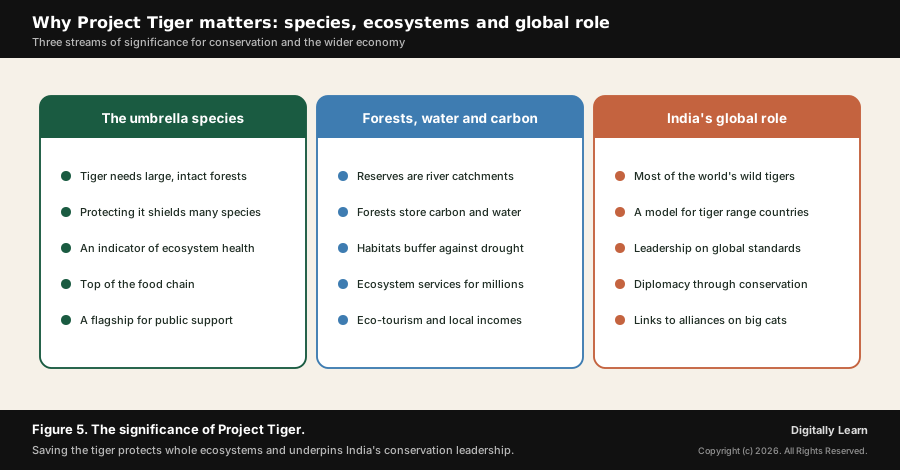
What is the significance of Project Tiger lies first in the tiger's role as an umbrella species. By securing the large, undisturbed habitats that breeding tigers require, the programme shelters the prey species, the smaller predators, the birds and the plants that share the same forests, so a single conservation effort delivers protection across an entire biological community rather than to one charismatic animal alone.
Its second significance is in ecosystem services. India's tiger reserves are also the catchments of major rivers, the stores of forest carbon and the buffers that moderate floods and droughts downstream. Protecting these forests for tigers therefore secures water, soil and climate benefits worth far more than the cost of the reserves, and supports livelihoods through eco-tourism, so conservation and development are not always at odds.
Its third significance is for India's global standing. Holding the majority of the world's wild tigers, India has turned conservation into a form of environmental diplomacy, hosting tiger range countries, sharing its monitoring science and, more recently, extending the model to other species through wider initiatives on big cats. The figure below draws these strands of significance together.
Challenges and Debates: Human-Wildlife Conflict, Forest Rights and Corridor Loss
Conflict, the Forest Rights Act tension, tourism pressure and single-species critiques
A balanced reading must weigh the genuine debates around Project Tiger, framed here as observers see them rather than as settled conclusions. The first is human-wildlife conflict. As tiger numbers rise and reserves fill, more tigers move into the buffer and beyond, where they may kill livestock or, rarely, people, while herbivores raid crops. For communities at the forest edge this is a real and sometimes deadly cost that the programme must manage to keep its legitimacy.
A second debate concerns the tension with the Forest Rights Act of 2006. That law recognises the rights of forest-dwelling communities over land they have long used, while the tiger law allows those rights to be modified to create inviolate critical tiger habitats. Critics argue that relocation has not always been genuinely voluntary or fully compliant, while conservationists counter that some cores must stay free of human use; reconciling the two remains a hard question in Indian conservation.
Further debates surround tourism pressure, corridor fragmentation and the very logic of a single-species focus. Heavy tourist traffic can disturb wildlife, while roads, mines, dams and farms sever the corridors tigers need to move between reserves, leaving populations isolated. Some ecologists also ask whether so much effort on one charismatic species is the best use of scarce resources. On each question a careful answer treats the issue as open, weighing clear gains against unresolved costs.
The Way Forward: Corridors, Coexistence and the Wider Big-Cat Agenda
Securing corridors, managing conflict and linking Project Tiger to wider conservation
The way forward for Project Tiger follows from its own success. With many reserves now near their tiger-carrying capacity, the priority shifts from raising numbers inside cores to protecting the corridors that connect reserves, so dispersing tigers can find new territory and the populations stay genetically healthy rather than becoming isolated islands.
A second priority is coexistence. Lasting conservation depends on the communities who live alongside tigers seeing a fair share of the benefits and a swift, adequate response when they bear the costs, so prompt compensation for losses, genuine and lawful relocation where it is sought, and a real stake in eco-tourism are now as important as anti-poaching patrols. The programme's legitimacy rests on being seen to protect people as well as tigers.
Finally, Project Tiger increasingly sits within a wider conservation agenda. Its model of reserves, monitoring and central oversight has informed parallel efforts such as Project Elephant and Project Lion, and India has sought to extend its experience internationally through the International Big Cat Alliance, a platform to pool effort across the world's big cats. Securing corridors, building coexistence and connecting to this broader agenda are what will carry the programme through its next fifty years.
UPSC Relevance and Exam Focus
Where Project Tiger fits in the UPSC-CSE syllabus
This topic maps most directly to General Studies Paper III: conservation and environmental degradation, since Project Tiger is the country's principal species-conservation programme and a case study in protected-area management. It also links to General Studies Paper II, government policies and the functioning of statutory bodies, through the National Tiger Conservation Authority, and to General Studies Paper I, through the geography of India's forests and the distribution of reserves.
For Prelims, hold the high-yield facts: Project Tiger was launched on 1 April 1973 in nine reserves; the National Tiger Conservation Authority is a statutory body created by amending the Wild Life (Protection) Act, 1972 in 2006; a tiger reserve has a core, or critical tiger habitat, and a buffer; the All India Tiger Estimation runs every four years using camera traps; and M-STrIPES is the tiger-reserve monitoring system, not a navigation or highway-security tool.
For Mains, the recurring framing is to assess the programme's design and dilemmas: how a single-species effort can protect whole ecosystems, how the rights of forest communities can be reconciled with inviolate habitat, and how conflict and corridor loss are to be managed as tiger numbers rise. A strong answer treats Project Tiger as a model of successful conservation while engaging honestly with the open questions of equity and human-wildlife conflict.
Recurring linked concepts an aspirant should keep in working memory:
- Umbrella species: A species whose conservation, because of the large habitat it needs, automatically protects many other species sharing that habitat, the role the tiger plays in India’s forests.
- Critical tiger habitat: The notified core of a tiger reserve, kept as inviolate as possible for breeding, identified on expert advice under the Wild Life (Protection) Act.
- All India Tiger Estimation and M-STrIPES: The four-yearly national tiger count using camera traps and stripe-pattern identification, recorded through the M-STrIPES monitoring application.
- Conservation Assured Tiger Standards (CA|TS): An international accreditation that certifies a tiger reserve as meeting a benchmark of good management.
A common Prelims trap is to confuse the bodies and laws: remember that the NTCA is a statutory authority under the Wild Life (Protection) Act, distinct from advisory committees, and that M-STrIPES relates to the maintenance and monitoring of tiger reserves, not to captive breeding, satellite navigation or highway security.
A common Mains trap is to recite only the success story of rising tiger numbers. The exam value lies in a balanced judgment that sets the genuine recovery of the tiger and India's global leadership against the open questions of human-wildlife conflict, the tension with the Forest Rights Act, tourism pressure and the fragmentation of the corridors on which the species depends.
Previous Year UPSC-CSE Questions By the end you will be able to draft model answers for the following UPSC questions. Each question carries a collapsible framework showing how to approach it in the exam.
- UPSC Prelims 2017 GS-IIn what context is the term 'M-STrIPES' seen in the news?
How to approach this Prelims question
Approach: Decode the acronym from its domain rather than from the letters alone. M-STrIPES is the Monitoring System for Tigers, Intensive Protection and Ecological Status, a field-and-desktop application used by forest staff in tiger reserves, so the correct context is the management and monitoring of tiger reserves.
Trap to watch: The distractors deliberately borrow ideas suggested by the letters, captive breeding of fauna, an indigenous satellite navigation system and highway security, to tempt a candidate who guesses from the sound of the name instead of recalling that M-STrIPES is a tiger-reserve monitoring tool.
Key facts to recall:
- M-STrIPES stands for Monitoring System for Tigers, Intensive Protection and Ecological Status.
- It is an application used by forest staff to record patrols, wildlife signs and threats in tiger reserves.
- It underpins the four-yearly All India Tiger Estimation conducted with camera traps.
- It is run by the National Tiger Conservation Authority with the Wildlife Institute of India.
- It relates to tiger reserves, not to navigation, captive breeding or highways.
Answer signal: If the term names a system used inside tiger reserves for monitoring and protection, the answer is the maintenance of tiger reserves, option (b).
Sources and Further Reading
- National Tiger Conservation Authority: About Us
- National Tiger Conservation Authority: Frequently Asked Questions
- National Tiger Conservation Authority: Our Work, M-STrIPES
- National Tiger Conservation Authority: Voluntary Village Relocation
- National Tiger Conservation Authority: Special Tiger Protection Force
- Press Information Bureau: All India Tiger Estimation 2022, release of the detailed report
- Press Information Bureau: India's 14 Tiger Reserves get Global CA|TS recognition
- Press Information Bureau: Achievements of the National Tiger Conservation Authority during 2023
- Press Information Bureau: All India Tiger Estimation 2018, results of the fourth cycle
- Wildlife Institute of India: National Tiger and Prey Monitoring
- Project Tiger Portal (NTCA): Home, conservation of the tiger across States
- National Tiger Conservation Authority: Joining the Dots, the report of the Tiger Task Force
- Ministry of Environment, Forest and Climate Change: Wildlife and tiger conservation
- Wikipedia: Project Tiger
- Wikipedia: National Tiger Conservation Authority
- Wikipedia: Tiger reserves of India
Editorial Disclaimer
This briefing is for UPSC preparation. Verify the facts and provisions against the official NTCA, Project Tiger and PIB sources before relying on them.


